Genshiken Second Season Episode 12 and the Fanservice You May Not Have Seen

Episode 12 wraps up the school festival. If you want to read my thoughts on the events of the episode, you’ll find them as part of my analyses on Chapters 81 and 83. At this point I’ll have to assume 82 will be covered in Episode 13 or just not at all.

So with all the cosplay this episode, particularly from Ohno, there was a hefty amount of fanservice in the most obvious sense. This was magnified by the fact that they combined two disaparate chapters together to make it an almost “cosplay-themed” episode, but amidst all that more overt fanservice the anime actually added a little something for the Ogiue fans in particular.

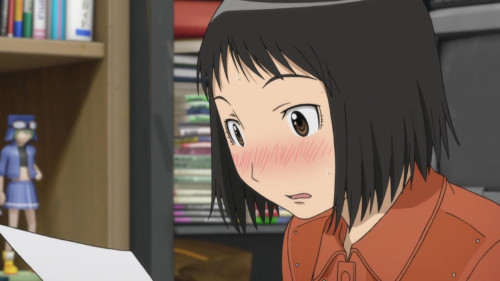
This image is actually an anime original, and though it’s just a single frame it communicates a lot of intimacy and perhaps even eroticism between Ogiue and Sasahara. Ogiue never ever, ever has an expression like that, with the wry and suggestive smile as well as the sideways glance towards Sasahara who’s more tacitly responding in kind. The message this image communicates is that Sasahara likes what he sees out of Ogiue, and Ogiue is pleased that he likes that. While you might think that this is me reading too much into it, given their interruption by Sue previously, there’s no doubt in my mind how we’re supposed to interpret it.

However, if you want something that I consider fanservice that probably no one else does, it would be another anime-exclusive moment:

A Go Go Curry parody!

As long-time readers of the blog might know, I am a huge fan of Go Go Curry, and what’s more, the very first Go Go Curry I ever ate at was one in Akihabara. Though there’s no way to tell if the one Madarame is at is the same one that introduced me to the wonders of Kanazawa-style curry, I’d like to pretend that it is.

Really though, Episode 12 of Nidaime actually combined two of my favorite things, Ogiue and Go Go Curry. On some level I have to rank it pretty highly, albeit at a fairly shallow level.

The Mawaru Penguindrum merchandise also helped.

Zankoku na Genshiken Second Season Episode 11

Now comes the other big moment of the new anime. Of course I’d have a lot of thoughts on what transpires this episode, which you’ll find in the equivalent manga analyses: Chapters 78, 79, and 80.

I think there’s little doubt that Madarame’s confession is one of the most significant events in Genshiken. I’ve felt sort of conflicted that it happened because it is possible for someone to move on from a former love without the confession and rejection you see so often in anime and manga, but the series makes it clear that Madarame was incapable of doing so, no matter how hard he tried. Looking back, the idea of “freeing” Madarame to some extent implies making it so that he’ll be open to others.

There’s a fairly significant mistranslation in the Crunchyroll subs, at the very end of the episode. After Kasukabe starts to cry, the translation has Madarame say, “Now I know that Kasukabe-san cries easily.” This isn’t quite right: what Madarame actually says is more along the lines of, “I already knew that Kasukabe-san cries easily.” It’s a reference to the events of Volume 4 of the manga (Episode 11 of the first anime), when Kasukabe accidentally starts a fire which gets the club into trouble. Though she put on a tough face, her guilt over the accident caused her to start crying. Essentially, Madarame’s line is supposed to reference how much he’s paid attention to Saki over the years.

It’s probably significant then that Keiko and Saki both notice how Hato pays a lot of attention to Madarame. Or is it?!

Some of the timing of the confession itself turned out different, and there isn’t quite as much impact from Madarame’s response to the line about the relationship that might have been, but I think the episode overall does an all right job of it. The manga devoted an entire chapter to just the two of them in the club room, mirroring previous chapters which did the same.

As for the actual confession and reaction, I could see how Kasukabe’s response could be interpreted as cruel, though I don’t necessarily think so. One thing anime viewers may not be aware of is that Kasukabe’s line about how a relationship with Madarame might have been a possible future is actually also a reference to another series by Kio Shimoku called Spotted Flower. In it, characters very (but not entirely) similar to Madarame and Saki, an otaku and his non-otaku wife who knew him since college, are married and expecting their first child. In fact, the title itself is a reference to them: Madara means spotted (which also explains the Naruto character), and Saki refers to the blooming of flowers. It’s a sort of holy emblem for Saki x Mada fans, but at the same time perhaps incredibly cruel itself for very nearly giving those shippers what they want before collapsing the entire thing like a house of cards.

Cruelty abounds.

Powerful Genshiken Second Season Episode 10

Mysteries melt away this episode! Covering chapters 76 and 77, it’s one of the more significant parts of the whole series.

In previous episode reflections (a better term than review I now realize), I mentioned how elements from the manga were cut and shifted, sometimes for thematic consistency within an episode, but more often because the Nidaime anime clearly has a particular end goal in mind. With Episode 10, we’re finally able to see whether or not this “cutting of the fat” has paid off, more or less. It already began with the previous episode to an extent, but this is when the revelations truly begin, and it’ll continue into the next episode too.

In this regard, I think that Episode 10 is probably the strongest one of the season so far. Whether it’s because of Mamiko’s excellent performance as Kaminaga, the portrayal of the way Hato’s denial/hiding of his inner self to others weighs heavily on him, Konno’s amazing facial expressions, or some combination of the three, I think that this episode communicates all of the complex emotions which make up Genshiken. The manga chapters were already great and enlightening, and the adaptation does them justice. In some cases, it even makes things clearer. One example is when Hato sees his brother driving with Kaminaga, with the clear implication being romance. In the manga, Yuuichirou’s expression is kind of ambiguous, but in the anime you can clearly see him smiling. It wasn’t necessary, but it helps communicate that information more overtly.

When I say good adaptation, though, I don’t simply mean that it’s accurate or 1:1 in terms of elements. The anime added an additional thing about Kaminaga moving in with Hato and his brother, but in the manga Hato lives on his own in an apartment far from the university so that he can maintain both his BL and crossdressing. They even visited it in one chapter, which was cut from the anime. The original manga also shows that Konno had dyed her hair in between high school and college, while the anime has always been brunette. It doesn’t impact the story much, but it is curious.

Yamamoto Nozomi also probably puts out some of her best Ogiue performance as well this episode. I still give the edge to Mizuhashi, but Yamamoto really displays a sense of Ogiue, particularly her delivery of Ogiue saying that turning your own boyfriend into BL material is “normal.” It really gives off the vibe that this is an area where Ogiue has not only a lot of experience, but a lot of history, while also showing how far Ogiue has come from her previous self.

I really like how the anime took the scene of Sue mimicking Rei from Fist of the North Star from the manga and added the after-images and laser lines from Fist of the North Star‘s anime. Basically, the anime adaptation of Genshiken enhanced its portrayal of a manga scene parodying a famous manga by utilizing the iconic effects from that famous manga’s own adaptation. The Crunchyroll subs do not make the reference obvious: Sue says, “Nanto Kyuukyoku Ougi!” and likely the translator either misheard or didn’t even hear the “Nanto” part.

One of the categories in the Fujoshi Files is “Fujoshi Level,” which is a not-so-serious way of describing just how polluted the mind of a particular character can be. While I actually don’t create specific rankings and try to give just a general impression in them, here you could see an obvious hierarchy: Kaminaga is off the deep end, Ogiue is right behind her along with Hato, and Konno and Fuji are definitely not as powerful. It makes me want to perhaps write up a full Fujoshi/Fudanshi Tier List one of these days.

It’s Been a While: Genshiken Second Season Episode 9

I’ve been away for the last couple of weeks so it’s time to do some catchup! Episode 9 covers Chapters 74 and 75. Also, there’s quite a bit of cosplay in this episode, and luckily for me a Japanese blogger Renko’s already laid out all of the references.

Sue = Meruru (Atelier Meruru)

Ohno = Asama Tomo (Horizon in the Middle of Nowhere)

Yoshitake = Inahime (Samurai Warriors)

Sawatari = Kunoichi (Samurai Warriors)

Fukuda = Okuni (Samurai Warriors)

Mimasaka = Leia Rolando (Tales of Xillia)

Yajima = Hirano Kouta (Highschool of the Dead)

Kuchiki = Matsudaira Katakuriko (Gintama)

The sheer amount of Ogiue content in this episode makes me happy, just as it did with the manga. You can really see her take center stage at least in the first half of the episode, and the sheer range of facial expressions that are not coming from deep anger and frustration is quite satisfying. There’s also something hilarious about Sasahara essentially roleplaying as a fictional version of himself.

Speaking of Sasahara, the new voices at this point are old news, but I have to remark that Sasahara’s voice really throws me off. It’s like his old voice was just the perfect shade of average that anything else sounds odd. Moreover, Sasahara doesn’t appear often enough for me to get used to him.

When it comes to adapting from manga to anime, I thought the decision to turn Yoshitake’s exposition into a Star Wars-esque text scroll was clever and properly captured the incessantly convoluted nature of her plot. The manga conveys this through the sheer amount of text in Yoshitake’s word bubble, but obviously that doesn’t fly in the animated format. Interestingly, when Yajima hits Yoshitake with the manga, you can see that it’s a Monthly Afternoon (the magazine Genshiken runs in), with its most famous and longest-running title Aa! Megami-sama on the spine.

(Seriously, Oh My Goddess! is still running).

Another thing I’ve been thinking about is the whole gendered pronouns thing (whether to refer to Hato as a “he” or a “she”), and while Japanese doesn’t typically use gendered pronouns the way English does, perhaps a comparison could be done between which characters refer to Hato as “Hato-kun” and which use “Hato-chan.” Those aren’t strictly gender-divided (guys can be referred to with -chan and girls with -kun), but it may speak to how they personally see Hato.

In the end, of all the things to happen in this episode, I especially hope people are enjoying the new characters’ old friends. Mimasaka comes across as the most shy and awkward of possibly any character in Genshiken (with her voice actor doing quite a good job showing this). You can also actually hear Yajima slipping into an accent when talking with Mimasaka, which is again a nice touch for the anime. I also have to wonder if Konno’s massive saucer eyes in the opening had people wondering just who she is. She doesn’t appear much, but she pretty much became my favorite of the new Nidaime characters just from her expressions. Given that Ogiue also had fantastic facial expressions, that might just be more indicative of my tastes than anything else.

As for Kaminaga’s debut, I find Noto Mamiko’s performance to be pretty spot-on with what I imagined.

Otakon 2013 Seki Tomokazu Interview

Though I doubt he needs introduction, Seki Tomokazu is a well-known and highly celebrated Japanese voice actor, who has performed roles such as Domon Kasshu in G Gundam, Tanaka Souichirou in Genshiken, and Takahashi Keisuke in Initial D, among many, many others.

Hello, welcome to Otakon! Actually, a few years ago when you were a guest at Otakon I actually asked you a question about Hiyama Nobuyuki, but now I’d like to ask you about your recent work.

So the first question I’d like to ask is your role in Gyrozetter as “Mic Man Seki,” because I’m wondering, as you share the same name, if you were the inspiration for the character, or is it merely coincidence?

So originally the character was called a different name, and his profile was different, but the staff said, “It’s Seki doing it, so we should probably change this around.” So they decided to change the name, change the profile, and now the character is me.

I’d like to ask you about another recent role you had, your voice work in Gokaiger. How is voice acting for a live-action show different from anime, and how do you feel about your voice coming out of children’s toys?

So when I was small, I was also playing with tokusatsu toys, and to think that children nowadays play with those toys and that my voice comes out of it, I feel very honored and very happy that children are playing with those toys.

Regarding acting, I don’t really differentiate anime acting from live-action. It would be the same, but then the only thing I would really care about is to say it very heroically and courageously, as the word “goukai” in Gokaiger implies.

My next question is actually about Genshiken, of which I’m a fan, because you play Tanaka, a character very different from your other roles. What was it like playing Tanaka, and because of the recent cast change, although I know this may be a difficult question, if you know the reasons for the change?

So regarding the character Tanaka, he really likes figures and plamos and such, and I personally really like models, and although this character is very different from the ones I’ve been doing, his inside, as a person who likes models, is something I could relate to very much. I feel that the casting and such were matched up for that purpose.

As for the cast change in Genshiken, it does sort of happen at times when the sequel of a series goes on with a different company or production, and I thought I would love to do it again, but since I took on other roles after other people in similar ways, I would just need to term it as an “adult world.” I don’t have much to say.

I would also like to ask you about working with Mizuhashi Kaori, especially in Genshiken.

Mizuhashi Kaori is small but very energetic. She’s a very nice girl, but I don’t get to see her much these days. She’s about this big. *Seki puts his hands about a forearm’s length apart, to which I do the same*

*Laughs* You don’t believe me.

You’re known for voicing a lot of powerful characters, but your strangest role may be Mepple in Pretty Cure. How did you get that role, and how was it playing the character? Was it a challenge?

About Mepple, this offer came in to me, and they told me to do it as I like it, so I thought I should just do it in my regular voice. That day, on my very first recording on Mepple, I was feeling really good, and I decided to do it with a sort of high voice. They told me, if you can do that for an entire year, please do it. So, the only really good day I had was just that one day, and afterwards I was having a really hard time doing that one voice. Now that I think about it, it was a year of really hard work.

My final question has to do with voice acting. A few years ago, Mitsuya Yuji was a guest at Otakon, and he talked about how in the old days voice acting was a side job for theatre and drama actors. Nozawa Masako has also mentioned outside experience is also valuable, as opposed to acting exclusively in anime or voice acting. What do you think of this advice, and do you think it’s possible to be a strong voice actor without that outside background?

I think both opinions are correct. Whether you have influence or not, it’s all about how hard you work yourself. But, I am in the generation where Ms. Masako was my teacher, my sensei, and I learned from her that to be a good voice actor you have to be very powerful without just the voice actor part, that you need to be very good at using your body to act and such. From how she raised me, I think that’s very true, and outside experience helps very much, but the recent generation don’t really follow that example, so it really is up to the person.

Otakon 2013 Anime Mirai Interview

This is an interview with Tachikawa Yuzuru and Suwa Michihiko, both of whom are involved with the Anime Mirai project, an annual Japanese government-funded program to help teach young animators the skills they need to improve Japan’s animation industry. Tachikawa is the director of one such Anime Mirai-funded work, Death Billiards. Suwa is better known as the producer for works including Detective ConanMagic Knight Rayearth, and City Hunter, and is part of the Anime Mirai selection committee.

So the first thing I want to ask you pertaining to Anime Mirai is, because the project developed from wanting to help young animators, what is your opinion of the current state of anime for young animators in Japan? Would you like to see a future perhaps where the AnimeMirai project is no longer necessary because there are so many opportunities for young animators?

Tachikawa: So the reality is that when it comes to the number of animators versus the number of projects, the projects are greatly outnumbering the animators. The upper staff (senpai) is supposed to teach the younger (kouhai), but that’s not really happening these days. To speak bluntly, the studio doesn’t have much time or money, so it’s sort of centered around making the project. So since Anime Mirai is being funded by the country, I hope that it will be a starter for raising new hopes for the anime industry.

In the end, what would be best is if the upper staff at the studio would be able to teach the younger staff and that way Anime Mirai would no longer be needed. That would be the best future we could see.

You said the Anime Mirai project is funded by the Japanese government. What unique advantage does this provide, the fact that it is state funded?

Suwa: So the country funds Anime Mirai with I think 38 million yen, check back with me for the numbers. Sfter Anime Mirai makes a project, throughout the year the project will be shown as a movie. But after that, the movie/show will be in the hands of the companies, and it will then be a new project for the companies to get a profit out of Anime Mirai, so I think it will be a new way of doing things.

This question is about Death Billiards because it uses a lot of 3DCG in its animation of billiards. I know 3DCG has been seen in a variety of ways, such as a shortcut, a new form of animation unto itself, and as a cost-saving measure. What is your opinion of using 3D computer graphics in anime?

Tachikawa: Personally I don’t like anime becoming all 3DCG, it has to be a balance of both. The importance would be using 3DCG in the right place at the right time. The balls in Death Billiards are 3DCG, but the project had plans to teach the younger ones how to draw the more human parts, so we left the billiard balls and such to 3DCG.

Inazuma: Genshiken II, Chapter 91

Have you been enjoying the new Genshiken anime? I call the manga of NidaimeGenshiken II” because that’s how I started, while I call the anime “Genshiken Second Season” because that’s how it’s widely advertised in English. While it makes things easier in terms of separating my anime and manga posts, I do feel a bit contradictory or incongruous in doing so. Anyway, here’s Chapter 91, which is a turning point, the latest of many.

After Yajima talks to Hato in an effort to tell him that he can’t simply dump Madarame onto Angela so he can get back to reading BL, Ohno calls to ask Hato to complete the Bodacious Space Pirates cosplay as the main character. Eager to rid himself of the fujoshi that is his mental alter ego, Hato agrees, but by doing so actually appears to reaffirm his feelings on Madarame. Hato apologizes to Angela, but Angela has other ideas, simultaneously confessing the mutual feelings of her, Hato, and Sue. Madarame, like a deer caught in headlights, tries to run but accidentally slips and fractures his wrist (again) when he sees Keiko.

I quite like how Kio Shimoku writes and draws Angela, as for all of her simplistic character traits she still comes across as a fully developed person. Angela makes various comments about basically having a foursome, but I don’t think we’re supposed to interpret that as her wanting that sort of relationship. Instead, I think the fact that her words intentionally sound like they’re coming straight of an eroge is what’s important. Previous chapters have established that Angela is extremely savvy and strategic when it comes to putting the moves on Madarame, such as Angela hoping that if she’s aggressive enough the timid and virginal Madarame will use her as masturbation material, and I have no doubt in my mind that she’s trying to appeal to that basic otaku side of Madarame, to give him the temptation to fuse fantasy and reality in his mind. There’s also the fact that Ohno stops interpreting out of embarrassment, so Angela has to be as braindead obvious with her words as possible.

Of course, the other component of all this is that Angela is blasting through the ambiguity in a way which normally Sue would, but this is not Sue’s area of comfort at all. It’s funny how the more social and perceptive characters in Genshiken have generally been the ones to point out budding feelings and similar developments where the dorks of the group have been oblivious, like when Keiko nonchalantly asked if Sasahara and Ogiue are dating before they started doing so. Even though Keiko makes only a brief appearance at the end, I think she provides a good amount of interesting material to analyze as well.

When I think about it, Keiko and Angela appear to be approaching Madarame in the same way, by trying to actively appeal to his otaku sensibilities. The way I see it, the key difference is that Angela is an otaku herself while Keiko is not. Angela is using her knowledge of anime, manga, and video games, her experience interacting with fellow otaku, and even how her own mind works, to feed into Madarame’s fantastic desires. Keiko, on the other hand, is giving herself a more natural appearance, maybe even one closer to Kasukabe’s, in an effort to appear less a part of the Shibuya world which most otaku reject. The fact that Angela has a dynamite body may or may not play a factor in this battle.

Hato’s feelings meanwhile are practically overwhelming him at this point, and the clarity that this chapter brings also serves to complicate things further. As silly as this may sound, I find significance in the fact that the “other Hato” has a different breast size compared to the “other Kaminaga” who has been appearing in Hato’s consciousness lately, as it basically means they’re two aspects of his mind. Both are representative of something inside him, but the other Hato, with her larger chest, speaks towards Hato’s ideal of the generic woman he’s aiming to visually emulate. As mentioned before in a 4koma, when Hato crossdresses he tries to have as many “female” signifiers in his appearance, and breasts are one of them. The other Kaminaga, on the other hand, has small breasts like the actual person, which I interpret as Hato tying that persona closer to the real Kaminaga, or more specifically her words, and her ability to cut to the heart of the matter. The fact that Kaminaga is literally the person he was originally trying to emulate has to mean something as well.

Aside from a panel or two, there wasn’t really an Ogiue content this chapter, but I do find an off-hand remark by Kuchiki to be interesting. Kohsaka and Sasahara mention to Hato that there’s nothing quite like the wrath of not so much a scorned woman but a humiliated one, which causes Kuchiki to refer to them as the “非DT,” or “not virgins,” to which Madarame and Kugayama react nervously. While Kohsaka is generally seen as the attractive guy, there’s something hilarious about having Sasahara considered even remotely close to being a stud.

This time, to finish, I’d actually like to talk a bit about the art, which I typically don’t get into much during these reviews. The same page where Kuchiki calls the two of them “not virgins” is rather nice, I think, because of the way the panel of Kohsaka up top anchors that small moment in time, as well as Kohsaka’s words (“I don’t think you can take thing back at this point”). This isn’t just because it’s a large panel, but the lack of a background contrasts with the busier panels before and after, which in turn makes that panel act as both a breather as well as a moment of impact. On top of that, it rests well at the top of the page and makes for a balanced composition. I think in general Kio is good at using these large empty panels, and if you look through previou chapters I’m sure you’ll find more examples.

Added Delusions, Genshiken Second Season Episode 8

With Episode 8 comes the second half of the previously discussed chapters of 70, 71, 72, and 73. You can now safely read them for my thoughts on the narrative developments of Second Season up to this point. Did you notice that Yoshitake’s drinking beer now that she was revealed to be 20? Oh, you wacky censorship.

As I mentioned last time, Episodes 7 and 8 mixed things up from the original manga, transforming this episode into a hyper-focused Hato exploration. I think it really does make the show feel even more focused on Hato than the comic. It’s strange to think about, because basically the same things happen overall. The fact that they added a new fantasy scene while extending another one also contributes to this. Funny that right as I said for episode 7 that the current anime cuts things out  while the previous one adds new scenes, Nidaime ends up putting in some original material, and racey material at that.

Specifically, the new scene involves Hato imagining Madarame walking in on him and then Hato seducing Madarame. While it’s not entirely out of character for him to imagine such a scenario, it feels like the anime is trying to push that angle harder than it was in the comic. Maybe this was done independent of Kio, or maybe Kio oversaw the addition, but author’s original intent or no, I think little things like that quicken the pace of that particular plot thread.

I don’t want these episode looks to merely be about nitpicking though, and I think the events in this episode can be discussed even further from what I originally spoke about in the chapter reviews. For one thing, I find Hato’s mental comment that male pregnancy may be a new thing for male-targeted works, it’s been  a long-standing trope in BL. It’s a funny thing to contemplate, that within the categorical segregation within manga and anime, that ideas arrive at different rates, but that ideas may also cross-pollenate as a result of reaching one before the other. It actually reminds me once again of something Fred Schodt wrote in Manga! Manga!, which is that during the early 80s when the book first came out, the character designs between girl-oriented and guy-oriented stuff began to converge a little, rather than being at their previous extremes. You can say that the current manga and anime industry reflects this as well.

To end off, let’s talk fanservice. There’s a lot of it in this episode, of course more concentrated in the BL-ish areas. Do you want to know what’s fanservice for me?

No, not Makoto and Madarame, more to the left.

Ogiue in a suit. Also this:

Truth be told, I’m still not entirely used to Ogiue’s eyes having so much more detail drawn into them.

Genshiken Second Season Episode 7, Cutting and Splicing

Episode 7 of Genshiken Second Season covers Chapter 70 as well as parts of Chapter 7172, and even 73 of the original manga. You can read my manga analyses there, though keep in mind that the missing parts of 71 through 73 are likely going to appear in Episode 8, so you might want to avoid them for spoilers.

First thing’s first, I must fulfill the promise I made last time and explain each of the cosplays at the beginning of the episode. I’m sure everyone at least recognizes one or two, but just to play it safe I’ll lay them all out.

Sue is dressed as the ever-enigmatic Princess of the Crystal, from Mawaru Penguindrum (a show I would highly recommend).

Kuchiki is Mr. 2, the master of “Okama Kenpou” from One Piece.

Ohno is the titular character from the popular PS3 game Bayonetta.

Other references include Sue’s “Nu-nu-nu Piccon!” which comes from Ramen Saiyuuki (thanks Anonspore) and Ohno’s mention of “HTT,” or “Houkago Tea Time,” the main characters’ band in K-On! who have a tendency to sit around and snack on sweets.

As I continue to watch the anime, one of the things I find interesting about the Genshiken Second Season anime compared to the Genshiken 2 anime is that where the latter would create additional scenes which didn’t exist in the manga, the current series cuts and rearranges things, and that in both cases it was so each series could reach a specific stopping point. With the previous anime, you even had entire episodes devoted to topics which were only barely touched upon, like how Tanaka and Ohno started going out, or an extended 20-something minute look at Ogiue’s BL fantasies.

I’m beginning to wonder if this relatively sped-up Nidaime is having an effect on how the narrative plays out. In the process of hastening things to get to “key points,” I sometimes feel like the meat of Genshiken gets kind of lost, that the little comments and rambling conversations played out in full have a lot of details and bits of characterization which flesh out the psychology and complexes contained within the characters. In looking again at Episode 6 versus Chapter 69, the manga version puts a strong emphasis on Risa feeling like she’s at a crossroads. Even though she enjoys basketball that if she keeps down this path she’ll never have the opportunity to do other things, a problem I don’t think any other Genshiken character has ever had to deal with. In comparison, Risa in the anime seems a bit…abrupt?

Also, the way the show shifts things around so that each episode contains a specific focus as opposed to the relatively constant shifting of the manga makes for somewhat of a different experience. I do wonder if it makes the show feel even more Hato-focused than the manga. In any case, I may just be over-thinking things here, or valuing the manga in my head too much. If I had approached the anime without the prior knowledge, I obviously wouldn’t be able to make comparisons in this manner, though I don’t know if I’d still feel like something’s just a bit off anyway.

Some other things:

Seeing the show zoom in on Male Hato’s drawing made me really want to see an entire comic drawn in that peculiar style. Even if it isn’t “beautiful,” it could be something great.

In this episode the series once again references Ogiue’s past with the assumption that you’d already read the first series, though at least this time the anime’s provided some information in a previous episode about those traumatic events. I feel like there’s a small issue with the Crunchyroll translation in that scene: when Ogiue remembers her past collaborations with Nakajima it’s not that they “usually don’t work out” but that it largely didn’t work out for Ogiue in particular, referencing the fact that her last collaboration with Nakajima was the foundation of Ogiue’s eventual suicide attempt and years of psychological turmoil. It’s sort of nitpicking, but I think that the context is pretty important, and that the translation should reflect that more thoroughly.

As always, I also like to keep track of the voice actors for new characters, which in this case is just Yajima’s old friend from high school you see in the flash back. The mousey friend is voiced by Akutsu Kana, who hasn’t done a lot of work, but was Henrietta in Gunslinger Girl: Il Teatriano.

As for the lack of romantic experience with Yoshitake and Yajima, I think it sort of shows 1) why the club was initially intimidating for Yajima and 2) Yoshitake is extroverted and excitable but not a master of all things. As I did in the manga, I also liked Yoshitake’s statement that part of fashion is communication between girls, albeit in this case aggressive communication. It’s a small way of saying that girls don’t necessarily dress up to be attractive to the opposite sex, as is often assumed when looking at girls who do dress boldly.

Genshiken Second Season Japanese Blurays Exclusive Deal Until September 1st

NIS America announced last month that they have the rights to the Genshiken Second Season anime, and knowing their history of putting out deluxe box sets that are a little pricier but come with all sorts of doodads (an art book being the main one), anyone who’s a Genshiken fan would be satisfied with their Bluray release (though we don’t know what’s there yet).

The question is, would you be satisfied enough?

bd1_animate bd1_gamers bd1_toranoana

For the Japanese release of Genshiken Second Season, there is a special deal: If you preorder all 4 Bluray volumes before September 1st from one of three specific stores, you will get a 12-page illustration booklet AND a color print by Kio Shimoku. Order from Animate for Double Hato, Gamers for Yoshitake and Yajima, and finally Toranoana for Ogiue and Sue.

(To be a Hato you’ve gotta be strong, humble never braggin’.)

This is in addition to existing extras, which at least for Volume 1 include a 16-page illustration booklet and an animated extra entitled “The First Meeting to Discuss How a Girl This Cute Can’t Possibly Be a Girl,” as well as a “Post-Clubroom Rambling Discussion.” Whether that’s another animated feature or voice-only, I don’t know.

The only thing is, if you opt into one of these deals, you’re looking at roughly 30,000 yen for 13 episodes. Also keep in mind that a lot of these stores don’t ship internationally so you’ll have to find a way around that, which can cost you even more. You can get them cheaper through Amazon JP but then of course you wouldn’t get the extra extras.

I’ve pre-ordered the Blurays because I am an idiot. As you may have guessed, I went for the Toranoana version. I did not decide to get all three sets of Blurays because even I’m not that insane.

Honestly, unless you’re me, you’re probably better off sticking with the NIS America release as I’m pretty confident it’ll look good. The Japanese Blurays are a realm beyond, for those looking to collect every bit of Ogiue merchandise they can (there’s not a lot, you know).

Actually I’m going to buy the NIS America release as well.