So Then Japan is All Like, “Oh You Crazy Ameritaku!”

In case you couldn’t tell from all the posts I make about the Otaku Diaries, I dig any attempts by people to get a better sense of what otaku are like, be they in America, Japan, Germany, South Africa, or anywhere in the world. Recently, Famitsu revealed the results of a survey they conducted via the Otaku USA website which asked questions such as “Who is your favorite anime creator?” and “What would you like to see sold in the US?” I participated in the survey myself, though none of what I said ended up being put into the magazine. Not a big deal, the things I said probably didn’t make for interesting quotes.

The survey was answered by about 800 people. When you compare it to the 3000+ people who attend Otakon, of course it’s not exactly the most ideal sample size, but it still provides an interesting window into how (internet) otaku who at least know about Otaku USA. Even then, no one should be surprised that certain shows are more popular than others. Naruto is Naruto, Bleach is Bleach.

One pleasant surprise is that Genshiken of all things is apparently as popular as Rurouni Kenshin among these anime fans. While I loves me some Genshiken (and specific Genshiken-related character), I still did not expect it to do this well in America. If this is the case, maybe they’ll bring Jigopuri over!

Nah.

Ogiue: Definitive Fujoshi Icon

Mousou Shoujo Otakukei Volume 3 has been out in America for a number of months now (under the name Fujoshi Rumi), and in the back of the book the author Konjoh Natsumi describes her experience meeting the guys who played her manga’s characters in the live-action Mousou Shoujo adaptation. In one of the panels, she talks about the fact that her “Yaoi Antenna” went off as a result of seeing these guys together, and I think it’s quite telling just how she decided to portray this Yaoi Antenna.

Interesting, no? Konjoh could have chosen plenty of other icons to portray the tingling of her Yaoi Sense. Ohno’s mole, a pair of glasses, a wheeled suitcase, a furry ball of a creature emerging from the back of her skull are all valid choices, but it is the Ogiue fude which immediately brings to mind the image of the “fujoshi.”

Now, Konjoh is not against making obscure references because she does so pretty regularly, but I wouldn’t count this as among the “obscure.” This is a clear sign that in terms of fujoshi characters, Ogiue is pretty much #1 no matter how you slice it, even if a million pretenders to the throne should appear.

Moe Anime Girl Gets Pregnant, Has Baby – Jigopuri Volume 1

Kio Shimoku is a manga author who is best known for his work on the 9-volume Genshiken series, about the members of a college anime/manga club. It’s personally my favorite manga series ever. It may come as a surprise then to know that Kio’s latest manga, Jigopuri: The Princess of the Hell, concerns itself with a topic normally far-removed from that of watching anime: Teen Pregnancy.

Well, not teen pregnancy per se, but it does center around a widowed 18 year old mother and her newborn child. The mother is Okiura Ayumi, her daughter is Okiura Yumeko, and living with them is Ayumi’s twin sister Hino Kaname. The raising and nurturing of young Yumeko, who is less than one week old when we first see her, is the central focus of Jigopuri, and the manga’s approach to a topic which is incredibly common in the real world but incredibly rare in comics is rather unique.

Despite its realistic tone and content, the art style of Jigopuri is closer to that of Kujibiki Unbalance than it is Genshiken, and it might be difficult to reconcile the fact that doe-eyed moe anime girls are discussing topics such as diaper-changing and the unbearable stress that comes part and parcel with raising a newborn. What can be even more jarring is the fact that Yumeko is drawn in a rather realistic style, more closely resembling a photograph than a kawaii anime infant.

No, Yumeko is not an ideal entertainment baby who is ten parts adorable and one part cuddles. She is a wrinkly, crying, pooping baby who needs attendance at all times because she’s a baby. Everything revolves around this fact, from the deliberately slow pacing of story (chapters generally span only a single day) to the way it handles all of its seemingly incongruous artistic elements, and understanding why Yumeko is portrayed in this manner is the key to understanding Jigopuri.

From the start, Jigopuri puts a young, inexperienced mother with no time or desire for romance in the spotlight, and in doing so makes Ayumi, and by extension the whole of Jigopuri, into something partially meant to stand against the tide of common trends seen in moe anime and manga. Although Ayumi at times feels helpless, it is never because she can’t do anything, but rather because she does so much. That doesn’t mean Jigopuri condemns moe, but it does remove much of the glamor and fetishism that accompanies many tropes of modern anime and manga. Nowhere is this more evident than in the comic’s portrayal of breasts.

As one might expect out of Jigopuri, breastfeeding occurs frequently, but the sight of an attractive woman exposing her large, shapely breasts (with nipples shown) begins to lose its erotic appeal once you are made aware of how inevitably their appearance is attached to the shrill cry of Yumeko as she wakes a sleep-deprived Ayumi up in the middle of the night. After a while, you begin to really feel for Ayumi, as you think to yourself, “She has to take out her breasts again?” And further cementing this un-fetishizing is the fact that Ayumi’s breasts are visibly veiny, an effect achieved through smart use of screen tones, and an indicator that these are not the idealized breasts you’d see in other works willing to show them with the same frequency as Jigopuri.

That’s Jigopuri as of Volume 1, and I really do recommend it, though I understand it’s not for everyone. Its cutesy art style combined with its realistic content can throw people off quite a bit, but if you can read Japanese or if it comes out in English, I think you should give it a chance.

A common sight in Jigopuri is a tired and weary Ayumi with deep bags underneath her eyes, a sign that each day wears on her even if she truly loves her daughter.

Let Me Tell You About Comic Market 76 Which I’m Not Attending

…But maybe someday!

It’s Friday evening in Japan right now, and that means the first day of Comic Market 76 has ended. Not living in Japan and not being able to fly over means I can’t join the hustle and bustle of sweaty nerds inching their way to tables full of fan-made comics, but for those of you who are and have been, I wish you the best of luck.

What’s most important though is the fact that people are still making Ogiue doujinshi. They’re not great in number, and apparently according to the catalogue they’re all located at the same table, but to you fine artists who are keeping the dream alive, I salute you wholeheartedly. I may or may not have friends who are willing to exchange my money for your goods, acting as a  proxy for those of us with a passion for Ogiue and a love of supporting those who also understand Ogiue’s position of superiority in the world of anime and manga.

Otakon 2009: When Guests Are the Real Deal

Otakon 2009 was punctuated by a number of personal differences and changes in my life, not least of which were a new method of travel, as well as a variety of new travel buddies. It was also my first year at Otakon as a member of the Press (thanks to the existence of this blog), and while I can’t say that it was as rockin’ as last year’s Otakon, I can tell you that it was a fine experience where I never felt like there was too little to do.

My trip began Thursday afternoon, where while on the bus to Baltimore and then on the city bus to Downtown Baltimore we argued about moe in all of its forms, seeking to wrestle the elusive beast to the ground with mixed results. Baltimore that day was a breezy 93 degrees Fahrenheit, the kind of weather perfect for strolling through the city carrying luggage. Dropping off our belongings at the hotel, we went off to dinner at the Cheesecake Factory and met up with esteemed guests such as Patz, Ed Sizemore, and Clarissa from Anime World Order. A variety of fine topics were discussed, such as the joys of showing little kids the Real Power Rangers and the deliciousness of beef (conclusion: it is very delicious).

Upon returning to the convention center to get our badges, we realized that there was a line still snaked around the building that normally would not be based on past experience. I luckily had my badge waiting for me at Press Ops, but many were not so lucky. It was yet another sign that this year’s Otakon was Different. The lines would continue throughout the weekend.


The Pre-Registration Line for Otakon 2009

I also had dinner with people on Friday and to a lesser extent on Saturday, meeting the rest of the AWO crew, Erin from Ninja Consultant and others who I can’t quite remember because the table was quite long. If you’re willing to sit down and relax, the downtown Baltimore area is good for food, and if you’re able to travel further out there are also some excellent restaurants. If you want fast food, that’s also available, and if you want to save money on food I recommend Grape Nuts and Parmalat. Grape Nuts is a dense cereal in a small box and is very filling and nourishing. It has the Ogiue Maniax seal of approval.

Food aside, there were so many events each day that they’ve started to blur in my head, and instead of discussing what happened chronologically I’m going to talk about things more categorically.

Industry and Otakon-related panels I attended were the Funimation panel and the Opening Ceremony panel. Funimation, as you might know already, announced some big-deal shows, namely Casshern Sins (which I reviewed here), Eden of the East (one of the best shows of last season), and the “Dragon Box” master edition remastering of Dragon Ball Z just like the one the Japanese have.

The opening ceremony also marked the second year that Madhouse animated a special opening for Otakon, akin to the Daicon IV opening of legend. This year’s animation incorporated the entire Otakon staff and had numerous references both eastern and western. If you wanted to see the Enterprise duke it out with the Yamato, this was your chance. Unfortunately, we were given the news that the director of the Otakon 2009 Opening Animation, Endou Takuji, had died the week prior, and our condolences go out to a man who reached out to American fandom so readily. Endou was also the director of Record of Lodoss War, a show which many fans in America consider vital to their beginnings as otaku.

As you might guess from the title of this post, guests this year were remarkably good in their decision to not constantly dodge questions and defer to others, though it still happened occasionally when it had to.

Yamamoto Yutaka, aka Yamakan, dropped down answers to questions which clearly showed him putting in some genuine thought and not just defaulting to stock answers. One person asked him how he got to be a director, and his response was that he wanted to be an animator but then couldn’t draw so he had to pick something else that would let him work in anime without drawing talent. To follow up, I asked what he thought of Takahata Isao, director of Grave of the Fireflies, because Takahata is also a director who cannot draw. Yamamoto answered that Takahata is one of the two directors who inspired him to get into anime, and that he considers the Anne of Green Gables anime directed by Takahata to be pretty much THE finest example of an anime TV series and how to tell a story in that format. Sadly, he would not reveal the second despite prompting.

I also asked him about Tonari no 801-chan’s anime debut, and he said that the original author asked him personally to do it, and that he felt destined to do it. Other highlights from Yamakan include his belief that what’s most important in animation is having characters stay “in-character” (and anyone who’s seen Tsugumi in Kannagi can attest to him putting his money where his mouth is), his desire for fellow anime creators to be capable of being creative with each other so that they may grow and improve, and his belief that today’s anime creators lack strong enough personalities akin to Miyazaki, Tomino, and Anno. As you can tell, he was not a “normal” Japanese guest and I am grateful for that.

Oh, and as for his definition of moe: If you like it, it’s moe for you.


Frederik L. Schodt

Frederik L. Schodt (apparently pronounced “Shot”) meanwhile revealed very good knowledge of the scanlation scene and an understanding of its appeal, as well as being good at handling the audience at his Astro Boy panel. At his Q&A panel, I asked him about instances where either American culture values in Japanese comics made them unapproachable by an American audience and vice versa. For the manga example, he pointed out how works are still censored to an extent, and that some companies are forced to claim the girls in their media are 18+ when they clearly are not given the context of the story, and that most of the genres of manga in Japan never come to the US, such as mahjong manga. His answer for American comics that were deemed not appropriate for a Japanese audience was even more interesting.

Schodt had accompanied the great Wil Eisner of all people to Japan, as Eisner was interested in publishing his works there and and there was a Japanese publishing company which published non-Japanese artists. However, when shown the work of Eisner, the company said that he had to rework it to flow more like a Japanese comic and have it read right to left. Eisner, who was over 80 years old at the time, naturally did not want to entirely redo one of his comics which had sold successfully internationally for decades and so the deal was off. He also talked about how much he likes The Four Immigrants Manga by Japanese immigrant Henry Yoshitaka Kiyama, a comic from California in 1927 which is written in a sort of simultaneous Japanese and English (thus requiring knowledge of both to read properly), and is arguably the first existence of a comic book in America, as well as predating Tezuka’s debut by a number of years. After the panel, I got Schodt to autograph my copy of Dreamland Japan.

While I did not manage to score any one-on-one interviews, I did attend some very informative press conferences. There was a sudden press conference with Maruyama Masao (head of Madhouse), Ishiguro Noboru (director of Macross and Legend of the Galactic Heroes), Kikukawa Yukio (producer of Legend of the Galactic Heroes), and Matsubara Hidenori (character designer for the Ah! My Goddess anime), which started off with Ishiguro and Maruyama deciding to just sit in the audience and act like they were members of the press. At this point we had some fun interviewing the translator in the room, asking him throwaway questions such as, “Who are your translating influences?” and “What made you decide to become a translator?” When the press conference actually began, as it were, it turned out to be one of the most informative hours of my life. This press conference will most likely appear online in its entirety at some point so you don’t have to worry on that front, but there are a few highlights I’d like to mention.

From left to right: Kikukawa, Maruyama, translator, Ishiguro, Matsubara

One interesting set of answers was everyone’s response to the anime they would love to make if they could. Matsubara said he would love to adapt the Tezuka manga Dororo into an anime, and even has the support of Maruyama. Maruyama meanwhile said that there were so many he’d like to have made and that’s why he makes them. Ishiguro wants to make a story set in Tokyo in 1948 that he’s been wanting to make for 30 years and even has the entire story plotted in his head. Kikukawa’s dream anime is to adapt the Darkover series of science fiction novels by Marion Zimmer Bradley.

Another interesting answer was one to my own question, where I asked Ishiguro to talk about his experiences with the deceased Nagahama Tadao, creator of Combattler V, Voltes V, and Daimos, as well as one of the directors of Rose of Versailles. Nagahama, as it turns out, was actually in puppet theater of all things before he became an anime director. Also, when working as a director he would act out every part, male and female, in the script to give a better idea to his staff as to how the story should go. Finally, because he had no talent for drawing, whenever he wanted to make corrections to a key animation (and he inspected every single one), he would write a detailed description on the back as to what needed changing. Nagahama is not terribly popular in the US even among old school fans so this was an amazing bit of information to find out. I personally cannot wait to ask Tomino this question at New York Anime Festival.

While the other press conference I attended with MELL was not nearly as informative, what I found was that MELL opened up to us much more than I would expect from a musical guest. We found out that, despite the heavy use of English in her songs she was never good at it in school, she had her first band at around the age of 15 or 16 where she sang for a college band, and that she mistook a guy for a girl due to his elaborate cosplay of a Victorian era character.

MELL was also one of the concerts I attended at Otakon, the other being the Tamura Naomi concert, and both were beyond my expectations. I am no music expert and my music vocabulary is entirely lacking, but I will say that MELL and her band knew very much how to perform and keep the audience in the mood. She sang songs from Black Lagoon and Rideback, and showed off why she’s well regarded among fans.

Sunday’s concert with Tamura Naomi showed how incredibly powerful her voice can be, as she demonstrated that the notes she hits in those opening themes she sings are notes she can hit in a live performance. Highlights of the concert include her own rendition of the Jackson 5’s I’ll Be There, and her Rayearth songs, namely Yuzurenai Negai (1st series opening), with which she ended her concert.
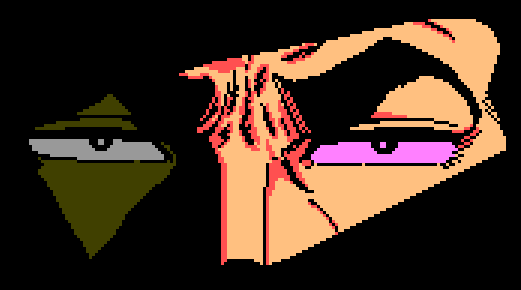
I also held my own concert on Sunday where I sang the theme song to the Golgo 13 NES games. In case you didn’t know, the song actually has lyrics!

My dealer’s room experience was also a most pleasant one as I managed to get everything I was looking for, specifically Ogiue-related…merchandise… as well as the recently released Revoltech Souther from Hokuto no Ken, or, as he’s known on the box, “Thouzer.”

On the fandom side of things, while I did not pay much attention to cosplay I was glad to see a good variety of costumes. While you had your endless Sora from Kingdom Hearts and the general love for Naruto and Bleach you usually expect, I also got some pleasant surprises, such as a cosplay of Kitarou and Nekomusume from Gegege no Kitarou.

Something I did not approve of was the near-total lack of Tainaka Ritsu when it came to K-On! cosplay. I like Mio too and all, but the ratio of Mio to Ritsu was unacceptable. I’m just saying.

The fan panels I attended were all well-run and had people who at least to some extent knew what they were talking about. The Neo-Shounen panel run by Daryl Surat succeeded in its goal of showing how Shounen as a concept changed over the years, mainly in its desire to appeal to both male and female readers, and the Lost in Translation panel was a good beginner’s panel for those interested in seeing some of the difficulties of translating from Japanese to English. The Mecha Appreciation Panel had knowledgeable panelists, but the format was a little haphazard and could have used some focus. If you ran this panel, I was the one who said “King J-Der” for coolest Gaogaigar robot.

I also went to the Anime Recruitment panel by the Reverse Thieves, which provided very good advice for how to get people into anime without scaring them off, offering tips such as, “If your first attempt fails, don’t press the issue. Instead, give them time to cool off, like three weeks or however long it takes.” I’ve spoken before on how difficult I find recommending anime to be, so I will take this advice to heart.

I had a personally vested interest in attending the Otaku TV and Genshiken panels, both run by Viga the Otagal, and was curious as to how these panels would go. Overall, they did a good job of showing the audience what these shows are all about, though I think Viga was a little too spoiler-friendly and it could scare off people who would want to see these series otherwise. Still, I was very glad to see such significant attendance for Genshiken-related panels. After the Genshiken panel, someone in the audience actually greeted me as a reader of Ogiue Maniax and asked to take my picture. Whoever you are, that made my day and I thank you.

Viga said in her Genshiken panel that she believes “The Psychology of Ogiue” would provide enough material for an entire panel, and I am inclined to agree. Keep on the lookout for that.

Overall, I have no serious complaints about Otakon this year, as I feel that the events I would have complained about I simply did not attend, such as the apparently misleading title of the “Sailor Moon’s Influence on Hentai” panel. The fact that Daryl Surat’s Anime’s Craziest Deaths got shut down because no one actually knew what Apocalypse Zero was disappointing, but I’m sure both sides will know how to better handle it next year. As a member of the Otakon press, I also would have felt better if I was told in advance that I would not be getting any interviews, rather than being left dangling. However, because this year’s Otakon was so packed with activities and intriguing and intelligent guests, I can say that this was one of my finest convention experiences, and everyone I traveled to Otakon and back with agreed wholeheartedly.

Let’s Get Ready for Otakon 2009

Otakon is upon us, and I will be attending this year. Unlike previous years however, I will be running around trying to get interviews which I hopefully will be able to post right here on Ogiue Maniax.

Below is a list of panels and such I want to attend. A lot of these conflict and a lot of them are duplicates on different days, but I included all of them just in case one turns out to not catch my interest and I head to another or if I happen to miss a Q&A session with a Japanese guest.

I’ve included the times and rooms, but these are all subject to change. I’ll try to edit this post accordingly so that everything is fine and dandy and up to date.

I might also be updating my location on Twitter, so if you want, you can follow me at http://twitter.com/sdshamshel or just click the link on the side bar.

Friday
Mobile Suit Gundam: Celebrating 30 Years 10:45AM-12:45PM Panel 6
Yutaka Yamamoto 11AM-12PM Panel 4
Kikuko Inoue Q&A 11AM-12:30PM Panel 3
Anime Recruitment 12:45PM-1:45PM Panel 1
Madhouse Panel 12:30PM-2PM Panel 3
The Mecha Appreciation Panel 2PM-3pM Panel 5
Opening Ceremonies 3PM-4PM Panel 4
Aniplex Panel (or TBD) 2PM-4PM Panel 6
I Cant Believe You Haven’t Seen This! 7PM-8PM Panel 6
Concert: Mell 8PM-9:30PM Main Events

Saturday
Anime, Lost in Translation 9AM-10AM Panel 2
Anime and Manga Studies 11:30AM-12:30PM Panel 1
Anime’s Craziest Deaths
12:45PM-1:45PM Panel 3
Fred Schodt Q&A
3pM-4PM Panel 5
Fred Schodt Autograph
4:30-5:30PM Autograph 2
Yutaka Yamamoto
5PM-6PM Panel 4
Noboru Ishiguro and Yukio Kikukawa
5PM-6Pm Panel 3
Otaku TV
4:30-5:30PM Panel 2
Genshiken: The Panel of Modern Visual Culture
5:45-6:45PM Panel 2
(Whoever’s running those two panels, I hope you’ve prepared well!!)
Dubs That Time Forgot
9:30-10:30PM Panel 1

Sunday
Anime Evolves 10:15AM-11:15AM Panel 5
Funimation TBA 10PM-11PM Panel 2
Maruyama Q&A
11PM-12PM Panel 3
Osamu Tezuka, Astro Boy, and the Manga/Anime Revolution, with Fred Schodt 12PM-1PM Panel 2
Noboru Ishiguro and Yukio Kikukawa 1PM-2PM Panel 2
Concert: Naomi Tamura 1:30PM-2:30PM Main Events

See you at Otakon! And if you happen to see me in the Karaoke room, know that I have quite a surprise in store.

Response: A Further Look at the Realism of Genshiken

The Reverse Thieves made a post today about perceptions of realism in fiction and how pessimism tends to overwhelm optimism in public opinion of what is “realistic” or not, at the expense of being able to tell more happy and uplifting stories. It’s a really good read and it got me thinking, particularly because of the primary example they use, my beloved Genshiken.

Hisui writes,

There are a standard list of complaints people have with Genshiken. The first being the prevalence of  female characters in the club and those female characters being too attractive to be in such. The second complaint is that too many of the club members wind up in relationships by the end of the series. Tacked on to this is the belief that the characters lives turn out too cheery overall. Too many of them get jobs they like and come to accept who they are through the club. Essentially, Genshiken is not harsh enough. Real otaku are sadder and more pathetic. Real otaku life is darker and drearier. To generalize the complaint, Genshiken white-washes the life of an otaku and makes it seems happier than it is. Genshiken is accused of having just enough realism to get you to ignore the lies and placates with what you want to hear but does not give you the true story.

I’ve talked about Genshiken on this blog numerous times, and it comes as a surprise to no one that I love the series. I’ve heard these complaints too, that Genshiken is too unrealistic in that its members all achieve some degree of happiness and success, whether it be in relationships, careers, or other areas entirely. However, I want to point out that having the majority of the cast descend into a pit of despair and bland mediocrity would be more unrealistic. It is very possible for geeks and introverts to remain immature and unsocial creatures who remain uncomfortably nervous when interacting with others, but it becomes much more difficult when these otaku are faced with the situations that Genshiken finds itself in.

There is one character in particular responsible for bringing the otaku of Genshiken out of their shells, and she arguably has the most influence on the entirety of the manga.

Did you guess Ogiue? You know me well, but this time you’re mistaken. The girl I’m talking about is Kasukabe Saki.

Saki is initially brought into the club by her boyfriend Kohsaka. Saki is not an otaku and has no interest in becoming one nor the subconscious will to do so. As Narutaki points out, and as I’ve seen numerous times, it is not so unusual for an otaku or a geek or a gamer to bring his non-dork girlfriend into his club. And it’s also not so unusual to have at least one otaku who is charismatic or handsome. Saki initially dislikes Genshiken and finds opportunities to insult its members or to devise ways to separate Kohsaka from the club, but what she inadvertently does is expose them to forces outside of Genshiken, outside of their comfort zone. It is their encounter with the “real world,” so to speak, and as anyone who was once debilitatingly shy or awkward will tell you about what was responsible for their change, increased interaction with others is central to that success.

Further still, you would find that having to confront someone with opinions different from your own when you have no way of escaping will affect you and make you grow as a person. This is the case with Genshiken, as the club itself is regarded as inferior to the Manga and Anime Societies of Shiiou University, making it a club dedicated to outcasts among outcasts and thus the end of the line with no points of escape other than to abandon clubs entirely, and to lose that opportunity to be around others. This is clearly something that none of the members want, and the result is growth and change.

As a fellow new member, Sasahara finds himself positioned opposite Saki through his status as a burgeoning otaku. Becoming chairman of Genshiken simply because he seemed the best fit for carrying on the lackadaisical spirit of Genshiken, his assumed role at the top of the chain and the responsibilities given to him result in his confidence and maturity growing accordingly. He is able to win Ogiue over because he represents someone who is comfortable with himself, something he learned from being with Genshiken for so long. Keep in mind that he applies for the position of manga editor out of desperation, but then realizes that it’s a position he’s already had similar experience in, and is able to use his sincere love of manga and status as an otaku to convince the interviewer of his qualifications. And it all came from having to be Genshiken chairman every day for an entire year. Do something every day and love what you’re doing, and it’s almost impossible not to improve. This is reality.

Similarly, Tanaka goes on to a fashion college after graduating. Tanaka was already interested in making costumes, but the arrival of Ohno gives him the opportunity to constantly improve his craft with a willing partner and to devote his personal time and energy to it. We the readers are not entirely sure when Tanaka began to actually have feelings for Ohno beyond simple physical attraction, but we can be certain that they interacted with each other often and became very good friends who were able to share and understand each other’s ideas and feelings. While you might say it’s unrealistic that a hot babe like Ohno would go for a scruffy tubby guy like Tanaka, would you say the same thing if you knew a guy and a girl in real life who hung around each other practically every day and were united by common interests, and the girl was given the opportunity to see that the guy was not only pretty decent but had creativity and ambition, albeit in cosplay form?

Saki herself meanwhile undergoes significant changes too. Just like how the members of Genshiken were forced to confront opinions different from their own, Saki became exposed to the world of otaku and understood that people are defined by more than their hobbies and interests. While success and confidence were hers from the start, they were incomplete, as Saki was initially embarrassed to reveal to others that her boyfriend is an otaku. However, by being with Genshiken she not only accepts the idea of a boyfriend who will never stop being an otaku, but is able to proudly show that it’s not something she simply tolerates but is another aspect of the man she loves.

In the end, the X-Factor of Genshiken is Genshiken itself. Gather a group of people with different personalities and outlooks on life, and have them interact with each other every day for years on end, and people will change. It’s inevitable. Genshiken just happens to be fortunate enough to be comprised primarily of people who, while socially awkward, are interested in friendship and being able to share moments with others. While it’s impossible for me to be a part of Genshiken, I can personally say that my own experiences as a geek and as an otaku do not fall far from this example given in fiction. Even those who find themselves subject to the pit of despair would be hard-pressed to resist personal transformation in such an environment.

OGIUE’S TRIUMPHANT RETURN TO MANGA (sort of)

I recently purchased Volume 1 of Genshiken: The Society for the Study of Modern Visual Culture creator Kio Shimoku’s newest manga, Jigopuri: The Princess of the Hell, about an 18 year old mom trying to raise her newborn child. A review will be posted in due time, but there is something more important I must address.

Manga published in Japan generally has a dust jacket where the manga’s front cover is printed, as opposed to manga published in the US where the image appears directly on the book. As such, manga often have images underneath the dust jackets. Curious about Jigopuri, I looked underneath only to uncover this on the back cover.

YEEEEEEEESSSSSSS

Ogiue is saying, “Whatever the circumstances may be, there’s no way they could get this big.” (Thanks to prinny for correcting my mistake)

Even when the content isn’t even related to Genshiken, Kio Shimoku still finds a way to fit Ogiue in, and for that I give him eternal respect and devotion.

Incidentally, this is on the front cover.

Madarame: Why did he use these designs?
Sasahara: Who knows?

Studying the Realism in the Fujoshi Character Design

Ever since the mid-2000s the fujoshi character has seen an increase in overall presence in anime and manga, as evidenced by my Fujoshi Files, an ongoing project where I catalogue fujoshi characters. While comparing various fujoshi characters, especially in seinen manga, I began to realize something interesting about their portrayal, and that is the fact that they are often the characters closest to how a Japanese girl would actually look: dark, straight hair, possibly wearing glasses.

There are series such as Genshiken and Zetsubou-sensei where the fujoshi characters having dark hair is not unusual given the rest of the cast also sporting dark hair. My discussion focuses on those shows where characters’ hair styles and colors tend to be the anime rainbow stereotype.

When you look at Lucky Star as a whole, you’ll see that bespectacled fujoshi Hiyori is the only female character to sport straight, dark hair. Contrast this with Konata, who is the biggest otaku in Lucky Star and her unrealistic blue hair. Patty, while a fujoshi, is an “American” character first, so she’s blonde. Again, I want to mention that Hiyori is the only example of a character with a realistic hair color and style mainly because of how much the rest of the cast isn’t. In a world where bright pastels rule hair colors, the fujoshi is the exception.

Similarly in Kannagi, Takako is also a dark-haired glasses-wearing fujoshi, though her hairstyle is arguably more unrealistic than most of the other characters. However, it cannot be argued that most of the rest of the cast, especially female characters, have hair colors that do not occur at all or much less commonly in reality among Japanese girls.

Meanwhile in Mousou Shoujo Otakukei (Fujoshi Rumi), the main character of Rumi also stands out as being much plainer than the other girl characters out there and even a lot of the guy characters. Part of this has to do with the fact that she is the main character and that this visual plainness is a part of the story being told, but it speaks to this desire to make her a more realistically accessible character even if it’s only at a shallow level at first.

“There’s plenty of characters who look like that who aren’t fujoshi!” you might be saying, and you’d be totally right. The dark-haired, straight-haired glasses girl predates the fujoshi character boom, and arguably falls into the same category as the “iinchou” class representative character. Adachi Hana from Yankee-kun to Megane-chan is a character who is actively trying to achieve that iinchou look, even going as far as to wear fake glasses. She also bears some resemblance to Asai Rumi from Mousou Shoujo. So in a sense, the author of Mousou Shoujo, Konjoh Natsumi, and the fictional character, Adachi Hana, are attempting to reach the same goal: design a character with the look of a realistic Japanese girl. The main difference of course is that the iinchou is characterized by an ultra-clean look and  responsibility, while the fujoshi is characterized by being somewhat disheveled and a tad irresponsible.

You might then be saying, “Ah, but that’s really how fujoshi look.” But then I have to ask, why is it that in these shows where all other characters are not beholden to reality that the fujoshi ends up being how fujoshi “actually look?” And why is this occurring in comics targeted towards guys?

Most other character types in moe or moe-ish anime tend to be fantastic versions of possible real-life people: childhood friends, reticent girls (tsundere), little sisters, etc. Everyone knows that little sisters in anime are rarely like actual little sisters, and even if you compared the imouto character in an h-game to an actual incestuous younger sister the two images would not line up. In this sense, a fujoshi character can be as unrealistic as the others but it is often the case that a certain sense of realism is desired in fujoshi characters in a manner different from other character types.

Looking back at tamagomago’s essay for which I provided a translation, one line in particular jumps out at me: “No matter how realistic it gets, it’s still a fantasy,” or in other words, no matter how realistic a female otaku character may be, they are still just a character in fiction. What this sentence implies is that there is to some degree a push to make female otaku characters have a sense of relatable realism, perhaps more than other character types, and fujoshi fall into this category by extension.

Perhaps the answer to the question of “why are there these realistic aspects in the fujoshi design” is that having a member of the opposite sex also be an otaku makes them more accessible, gives the male otaku a glimmer of hope brighter than previous. Also, by making them a fujoshi instead of just an otaku, a useful distinction is created. And of course, if applied to actual reality with real girls, it is not in itself a realistic goal as long as the male otaku does not confuse his image of 2d and 3d girls.

Muteki na Fujoshi: 801-chan’s Small Anime Revival

Months ago I reported on the fact that the popular Japanese webcomic turned franchise Tonari no 801-chan, about a hardcore fujoshi and her otaku boyfriend, was getting an anime and later that the anime was getting scrapped. Well now it is back in the form of a 90-second opening-only anime titled Tonari no 801-chan R to be released with volume 4 of the published manga, a follow-up to the Drama CD released previously.

This opening special will be directed by Yamamoto Yutaka, the director of Kannagi who had also previously worked on Haruhi and Lucky Star (before getting fired), and is the modern father of the Dance Op/Ed. It will also have an opening composition by A-bee, who worked on songs for Lucky Star and Keroro Gunsou. As for the singer, why that will be for Nico Nico Douga to decide, because they are holding an online audition to be the singer OF the 801-chan opening.

The test song is the third Yawara Opening, “Makeruna Onna no Ko,” and you can download the song here and then upload them here, provided you have a Nico Nico Douga account. They are looking for female singers, though if you’re a guy with a feminine voice then you also have a chance. The audition schedule is available but in Japanese, so I’ve provided a translation.

All times are in Japan time. Check to see how it translates to your own time zone.

6/19 13:00 – Open for Auditions
7/6 00:00 – Closed for Auditions
7/9  21:00 – Preliminary Results, as Chosen by Nico Users!
7/16 21:00 – Decision-Making Process LIVE

After that, the vocalist will be decided and recording will begin on 7/20.

Who knows? Maybe someone outside of Japan could land the role. I’d look forward to that.

If you’re curious to check out the 801-chan comic, keep in mind that it is still a free webcomic and that provided you understand Japanese you can read it on the official website.

This takes me back to the time when they announced the first Genshiken drama CD with Mizuhashi Kaori as Ogiue, followed by the release of the OVAs and then Genshiken 2. While I’m not quite as excited for 801-chan as I am for Ogiue (this is not 801-chan Maniax after all), I still really hope this does well.