Chousoku Henkei Gyrozetter is about a world where everyone can drive, including 8 year olds. Cars can also turn into robots called Gyrozetters. This technology comes from a prophetic tablet known as the “Rosettagraphy” which also contains a list of “chosen drivers,” kids with the attitude and will to drive the most “wicked cool” Gyrozetters in order to fight evil or corrupt fuel companies or whatever.
If it wasn’t clear from my summary, I think Gyrozetter is an odd show, but what I think is really strange is how typical it is without veering towards tedious or amazing or even average. Its mostly episodic format gives off “standard kids’ anime” vibes in spades, but it neither comes off as a refreshing take on the formula nor so rote as to be unentertaining. I find it difficult to talk about if only because I definitely enjoyed the show in a way which would have me looking forward to more, but it doesn’t feel quite special. People say that the hardest shows to talk about are the ones that are utterly mediocre, but when it’s “better than average, though not great,” a show like Gyrozetter poses its own review challenge. The robots/cars are fairly well-designed, the characters are fun and expressive, and both the episodic elements and the overarching plot work well enough together. I think the best I can do though is to talk about some aspects of Gyrozetter which I found fairly notable.
First, is the endings which are pretty much Precure-style dance sequences but done with giant robots. It’s eye-catching if anything.
Second, even though it’s a kids’ show it spends a lot of effort on attractive ladies. Apparently in some interview the director or producer said something along the lines of wanting to make the show “erotic” but I don’t know how seriously to take that.
Third, the villains are an appealing part of the show, and though they start off fairly serious they get increasingly Team Rocket-ey as the series progresses. Curiously, as this is happening the plot is also getting more dramatic so there’s this almost schizophrenic feel to Gyrozetter which isn’t offputting but gave me pause every so often.
Fourth, it’s a boys’ show which develops the relationship between the main character Todoroki Kakeru, who’s very much of the Ash Ketchum-type (or Satoshi if you prefer) and his would-be girlfriend Inaba Rinne to a surprising extent. He’s 10, she’s 12 (or somewhere along those lines), and it’s actually really close to if Pokemon had spent more time overtly pushing Ash x Misty as a thing instead of just giving the vaguest of hints. Maybe that’s what’s oddly refreshing about the show even though it’s so formulaic.
Fifth, Mic Man Seki, who is literally voice actor Seki Tomokazu. His job is to hype up everything ever, and he certainly does a good job of it.
Sixth, the Valentine’s Day episode.
Gyrozetter is a bit different from other giant robot anime because it’s not based on a toyline or pushing sales to nostalgic older fans, but comes from an arcade game where you’re supposed to drive around for a while collecting powerups and then transform into a robot for a 3-on-3 battle. Apparently the anime didn’t do well, and I wonder if it was partly because the show’s format (children of destiny use their car robots to save the world!) was too different from the actual game, and I did notice that towards the end they tried to actively foreground the arcade gameplay in the actual anime. However, it seems like the arcade game itself wasn’t terribly popular and is going away, so maybe there’s plenty of blame to go around.
From what I’ve been told (by Kawaiikochan author Dave), the arcade machine is the embodiment of rad as the giant cockpit-like arcade machine will literally transform into a battle mode as you shift gameplay modes and do so in the flashiest way possible. I have to wonder if maybe the game was too much, as a lot of the popular arcade games for kids seem to be the super automated games where characters dance or fight on autopilot based on a special card you use.
In terms of favorites, the best robot design in my opinion Rinne’s second Gyrozetter, Dolphine. Its curved design makes for a pleasing sillhouette and its figure skating gimmick reflects Rinne’s own interests (her dream is to be an Olympic skater) in an interesting fashion. I can’t pick a favorite character but I was fond of Kotoha the bridge bunny (the one in green and glasses), Haruka, who is shown in the shot of the villains above, and the secretary character Kouno Saki.
If I stretched even further, I think I could say some things about how the show addresses the concept of destiny through the later developments concerning the Rosettagraphy, but I’ve said a lot more about a show I find to be “not bad” than I was expecting. With that, I’ll just end with some final screenshots.
When the Robotech/Voltron crossover comic was announced a few months ago, my immediate response was, “Why?” Of course the answer is “nostalgia grab,” but there’s something strange about both of these works and their continued presence in the geek public eye (and perhaps even beyond that). Unlike Transformers which not only has a huge variety of toys both old and new, as well as a long history of cartoons both from America and Japan (not to mention the live action films), both Robotech and Voltron do not really renew themselves, aside from the occasional thing like the The Shadow Chronicles or The Third Dimension.
Though this speaks more about the people I associate with, I can’t say I’ve ever talked to anyone, online or offline, who is hardcore into either Robotech or Voltron. I know that there’s a Robotech community of course (they even have an official site for it), though I have little interest in it. With Voltron, I know people who have fond memories of it, myself included, but the foundation that Voltron has in geek culture seems not only deeper than Robotech‘s but to the extent that, when you say cool giant robot with a signature finisher, Lion Voltronis just the default, or it shares that spot with the Megazord from Power Rangers. It’s like Voltron as a source of nostalgia goes so far beyond itself that the vague perception of it exceeds the influence of the actual anime.
What’s funny about a show like Voltron and its emblematic presence in US geek culture as de facto super robot is that the process of dubbing and adaptation that turned the anime King of Beasts Golion and Armored Fleet Dairugger into Voltron: Defender of the Universe happened with different anime in different countries to similar effect. In the Philippines, Voltes V exploded with popularity. In France and Italy, UFO Robo Grendizer captured attention as Goldorak and Goldrake respectively (with success in the Middle East to boot). In Brazil, Gloizer X became O Pirata do Espaço, the country’s first real exposure to giant robots. While it’s possible say that this was all a matter of timing and that they’re all interchangeable in that respect, I do think that the specific properties of each show had a major impact on how each country perceived giant robots from that point forward (I’m less sure about Gloizer X so if any Brazilians want to help, feel free to leave a comment).
One thing that I do believe plays a role in how these series become more specific in their nostalgic output is the level of support the original works have in Japan. I visited France recently, and when I went into the comic stores I would regularly see displays of Grendizer merchandise. Whether it was the Super Robot Chogokin or the Soul of Chogokin or a chibi version, it was all straight from Japan, sitting prominently in the store. Grendizer has enough cultural presence in Japan that it can continue to get these toys and even a fairly stable presence in Super Robot Wars, whereas Golion has had to content itself with just one Nintendo DS appearance. In lieu of support from Japan, Voltron‘s had to carve its own place, and often times it’s not even from the company World Events which holds the Voltron license but from fans conjuring it up in their own minds. And while Robotech is an utter legal mess due to the way it stifles the presence of Macross in the US, if you put that aside part of Robotech‘s prolonged presence comes from the fact that its fans want new Robotech to constantly feel like old Robotech, whereas Macross changes according to the whims of its dark lord Kawamori Shouji.
Actually I wouldn’t mind at all if Voltron got a revival with a solid piece of fiction to support it which doesn’t rely too much on nostalgia. I know we got Voltron Force, but the less said about that the better.
I’ve come to notice that there are few female characters in anime with seductive personalities.
There are characters who are physically good-looking, characters who are proud of their appearance, characters who are in love, and characters who try to get closer to the person they’re interested in. Rarer is the type of female character whose mannerisms ooze fiery passion in such a way that their sexuality is more than simply their physical design.
Here’s a character who I think qualifies: Fuwa Aika from Blast of Tempest. Good-looking but not to an incredible degree, you can sense in her interactions with her boyfriend Yoshino not only the way she focuses all of her charm on him, but also the strong physical and emotional response that Yoshino has to Aika’s desire. It’s difficult to capture this impression in a single image.
Another lesser example comes from a few years ago in Macross Frontier. The character of Sheryl Nome is more sexy than seductive normally, but in one scene both she and Ranka Lee are trying to out-sing each other in order to demonstrate their interest in the protagonist Alto and why he should choose one over the other. In that moment, both Sheryl and Ranka exude strong desires which fill the space they’re in.
In thinking about this, I’m reminded of an old post on Heisei Democracy, in which Shingo states that lips aren’t moe. The argument is that lipstick denotes an assertive un-moe character, while lips in general are a sign of active sexuality which is counter to moe’s ostensible image of innocence. I don’t quite agree with that premise, and my discussion of characters isn’t limited to just those who would be considered “moe,” but I do feel like there’s something relevant in Shingo’s argument. There’s this rough idea that moe characters, even when they are attractive or overtly sexualized, at most tend towards conflicted expressions of desire (e.g. tsundere) or displays of innocence even in less “innocent” moments. If you then move the idea to being about the difference between sexual/seductive, maybe it’s not so unusual for seductive characters to be a rarity.
This year’s Otakon was its 20th anniversary, and as expected of the staff they brought out the big guns, with names such as Watanabe Shinichirou, Kanno Yohko, and Seki Tomokazu. As with every year, one of the biggest strengths and weaknesses of Otakon is that there’s too much to do, and it leaves me feeling both satisfied and a bit disappointed.
For one thing, I didn’t get to see the Space Dandy trailer.
Industry
Watanabe Shinichirou (Cowboy Bebop)
Possibly the biggest news to come out of Otakon was the announcement of Watanabe’s new anime, the aforementioned Space Dandy. Described by Watanabe as “80% comedy, 20% serious” in contrast to Cowboy Bebop‘s “80% serious, 20% comedy,” the series sounds just plain interesting when you hear how much they’re putting into it. In terms of music, for example, Watanabe stated that they would have over 20 artists contributing to the soundtrack, and in terms of production every episode would have different episode directors and different designs for the aliens inhabiting their planets.
I managed to ask Watanabe about having Thomas Romain (Basquash!, Oban Star Racers) on staff for ship design, and Watanabe mentioned that he had been impressed with Romain’s work for a while. Also, while Romain is Satelight staff and normally wouldn’t be able to work at Bones for Watanabe, Romain turned out to be a huge fan of Cowboy Bebop which gave Watanabe the leverage to get him on board for this one project.
I do wonder how it’ll be received among American fans, because there was some disappointment from the fanbase over Watanabe’s previous work, Kids on the Slope. While Space Dandy is closer to his action-ey works, the “80% comedy” part might be unwelcome by those fans looking for drama and grit. That said, I’m certainly looking forward to it.
One of the more unique guests this time around was Kurosaku Kaoru, a novelist in her own right, but also more relevant to the otaku audience as the wife of Watsuki Nobuhiro, author of Rurouni Kenshin. Originally Watsuki himself was supposed to come as well, but he was unable to due to working on Embalming. Kaoru also held a panel all about Watsuki, but because of the way she went about it the crowd also learned a lot about some of the most famous Shounen Jump manga artists, as well as the workings of Jump in general.
There was also a gallery of Watsuki’s works, the first of its kind, but sadly even though we could take photos we are not allowed to share them online. (I’m sure somebody has though.)
Watsuki we learned is a big fan of American media, as one of his biggest regrets about not being able to attend Otakon was not being able to visit a Toys “R” Us and look at the Pacific Rim merchandise. He’s also a big fan of American comics, and his favorite superheroes are the X-Men. We also got to see his daily work schedule, which is mind-bogglingly arduous but also par for the course. According to the breakdown, Watsuki works from 10am to 6pm, from 7pm to late, and midnight to 4am. Sleep is 4am-9am, and the other gaps are for meals. That’s 5 hours of sleep versus about 15 hours for work. If he keeps on schedule, he gets four days of rest at the end of each month.
Kurosaki also provided a monthly breakdown of his schedule, and while inking comprised the majority of it, it was especially fascinating to see that the “name,” an extremely rough preliminary version of the manga which is mainly about panel and page layout and narrative flow, takes four days to comple. Kurosaki mentioned that the “name” is so simple as to use stick figures, but the attention paid to this part of the manga-creating process does emphasize how important panel flow is in manga.
Kaoru also took us through the process by which Watsuki makes color images, which involves drawing a thumbnail and then going over it with a Japanese calligraphy brush and copic markers for color. Watsuki apparently thinks that It’s good for one shot illustrations but not the manga itself, as it requires more concentration but the lines become more dynamic, and it acts as a time-saving measure for color images. The traditional feel that the brush art gives off also matches the theme and feel of Kenshin. Related to that, when someone asked about the setting of Rurouni Kenshin, the answer was that Watsuki wanted to draw a period piece with sword fights but didn’t want to draw topknots (they were strange-looking to a modern Japanese audience as well as an international one), so the Meiji period was the only point in history where you could have the former without the latter.
I wish I could’ve asked more about copics, as I find it interesting that they’re such an industry standard.
In terms of former assistants, Watsuki’s lineup is near-Olympian, counting among them Oda Eiichirou (One Piece), Murata Yuusuke (Eyeshield 21), Shimabukuro Mitsutotshi (Toriko), Mikio Itoo (Normandy Secret Club), and Takei Hiroyuki (Shaman King), all of whom consider Watsuki a friend. From Kaoru we learned that there are three breaks a year for Jump artists, and that during those breaks everyone either gathers at Watsuki’s or Oda’s house. Shimabukuro is a current neighbor of theirs, while Takei is a former neighbor. Murata, now known for his exquisite artwork on One Punch Man, used to be an assistant on Gun Blaze West, though at the time Watsuki thought his drawings were “no good.”
Mikio Itoo is known as the “cameo king,” appearing multiple times in One Piece, Shaman King, and even Kenshin in background posters and crowds and such.
Another major name who worked with Watsuki on Kenshin was former editor-in-chief of Shounen Jump, Sasaki Hisashi, whoworked with Watsuki from his first submission all the way to the end of Kenshin. The basis for a certain character in Bakuman (he even uses the fictionalized version of himself as a Twitter avatar), Sasaki is often asked about the accuracy of Bakuman, to which the official reply is, “Things depicted in Bakuman are neither true nor false.” We also learned that Jump employees are not supposed to give comments outside the office using their real faces.
Not limited to people who have worked directly with, over, or under Watsuki, we also saw comments from Kishimoto Masashi (Naruto), Inugaki Riichirou (also Eyeshield 21), Matsui Katsunori (La Sommelière), and Suzuki Shinya (Mr. Fullswing). Did you know the last chapter of Kenshin ran in the same magazine as the first chapter of Naruto? Kishimoto saw this as a kind of passing of the baton, and credits Kishimoto for making Japanese culture popular in manga again (but also believes that now it’s become too much). For this reason, Kishimoto calls Watsuki the leader of a generation.
Inugaki’s comment was that Watsuki taught him techniques to speed up the manga-creating process, namely giving rhythm to the use of detail and not trying to draw every little thing. We then learned from Kurosaki that both she and Watsuki playGerman board games often with Inugaki and his wife, and are especially fans of Dominion. As someone who hasn’t played it but has played games like it and has heard much about it, the intrigue continues to build for me.
Suzuki’s message talked about Watsuki’s fandom, as he once found an entire box full of fan letters for Watsuki. Matsui, whom Kurosaki commented that he’s especially good at drawing cute girls (I would agree), actually did not send any comments, except to promote him in the US. As much as I’d like to see that, I know Drops of God didn’t knock the manga community off its socks, so I don’t know how well the less adventurous La Sommelière would do.
What was maybe the most interesting bit of trivia of all, however, was that a lot of the Jump artists use the instant messaging service LINE to talk to each other and joke around. Watsuki doesn’t use it because he’s bad with computers, so his wife has to tell him what’s going on.
Sentai Filmworks
The only American industry panel I attended was Sentai Filmworks’, where they were very excited over their recent Girls und Panzer announcement. I also ran into an unfortunate bit of luck, discovering that they had license rescued Betterman, a show which I had just recently scoured Amazon for in other to get the complete release of the original Bandai DVDs. It’s a shame, because it definitely would have been a show I would’ve bought and supported, mainly because it’s such an unusual piece of work.
I asked Sentai Filmworks about the translation issues in their release of Mawaru Penguindrum but the answer given was ignorance, claiming that they had not been aware of the criticisms brought out against their translation choices. Oh well.
Maruyama Masao
While many of the industry guests and panels are excellent, every year the most stand-out guest is Maruyama Masao, founder and former producer at MADHouse, currently founder and producer of MAPPA (Kids on the Slope). Even though he’s been at one Otakon after the other, his Q&A panels are consistently informative and interesting. To give you an idea of how great his answers are, when asked about production delays for Redline (which took 7 years to complete), Maruyama answered that Redline was not late, it took as long as it should have, which was a lot of time due to the amount of work required for it. Maruyama then said that he left MADHouse to take responsibility for the debt that Redline put them into but then said in English, “IT’S A JOKE.”
In one of my favorite moments of Otakon, I asked Maruyama to share some stories about the recently departed Dezaki Osamu (director of works such as The Rose of Versailles, Aim for the Ace, Black Jack OVAs, and even Dear Brother), to which he replied with what was about a 10-minute long answer. Maruyama stated two significant events responsible for his long career in anime: working with two Osamus. First, he worked for Tezuka Osamu at Mushi Pro, and then formed MADHouse with Dezaki. Their first non-Tezuka work was Ashita no Joe. Eventually when the Ashita no Joe 2 film was in planning, they had creative differences where Maruyama believed it was unnecessary and Dezaki wanted to work on it, so he left and formed a studio called Anapple. They would not work with each other for many years, though they were still friends and still played mahjong with each other.
During the time they were apart, Maruyama produced directors such as Hosoda, Kon, Kawajiri, and had no time to work with Dezaki. Eventually, as they both reached old age, they decided to work together once more, and their final project together was, of all things, Ultraviolet. Dezaki wasn’t sure if it was the right work, but it was the only one in the pipeline at the time and the only chance they had to work together. Maruyama said they were happy to make it, though said nothing of the quality of the show. Maruyama then mentioned that Dezaki’s final work, Genji, had Dezaki tryingg to put in everything he couldn’t put into Ultraviolet. Then Maruyama said that with the time he has left on Earth, he would try to bring Dezaki and Kon’s remaining works to the world.
The panel also included a special showing of a short titled Hana wa Saku (Flowers Bloom), directed by Katabuchi Sunao (Mai Mai Miracle) with music by Kanno Yohko, whose purpose was to encourage the people affected by the earthquake. I hear in his other panel he also showed a video directed by Rintaro which was a funeral tribute to Kon Satoshi.
Interviews
I managed to get interviews with both acclaimed voice actor Seki Tomokazu, as well as Tachikawa Yuzuru and Suwa Michihiko, who are involved with the Anime Mirai project. Keep checking Ogiue Maniax for those.
Fan Panels
In terms of fan-run panels, this year was a mix of new and interesting subjects as well as a few “greatest hits” to celebrate the 20th anniversary. Mike Toole’s panel on “Outsider Anime,” his take on the Henry Darger-esque idea of “Outsider Art” looked at a number of creative and off-the-wall artists who, while for the most part not totally “outsiders” still push the boundaries. Names such as Shinkai and Yuasa are somewhat familiary to anime fans at this point, but I hadn’t heard of Tomioka Satoshi and his bizarre toilet humor rabbit animation Usavich for instance, and only recently learned about Mizue Mirai and his abstract animations. I was especially glad though to see him mention Iseda Katsuyuki, a man infamous for creating anime pretty much on his own with… unique results.
I attended the “45 Years of Shounen Jump” panel (while also singing along with the anime openings). Run by landofobscusion, it was a short “greatest hits” breakdown of the magazine. I learned quite a few things. For example, I did not know Sexy Commando was a top 3 title at one point, nor did I know that the end of Dragonball lost the magazine 500,000 readers while Slam Dunk’s finish lost them 2 million. What was even more interesting was hearing the crowd react to all of the titles mentioned. Yu Yu Hakusho for instance got a gigantic pop that I wasn’t quite expecting, as I knew people liked the show but didn’t know it was nestled that fondly in the hearts of fans who watched it on Cartoon Network.
Because of this panel the second City Hunter opening is stuck in my head now.
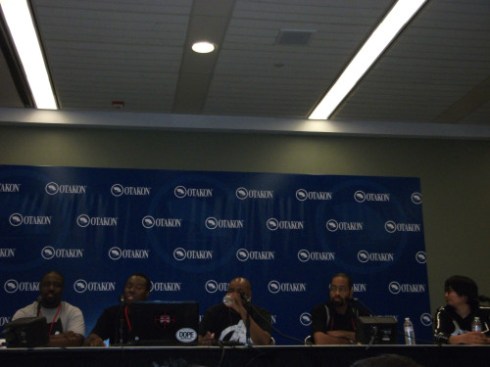
Speaking of surprising fan reactions, I am pleased to see the mecha fandom’s opinion of Gundam SEED turn around tremendously. Traditionally, when you go to a giant robot or Gundam-themed panel, there is a valuing of the Universal Century timeline over the alternate universe counterparts not named G Gundam. (The Seki Tomokazu panel I attended taught me just how many people love G Gundam, to the extent that more than one attendee exclaimed Domon Kasshu as a role model for how to live as a man.)
In the past Gundam SEED was seen as a black spot on giant robot anime, “the beginning of the end,” and all it took was a panelist to go “Gundam SEED! BOOOO!” to get the crowd to follow along. This time, though, when I attended the Mechapocalypse panel, Gundam SEED received largely applause rather than jeers, and it just warms my heart to see a mecha fandom which accepts what SEED brings to the table. We all agree though that SEED Destiny is still terrible.
Actually, the Mechapocalypse panel in general was a good deal of fun. Generally mecha panels are all about going through the history of giant robots and having everyone cheer for their favorites, and while this one retained some of that, it also mixed it up heavily with roundtable discussions of specific themes and characteristics of robot anime, all while keeping it light-hearted. While I’m already familiar with the Japanese Spider-Man, it’s inevitably a crowd pleaser whether you’ve seen it or not.
The other mecha panel (of sorts) I attended was Al’s presentation of the directorial works of Tomino Yoshiyuki, creator of Gundam. Neither full of blind praise for the man nor unfairly critical of his body of work, the panel laid out the various aspects of Tomino’s reputation, particularly his tendency for works to be either fairy light-hearted or particularly violent and morbid, and how both make up Tomino’s overall ouevre into something special. While I know a decent amount about Tomino anime, I also learned a good deal from the panel. I also realized based on audience reaction that Gundam has this strange memetic power which actually exceeds the content of the actual shows. This might be commonplace for anime fans nowadays as a lot of current anime operates actively under such influence, but I recall seeing the shouts of “Char is a lolicon!” back in the late 90s, and I think it’s what fuels some of the odder aspects of most Gundam panels, whether the panelist plans it or not.
The last panel I want to mention is “Anime Mystery Science Theatre 3000.” Although it was my first time seeing it, I learned from others that it was an extremely popular and well-regarded Otakon panel back in the day. Coming out of retirement for Otakon’s 20th anniversary , the Anime MST3K crew took down the GONZO film Origins: Spirits of the Past (aka Gin-iro no Kami no Agito), pointing out the hamfisted environmentalism message alongside the sudden and strange character/romance development points which result in the deformed child of Appleseed and Nausicaa. In addition to being hilarious, I noted that they had indeed kept up with anime over the years, spotting multiple Girls und Panzer references.
Concerts
This year, Otakon decided to hold two double concerts for its four guests, which resulted in Home Made Kazoku starting for TM Revolution and Ishikawa Chiaki preceded Kanno Yohko. I saw Home Made Kazoku back in 2010 at Otakon and TM Revolution back in 2008 at the first New York Comic Con. In both cases they’re among my favorite concerts I’ve attended, and to see them together was quite a treat. One notable thing about the Kazoku/Revolution concert was that it was held in the Mariner Arena, which made lining up in advance almost entirely pointless as you could get a decent seat even at the last minute. It was a pleasant change-up compared to previous years, and unlike the time with JAM Project I was glad to see the arena fill up a decent amount. I heard that at the end the two groups had a superhero teamup and did a song together, but I sadly had to leave before that.
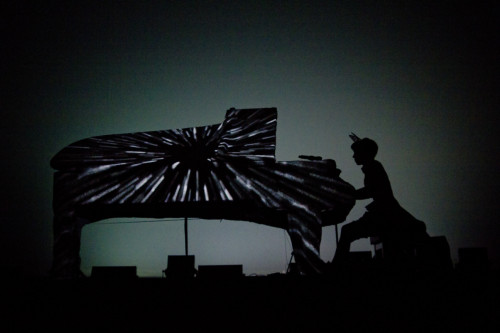
The Ishikawa/Kanno concert was an anomaly before it even began. Unlike every other concert at Otakon, this concert required tickets due to “unforeseen demand,” and tickets could only be picked up at specific times of the day. While I know Kanno is probably the most popular anime composer out there, it seemed to be an intentional choice to up the value of each seat, marketing at its finest. In order to keep up with demand, Otakon actually created an overflow room so that people could watch the live feed from elsewhere within the Baltimore Convention Center. The concert itself was also quite fantastic, as Ishikawa’s haunting melodies (“Uninstall” is a perennial favorite) led well into Kanno’s part, which was unlike any convention concert I’ve attended. Kanno was alone on stage with a piano, playing a number of her best hits, including of course “Tank!” and “The Real Folk Blues” from Cowboy Bebop. As the concert went on the white covering laid over the piano became a kind of projection screen which displayed graphic animations to accompany her music. It was a full-on aural/visual combination, as much an artistic performance as it was a musical concert. It was definitely another highlight of Otakon 2013.
The title of this con report comes from Kanno’s introduction by her producer, which I found quite memorable.
Baltimore and Friends
The most surprising news to come out of Otakon had to do with the convention itself, as the staff announced that Otakon would be moving out of Baltimore into Washington, DC in 2017. Citing capacity issues, I experienced firsthand the fact that the Baltimore Convention Center is increasingly unable to handle the growing attendance rate of Otakon. Friday afternoon saw for whatever reason extreme, extreme congestion on the third floor that made it so it literally took me 15 minutes to walk what should be a 3-5 minute trip, tops. I do feel pretty bad for Baltimore, as I know that Otakon provides them a good deal of money every year. On a personal level, my friends found a great hotel and great places to eat, and to leave them with the possibility of never returning does fill me with a bit of sadness. That said, I still have three years to chow down and go wild.
By the way, if you ever are in Baltimore and decide to go to Abbey Burger Bistro, I’ll tell you about my custom burger I ordered this year because it was fantastic. Duck meat burger (it’s a meat of the month so it might not be available) cooked medium rare, with brie, grilled onions, mushrooms, pineapple, and red pepper paste on thick toast. Do it.
I didn’t hang with or meet people as much as I had in previous years, but I still enjoyed seeing everyone. In terms of group activities, the highlight of the convention was watching Salty Bet in the hotel room. We happened upon a great night which pitted all of the famous overpowered characters against each other, and the unstoppable force vs. immoveable object that was Berserk vs. Rare Akuma made for an unforgettable evening.
Cosplay
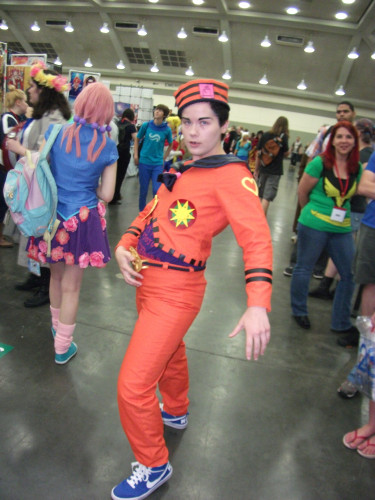
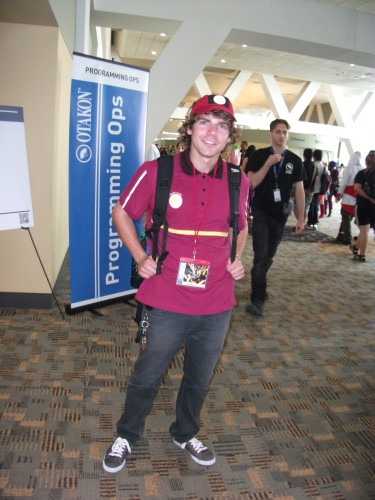
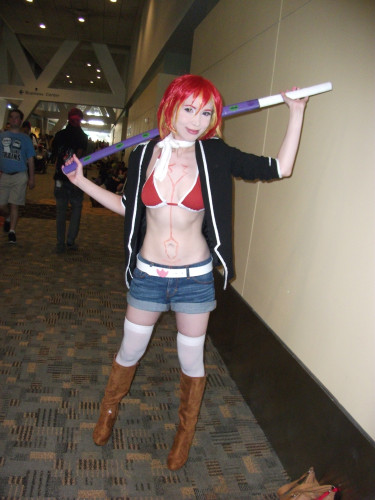
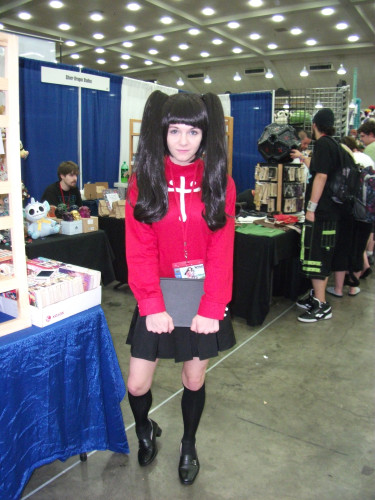
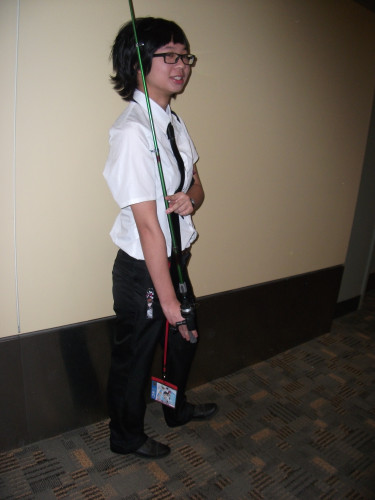
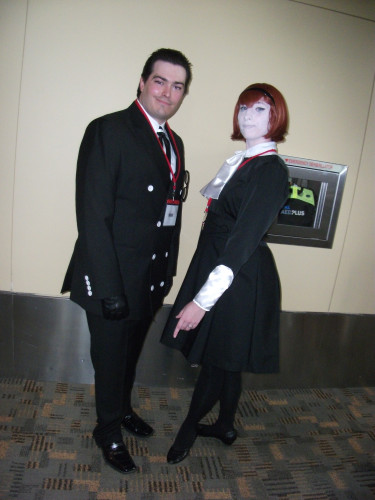
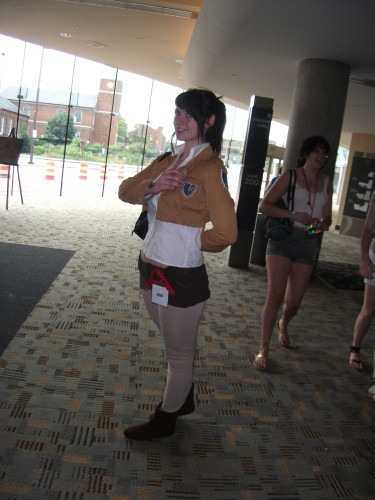
I’ll end off with the semi-standard cosplay photo bonanza. I was not quite as trigger happy with the camera this year, but I did find some definite gems. Special shout out to the Sasha cosplayer who actually handed me a potato afterward.
Introduction: “Gattai Girls” is a series of posts dedicated to looking at giant robot anime featuring prominent female characters due to their relative rarity within that genre.
Here, “prominent” is primarily defined by two traits. First, the female character has to be either a main character (as opposed to a sidekick or support character), or she has to be in a role which distinguishes her. Second, the female character has to actually pilot a giant robot, preferrably the main giant robot of the series she’s in.
For example, Aim for the Top! would qualify because of Noriko (main character, pilots the most important mecha of her show), while Vision of Escaflowne would not, because Hitomi does not engage in any combat despite being a main character, nor would Full Metal Panic! because the most prominent robot pilot, Melissa Mao, is not prominent enough.
—
It’s not uncommon for an anime to pay homage to its predecessors, but when the homage becomes a source of inspiration itself, then you have something special. That’s Aim for the Top!Gunbuster. The image of Gunbuster rising up from a ship with its arms crossed is especially famous, and for anyone to whom the phrase “female robot anime protagonist” is relevant, Takaya Noriko and the Gunbuster carry great significance. As I even use it in my introduction, it was only a matter of time before Gattai Girls got around to Aim for the Top!
In the future, mankind is under siege from massive alien creatures. In order to combat them, young cadets are recruited and trained so that they may travel through space and confront the aliens directly. One such pilot is Takaya Noriko, who appears to be lacking, but the school’s coach sees potential in her and makes her a candidate for mankind’s strongest weapon, the Gunbuster. As she trains alongside her “big sister,” a talented, beautiful, and hardworking upperclassman named Amano Kazumi, Noriko learns and matures. However, because battling the enemy requires faster-than-lightspeed travel, those who fight must live in a different time frame from those they care about.
First released in 1988, Aim for the Top! is in many ways an anime for anime fans, which should come as no surprise when considering that it’s an early Gainax production. Gainax is famous for being the anime studio created by fans, and when you look at this OVA series and even the fact that it bucks the trend by going for a fierce and powerful female protagonist in Noriko likely stems from these origins. The series fuses the melodramatic shoujo sports setting of the tennis manga Aim for the Ace! (of which the OVA is at first clearly a parody) with both the hot-blooded nature of the super robot genre and the devil-may-care atmosphere of Top Gun. One thing that strikes me about Aim for the Top! is that, even though it has its basis in shoujo, the character designs and overall art style are quite far-removed from Aim for the Ace! and really embodies that 80s look.
If I had to pick a more modern series with similar tendencies (aside from its sequel Aim for the Top 2!, of course), it would be Magical Girl Lyrical Nanoha and the way it takes the magical girl concept traditionally aimed towards girls and combines it with an almost mecha-like aesthetic for the enjoyment of male fans. Same goes for the treatment of male characters: like in Nanoha, guys are clearly less important, even to the point of being more plot devices than anything else.
The reason why I bring all of this up is because I can’t say that Takaya Noriko is intentionally a progressive character. Giant robots and cute girls are two popular tastes among otaku, and Noriko is a notable example of that. It also should be noted that Aim for the Top! is notorious for popularizing in anime the concept of incredibly jiggly breasts, the girls’ outfits emphasize their legs like crazy, and casual nudity is somewhat common in the series. Nevertheless, in some ways I would argue that there are very clear benefits to the fact that Noriko is a very strong female protagonist regardless of feminist intentions. Aim for the Top! asks, why can’t the girl be the lead? Why can’t she save the day? And why can’t she be the one yelling with fury at the top of her lungs as her robot plants the spiked treads on the bottom of its foot on alien creatures ten times its size and tears straight through them?
It’s not like Noriko at her core is a very original character. She’s not much different from her predecessor Hiromi in Aim for the Ace! (and Kazumi is still clearly based on Ochoufuujin from the same series), but just by shifting the activity and context, it changes the responsibility given to the lead character away from the relative safety of “sports as a female activity.” Where Hiromi learns to utilize a more “masculine” style of tennis which better suits her, Noriko ends up exceling in the traditionally masculine role of super robot pilot. In that capacity, “preventing the extinction of the entire human race” is a pretty big accomplishment.
I think the one thing which really captures Noriko’s appeal is her screaming. Noriko’s cry as she launches attacks is so distinct and memorable that, in terms of the ability to generate sheer excitement through her passion and intensity, she is possibly unmatched among female robot pilots in all of anime. By the end of the series, Noriko has more than proven herself as not only powerful in her own right, but a source of strength for others. Noriko’s strength is such that guys may not just want to be with her, but actually be her as well.
Gargantia on the Verdurous Planet is probably my favorite show of the spring season. It has a very strong science fictional feel without constantly, constantly delving into exposition, and it has some interesting narrative themes too, as well as ways of expressing those themes. It also has a strong cast of characters through whom the world is experienced, and the excellent design of the robot Chamber also doesn’t hurt. Episode 11 in particular caught my interest, so I’d like to discussi t.
In episode 11, Ledo’s superior officer Kugel returns. Initially disappearing in episode 1, Kugel turns out to have been on the other side of the planet, where he has basically become the god of a people over there. Using the philosophy of the Galactic Alliance, Kugel moved their way of life away from a familial/religious structure and more towards a stratified meritocracy. This is, of course, quite different from Ledo’s own experiences.
Key to this difference is the reveal that, due to an endemic disease, Kugel cannot leave the sterile environment of his own cockpit. Although this decision is clearly practical in many ways, it also sets up the idea that the cockpit of his Machine Caliber is a bubble, not only physically but also ideologically. Because Kugel is unable/unwilling to leave the safety of his environment, he never had the chance to experience firsthand the way of life of the people who now worship him, nor for their philosophy to “contaminate” him. Even though he’s basically a good person (as can be seen when he saves Ledo in episode 1), Kugel continues to follow the hard line of the Galactic Alliance without flinching.
I think it’s a really nice piece of symbolism, and what I especially like about this development is that it’s sort of the “war comes to Earth” theme which seemed very likely from the start, but in a different sense. With Kugel, Gargantia, and then Ledo in the middle, it’s more of a clash of ideas and perhaps even a postcolonial criticism of the idea of bringing “civilization” to other cultures.
Despite its iconic nature, mecha is often considered a dying genre of anime these days due to a number of different forces, from kids’ changing tastes in entertainment to a shifts in demographic. This is why this season of anime is quite a surprise, as three new giant robot anime have debuted for the Spring: Ginga Kikoutai Majestic Prince, Gargantia on the Verdurous Planet, and Valvrave the Liberator.That’s not even counting the still-running Chousoku Henkei Gyrozetter, and the Mobile Suit Gundam SEED Destiny HD remake. All of them have been out for a few weeks now, and I’m enjoying all three, but what is especially impressive is the fact that all three shows are different enough from each other that they end up fitting rather different tastes to the extent that I can’t necessarily recommend all of them to every single person.
Ginga Kikoutai Majestic Prince is basically animated tokusatsu, a mostly silly show with some serious undertones akin to Magiranger or Kamen Rider Fourze. Featuring a group of five heroes (surprise) known as the “Failure Five” due to their repeated screwups, they’re given extremely powerful prototype robots to fight off a mysterious enemy that seems to have overwhelming numbers as one of its many advantages. The oil-and-water nature of the heroes’ personalities makes for some good albeit cheesy laughs, while on the mecha side each of the robot designs are so varied both in look and function that they each have their own unique flair. For example, the main character’s unit is specially designed to monitor the others, making it actually fit for someone in the lead position. Also, the character designs are by Hirai Hisashi of Gundam SEED fame, who is known for his tendency to draw very similar-looking characters, but who here has more variety than I’ve seen out of him in a long time.
Gargantia on the Verdurous Planet is the most robustly science fictional out of all of them, and probably the one that will appeal most to fans of older 80s mecha anime due to its world-building and clash of cultures. Featuring a setting where humanity has spread into the galaxy and is at constant war, the main character Ledo is a boy who like so many of his peers has been trained to fight from childhood. During a battle, he is flung far off course to another world, where both he and the strangers he meets must adapt to the others’ extremely alien mindsets. The central robot has a very slick yet conventional design, and its rounded look and artificial intelligence remind me of the titular robot from Blue Comet SPT Layzner. It also boasts some serious hard-hitters when it comes to production, with Urobuchi Gen (Madoka Magica, Fate/Zero) on writing and Murata Kazuya as director (Fullmetal Alchemist: The Sacred Star of Milos), as well as Naruco Hanaharu (Kamichu! manga) on character design, who is more famous for his less “mainstream” work. Urobuchi, who is generally criticized for being overly expository, seems to be tempered n this case, making it so far maybe his best writing in anime to date (though of course that remains to be seen).
Lastly, Valvrave the Liberator appears to be a textbook case of the modern giant robot anime, cut from the same cloth as Code Geass. Like the other two shows, Valvrave concerns a future of conflict, but the overtly dramatic personalities of its characters, as well as the focus on them amidst this war, gives it an appeal that the other two don’t quite approach in the same way. The similarities to Code Geass should come as no surprise as Sunrise is also responsible for Valvrave, and the character-centric motivations are capable of pulling in people who are more interested in that character drama. The mecha have some unique yet familiar designs, and the relationship between the main robot Valvrave and the protagonist looks to be an important factor in the story. Personally speaking, I also quite like the character designs in this show.
Given that I consider variety to be a valuable asset of the ever-changing entity that is the giant robot genre, I think this spread of shows is a very good thing. What’s even more important is that even though I compared and categorized the shows according to familiar examples, none of them seem to necessarily be absolute retreads of previous works. Majestic Prince, Gargantia, and Valvrave are not nostalgia grabs pining for a better mecha yesteryear, but are firmly contemporary anime that take their influences from different areas. I can’t say for now how any of these shows will turn out in the end, but the unique flavors of each leave me looking forward to continuing with all three of them.
When I wrote my overview of anime in 1977 for the Golden Ani-Versary project, one thing I did not mention was the fact that all three of the major robot anime of that year featured to some extent a the relationship between a boy and his father. In Zambot 3, Kappei’s father had been away for a long time before he first appears. In Voltes V, the father of three of the pilots is missing, and the story goes from defending the Earth with the robot and base he built to finding out that he had been working on a noble task that requires him to be away from his family. In Danguard A, the hero Takuma becomes a pilot in order to fight the legacy of his father as the greatest traitor to mankind. Now the reason I did not mention this tendency in the article was that, upon further thinking, I realized that the “shadow of the (missing) father,” whether to be supported by it or to overcome it, is so ubiquitous that examples of it are strewn throughout the history of giant robot anime.
Here are some additional examples.
Tetsujin 28: The Tetsujin 28, originally a weapon of war invented by Shoutarou’s father, becomes a tool for protecting peace.
Toushou Daimos: Kazuya’s father, after having designed and developed the titular robot, is killed during negotiations between humans and the alien Baams.
Mobile Suit Gundam: Amuro’s father Tem is a workaholic who barely sees his wife and child, and who has also developed the Gundam. When they meet again, Tem has gone insane due to oxygen deprivation. Char Aznable must also work through his legacy as the son of the great rebel leader Zeon Deikun.
Rokushin Gattai Godmars: Takeru’s father secretly built the other five robots in order to protect Takeru.
Mobile Suit Z Gundam: Camille, after informing both of his parents that they were cheating on each other the whole time, has to watch both of them get killed one after the other.
King of Braves Gaogaigar: Mamoru inherits not just the will of his father but also of his entire race to protect the universe.
Psalms of Planets Eureka Seven: Renton must continuously deal with the fact that his father is considered mankind’s greatest hero.
If you factor in the “shadow of the mother,” the list becomes larger as well, including titles such as Reideen the Brave, Panzer World Galient, Eureka Seven AO, Choujin Sentai Barattack, and even overlaps into some titles mentioned above such as Z Gundam and Voltes V. And I won’t even get into grandfathers at this point.
I intentionally excluded one title from the list above that I’m sure many people think of immediately when seeing the combination of giant robots and a strained relationship with a parent, because I wanted to set some perspective before talking about it in detail. Shinji in Neon Genesis Evangelion is sometimes spoken of as nothing more than a teenager with daddy issues. It’s not too far off, and of course the mother plays a role here too due to the fact that his long separation from his father Gendou is the result of his mother’s disappearance, but I think whenthis aspect of Evangelion is put into relief against the robot shows that have come both before and after it, you can say that it is the common thread which ties him with a lot of the hot-blooded heroes who are often considered his antithesis. The place where Evangelion differs, then, is more the degree to which the shadow of the father, and of the mother, are explored on the internal and psychological level Evangelion is famous for.
I do have some ideas about how this came about, though I also think the reasons may have changed along the way. With a title like Tetsujin 28, which began as a manga in 1954 and the anime in 1960, its back story contains the specter of World War II. The father becomes symbolic of that past, and so the shadow cast was about carrying their legacy or making up for their failure. The 70s marked the rise of the salaryman, and if you look at those 70s titles, they often feature missing fathers who are off either prioritizing their job above all else or working hard for the sake of their families. In this way, it’s not hard to see the relation to someone like the father Kentarou in Voltes V. My thought is that these series addressed a worry of children in this regard in order to assuage their fears about it, criticize the system, or to just point it out as something to relate to.
I haven’t thought through the transition into the 80s and then through the 90s, but Evangelion is often spoken of as the post-Bubble Economy anime, reflecting the reveal that the salaryman system of lifetime employment was not as guaranteed as people originally thought, which speaks to those reassuring images of the hardworking father from those 70s robot anime. It may also be, then, that a show like Eureka Seven reflects the current generation being told that the previous generations were so much better and greater that they wish to rid themselves of that legacy.
On the recent Anime World Order podcast there was an e-mail from a listener lamenting the lack of “real mecha anime.” The AWO guys (Clarissa was absent) concurred with his view, and said that, while they understand the argument that elements they don’t enjoy in current shows were present in past robot anime, the ratio of ingredients for baking this “cake” has changed for the worse. As one of the people who speaks about elements of current robot shows being able to trace their elements back to previous decades, and who has argued this point before, I agree that the shows of today are different. Different things are emphasized to differing degrees, and the robots are not always used in the same ways as they would in the past. My question in response is simply, what is wrong with this change?
From what I understand, when Anime World Order and their listener say they desire proper mecha shows, what they are actually looking for are shows heavily featuring action, power, and manliness as represented by giant robots. While I too am a fan of cool robots shooting lasers and all sorts of diplays of machismo, and I’m aware that Daryl and Gerald’s tastes are not exactly the same as their listener, the problem is that if you define “proper mecha” as such, then the genre becomes extremely limited. Who draws the line to say, “this is the correct amount of robot prominence in a mecha show?” You can point to Mobile Suit Gundam and say that it’s a show that has the “right ratio” of elements, but I can point to Mazinger Z and say how actually different it is compared to Gundam in terms of narrative focus and even the ways in which the robots are used, not to mention the differences between Gundam the movies vs. Gundam the TV series. How about Superdimensional Fortress Macross, which (indirectly) takes the Char-Amuro-Lalah love triangle and transforms it into a main draw of that series?
The reason I bring this up is firstly because I want to emphasize how much that ratio has changed even within the conventional history of robot anime (and I am deliberately avoiding bringing Evangelion into the equation due to its unusual position), but even more importantly because the shows which “get it right” in the current age are the product of adjusting the ratio in favor of a certain perspective on what giant robot anime should be like. Shin Getter Robo vs. Neo Getter Robo is brought up frequently in the podcast as an example of a relatively recent giant robot anime done right (or at least in the spirit of the old stuff), but it does not actually have the same ratio of elements as the robot anime of the past. If anything, it’s somewhere between the tamer Getter Robo anime of the 1970s and the harsher Getter Robo Go manga in terms of action and violence, and to highlight certain elements of each while ignoring others makes not for a show like the old stuff, but one which emphasizes certain desired elements from the previous works. This is hardly a problem as Shin Getter Robo vs. Neo Getter Robo does in fact offer the things that AWO says it does, but it’s also the result of distilling a robot anime into something more focused and specific to the preferences of particular viewers, which is not that different from the objections leveled at the current audience of robot anime.
I understand that this criticism is primarily aimed at Code Geass and other anime like it which put characters front and center in their stories and use robots for flavor. While I could argue that shows like Votoms do the same thing only in a way which emphasizes a masculine ideal, if we assume that current shows simply do not have enough robots, then I have to ask why the thrill of violence and power should be the primary motivation of robot anime? AWO speaks of the sacrifices that robot fans must endure in current mecha shows, but what about the same sacrifices people made in the past to enjoy those old robot shows when the ratio may not have been ideal for them? If people see elements such as romance, attractiveness of characters, drama of war, friendship, or any number of themes in robot anime, then I think it’s fair to say, “You know what, it’s cool that those elements are there, but wouldn’t it be great if there were anime which really brought those things to the forefront for people instead of having them buried beneath layers of action?” Using robots as a means to tell the story at hand, having problems solved by thoughts and intentions instead of by robots as a power metaphor, those sound like great ways to convey a narrative or express an idea. De-emphasizing power in a giant robot anime can and often does lead to interesting things.
Turn A Gundam, which isn’t a “modern” mecha series like Code Geass, but still places both a different level and type of emphasis on its mecha component, results in an overall stronger story because of it. The 2004 remake of Tetsujin 28 is hardly like the old 1960s one, because the theme shifted from “isn’t it cool that this kid has a robot?” to “exploring the post-war condition of Japan and the specters of the war through this robot as a science fictional element.” Yes, the latter theme was part of the original manga and anime to an extent, but by not having to value the proper “ratio,” it was able to do more. Robotics;Notes possesses many of the “flaws” of current robot anime such as an emphasis on high school, a lack of robot action, and a strong dose of drama, but it’s also an anime which emphasizes the thematic purpose attributed to giant robots. It uses the intimacy of a high school setting to show the bonds the characters have with the concept of giant robots, and does so by utilizing the “modern formula” that is supposedly anti-mecha. In all three cases, their amount of straight-up conventional robot fighting is less than expected, but it allows them to serve different purposes.
Gerald spoke of Die Hard and how keeping its constituent elements but not understanding it as a whole does not necessarily make for a proper Die Hard. That might be true, but why are we limiting the scope to just one movie? Action movies can be Commando, but they can also be Highlander or The Dark Knight. If that example is too broad, then let’s look at a franchise like The Fast and the Furious. After four movies about racing cars in deserts or highways and having some vague infiltration plot, Fast Five comes out and changes the formula into what is essentially a heist film. By focusing more on action with purpose and the teamwork element, and being less about the cars themselves, the result is a much more solid and well-rounded film which is still undoubtedly of the action genre.
Or to put it in terms of Daryl’s analogy, yes if you change the proportion of ingredients when baking a cake, you get something different. The thing is, cakes are but one possibility. What we have now are robot pies, robot souffles, robot quiches, robot donuts. You might prefer cake in the end, but all of those are equally valid and can be equally delicious.
There are many interesting aspects about the anime Robotics;Notes, but one thing that’s particularly noteworthy is that it is a show about giant robots. That might not sound so impressive on its own, but it’s actually quite rare for a show to be “about” giant robots. Certainly, there are anime which include giant robots, anime which place giant robots in the spotlight, and giant robot anime which are driven by strong themes, all of which can be strong in their own rights. Where Robotics;Notes differs, however, is that it concerns the very thematic concept of giant robots, particularly what they mean to the people who watch and follow them.
Senomiya Akiho, Robotics Club President
In episode 1, we’re introduced to the Central Tanegashima High School Robotics Club and its president, Senomiya Akiho. An energetic girl, Akiho is an avid fan of giant robot anime, particularly the highly influential and hot-blooded series Gunvarrel. Akiho’s primary goal as Robotics Club president is to complete a 1:1 scale functioning robot replica of Gunvarrel called the Guntsuku-1, a task she inherited from her sister Misaki. Akiho, we are shown, has nowhere near the genius of her sister who designed the blueprints for Guntsuku-1 in the first place, and the enormous task before her sets up a couple of important questions. First, is Robotics;Notes the sort of anime that would, after deliberately pointing out how unfeasible it would be to replicate the design of an in-story fictional robot while also providing examples of “realistic” robots in society, allow Guntsuku-1 to be completed? Second, whether it ends up being finished or not, how prominently will Guntsuku-1 figure into the narrative? More specifically, will it actually somehow fulfill the role of a giant robot even with its various setbacks? These two mysteries work together to create a slow-burning sense of anticipation in Robotics;Notes which center upon the idea of “giant robots,” or more specifically the “giant robots of anime.”
Legendary anime Gunvarrel
The “high school kids in a club” setting is not new to anime, but because of its increasing prominence in recent years Robotics;Notes initially gives off the impression that it might stay primarily in the microcosm of the clubroom. Even when factoring in the fact that Robotics;Notes is from the same company which created Chaos;Head and Steins;Gate, two series with grander themes than K-On!, there still exists in the early episodes the possibility that the anime would focus on the everyday of the Robotics Club amidst this greater story, or at most show how small their world is by comparison. While the story of the Robotics Club does eventually begin to tie itself into a greater conspiracy and makes it clear that the show is not so limited in scope, even from the beginning Robotics;Notes creates a strong sense of connection between many of the characters and varying conceptions of robots. This in turn helps to establish that deeper thematic level of the meanings of giant robots.
Robotics Club members (left to right): Senomiya Akiho, Daitoku Junna, Koujiro Frau, Yashio Kaito, Hidaka Subaru
Going by just the club members, the male lead and childhood friend of Akiho, Yashio Kaito, is a slacker who primarily experiences giant robots through a fictional Virtual On-esque game called Kill-Ballad, which is itself inspired by Gunvarrel. The hikikomori fujoshi Koujiro Frau, turns out to be not only the creator of Kill-Ballad, but also the daughter of the producer of the original Gunvarrel anime, making Gunvarrel her tie to her missing mother. Hidaka Subaru, who initially refuses to join, is a champion of small-scale robot battle competitions who is forced to compete in secrecy because of his father’s disapproval. Daitoku Junna’s grandfather specializes in robotics, but an accident at a young age left her with a fear of robots. In each of these examples, Robotics;Notes in some way connects the theme of giant robots to other people.
The completed Guntsuku-1
There are two important developments about halfway through the series. First, the Robotics Club manages to complete Guntsuku-1, but it turns out to have accumulated over time so many compromises and shortcuts in its construction that the final product is a cumbersome and ugly-looking machine. Physically speaking, it is no more a robot than a golf cart with a head grafted on. Second, it is revealed that the final episode of Gunvarrel never aired because it was actually brainwashing propaganda (the broadcast of which was was stopped by Frau’s mother), which creates an extremely negative public opinion of Akiho’s beloved anime. Here, Akiho’s reactions to both events emphasizes the role of giant robots in her life, which in turn foregrounds how giant robots as a fictional concept can be interpreted.
The Gunvarrel conspiracy
In regards to Guntsuku-1 and its lackluster debut, Akiho specifically mentions that they are not abandoning Guntsuku-1. Rather, they are setting it aside so that they can come back to it later, which is indicative of Akiho’s belief in the spirit of the giant robot concept. Even as the Robotics Club moves onto working on a more realistic robot (the Guntsuku-2) for a robotics expo, Akiho not only makes sure not to forget Guntsuku-1, but her influence encourages the other club members to create an augmented reality modification so that people using a technological interface can view Guntsuku-2 as if it actually were Gunvarrel. Similarly, even when the horrible truth of Gunvarrel becomes known and people view it with disdain, Akiho resolves to still love Gunvarrel because she believes that her positive experiences with it trump whatever diabolical authorial intent may have been at the heart of it. At this point, it becomes increasingly clear that what is important to Akiho (and Robotic;Notes) is not the physical component of giant robots as massive titans of power but as symbols and icons of inspiration, existing in the hearts of those who love what it could be, instead of what it was supposed to be.
Akiho’s persistent spirit along with Guntsuku-2
Akiho embodies this “giant robot spirit.” Late in the series, when the conspiracy which underpins the series is in full swing, Akiho falls into a panicked depression, which comes as a shock to Kaito. Throughout the series, Kaito acts like a reluctant accomplice to Akiho’s madness, someone who follows only because he must. In this situation, however, Kai reveals that he was only able to act the role of the slacker because Akiho was there as his beacon of light, with enough motivation to carry the both of them. Kaito always saw in Akiho what Akiho sees in giant robots: something (or someone) who is not the most logical or rational but is an enduring source of motivation.
Guntsuku-1, revived
By the end of the series, the Robotics Club must stop the leader of the conspiracy and prevent the death of millions. In order to do so, they (along with their friends and family) repurpose the Guntsuku-1 using parts of Guntsuku-2, giving it functional modifications that they were simply unable to the first time. Appearance-wise, it’s still more or less the cumbersome hunk of metal it was before, but at this point in the story it’s clear that what makes Guntsuku-1 into a valiant giant robot just like Gunvarrel is not how closely it matches the original design but rather the intent of the people who support it. This includes not just the current Robotics Club and the people they know, but the people who worked on it throughout the years such as Akiho’s sister. As if to reinforce this point, when the antagonists view Guntsuku-1 through the technological interface of their own robot, all they can see is the actual Gunvarrel (via the same augmented reality image used for Guntsuku-2), complete with signature attacks.
The virtual image of Guntsuku-1
In describing Robotics;Notes as an anime about giant robots unlike so many others, this distinction mainly has to do with the fact that Robotics;Notes incorporates into its story how giant robots as cultural artifacts are received and interpreted by the people who engage with them. It is not the only anime to address this on some level, with Martian Successor Nadesico and the 2004 Tetsujin 28 being a couple of examples, but Robotics;Notes does so while putting into question throughout its narrative the very existence of its signature robot. It is not until the conceptual processes for conceiving the effects of “giant robots” are in place that Guntsuku-1 truly takes center stage, which in turn creates a unique and interesting position for Robotics;Notes. If one were to categorize Robotics;Notes, would it be considered a “giant robot anime?” The fact that this can be argued both ways is, rather than being a weakness of Robotics;Notes, one of its greatest strengths.



















 Senomiya Akiho, Robotics Club President
 Robotics Club members (left to right): Senomiya Akiho, Daitoku Junna, Koujiro Frau, Yashio Kaito, Hidaka Subaru
  The completed Guntsuku-1

 Guntsuku-1, revived
 The virtual image of Guntsuku-1
 Dyuhuhu
