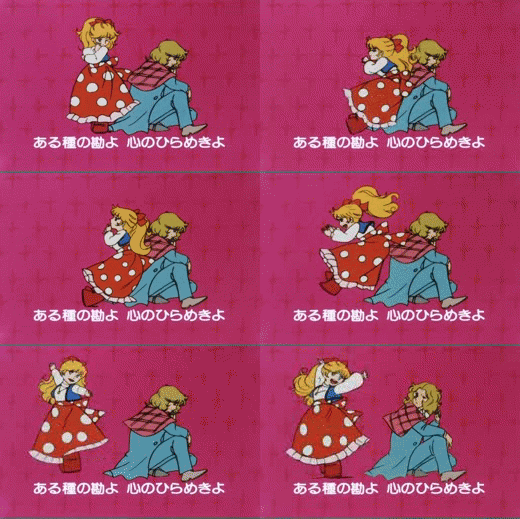
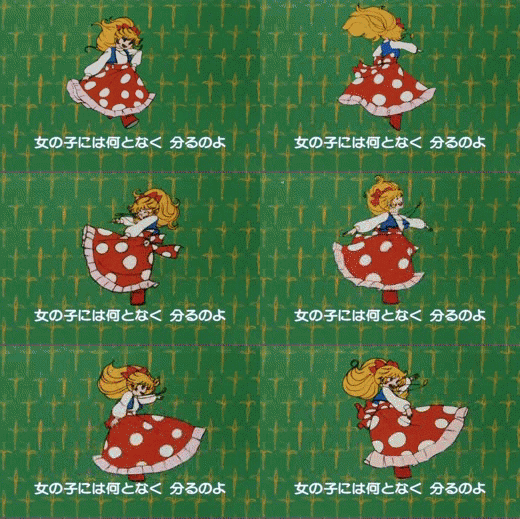
The Function of AKB48 Songs in AKB0048

The anime AKB0048 asks a simple question: “What if the J-pop AKB48 was in the future and its members fought with light sabers?” Essentially another marketing platform for an already extremely popular band, the anime uses a lot of existing AKB48’s songs, most of which are fluff pieces about falling in love or being young girls. The songs are part of their image and have factored into their popular and financial success, but within the context of AKB0048, I find that these same pop songs start to carry a different meaning.

AKB0048 takes place in a future where mankind has colonized space, and during which a movement to ban all entertainment and performance has grown increasingly strong. Successors to the “legendary AKB48,” the girls of AKB0048 fight in order to protect people’s rights to rock out, and in this setting the songs of AKB48 are near-ancient “relics” passed down through the generations. No longer acting as the supposedly genuine expression of young girls’ thought and feelings, the songs are “weaponized” within the context of a guerilla movement to restore entertainment in the universe. The songs act more like representative anthems of a better world, not so much in the actual lyrics, but in the way they promote the right to have lyrics so light and fluffy.

AKB48’s songs in AKB0048 act as symbols of change, revolution, and renewal. This is even more apparent when looking at the songs made for the anime. Compare the lyrics below:

First is “Heavy Rotation,” a popular preexisting AKB48 song used frequently in the anime:

I want you!
I need you!
I love you!
The blaring music
Playing in my head
Is on heavy rotation

The words “I love you” dance
Like popcorn
Popping
Just thinking
Of your face and voice
Makes me go crazy

I’m so lucky
To get to feel like this

(translation taken from Kiwi Musume)

Now compare it with “Dreams Will Be Reborn Again and Again,” the 1st ending theme for AKB0048:

The stars shining in the night sky
are billions of light-years away
Even if the deep despair
turns into endless darkness
The truth will be passed on
Who will be the one to accept
its message of light
that is entrusted to the flow of time?

People will be born
People will die
The flesh is mortal
What resurrects
from its ashes
is passion
that goes to the next generation

(translation taken from Words of Songs)

The lyrics writer for all of the AKB48 songs, as well as “Dreams Will Be Reborn Again and Again” is the famed AKB48 producer Akimoto Yasushi, so it’s not like AKB0048 is divorced from the creative forces which govern the actual band. Suffice it to say, however, the songs from the “future” seem cut from a different cloth than their predecessors, and this changes the meaning of “pop idol group,” at least for the anime.

It is difficult to regard the fictional group AKB0048 as simply girls who desire fan support within a specific section of the music industry. The girls begin to embody values beyond music, youth, and sexuality, such as social and political potential. Granted, this isn’t too surprising, seeing as the man directing AKB0048 is the creator of Macross. Kawamori Shouji has decades of experience in creating anime about pop idols changing the world, though I actually feel that the usage of pop music in AKB0048 surpasses Kawamori’s more established work because of the more thorough incorporation of the very idea of popular music into the anime’s narrative.

With the criticism and controversy surrounding AKB48 as a pop idol tour de force and all that it entails, the existence of AKB0048 is a curious thing. Is it in support of that system, does it go beyond, or does it sit somewhere in the middle? Is the “ideal” of AKB0048 different enough from the constructed space of AKB48 that it can be considered something more?

Straight Title Robot Anime, or, MIKUBAIN: LET’S GET SILLY

In a previous post, I had likened the bizarre 3dcg anime gdgd Fairies to an Adult Swim cartoon. I still think it’s an apt comparison, and with the new season currently running this only renews my confidence in that description, but what I hadn’t expected was for there to be another anime like gdgd Fairies, especially not one that’s themed around a giant robot future. This isn’t so surprising once you learn that it’s from the same creator as gdgd Fairies, but what’s impressive is that in some ways this new show’s humor is even more absurd.

Straight Title Robot Anime (yes, that’s the title) takes place in a time when humanity has gone extinct and only giant robots are left to fight an eternal war. Living on this Earth are three human-sized female robots who are trying to stop the war by re-discovering mankind’s great invention: humor. In order to accomplish this, they try to figure out what it means to tell a joke and induce laughter, but the concept is so foreign to them that they’re unable to make any headway.

In other words, this anime is actually all about trying to explain jokes, which is classically regarded as humor’s own kryptonite, but amazingly this just makes the whole premise funnier. It’s also animated entirely in the free program Miku Miku Dance, which was created for just the purpose its name implies (animating Hatsune Miku).

If it wasn’t obvious that this show is from the same mind as gdgd Fairies from, the fact that there’s an “improv” section similar to the fairies’ own “Magical Spring Dubbing Lake” should be more than sufficient evidence. In it, the three robots visit simulations of “ancient human locations,” such as a hardware store, and try to figure out uses for the objects found. I’m not sure how they accomplish these scenes, but I imagine it actually involves them gathering materials from those real-world places and then having the voice actors engage in prop comedy. Here, not only are the voice actors unable to keep up their acted roles and break down into their normal voices, but one character goes from having a very artificial BEEP BOOP I AM A ROBOT voice to having a natural cadence which not even an electronic voice distortion can fully hide.

Most telling of all is the fact that, despite the show being premised around the idea that the robots do not understand what it means to laugh, the robots in this sequence are giggling constantly. The narrator nonchalantly explains this as “interference,” invoking that old Mystery Science Theater 3000 mantra, “It’s just a show; I should really just relax.”

So that’s Straight Title Robot Anime. In my opinion, the humor isn’t quite to the level of gdgd Fairies yet, but its appeal is such that if you liked gdgd Fairies you’ll probably enjoy this too. However, if your only response to the fairies was revulsion then this show won’t help either. These really are both love it or hate it shows, as is evident from the comments both anime received. You can experience Straight Title Robot Animegdgd Fairies 2, and the angry comments these shows tend to get, on Crunchyroll.

My Article on the Anime of 1977 at “The Golden Ani-Versary of Anime”

The “Golden Ani-Versary of Anime” is a collaborative effort among bloggers, fans, and experts of anime to celebrate the 30th anniversary of anime on television. Coordinated by one Geoff Tebbetts, the plan is to have one article per year from 1963 and the debut of Tetsuwan Atom all the way up to 2012. I’ve included below an excerpt from my entry on the year 1977.

angie-predance

The year 1977 is something of a contradictory time in anime. Although the industry at this point was at the beginning of an animation boom and had been firmly established for over a decade, it can be difficult to pinpoint the exact level of experimentation vs. continuation of formulaic trends, simply because in many cases the individual works of 1977 featured both.

The ’70s were the golden age of giant robot anime, and with six super robot-themed anime debuting (as well as five holdovers from the previous year) 1977 was no exception to that trend. Somewhat unfortunately for the robot anime of that year, the legendary arrival of Mobile Suit Gundam in 1979 tends to overshadow them as a whole, but while nothing in 1977 broke the mold as Gundam would, there were a few series which pushed that mold to its very limits. These shows managed to convey new and interesting ideas while working well within established convention, an impressive feat in its own right.

Continue reading “1977: Conventions and Innovations”

1977-petiteangie3a

Delicious Rate 300%

Didn’t Quite Go the Distance: Eureka Seven AO

It’s fairly common knowledge that sequels aren’t the easiest thing to successfully pull off in entertainment. Even if the sequel ends up being okay, it may not live up to its predecessor because of how iconic moments and innovations can start to become formula (having to fit “Yippee-ki-yay, motherfucker” into every Die Hard for example), or plot points from the first in the series have to be modified in order to cater to the new version. Whenever I watch a sequel, I’m aware of how daunting this mountain can be, and try to take into account those problems even if they ultimate are my criticisms. This is the approach I took when I heard that Eureka Seven, one of my favorite anime ever, was getting a sequel, but even with an open mind I felt that Eureka Seven AO not only paled in comparison to the original but was in certain ways a regression of what Eureka Seven had done.

Eureka Seven AO is billed as a direct sequel, as opposed to an alternate universe/retelling like the movie or the manga. The story centers around a young boy named Fukai Ao, who lives in the independent nation of Okinawa, and for whom life is difficult because of the way the community tries to ostracize him. In this world, the skub (or scab however they want to spell it this time), are considered a problematic natural disaster, especially because they bring with them mysterious monsters known as “Secrets,” which Ao ends up having to fight. For anyone who’s seen the original, the fact that the world of AO consists of real-world countries and continents is meant to imply that something is very strange or different about its setting, and trying to figure out just what in the world happened becomes part of the initial intrigue of the series.

When I say “regression,” I’m not referring to retcons or weird developments in AO‘s plot which cast a different light on the original’s events, but a regression of what mecha anime is capable of. Eureka Seven took an approach which let viewers explore its world through a cast of engaging, fleshed-out characters and a central love story developed gradually over the course of many episodes, and which anchored the narrative in such a way that the emotional excitement of the series builds up continuously throughout. It’s not altogether unique to Eureka Seven, and you can probably trace this style of show all the way back to Macross.  Eureka Seven AO, on the other hand, feels more like a mediocre 80s mecha anime, more keen to develop its story as a set of vague mysteries and tensions but never entirely delivering on any of them. It’s not just that the plot is worse, but that it ends up resembling the way a staunch non-fan might look at and describe their idea of a Gundam anime.

What Eureka Seven AO does have, at least initially, is a strong cast of characters with plenty of potential as to how they’ll develop, but much of it never comes to fruition (though the brief glimpses at Ivica’s character and past were things I enjoyed in particular), or if there is a development the lack of impact from the rest of the series lessens the overall effect. In particular, AO never manages to have its story properly focused by something like Eureka and Renton’s romance,  and though it didn’t have to necessarily be “another romance” (which might have well turned it into just a rehash of the original), there was nothing that could properly fill that void. It seems like the closest thing was just the mystery of what happened to Eureka and Renton, the intrigue of which the show feeds into fairly well, but the explanation we’re left with at the end is less than satisfying. And there is the potential for romance at the beginning, as the dynamic between Ao and his friend Haru is cute and gives a good sense of their relationship, but it ends up getting pushed aside. In the end, probably the most interesting point brought up in the show has to do with how the Secrets are treated by humanity, and how it reflects in some ways the way the Skub were regarded in the original Eureka Seven.

If the movie Eureka Seven: Good night, sleep tight, young lovers suffered from having a weak and confusing beginning but then a fairly strong finish as all of its disparate ideas came together, then Eureka Seven AO is the opposite: It starts off strong and with many of the pieces in place to tell something both grand and personal, but its plot and character development are so discombobulated that when the ending finally comes it hits like a drizzle instead of the torrent of emotions that the original provided.

Gamification of Drama

There’s a scene in the old Nintendo Power comic based on The Legend of Zelda: A Link to the Past, where Link and Zelda are finally facing off against Ganon himself, the primary antagonist of the Zelda series. As Ganon has Link and Zelda nearly beaten, Zelda says a prayer and desperately fires a seemingly plain wooden arrow at Ganon, only for the arrow to transform into the legendary Silver Arrow mid-flight and slay the pig demon. The whole notion of the Silver Arrow as Ganon’s one weakness is taken from the video games, but as anyone who has played Link to the Past knows, you don’t need one Silver Arrow to defeat Ganon, but four. Essentially, while there are a number of approaches that could have been taken, in this case the comic dramatizes the impact of the Silver Arrow by having its singular appearance act as the climax of the story in order for it to function better as a narrative.

If the Link to the Past comic is a case of taking a gameplay element and transforming it into a plot point, then the Super Robot Wars games, especially the recent ones, are a strong example of the opposite. Based on the idea of taking robots from actual anime and having them fight together, the SRW franchise is all about the conversion of story elements into gameplay, but the early games were limited by an emphasis on statistics. The result was that certain characters and robots became less useful because they lacked effectiveness in the game itself. There have been attempts to mitigate it, such as creating an original upgrade for one of the robots, such as the relatively weak Mazinger Z into the mighty Mazinkaiser, but recent SRW games, particular the series, have sought to remedy this discrepancy by completely prioritizing dramatic impact over a sense of logic. Thus, not only are the most powerful weapons transformed into attack options, but the most powerful moments in the original anime are given a gameplay function.

Thus, what you see is not simply the robot Godmars’ strongest technique, but a recreation of the moment when Godmars and its pilot Takeru draw upon the last of their energy to deliver a final blow to the main antagonist of their story. The “Super Final Godmars” technique is meant to carry the same weight as Zelda’s Silver Arrow in the comic, only it’s made repeatable throughout the game so it also functions as the Silver Arrow from the video game.

This approach even transcends specific moments in a series, as is shown when looking at how the characters in those robot series are themselves given unique properties to show off their individuality. Lelouch, protagonist of Code Geass, is meant to be a strategic mastermind in his story, and so the game gives him the ability to boost allied units in specific ways which make him best suited for staying out of the front lines and for issuing commands.

What I find interesting about this transformation of plot point into gameplay elements is that the actual end goal of such a function is to invoke intangible qualities by way of tangible mechanics of intangible moments. In other words, in order to give players the feeling of re-enacting those climaxes from anime, the SRW games look at those dramatic moments, figure out how it should impact the game in terms of requirements/damage/etc., but then has to arrange those numbers to best replicate the feelings created by those original scenes. This is probably what makes the original robots which appear in SRW games to have such over-the-top animations compared to the robots with actual source material; they have to add another step to try and convince players that they should be just as into their (at the time) ahistorical designs as they are the robots straight from anime.

Secret Santa: Overman King Gainer is Such a Thing

This post is my latest participation in the Reverse Thieves Secret Santa Project, wherein fellow bloggers anonymously recommend each other some anime and everyone writes a review of one of their “presents.” Given the Christmas theme of the endeavor, it is perhaps all the more appropriate that I review an anime which takes place in a land of endless winter, but really the reason why I ended up picking Overman King Gainer out of the choices I was given is that I had always wanted to watch it but had never gotten around to doing so.

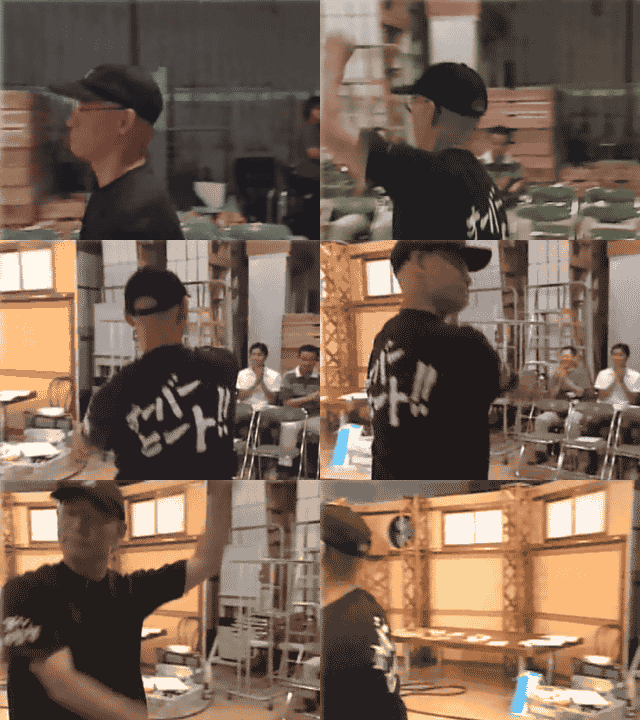
Overman King Gainer is a 2002 anime from the mind of Tomino Yoshiyuki, the famous creator of Gundam. He’s a man with a long history and resume in the industry, and when people talk about Tomino anime, they usually divide them into two categories: Depressed Tomino Anime and Happy Tomino Anime, with the amount of bloodshed and trauma varying accordingly. Featured above is a gif of Tomino during the production of Overman King Gainer; I’ll let you decide which kind of show this is.

At first glance, Overman King Gainer is a strange show, not only because of its extremely catchy opening courtesy of Fire Bomber and JAM Project’s Fukuyama Yoshiki, Gaogaigar composer Tanaka Kouhei, and both characters and giant robots alike doing the Monkey (possibly the show’s most enduring legacy in anime), but because it presents new information about its world constantly and without any prior warning, making the whole thing quite difficult to summarize.

In the future of Overman King Gainer, humanity attempts to survive a harsh and close to uninhabitable planet by living in massive shelters known as “domepoli,” but among the people there are movements to participate in “Exoduses,” mass pilgrimages to lands with potentially more opportunity and resources, accomplished through the use of massive moving cities. The main character is a boy named Gainer Sanga, a video game champion who becomes the pilot of a mysterious organic robot he dubs the “King Gainer,” and who ends up becoming a part of the Exodus despite his objections to it. There is a complex world underpinning the main narrative, but we the viewers only ever get to see a few slivers of the whole, and even into the final episode the show still keeps a lot of its secrets. In that respect it reminds me of Xam’d: Lost Memories, which shares that similar pacing of world-building = plot progression, but much like Xam’d that’s also where a good deal of its charm lies.

Watching this show, I couldn’t help but feel that, more than Ikari Shinji from Evangelion or Kira Yamato from Gundam SEED, Gainer Sanga is the true updated version of classic Gundam hero Amuro Ray. Gainer has this strange introversion to him, as well as an aversion to the situation he finds himself in, but he adds this additional modern otaku element from the way he engages in his gaming. As an aside, the fact that he engages in games instead of tinkering with machinery reminds me that the original Gundam came out in a very different era of video games.

The character designs in this show are excellent, with both male and female characters clearly showing that a lot of care was put into their creation. The designs are full of vibrancy and personality, and though not the sole character designer on the show, the influence of Yoshida Ken’ichi (who would go on to do character designs for Eureka Seven and Xam’d) is both quite obvious and welcome.  I have to wonder what material would have been made for Overman King Gainer had it appeared in a post-Megami Magazine, maybe even post-Pixiv fandom environment. The show has a large number of female characters who seem to have a fair deal of enduring popularity, and I suspect that characters such as the strong-willed Sara Kodama, the spunky child princess Ana Medaiyu, the spy-turned-humanities teacher Adette Kistler, and the eccentric Cynthia Lane would’ve won the hearts of many current fans had the show been made in the last few years.

Tomino is often known for having rather stiff dialogue, and it’s easy to put Overman King Gainer in the same category, but I feel like that doesn’t quite tell the whole story, because it doesn’t take into account for its usage as a comedic element. The awkwardness of the phrasing and the responses they engender from other characters feels like this constant revolving tsukkomi, and when you take that sort of interaction and apply it to a diverse range of characters, including crazy Koyasu Takehito (see current anime JoJo’s Bizarre Adventure for reference), it makes for a fun if confusing anime which exudes a strange sort of energy that’s hard to find in other anime.

Another element of the anime that really stands out from other shows is its mechanical design, which both Yoshida and Yasuda “Akiman” Akira of Capcom fame worked on. The robots in Overman King Gainer come in two categories, the more basic and grunt-like “Sillhouette Machines,” and the “Overmen,” strangely powerful robots with a variety of abilities from invisibility to lightning bordering on the super (natural). Between their organic appearances and elements (artificial muscle tissue in the limbs for instance), as well as their striking appearances, probably the part of the show which most clearly describes the aesthetics of the anime, and that’s putting aside the whole Monkey-dancing thing.

I know I’m talking more about the components of Overman King Gainer than I am the overall feel of the series, and it’s something I normally prefer to avoid when I write reviews, but again I have to point out that the show kind of messes with expectations. Overman King Gainer is an unusual hodgepodge of elements which perhaps shouldn’t work together but do, and it defies categorization in the sense that it’s hard to say whether the anime is extremely straightforward or extremely obtuse, but which ends up being fun and clever.

Super Robot Wars UX is Full of Whippersnappers

A new Super Robot Wars game was announced yesterday, Super Robot Wars UX for the Nintendo 3DS, and the amount of new and unexpected entries makes me want to talk about it, as well as some other SRW-related thoughts.

I think you can roughly categorize Super Robot Wars into two types of games: the flagship titles, and the experimental ones. The former consists of the titles with the best animation and the most-anticipated anime entries into the franchise. The latter can go in a number of directions, from aesthetics (3D models instead of 2D sprites in Super Robot Wars GC) to gameplay (a switch from turn-based to real-time strategy as with Super Robot Wars Scramble Commander), but often times “experimental” simply ends up referring to the titles chosen for that game.

That’s pretty much where UX is. Just look at the debut works for this version.

  • Kishin Houkou Demonbane
  • Fafner in the Azure: Heaven and Earth
  • Wings of Rean
  • Cyber Troopers Virtual On’s Fei-Yen HD
  • Mobile Suit Gundam 00: A wakening of the Trailblazer
  • SD Gundam Three Kingdoms Legend: Brave Battle Warriors
  • Mazinkaiser SKL
  • Heroman

When you include the other titles that are in this game, the first thing that jumps out is just how new most of the anime are. Not only is the Mazinger franchise represented by its latest one-off OVA series, but the actual oldest anime in the entire game (and the only two from the 1980s) are Aura Battler Dunbine, and then Ninja Senshi Tobikage of all things. If it were a flagship title, there would have to be certain staples, but with a “lesser” SRW like this, it’s possible to inject a ton of new blood into it and not offend anyone.

Not only that, but when you look at some of the recent titles chosen for UX, they seem to be among the least likely candidates even among non-flagship SRW games. Brave Battle Warriors is actually an already-super deformed Gundam anime done entirely in 3DCG and based on classical chinese literature, the sort of title one would least expect to represent Gundam even with the fact that SEED Destiny and 00 are there. Though I’m sure it’s based on the anime version, Demonbane‘s inclusion may be the first instance (and correct me if I’m wrong) of a visual novel appearing in SRW, which opens the gate for things like Muvluv Alternative.

Heroman I wasn’t even sure counted as a giant robot anime, though I guess if you think about it, it’s basically a combination of Tetsujin 28/Giant Robo with Gold Lightan (though Gold Lightan has yet to make its debut). Possibly craziest of all is the inclusion of Virtual On in the form of a Fei-Yen dressed like Hatsune Miku. Virtual On in SRW Alpha 3 paved the way for non-anime/manga to appear in Super Robot Wars games, and this takes it to another level, as I’m pretty sure Miku Fei-Yen is nothing more than a model kit!

It might sound like I’m complaining, but I’m really not. I actually love it when SRW games go a little wild like this, though one complaint I do have is that the DS SRW games have never been the most impressive when it comes to animation. My issue isn’t even with the quality of the sprites or an unfair comparison to the exquisitely animated Z series of SRW, but that a lot of the shortcuts taken to try to make the games look better actually end up making them look worse. In particular, I’m referring to the way the DS games including UX incorporate cut-ins, and detail shots. Instead of creating the images to better match the sprites and the visuals of the rest of the game, the DS SRWs basically take screenshots directly from the original anime, and while this means things look accurate, it also sticks out in an odd way and messes with the way the attack animations end up looking in a manner which didn’t quite affect previous games with worse sprite animation.

But it might just be that with a game with this daring of a series list, some things have to give. In that case, I’ll take it, but will still hope for better the next time around.

The Future of iDOLM@STER is Gyrozetter

I have a theory: Chousoku Henkei Gyrozetter actually takes place in the same world as The iDOLM@STER many years into the future. I’m going to lay out my ideas for how this transition comes about while also providing ironclad proof of their shared universe.

1) Inaba Rinne is a Futami Descendant

It’s not clear which of the Futami twins Rinne is descended from, but most likely it’s Mami. It’s not clear just how many generations into the future Rinne is removed from Ami and Mami, but Futami genetics are undeniably strong.

The resemblance is uncanny.

2) The Success of 765 Pro and the Start of the AI Car Boom

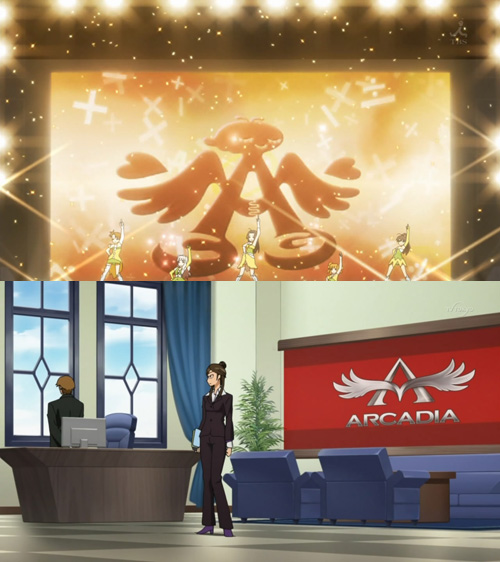
Thanks to a combination of talent, spirit, and camaraderie, 765 Productions becomes wildly successful. At first, they do only promotions for car companies, but thanks to rich girl Minase Iori’s connections and the advancement of technology 765 Pro manages to start their own automobile line. They name the car company offshoot “Arcadia,” modifying their logo along the way.


Assistants to the CEO continue to dress in black suits in honor of Akizuki Ritsuko.

3) Shijou Takane is Responsible for the Rosettagraphy

At first glance, the Rosettagraphy makes no sense. A mysterious stone tablet that tells humanity how to build advanced cars that turn into robots? It sounds like nonsense, until you remember that Takane is equally engimatic, and that she is capable of speaking in many tongues. As we can clearly tell now, it’s because she holds the secrets of not only technological growth but also of prophecy. If she had revealed it to humanity too soon, who knows what would’ve happened?

Takane was a Messenger in Many Ways.

4) Gyrozetter AIs are Actually Based on 765 Idols

How else would you explain this?

I rest my case.

A Boy and His Universe: Turn A Gundam

Gundam is one of the most well-known, influential, and highly regarded franchises in anime history. At this point over three decades old, many changes have occurred in Gundam, but none may be as interesting or so able to fulfill its potential as 1999’s Turn A Gundam. Created to celebrate the 20th anniversary of Gundam and directed by the creator of Gundam himself, Tomino Yoshiyuki, it differs in many ways from other iterations, notably in its setting and aesthetics, but at the same time does wonders with everything it has. It shores up many traditional weaknesses of Gundam and Tomino’s work, and brings a variety of interesting twists to Gundam that don’t just come across as differences merely for the sake of them, resulting in just an all-around strong, engaging, and multifaceted story.

In stark contrast to every other Gundam series in current existence, Turn A Gundam takes place on an Earth with roughly World War I-level technology and social standards. In an age of biplanes and debutantes, the world is flipped upside down when lost descendants of humanity from the moon return to the planet with intentions to emigrate. Because the humans on Earth see this “Moonrace” as alien invaders taking away the land of their ancestors and the Moonrace sees the Earthlings as backwards barbarians prone to violence, tensions rise.

The only things keeping the scenario from boiling over and the Moonrace from wiping out the opposition with superior technology are the fact that the political scenario is not as simple as “Us vs. Them,” and the discovery of ancient and seemingly anachronistic “mechanical dolls” (what the people of the Moon call mobile suits) in the mountains, particularly the powerful and mysterious “White Doll.” Caught in the middle of this conflict is a Moonrace boy living on Earth named Loran Cehack, whose love for both his original and adopted homes pushes him to pilot the White Doll in an effort to prevent all-out war from breaking out.

There are certain phrases thrown about when reviewing anime, such as “character-based,” “theme-based,” “story-based,” and “world-based,” as if these categories are mutually exclusive or even contradictory, but Turn A Gundam is a series which strongly delivers on all these levels and more because of the way all of those components reciprocate with one another. The history of the world shapes the thoughts and backgrounds of the characters, who act within that world to create a grand story with many intricate elements, and it ultimately results in the delivery of certain themes, such as “the strengths and weaknesses of technological progress” and “awareness of history,” by taking a large-scale, global perspective and focusing it through smaller and more intimate character struggles.

This can be seen in the way the series portrays the constant clash of values and beliefs at various levels and between different people, consistently showing how many of the people involved are intelligent or enlightened or even kind-hearted in their own way, but are prone to mistakes due to the limits of their experiences. An archaeologist who cares little for religion and ceremony is so intent on digging for the sake of knowledge that he ends up exacerbating the conflict between the two sides by uncovering powerful military technology. Politician characters possess the negotiation skills and long-term thinking necessary to balance out their followers’ shortsighted and hotheaded reactions to the deaths of their comrades, but their high ambitions blind them to their own misdeeds. Qualities praised in soldiers, such as valor and daring, become problematic in the face of dangers well beyond their comprehension. As such, when these characters and many more sabotage themselves it comes across as perfectly understandable.

The cast of Turn A Gundam is absolutely gigantic, but it never comes across as too unwieldy for the show. Civilians and soldiers alike are given proper time and elaboration, and it really makes Turn A Gundam feel like a comprehensive world populated by real people. Loran is a gentle soul, but not one whose desire for peace prevents him from taking action, and over the course of the series is simultaneously built up and torn down by events both within and out of his control. Dianna Soreil, the leader of the Moonrace, is beloved by her people, but must deal with not only the difficulties of being opposed by Earth militias but also political infighting on her side. Her personal bodyguard, Harry Ord, is a loyal and admirable man, but one who over the course of the series shows how he is not blind to deception or his own feelings. Neither of Loran’s companions from the moon, Keith Leijie and Fran Doll, are soldiers or anything close to it, yet their stories about trying to start new lives on Earth are just as strong.

The Heim sisters, the adopted family of Loran (pictured in the middle below), or more accurately, the masters he works for as a servant, probably grow the most in the series. The tomboyish Sochie (left) must deal with her prejudice and anger against the Moonrace, while Kihel (right) and her uncanny resemblance to Dianna puts her in a situation central to the story, where she must push her already clever mind to its limits. Even extremely minor characters exude a sense of place in their world, and in some cases a lack of sense of place actually winds up becoming a strong defining trait in and of itself.

Also contributing to the strength of the show’s cast is the fact that the romance is actually extremely well done. Traditionally this has been a weakness of Tomino’s anime, particularly in the Gundam franchise because it is often ran through at an accelerated rate so that it can be a plot point or cause for tragedy, but Turn A Gundam manages to provide relationships which grow organically over time, particularly the two most prominent ones in the series. In these cases, the characters don’t so much have a moment where they Fall in Love, but rather as you watch them you see how they grow closer. Even the relationships which are a little more fast-paced are given reason in the series itself: in a situation like war, people start to think about their own mortality and regrets.

Possibly one of the reasons why the romance comes across so well is that many episodes are devoted primarily to showing people living out their lives amidst the backdrop of war, what might be deemed sillier episodes but which work to build the characters further. For Loran in particular, he is able to show how the White Doll, the titular “Turn A Gundam” as is revealed later, can function as more than just a weapon of destruction, and even the instances where he ends up having to crossdress (apparently an enduring legacy of Turn A if fanart is any indication) becomes both a plot point and a hint for later character development. War is shown as both the forefront and the background depending on the episode, and it creates a more robust setting as a result.

One topic that is difficult to avoid when discussing Turn A Gundam is the aesthetics of the show because of how the series visually sticks out among its fellow Gundam anime. Central to this is the fact that the Turn A itself is a far cry from the traditional Gundam design, and I remember that back when the series and its visuals was first announced there was a backlash against it. Designed by American Syd Mead (Blade Runner, Tron), the style of the Turn A, with its signature white mustache and strange angles, seemed to go against the image of Gundam that had been cultivated over the years. Even over a decade ago I jokingly photoshopped the Devil Gundam from G Gundam onto a Turn A Gundam head and called it “The Ugliest Gundam Ever.” But now, my opinion of the Turn A Gundam is that it not only looks good, but that it fits the role of a Gundam far-removed from those that have come before it. Over the course of the anime, the “White Doll” plays many roles and carries with it the question of to what degree can we break from the past, and this break in design says a lot in and of itself.

What’s even more impressive to me, however, is that each of the robot designs in Turn A are strikingly different from one another in a clear manner even, I would argue, when the person watching doesn’t have a particularly keen eye for mecha. The ostrich-like WaDOM looks nothing like the “muscular” Sumo, and even when it shares the same color scheme as the WaD their sheer difference in size makes it plainly obvious which is which. At the same time, the mobile suits of the Moonrace share a certain similar aesthetic quality which unites them thematically.

Compare this with the mobile suits of Zeon in the original Mobile Suit Gundam, where even though there is a clear direction for enemy design, it can potentially be difficult to tell a Gelgoog from a Zaku from a Dom, or from a later series like Gundam W or Gundam 00, where the “Gundam design rules” mean the differences are primarily in little details like weapon types or color schemes or what sits on their backs. With Turn A Gundam, even the retro Mobile Suits found over the course of the series by the people on Earth are so different from each other and everything around them that they gain individual identities all over again.

Like the mobile suits, the characters have a particularly strong pedigree somewhat outside of traditional mecha anime, as the character designer for Turn A Gundam is Yasuda “Akiman” Akira, a man known for his work on the Street Fighter franchise, particularly the creation of Chun-Li. Also like the mecha, the characters and animation for the series don’t seem to carry the best reputation, often times regarded as “okay” or “serviceable” due to the simplicity of the designs, but in my opinion the character designs are excellent.

The designs are deceptively elegant, and that “simplicity” gives me an impression similar to Yasuhiko Yoshikazu’s original designs from the first Gundam. Careful attention is paid to details such as clothing and hair without going overboard, and even the sparse shading contributes to a more refined and subdued look. Much like the mecha, the characters all stand out uniquely at a glance, with one notable (and intentional) exception in Kihel and Dianna.

If I had to describe Turn A Gundam using other anime titles, I would say it has the thematic elements of Panzer World Galient, half the grandeur of Legend of the Galactic Heroes (which keep in mind is still a vast amount), and characterization on the level of Eureka Seven. The show is amazing. It’s gripping in a way that shows Tomino at his finest, with its balance of heavy elements with a sort of lighthearted whimsy which also manages to enrich every aspect of the story, its characters, and its ideas. As I finished Turn A Gundam, I could feel it taking over my thoughts and emotions. It’s amazing, and I can’t get it out of my head.