Kio drew his first original 18+ doujinshi, called It’s All Your Fault, Sensei, which is now available on FANZA and DLSite under the circle name ぼたん堂. Content note: It is futanari on cis girl, and in terms of depictions of sex goes well beyond anything shown in Spotted Flower.
Those who have been following Kio’s Twitter account might recognize one of the girls, as he drew an earlier version of her around the New Years in a bunny outfit.
Kio mentions that had he wanted to draw what happens between Sasahara and Ogiue on the couch, it would have been “something similar,” though the original tweet has been deleted, so it’s not clear if he’s referring to his doujinshi or the fact that Not-Sasahara and Not-Ogiue are in bed together in the side chapters.
A doujinshi cover of Ritsuko from Genshiken Volume 1.
From Genshiken Volume 4, reviews of different routes in the Kujibiki Unbalance visual novel. Madarame reviewed Renko’s, Sasahara Ritsuko’s, Tanaka Izumi’s, Kugayama Kasumi’s. Kio agrees with a commenter that Ootani Ikue (voice of Pikachu) fit the character perfectly.
According to Kio, drawing ero manga is sort of the opposite of regular manga, and that’s what made it tough for him when planning it. In regular stuff, his thought process is paneling -> text -> art, but for pornographic stuff it’s art -> text -> paneling.
I’ve been thinking about what I call “safe yandere,” or alternately “yandere aesthetic.”
Yandere character fetish feeds off many things. The notion of a character who’s so in love with another that she turns into a crazed axe murderer (and that this is a good thing!) is at the same time obvious and complex. It’s a realm of fantasy that, in my estimation, works by essentially being so hyper exaggerated as to feel real—like how food for astronauts is made extra spicy because the sense of taste is dulled in space.
Because yandere characters come primarily from media like anime, manga, and visual novels, there are many visual shortcuts to convey that quality. The thousand-yard stare, the creepy smile, the icons of sadism, and so on make portraying a yandere in a single drawing perfectly possible. What this also means is that this aesthetic can be extracted and placed onto characters who aren’t necessarily trying to trap their significant others in cement so that they can be together forever.
The first example that stands out to me is Jabami Yumeko in Kakegurui. She has all the visual hallmarks of a yandere, except she directs that primal energy towards the art of gambling instead of a person. She doesn’t take pleasure in hurting others so much as she does mutually experiencing the torrent of emotions that stir when everything is on the line.
Another is the teasing girl. They’re not exactly yandere—more like a midway point between that and tsundere—but they can serve a somewhat similar function. Nagatoro might be the most well known at this point, and her sneers evoke a kind of pain/pleasure combo that aligns with the general yandere for vibe.
The last example actually comes from the world of VTubers. The Hololive zombie girl Kureijii Ollie has a visual presentation that is very reminiscent of yandere, especially in the eyes, but her personality is far from it. I suspect that this contrast is part of her charm, though, and a reason she’s so popular. Incidentally, another Hololive member, Ceres Fauna is sort of the opposite: Her appearance is gentle but her words and demeanor can get yandere, especially in ASMR streams.
I don’t think separating out the visual component of yandere is a bad thing—far from it, in fact. It gives people the opportunity to assess themselves and what they enjoy, allowing for greater personal discovery. It also reminds me a bit of what has happened to the concept of vampires. Some people just want a specific sub-flavor of hotness, and that is okay.
I don’t know if we’ll reach a point where the definition of yandere has fundamentally changed and it goes towards the safe yandere. I doubt it, given the continued popularity of characters like Toga Himiko from My Hero Academia. But like so many things, I’d rather people be able to remember that this transformation has occurred rather than wholly adhere to some specific definition. History is important, even that of the yandere.
(And technically, all fictional yandere are safe precisely because they remain in the realm of fiction. Though that does mean VTubers can blur that line…)
April is cherry blossoms in Japan, and their fleeting nature is associated with an aesthetic valuing of the ephemeral in Japanese culture. I normally don’t get all poetic about it, but recent events have me reminiscing and feeling the passage of time. One month after the death of Matsumoto Leiji, one of my favorite character designers, Kimura Takahiro, passed away. Ash Ketchum is being retired as the lead of the Pokemon after two decades. Not one but two VTubers are graduating: Heavenly King Mirai Akari and Pikamee Amano, one of the lights of the early COVID pandemic. And just today we learned that Sakamoto Ryuichi of Yellow Magic Orchestra passed on the 28th of March—the second member to go this year after Takahashi Yukihiro.
March has been a big month for Kio, as Spotted Flower Volume 6 just came out today, the 31st! Not only that, but he’s been posting lots of high-quality art from the original Genshiken run, particularly about Kujibiki Unbalance.
Front and back covers of Spotted Flower Volume 6. Like all volumes, the underjacket cover features the characters in their underwear, and you can just barely see it peeking through.
Clean version of the title page image for Genshiken Volume 3.
A commenter talks about how the line “You have a nose hair sticking out” comes to mind. Kio replies that such a line would be in a Saki route, and it would lead straight to a Bad Ending.
A model kit of the Knight of Gold (K.O.G.) from The Five Star Stories that Kio built. When asked if the kit is lacking a Buster Launcher (a standard weapon in that universe), Kio replies that there actually aren’t many design specs for the K.O.G., and modelers had to use their imagination to make these kits. Likely, the K.O.G. doesn’t have a Buster Launcher because it would need a counterweight to balance it.
Genshiken Volume 3 extras: Artwork from Unbalance Fighter, a fictional Kujibiki Unbalance doujin fighting game. Kio notes that while Berserk Tokino is based on Berserk (Orochi) Iori from King of Fighters, all her attack names are based on NECO from the game Zero Divide.
The strategies as they’re written in the volume are inspired by the guides from the magazine Gamest.
Starting from here are “screenshots” from Unbalance Fighter. Here is Renko and Yamada vs. President (Ritsuko). Supposedly this isn’t an unblockable, but it is an incredibly strict high-low mixup.
President vs. Shinobu-sensei. Ritsuko’s fighting style isn’t based on a fighting game character, but rather Jhons Lee from Air Master. Kio is an Air Master fan.
Renko and Yamada vs. Lisa. This is an animation frame from Lisa’s “Coin Toss” attack. A commenter mentions that they used to play a lot of fighting games (like KoF ‘94) but not anymore. Seeing the fine details of Kio’s explanations takes him back, though. Kio responds that the depth of the characters is based on SNK, and that he owned a NEO-GEO. However, the animation impact is Capcom-esque.
Lisa’s super being performed on Kasumi. As mentioned in Volume 3, Kasumi loses a lot of her abilities if she gets grabbed as a way to be lore-accurate at the expense of game balance (Kasumi basically faints if she gets hugged).
A commenter replies that in the modern era, broken stuff in fighting games gets patched, and this probably wouldn’t last. Kio replies that because Unbalance Fighter is a doujin game, it might have gotten a patch at some point.
The title page image for Genshiken Chapter 18, which was later turned into a jigsaw puzzle. Kio tried to fill it with as much stuff as possible to make it good for a puzzle, but he feels like the results were iffy. One fan shows their completed puzzle, and as noted by another, it originally came in the Nov 2003 issue of Monthly Afternoon.
A fan recalls that the figure version of Ohno on the TV from Volume 3 was from a Wonder Festival. Kio replies that he has the entire series stored somewhere.
Kio is starting to build another kit: the Demi Trainer from Gundam: The Witch from Mercury. It has three sets of runners and no polycaps. He’s also resisting the urge to start filing things down right away.
Kio’s progress on the Demi Trainer. His comments are basically marveling at the quality and advancements of current Gundam model kits, including the lack of need for polycaps (which used to be the standard for kits in the old days).
“Sprites” and “backgrounds” for Unbalance Fighter. Someone in the replies comments that all this fine and detailed work shows how much love Kio put into it, and they’re glad to know that he had fun drawing it. Kio responds that “youth” was also a big factor.
Spotted Flower Volume 6 will have exclusive illustration cards at six different stores in Japan. (For the record, I plan on getting the one at Toranoana).
The illustration from the cover of Genshiken Volume 4. Someone in the replies says that her wearing a mask feels like this picture is happening in real time, and Kio says he has the same thought.
In response to a hashtag prompt, artist and character designer Kotobuki Tsukasa shows a drawing of his from 30 years ago: a manga titled Go Go! Our Marbet-san, from his Victory Gundam short story parody series. Kio mentions having this book all this time.
It can sometimes be a struggle to explain why Chainsaw Man is so good, even to those who have become fans of it through the anime. It’s as if they’re eating a peanut butter cup and going, “Wow, this chocolate is good!”
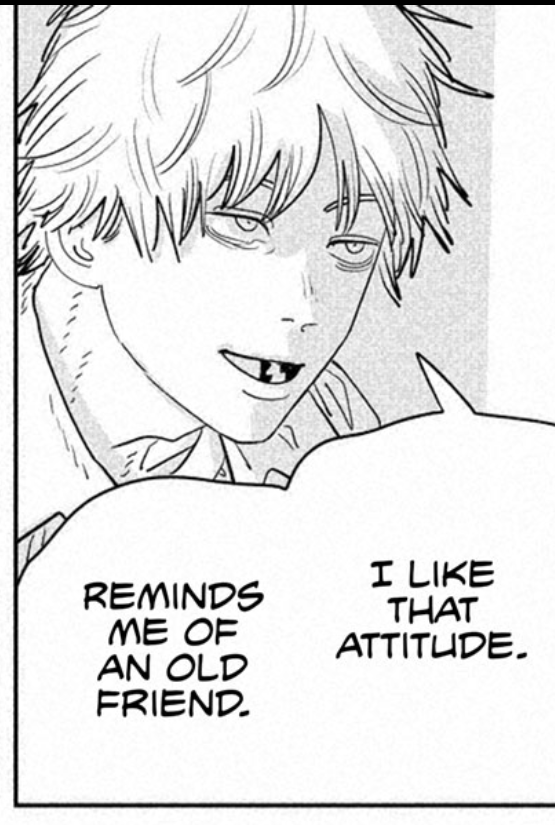
But recent chapters of the manga have shown just how much Denji’s journey has changed him when we see Denji talk about Power, as well as his interactions with the character Nayuta.
MANGA SPOILER WARNING
Part 2 of Chainsaw Man has been fun, especially between having a new perspective character in Asa and the way Denji keeps trying to “accidentally” reveal that he’s Chainsaw Man. The guy is still pretty shallow and dim, but then he starts talking to Asa about a “good friend” he knew, and his words carry a tone both mournful and joyful. Over time, his bond with Power became genuine and full of caring, and the weight that comes with his current maturity can be felt.
Then, when you see him interact with Nayuta (the new Control Devil after Makima), that feeling only multiplies. Denji in Part 1 thinks mostly about himself—a product of his upbringing as an orphan surviving on scraps—but here, he has responsibilities as Nayuta’s guardian. From the little bits we can see of their relationship, he knows full well how dangerous the Control Devil can be, but behaves like a mix of dad and big brother in order to get Nayuta to listen. Hearing “I’ll only revert my transformation of this girl’s psyche into a dog’s if you let me eat ice cream every day” and replying with “Fine, but only if I get to eat some too” sums up how Denji negotiates with her. He’s no paragon of virtue, but he tries to make sure Nayuta does the right thing by treating her practically as a peer.
Given all of Denji’s trauma before and during the events of the manga, I see his attitude towards Nayuta to be a desire to not repeat the same heartbreaking mistakes, especially for Nayuta’s sake. Flawed as Denji is, including morally, he doesn’t want her to feel the pain of loneliness on the scale that he, and even Makima, knew all too well. Denji’s doing his best to set a good example, and seeing the odd contours of that attempt speaks to a profound personal growth.
The end of last month hit with some tough news as the world learned that Matsumoto Leiji had passed away at the age of 85. I’m still thinking about what an end of an era that is, and I’ve been spending time with his works. In addition to finally watching more Space Battleship Yamato 2202, I decided to revisit my favorite anime of all time, 1979’s Galaxy Express 999. It’s as gorgeous as the day I first saw it.
This month’s Kio Shimoku tweets are a real treat, as he’s been posting a bunch of old Genshiken art without any text, including at least one piece that’s never been released widely see above)! Genshiken was also trending on Japanese Twitter thanks to being spotlighted on a TV show!
On Duck King’s birthday, Kio mentions that he used to play Duck King. He could do Duck King’s command throws from jumping or out of a block, but never from standing.
In response to a Kim Kaphwan player, Kio refers to Kim as a “demon.” Another commenter replies with “Obenjo Baby!” (Toilet Baby)—a mishearing of one of Kim’s attacks. Kio jokingly says he never could figure out what Kim was saying, so he’ll accept this interpretation
Kio bought a Playstation 5 and Elden Ring despite a lack of free time. He also wants to try SEKIRO.
A long-time fan asks him to please not die without releasing any new works because he was playing nothing but Elden Ring. Kio says he’ll be careful. (Others in the thread do not mind encouraging him to play more.)
Kio accidentally misplaced some parts for a model kit. Manga artist Ikuhana Niiro and Kio talk about how this sort of thing makes them grateful for the quality of Gundam kits.
Kio showing the parts he’s built. When asked if this is a garage kit, he says that it’s technically an action figure kit Kaiyodo used to sell, but it’s functionally a garage kit.
Kio built one of the kits from the box in this older tweet: Knight of Gold from The Five Star Stories. It turns out one of the parts that went missing earlier is actually for this.
Kio learns that Genshiken is going to be on the TV show Sukkiri the next week, on the segment “Hot Comic.” He’s excited about this, and naturally receives a bunch of congratulations from fans (too many to list in this post).
I will make an exception for this one person who says they love Ogiue and Sue. Kio responds “OgiSue! ……Or Sue/Ogi?”
Kio has been so busy with Spotted Flower and other things since the end of last year that he hasn’t had time to work on his ero manga project. Even though it’s the same amount of work that he had when doing a monthly series, it somehow feels unsustainable these days.
Kio posts this old drawing of Madarame and Jin, to which someone responds that they wish they could see both Genshiken and Hashikko Ensemble continue. Kio thanks them, and says he’ll continue to work hard on Spotted Flower.
Another older drawing, but this time someone shows Kio that they have the hot-spring bathing Ohno bust that came free with an issue of Monthly Afternoon. Kio calls it a fine product.
An Ohno fan says they loved Ohno so much, they ended up with a girl like her, and that Kio is responsible for this “severe” crime. Kio jokingly says that’s unforgivable.
A fan mentions that he used to be embarrassed to say the word eroge before Genshiken. Kio replies that they actually checked if there was any issue using it for the anime, and the response was “none at all.”
Kio finished watching Sukkiri. He jokingly equates hearing all the old lines he wrote 20 years ago to humiliation fetish play, and says he’s happy to see it regarded as a story not merely about otaku but about human beings.
Kio feels the depiction of otaku in media has changed since then.
Director Mizuhima Tsutomu (Girls und Panzer, Shirobako) mentions working as staff on the first Genshiken anime and the Kujibiki Unbalance stuff in there. He also worked on the Kujibiki Unbalance light novel as part of the group called “Yokote Michiko and Her Pleasant Companions.” (Yokote Michiko is a writer who’s worked on Genshiken.)
Singer Atsumi Saori talks about how if it weren’t for Genshiken, she wouldn’t have wrote the ending theme for it, “Biidama.” She’s grateful to the series for that reason.
Kio thanks her back, and talks about how he likes the fact that the song contains both happiness and sadness.
Manga creator Shikizawa Kaya describes Genshiken as if actual real people were chiseled and dug out for it. Spotted Flower uses an even sharper chisel, and results in something very thrilling. Kio responds with gratitude.
A fan didn’t realize that the name Genshiken Nidaime is in part a reference to the second club president. I.e. Madarame. Kio responds that this was one thing he considered when naming the series.
A Japanese model, Ikeda Miyuki (aka Michopa-san) said something along the lines of it being weird to experience works from an era before the concept of otaku had proliferated in the culture. Kio agrees.
Kio thanks the host of “Hot Comic” on Sukkiri, actor Okayama Amane, as well as the staff for talking about Genshiken.
He then promotes Spotted Flower by calling it “What-if after-story, or maybe a spin-off, or maybe a parallel world—even the author isn’t sure.” He then shows the above drawing of Not-Sue and Not-Ogi and says “Characters like these show up.”
The cover of Genshiken Volume 8. Also, it turns out that my Twitter mutual and fellow Ogiue fan Noori actually went to the spot referenced in the cover! Kio thinks that’s probably the place?
Kio responds with a “Nice!” to someone telling him that they grew up wanting a senpai like Madarame, and eventually found one after they started working.
Ritsuko from Kujibiki Unbalance in a school swimsuit, from the back cover of Genshiken Volume 2. When shown a sealed figure of the same character, Kio points out that the figure in question is based on an illustration by Yagumo Kengou (who illustrated the light novels, and was later in charge of the designs for the anime).
A commenter mentions to Kio that the Midnight Blissed version of Hydron (Nool) from Capcom Fighting Evolution is clearly based on Ritsuko from Kujibiki Unbalance, and not only does Kio know that, but the artist who made those drawings has also made a Ritsuko doujinshi.
Title image from Genshiken Chapter 9. Kio notices that the colors seem different on Twitter compared to how they actually are, and one commenter replies that it might be because they need to be converted from CMYK to RGB for viewing on screens. Kio realizes this is the case and proceeds to repost many of the earlier illustrations.
Kio bought a plastic model of Super Sasadango Machine, a wrestler from the comedy wrestling company DDT. He’s a parody of Super Strong Machine from New Japan Pro-Wrestling.
Kio explaining about how the first anime had a special addition with the Kujibiki Unbalance OVAs, and this is what led to Director Mizushima helming the TV series.
The cover art of Genshiken Volume 3. Kio also replies to a commenter talking about how he thinks the quality of the old Genshiken trading figures is really high for how small they are.
It’s been many years since the late-2000s peak of the tsundere archetype, when the girls with prickly personalities all but captivated anime and its fandom. I was no exception to this—while I don’t consider myself a huge tsundere enthusiast, many such characters are included among my favorites. But as their novelty has aged into a well-worn trope, I’ve found myself almost forgetting how potent they can be in terms of the emotional force they exert upon fans. What‘s more, the reminder I needed was to realize how much has changed in my own life.
In certain ways, I’m not who I was 15 years ago. Mentally and emotionally, I’m in a different place, no longer constantly doubting whether my social awkwardness would ever keep me from connecting to others. However, I can recall what that felt like, and the crushing fear that it might never be overcome. And I can also recall the amazement and comfort I felt seeing characters who had similar struggles. This is essentially what led me to becoming so fond of Ogiue Chika from Genshiken and naming this blog after her. Her fight with herself felt so very real, even if it wasn’t exactly what I was going through.
It’s arguable whether Ogiue is a tsundere, but one can think of tsundere as characters who face a similar conflict between what they feel inside and how they wish to express themselves, but also boiled down to a powerful essence. There is a difference between the old-school and new-school tsundere (a distinction that’s quite long in the tooth these days), but either way, it is an easily digestible personal trait that can be eminently relatable. To see a tsundere lash out is to see a character fight within in a clear and distinct fashion.
You might hear someone say “I wish I had a tsundere partner,” and they could mean that they want someone straight out of anime—a crystalization of a fetish. But they might instead mean “I want someone who understands me because they face similar challenges.” It’s in the ability to occupy both spaces that the tsundere is strongest.
I originally did not intend to bring up Ogiue, but the more I thought about it, the more it made sense. Not only does she skirt the kind of tsundere, but she’s also been portrayed as growing out of the inner turmoil she carried when she was first introduced. She is no longer the same person, and it’s reflected in her personality and even her visual design, but I still love the heck out of her character. Even though the severity of anger and awkwardness she carries has waned, the struggle was undeniably there, and its marks are noticeable. The tsundere is powerful because of how succinctly they capture a variety of heavy feelings in a digestible fashion, and it would behoove me to keep that in mind.
In the past few years, I’ve developed a terrible interest in reading and viewing arguments about martial arts, from kung fu to MMA and beyond. There’s a combination of established knowledge, lost knowledge, myths and legends, fraudsters, hero worship, dick-waving, differing philosophies, and genuine curiosity that makes it a weirdly compelling shit soup. During these trawls, I occasionally see an argument that goes something like “If their kung fu is so great, why don’t they prove it in the ring, and also make a ton of money?”
But what I was surprised to find is a response of sorts to that question in the pages of the manga Mashle—a series that asks, “What if Harry Potter was a non-magical himbo who overcame all obstacles through comically absurd physical prowess like Saitama from One Punch Man?” Not only does Mashle do a surprisingly good job of addressing the inequality inherent in its world, but it also cuts through expectations in other ways too, including how and why people learn to fight.
It’s important to note that con artists are a dime a dozen in the world of martial arts. It’s the realm of claims of supposed no-touch knockouts, poison fists, and chi energy. Even when you put such ridiculous “feats” aside, there are plenty of generic schools that are justifiably derided as “McDojos” or “belt factories,” essentially teaching nothing of substance. Because of this, many have reasonably become skeptical towards anyone who purports to fight with superhuman abilities. Asking for real proof makes sense, but there’s this peculiar jump in logic I see sometimes, where “prove it in the ring“ becomes “doesn’t everyone want to prove themselves?”
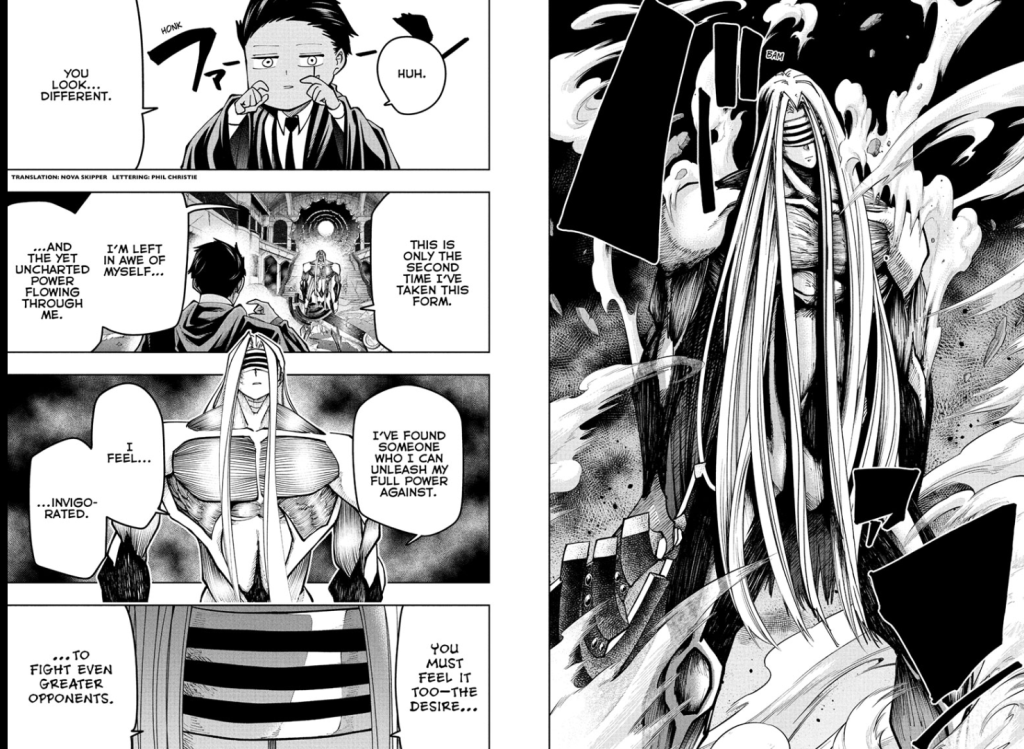
That’s where Mashle and its hero, Mash Burnedead, come in. During one of Mash’s most fearsome battles to date, his opponent says, “I’ve found someone who I can unleash my full powers against. I feel…invigorated. You must feel it too—the desire to fight even greater opponents.”
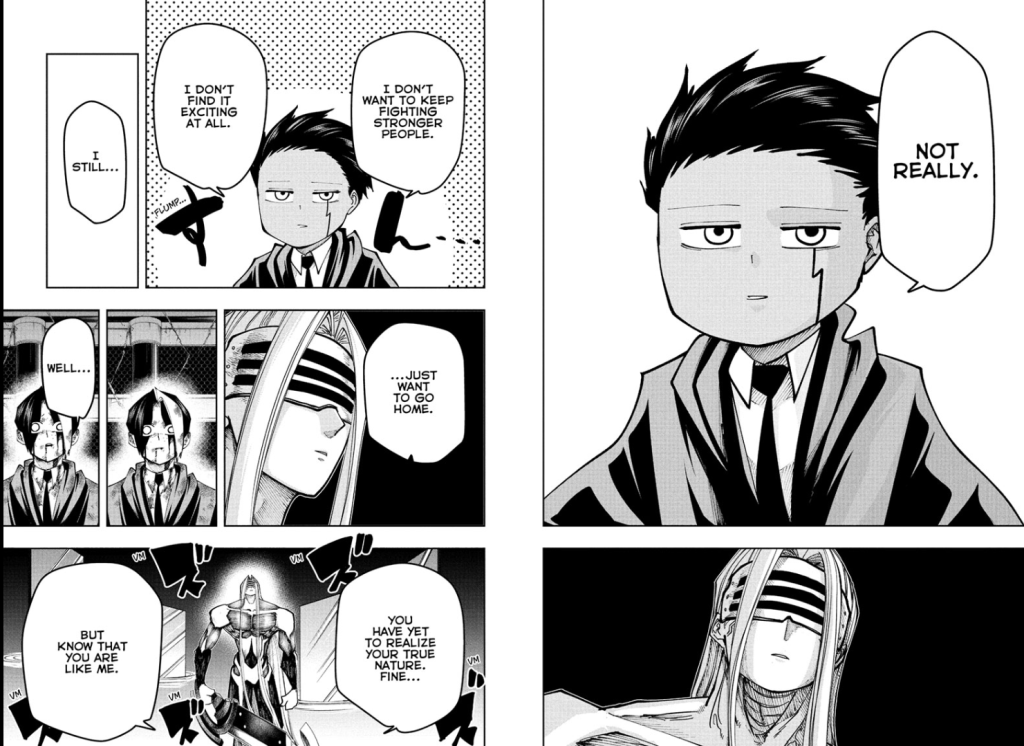
To which Mash responds, “Not really. I don’t want to fight stronger people. I don’t find it exciting at all. I still…just want to go home.”
This whole scene is a brief gag in a larger action scene, but Mash’s answer is a succinct counterpoint to the notion that everyone who truly learns how to fight has this killer instinct they need to unleash upon the world, whether for profit, fame, or to prove something. It actually takes a particular kind of person to want to willingly get in harm‘s way in order to show the world what they’re capable of.
One of the martial arts videos I‘ve watched (see above) is from an instructor on Youtube named Adam Chan, about the Hakka fist. As Adam explains, the Hakka are an ethnic group in China who were historically very poor and had to migrate a lot, and the various martial arts they developed came from civilians needing to survive against prejudice and xenophobia rather than as part of an army or in order to engage in duels. This is where Mash is: he didn‘t learn how to fight because of ego, bravado, a thirst for more, or because of a chip on his shoulder. He did it to protect himself and those dear to him.
Within online discussions of martial arts and fighting, conversations end up getting geared towards “Whose kung fu is strongest?” in the literal sense. But Mash Burnedead represents the reminder that sometimes it’s the wrong question to ask. The desire to hurt others and risk getting yourself hurt in the process is not the only way to view things, even if there is a certain glamor to the idea of honing oneself into a human weapon.
In amazing news for people who run blogs called Ogiue Maniax, Kio actually retweeted one of my blog posts this month! He also drew a bunch of Year of the Rabbit bunny girl art and went to an Animage exhibit at the Ghibli Museum.
Kio’s 2022 included the end of Hashikko Ensemble at the beginning of the year, which resulted in him taking it fairly easily for the remainder. In the morning, he’d wake up and notice no dark circles under his eyes. But because he’s been doing stuff like practicing ero manga, he’s itching to get back into things.
Kio was into the Horizon in the Middle of Nowhere anime, but wasn’t interested in the original light novels at first. However, a few years ago he bought all of them and became a fan.
Someone replies that the books look intimidating even without opening them, to which Kio agrees. (Note that the Horizon novels get very lengthy, with my some exceeding 1,000 pages in Japanese.)
Something that appeals to Kio about Horizon is that it’s a world without any knowledge of its own history—an idea that has always appealed to him. He recalls the author being a huge history buff too, to the point that he read history books every day prior to starting Horizon. It’s something Kio wants to try but has never done.
He’s also done Horizon art for a comic anthology book, but nothing beyond that.
Painting his The Five Star Stories model kit using the Citadel Colour system. Replies congratulates him for finishing, and he says Citadel is great for small details like this.
Kio getting overwhelmed with nostalgia seeing the Animage Ghibli Museum exhibit, pointing out that these are exactly the magazine issues he remembers from that time. (The Nausicaa manga started in Animage and the time Kio got into drawing because of Miyazaki, per his interview with Luis Cammy.)
Kio (and Rakuen magazine) retweeting one of my blog posts!!! “Hmm? Oh, what’s this?” Except he’s making a pun based on oya (parent) and oya (oh?) because it’s about Not-Keiko from Spotted Flower being a mom.
It might be obvious, but I’m very happy that this happened.
Kio bought the March 2023 issue of Weekly Model Graphix, which has a cover drawn by the manga artist Kusada. Kio mentions to Kusada that the magazine definitely stood out in the store.
After seeing a demonstration of how 3D graphics can be used to create background and reference images in manga, Kio laments that he’s gonna have to learn 3D if he wants to keep drawing alone.
Someone in the replies points out that Clip Studio Paint has 3D reference objects as part of the program, and Kio thanks him while saying that he’s only just started using ko it.
Kio talks about how great it would have been to be able to use 3DCG models for Genshiken, and for anything involving Tokyo Big Sight (the venue for Comic Market). That said, Kio has collected tons of reference photos of Big Sight, so he can draw the place relatively easily.
Some fans talk about how they love Kio’s analog background work (with one person calling it his bathroom reading material as a compliment), and Kio thanks them for their compliments. Kio does enjoy drawing analog backgrounds, and he used to be able to draw Genshiken backgrounds from memory (but not anymore).