Please Tell Me! Galko-chan and Portrayals of the Nerd/Bombshell Romance

When the anime for 3D Kanojo (aka Real Girl) first started airing, my review of the manga by Nanami Mao would see an influx of hits. The story of an otaku boy who ends up in a relationship with a girl with a reputation for dating around, it’s a charming romance where two people genuinely connect on a deeper level. However, in response to that review, I’ve been getting the same question over and over again: “Is the girl, Iroha, a virgin or not?!” The answer is “most probably not,” but the fact that viewers feel so strongly about Iroha’s virginity saddens me a little. Part of the appeal of 3D Kanojo in the first place is that it eschews that whole obsession with virginal purity and the girl having to be someone’s “first,” something that permeates not just Japanese society but much of the world too. The message that audiences of 3D Kanojo should be taking away is “it doesn’t really matter if Iroha’s a virgin or not if they love and care for each other.”

It’s my hope that the idea gets across to viewers and readers, especially to those who judge a woman’s worth by their sexual behavior. But if it isn’t clear that virginity isn’t the be-all, end-all, a different (and perhaps unexpected) manga provides an interesting perspective on this type of virgin nerd/experienced babe relationship: Please Tell Me! Galko-chan by Suzuki Kenya.

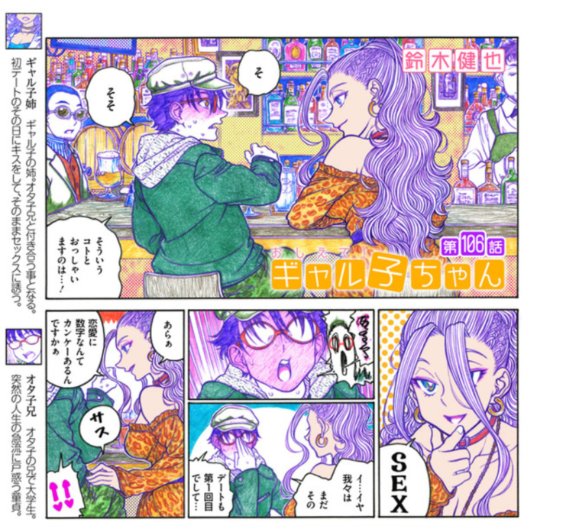
Galko-chan is primarily known for its attractive female characters talking frankly about sexual topics which they actually have no idea about, but there’s at least one character who’s extremely, unabashedly sexually active: Galko’s big sister. College-aged unlike the teenage Galko, the big sister isn’t afraid of getting down and dirty, to the extent that she’ll even “borrow” Galko’s school uniform for some guy she’s dating. However, while she’s comfortable sleeping with lots of guys, the most recent storyline in the manga concerns a burgeoning romance between Galko’s sister and the otaku brother of Galko’s best friend Otako.

What starts out as Galko’s sister wanting to rock some nerdy virgin’s world for kicks turns into something greater. Galko’s sister agrees to go on a date with Otako’s brother, and during it makes her intentions crystal clear. She directly brings up the topic of sex and even nibbles on his ears during dinner. But as much as Otako’s brother wants to sleep with her so very badly, he doesn’t want to be treated like a mere conquest. Instead, he wants their relationship to be something special, and if he’s just another tally for the “virginities taken” box, then he wants no part of it.

This hits Galko’s sister harder than she expects, because she genuinely began to fall for him, and realizes she took the absolutely wrong approach. Which is to say, lust and love certainly overlap, but they’re not the same thing.

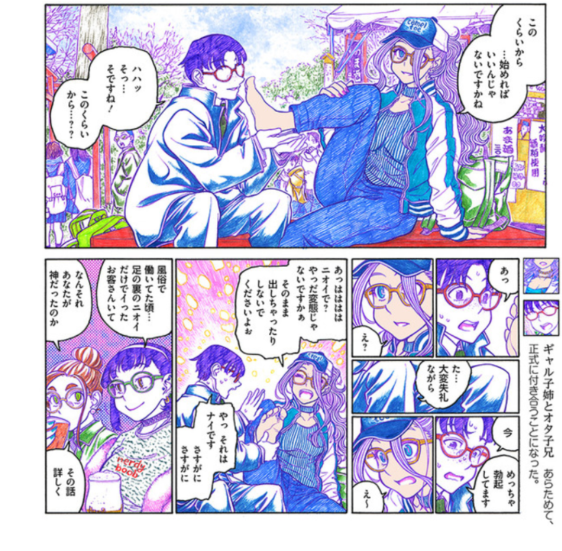
And then Galko’s sister tries to show her feelings for Otako’s brother by letting him in on a secret—that she has athlete’s foot—which in turn causes him to get visibly turned on. Romance successful! That’s Please Tell Me! Galko-chan for you. I said it provided an interesting perspective, not that it’s ultra-classy.

I think the big takeaway here is that the struggles between Otako’s brother and Galko’s sister on their date don’t come from the idea that Galko’s sister should have been a virgin, or that virginity should matter all that much for men or women. Instead, it’s about what sex means to each of them, and coming to a mutual understanding of what it takes to make their relationship potentially work. It’s sweet, it’s hot, and it displays something unique for this classic nerd/beauty trope.

The Fujoshi Files 181: Momose Narumi

Name: Momose, Narumi (桃瀬成海)
Alias: N/A
Relationship Status: Dating
Origin: Wotaku ni Koi wa Muzukashii!

Information:
Momose Narumi is a 26-year-old OL (office lady) who comes to date her childhood friend and co-worker, Nifuji Hirotaka. Cheerful and hardworking, she supports and is supported by Hirotaka through their mutual understanding and love of otaku subculture (Hirotaka is a gamer while Narumi is a fujoshi). Narumi is also friends with her co-workers Kabakura Tarou and Koyanagi Hanako, the latter being a fellow fujoshi.

Fujoshi Level:
A closet fujoshi at the workplace, Narumi was once so visibly shaken by the fact that her favorite manga character had died unexpectedly that it affected her ability to concentrate on her job.

Gangplank Galleon All Day Every Day: Ogiue Maniax Status Update for September 2018

The summer is coming to an end, but here I am still feeling jitters from the August Super Smash Bros. Ultimate Nintendo Direct. I was stoked when they announced King K. Rool, especially because the official version matches my fan concept version pretty closely!

As for my Patreon and Ko-fi, I’m thankful to all those who continue to support Ogiue Maniax. Thanks to the following!

Thank you to…

General:

Johnny Trovato

Ko Ransom

Alex

Diogo Prado

Sue Hopkins fans:

Serxeid

Hato Kenjirou fans:

Elizabeth

Yajima Mirei fans:

Machi-Kurada

The past month has been quite comfortable overall for Ogiue Maniax; even the strange Patreon non-payment issue didn’t affect me too much. Instead, what I’m struggling with (though “struggle” is a bit over-exaggerating) is trying to strike the right balance between how much I write about anime and manga and how much I actually engage with the stuff. I’ve been spending a lot of time recently watching and reading more than blogging, and it’s helped to refresh my mind and inspire new ideas. However, if I write less than I usually do in a given week, I can feel myself getting a bit lazier, and wanting to put things off more and more. It’s as if there’s a groove that I can ride to putting out lots of good content, but staying with it for too long can wear me down.

That said, here are my favorite posts from August.

Kio Shimoku’s Kagerowic Diary and Its Influence on Genshiken and Spotted Flower

Some of Kio’s old manga is getting new special-edition releases! Here’s a look at an early work of his, and the footprints it has in his more recent titles.

Otakon 2018 Interview: Kawamori Shoji

My one-on-one interview with the creator of Macross, Aquarion, and more!

Tatanga for Super Smash Bros.

After about a two-year hiatus, I’ve gotten back to drawing Smash Bros. character concepts in celebration of Super Smash Bros. Ultimate! So far, I’ve done Tatanga and Turrican.

Hashikko Ensemble

Chapter 7 of Kio’s new manga has some introducing new characters. Among them, one awesome mom. 

Patreon-Sponsored

The Big O and Loving Robots

A look at artificial intelligence, love, and agency.

Closing

I of course am also stoked for Castlevania being in Smash. Let us celebrate with some fine tunes:

Mecca of Mecha: Otakon 2018

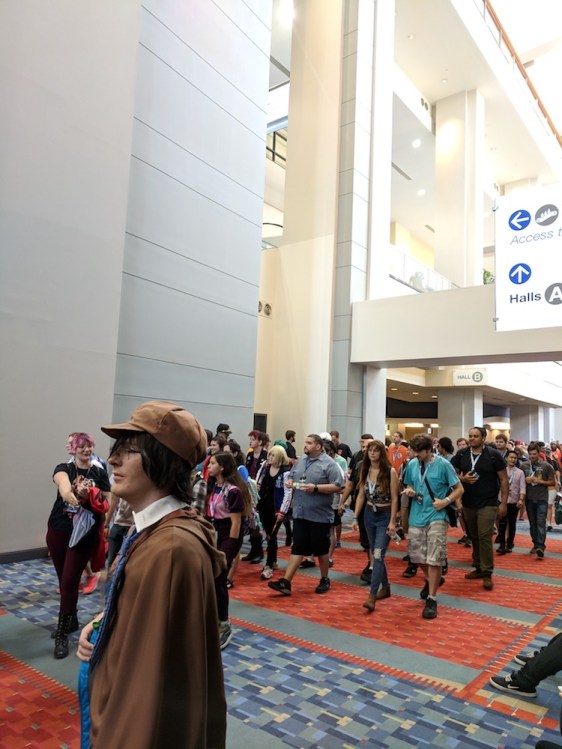
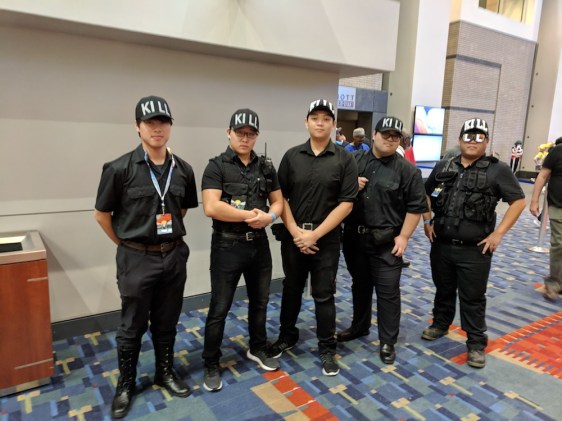
2018 marked the second year of Otakon in Washington, DC, as well as a year that posed some unique challenges. Scheduled for the same weekend as a nearby white nationalist ally, the potential danger cast an uneasy cloud over both a multicultural city and an anime con that typically attracts people from a wide variety of ethnic backgrounds. Fortunately, the rally amounted to nothing more than a fart in the wind, totaling around 30 people and far outnumbered by counter-protesters. What was left was an enjoyable Otakon that accomplished what the convention is meant for: celebrating Japanese culture and the people who make, enjoy, and are inspired by it.
Panels

Where there might have been three to five panels on giant robots in a typical Otakon, this year’s programming was rife with robot content thanks to the theme of Otakon 2018 being “mecha and science fiction.” As a huge fan of all things anime and robotic, this was right up my alley. I made it something of a mission to check out as many panels as I could, whether they were by fans, companies, or special guests.

I was even on a panel myself! “Mecha Fight Club” with Patz, Tom Aznable, Doug, and myself was an hour of debate and discussion on various topics concerning giant robots and giant robot fandom. If you came to our panel, thanks for waking up at 9am on a Saturday. I hope we gave you some food for thought.

Fan Panels

Transformers: The Birds and the Bumblebees

This panel, from the group “Manly Battleships,” looked at the early history of the Transformers. Impressively, it started not at the release of the toys in the US or even the Japanese Diaclone toys from which Transformers took many designs, but with the advent of GI Joe in America and is exporting over to Japan. It was quite an informative panel, and while I thought the “nerd humor” fell flat at times, it was a solid presentation overall.

NoS Anime

I attended two panels from a group called NoS Anime: one a Gundam Wing retrospective, and the other a look at mecha in the 1960s and 70s. Both panels were well researched, and made efforts to explain the social and economic climates of their times. I had only a few criticisms, and even those are more about what I’d prioritize, rather than what I think would make the panels absolutely better.

First, for the Gundam Wing panel, I would have preferred a greater look into the Japanese fandom, as it was mostly a nostalgia panel from the US side. Also, the comments about the first opening theme, “Just Communication,” having odd lyrics seemed off to me, as plenty of robot shows and Gundam anime feature similar music.

Second, for the 60s and 70s panel, I think more explicit mention of Nagahama Tadao and Tomino Yoshiyuki being directors on Reideen before working on the Robot Romance Trilogy and Gundam respectively should have been explicitly emphasized.

Overall, NoS Anime showed they were a deft hand in presenting.

Outsourced Anime

I try to attend at least one Anime World Order panel at conventions because they’re usually quite entertaining. This panel focused on American cartoons which actually had as lot of the animation work done in Japan. One of the major points of their talk was the impressive flourish that Japan would give these shows—and that their best efforts became the most memorable parts of these cartoons for young minds.

Gattai! Giant Robots from 198X

Essentially a 1980s robot anime recommendation panel, the hosts Patz, Tom Aznable, and Hazukari went over why their favorite mecha shows of the era deserve a look. While there was some trouble with keeping on time, and I feel like they didn’t sell certain shows as well as they probably intended, what worked for me is that each of the presenters clearly valued different things and you could get a more balanced view as a result.

Industry/Guest Panels

Kawamori Shoji
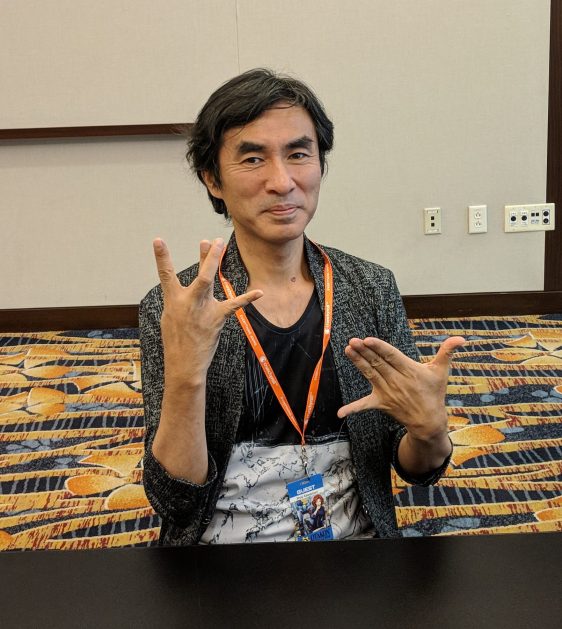
Out of all the guests at Otakon this year, Kawamori was arguably the most significant. Because there’s so much content from him, I’ve spun it off into two separate posts: a recap of his “History of Macross” panel, and my personal interview with him.

Ebikawa Kanetake

A mecha designer on series such as Full Metal Panic!, Gundam 00, and Gundam Build Fighters, Ebikawa’s panel was fairly restrained, and his answers short. One of the main things I learned is that while fans mostly remember the glamorous parts of being a “mechanical designer,” it also includes more mundane items such as coffee mugs and utensils.

Nagai Tatsuyuki

The director of The Anthem of the Heart, Anohana, Toradora!, Iron-Blooded Orphans, and more went over his history in the anime industry. We learned that he first found an anime production assistant job while unemployed and needing work. It was a position that required driving around to pick up and deliver things, and when he lost his license, it forced him to try his hand at other roles such as storyboarding. This eventually took him on his path to episode director and director.

I had the opportunity to present him a question, so I asked about the reasoning behind the unorthodox romances in Mobile Suit Gundam: Iron-Blooded Orphans, which includes an actual harem. Nagai responded that it was to show that many different forms of love exist in the world, and that he did indeed meet resistance at first from the staff when he told he wanted to put this in. I also told him the true story of my friends and I walking through a blizzard just to see The Anthem of the Heart. By the way, everyone should go see that film.

Another person asked how he feels that Okada Mari (writer on Iron-Blooded OrphansAnohana, and Anthem of the Heart) seems to get all the attention and credit. It felt like a question tinged with bitterness toward Okada, but I might have been mistaken. Nagai answered that he actually liked it because it meant he could sort of hide in secret, perhaps a defense of Okada without getting too aggressive.

One interesting takeaway came when Nagai talked about how he often worked with the same core staff, and that because they’re around the same age, they can talk to each other more candidly when working. Kyoda Tomoki expressed something similar in my interview with him at Otakon 2017, which makes me wonder if studio hierarchy is often a thorn in young creators’ sides in the anime industry.

Discotek Media

During the weekend, friends and acquaintances informed me of one anime company planning a licensing bonanza: whereas most publishers tend to announce maybe five or six new titles, Discotek was going to reveal new shows totaling in the double digits! I had waffled on going to their panel, but now I had to attend. And as it turns out, for fans like me, their announcements pretty much won Otakon.

  • Area 88
  • Message from Space: Galactic Wars
  • Space Wolf Juspion
  • Space Warrior Baldios TV
  • Voltes V
  • God Mars
  • Psycho Armor Govarian
  • Galaxy Express 999 TV
  • Bobobo-bo Bo-bobo
  • Lupin III: Blood Seal of the Eternal Mermaid
  • Kimagure Orange Road
  • Giant Robo: The Day the Earth Stood Still

To say I am overwhelmed is an understatement. Voltes V is one of the greatest mecha anime ever to not get a proper US release, and is one third of the famed Nagahama Robot Romance Trilogy (which means I hope Discotek is looking at Combattler V and Daimos next). Baldios and God Mars are classic 80s robot action, with the latter actually being a fujoshi favorite of its time. Giant Robo is one of director Imagawa Yasuhiro’s finest works. Psycho Armor Govarian is an obscure Nagai Go robot series animated that is said to be Studio Knack’s best work—faint praise, perhaps, for the studio behind Chargeman Ken. Kimagure Orange Road is one of those 80s classics I’ve always wanted to watch but never did. Galaxy Express 999 holds a special place in my heart, and the additional update on the 999 films getting a Blu-ray box set makes me want to pump my fist in the air and high-five the clouds.

Hiccups and Missteps

Not all was smooth sailing. One of the more significant problems I ran into was subpar management of the autograph line on Friday.

To start off, the autographs section was in the Dealers’ Hall, so that anyone who wanted to get anything signed had to wait on the same massive line as those wishing to make purchases. This in itself would not be so bad, except that there were autograph sessions close to the opening time, and having both aforementioned groups plus those waiting for the nearby Artist Alley to open meant that the line size inevitably became a fire hazard. This issue was compounded with the fact that telling people to go away and come back later never works because it punishes those who decide to follow the rules, and rewards those who skirt/defy them. This would become a recurring theme with the autograph area.

Upon getting in line for the actual autographs, I ran into another problem. The way the area was set up, the idea was that a small group at the front of the line would break off and go into a section where all the guests were waiting. From there, attendees would get their autographs, and then the next group would have their turn. In practice, however, only the first group ever got the chance to get autographs and the rest of the line was stuck waiting the entire time, with not even a single person having an opportunity to move from that second line. In other words, even accounting for the fact that not everyone who wants an autograph is going to get one, many people were denied autographs when they shouldn’t have been.

In my eyes, the underlying issue was that the volunteers in charge of the main autograph area did not communicate properly with the volunteers managing the line, and so the former never seemed to realize there were additional attendees waiting in the first place. Those who went first, or had guests with smaller lines, could easily ping pong between all the guests, while those who (again) followed the rules and waited patiently were done a disservice. My hope is that this changes for next year, including finding a better place for autographs. While Otakon in Baltimore had its own issues with signings, this never happened as far as I can remember.

Another non-autograph-related problem was that at one point on Saturday, the tunnel between the Marriott and the convention center was closed off, forcing everyone to go in through the convention center’s main entrance in the sweltering, 90+ degree heat. This was apparently another miscommunication, but the fact that the weather played a role was a concern.

Con Food

Eating out on Otakon weekend is always a potential hassle, given the amount of attendees. Because of the prospect of both protesters and counter-protesters, my friends and I avoided restaurants and decided to (for once) stick to supermarket and convention-center food. The latter was overpriced (as these things usually go), but the quality was surprisingly decent, and many of the food stands had Japanese cuisine to along with the general theme of Japanese culture. At the same time, $15 for not much food can hurt the wallet a bit. My advice is that if you can’t get out anywhere to eat, and you didn’t bring anything, the Caribbean food is only $12 a dish by comparison, and still plenty good. You can avoid the “anime fan” tax and still get a hot, delicious meal.

Events

Concert

Otakon attendees had the rare opportunity to attend a performance of the “Distant Worlds” Final Fantasy orchestral concert series. With legendary Final Fantasy composer Uematsu Nobuo in the audience, it was a pleasant experience that took the audience through songs from throughout the franchise. I definitely enjoyed the concert, though I felt there was a distinct lack of battle music. I was selfishly hoping for some personal favorites, like Zeromus theme from Final Fantasy IV and the Four Fiends theme from Final Fantasy I remakes, but alas.

Hi-Score Girl

Another special event was the US premiere of the Hi-Score Girl anime, which is adapted from a fantastic manga about romance and growing up in 1990s Japan arcade culture. The show is a pretty straightforward adaptation of the manga, albeit with CG that can feel awkward at times. It’s coming out on Netflix in the coming months, so I recommend everyone check it out when they have the time.

One odd thing about the Otakon showing was that it included a panel beforehand that kind of spoiled a lot of what the first episode was about—pointless if we were going to watch it right afterwards. Also, unfortunately, the interpreter didn’t seem well-versed in fighting games, so she ended up missing a few points here and there. One omission that stood out to me was that the producer mentioned the manga’s author, Oshikiri Rensuke, having participated in Vampire Savior tournaments, but the interpreter translated it as having experience with games in general. Because Vampire Savior holds a certain significance for the history of fighting games and the fighting game community, a bit was (as the cliché goes) lost in translation.

Overall

The final number put Otakon 2018 at over 29,000 attendees, but even so, moving around the Walter E. Washington Convention Center was never a burden—especially compared to some of the most sardine-esque years of Baltimore. Between the quality of the guests and the convenience of Washington, DC (aside from the notoriously terrible traffic), I solidly believe now that Otakon moving to DC was the right choice. There’s so much more room to grow! I’m looking forward to seeing how things will change in 2019 and beyond.
Won’t You Be My Neighbor?: Hashikko Ensemble, Chapter 7

Last chapter, a new girl showed up. I wondered if she was Akira’s sister, or maybe his very youthful-looking mother. Turns out the answer is “neither.”

Summary

After a bit of singing, a disheveled-looking girl has shown up at Akira’s door to tell the Chorus Club to pipe down. Akira explains that this is his next-door neighbor, Himari, who he’s known since childhood. Jin thinks she looks kind of familiar, and it turns out that she sits right behind Jin in homeroom—which means she’s been in Akira’s class all along without him even realizing it! Having not really spoken to her in a long time, Akira decides to see if she wants to walk to school with him, but when her dad answers the door instead (and tells him she’s still asleep), Akira walks away embarrassed.

At the Chorus Club “clubroom” (i.e. the corner of a stairwell), Jin teaches Akira about harmonizing, but only after a brief discussion about how the school’s been talking about Jin’s harmonizing push-ups from Chapter 5. During this time, they’re visited by two different classmates: Hasegawa, who walks away disappointed that Jin isn’t showing his muscles, and Orihara. The latter isn’t there to start trouble, but to tell Akira that he’ll be borrowing his earphones for a little while longer—noise-canceling earphones are expensive, and he needs to save up for it. Jin, however, has another idea: they’re at a school that specializing in engineering, so why not repair the things themselves? Orihara gives in, but then Akira says something that surprises everyone: “If we fix your earphones, you have to join the Chorus Club.

Sound Engineering

I’ve mentioned in previous reviews my interest in the combination of “art and science” in Hashikko Ensemble, and this chapter does a fantastic job of highlighting that aspect. It makes total sense that students of a school that specializes in engineering would try to repair earphones themselves! Combined with Jin’s generally scientific approach to singing, it means the two sides integrate more and more. His explanation of how many Western European churches are built to emphasize the “angel’s voice” phenomenon (as if Heaven itself is singing along) is fascinating.

Music and engineering are both a matter of physics, but that doesn’t take away from how impressive either one is.

New Steps for Akira

It was one thing seeing Akira singing in his room with his friends last chapter, but it’s another to see him overcome enough of his self-consciousness to actually hit a note in the stairwell. The harmonizing, even if it’s mostly thanks to Jin, feels like a major accomplishment for Akira. To then see him be assertive enough to ask Orihara to join the club, it’s as if he’s grown up immensely in the span of two chapters.

There’s also the clear parallel between how Jin got Akira to join and how Akira is trying to get Orihara to join (“If we help you with this problem, become one of us”), but we’ll see if it pans out similarly.

More Characters

This chapter gives a lot of info about Koizumi Himari: her history with Akira (they used to read picture books together!), her generally surly disposition, the fact that she hasn’t attended class in a while. Is she having some trouble in school—perhaps some form of anxiety? Moreover, Akira’s mom seems to think there’s always been some sparks between the two, which seems to be reinforced by Akira’s profuse blushing when he tries to ask Himari to walk with him to school. Or is it because Akira just gets embarrassed easily in general? And between Himari and Hasegawa, I have to wonder if the prospect of romance is starting to emerge.

Speaking of Akira’s mom, she’s wonderful! Her first appearance in the manga is such a succinct yet effective introduction to her character. Previously established as a nurse and a single mother, she’s shown haggard from a tough day at work, but purposely puts on a more cheerful appearance for her son. That one moment says so much about her person and her way of being that I hope we see more of her in the future.

Songs

No songs this month. Just folks going, “AAAAAH.”

Final Thoughts

Chapter 7 is the first to have a full character introduction page at the beginning, no doubt because the first collected volume of Hashikko Ensemble just came out. The biggest reveal here is that Kurata (the super-intense, music-hating female student) is named Shion.

Actually, I call her “super-intense,” but all of the female students at Hashimoto Technical High School seem pretty powerful. I wonder what Kio’s thinking is, though it suits me just fine. It kind of feels like different degrees of Ogiue all in one series.

The Fujoshi Files 180: Fujimi

Name: Fujimi (ふじ美)
Alias: N/A
Relationship Status: N/A
Origin: Please tell me! Galko-chan

Information:
Fujimi is a high school girl who gets nervous speaking in public, even when ordering at a cafe. At one point she spots Galko, a gyaru from another high school, reading one of her favorite manga. Fujimi enjoys seeing Galko react to a BL development in the middle of the manga, but is otherwise daunted by Galko’s fashionable appearance.

Fujoshi Level:
Outside of being a BL fan and reading a lot of manga, nothing else is known.

Kio Shimoku’s Kagerowic Diary and Its Influence on Genshiken and Spotted Flower

A special edition of Kio Shimoku’s Kagerowic Diary (aka Kagerou Nikki) just came out last month, which prompted me to read an ebook of it I purchased ages ago. Having now finished it, I find myself reevaluating certain aspects of Kio’s more recent titles in Genshiken and Spotted Flower.

Kagerowic Diary is split into two parts. Part I concerns a female college student named Suzuki Touko (above) who seemingly has it all figured out but hides the fact that she’s a virgin from her friends. Part II follows a different woman in college, Tachihara Hatsuho (below), and the complicated web of sex, emotion, and deceit she finds herself in. To Genshiken fans, it can feel both comfortably familiar yet also exotic due to the strong emphasis on physical relationships.

Touko’s story shines new light on Genshiken, specifically the final volume of the first series. In the epilogue, the characters begin a discussion of how Saki, the sole non-otaku of the bunch and by far the most mature character, could be viewed through a moe lens. After some deliberation, Madarame says that she would have to be a virgin (Saki very clearly is not). When I previously read this scene, I thought the purpose was merely to show how Madarame’s mind works and to embarrass Saki. Now, I realize it’s actually a reference to Touko and Kagerowic Diary.

Hatsuho’s story, on the other hand, makes me feel that Spotted Flower and its adultery subplot are not as out-of-left-field as fans assumed. While it’s a far cry from Genshiken, the tangled web of love and lust in Spotted Flower is not unlike the plot of Part II in Kagerowic Diary, where Hatsuho sleeping with a male friend of pity and then discovering that her boyfriend cheated on her too (and probably has been for a while) It’s charged, it’s messy, it’s complicated. In other words, Spotted Flower is sort of a return to the old days for Kio, when writing realistic characters meant more than just realistic portrayals of awkward nerds.

In addition to Kagerowic Diary, there’s a special edition of Kio’s Yonensei (“4th-year Student”) out too. I intend to read through it and see how that other early work of his compares to his more famous material.

Kon Kon Otakon Iroha: Ogiue Maniax Status Update for August 2018

It’s August, and another opportunity to express appreciation for my supporters on Patreon and Ko-fi. I try to live up to your contributions!

Thank you to…

General:

Johnny Trovato

Ko Ransom

Alex

Diogo Prado

Sue Hopkins fans:

Serxeid

Hato Kenjirou fans:

Elizabeth

Yajima Mirei fans:

Machi-Kurada

August means one of my favorite times of the year: Otakon season! Hopefully my wait-listed panel will magically get in, but in the meantime I’ll be on Patz’s Mecha Fight Club panel on Saturday at 9am in Panel room 7. Come by to hear me and others nerd it up about giant robots.

There is a more serious matter when it comes to Otakon, however, and that’s the fact that a white nationalist rally is going to be held the same weekend in Washington, DC. My fellow con attendees, please remain safe, and pity these idiots for putting so much energy into anger and hate.

Speaking of dealing with racists, I’ve recently begun revising my informal policy when it comes to blog comments. It’s not like I receive tons of comments these days, but I’ve come to realize that the concept of “let the ideas do the talking” only really works if the goal of everyone talking is to actually learn something. The alt-right/white nationalist agenda tries to feign actual debate but just wants a podium to posture and look strong. So if I see anyone arguing in bad faith, I’m basically deleting their comments. Simple as that.

But if you want to argue in good faith, here are my favorite posts from July.

Darling in the Franxx: Thoughts on a Divisive Anime

A show that people seemed to either love or hate, I give my own thoughts on a show where viewers can’t even agree what it’s about.

The Important Lesson Nadesico Teaches Us About Entertainment

One of my old favorites has an important message in these current times, about the strengths and pitfalls of pop culture entertainment.

Precure: The Crossroads of Voice Acting

A look at how a 15-year-old franchise brings veteran and newbie seiyuu alike.

Hashikko Ensemble

Chapter 6 sheds new light on Akira, and is in certain respects the most interesting chapter yet. If you didn’t know Kio Shimoku has a new manga, now’s the time to read up on it!

Patreon-Sponsored

The Newest Nekomusume is the Obvious Character Evolution

What began in 2007 continues in 2018.

Closing

Otakon! Whoooooo!

The Fujoshi Files 179: Rulutieh

Name: Rulutieh (ルルティエ)
Alias: N/A
Relationship Status: Single
Origin: Utawaterumono: The False Faces

Information:
Rulutieh is the youngest princess of the vassal state of Kujuuri. Accompanied by her trusty companion, an adorable yet powerful giant bird named Kokopo, she winds up traveling with the amnesiac Haku and his guardian Kuon to the capital of Yamato. Though typically shy and softspoken, her passion can be roused by the thoughts of two men showing passion for each other. Rulutieh’s father is Oozen, one of the Eight Pillar Generals.

Fujoshi Level:
In the capital of Yamato, Rulutieh comes across a shop selling original editions of male-male romance art books. The uncharacteristic aggression she expresses at finding such rare treasures is enough to scare her friend and fellow princess Atui.

Sex, Sex, and More Sex: The Romance of Shima Kousaku and Oomachi Kumiko

Ask any Japanese businessman who Shima Kousaku is, and chances are likely they’ll tell you. The protagonist of the long-running Shima Kousaku manga series, he’s a businessman extraordinaire, having risen up the ranks from feisty young employee to veteran CEO—the “Goku” of salaryman manga both for his power and notoriety. One of his other characteristics is his James Bond-esque talent at bedding women, and his escapades have led him to having lovers (and illegitimate children) all over the world, which also led to him and his wife having a divorce.

However, in 2014, after decades of dalliances, 65-year-old Shima Kousaku remarried. The wife: Shima Kumiko (née Oomachi), an on-again, off-again companion who’s about as sexually experienced with the guys as Shima is with the ladies, if not more. While Shima Kousaku is a pretty politically conservative manga overall, it is fascinating to me that his greatest partner is as far from “virginal ideal” as possible. In fact, if there was some sort of contraption to test her sexual “purity,” it would explode into a thousand pieces.

After their marriage, the publisher, Kodansha, released a two-volume Kumiko-only collection titled The Selection of Oomachi Kumiko, which helps provide an overview of their relationship, and it’s an interesting one indeed. There’s also a two-chapter spin-off called JK [High School Girl] Oomachi Kumiko, which showcases her early misadventures and her talent for manipulation.

Kousaku first meets Kumiko in his early days as a section chief at his company. While they’re both talking business at first, Kumiko is quick to present him a gift: hotel keys to her room. There, they make mad, passionate love, and then go their separate ways (as is usual for Kousaku). But then he learns that he’s hardly her only partner in the short term. Kumiko, it turns out, is a sex fiend. Having witnessed her mom have a threesome with two men when Kumiko was 14, her life changed forever into a constant pursuit of carnal pleasure. The only thing is, she tries to keep her true self on the down low, and her boss (who she’s also sleeping with) is realizing something’s amiss. It’s because Shima rocked her world so hard, she couldn’t control her voice that night. Of course.

Eventually, Shima Kousaku is able to solve the problem of her boss, and he only sees Kumiko once in as while, between other lovers. But every time they meet, the sparks fly all over again, and the sex is bigger and better than all else. And it’s of course implied that for every woman Shima has slept with between their lulls, Kumiko’s probably outdone him. This happens repeatedly until both are significantly older and decide to tie the knot. A part of this decision is that Kumiko reveals that she has cancer, which makes Shima realize how much he cares for her (she later gets surgery with his help to remove the tumor).

So in summary, the main romance of Shima Kousaku is as follows: Shima is a businessman who sleeps with women all around the world. He meets Kumiko, who sleeps with men all around the world. They keep doing this (and each other) for around twenty years until deciding, finally, that they like sex with each other best. “Childhood friend” Kumiko is not.

While ultimately Kumiko is rooted in a hyper-sexual, socks-rocking sexpot character type, what I find notable is that she’s still considered Shima Kousaku’s ideal partner even as she ages. By the time she becomes his bride she’s 45 years old, and a series like this whose bread and butter is male power fantasy could easily have the now-elderly Kousaku end up with a young thing in her 20s. The Selection of Oomachi Kumiko books call her Shima’s “everlasting sweetheart” and “eternal companion,” and it kind of works out, as theirs is a world where purity and sanctity take a backseat.