The Fujoshi Files 94: Hoshino Rei’s Senpai in Life

Name: N/A
Alias: Hoshino Rei’s Senpai in Life (星野 れい人生の先輩), Beret Adventure Club (ベレー帽冒険部)
Relationship Status: Dating
Origin: Tonari no 801-chan: Fujoshi-teki High School Life

Information:
The unnamed girl referred to by fujoshi Hoshino Rei as her “Senpai in Life” is an experienced doujinshi artist who regularly attends events while also dispensing advice for Rei. At one event, Rei, along with Rei’s acquaintances, help her to sell her entire stock.

Fujoshi Level:
Little is known, other than that Hoshino Rei considers her to be a stronger and wiser fujoshi.

Kio Shimoku in the Flesh

Kio Shimoku, the author of Genshiken, is an elusive individual. Portraying himself as a kind of ape, he so rarely makes public appearances that he is sometimes mistakenly believed to be a woman. In fact, when he appeared for an event to celebrate the Genshiken Nidaime (Second Season) anime, it was kind of a big deal. Thanks to Brazilian Genshiken enthusiast Diogo Prado, however, I’ve learned that photos of Kio do exist.

Apparently Kio had attended an event in Taiwan in 2010, where he promoted the release of his manga Jigopuri (also known as Digo Puri). His desire for privacy is respected here, as none of the photos actually show his face, yet it’s still pretty cool to see the man himself. Obviously I don’t know how he is as a person, but the fact that he looks like a nerd who knows how to clean himself up and dress nicely is a trait also demonstrated by the characters in Genshiken over time, namely Ogiue and Madarame. In fact, he looks pretty similar to Madarame from behind, while in the old Publisher’s Weekly interview with Kio he said that Ogiue is somewhat reflective of his own experiences.

By the way, I wonder how Jigopuri ended up doing in Taiwan.

The Fujoshi Files 93: Hoshino Rei

Name: Hoshino, Rei (星野れい)
Alias: 801-chan (801ちゃん)
Relationship Status: Dating
Origin: Tonari no 801-chan: Fujoshi-teki High School Life

Information:
Hoshino Rei is a girl who in middle school has been overweight and the subject of ridicule. Encountering a handsome high school student from Jion Academy named Akai Sui, Rei underwent a rigorous dieting and exercise regimen to slim down. Upon entering the same high school, Rei at first tries to hide her fujoshi side from Akai, but Akai is too oblivious to know what that is.

Hoshino is a big fan of various works, but is especially fond of the Gundam franchise. She has a couple of close friends, namely her male childhood friend Kamiyu Shoutarou and a comrade in fujoshi activities whom Hoshino refers to as her “Elder in Life.” Her rival in romance, Kurotsuki Luna, tries to use her identity as a fujoshi against her, but ends up only bringing Hoshino and Akai together.

Fujoshi Level:
Like her namesake, Hoshino Rei manifests her fujoshi side in the form of a small furry green creature. She approaches history class by thinking of famous figures in “seme” and “uke” categories.

You’re Already Red: Genshiken II, Chapter 97

Chapter 97 of Genshiken II has quite a few significant developments, but they appear almost when you least expect them.

Yoshitake and Yajima decide to check out Hato’s new apartment, which is closer to the university. As they relax together, Yoshitake persists in trying to get Yajima to make a move on Hato or at least do something. The conversation goes to the topic of Madarame (who’s been looking for a new job), who then turns out to have a cold, prompting a visit.

While Hato uses his spare key to check up on Madarame and returns it, Yoshitake finally gets Yajima to admit that she has some feelings for Hato. As they discuss the fact that there’s actually an open apartment in Madarame’s building, Sue pulls up in a moving truck revealing that she will be living next to Hato (edit: not Madarame like I previously thought) from now on.

I find this chapter fairly difficult to process because it progresses so deceptively. What appears to start out as a Hato-centric chapter slowly reveals itself to be actually more of a Yajima and Yoshitake story, while the idle chit chat of the beginning eventually transforms into probably the most serious conversation about sexual orientation seen thus far in Genshiken. This unusual pacing makes it so that when Yajima finally quietly and grudgingly admits that she has some feelings for Hato (“…I don’t not like him”), it’s so subtle yet upfront that at least for me personally it feels like there’s a delayed response, like I’ve been hit by Kenshiro and am just waiting for my head to explode once it fully processes all of the implications.

Yajima’s moment plays out in the page below, and just the juxtaposition between her face and Yoshitake’s delightfully beaming face over getting her friend to finally come out with what Yoshitake herself has known all along is probably the highlight of the chapter. I know that manga sometimes gets ragged on for focusing too much on faces and not trying to draw more anatomically realistic characters or backgrounds, and then that the common response is to whip out something with really nice rendered art like Berserk. However, I think it’s important to appreciate skillfull use of faces in terms of creating a strong sense of flow and composition, even when it’s just two panels.

There’s also this sense of a narrative passing of the baton as while Hato has come to accept his feelings for Madarame, now it’s Yajima’s turn for conflict and confusion. In Yajima’s case it has nothing to do with her own sexual orientation. Instead, as far as I can interpret things, it has a lot to do with her own poor self-image mixed with some guilt over how she’s treated Hato and the realization that Hato feels something for Madarame. More than her appearance or her fondness for Shounen Jump analogues, it’s moments like these, where Yajima diminishes the value of her own romantic affections in favor of what’s already where, that makes Yajima feel really and truly like an awkward otaku.

As an aside, as much as I like Kinnikuman myself, I’m always a little surprised to see it referenced so readily in anime and manga, a reminder of how popular and beloved it really is. In this case, it’s Yajima using the Hell’s Guillotine, a signature move of the villain Akuma Shogun when she retaliates against Yoshitake’s antics.

When Yoshitake discusses sexuality, she mentions the idea that the fujoshi fantasy world of BL pairings is far different from the reality of a homosexual relationship and that there are (social) challenges awaiting anyone who accepts being part of a sexual minority. Not only is this rather poignant and serious, but together with the fact that she considers the likely reality that someone is going to get hurt in this no matter what, this chapter really highlights the fact that Yoshitake really thinks a lot of her friends. That said, she also kind of brushes aside her high school friends in a comment to Yajima and Hato, thought I take that as her having different types of friendships with different people. Even her friendships with Yajima and Hato individually aren’t quite the same.

As for Sue, the comedy potential for her living next to Hato  is obvious, but it casts an interesting context in retrospect on Sue’s appearance in Chapter 95. While Sue being surrounded by mountains of merchandise epitomizes her as a mighty otaku, it also gives off this stark image of loneliness and isolation, which might explain in part the decision to move.

The last thing I want to do is go back to the faces, because this chapter has some of the best I’ve ever seen in Genshiken. You can already see in the Yajima-Yoshitake image above. The series has always been pretty good with the expressions, especially with the old Ogiue’s intense glares and Yoshitake’s general aloofness, but I feel like they’re on a whole other level here.

Seeing this Ogiue face below fills me with a strange kind of glee. In it, she’s basically refusing to get anywhere near a beauty salon. It’s interesting but also completely in character for her to be especially uncomfortable going to that sort of place even though she’s become much more fashionable over time.

And Yet the Digital Manga Moves: Soremachi is Back

Back when JManga was still alive, Soredemo Machi ga Mawatteiru, aka And Yet the Town Moves, was one of its most popular titles. While that didn’t mean much in the grand scheme of things, it’s clear it did have at least something of a fanbase. When JManga went under, it was a big loss in my opinion, but fortunately Crunchyroll Manga has brought it back.

Soremachi (as it’s called by fans) is a manga ostensibly about a maid cafe, which is better described as “a coffee shop which happens to have maids.” Its main character is a teenage girl named Arashiyama Hotori who has a love of detective fiction and a knack for thinking outside the box but is otherwise dumb as bricks. The humor is clever and varied, and it shares a number of qualities with Yotsuba&.

As far as I can tell, it’s the exact same translation as the one that was on JManga. Also, though it doesn’t really matter that much, one casualty of the switch to Crunchyroll is the original Japanese version. JManga originally allowed readers to switch back and forth between English and Japanese text, and it was fun seeing what certain jokes or puns were originally. Hotori mishearing “calculus” as “calculator” was, in Japanese, confusing “bibun sekibun” (calculus) as “sebun irebun” (Seven-Eleven).

That said, I’m willing to make that “sacrifice” for Crunchyroll’s more sensible pricing structure.

The Fujoshi Files 92: Suzuki Ikuyo

Name: Suzuki, Ikuyo (鈴木イクヨ)
Aliases: Edajima Simone (江田島シモーヌ), Ikuyocchi (イクヨッチ)
Relationship Status: Single
Origin: Hanaukyou Maid Tai

Information:
17 year old Suzuki Ikuyo is one of the dozens of maids working for the Hanaukyou household and head of the Technology Department in the mansion. Ikuyo is a mechanical genius who invents a variety of complex contraptions from hypnosis guns to cloaking devices, and is known for her general sense of mischief as well as her lack of physical talent. Her favorite food is eel pie.

Ikuyo is talented and diverse in her otaku hobbies, creating not only doujinshi but also figures in addition to cosplaying. Her preferences in yaoi lean towards older, tougher men, but she also draws male-oriented doujinshi as well. Ikuyo sees her fellow amateur artists as rivals, and attends Comic Manga Market with that ruthless attitude in mind. At Comake, she gets along with Kabukicho resident and mahjong player Gen’ei Ryou.

Fujoshi Level:
Ikuyo is more of a generally powerful otaku than exclusively a fujoshi, though her fujoshi side is definitely always present.

Is Shoujo Manga Becoming More Varied?

This is a follow-up to my previous post, A Sexy Star is Born: Thoughts on the History of Romance in Shoujo Manga.

While romance has been the dominant force in shoujo manga for over 40 years, lately I’ve begun to wonder if a quiet revolution is occurring within the shoujo manga industry, or at least within the publisher Kodansha.

For example, recently there has been a comedy manga about young girls who use model guns and play in survival games. “But Stella Women’s Academy C³-Bu isn’t shoujo!” you might say. You’d be right, except that I’m actually talking about the shoujo manga Survival Game Club! by Matsumoto Hidekichi.

What’s remarkable about Survival Game Club! is not only that it’s a manga which eschews romance in favor of firearm gags, but that it runs in Nakayoshi, a magazine whose primary demographic is 5-10 year old girls and whose alumni include Cardcaptor Sakura and Sailor Moon. These aren’t jaded manga experts looking for the next big thing, they’re readers who just want to enjoy their comics (and their free goodies). That said, the expectations for 10 year old readers might be surprisingly different, given that Survival Game Club! starts with one of its characters threatening a train molester.

Survival Game Club!

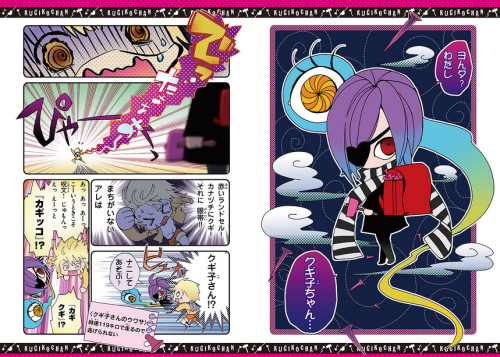
Other titles currently running in Nakayoshi include No Exit/Deguchi Zero by Seta Haruhi, about a school for aspiring actresses which becomes a survival horror story, and Kugiko-chan by PEACH-PIT (Rozen Maiden, Shugo Chara!), a gag spinoff of a manga about a ghost who is said to drive nails into people’s eyes. Both of these series not only revolve around a horror theme but are fairly unorthodox when it comes to art style.

No Exit

Kugiko-chan

According to Wikipedia (so take it with a grain of salt), the shoujo magazine Bessatsu Friend began to shift away from romance because of manga by artists such as Suenobu Keiko. Notably, her 2009’s manga Limit, a story about a group of girls in a life or death situation where the social statuses afforded to them by their school cliques no longer matter and feelings of betrayal and revenge run high, stands out as being very far from the romance-centered stories associated with shoujo. While Bessatsu Friend targets an older age group compared to Nakayoshi, I wonder if its influence slowly bled down to the younger audience.

The sense that there’s a quiet revolution isn’t just coming from shoujo manga which de-emphasize romance, however, as there’s a sense that titles about love and relationships are approaching them with greater mindfulness and breadth of topics. For instance, 3D Kanojo by Nanami Mao, about a popular girl and her otaku boyfriend, deals with the lack of respect that sexually active girls can get. One story from the girl’s past involves her trying to express her feelings of frustration and loneliness to her then-boyfriend, only to realize that he wasn’t really listening and was trying to just make out with her. Pochamani by Hirama Kaname, about a chubby girl and her handsome boyfriend, looks at body image issues and the ability to be confident in an appearance which does not fit the social standard. In both cases, these manga are about relationships already in motion as opposed to the journey towards one, and so bring to attention the challenges which can confront couples.

Of course, this is all more or less a hunch, and while I read a good deal of shoujo manga I’m not as well-read in it as other bloggers like Magical Emi or Kate from Reverse Thieves. If anyone can provide examples to further prove (or even disprove) the idea that shoujo manga has begun to move somewhat against its long-standing conventions of love and romance, I’d be more than welcome to hear it.

A Sexy Star is Born: Thoughts on the History of Romance in Shoujo

A common complaint against shoujo manga is that it’s too obsessed with romance. When you look at shoujo as a whole, love is not just a major factor in a lot of series, often times it’s the only factor. It all boils down to a simple question: “Why can’t shoujo manga be more ambitious?”

To a fair extent, this criticism is justified, but I finished reading the English-language release of Hagio Moto’s The Heart of Thomas recently and the afterword by Matt Thorn provided an interesting context to the romance-heavy nature of shoujo as we know it. Thorn writes about how, in contrast to the shoujo manga of the time which assumed that girls had no interest in stories in the more adult side of relationships, manga like The Heart of Thomas were revolutionary because they introduced the thrill of romance and sexual desire to shoujo manga. This is not to belittle the shoujo manga before Hagio and her contemporaries as somehow inferior as that’s certainly not the case, but it’s clear there was a trend of chaste stories about daughters reuniting with their mothers and such, which was supplanted by shoujo manga as love story. Romance in shoujo is the 800 lb. gorilla now, but it wasn’t always that way.

It actually reminds me about one of the biggest difficulties in discussing depictions of women with respect to feminism, which is that both the denial and exploitation of women’s sexuality have been used to control women in the past, and good and bad intentions exist within various a complex array of cultural contexts. Romance in shoujo manga is  a way for readers to learn about their own desires, but perhaps at the same time also a way to control their interests.

On a certain level, the reason behind the proliferation of romance-based shoujo is obvious: money. Girls liked romance, it sold a lot, and so it became de rigueur for an entire industry. It’s understandable, as is the criticism against it. While romance is just the thing that many fans (including myself) look to shoujofor, at this point, it could stand to have some more variety.

The funny thing is, I’ve recently begun to suspect shoujo manga is undergoing just such a transformation, but I’ll leave my thoughts on that for a follow-up post.

The Fujoshi Files 91: Kawashima Moko

Name: Kawashima, Moko (川島もこ)
Alias:
Gojappe (ゴジャッペ)
Relationship Status:
N/A
Origin:
Fudanshism: Fudanshi Shugi na Seikatsu

Information:
Kawashima Moko is a worker at an Akihabara maid cafe with a love of frilly and gothic lolita clothing, though is at first unsure of wearing the latter. Originally, a fan of the doujin circle Gojappe, she eventually ends up becoming a part of the circle, helping at every convention to sell their doujinshi. Though at first unaware of the fact that the fujoshi known as “Amane” is a guy, she learns the truth as a result of helping Gojappe.

Moko is a regular attendee of Comic Manga Market, and is a fan of the anime Omakase Tentel, particularly the pairing of Tentel x Mikoto, or Ten x Miko.

Fujoshi Level:
The exact degree to which Moko is a fujoshi is not known, but it is clear given her interest in Gojappe that she definitely is one.

Things Are Tight: Genshiken II, Chapter 96

Ohno and Yoshitake are thinking about going to a beauty salon, and try to rope Yajima along. Yajima, being the consummate otaku she is, resists to the best of her abilities but eventually concedes. (Un)fortunately, the latest fujoshi-targeted anime hit comes out and all of their plans go out the window as Ohno and Yoshitake spend all of their money on buying the blurays. Yajima gloats.

I enjoy every chapter of Genshiken that comes out, but this month in particular I found myself literally laughing out loud multiple times while reading. Even though most of it is just Yoshitake, Yajima, and Ohno sitting around and talking about whether or not they should go pretty themselves up, the combination of Yoshitake teasing Yajima and the way their conversation always re-emphasizes their identities as otaku makes the whole thing feel delightfully endearing. At one point Yoshitake suggest bringing along Kasukabe and going to a particularly expensive salon, only to be reminded by Ohno that they just all went to ComiFes and are mutually low on funds.

In a way, I find the beginning of the chapter to be kind of a fake-out even ignoring the way Ohno and Yoshitake backpedal, because the fact that it begins with Ohno talking about finally cutting her hair short brings to mind an older conversation where she mentions that the long hair can be an interview while job-hunting, and so we’re led to believe that she’s referring to finally getting serious and moving out into the adult world. It even ties a bit into Tanaka’s implicit proposal back in Chapter 83. Then we find out it’s just so that she can cosplay more character and that goes out the window. Ohno’s refusal to enter the “real world” is an interesting character flaw, to say the least.

(Also notable is the appearance of Kantai Collection references. It had to happen!)

The real focus of the chapter though is Yajima, who once again is feeling the pressure of fashion and appearance, though notably this time Hato is in no way involved outside of a mention by Yoshitake. It’s interesting seeing this topic again after so many other other developments have occurred, like the resolution of Mada/Saki and Hato’s realization about his own feelings, as I think it makes it easier to connect to Yajima who appears to feel almost lost in the madness. Yajima scoffs at the idea of going to a beauty salon initially, stating how she prefers getting 1000-yen haircuts to whatever madness other girls prefer, and it’s entirely understandable. Hell, when it comes to conversations like this, I am mostly on the side of Yajima, and I even recall recoiling in horror at seeing the price of haircuts when I lived in Japan myself.

Of course, as a guy I don’t have to deal with the same societal forces which tell me that appearance is important, and when you look Genshiken it’s clear that even though all of the guys have become more fashionable over time, it’s not nearly the same as what girls have to go through. Like the most significant pieces of fashion advice I’ve received are to not wear clothes that are too large for me, and to never wear yellow (it doesn’t match me apparently), and that’s pretty small potatoes compared to going to a beauty salon. That said, I’m reminded me of what Yoshitake had to say about fashion, which is that she dresses up not to attract men but to intimidate women. Fashion becomes a tool, rather than an identity, though that’s probably still too much for Yajima (or myself for that matter).

Out of all of the funny moments this chapter, the biggest one has to be the reveal of the fujoshi-bait show of the fictional in-universe Winter 2014 season of anime. Suikyuu! is an anime about water polo of all things, a kind of mix between the team competition of sports series (like volleyball manga Haikyuu!!, namely) and the lithe, well-defined fanservice of Free! It even has the exclamation point! From Yoshitake’s reactions to seeing a team of elderly men join in (and thus set up the obvious reveal that Ohno watched it too), I think this is the first time that Nidaime has its own Kujibiki Unbalance, something which is grounded in the tropes and trends of the time that can be a consistent source of discussion for the Genshiken members. At least, that’s the potential, as we’ve of course yet to see more of it.