The Hero in Smash Bros. Ultimate and the Skill Found in Randomness

When the Hero from Dragon Quest was first revealed as a playable character in Smash Bros. Ultimate, there were hints as to how the character would function, but few were able to predict that the character would be so volatile. Because the Hero has not one but multiple random mechanics that can make him both inconsistent and unpredictable, part of the conversation surrounding the character has revolved around whether the character’s “luck” elements hurt competitive Smash Bros. There’s even talk, however small, about the possibility of banning the character outright.

The Hero has smash attacks that can randomly trigger critical hits (effectively double damage). He has a spell menu the contents of which are random every time you open it. He even has a spell inside the spell menu that gives random results. So the fear is somewhat understandable—especially given the scene’s general dislike toward and removal of spawning items (i.e. a major random element) from tournament play.

While there are many arguments to make for why banning the Hero is a bad idea—the character is simply too new to understand his impact on high-level play, for one—I want to make a different case about his merits. Specifically, I believe that the Hero and his special mechanics provide new and interesting tests of skill that revolve around managing randomness without the major downsides and stigma of items-on play.

Skill and Luck Are Not Opposites

Before this argument can move forward, it is necessary to try and dispel an idea that has plagued competitive Smash since the earliest days: the false dichotomy between skill and luck. On a surface level, randomness interfering with skill makes sense because a coin flip, for example, can’t be modified through talent and effort.

But competitive scenes exist for games with heavy elements of chance, and in these environments, the question of how to navigate, take advantage of, and cope with random chance is ongoing.

Magic: The Gathering

People complain that their opponent topdecked their only out the turn they needed it, but do not realise that often their own poor play either gave their opponent more turns to draw the out or overcommitted turning the eventual out into one in the first place. —“There’s No Such Thing as Luck.”

Japanese mahjong (plus poker)

Poker players think a lot about how to maintain a strong table image…. [I]t’s going to be a lot easier to get lucky if the other players aren’t gunning for you because they’re afraid you’re too strong for them. When I’ve played Mahjong with him, Sarukawa maintains a fierce table image and it definitely makes me think twice about declaring reach even with a strong hand, thus increasing his chances of getting lucky and decreasing mine. —Nagare, Luck, or whatever you want to call that crap

There’s even a very good video from Game Developer’s Conference 2017 by designer Skaff Elias all about the false dichotomy between skill and luck.

Those who think that they have unfairly lost a Smash Bros. match due to a Mr. Game & Watch Judge 9 would likely fall into a coma if confronted by some of the agonizing probability-based losses that Texas Hold ’em players have to go through. But whereas Smash players have historically shunned randomness, other games use randomness as an opportunity to test two things: how well you can take advantage of good luck and how well you can mitigate bad luck. While complete randomness with no opportunity to interact doesn’t provide much room for interaction, good games of chance give players plenty of opportunities to show how they can roll with the punches.

Although it’s early on, I feel that the Hero provides enough avenues for both the user and the opponent to manage the character’s random elements. This, in turn, is what makes him different from turning on items—which, for the record, I am also not against, but I’ve learned long ago that trying to convince Smashers to play with items is a losing battle. Still, I think there’s hope for the Hero.

Random Factor 1: Critical Hits

Let’s first look at the Hero’s smash attacks. They are quite strong in terms of sheer power; forward smash can kill a Pichu at the ledge at around 50%. But there’s also a 1 in 8 chance to land a critical hit, which turns a roughly 20% damage attack into a 40%+ monster capable of KOing opponents close to 0%. There is no way to prevent or induce a critical hit artificially once an attack lands, so neither the Hero or the opponent can control when they happen.

The only way to guarantee not getting blasted by a critical hit is to avoid getting hit at all. But while that sounds ridiculous at first, there are a couple of limiting factors: the Hero has to actively choose to use a smash attack, and the actual moves have numerous flaws that make landing hits easier said than done.

The Hero’s up smash is similar to Marth and Lucina’s—a vertical stab straight up into the air—but unlike theirs, the Hero cannot hit anyone standing next to him. In fact, the horizontal range of the smash attack is so narrow that the opponent has to be virtually right on top for it to connect. Down smash is fairly quick and hits both sides, but is the weakest and unlikely to KO without the power of a critical hit. Forward smash is the best one, but it’s relatively slow and doesn’t reach quite as far as one might expect. Outside of the critical hit factor, all three are lacking.

And much like Mr. Game & Watch’s Judge hammer or Luigi’s Green Missile, the Hero’s smash attacks have to be deliberately chosen. They do not just happen randomly without anyone’s control, as if they were Bob-ombs spawning into a player’s attack. So the critical hits are random and they are extremely powerful, but they’re locked behind slow, somewhat unreliable moves that leave the Hero vulnerable.

Every smash attack is a roll of the dice, except those dice are cumbersome gigantic novelty ones and the table you’re rolling on is a toddler’s high chair. While they don’t have any random negative side effects like Judge, they’re inherently risky. Most importantly, the Hero player has to actively make the decision when and where to take those swings—they don’t just happen automatically.

Random Factor 2: Command Selection

Hero’s down B special is Command Selection, in which the Hero pulls up a menu of spells and special strikes, and it’s the other area of contention in regards to fairness because of how multiple layers of randomness are built into the move. First, only four spells can be displayed at a time, and it will change every time the menu is re-opened. Second, the order in which the spells show up is also inconsistent. Third, two of the spells—Whack and Thwack—have a probability of instantly KOing an opponent; the higher their damage, the more likely they’re toast. Fourth, the spell Hocus Pocus is literally a spell that randomly triggers either a move from the existing list of commands or additional modifiers both beneficial and detrimental. Although highly unlikely, it is actually possible for the Hero to hit down b, blindly pick Hocus Pocus, have Hocus Pocus trigger Thwack, and kill an opponent at 0%.

While there’s no doubt that getting destroyed by such an unusual chain of events could tilt just about anyone, I think focusing on those edge cases would be more a symptom of focusing too much on isolated results in the short term rather than consistency in the long term. Moreover, while the spell list is random, it doesn’t remove skill. Rather, it tests the players’ ability to assess what is worth using every time it opens, and to act accordingly.

Above, I mentioned games like Yu-Gi-Oh! as examples where players must randomness into account when strategizing. When it comes to Command Selection, this comparison is especially apt, because opening up the menu is not unlike drawing cards in a TCG. While there is an element of luck, it’s the responsibility of the player to be able to adjust their approach–to sometimes turn lemons into lemonade. There’s also a common mechanic in trading card games called a “mulligan,” where a hand that’s sufficiently terrible can be discarded and replaced in its entirety. The Hero essentially has the ability to mulligan his hand at any moment, but with the caveat that the opponent can see what the Hero’s options are, and that he can’t keep any of the “cards” he doesn’t use. A good Hero has to be able to build upon the tools available to him in a given moment, and just because it’s uncommon in competitive Smash doesn’t mean it’s not a skill worth testing and valuing. The ability to improvise on the fly and be effective at crisis management in the face of external forces somewhat beyond the players themselves is good.

Conclusion

Luck can bless the Hero, or it can curse him, but there are multiple caveats that make him a worthy character who should be welcomed in tournaments. First, he has to be in a position to test that luck in the first place, and most if not all of his random-outcome moves are telegraphed or announced in some way. Second, just because he gets a lucky or unlucky move doesn’t mean the match ends there—both Hero and opponent have to be able to make the best of a situation. The result is a character who works to find chances and has to adjust on the fly to external forces, and those who master this are the likeliest to find success built not on favorable fortune but the ability to seize opportunity.

Spoilers Matter

Between Avengers: Endgame, Game of Thrones Season 8, and the upcoming Star Wars Episode IX: The Rise of Skywalker—all concluding parts for their respective stories—pop culture has been in prime “spoiler warning” territory. If you’re plugged into any sort of social media, and you don’t have the opportunity to watch things as they’re released, it can be a struggle to avoid any and all information. This also means it’s incredibly easy for a few trolls to ruin other people’s days, but what I’m even more concerned about is a recurring notion I’ve been seeing, about how people’s anger and frustration over being spoiled is some kind of sign that these works are less about art and storytelling and more about shock value and surprise. They might even say something like, “Truly good works are good even when spoiled.”

Perhaps they’re right. Perhaps they’re not. Either way, it still doesn’t mean that a desire to go in relatively “blind” is somehow valueless. In fact, I find it to be quite rude and even a little elitist to value a work over people’s own desires to such an extent that negatively impacting their experience is somehow “okay” because it shows how “limited” both the people and their “shocking” entertainment can be. While it’s true that some things stand the test of time better than others, and that a piece of media that can be enjoyed over repeat viewings is strong in many ways, you still only get one chance to see something for the first time regardless. Just because something is even better the second or third time around doesn’t mean that the initial exposure should be diminished.

Granted, even without spoilers, “going in blind” means different things to different people. Some might have ideas as to what they think will happen, and will be bracing for the moment that their pet theories are confirmed or denied. Others might be looking at character interactions and trying to see if their chosen characters have any romantic developments. Personally, I purposely try to avoid pushing my expectations onto a work as much as possible. But whatever one’s approach, and even if a work holds up after spoilers, being aware of what happens changes the way a work is experienced. You go from trying to navigate the work on your own terms to being aware in the back (or front) of your mind that an Important Thing is going to happen. That’s not necessarily bad, but if you view a work once without spoilers and then a second time with spoilers, it means you get to have both experiences.

Note that there are a few caveats. The choice of spoilers vs. no spoilers is anything but binary, and that something as simple as a movie trailer can be “too much” for some and “not count as spoilers” for others. There’s also a difference between “being okay with spoilers” and, say, people who want advance warning on anything that might trigger them and cause deep psychological pain. And for instances where a work might come from a very unfamiliar time and culture, and not knowing the proper context can mean not catching many of the meanings and signals that are assumed to be “obvious” or “common sense” to anyone from that original time or place. Foreknowledge can be significant, but having it isn’t inherently better than not having it. First impressions can potentially be based in ignorance, but that ignorance can be corrected afterwards. You can’t take back a spoiler.

If all a film, TV show, book, or whatever has is shock value, so be it. If it has more to offer, all the better. That still doesn’t make those who wish to be surprised or who wish to focus on the unexpected somehow symptoms of an ailing entertainment industry, or make their experiences trivial. They can always come back, and if the problem is that people don’t want to revisit after the first go-around, that’s not an issue with anti-spoiler culture—that’s an issue with time and its usage. But ultimately, if people only have enough time to see something once, they should be able to do it on their terms, and not ones set by some externally imposed values rooted in notions of how “true quality” is defined.

Changing of the Guard in Fandom

ComicsGate, or what remains of it, has been a thinly veiled campaign to bully women out of comics, and the “movement” itself is hardly worth talking about as anything more than unjustified harassment. However, I find that it pulls its energy from a profound change occurring in readers of the superhero genre: the ever-increasing presence of women as both readers and creators, and with it, a change in how the comics-reading community determines what is worthy of praise. I’ve seen it on a personal level, as I went from understanding comics fandom as a boys’ club filled with casual sexism and jokes about Hal Jordan’s punches to one where a mutual understanding and acceptance of such things can no longer be assumed.

I previously wrote a blog post exploring the interaction between canon, fanon, and headcanon, and in it I used those terms the way one would when talking about narrative continuity. However, I think the contrast between those concepts still exists if we use the other definition of “canon”: the commonly accepted masterpieces of a given medium. The challenging of “canons” and “fanons” in that sense is what I’ve seen as a result of the changing demographics of superhero and comics fandom. Over the course of many years, women and girls have come in with their own ideas about which artists to respect and what ideas should be taken away from a given comics, and those deeply entrenched in the older ways feel the ground shifting beneath them. Guys like that can be vulnerable to a smooth-talking neckbeard snake whispering to them, “They’re changing the rules. They’re outsiders. What happened to the things that matter?” Losing the place they belong can be more important to some than trying to address political issues in communities.

Fandom is built in partly on passion, partly on accruing knowledge and experiences. This combination lets fans both embrace that which they love—be it a book, musician, film, or anything else—and perhaps even take it to places that the work by itself would never travel. Fandom creates communities and communication, and it encourages fans to pool their resources together and establish some common ground. But when that common ground is challenged, or finds its foundation shaken by newer generations eager with different preconceived notions of what’s good or acceptable in both people and works, it can create schisms between fans.

In a way, it reflects the world’s politics at large, as previously established majorities have seen their numbers slowly dwindle in ways where numbers alone will not let them hold onto power, and a loss of influence can be downright frightening for those accustomed to always being on top in their own universes. Even if there’s an intellectual understanding that the actions of today are meant to address certain past injustices, it can be a bitter pill for those who assumed a stable foundation in their comics fandom.

You (Meaning I) Don’t Need to Know Everything

The original intention of this blog post was to review Ikeda Riyoko’s Claudine, a scandalous and emotionally intense look at a man born in a woman’s body and the complications it brings. It provides an interesting contrast to Ikeda’s most famous work, The Rose of Versailles, whose protagonist, Oscar, is raised as a man but is ultimately a woman inside.

However, as I tried to shape my thoughts on Claudine, I began to worry about whether or not I was the right person to be writing about a transgender-focused manga, never mind that Ikeda herself, as far as I know, isn’t transgender either. It’s not as if I haven’t written about similar topics before, but I’ve been increasingly self-conscious about it. My concern with writing about Claudine was that I do not know how actual transgender people might experience its narrative. Is the dominant tragic aspect of the manga considered a step backwards?

Then something dawned on me. While I consider my constant desire for knowledge a strength, this pursuit of expertise has its downsides, one of which is an inner need to say things from a place of authenticity that isn’t necessarily in reach. I expect myself to be able to understand everything eventually on a deeper level, but in some situations, as with the transgender experience, there’s only so far I can go. While there are many ways I don’t match up to the ideal male image society upholds, I don’t know what it’s like to feel uncomfortable in my own skin to that degree—to feel like who I appear to be on the surface isn’t who I am.

What I’m realizing is that it’s okay that my knowledge will forever be limited to a certain degree. I don’t need to try and be an expert in everything; I can listen to the voices of those with direct experience and those who dedicate their lives to the pursuit of equality. Support when I can, guide when I can, and learn when I can: that’s the way to approach life, especially as I grow older.

PS: I’m well aware of the irony of me taking what should have been a review of a manga about a member of a trans man and making it all about me realizing the limits of my emotional knowledge when it comes to trans people. I hope you’ll forgive me.

Privilege is a Super Meter: A Fighting Game Analogy

The concept of “privilege” is a tricky one, because it’s extremely apparent to those who lack it, and yet often unnoticeable to those who possessed it. And given the dominance of the white male in gamer culture, others have attempted to make video game-based analogies to help the unaware comprehend “privilege.” But the most prominent comparison, the idea that being privileged is like playing a game on easy mode, is ineffective for multiple reasons. While its simplicity gets the point across easily, it’s also pretty antagonistic and liable to make people defensive. “How dare you say my life is easy, just because I’m a man?”

So I propose a different analogy: being privileged is like starting each round of a fighting game with a full super meter.

Not everyone is familiar with fighting games, so this bears some explanation. Typically, when you start a match, both characters have full health, maybe somewhere between zero to 50% super meter, and placed at a neutral distance where neither has an automatic leg up on the other. Super meter is a gauge that, when sufficiently full, gives access to powerful moves that can aid players in various situations.

A full super meter at the start of a round does not guarantee a win. It does not replace or remove the need for skill, hard work, or experience. It can be squandered to the point of being useless. Some players might end up perpetually unable to truly take advantage of it. However, even if it never gets explicitly utilized, the presence of that full super meter at the start of each round influences player and character interactions from top to bottom. Just by its existence, that meter affects how your opponent perceives you.

If all you ever do is fight other people who also start with a full meter, you might never notice that there’s an issue. But as soon as you fight someone who doesn’t have this perk, the dynamics change. Imagine two players with the exact same talent and skill, playing the same character, but only one of them has that meter. The two should be able to do the same things, but one starting with more resources makes it so that what should be even exchanges are always potentially lopsided. The player with the super meter has access to additional options. That means not only does it let that player get out of tight spots they wouldn’t otherwise, and press advantages that they already have, but when only one person has that starting meter, a “neutral start” isn’t actually neutral.

That’s the thing about privilege: it subtly affects how you are perceived in the world and what you are thought to be able to get away with. It doesn’t automatically mean those who are privileged have a leg up in every situation compared to those who aren’t, but its influence permeates aspects of life big and small without anyone even having to try. It’s why assuming that everyone is on a level playing field is the classic sign of someone who is privileged and unaware of it, but also why it can be so hard to grasp for those ignorant of its existence.

Love is Like a Good D&D Campaign: Advice on Relationships

As a general rule, I try to avoid discussing love and relationships on this site. This is an anime and manga blog first and foremost, and trying to dispense human advice on a regular basis would be too off-topic for my liking. However, I’ve noticed that there is an increasing sense of hopelessness, anger, and frustration among guys who feel alone, and attribute their loneliness to either structural issues about society or unchangeable flaws in themselves. I want to help, and my hope is that anyone who feels themselves teetering on the edge of destructive hate (either for themselves or for others) might consider otherwise.

When I was younger, I had convinced myself that I was inherently unattractive, that I was somehow lacking an inherent “it” factor that everyone else around me possessed. It was lack of confidence, a lack of looks, a fear of my own awkwardness—anything that fit my internal narrative. Whatever the “rules” of attraction were, they deemed me less than adequate. If love is like a video game, then I felt as if I was missing a controller to even begin to play.

However, I came to a realization long ago: attraction is only predictable to a certain point, and one’s ability to navigate uncertainty and empathize with others is what leads to genuine love. Indeed, if love is a game, then it’s not a video game RPG where you can level up, grind for the best equipment, and ensure success—it’s more akin to running a classic tabletop RPG such as Dungeons & Dragons.

In D&D and other games of its kind, the basic goal is to go on some kind of adventure, and the role of the GM (game master) is to oversee the journey. They provide a setting and a continually evolving story in the hopes of giving players an enjoyable experience. However, a good GM eventually learns that different people have different ideas of what it means to play a tabletop RPG. Some want to be heroic dragon slayers. Others want to explore the culture of the world. Certain players love to analyze the game mechanics themselves and optimize their characters for maximum effectiveness. Some might even love performing their character for an audience. Everyone has their own yardsticks for what is a “good” campaign, and the GM ideally works with the player(s) so that it feels more like fun than work. In other words, the “rules” of what works are subjective, and will vary not only from person to person but even sometimes from one moment to the next.

Human relationships are a very similar phenomenon. Some prioritize looks more than personality, while others might be the opposite. Tall and willowy might be one person’s ideal, while another might prefer hairy and burly. Shy and contemplative might win one heart, but fail to reach those who seek the bold and the daring. There might not even be a single ideal for a given person, and some don’t even realize what they truly want until they see it. Trying to see if there’s a mutual attraction is akin to figuring out what a player wants out of their D&D sessions—it’s a feeling-out process that involves understanding individuals as individuals. Yes, there are broad patterns of human behavior, but it’s the differences that become especially important. In other words, love might appear to be a rigid game beholden to codified rules, but all that really exists is a bare template that can be molded according to what the people themselves want. That foundation provides an environment for free-form interplay and reciprocation between those willingly adapting themselves to each other, and who want to create a shared and greater sense of enjoyment.

Sex and relationships aren’t “goals” to be achieved or a box to be checked off, or milestones that one must pass in order to graduate into true adulthood. They’re also not going to instantly repair whatever problems exist within yourself. Relationships can heal the pain inside, but it’s not about fixing what’s broken—it’s about people helping each other rise to greater heights.

The Identity Crisis of Twitter

To a great many, social media is just a part of life now. Whether it’s Instagram, Facebook, Snapchat, or Twitter, these websites and apps are practically glued to us due to the ever-increasing ubiquity of smartphones. But each form of social media in certain ways replicates the online communication tools of old, and I find that with Twitter in particular, its strengths and weaknesses come from being essentially a highly modular chatroom. The problem is that, while the scope of this “chatroom” can be large or small, individual users only have so much control once it gets beyond a certain size, which leads to Twitter and its users running into an identity crisis of sorts.

It’s true that if you want an absolutely private experience on Twitter, you can more or less make it happen. Set your account to private, only follow a handful of people, and maybe even communicate primarily through direct messages. You can actually just make it about you and your friends. However, there are a few aspects that limit the Twitter experience once you move past that point and want to utilize the site as most others do, which is to operate in this massive space where you can instantly search for what people are saying about any given topic.

Traditionally, chatrooms were less people-focused and more concept-focused. Even in the earliest days of AOL, you scrolled through a potential list of chats, picked one that matched your interests or desires, and then joined. Even if it was just to ask A/S/L to everyone, there was a sense that you were stepping into a shared, localized space. Web 1.0 had this feeling in general. With Twitter, you are essentially your own chatroom moderator, and it’s up to you to constantly manage who you want to listen to and who you want to interact with. This kind of customization certainly has its merits, as it lets you really control your experience on Twitter to a certain degree, but having to potentially police your own twitter feed constantly is practically a recipe for decision fatigue. A user doesn’t have to care that much, but that can lead to the next problem: if you choose to take a relatively hands-off approach, that means you can’t control the people who are peering inside.

A common story of many a Twitter faux pas is that a user (often a fairly prominent one) treats their very public and well-known account like it’s still a small, localized experience when things have in fact changed. This person might be using in-jokes that appear crass or downright offensive to outsiders, but is considered to be innocuous teasing by their more immediate circle. They might even get called out by their followers for those words and asked to apologize, and those followers might even have a point. Even so, it can feel like there’s a disconnect between what this particular user thinks is their Twitter experience (shooting the breeze with friends) and what the users at large think is the Twitter experience (a public forum where any and every statement hangs in the air for all to see).

Consider two scenarios of a person in real life who says something racist, not expecting it to be an issue, only to be reprimanded by someone listening. In scenario #1, it’s a private setting where a friend is warning this person that what they’re saying is messed up, and they need to watch how they think and use words. In scenario #2, it’s an open space where everybody’s listening and a stranger shouts down the speaker for being so damn racist. Both cases involve someone rightly pointing out racist speech and that it needs correcting, but there’s a fundamentally different experience between someone who says something around those with whom they’re familiar and while surrounded mostly by strangers. The issue with Twitter is that it can seem like the former on the surface, only for a user to discover that it’s been a public square all along. The perception of extremely public vs. relatively private space explodes and collapses in a way that doesn’t happen when you actively search for servers and chatrooms on IRC or the more modern Discord.

I believe that this folding of public and private on Twitter is also what makes harassment on the platform especially insidious. It’s no secret that certain groups (especially the alt-right) have learned to almost weaponize Twitter’s idiosyncratic behavior. They can make a statement, “innocently” @ another user, and sit back and let their followers dog-pile that user. They can search out people who are discussing a topic, and attack total strangers in their replies. Users might want to interact through Twitter as if they’re just talking to their friends and acquainances, but the search function makes it possible to seek out holders of different opinions and try to verbally abuse them. It’s all too easy to find someone you disagree with on Twitter, and to see them as the enemy.

Chatrooms aren’t and weren’t ever peaches and rainbows. They come with their own hosts of problems, from power-abusing moderators to the active nurturing of toxic spaces by users if they should so choose. I used to be part of a chatroom or two where there were some people with gigantic chips on their shoulders—folks who seemed a little too trigger-happy with their hostilities. I remember a time where I talked about my surprise that a couple of anime voice actors were married to each other, only to get shouted at about how I must be one of those shallow folks obsessed with following the frivolous minutiae of celebrities (but of course said in a much less polite way). I thought the guy was being an asshole, but I also went into that chat knowing that this was a possibility, and that I was ready to fight back and call him out on being unnecessarily angry. Not everyone is willing or should be willing to have to fend off trolls and angry mobs, but Twitter’s public/private collapse makes that fight all the more inevitable for anyone discussing a controversial topic.

I’ve been on Twitter for over ten years now, but I’ve come to realize that I’ve reduced my utilization of its chatroom-esque qualities a long time ago. I still do communicate with friends and mutuals to an extent, but a lot of it is me shouting into the wind and seeing what sticks. Much like this blog here, I use it as a place to experiment with an express thoughts and ideas. Analyzing this shift in Twitter behavior, I think it’s largely because a certain degree of distance is necessary. Those who jump onto Twitter with bleeding hearts inevitably attract sharks. But while there were always sharks, even among the islands of Web 1.0 and 2.0, the social media age means being surrounded by potential predators on all sides.

Good Harems vs. Bad Harems: Morality in Polyamorous Manga

The term “harem” gets thrown around often in anime and manga, but series considered to be part of the harem genre rarely feature actual polyamorous or polygamous relationships. Instead, the purpose of many of these series is pure, carnal power fantasy. However, I’ve noticed that a few series make a distinction being “good harems” and “bad harems.”

Case 1: Tales of Wedding Rings

For the most part, Tales of Wedding Rings is a fairly orthodox harem fantasy series about a boy who gets transported to another world and must wed powerful princesses across the land to defeat an evil entity revived. The girls are all beautiful in different ways, and unlike those works which tend towards having the hero choose a true partner, the implication is that none of the heroines mind a polygamous relationship. It’s no strings attached. Or is it?

More recent chapters have revealed an interesting wrinkle. The hero, Satou, is the new “Ring King,” and for most of the series, his predecessor has been spoken of as a legend savior. But one of his former wives reveals a dark secret: as he continued in his role as the first Ring King, his thirst for for power grew in more than one sense. Knowing that his might relied on his physical and emotional bonds with his wives, he began to abuse and even rape them. The wives endured all they could, but ultimately they worked together to take revenge and kill the Ring King.

Suddenly, a manga about an ideal male power fantasy, the harem of hot and powerful babes, carries a lesson that there’s a difference between genuine love and the desire for control and power that leads to abusive relationships. It’s not enough to have all the women, but to treat them with respect as well. Otherwise, the fate that the first Ring King brought upon himself through his violent behavior might very well befall Satou as well.

Case 2: Mobile Suit Gundam: Iron-Blooded Orphans

The Gundam franchise traditionally doesn’t stray too far from heteronormative relationships, at best teasing about the prospect of other types of attraction and love through its characters. Mobile Suit Gundam: Iron-Blooded Orphans is a major exception to this rule. Its romances feature homosexuality, major age gaps, and yes, actual harems.

The character Naze Turbine commands a ship piloted by his many wives. But while he might appear to be a dubious personality at first, his real goal in marrying so many women is to take them out of dangerous, dead-end situations. He makes them his wives so as to afford them the protection of his yakuza-esque organization, Teiwaz, and he provides training and education for them so they have the skills to survive in their own. He doesn’t even require his wives to actually sleep with him, so some are spouses in name only. Of course, he won’t refuse a physical relationship either, and has fathered many offspring as a result.

Like first Ring King in Tales of Wedding Rings, there is a character who represents the “bad harem” in Iron-Blooded Orphans: Jasley Donomikols. Another member of Teiwaz, he constantly tries to bribe Naze’s wives to his side with gifts of money and power with no success, failing to realize that what they value most in Naze is not riches but love and caring. Eventually, Jasley is murdered out of revenge by Naze’s wives.

Naze’s approach to love ends up influencing even the main love triangle of Iron-Blooded Orphans. At one point, Amida (Naze’s #1) says to a young Atra Mixta that a true man has enough love to go around, a lesson Atra takes to heart.

So What’s the Difference?

In both Tales of Wedding Rings and Iron-Blooded Orphans, a clear distinction is made between a healthy harem and an unhealthy one. The former is based on caring and generosity, while the latter is founded in greed, selfish desire, and the treatment of women like objects. Both the first Ring King and Jasley make this mistake, and end up paying the price for it.

This notion of the “selfless harem” is fairly idealistic and at odds with how harems are generally envisioned. Normally, they are wish fulfillment fantasy for boys and men filled with lust and eyes for many, or for those who don’t want to choose. Institutionalized polygamy (like the kind found among Fundamentalist Mormons) can become a dangerous source of power imbalances in communities, harming both men and women. The irony is that according to the series which champion selfless harems, they can only be truly obtained when one does not greedily desire for them, like some kind of Zen or Taoist riddle.

On Loli Vampires, Morality, and Fiction

Anime and manga are full of relationships with large age disparities, ones that would assuredly get people arrested in real life. While fiction isn’t reality, and therefore doesn’t necessarily reflect what people desire or are willing to do in their actual lives, the fear of harm is founded in a simple and important value: adults having physical and romantic relationships with kids is wrong and impossible to justify in reality.

“But why is it wrong?” Generally, when presented with this question, people react that it is just morally repugnant, that it should cause disgust in all people. But what often isn’t taken into account is that there are two components to this answer that are conflated into a single response: the physical disgust and the moral disgust.

The Power of Fiction for Breaking Down Ideas

Before getting into the subject at hand, I want to emphasize some of the strengths of fiction: it can introduce ideas not easily found in reality, working alongside imagination to help people envision a world different from their own. It can also dissect and decouple concepts we believe to be either inextricably tied together, even those multifaceted ideas thought to be a single entity. This aspect of fiction enables people to reflect on its assumptions, and to further clarify how we think as human beings.

Take the example of being transgender, that one can potentially appear as one sex on the outside, but feel they are truly another gender on the inside. Thousands of years of social reinforcement emphasizes that the outer appearance dictates the inner mind, so for many someone being transgender is still a difficult concept to grasp. They cannot divorce sex from gender.

Yet fiction helps make this comprehensible. For instance, the old manga and anime Ranma 1/2 stars a boy who, due to a curse, changes physically into a girl every time he’s hit by cold water (hot water reverses the transformation). The more recent and wildly successful anime film, your name., features a boy and a girl who switch minds and have to live in each other’s bodies. In both works, the idea of “a girl on the outside but a boy on the inside” becomes more easily relatable. One need only watch these works, then think, “If I was in their shoes, how would I think? How would I feel?”

Physical vs. Logical Morality

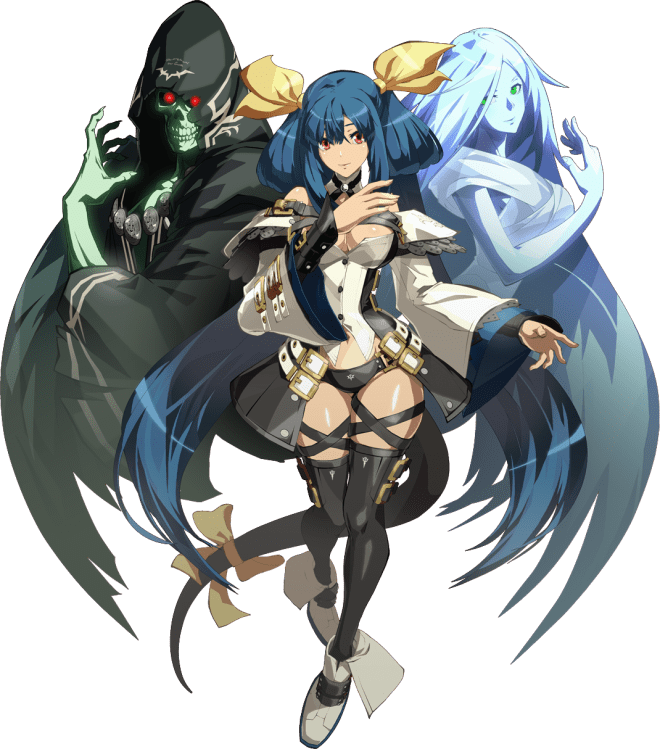
Adults having relationships with minors is morally wrong, but in order to illustrate the complexities of this idea, I’m going to reference two characters from the company Arc System Works’, which specializes in fighting games. First is Dizzy from the Guilty Gear series. Second is Rachel Alucard from the BlazBlue series.

Visually, Dizzy appears as a fully-grown adult. Tall and voluptuous, she holds zero physical appeal for anyone who would be into much younger characters. However, in her first appearance in Guilty Gear X, she’s stated as being a mere three years old. While it’s more the case that she emerged fully grown like the goddess Athena, the conceptual contrast is still there: young in age, but old in appearance.

Rachel Alucard is the opposite. Having the appearance of a child, Rachel is actually an ageless vampire with the maturity and wisdom to go along with it. She’s very intentionally designed to follow that old lolicon trope of “she looks 10 but she’s 1,000 years old!” that often comes across as the flimsiest of excuses.

If you were to apply real-world laws to Dizzy and Rachel, you’d get two different results. If an adult had a sexual relationship with Dizzy, they’d be breaking the law 100%, but at first glance no one would find anything amiss. If an adult had something with Rachel, it would be legally justified but they would get pulled over by the cops every day for the rest of their lives.

Being bothered by Rachel’s design reflects a physical, visceral disgust—that one should not perceive her appearance as sexually attractive. On the other hand, being disturbed by Dizzy’s situation has more to do with the logic of morality. Even if someone appears fully mature, that does not mean they are mentally or emotionally ready. Age of consent laws are designed to protect minors from the inherent power imbalances that exist in adult-child interactions, even if she “looks like an adult.” The two sides of this argument can and do join together, but they’re fundamentally separate ideas.

So What About Those Stories?

While there is a clear immorality to having an underage relationship in reality, I do not believe that fiction is beholden to the same rules. Putting aside the fact that fiction, in and of itself, causes no harm, what ultimately makes those large age gaps morally problematic is the power dynamic. Adults inherently hold authority over children, even if those kids could pass for adults themselves, and the excuse that “she looked 18” doesn’t take into account the psychological harm that can occur. In stories, however, “power” comes in many different forms, and a story can be all about seeing how two individual characters can join together as equals. This doesn’t mean that people should never feel disgust at what’s depicted in fiction, especially because what goes on can potentially be used as an excuse or justification for bad behavior in real life. But it still, in the end, highlights how we perceive equality (or lack thereof) in fictional portrayals of romance.

Real vs. Perfect: The Two Opposing Idol Values

1983’s Creamy Mami was the first idol anime, and it made an idol out of Mami’s voice actor as well. Watching her videos from back then, a 15-year-old Ohta Takako comes across as awkward and unaccustomed to the spotlight, even in “Love Sarigenaku” above, her most “grown-up” song. Compared to many of the slickly produced pop hits of later years, Ohta can come across as almost unprofessional, but that’s exactly where her appeal lies. When it comes to Japanese idols, there are two general directions: “unrefined and real” or “polished and perfect.”

When comparing the Japanese idol juggernaut AKB48 to the K-Pop sensation Girls’ Generation (who have been enormously popular in Japan), the latter visually comes across as a much more “professional-looking” group. While calling them idolsTheir dance and choreography are on point, and their music videos make them look like a million bucks. But while the girls of AKB48 have a kind of awkwardness about them, and many aren’t the greatest singers, there’s a sense of them “trying their best,” and this is exactly what the fans want. In other words, perfection isn’t necessarily desired. It can be, but that strain of inexperience and perseverance is just as strong.

These dual forces can be seen in idol anime in spades. In Love Live! School Idol Project, the main characters are the ragtag group μ’s (pronounced “Muse”), and the defending champions are the practically-professional A-RISE, who come from the richest high school in Akihabara. In Aikatsu!, Hoshimiya Ichigo is shown as having some kind of natural spark of genuineness that contrasts her from the seemingly unassailable Kanzaki Mizuki. And in Macross Frontier, the main love triangle features, as seen above, the humble waitress Ranka Lee (right) vs. the sultry Sheryl Nome (left). In every case, what causes the “small fry” to ascend isn’t that they transform into polished and perfect idols, but that even as they improve, that unrefined and authentic quality shines through. Perhaps it says something that the main heroines of these shows tend to lean that way as well.

And yet, as touched on briefly in the beginning, voice actors who play idols in anime actually end up being idols themselves. When the girls of Love Live! hold live concerts their flaws come out, but that’s part of the appeal of seeing them in person. When watching the characters in the anime or in music videos, that imperfection doesn’t come across in the performances so much as in the dialogue and supporting materials. A similar phenomenon exists all the way back with Creamy Mami. She comes across as much more “polished” than Ohta Takako does, yet they share the same voice.

An interesting case of the strange interaction with the 2D vs. 3D and real vs. perfect contrasts are those that toe the line, like Hatsune Miku or virtual youtubers. With Miku, her limitations—the fact that her voice sounds robotic—is considered part of her appeal. With virtual youtubers, the fact that there’s a person performing behind the character is much more obvious, and the idea that they start to break down or break character is what lends a sense of “realness.”

In this regard, California-born Japanese idol Sally Amaki is especially interesting. A member of 22/7, an “anime-style characters” idol group in the vein of Love Live!, she plays the bilingual character Fujima Sakura while bringing along her own fans as Sally. Not only does she perform the virtual youtuber role as Sakura, but her native English fluency brings an interesting dynamic that highlights a sense of “realness,” especially for English-speaking fans. Not only is there often a contrast between Sally’s “cute, practiced idol” voice and her Californian mannerisms when switching between Japanese and English, but she’ll mention something that only someone growing up in the US would know off the cuff. This lets American fans connect with her sense of authenticity in ways that they might not have been able to in the past.

In the end, “real vs. perfect” is not a true dichotomy by any means, and every idol/idol group approaches that divide in different ways. Whether you’re an idol fan or not, which do you prefer?