I have watched a lot of anime, but I’m far less experienced with tokusatsu stuff. When Toei launched their official worldwide tokusatsu channel on Youtube a few months ago (despite a major hiccup where they accidentally banned themselves), I originally saw it as a way to legitimately watch more obscure giant robot anime such as Lightspeed Electroid Albegas and Space Emperor God Sigma. However, thanks to the sheer range of shows available—stuff leading back to even the black & white era of television—I thought it was high time I made a more concerted effort to watch tokusatsu and form my own opinions.
What I’ve come to notice is that I enjoy these series a lot more than the adapted tokusatsu works I’ve seen over the years in the US—Power Rangers, VR Troopers, Super-human Samurai Syber Squad, etc.—and I think I know why. When it comes to Japanese tokusatsu, there is a greater degree of earnestness that makes these shows more enjoyable overall. They might not have much of a budget, as shown by their threadbare special effects, but everything feels somehow more sincere.
Sure, the localized shows have their own merits, and there have been memorable storylines over the years that lend at least an air of seriousness and compelling storytelling to their worlds. In Power Rangers alone, there’s the original Green Ranger storyline from Mighty Morphin’ and the bond between Astronema and Ecliptor in Power Rangers in Space that revealed the two as more than just evil villains. However, they feel more like exceptions to the rule—-chances for otherwise very non-serious stories to reveal an edge.
With Japanese tokusatsu on the other hand, even the very first episodes feel like they’re working hard to get viewers emotionally invested. They’re also still ultimately kids’ shows as well, but their presentation is such that they expect the young viewers at home to enjoy drama and tension in their entertainment. When you hear the ending theme to Janperson, even if you don’t know Japanese, there’s a strange yet heartfelt sense of passion. It’s definitely cheesy, but it’s a convincing kind of cheesy. The difference is akin to the kind of pro wrestling that easily makes you suspend your disbelief versus the kind that takes you out of the magic.
Anyway, if anyone has recommendations, I’m all ears. A part of me wants to check out Space Ironmen Kyodainand Akumaizer 3 just because of Konata’s fiery karaoke from Lucky Star, but I’m down to keep exploring.
Emotions run hard and Hasegawa gets to the heart of the matter in Hashikko Ensemble, Chapter 30.
Before we get into the review, I have a couple things to share, for those that missed previous blog posts:
The final episode of the anime Wave, Listen to Me! features “Miagete Goran, Yoru no Hoshi o,” the song that the Hashikko characters have been singing and practicing up to this point. I talk about it here.
Also, I took extensive notes from a recent interview with Kio Shimoku by Virtual Youtuber Luis Cammy. It’s long, but I recommend you all check it out! There’s a whole lot of insight into Kio’s life and career, and it’s his first ever audio interview! If you ever wondered where Akira’s ultra-deep voice comes from, it’s a reflection of the author himself.
Summary
Shion is lost somewhere in the woods, but Orihara manages to be the one to bring her back to safety. The image of him carrying Shion on his back haunts Akira to such a degree that he dreams of the two in a loving embrace. This awkwardness persists through breakfast the next morning.
Later, Hasegawa tries to get all four of the Chorus Appreciation Society’s singers to resolve the question of whether to do an a capella performance for the school festival (Jin’s stance) or to involve Shion on piano (Akira’s stance). In order to coax Jin’s true motives out, Hasegawa brings out a live video chat of Yumerun, Jin’s condescending childhood friend). Her casual conveyance of the dismissive words of Jin’s mother causes Jin to reveal the truth: he wants to do something musically impressive to show his mom up, knowing that she’ll be watching.
However, just as it seems consensus has been reached and a capella is the way to go, Hasegawa turns around and declares everyone to be idiots. She explains that Jin is so caught up in trying to prove his mother wrong, he’s forgotten their actual goal: to attract new potential members in order to graduate from appreciation society to full-fledged club. With everyone now on the same page and their eyes on the prize, Hasegawa is poised to reveal the popular, catchy, possibly anime-related song they’ll be doing next.
It’s Ghibli, Isn’t It?
In Chapter 14, Hasegawa goes ballistic when she discovers that multiple members don’t know Studio Ghibli and its famous music. GIven that their goal is to try and do something that’ll have wide appeal to students at a technical high school who likely don’t know much about music, this seems to be the natural choice.
The question, then, is what song (or songs) has Hasegawa decided on? I have my own favorites (“Carrying You” from Laputa: Castle in the Sky, “Hikoukigumo” from The Wind Rises, “Always with Me” from Spirited Away), but what’s tricky is that most of the Ghibli songs are performed by women. One hint might be Orihara’s interest in harmonizing, but given my limited musical knowledge, I don’t think I’d know what a “good song for harmonizing” would even be.
Hasegawa is the Saki of Hashikko Ensemble
By cutting through all the reticence, the veiled reasonings, and the personal hang-ups, Hasegawa fulfills a role akin to Kasukabe Saki in Genshiken. She’s direct, keeps her eye on the prize, and seems more insightful when it comes to human relationships compared to the others. Granted, she doesn’t seem to have the social grace of Kasukabe. In that sense, Hasegawa reminds me of something akin to Hikigaya from My Youth Romantic Comedy is Wrong, as I Expected (aka My Teen Romantic Comedy SNAFU)—good at finding solutions but willing to play dirty in the process. I wonder if her contacting Yumerun is just for this, or if she’s actually formed a friendship with the strange girl.
Jin himself comments on Hasegawa’s effectiveness, telling her that he’s glad she’s on board as their conductor. Jin also uses Hasegawa’s first name—Kozue—for the first time, which she herself points out is quite the milestone. Jin calls people by their first name extremely easily (including Orihara!), so it’s interesting in the first place that he had previously avoided doing so with Hasegawa.
Love Triangle Man
Everything seems to be pointing towards both Akira and Orihara liking Shion on a romantic level. A part of me still suspects that Orihara’s and maybe even Shion’s reactions are being misread by Akira, but it could really be that obvious. Whatever the truth may be, the important thing is how self-conscious Akira is about the whole situation, and that it’s likely going to get worse. Akira’s overactive imagination even comes into play a second time (the first was with Shion and Shunsuke). There’s a chance Hasegawa (or maybe Kanon?) will find some way to untangle this mess, but I think it’s going to get crazier and crazier.
I still want to hear from Akira at some point what he likes so much about Shion. I know people shouldn’t necessarily have to articulate their feelings, but I’m genuinely curious.
Songs
No songs this month.
Final Thoughts
I’m looking a few chapters ahead and thinking if any new faces will join the appreciation society after the upcoming school performance. I’ve still got my eye on Kurotaki Mai, the deep-voiced girl who helped Akira, and the possibility of a girls’ vocal group starting up. If Yumerun somehow ends up at Hashimoto Tech, that would be wild.
Wave, Listen to Me! is a great manga and anime about a woman who unexpectedly becomes a radio host—a mature comedy that is about five genres away from author Samura Hiroaki’s most famous work, Blade of the Immortal. I recommend everyone check it out. For those who have recently finished the anime TV series, I’m here to point out that the song played in the finale has a special kind of relevance to the episode.
SPOILER WARNING, of course.
In episode 12, an earthquake hits Hokkaido, causing blackouts. As the characters look up at a starry night sky, a song plays: Kyu Sakamoto’s “Miagete goran, Yoru no Hoshi o” or “Behold the Nighttime Stars.” This song originally came out after the Great Kanto Earthquake of 1923, and it responded to the fact that the lack of light pollution made the stars more visible than normal. A common interpretation of the song’s lyrics is that the stars are also the souls of those who died in the disaster. In short, having “Miagete goran, Yoru no Hoshio” play was an active choice with a specific meaning to Japan.
Incidentally, I actually only learned about the song and its significance because I’ve been following Kio Shimoku’s current manga, Hashikko Ensemble. The tune has a central role in the narrative up to this point, and one of the characters goes as far as to explain everything I mentioned above. I find it a little funny that these two streams dovetailed so nicely together.
Both Wave, Listen to Me! and Hashikko Ensemble run in the magazine Monthly Afternoon, so maybe this synergy isn’t totally out of the question. Most likely, however, is that they’re both referencing the same major moment in Japanese history.
When I was more actively into superhero comics, the prevailing sentiment about Superman was that he’s a “boring” character whose nigh-invulnerability and moral uprightness were far less interesting than the grim and gritty Batman or what Marvel Comics had been doing. But I think that was as much a reflection of the kinds of people who called themselves comics fans as well as a kind of blindness towards the very fact that Superman is a reflection of both the ideals and the shortcomings of the United States. It’s a country built upon both racism and opportunity, and Superman as the “ultimate immigrant” stands at that crossroads.
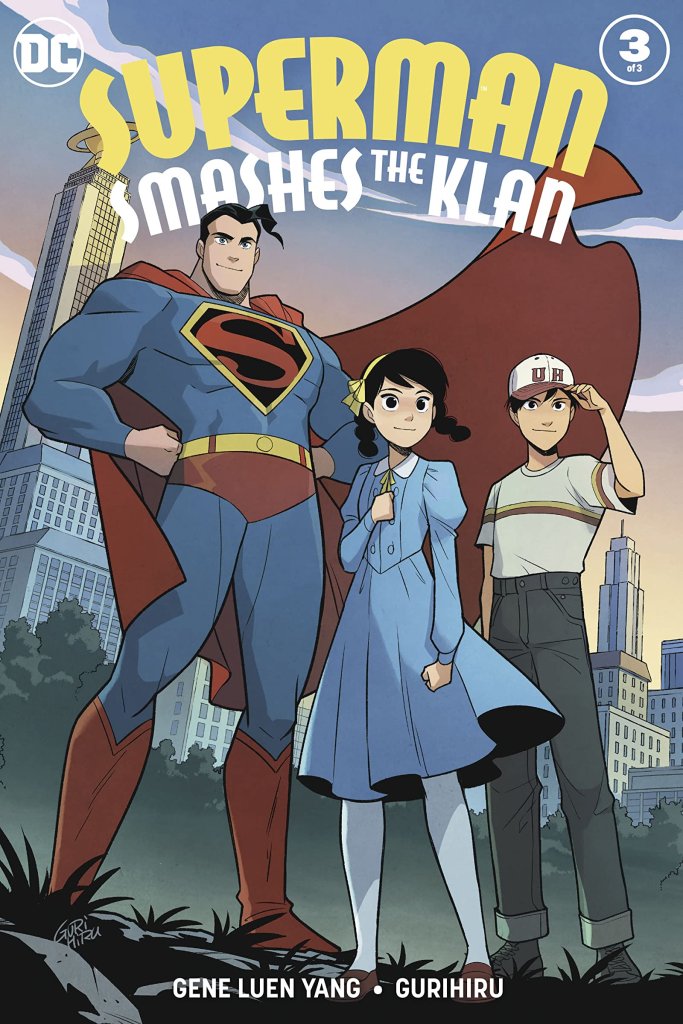
Plenty of works about Superman have helped to showcase his humanity, from All-Star Superman to Smallville to the 1990s’ Superman: The Animated Series to even the controversial Man of Steel, but Superman Smashes the Klanby writer Gene Luen Yang and artists Gurihiru that I think presents an especially poignant story about Superman’s internal conflict through his own status as an immigrant.
Superman Smashes the Klan is an adaptation/re-imagining of one of the most famous stories ever told in the old 1940s radio show, The Adventures of Superman, in which Superman faces off against a Ku Klux Klan analogue. The catch: the show had actual KKK secrets and code words, and helped to expose them to a greater American audience, weakening their ability to recruit new members. Where Yang makes his mark as the writer This particular arc also includes the Chinese Lee family as minor characters, and that’s where Yang—whose previous comics focus heavily on the Chinese experience in the US—makes his mark by giving them extra attention. The topics of racism and the immigrant experience are portrayed with an incredible amount of nuance that leads to far more than just a “racism is bad” moral lesson.
The Lee family, for example, is portrayed as each having different relationships with the concept of “Americanizing.” Tommy, the son, loves baseball and will even make jokes about his Chinese-ness as a way to befriend the white kids around him. Roberta, Tommy’s inquisitive sister, sees his behavior as incredibly fake, and doesn’t want to have to put on a show or play into stereotypes. Their father is so intent on presenting himself as a model minority that he tries to dress the part of the professional scientist even in dire emergencies. Their mother gets fed up with her husband’s insistence on speaking English instead of Cantonese even though it’s a much more comfortable language for her to express herself. Even though all four characters are Chinese and even related to one another, they’re shown to be influenced by the tension between their Chinese background and American life in different ways.
The white characters are given a similar treatment, where Tommy’s baseball rival, Chuck Riggs, is shown to have both good and ill within him. He worships Superman and the righteousness he embodies but also has a white supremacist upbringing that influences how he sees others. It’s the conflict between these two aspects of him that defines Chuck’s own development throughout.
Superman’s part in this story mirrors that of the Lees. He actively tries to portray himself as a Good American just like any other—albeit with superhuman strength and speed—but has to deal with knowing that he’s not human like everyone assumes he is. One antagonistic character even assumes that Superman is white, and asks how Superman could betray his own race, a scene that touches upon those with non-white backgrounds who are able to pass as “white” in American society, and reap the benefits as a result. There’s even an acknowledgement of Superman’s parallels to the Nazi idolization of Nietzche’s concept of the “Die Ubermensch” by having a Nazi villain constantly call him “The Superman.”
There’s one aspect of Yang’s writing of Asian characters that I must praise, and that’s his willingness to portray them as having their own problematic beliefs. After the Lee home is attacked by the Klan, a group of black men driving by stop to help them out. However, Roberta and Tommy’s father immediately sees them as a threat and treats them as such. Here, his racism and stereotypical assumptions of black people reveal themselves, even as he himself tries to fight racism towards himself and his family. As an Asian-American myself, the capacity for Asians to both bristle at the discrimination inflicted upon them while being complicit in racism against other peoples is one of my greatest frustrations in life, and I am glad to see Superman Smashes the Klan showing both the fact that this happens and the complexity it carries. It’s very much in line with the kind of well-rounded yet complicated depictions seen in Yang’s previous works such as American Born Chineseand The Shadow Hero.
While I focused mostly on the writing aspect for this review, I want to give credit to Gurihiru’s excellent art. As always, their work feels both approachable yet filled with a sense of quiet grandeur. The care they give to showing the differences between the characters through their body language ends up enhancing the greater themes and important points of the comic overall.
Superman Smashes the Klan feels ever more relevant as the United States is seeing the rise of hate groups and increased violence towards non-white groups of all stripes. It is an accessible book that is worth reading by kids and adults alike, and I think it would especially resonate with Asians living in the US. It’s worth not just a look, but also a close examination of how America succeeds and fails at the ideals it presents to the world.
Akira vs. Jin?! It’s Chapter 29 of Hashikko Ensmble!
Summary
The Hashimoto Chorus Appreciation Society arrives at the site of their training camp, which is packed with seemingly all the audio equipment they’ll ever need. But as Jin is living in audiophile paradise, Akira is still thinking about seeing Jin at Himari. Jin explained that he was there to help Himari build her own speaker, but it still doesn’t sit well with Akira.
Hasegawa (who has declared her intent to join the club proper as conductor—and drag Kanon in along as well) reveals to Akira that having Jin help Himari was all her idea. In fact, she purposely timed things so that Akira would be on the previous castle trip. Hasegawa also prods Akira about his obvious feelings towards Shion.
Jin talks about his next plans for the group, which involves having the guys all sing a capella for the school festival. His motivation seems a little off somehow, but what’s even more unusual is Akira vehemently disagreeing with the decision—a first “fight” for the two. The group later goes outside to look at the stars and to practice harmonizing, only for the debate about the school festival to continue. However, the argument is suddenly interrupted when everyone realizes that Shion is missing!
Feelings and Tensions
It feels harder and harder to write chapter summaries for Hashikko Ensemble. Whether it’s the burgeoning (?) romances or the friction that exists between the characters, everything feels important and frivolous at the same time. Jin and Himari could just be as innocent as they claim, seeing as Jin is not one for deception, but maybe there’s still something sparking there. Akira’s crush on Shion seems to only grow stronger, and it’s clear that his reluctance towards doing a capella is that Shion (who’s only just recently healed from her hand injury) wouldn’t be able to play. Meanwhile, I suspect Jin’s eerily forceful desire to do a capella comes from wanting to further defy his mysterious mother.
Orihara seems especially tense, but I can’t really tell for sure what the reason could be. He seems like he’s trying to work through something possibly related to Shion, but I feel like the series is trying to use him as a red herring romantic rival. Orihara’s a complex yet simple character, so it’s hard to peg what he’s about, even when knowing his tragic past.
Sound Training
I like seeing Jin nerd out about audio electronics, even if I don’t fully understand everything that’s going on or how it’s supposed to all fit together. To be fair, that’s something I share with most of the characters in this chapter. Still, I at the very least learned that Accuphase is a manufacturer known for its power amps, and that with sufficiently good equipment, you can even hear where the singers were positioned in a room.
There’s also an interesting little training regimen shown in this chapter, meant to strengthen your voice and your muscles at the same time. In fact, the manga itself points to the original source, “Muscle Voice Training,” which can be found on Yamaha’s official Youtube channel!
As for its portrayal in this manga, one thing I find curious is that Shinji is able to generate more force in his “He!”s than the bigger and stronger Orihara. I think either Orihara is just not trying very hard (possibly out of embarrassment), or there’s something about Shinji’s castle-exploring cardio that gives him a slight edge.
Songs
You know the drill by now. It’s“Miagete Goran Yoru no Hoshi o” by Kyu Sakamoto. Most likely, things will change now that we’re seemingly moving into a new arc.
Final Thoughts
Kanon joining the club seems inevitable, but I have to wonder what role she’ll end up in.
Also, this series being a manga and all, I often picture Akira’s voice in my head as something soft and light, only to remember that he’s supposed to have a serious bass to his voice. It’s so unlike what’s typical that I want even more to see it in anime form.
The Promised Neverland recently concluded in Weekly Shounen Jump, and it caps off a four-year run as perhaps my favorite dedicated shounen manga of the last twenty years. It both elevates and challenges the foundational Jump motto of “Friendship, Hard Work, and Victory” by pushing far past simple power fantasies and the thrill of adventure. It dives deep into the territory of political thought as it tells an intriguing story about kids trying to both survive and make a difference in their world.
This is not the first time I’ve praised The Promised Neverland. I’ve previously written about the significance of its main heroine, Emma, and the fact that the series criticizes the entrenched systems of injustice that stay in power by pitting people against one another. Now that the series has crossed the finish line, I feel that my positive opinions of the manga have been more than justified. The Promised Neverland is a series that dares to say something about the world, utilizing its world and its characters to challenge readers to imagine a better world.
The Promised Neverland places a female protagonist front and center, gives her the agency to make changes, and emphasizes the idea that we don’t have to perceive the world as some zero-sum game of absolute winners and losers—a world where the first thing we ask is how we can save as many people as we can, and not how many people we need to sacrifice to achieve a goal. Here and now in the year 2020—between COVID-19, Black Lives Matter, democratic protests in Hong Kong, and countless other human rights and safety issues—these are messages we need.
An opinion I keep seeing online is that The Promised Neverland was at its best in the first arc, when it was about orphans trying to outsmart their sinister and powerful mother figure in order to escape. And certainly, there was a kind of thrill to the “high stakes battle of wits” that defines the early manga. However, I am so glad that The Promised Neverland evolved past that point. It would have been all too easy for this manga to simply be about the nerve-racking excitement, but it became a genuine piece of thought-provoking science fiction—the kind that encourages readers to imagine a different world, one that looks at concepts of utopia and dystopia, and asks how one could turn into the other and vice versa.
There is another Shounen Jump series that I feel hits with a similar weight, though it’s a far different series in a lot of ways: Barefoot Gen, the story of two siblings who live through the bombing of Hiroshima and the pain of post–World War II Japan. No, The Promised Neverland is not couched in the trauma of directly experiencing a nuclear explosion, and its pain is abstracted through its fantastical setting, but it still looks deep into who we are as a collective people called humanity, and challenges us all to be better.
Animal Crossing: New Horizons arrived just in time to explode in popularity. With so many people staying home due to COVID-19 and in need of some respite, the series’s laid-back atmosphere might just be what the doctor ordered. I know because more than a few of my friends and loved ones have been playing it, some long-time veterans of the franchise and others absolute newbies. After a while, seeing the people I know derive such enjoyment out of it, I had to see firsthand what the fuss was all about.
I wouldn’t quite call Animal Crossing: New Horizons a personality test, but I find that it does reflect something of what’s going on in each of us. There are goals you can progress towards, and there are achievements that can net you bonuses, but the game is largely without any demands. You could do everything or you could just do the bare minimum. You gradually shape your space according to however you feel, with some harmless elements of luck and the mellow atmosphere preventing it from being something like a SimCity. Seeing my island slowly come together and comparing it with others’, I can see how we express ourselves through the game’s quirks.
Animal Crossing is clearly not for everyone, and I can think of two categories of players who might regret getting the game. The first is anyone who needs there to be a distinction between winners and losers. While there are areas in which you can potentially compete—fishing events, the size of your collection, how much money you have, etc;—they’re largely arbitrary and there’s no judge keeping score. You really have to go out of your way to make it about competition, because there’s nothing that inherently says one person’s stuff is better than another’s.
The second category is anyone who would feel anxiety over accomplishing all the million little tasks and activities the game offers. It’s possible that, rather than being a calming, almost meditative experience, Animal Crossing: New Horizons becomes a source of stress. If you feel bad about ignoring things you could be doing, and you feel like you avoided guilt rather than achieved satisfaction by accomplishing them, then playing this might be a bad idea.
As for me, I’m trying to make my island into an incongruous mix of relaxing good times and abstract horrors. Either way, my villagers look like they’re having a good time.
Exploring the tension of anthropomorphic animal society from the perspective of high school students, Itagaki Paru’s Beastars can at times feel like it’s encouraging a very dangerous view of the world. In a world where carnivores and herbivores co-exist peacefully and eating your fellow animal is illegal, the constant pressure faced by the timid wolf protagonist, Legoshi, for not embracing his violent, meat-eating ancestral nature seems to bleed into sexist alpha/beta nonsense territory. Yet, by the end of a first anime season filled with tumultuous and shocking developments, the message I took away was something far different and more nuanced than a simple animalistic nature vs. civilization dichotomy.
Warning: Beastars spoilers ahead
Legoshi is portrayed as shunning the spotlight. Although he’s in the drama club, Legoshi works as a meek behind-the-scenes stagehand, leaving the attention to others such as the club’s star actor, Louis the red deer. But what Louis notices is that Legoshi is clearly stronger and potentially more intimidating than he lets on. As a gray wolf, he possesses might that no herbivore can hope to match, and it incenses Louis that Legoshi can be such a pushover. When Louis gets hurt and a shuffling of roles causes Legoshi to appear in a play, a tiger clubmate named Bill tries to bring out Legoshi’s dormant ferocity.
However, Legoshi is afraid of his own carnivorous side. Not only was his good friend, Tem the alpaca, eaten by a carnivore, but Legoshi himself comes dangerously close to succumbing to his lupine instincts and devouring a female dwarf bunny named Haru—a girl he later develops strong feelings for. Legoshi does not want to be that kind of animal, which is why he looks up to Louis, who accomplishes things through grace and diplomacy. Even so, there’s no denying that Legoshi would be incredibly powerful if only he let himself be.
Part of what holds Legoshi back is a society that discourages carnivores from exerting dominance through force. Meals for them are made with high protein content, e.g. eggs, as a way to sate hunger, but the appeal of real flesh can be overwhelmingly difficult to endure. Throughout the series, Legoshi struggles to fight that desire for meat, which then blends in odd ways with his love/lust for Haru, further complicating things in his heart.
Towards the end of the series, Haru gets kidnapped by an organized crime group—a cadre of lions called the Shishigumi—with the intent to eat her. Having discovered previously that Louis is seeing Haru (though what Legoshi doesn’t know is that Haru is extremely promiscuous as a way for her to have some control over her life), Legoshi tries to bring Louis along. However, Louis declines, having already learned about the kidnapping and being told that he must stay quiet if he is to accomplish his goal of rising to the top of society and being able to effect widespread change. Legoshi storms the Shishigumi base without the red deer, and by fully tapping into his violent side, is able to rescue Haru.
At first, the lesson seems to be that Legoshi finally set aside his false persona of timidity for what was truly inside, but what happens afterwards communicates what I found to be the most important takeaway from Beastars: when it comes to instinct vs. reason, there is no universal answer.
Having saved Haru, Legoshi and her end up at a love hotel prepared to take their relationship to a physical level. Legoshi confesses that he was the one who tried to eat her, and Haru says she always suspected it was him but was still drawn towards Legoshi. However, just as they are on the verge of consummating their relationship, Legoshi’s mouth moves uncontrollably as if he’s going to eat her, and Haru’s body moves, as if on its own, to be eaten by him. Built into their genetics is a relationship of predator and prey, and sex between them isn’t “supposed” to happen. Even so, they’re genuinely in love with each other and they want to make it work, which means denying what their DNA is screaming at them to do. If Legoshi wants his heart’s desire, reason must prevail over instinct.
The underlying message I take away from Beastars is that the question of whether to follow or rebel against one’s animalistic nature is not an all-or-nothing proposition. There are times when it can be of great benefit, but other times when it can be a mistake or lead to disastrous outcomes. Moreover, whether or not doing so is a right choice will vary from individual to individual. Legoshi is not Louis. Legoshi is not Haru. They can naturally accomplish things he cannot and vice versa, but they’re also all capable of going out of their inherent comfort zones to do even more. It is the moderation of both reason and instinct relative to each other that allows us to flourish.
The first thing one notices when looking at the cover of a volume of Saotome-senshu, Hitakakusu (Saotome Covers Up) is the main heroine and her abs. Who is this muscular girl? How did she get that impressive six-pack? What’s her deal? The answer: she’s the heroine of a beautiful manga that’s a little romance, a little sports, and a whole lot of stupid in the best possible way. More than that, its central boyfriend-girlfriend relationship is portrayed so wonderfully and positively that I would present it as a shining example of a love that feels healthy and genuine.
Saotome Yae is her high school boxing club’s ace, blessed with strength, agility, and a preternaturally good knack for fighting. But the first chapter opens up with a low point, as the boy she likes, Tsukishima Satoru, rejects her confession. The reason: he’s also in the boxing club, and he doesn’t want to jeopardize her next crucial match. However, the romantic feelings are clearly mutual, and by the end of the chapter, Tsukishima has become Saotome’s coach—a setup that not only hides their going out against school rules, but also allows Tsukishima’s endless passion for boxing to benefit Saotome as well.
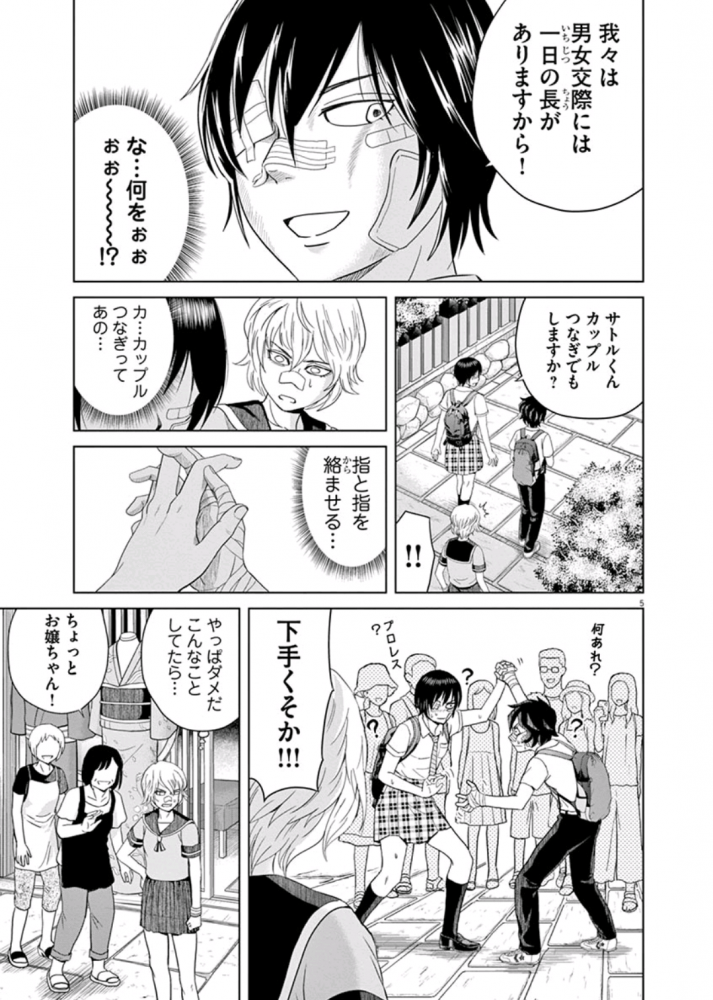
Saotome and Tsukishima are the definition of adorkable. They will try to hold hands, but their unfamiliarity with doing boyfriend-girlfriend things makes it look closer to a test of strength. At another point, Tsukishima declares that they’ll succeed through the power of love, only to realize that he’s talking to Saotome’s little brother, who proceeds to forever call him “Power-of-Love Man.” This is one of those series where everyone is kind of an idiot on some level, and it results in a wonderfully silly and sweet series that isn’t afraid to go for a heartfelt scene one moment and immediately transition to a gut-busting gag the next. The humor is somehow both subdued and absurd, and I can’t really think of many similar works. It somewhat approaches the stylings of Shibata Yokusaru’s 81 Diver, but isn’t quite as extreme and over-the-top.
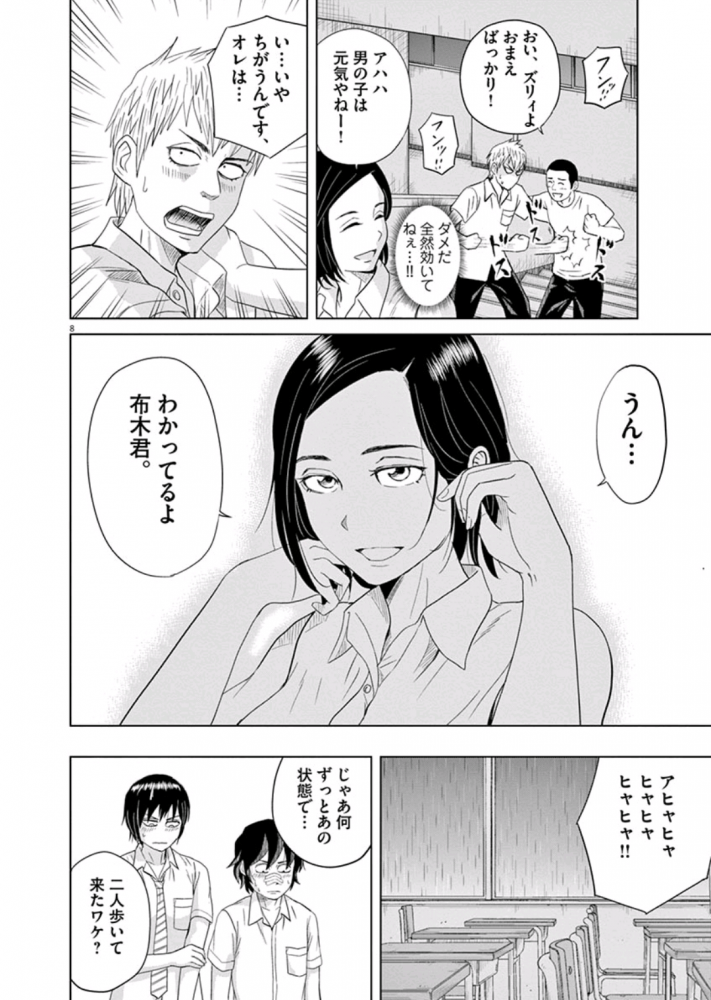
Virtually every character, from the main couple to the wide array of side characters, are hilarious and memorable—even Saotome’s random clubmates. Above is a scene where one of their clubmates tries to get some alone time with Wakano, a college-aged boxer and childhood friend of Tsukishima’s, by incapacitating his own friend with a punch to the stomach. …Except, they’re all boxers and can take a hit, so his friend just stands there laughing merrily. This whole thing ends with Wakano showing how to really deliver a body blow, leaving the clubmate doubled over but also a little happy.
Of the supporting cast, my favorites are Satsukawa Mizuki, a rival of Saotome’s who transitioned from karate to boxing with the most terrible sense of direction, and Konno Mito, the boxing manager who basically teases anyone and everyone. In those rare instances where the two are together, it’s even better.
But what I think really anchors this series and will make it endure is the depiction of Saotome and Tsukishima’s excellent relationship. On the surface, the two look like a somewhat mismatched couple that seems to thrive on reversing gender roles. Saotome is big and tough, and knows how to achieve victory after victory. Tsukishima is small and weaker, and has yet to win a single match in his boxing career. However, you can see that the two think the world of each other, and both inspire each other to greater heights. Saotome does not see Tsukishima as a “loser” who’s capable of less, but rather as a guy full of love for boxing, and who is making progress on his own terms through his own power. Tsukishima, for his part, is 100% supportive—not jealous—of Saotome’s greater success. He’s a challenge to toxic masculinity and the fear of emasculation: he’s shorter and less skilled in his own chosen sport than his own girlfriend, but absolutely no one thinks less of him, especially himself.
One unfortunate thing about Saotome-senshu, Hitakakusu is its timing. Saotome’s boxing path is about aiming for the 2020 Tokyo Olympics, and the series even ends with a flashforward to them. Before, it would have been possible to imagine the characters actually being there for the real deal, but COVID-19 has turned the 2020 Olympics into the 2021 Olympics, forever dating the series as a pre-coronavirus title. However, while that dates the manga, this doesn’t really detract from its overall excellence, and I hope as many people as possible end up reading it.
It’s Shinji’s turn to live his passion in Chapter 28 of Hashikko Ensemble.
Summary
Now that M-Con is over and the rest of summer break is left, Shinji decides to do what he’s been wanting to this whole time: visit a castle! After all, his original plan in high school was to make a Mountain Castle Club, before he got roped into singing. He wanted to bring the other members along, but only Akira and Hasegawa ended up joining him. Also, it’s technically a valley castle and not a mountain one, but that’s better for amateurs like the latter two anyway, according to Shinji.
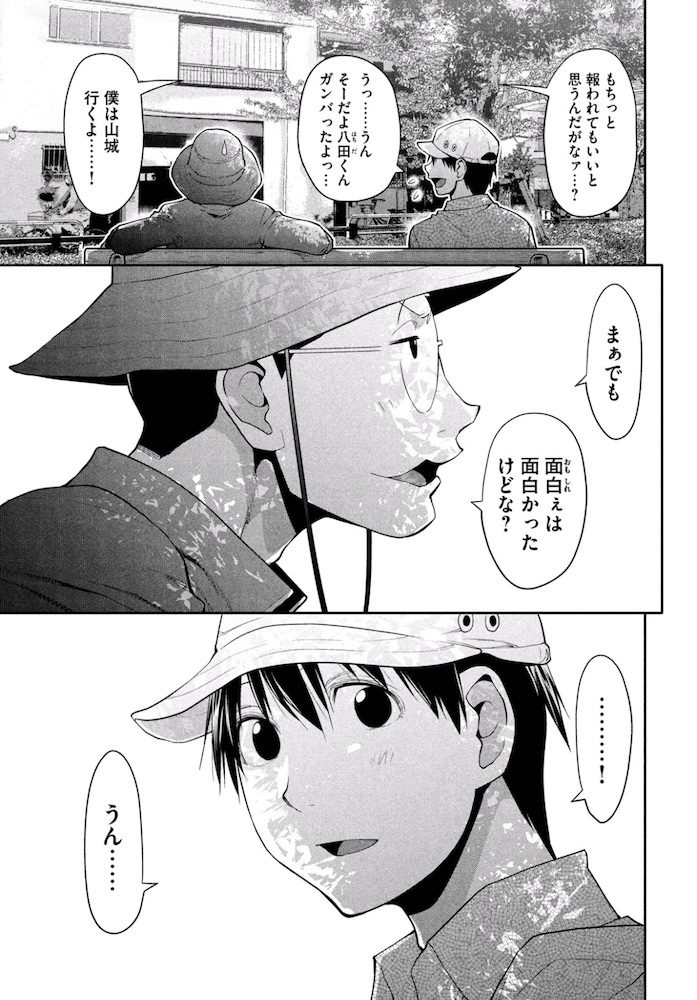
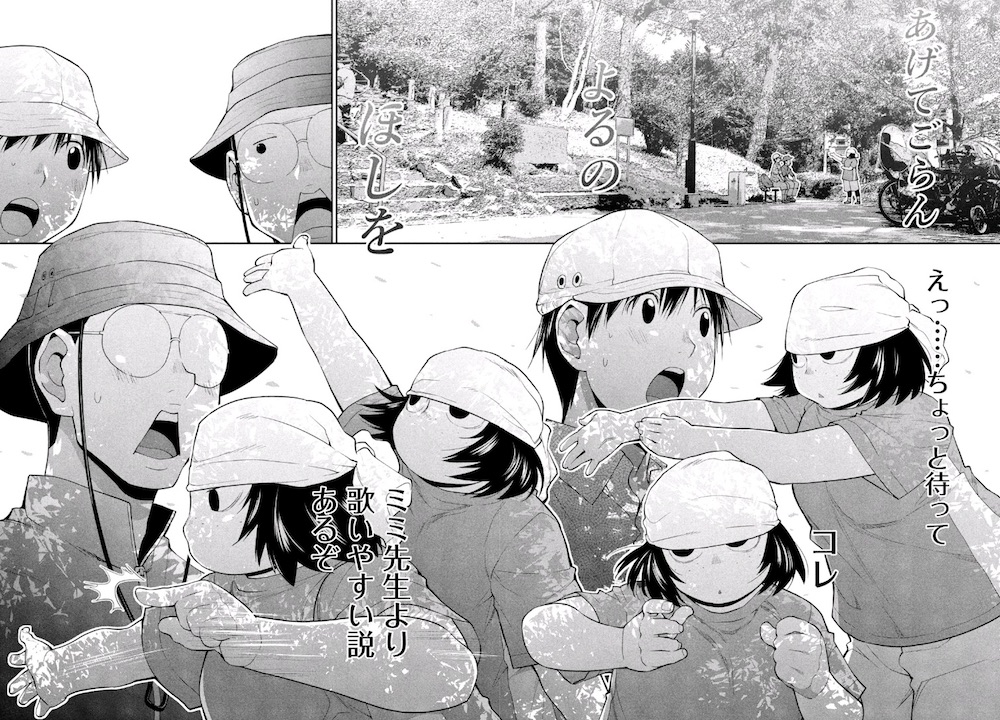
As the three take a break, Akira expresses his desire to sing more, while Shinji admits that even he got into it more than expected. Hasegawa surprises the both of them when she suddenly starts conducting, and the two guys start singing. She reveals that she’s been practicing in secret while watching Mimi-sensei, and the two immediately realize that she’s actually better at it than their club adviser.
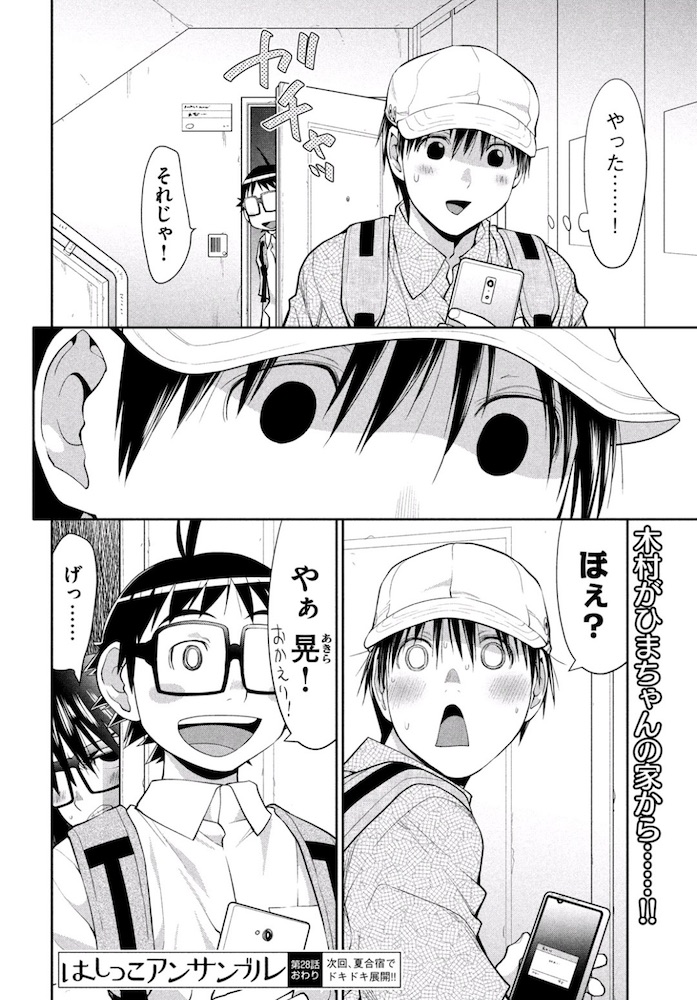
The singing draws the attention of an old man walking around, who explains that he’s a member of the Suns—the chorus they had visited when they were trying to figure out Orihara’s “hearing issues.” The old man, whose name is Yoshinaga, is himself a castle enthusiast, which thrills Shinji. During their conversation, he mentions having a vacation home in a nice outdoor area they could use for a training camp. After some calls, most of the club is into the idea, including Jin, who responds to Akira last. However, just as Akira is leaving his place, he sees Jin exiting Himari’s apartment while greeting Akira with a smile!
Oh Castle, My Castle
I had been wondering if Shinji’s love of castles would forever remain on the back burner in Hashikko Ensemble, so I’m happy that he finally gets to enjoy his true passion. Unfortunately, we don’t actually get to see the castle they visited, which is a reminder that this is indeed a manga primarily about music. I hope he eventually gets a true mountain castle.
I wonder if we’ll end up seeing more of Yoshinaga, if only because this would give a real mentor to Shinji—someone who can foster his love of castles and his burgeoning interest in singing. It could be something unique to Shinji among all the characters, and it might be the key to leveling him up really quickly for the next time the Chorus Appreciation Society performs.
Jin x Himari…?
In all likelihood, Jin stepping out of Himari’s family apartment (along with Himari’s angry grunt at being discovered) is going to just be some innocent misunderstanding on Akira’s part. Still, if i were to entertain the notion that something happened between the two during summer vacation, I have to admit that I think they’d be a cute couple. There’s something about the contrast between Jin’s overwhelming cheer and Himari’s curmudgeonly attitude that would appeal to me if they were an item, and one can only imagine how awkward everything about their relationship would be.
But putting that aside, the real purpose of that last-second shock is to highlight that Akira has romance on the brain to a certain extent. He’s been thinking about Shion a whole lot, even feeling continued jealousy toward Shunsuke after finding out that Shion’s been visiting Shunsuke’s home to practice piano now that her hand has healed. Now that Hasegawa is aware of the truth, her teasing is getting stronger, though it’s interesting that Hasegawa isn’t being protective of Shion. Instead, she seems to be encouraging it.
The innocence of the romances in Hashikko Ensemble is such a contrast to Spotted Flower, I must say.
Conductor Hasegawa
I figured at least a few of the characters not directly involved in the music would eventually join the club in a more involved capacity, but certainly didn’t expect Hasegawa to start working towards a role as conductor. I have to wonder how the others might eventually reach this point, and if this is the real reason behind Jin being at Himari’s home.
Then there’s Kurotaki Mai, the girl with the deep voice. I still think she’ll come in for a more prominent role eventually.
Songs
As Hasegawa conducts, Akira and Shinji sing “Miagete Goran Yoru no Hoshi o” by Kyu Sakamoto—the same featured song as the last handful of chapters.
Final Thoughts
Given that M-Con is in the past now, I can only assume they’ll be practicing some new songs to add to their repertoire. I wonder where they’ll go next. I personally don’t have any must-see songs, but something far off from “Miagete Goran Yoru no Hoshi o” could be a nice change of pace.








 OGIUE MANIAX