Giver of Thanks: Ogiue Maniax Status Update for November 2016

November is anniversary month for Ogiue Maniax, but I’ll be saving that for its own dedicated post (if I remember, that is. Someone please remind me!).

A big thanks to this month’s Patreon sponsors. You might not understand how much I appreciate your help, but I’ll explain at the end:

General:

Johnny Trovato

Ko Ransom

Alex

Diogo Prado

Yoshitake Rika fans:

Elliot Page

Hato Kenjirou fans:

Elizabeth

Yajima Mirei fans:

Machi-Kurada

Before going into an overview of my favorite posts of the month, I want to talk a bit about my appreciation to my readers for being curious as to what I have to say. As I go through life, I meet more and more anime and manga fans of different tastes and philosophies, but often I feel it can be difficult to engage in conversations about the nitty-gritty of anime and manga as ways to explore thought, society, emotion, and more. Talk about anime and manga floats at the surface, or, if it delves deeper, is often connected to value judgments or inside looks at the mechanics of industries. I know my audience isn’t especially large, but I am grateful that the topics I’m interested in at least pique your curiosity.

That being said, I know I’m really bad at responding to comments on a frequent basis, and I intend to work harder at fostering actual conversation on Ogiue Maniax. Also, because I’ve been more review-heavy as of late, I’m wondering if this is steering away from the strengths of the blog.

As for this month’s post highlights…

First, at long last, is a final review of one of my favorite manga in recent memory: Mogusa-san. If you love food manga, this is right up your alley.

Second, out of the many films I watched over October, Miss Hokusai has to be the one I enjoyed the most. ALso, check out Kizumonogatari Part II and Shin Godzilla.

Third, I took a different approach to covering New York Comic Con this year, and have been writing response essays to things that caught my attention. If you like giant robot toys, check out my thoughts on Soul of Chogokin Voltron and Megazord.

Lastly, I wrote a bit about Star Ocean EX, and just how 2003 it is.

I’m not sure what I’ll have in store for November, but I’m thinking of devoting a significant chunk to talking about some of my favorite recent characters.

Where in Time is Thomas Edison?: Time Travel Girl Anime Review

timetravelgirl

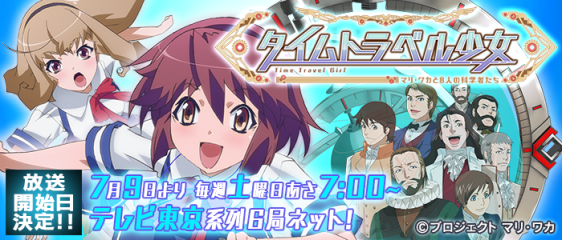
As a kid growing up in the 1990s, there were a number of educational shows that tried their best to be cool. Some perennial favorites, like Sesame Street and Mr. Rogers, played to the beat of their own drums. Others failed miserably and came across as more cringe-worthy than anything else. But there were a handful that managed to just be “cool enough” that, while you wouldn’t brag to your friends that you were watching these shows, they still felt like they had merit and weren’t overly didactic in their “edumucatin’.” That’s exactly the territory where the 2016 anime Time Travel Girl: Mari-Waka and the Eight Scientists resides.

Apparently based on a 1983 Japanese children’s educational book called Magnets & Electricity, Time Travel Girl follows a girl named Mari as she inadvertently discovers a way to travel through time, always finding herself meeting a great scientist or inventor tied to the history of electromagnetism. As shown in the opening, the eight in question are: William Gilbert, Benjamin Franklin, Alessandro Volta, Michael Faraday, Samuel Morse, Alexander Graham Bell, Heinrich Hertz, and Thomas Edison.

In terms of look, Time Travel Girl does not seem like it comes from this era of anime, no pun intended. From the characters’ hair and eyes, to their archetypes, to even the opening itself, it looks like a show that stepped out of 2003. Placed next to older series like World of Narue or Someday’s Dreamers, it wouldn’t appear out of place at all. I think that also lends to the feeling of Time Travel Girl being a “cool” educational cartoon, because it’s like the aesthetics are a bit out-of-touch with current Japanese animation. That being said, the actual show is fairly fun and informative, and it does resolve instead of remaining open-ended. This is despite the fact that its formula makes that sort of repetition oh-so-easy.

What probably impresses me most about the series is the way it pushes the message that science and discovery are about questioning what we take for granted. By not letting assumptions (be they personal, religious, etc.) control us, it opens up pathways not only for we as individuals to learn, but also in the process creates opportunities for those in the future. A less pertinent message, but important in its own right, is that the show implicitly presents its own theory for why Thomas Edison was an asshole (seriously, look it up). There’s even a bit about slavery in the Benjamin Franklin episode.

If there’s any American cartoon series I would liken Time Travel Girl to, it would have to be Where on Earth is Carmen Sandiego? No, not the one with Rockapella, and not (despite the thematic similarities) the followup quiz show Where in Time is Carmen Sandiego? I’m talking about the one with the grandiose opening, the two kids, and the giant floating virtual head for a chief. Both it and Time Travel Girl have just enough pizazz to be entertaining, but neither are especially gripping examples of animation.

Based on my dated comparison, it’s very clear that Time Travel Girl is certainly not meant for me. However, I could actually see it being dubbed into English and broadcast on TV, as it is unabashedly an educational cartoon. I think it would do all right in that capacity, though I don’t know if we’re still at a point where the characters’ Asian origins would be removed.

If you liked this post, consider becoming a sponsor of Ogiue Maniax through Patreon. You can get rewards for higher pledges, including a chance to request topics for the blog.

Game of Undeath – Kizumonogatari Part II: Nekketsu

kizumonogatari2

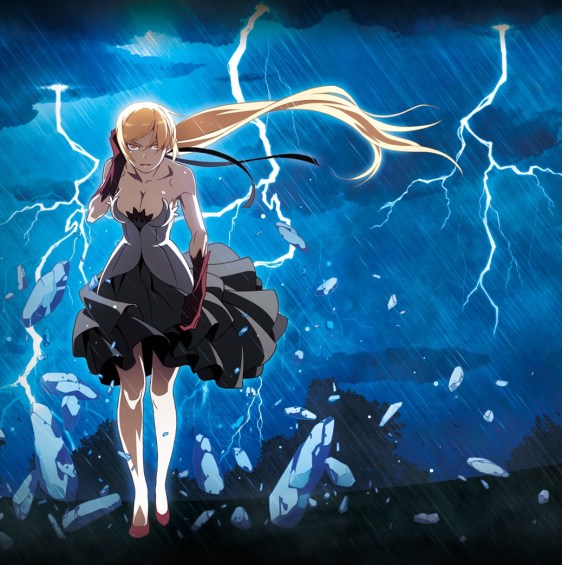
One of the many purposes a prequel can fulfill is to show how the characters we’re already familiar with came to be who they are. This is the story of light novel author Nisio Isin’s Kizumonogatari, which recounts how Araragi Koyomi, protagonist of the Monogatari series, would become embroiled in the world of the supernatural, and how his friendship with his beautiful classmate Hanekawa Tsubasa would form. In its adaptation to film, Kizumonogatari has been split into a trilogy, with the first being an introduction to the cast, and now the second covering Araragi’s realization of his newfound vampire power. Suffice it to say, this film is not meant for people to watch it without having seen Part I.

While the first film was quite violent, as we see images such as a limbless Shinobu bleeding all over the ground, Araragi writhing in agony as the sun sets him aflame, Kizumonogatari Part II: Nekketsu is much more violent in terms of the ubiquity of action scenes. Presented much like a series of video game bosses or Bruce Lee’s Game of Death progression, Araragi (with his new vampire abilities) must fight three increasingly strong opponents who have taken the limbs of his master, Shinobu. During these fights, we begin to see the origins of Araragi’s favored game plan: sacrifice his own body because its regenerative power allows him to take a lot of abuse. In Bakemonogatari, he’s much less of a vampire than he is here, so this is the strategy at its most powerful, even if Araragi’s lack of experience means he isn’t using it as well as he could. One of the other interesting aspects of Araragi’s battles is that he initially assumes himself to be the underdog, which is very much in line with this personality.

In terms of the action scenes but also many of the “slower” parts of Kizumonogatari Part II, this film is unmistakably SHAFT-esque. Ever since director Shinbo Akiyuki brought his signature visual style of sudden cuts, fragmented imagery, and head tilts to the world of Monogatari, it’s created a certain expectation for how these anime should look. With a clearly larger budget than what they get for their TV series, the fight scenes get elaborate and intense beyond what one might even expect simply reading the light novel, and even the endlessly large rooms where battles take place in the TV series feel somehow less infinite than the sets of Part II. Unlike Part I, which I found to be a good deal more amenable to those unfamiliar with or jarred by the Monogatari style, this middle part of the trilogy pretty much goes in full force. Due to how much both Nisio Isin and Shinbo love to indulge in metatextual elements, it often feels like a match made in anime, but at times I wonder if there’s a breakdown somewhere between the two creators’ approaches.

One aspect of the film that still leaves me puzzled is the way that Araragi and Hanekawa would eventually end up the way they are. While Araragi is clearly always attracted to Hanekawa and vice versa in later parts of the series, in Kizumonogatari their mutual interest is almost animal at times. By the time of Bakemonogatari, it’s still there, but somehow also a lot more cordial. Not only that, the two of them also just feel fairly different personality-wise and somewhat disconnected with the images of them I’m more familiar with. This is probably intentional, in order to show their growth. Also, while the disconnect seems jarring, Part II lays some of the foundations for what we see from Araragi and Hanekawa later on in terms of secrets and revelations.

Kizumonogatari Part II: Nekketsu suffers a fair amount from being the second part of the trilogy because the context can feel lacking and the end of the film leaves things a bit unsatisfying so that it can lead directly to the third film. However, it still ends up being a very thrilling and visceral experience in terms of both action and sexual tension. In a way, this film is mainly a transitional state, the point where everything begins to really change, but the outcome of which is still a mystery.

If you liked this post, consider becoming a sponsor of Ogiue Maniax through Patreon. You can get rewards for higher pledges, including a chance to request topics for the blog.

New York Comic Con 2016 Essay #2: Lucha Underground and Scripted vs. Unscripted Promos

I don’t talk about wrestling all that often on this anime and manga blog. Pro wrestling hasn’t been a staple part of my pop culture experience in over a decade. That being, said I do maintain a curiosity towards the state of its industry and its viewers. Who are the popular heroes (faces) and villains (heels)? What wrestling promotions are currently out there? What do the fans think? It’s this desire to keep a finger on the pulse of wrestling that prompted me to attend the Lucha Underground panel at New York Comic Con 2016, despite the fact that I had seen less than 30 minutes’ worth of material.

Lucha Underground is a current American television program that focuses on the high-flying acrobatics style of Mexican wrestling called lucha libre. The panel featured both writers and performers for Lucha Underground, most notably Rey Mysterio, Jr., the man who has become the icon of lucha libre itself in the United States. The panelists discussed what it’s like to work on the show and what Lucha Underground does differently compared to other promotions. Of these various comments, what stood out to me most was the fact that Lucha Underground is produced more like a traditional television series. Storylines are plotted out, many characters are created well in advance (with wrestlers having auditioned to fulfill those roles), and a lot of post-production is utilized to create a more cinematic experience. In other words, Lucha Underground is neither “live” in the traditional sense nor “live to tape.”

The reason I find this notable is that if you ask many current wrestling fans (and I imagine even fans of Lucha Underground) what’s wrong with WWE today, it’s that the show is too scripted. Individual wrestlers have their promos written for them, and only a select few are allowed to go off the cuff. This is a very different world from where wrestling was in eras past, where things like “Austin 3:16” and Macho Man’s “cream of the crop” were their own creations. It makes sense, given that wrestlers are in general not the greatest actors, but that they can be very good at crafting their own characters based on their own personalities, or taking a gimmick given to them and going the distance with it. The fact that Lucha Underground goes even further in the direction of being scripted (not just in outcomes, but also in long-term story planning) seems to fly in the face of this criticism.

However, I wonder if the issue is that promotions like WWE are caught in the middle, such that it lacks both the improvisational feel of old and isn’t refined enough in its narrative elements to really make sure its scripted elements are as tightly plotted as possible. This might just be a symptom of still being a live show on top of being the biggest wrestling show on air today. There’s a desire to avoid taking too many risks at the same time they understand that new blood and new opportunities are necessary, and if something awry happens they can’t just make it so that it never happened (even if wrestling storylines are always incredibly fluid). At the Lucha Underground panel, they mentioned how not having the show be live allows them to do multiple takes, and try crazy and untested ideas because anything that isn’t effective can go on the cutting room floor.

Given that this is how Lucha Underground is made, I find that this format ends up veering closer to sports anime, such as the current wrestling series Tiger Mask W. They can emphasize emotion and power in ways that don’t have to adhere to the semblance of realism (kayfabe) that still persists in other places even though everyone knows wrestling is “fake” now. By using creative camera angles, by making sure the mystic or occult elements of their universe don’t require you to suspend disbelief any more than you would a late-night drama, it perhaps allows Lucha Undeground to create an experience where its luchadores are truly “characters.” And by being characters, they can feel even more real.

If you liked this post, consider becoming a sponsor of Ogiue Maniax through Patreon. You can get rewards for higher pledges, including a chance to request topics for the blog.

Days of Future Past: Star Ocean EX

staroceanex-01

Star Ocean is one of those longstanding RPG game series that I know next to nothing about. I’m aware that it’s been around a while, and that it just got a new iteration this past year. So, when I was requested through Patreon to write about the 2001 anime Star Ocean EX, I had to come at it as a total novice. I didn’t know where it fit into the franchise, if it was a prequel, sequel, alternate universe, or whatever. However, because of when it came out, I find Star Ocean EX to be a historical artifact of sorts, a slice of anime and Japanese pop culture history at the time. Thus far, I’ve only watched five episodes, so my view of the show isn’t complete, but I still have some thoughts I want to share.

Overview and Basic Thoughts

Star Ocean EX is the story of Claude C. Kenny (the blond above), a young space officer and son of his ship’s captain. Self-conscious about the possibility of being viewed as being there only because of nepotism, Claude constantly tries to prove that he’s his own man. While investigating some ruins, he’s transported to another world where magic, rather than science, rules the day.

While the show looks pretty dire in terms of animation in budget, I can get behind the story. Its basic premise of a boy from a futuristic world ending up on a more fantasy-style planet has instant appeal in terms of setting the stage for interesting contrasts. The initial conflict between Claude and his father is also understandable on both sides. Claude wants to leave no doubts, especially from himself, that he’s his own man. His father is stoic and stern, but cares for his son deeply. I do wonder whether I would have picked up on both characters’ feelings had I watched this 15 years ago, or if I would have found both aggravating.

An Anime of Older Tropes

The character designs are straight out of the late 1990s/early 2000s aesthetics, but even if you ignore that element the characters’ personalities also shout “turn of the 21st century,” similar to many of the original characters in Super Robot Wars such as Ryune. While fathers being distant (both figuratively and literally) is a tradition in Japanese pop culture media like anime and games, there’s something about Claude in particular that rings especially true in a post-Evangelion period. While it’s clear that his relationship with his father is nothing like Shinji and Gendou’s combines aura of dysfunction, the chip Claude carries on his shoulder, as well as his dad’s inability to communicate his love and concern for Claude speak to that in a rough way.

staroceanex-03

With the other two important characters Claude meets early on, I get a similar vibe of “archetypes from a past era.” Celina Jules is a seductive-looking treasure hunter who visually seems like a mix of Belldandy and Urd from Oh My Goddess! Rena Lanford (the other character in the first screenshot) is a young blue-haired healer who exists somewhere in the vein of Azmaria from Chrono Crusade (manga: 1998-2004), and Index from A Certain Magical Index (light novel: 2004-2010). Those characters aren’t that far off time-wise from Rena and Star Ocean EX, but her particular brand of gentle demeanor crossed with spunk fades away with every passing year.

The Frontier of Digital

staroceanex-02

The other aspect of Star Ocean EX that really caught my attention was its animation style. The series came out right when full digital animation in Japan was becoming a thing, and it shows. It’s often really rough, with characters behaving like cardboard cutouts sliding about a little too smoothly. There’s also a feeling of clunkiness in terms of getting used to digital tools, which often means that the art itself looks unrefined. That all being said, I can forgive many of these gaffes, because being smack dab in the middle of a transitional period isn’t easy. A lot of what has defined anime aesthetic in days past is how creators make the most out of low budgets, and seeing the staff try to make the most of what they have is rather intriguing. For example, when Celina uses her fire spells, they apply a digital blur effect that’s meant to be the haze created by the heat of flames, but it sort of just ends up making things hard to see.

Overall

The old reputation of anime and manga based on video games is that it’s a pantheon of terribleness, but Star Ocean EX holds up fairly well. It’s not exactly a lost gem, but it is a product of its time, and at the very least a fun show to observe in that respect in addition to its actual narrative.

This post was sponsored by Johnny Trovato. If you’re interested in submitting topics for the blog, or just like my writing and want to support Ogiue Maniax, check out my Patreon.

A New Memory: Shin Godzilla Film Review

shin_godzilla_us_poster

What does it mean to be a “true” Godzilla film? Is it a spiritual closeness to the original film from 1954? Is it embracing all aspects of what Godzilla has represented (criticism of humankind’s folly, defender of the Earth, and more), just as the recent 2014 film did? The latest film, Shin Godzilla, tackles that question in an interesting light, bringing the classic Japanese monster into the concerns of a contemporary Japanese (and to some extent global) audience.

Directed by Anno Hideaki, a man known more for his influence in anime as the creator of Neon Genesis Evangelion, Shin Godzilla exists as a clear reboot. Set in modern times as Japan encounters Godzilla for the first time, the monster is quickly revealed to be the product of nuclear waste much like the original, but with the implied added context of the Fukushima Triple Disaster that hit Japan in 2011. While the expectation might be to focus primarily on the horror and destruction caused by Godzilla, the film defies this and instead has most of the action occur in government  offices. This may very well sound like the most boring approach to a Godzilla film possible, but it’s actually very amusing and effective at getting the thrust of Shin Godzilla across.

While Shin Godzilla can be viewed as a movie full of talking heads and a bit of (extremely well-choreographed) Godzilla violence, the film draws strength from this format. By having groups of government officials move from one meeting room to the next over the slightest change in scenario, and by giving those characters increasingly long official government titles (to the extent that they begin to fall off the screen), it takes a stab at the bureaucratic inefficiency of the Japanese government. Instead of trying to create a character drama where a hero goes through a process of growth, the narrative unfolds more like an onion, as we the viewers see them try to figure out the mystery that is Godzilla, and how Japan will have to deal with its presence.

The actual protagonist of the story, Yaguchi Rando, is a young politician who chafes at the amount of red tape that weighs down any government action, and ends up forming a Godzilla task force. While Rando’s actions, as well as the portrayal of how the Japan Defense Forces are shackled by a long and tedious chain of command, potentially renders the film one in favor of less democracy and more military action, the actual portrayals of the politicians themselves appear to say otherwise. Every government official in Shin Godzilla, from Rando to US senators to the bumbling Japanese prime ministers, are shown to ultimately have the interests of the people at heart, even if they’re not always best-equipped to handle their positions. It’s an unusually positive portrayal of the desire for politicians to do good, and even the most scheming politician in the film ultimately works in a fairly altruistic fashion.

As for the portrayal of Godzilla itself, there are a number of new elements that breathe new life into the kaijuu, such as rapid evolution, a new attack reminiscent of the titular giant robot from anime Space Runaway Ideon‘s missile barrages, and even new anti-Godzilla countermeasures. Shin Godzilla highlights the power, majesty, and connection to nature that is a part of Godzilla, but also brings a new meaning to “destruction in Tokyo because of Godzilla.”

Shin Godzilla ends up being a clever and insightful film that challenges viewers to look at the problems of today with both an understanding of the past and an awareness that the solutions of old do not necessarily work today. While the actual action is scarce, what little is present ends up being captivating. The result is an excellent new film, though I wonder if it should be followed up with a sequel at all. It might very well end up changing the “meaning” of Godzilla yet again.

If you liked this post, consider becoming a sponsor of Ogiue Maniax through Patreon. You can get rewards for higher pledges, including a chance to request topics for the blog.

The Strength and Creativity of a Woman: Miss Hokusai Film Review

misshokusai

When it comes to the history of Japanese art, no name stands out more than Hokusai. Most famously known for works such as his amusing sketches known as Hokusai Manga, as well as The Great Wave Over Kanagawa, his prints and paintings are the definition of iconic. One lesser known fact, at least to folks such as myself, is that he had a daughter who was a renowned painter and printmaker in her own right. Her life is the central focus of the film Miss Hokusai (known in Japanese as Sarusuberi), a highly appealing movie directed by Hara Keiichi (Summer Days with Coo) whose meandering path from beginning to end makes it all the more engaging.

What stands out about the film above all else is the main character herself, Katsushika O-Ei. “Miss Hokusai” exudes a strong charisma that gives her story weight and carries the film forward despite the fact that she doesn’t have any sort of singular ambition or goal she’s trying to fulfill. Instead, the focus is broader, showing her personal challenges as an individual, and how she handles them from one day to the next. For example, she works as an assistant to her father, and her awareness of both his general disheveled nature and his brilliance makes it so that the sheen of celebrity that he possesses is simultaneously both dulled and refined. The most notable aspect of her design visually is her big, bushy eyebrows (inherited from her dad), which gives her a memorable appearance.

Though the film presents in some ways an idealized image of Edo (currently Tokyo), it takes great steps to reflect the realities of the times it’s portraying. None of the characters speak in the style of Japanese one would hear today in modern Tokyo, and instead everyone has an Edo accent. Though this is not explicitly stated in Miss Hokusai, one of the main reasons the “Edo dialect” became more widespread was that it was how the women in the brothels spoke. The commonality of prostitution, and the fact that it wasn’t considered an especially big deal, sets the kind of environment that O-Ei lives in, all without admonishing it.

Related to this, one of the more interesting aspects of the film is the full acknowledgement that ukiyo-e and other forms of printing were not especially glamorous worlds. Its makers toed the line between artists and artisans, and the fact that pornographic and erotic art was a staple of the market is both well-established and incorporated into O-Ei’s own narrative. Her inexperience with love has an effect on both her business (she’s known for her unrivaled talent in drawing beautiful women but isn’t as good at depicting sex), as well as her personal life (she’s constantly flustered when speaking to the man she’s smitten with).

There’s also a spiritual/occult element to the film that I don’t want to spoil too much, but it reflects a kind of deep emotional and spiritual connection to art as expressed by both O-Ei and her father. It really makes me think about the idea that, even since the time of prehistoric cavemen, the ability to recreate worlds both familiar and alien assumed a kind of power bordering on the divine. The way Miss Hokusai depicts the act of creating art portrays it as a magical experience that visits different creators in different ways.

Another visual quality that gave me much to chew on mentally was the act of seeing these anime characters drawing in this older style. Though ukiyo-e and such are sometimes argued to be the precursors to manga and anime as we know it today, the connection is actually rather tenuous. However, seeing the same characters depicted in both anime form and in that woodblock print style connects these two different aesthetics together. As a result, I began to consider the idea that, even if they aren’t related all that much historically, there is a kind of spiritual succession at work between “Hokusai manga” and “manga,” so to speak.

Overall, I highly recommend Miss Hokusai to anyone who enjoys a kind of circuitous storytelling where the important pieces slowly come into view, and to anyone who wants to see an inspirational and uplifting woman who is certainly not without her own flaws. It’s visually rich, full of characters who need only moments to draw you into their world, and a clever portrayal of what it’s like to be a creator.

If you liked this post, consider becoming a sponsor of Ogiue Maniax through Patreon. You can get rewards for higher pledges, including a chance to request topics for the blog.


Third Time’s the Charm?: Kimi xxxru Koto Nakare, Chapter 6

kiminakare6-hayatoshingo Whenever I read a chapter of Kimi Nakare, it always feels like the next chapter might be the end of the story. Chapter 6 not only follows this, but the vibe is stronger than ever.

Summary

In spite of whatever hopes might be lingering, WARP’s days as an idol group are numbered. As a final farewell to their fans, their manager has arranged one last massive meet ‘n’ great with the fans.

Not long after, Hayato and fellow WARP member Shingo are having a bath time discussion about their futures. While Hayato believes himself to be ill-suited to the idol path, especially because his initial motivation was just so he could meet Nobuko, Shingo responds that Hayato’s attitude (and idiotic qualities) are what make him a natural idol.

In a flashback to Shingo’s high school days, we see a conflicted Shingo unsure of whether the idol path is for him, not least of which is because his hospitalized father is very much against it. Shingo ends up bumping into a girl at the hospital who turns out to be a fan of idols. Accidentally revealing that he’s an idol from the same agency as her favorite, Shingo listens to her story of how idols helped her to keep living in spite of her illness, which strengthens Shingo’s determination to continue his idol career no matter the odds.

The next day, Hayato is discussing the upcoming meet ‘n’ great with Nobuko and Natsumi. When Nobuko promises that she’ll defend him from all of the fangirls, Hayato confesses his feelings for her once more—this time in front of the whole class!

Urgency

kiminakare6-3rdconfession

As I briefly mentioned in the introduction, Kimi Nakare often feels like it’s moving at a breakneck pace in terms of typical romance manga developments. It’s one thing to have a confession in Chapter 1, but it’s another to have three confessions in six chapters. Not only that, but each of them raise the stakes more and more, because now it’s not even a secret among close friends anymore. While I could see the class not taking it seriously, especially because Nobuko has made a running gag out of her on-screen obsession with Hayato, I think they’re going to realize what’s going on sooner or later.

The sense of urgency isn’t limited to just the main romance, either. Just the fact that a scandal has already dissolved Hayato’s idol group and put him on a slightly different path is the kind of development that would usually occur late into a manga’s life. In some ways, it feels like early Kimi ni Todoke, where every time you think the story would move one way, it would swerve in the other direction, and usually for the better. Can Kimi Nakare keep up this pace? It’s something I welcome, and while I hope the series does well, I also hope that it wouldn’t fall into the trap of becoming increasingly meandering if it reaches major success.

The Side Cast is Growing on Me

kiminakare6-hospital

In my review of Chapter 5, I mentioned that the side characters aren’t nearly as interesting as Hayato and Nobuko. While I still stand by that statement, I think the other characters are starting to come into their own. I actually previously had trouble keeping track of all the guys in WARP, but now I have a firmer grasp of Shingo as a character. We’ve yet to see more characters on Nobuko’s side of the story, so I’m curious as to what might be in store there.

The Irony of the Natural Idol

After reading Shingo’s comments to Hayato about he’s a natural-born idol, it made me think about how idols are presented to the world, and in turn how idols are presented in Kimi Nakare. Idols, male or female, often project an image of both innocence and sensuality, and this quality is central to the story of this manga. There’s the scandal with WARP member Jirou and his having a girlfriend, but there’s also the idea that the idol business has a dark side. In the real world, idols are often controlled day-in and day-out by their agencies, and it’s what leads to the criticism that idols are just a way to make money off of gullible fans. For me, I think that it can be healthy as long as there’s a tacit understanding that it’s a shared fantasy, something akin to pro wrestling.

If Hayato is a natural idol, it means that he achieves that innocent sensuality without effort, through both appearance and attitude, and it’s exactly that kind of demeanor that you’d expect to get subsumed by the idol engine. To be in the right spot, he has to be just strong enough to never stop being himself, but also just “dumb” enough to stay naive. It’s a precarious position that is preserved in part by his love for Nobuko. That, of course, is also the other irony, that what makes him a natural idol is also what is liable to get him kicked out of the business.

One might also say that his masturbation scene in Chapter 4 represents that combination of innocence and sensuality perfectly. Here is this handsome yet goofy guy who just can’t hold back his very real passion for the girl of his dreams. Her being not beautiful by conventional standards only adds to that rather special moment of characterization.

Last Thoughts

Idols are all well and good, but I want to see more of Nobuko!

If you liked this post, consider becoming a sponsor of Ogiue Maniax through Patreon. You can get rewards for higher pledges, including a chance to request topics for the blog.

Mogusa-san: The Joy of Superhuman Eating 

mogusasan-unajuu-small

I love to eat. Just thinking about all the varieties of cuisine out there in the world, with dishes for the rich and the poor, gives me pure joy. That’s why one of my favorite manga over the past few years has been a food-themed series called Mogusa-san. The simple story of a cute and gluttonous girl who has mastered the art of stealth eating, I’ve already written two posts praising the series up and down. I recently picked up the most recent volumes and was surprising to learn that Mogusa-san as I originally knew it had come to an end. Volume 10 actually marks the conclusion to Mogusa-san, but it turns out that there’s already a sequel (more on that later). In any case, this gives the perfect opportunity to write an overall review of the manga.

Mogusa-san follows Mogusa Minori, a seemingly normal girl with a seemingly normal appetite. However, one day her classmate Koguchi Torao notices something odd: while Mogusa appears to be writing in class, she’s in fact snacking on a pretzel stick. The reason no one notices is that her pantomime is so convincing that most people assume she’s just using a normal pen. It turns out that Mogusa’s appetite is near-insatiable, and that she sustains herself by eating constantly, hiding her food in plain sight. After Koguchi reveals that he’s aware of her secret, the two of them become “food buddies,” visiting snack shops and other food establishments to bask both in the quantity and quality of various foods.

mogusasan-popsicles-small

Generally speaking, there are two different types of food manga. There are the series that bask in portraying the simple joy of eating and drinking, such as Sweetness and Lightning. These works portray characters with wide-eyed expressions as food brings them true joy, resulting in “food responses” that are intense but not especially over-the-top. Then there are the manga that make eating and drinking the most powerfully dramatic and sensual experiences possible. These are the Yakitate!! Japan-type series, where tasting and creating foods becomes a religious experience fueled by impossibly superhuman abilities. One thing I love about Mogusa-san is that it possesses elements of both worlds.

When Mogusa has to engage in covertly satisfying her never-ending munchies, the series emphasizes the physical limits that Mogusa pushes in pursuit of eating. Whether it’s eating a stick of dango in 1/60 of a second, hiding candy inside the corners of her jaws in case of emergencies, she always has a trick (or a pastry) up her sleeve. However, when she’s allowed to just eat without feeling any sense of shame, especially when she’s with Koguchi, the look on her face as she bites into a succulent piece of meat or slurp some delicious ramen carries the same joy as a tamer degree of food manga. While Mogusa’s expressions are near-orgasmic at times, they’re not “actually orgasmic” as one would find in Food Wars!

mogusasan-kabayakitarou-small

While the concept might seem like it overstays its welcome, and a part of me expected that might be the case, Mogusa-san actually provides both enough narrative development and a sufficiently robust supporting cast that the series never gets tiresome. Koguchi and Mogusa bond over the course of the ten volumes in a beautiful way. Characters like Taira Chigumi (Mogusa’s opposite in that she has developed ways to hide the fact that she has the palate of a 10-year-old) and Tabe-chan (a professional competitive eater who considers Mogusa her life-long rival) add a surprising amount of variety to the theme of eating. Because these characters grow as well, Mogusa-san shows itself to be remarkably heartfelt while still remaining true to its core themes. Although there’s clearly a decent amount of experimentation in order to keep the concept in motion, the entire manga ends in an extremely satisfying way that leaves little room for disappointment.

mogusasan2-splash

So where does that leave the sequel? For whatever reason, it was decided that Mogusa-san would take on a new form, and it has now been replaced by a new series called Mogusa-san wa Shokuyoku to Tatakau (“Mogusa-san Fights With Her Appetite”). Taking place after a short timeskip, Mogusa is now a college student in Tokyo, and because she no longer has her family to support her regularly, she’s trying her best to refrain from eating all the time. The result is that Mogusa-san desperately tries to stick to “only” three meals a day that, while enormous in quantity for the average human being, are clearly signs of Mogusa trying to practice willpower and diligence when viewed in the context of the previous series.

One of the two most notable changes in this new setting is that Koguchi is no longer the perspective character, and readers are instead more privy to Mogusa’s own inner thoughts. The other big change is that there appears to be less of the shounen-esque “wacky stealth eating,” giving the sequel a somewhat mellower feel. A part of me definitely misses the old style, but I am quite curious about how college life is going to treat Mogusa.

You’ll know in just one chapter if you’re going to like Mogusa-san. For me, I think it took about four pages. It’s just a food manga that has never let me down, and I’m more than happy to keep reading it with the awareness that Mogusa Minori is a kindred spirit.

If you liked this post, consider becoming a sponsor of Ogiue Maniax through Patreon. You can get rewards for higher pledges, including a chance to request topics for the blog.
I’m Pleasantly Surprised that Hidamari Sketch Hasn’t Ended

hidamarisketch-vol8

Though I’ve been away from the series for a while, I recently read Volume 8 of the Hidamari Sketch manga. Rreleased in the US as Sunshine Sketch, it covers Sae and Hiro’s transition to college and the arrival of a new girl named Matsuri. With graduation and all that it typically entails in anime and manga, I expected this volume to be the last, so color me surprised when I found out that the series is still continuing.

Fan favorite K-On! had a similar change, but while I loved the move to college for K-On! and the transition into a new environment, I also know I’m the exception. It’s very telling that the series didn’t continue much longer after that. If I try to look at it from an unbiased perspective, it was perhaps too sudden a change in terms of how time seems to flow (or not flow, as the case may be) in K-On! Prior to graduation, Azusa is the only major underclassman in that series who was also a club member, and the rest were all of the same age. As a result, when they go to college, the focus shifts sharply away from their familiar and beloved high school setting, while the girls who remained in high school don’t have quite the group dynamic that readers loved over the years (even if Ui deservedly got more of a spotlight).

I don’t think Hidamari Sketch will have that problem, or at least not quite so much. When the series began, it was already about senpai and kouhai, whether that’s Sae and Hiro in contrast to Yuno and Miyako, or how later characters both older and younger are introduced. There is a greater sense of the forward progression through high school, even if Hidamari Sketch is moe slice of life comedy at its most mellow. Also, because it’s only a part of the cast moving on (not to mention that Sae, Hiro, and probably even Natsume still show up), the transition also doesn’t feel quite as jarring.

I’m looking forward to reading more, and I’m especially looking forward to Miyako as a terrifying high school senior.

If you liked this post, consider becoming a sponsor of Ogiue Maniax through Patreon. You can get rewards for higher pledges, including a chance to request topics for the blog.