Sunset on Somerset: AnimeNext 2015

Intro

Six years ago, I attended my very first AnimeNext and had a hell of an experience. Six years later I returned to the Somerset, NJ convention, only to find out that it’s the very last AnimeNext before it moves to Atlantic City in 2016. I feel glad that I could see it one last time before the big move!

Overview

AnimeNext in 2009 was well-populated, but it’s amazing how much it’s grown since then. Last time I went, I stayed at the Somerset Bridgewater Hotel in order to be close to the convention. This time around, it was part of the convention. As expressed to me by both my friends with whom I traveled and by AnimeNext staff, the convention had simply outgrown its space, necessitating the move to a more spacious location. Thankfully, aside from a terribly hot and humid first day, the weather was surprisingly manageable, which made the outdoor space between the three locations (Bridgewater, Double Tree, Garden State Exhibit Center) a nice reprieve between events.

Events

This year I helped out Waku Waku +NYC, an upcoming New York anime con this August 29-30, which made it so that I couldn’t attend quite as many panels and events as I normally would. However, the ones I did see where all quite interesting. The Penguindrum panel by the Reverse Thieves showed how the train imagery of the series incorporated both classic Japanese children’s literature and traumatic real world events. Land of Obscusion‘s “Greatest Anime We Never Got” told fans to find Sexy Commando, which I’m all for. The FLOW concert was fantastic, and I found myself singing along to the first Eureka Seven opening, even though I swore I didn’t know the lyrics. I even got them to autograph my anime DVD box set, alongside the Satou Dai signature I obtained back in 2009, not long after I attended AnimeNext.

Studio Trigger

Speaking of autographs, the highlight of the convention had to be Studio Trigger, creators of Inferno CopNinja Slayer, and Kill la Kill. I had heard how fantastic they were as guests last year, and so I had to speak with them. In addition to getting their autographs (Koyama Shigeto’s on Eureka Seven with a little Nirvash Spec3 sketch), most of the rest of the staff’s on Panty & Stocking with Garterbelt, I also joined in on their press conference and attended their 2-hour panel on Saturday evening. One thing that was clear from the press conference and the autograph session was that the people at trigger loved Panty & Stocking and sincerely wish they could make more.

The press conference itself was brief but amazing. At one point, Koyama introduced himself in Japanese as the designer on Inferno Cop, to which the translator “assisted” him by interpreting his line as “designer on Big Hero 6” (which is true). They explained how Inferno Cop actually came out of a commission by Google of all things, which is made all the more surprising by how much money Google is known to have and how little money and effort was placed into Inferno Cop. This isn’t a knock at Trigger, as they themselves mentioned that they set a rule that they could only spend two hours a week on Inferno Cop, which, according to Koyama again is a very original series about a hero of justice with a flaming skull that is 100% original in every original way, really and truly. They also mentioned how their original idea was the story of an ordinary guy in a superhero academy, which they would’ve called Superson, except that it was a “crappy anime,” in their words.

As a final question at the press conference, I asked Studio Trigger about one of their more obscure works, Turning Girls, or more specifically how it came to be. The story of its creation turns out to be one of the greatest tales ever brought forth by humankind.

Turning Girls, which is named so because it’s about girls who are about to turn 30 and have hit a transitional point in their lives, is created and produced by the non-animator female staff of Studo Trigger. Essentially, they wanted to see how people with no experience in animation would make an anime. Though the series did not attract much of an audience abroad, the sponsor who asked them to do it in the first place keeps asking for more, against their expectations. During the Q&A session at their panel, I casually commented that they should produce more Turning Girls as well, to which they responded with “NO” in English. Also, it’s important to note that all of the girls are apparently based on the staff members themselves, and that one of them indeed carries shades of Kaerun, the highly abrasive aspiring idol from Turning Girls.

If there’s one major highlight of the entirety of AnimeNext, however, it has to be the return of Inferno Cop. This wasn’t just any episode of Inferno Cop, though. It was, in fact, an Inferno Cop x Little Witch Academia crossover. Sucy Manbavaran made an appearance in the episode while drawn (and voiced!) in the signature Inferno Cop style. While they showed a number of animated shorts created by the staff, this had to take the cake.

Thanks to Ani-Gamers and All Fiction for asking good questions at the press conference, and to Ani-Gamers in particular for providing the audio.

My Panels

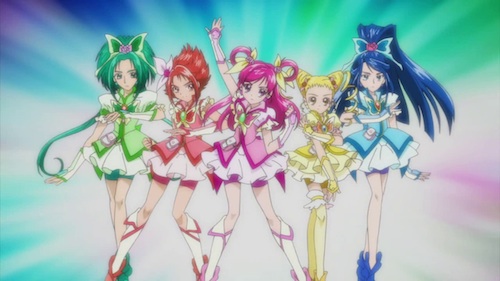
I ran two panels at AnimeNext alongside my friend Alain from the Reverse Thieves. These were “Precure Party” and “Giant Robot Romance: Boy Meets Girl Meets Mecha.” The first covered the history of the immensely successful Precure franchise, which we might rename if we ever bring it back to make sure that people know that Precure is a mahou shoujo series. The second was about giant robot anime that focused heavily on romance and romantic relationships, taking us through a strange path from Toushou Daimos all the way to today.

If you attended either panel, thank you. The turn-out was somewhat small though I suspect that the inconvenience of getting to the Somerset Bridgewater where the panels were both held played a role. I definitely enjoyed running the panels, including the extra time we had to show fun clips for the audience at the end of the robot panel. I feel glad to be able to talk about two of my great loves, magical girls and giant robots, all in the same weekend.

Criticism

Aside from the location issues, which AnimeNext has been well aware of for years now, my only real complaint was that often the staff and volunteers weren’t much help. This isn’t painting all of the volunteers with the same brush, but on multiple occasions I had asked questions (best way to get to a location, where to line up for FLOW autographs), only to receive the response of “I don’t know.” Sometimes it was “I don’t know, let me check,” only for the volunteer to disappear into the aether never to return. Of course, a volunteer is a non-paid position, and I’m sure many of them were new, but after the 5th time it started to grate on my nerves. We all have to start somewhere, though!

Food

As my friends last year came back from AnimeNext, all I heard about was the gloriousness of the hot dogs at Destination Dogs. Seeing as AnimeNext was leaving the area after this year, it was a must-try place for me. I ordered the Boston (beef frank, baked beans, cole slaw), the Swede-Dreams (bratwurst, mashed potatoes, gravy), and the Charles Dog Gaulle (duck sausage, duck confit, foie gras). It’s tough for me to decide which one I like more, the Swedish dog or the French one, but the redundant duck action and the delicious yet controversial foie gras (which I had for the first time!) makes the latter feel more special. Will there be an adequate replacement for Destination Dogs in Atlantic City, or will we be doomed to always pine after it?

Cosplay

I usually leave cosplay for last in these con reports just so I can segue into a large cosplay image dump, but this time around I think it’s important. For one thing, this is literally the first time I’ve seen Precure cosplay on the East Coast! For a series that is over 11 years old and outperforms things like Sailor Moon, it is a shock that more people don’t know Precure. That’s why we threw the panel.

Other big trends were Kill la Kill, due in no small part to the presence of Studio Trigger, and Love Live!  As a fan of the Love Lives, it was a pleasant surprise to see so many μ’s copsplayers around. Quite intelligently, many of them wore summer-centric costumes to fight the heat. The most popular by far was Kotori, followed by Nico. Sadly there was only one Hanayo cosplayer I could find, but I’m grateful that she had the wisdom and unbeatable sense of taste to pick the best one.

So, see you in Atlantic City?

Ass-Kicking and Bubble Gum Both Still in Supply: Yes! Pretty Cure 5 Go Go

precure5gogo-team

The original Yes! Pretty Cure 5 was in certain ways a radical departure back to the familiar. Whereas the previous Pretty Cure shows had focused mainly on duos, Yes! Pretty Cure 5 went with the five-girl sentai team, reminiscent of Sailor Moon. In execution, it ended up being neither a better or worse decision in that each character still received plenty of the spotlight, but what really made the series stand out to me were the unique villains (a literally evil corporation with company hierarchy and everything), as well as a dedication to showing its heroines eating that surpasses even the likes of K-On!

The sequel, Yes! Pretty Cure 5 Go Go, brings a fresh coat of paint that keeps with the spirit of its immediate predecessor. Right from the first episode, the new outfits are much improved from the bizarrely beige/yellow costumes from the previous series, and the attacks are flashier and more impressive: Natsuki “Cure Rouge” Rin’s “Pretty Cure Fire Strike” involves kicking a soccer ball made from flames, for example. The characters’ personalities still provide plenty of humor and opportunities to talk about food, as well as some nice moments of development. The new characters bring excitement and intrigue, especially the mysterious Milky Rose, who comes to save the Cures but initially positions herself neither as ally nor enemy, and eventually starts shooting rose-shaped clouds of shrapnel.

precure5gogo-lemonade

Overall, Yes! Pretty Cure 5 Go Go is actually a sequel that improves on the original, as rare as that is.  The show takes the time to how far the characters have come from the previous series, like when protagonist Yumehara Nozomi (Cure Dream) ends up tutoring Rin’s younger siblings and introduces to them her unique approach to learning. It also continues to do a great job of just showing how the characters are more than two-dimensional, like how Kasugano Urara (Cure Lemonade) is clever yet surprisingly naive at times, and how Akimoto Komachi (Cure Mint) takes her writing very seriously. That said, I can’t help but feel it lost a couple of important gems in the process.

The first is that the new group of villains, even if some of there are individually interesting, aren’t quite as memorable as the Nightmare Corporation from Yes! Pretty Cure 5. While an evil museum collector is a nice concept, and his assistant Anacondy brings in some of that much-loved evil bureaucracy (you can’t be truly evil until you’ve mastered evil paperwork), it just doesn’t feel quite on the same level. The second oversight is just a lack of Masuko Mika the school reporter, whose insatiable appetite for journalism and a desire to find out the secret identity of the Cures led the way to some of the funniest and most heartfelt episodes of the previous series. In fact, her doppelganger Masuko Miyo (intentionally a reference to Mika) probably gets more appearances in HappinessCharge Precure! than she does in Go Go.

If someone liked Yes! Pretty Cure 5 it’s hard to think they’d vehemently dislike Yes! Pretty Cure 5 Go Go, and I even think the sequel can be viewed on its own without any prior exposure to Precure in general. That said, I do think that watching the first series can help, as it does a much better job of showing where the girls came from and how they developed over the course of their narrative.

precure5gogo-spinylobster

There are two things I want to mention at the end. First, one of the most memorable gags for me is the gag above, which reminds us that Minazuki Karen (Cure Aqua) is indeed extremely wealthy. Second, if anyone ever wondered who the animators’ favorite character was, the exquisite fight scenes with Kasugano Urara (Cure Lemonade) removed any and all doubt.

If you liked this post, consider becoming a sponsor of Ogiue Maniax through Patreon. You can get rewards for higher pledges, including a chance to request topics for the blog.

Basement Reloaded: Special Edition NYC 2015

How do you make a convention or event feel big and small at the same time? There’s a combination of intent and circumstances at work, including how it looks, to how easily people can move around, to how interactive both fans and guests are. Some things are simply out of a convention’s control, and even the idea of “massive yet humble” can be a double-edged sword. For better or worse, this is what Special Edition NYC felt like. Set at a warehouse (or something like that) that gave the event an industrial feel that harkened back to the days of comics as less of a mainstream presence, yet still on some level undeniably a different world compared to those times.

Special Edition NYC is an event run by Reed Pop, the people behind the massive New York Comic Con. According to official material, the point of Special Edition is to focus on the comics themselves, rather than the movies, the TV shows, and all of the media and publicity that has come from the comics. Away from the massive signage labeling entities as “DC, Marvel, or other,” (though at this point do they really need it give the iconic nature of their characters), it was interesting to be in an environment where artists didn’t really have to associate themselves too much with one company or identity. After all, many artists or writers do both independent and company work at one point or another, and this allows attendees and creators to be about the people themselves. It’s a nice feeling.

Because I was away in Europe for so long, and because I primarily devote my increasingly scarce free time to manga and anime, I have felt something of a disconnect with American comics. While I can’t ever totally remedy it, I did approach Special Edition both with a desire to learn more and perhaps break some of my lingering preconceptions about American comics while still aware of the fact that superheroes are less an actual dominant force in American comics and more just woven into the fabric of American culture that it’s what people often mentally default to. To that effect, I made two purchases. Battle Bug by Joven Tolentino, Aleksis Shi, Sekou Noel, and Dante Crayon from Hijack Press is a loving send-up of the localization of Kamen Rider Black into Masked RiderEmily and the Strangers: Breaking the Record by Rob Reger, Mariah Huehner, and Cat Farris from Dark Horse Comics is the sequel to Emily the Strange, and about trying to start a new band with an occult guitar. It has has a cute, vibrant style I really enjoy. I also attended the Image Comics panel run by David Brothers, and I find it amazing that his genuine passion for comics motivates people to find out more. It’s the kind of marketing I want to see more of.

There are two criticisms I have for Special Edition NYC, one more from what friends and other fellow attendees informed me, and one more personal. First, many people went to Special Edition just for the chance to purchase a ticket to this year’s New York Comic Con, and had to line up for hours and hours. While this is on some level inevitable, I heard that the people running the line sold tickets at an awfully slow rate, exacerbating the situation. Second, the ventilation at the venue was significantly less than ideal. Towards the back of the place, I could actually feel myself getting light-headed. At first, I thought it was due to a lack of sleep or perhaps an illness coming on, but as soon as I stepped outside it went away. I really hope they fix that problem, if only because it prevents people from being able to discover more.

I’d definitely like to come back next year, and it’ll be interesting to see if it grows further. I’ve heard that last year the event was sparsely attended, but this year there was a clear and obvious population increase. The spirit to focus on the comics themselves is quite welcome in a world where comics are becoming in a way more about movies than actual sequential art.

If you liked this post, consider becoming a sponsor of Ogiue Maniax through Patreon. You can get rewards for higher pledges, including a chance to request topics for the blog.

Also, if you’ve been looking for an event to fill the hole left by the absence of New York Anime Festival, check out Waku Waku +NYC.


Is Feminism Grandma Shanking a Dude? Mad Max: Fury Road

Mad Max: Fury Road has received immense praise from critics like few films, both of its type and in general, have ever received. With an astounding 98% fresh rating on Rotten Tomatoes and a long and difficult production history, it’s the kind of movie that I would say was easily worth the wait, had I actually realized it existed prior to opening day. Even then, I didn’t even see the movie until a week later, when half the people I follow on Twitter repeatedly sang its praises and articles talked about just how well-executed a film it is, visually, conceptually, and in terms of narrative.

This would normally be the point where I throw in a “however,” but I really can’t. Mad Max: Fury Road lives up to the hype and then some, even to someone like myself whose only knowledge of Mad Max is that it’s a heavy influence on Fist of the North Star. As a newbie to the Mad Max universe, I was taken in by a story that’s fun yet profound, the creative action sequences that give a true sense of continuity as well as cause and effect that never leaves you confused as to what’s actually going on (no shaky cams here), and a cast of characters that are surprisingly largely sympathetic. Mad Max: Fury Road leaves a lot up to the audience to read between the lines, but gives enough so that interpretations aren’t shots in the dark.

One major aspect of this movie that’s gotten quite a bit of attention is that its story can be interpreted as being quite feminist. On the surface this can be surprising, given that the aesthetic of the Mad Max world is centered around machismo cranked up to 11. Arthur Chu at the Daily Beast argues that Mad Max has always been critical of violent, belligerent masculinity and that the greater presence of female characters able to take a broader perspective on history in Fury Road is what finally make this directly obvious. Again, I have no experience with the franchise so I can’t agree or disagree, but along these lines I think there’s an additional component to the movie and its use of female characters that gives the movie a kind of feminist foundation.

The world of Mad Max is a post-apocalyptic wasteland, where water and other supplies are scarce and death is a common sight. In Fury Road, the antagonist Immortan Joe is the cult leader of a religion that combines emphasis on vehicles and technology with Norse mythology, and the result is a bunch of pale zealots spreading violence and destruction wherever they go. Deserts, blood, and bullets are what make up the environment, and what Fury Road does is say, “Well, of course women can be gritty, seasoned veterans of a war-torn Earth.” In this way, it’s kind of like how the anime series Precure assumes as a matter of fact the immense power of its female characters, though Mad Max: Fury Road takes it a number of steps further by removing much of the glamor, and being very deliberate in where the remaining bits of beauty and eroticism come up.

Imperator Furiosa, played by Charlize Theron, is just as much a fighter as the eponynous “Mad” Max, and the elderly female nomads who appear later show their decades of experience fighting both people and their harsh surroundings. Even the five wives of Immortan Joe, characters crucial to setting off the main conflict of the film who were locked away and are highly sexualized (what else would women selected by a cult leader specifically to bear his children be?), but they also show their desire to learn more about the world they were hidden away from, and the fact that their skin is so perfect and their clothing barely hides anything is more a contrast with the world than the sole image of women in the film. The film features women participating in this classically hyper-masculine setting as men typically would, and in doing so argues that it need not be considered a “man’s world” at all.

Another interesting point about the five wives is that, while their original purpose was to be sex slaves, this also affords them the power of knowledge: outside of Immortan Joe’s own family, they are the only ones who know that he is not an immortal god descended from Valhalla, but merely a weak, decrepit old man whose seemingly powerful appearance is a lie. Vulnerability is a persistent theme in Mad Max: Fury Road,  from the fact that Max is haunted by the memory of his dead daughter, to the fact that one of Joe’s fanatical followers, Nux, keeps ending up in different situations that force him to confront his own identity even as he struggles to please his god-king.

The story on the internet is that men’s rights advocates are upset at Mad Max: Fury Road, and while I don’t know how far that stretches even within that particular community, I can see why it might be a cause for alarm in that world. The film utilizes a setting that classically exploits women and views them as play-things (though that’s not to say such stories are inherently bad), and flips it on its head. All the while, the sheer sense of action and excitement is of a level higher than probably any movie in recent memory, so it’s not like focusing on female characters detracted from the presentation. If anything, it’s made Mad Max into something that can bridge generations.

If you liked this post, consider becoming a sponsor of Ogiue Maniax through Patreon. You can get rewards for higher pledges, including a chance to request topics for the blog.

An Acquired Taste that Gets Better with Time: Mysterious Joker

This is a sponsored post. If you’re interested in submitting topics for the blog, or just like my writing and want to be a patron of Ogiue Maniax, check out my Patreon.

mysteriousjoker-crunchyroll

A comedy/adventure anime about a phantom thief named Joker and his bumbling ninja sidekick, Mysterious Joker (also known simply as Joker) is one of many anime derived from the Arsene Lupin-inspired archetype. In fact, this anime began the same season as a similar show, Magic Kaito 1412, and in that respect Mysterious Joker initially seems pretty unremarkable. Having watched the first 4 episodes, however, I noticed a couple of interesting qualities about the series. First, is that the visual designs of its characters are really indicative of a comics lineage that gets somewhat less attention from English-speaking audiences. Second, is that each episode has been better than the last.

mysteriousjoker-v11

In regards to the first point, I’m referring to the fact that Mysterious Joker was originally a children’s manga. However, when people talk about a category like “shounen,” they probably think of series like Dragon Ball or Naruto. Though titles like those are indeed meant for children, what some might be unaware of is that there are also manga magazines dedicated to very young kids, and chief among them is Corocoro Comics. This is where Mysterious Joker (created by Takahashi Hideyasu) comes from, and while the anime cleans up the look of the characters for consistency (generally a must when it comes to commercial animation), their appearances remain colorful and bombastic, with large facial features beyond even what people typically expect out of anime.

The reason why I bring all of this up is that I think it can make Mysterious Joker feel somewhat odd even for those who are accustomed to most other anime that are targeted towards children, as many of them, even if they do not expect an additional older readership, have qualities that almost inherently appeal to a roughly 15-21 demographic. This is not to say that Mysterious Joker is a show that can only be enjoyed by kids, as it can be quite clever in how its mysteries and puzzles play out, and the humor is delightfully crass at times without being crude, but it requires on some level an acknowledgement that it is indeed a kids’ show and that older viewers may not even be taken into consideration. I think this can be a sticking point for a lot of anime fans, particularly teenagers, and so enjoying Mysterious Joker, even on a basic level, requires something of an open mind.

mysteriousjoker-diamond-small

As for the second point, which is about how the show seems to improve with every episode, it’s as if each episode adds a bit more to the story and the world of its characters, and motivates viewers to keep watching. I originally planned on stopping at Episode 3, but then saw the reveal of a female rival phantom thief, which compelled me to see how that turns out. Episode 4 doesn’t feature her in any way, but it explores the friendly rivalry between the main character and another established in the previous episode, and in doing so gives even more reason to keep watching.

mysteriousjoker-jokerspade-small

I looked up the staff for Mysterious Joker and was surprised to see that Satou Dai of all people is responsible for series composition. While I can’t say how much of the story’s quality comes from the original manga and how much Satou himself is a factor, from my experience with his work I think you get a true sense of what it means to be responsible for series composition. Eureka Seven, another show of his, builds upon itself beautifully. Satou wasn’t around for the sequel, Eureka Seven AO, and it really shows. A more relevant work of his Battle Spirits: Shounen Toppa Bashin, which took the humble card game anime and made it into something more substantial and mature, yet still very attuned to its young audience. While I’ve not seen all of Mysterious Joker, I would not be surprised if it ends up developing in a similar way.


Friendship, Love, and Fandom: Fujoshissu!

If you were to ask me about my favorite fujoshi-themed manga, I would predictably answer that it’s Genshiken Nidaime. However, if you were to ask me this question before 2010 (when Genshiken re-started), I would have said Fujoshissu!: Maniac High School Girls Comedy by Okachimachi Hato. I’ve mentioned it a few times over the years on Ogiue Maniax, and have even devoted multiple Fujoshi Files to its characters, but I’ve never really spoken about it to any major extent. Now that the manga has concluded after seven years of publication, I find that it’s all the more important that I share what has been one of my favorite manga in recent memory.

Fujoshissu! (meaning “We’re fujoshi!”) is the story of three fujoshi friends who have to navigate high school while in different stages of their romantic relationships. Satou Megumi is the artist of the group and meets a classmate working at a convenience store and developing a mutual attraction. Aoi Yuki is the resident cosplayed, who begins the series already dating her childhood friend. Yoshizawa Eri is the writer, and who finds herself attracted to her younger brother’s best friend.

Though this seems to follow more or less the formula of so many other manga and especially fujoshi-themed manga, what appealed to me about Fujoshissu! from the very beginning was its approach to portraying its characters, as well as their connections to both each other and their respective boyfriends. In many manga about female otaku, be they fujoshi or otherwise, characters are portrayed as having their fandoms factor extremely heavily into how they find significant others. Boys will fall in love with fujoshi because they love their honest enthusiasm, or girls will work actively to hide their BL fandom. Though generally meaning well, these series often reduce their characters to bare-bones elements, with little characterization beyond the extent of their fandom.

Though this has changed since 2008 when the manga first began, I do think it’s important to note how much Fujoshissu! treats the fact of their fujoshi identities very naturally, especially in the development of their respective romances. Being fujoshi is shown to be very much a part of their identities, yet it is not their sole defining trait or the only impetus for their interactions with others. Their relationships do not hinge on whether or not they can accept their fujoshi selves or whether or not the boys are either attracted to or learn to love their energy, but are more multifaceted concerns having to do with topics such as concern for the future, worrying about personality compatibility, body image, among other things.

In regards to body image in particular, the character Eri is focused on extensively, and her story really explores the idea in ways that are frequently ignored in manga in general. Eri is depicted as short and chubby, and not just “chubby because the manga says she is” as one often finds in series (Yomi in Azumanga Daioh being a notable example). Though not lacking in fashion sense, she reveals over the course of the manga that, due to having internalized a great deal of bullying she experienced when she was younger, she doesn’t believe herself to be beautiful. To Eri, her fashion choices compensate against her own self-perceived ugliness, and she doesn’t even believe her own boyfriend when he says he finds her to be attractive. The combination of not just having this subject talked about but having a character who at first glance reasonably shows through her design why she would come to this conclusion is remarkably poignant, as is the ultimate resolution of this particular narrative.

Even with subjects this emotionally heavy, however, the manga always feels delightfully romantic and fun because of how close and invigorating the friendship between the three main girls is depicted to be. The depths of their personalities come across in times of joy just as much if not more than in times of pain, and their shared hobby of anime, manga, and BL becomes the lens through which we see this deep friendship. It also embraces a manga aesthetic that for the most part can be called shoujo, but the roughness of the artwork is not quite the same as what you’d normally see, more of a BL style that’s been re-translated back into shoujo such that it embraces the expressive qualities of its own lines much more thoroughly.

Interestingly, Fujoshissu! runs in Sylph a magazine largely devoted to BL stories. While the subject matter of fujoshi isn’t that far off, it also shows that a manga title need not be entirely beholden to its own magazine’s themes, and that readers of BL can have just as much interest reading manga about other topics. This isn’t exactly a revelation, especially with magazines such as the recent Comic it, which advertises itself as being manga for female otaku that aren’t so obsessed with love, but the fact that Fujoshissu! successfully ran for seven years shows that this quality is appreciated.

If you liked this post, consider becoming a sponsor of Ogiue Maniax through Patreon. You can get rewards for higher pledges, including a chance to request topics for the blog.

orz: Genshiken II, Chapter 111

Chapter 111 of Genshiken II more or less features Madarame on top of Hato for the entire duration. Is it a sign of Madarame’s feelings gradually changing, an extended comedy scene, a heart to heart pep talk, nerds nerding it up, or something more?

I find it very appropriate how the conversation between Madarame and Hato goes, with respect to the mix of anime/manga analysis, sexual confusion, genuine desire to help, and how all of this connects to the basic premise of Genshiken as the story of a club of awkward otaku. Almost as soon as Madarame accidentally falls onto him (see last chapter), Hato starts to talk about Madarame as a “lucky pervert” (lucky sukebe), the trope often found in anime and manga (especially harem series) where guys and girls will accidentally fall on each other in compromising positions. Like gusts of winds blowing skirts up, it’s generally regarded as something that only conveniently happens in fiction. By mentioning it, Hato attempts to deflate situation and, as we can later see, to avoid having his imagination go wild. “It finally happens, but it’s when I’m a guy. How unfortunate for you.” While “This isn’t manga!” has itself become a trope of Japanese comics, here I think it’s used to different effect as a way to highlight Hato and Madarame’s characters.

I believe the fact that Hato is a guy during this situation is an important factor, and not simply for the possibility that Madarame might be feeling something for Hato even without his female guise. Rather, it’s because Hato is a guy that Madarame can speak comfortably to him in this situation and even encourage Hato to not be so down on himself. Madarame basically says to Hato to stop mentioning “reality” as if it’s the final destination, the end of hope, the cruel master that rules over him, and uses his own feelings about Hato giving him chocolates as the example of how Hato’s actions have meaning, pperhaps playing into the idea that reality is a social construct and that people can attempt to change reality through the same channels. At the same time, he engages in a dialogue with Hato that follows a similar flow to the typical Madarame/Genshiken discussion over anime, manga, moe, and other otaku topics. In a way, because Madarame has a tendency to freeze up when confronted with the opposite sex, even though it’s clear that he is attracted to them, all of this could only have happened when Hato was a guy.

As mentioned above, Hato tries to use otaku talk to deflect, but Madarame actively engages with it to bring the situation back to “reality.” I think it’s because, while Madarame certainly doesn’t confuse fantasy for reality, he long ago embraced his 2-D complex and his love of anime for all of its worth, seemingly at the expense of his connection to the real world. Of course, the current arc with its emphasis on potential romance for Madarame is partly about how much this has changed, and the more I think about it, the more I find it interesting just how these two characters, as well as every other character in Genshiken, approaches that anime/fantasy vs. reality question in different and fascinating ways. It’s actually one of the topics that’s been with Genshiken throughout, and perhaps it should be the subject of a future post. It’s been a long time since I wrote about Genshiken outside of these chapter reviews, after all.

I think at this point it’d more than make sense for Madarame x Hato to happen, but at the same time I find that the other girls have their own interesting interactions with Madarame as well, so it’s not like this one outshines the others. In that sense, perhaps Genshiken provides more of a “harem” feel than most actual harem series, because often times those will have one girl clearly stand out among the rest as the “main heroine.” For Genshiken, all of the possible Madarame romances have potential, and all operate under different dynamics. Connected to this somewhat, when Madarame brings up the topic of BL, which Hato tries to mentally resist, he says that this situation isn’t right for Madarame, who’s supposed to be an “uke.” While admitting that he doesn’t really know anything about BL in the first place, Madarame replies that Hato is the only person out of the “harem” where Madarame would probably be the aggressive one, even if alcohol were to be involved.

Upon reflecting on Madarame’s words, I find that he’s actually right. Only Hato would end up in this situation because Angela, Keiko, and Sue are very strong-willed. With any of the three girls, with the possible exception of Sue, it’s hard to imagine them even in that position, and if Angela and Keiko were it’d probably be of their own devices, an intentional seemingly passive action to appeal to Madarame’s otaku senses/fear of women.

In any case, I feel like this is a point of no return for Madarame and Hato, not least because they were “interrupted” by Kuchiki, rather than breaking apart of their own volition. Whether or not it ends in love, pain, or just mutual yet awkward friendship, they’ve arrived somewhere new.

If you liked this post, consider becoming a sponsor of Ogiue Maniax through Patreon. You can get rewards for higher pledges, including a chance to request topics for the blog.

Stress and Inspiration and Animation: SHIROBAKO

shirobako-aoi

shirobako-director

With a lovable cast of characters, in-depth look into the world of anime production, and numerous references to famous creators and works,  SHIROBAKO has been a darling of the internet anime fandom, particularly among those who consider themselves to be, if not among the most informed anime fans, then at least those who desire to be more informed. While SHIROBAKO is not the first anime to delve closely into its own industry, I believe it is the first full-on 26-episode television series to do so, and this allows it to show multiple facets that are involved when making anime, while also giving them room to breathe and to garner appreciation.

SHIROBAKO centers around Miyamori Aoi, a young animation production assistant at Musashino Animation Productions (aka Musani), a once-renowned anime studio that is trying to rebound and recover its reputation. Back in high school, Aoi and her friends in the school’s anime club created their very own animated short, with the hope of someday working together professionally to create it for real, which has led them each into different areas of the anime industry: 3DCG, voice acting, writing, 2D animation, and of course production. As each of them deal with their own struggles in trying to get closer to their dreams, which include wondering if anime is right for them after all, Aoi and the others learn about what it takes to make an anime, and all of the joy, stress, and sleepless nights that go into it.

P.A. Works, the studio behind SHIROBAKO, has a reputation for producing very specific sorts of works. Whether it’s True Tears, Tari Tari, or Hanasaku Iroha (which I love), many of their shows involve cute high school girls and a lot of emotional drama. It’s a formula that works for some but is like poison to others, and with SHIROBAKO we have a work that successfully toes the line between the two. These aren’t high school girls but rather young professionals, and though many of the women in the anime are purposely designed to be attractive, there’s more than enough focus on anime production that the show hardly feels like a cute girl/melodrama delivery system. In a way, because of how taxing anime production is (as has been revealed in numerous articles and interviews over the years), a bit of melodrama doesn’t seem surprising between people fighting back their tears so that they make an absurd deadline.

A more cynical part of me thinks that the girls are there to an extent to be the gateway to introduce those anime fans obsessed with cute girls to what goes on behind the scenes, and that the series in general is very much designed to promote the anime industry and encourage people to join. It’s also a problem that they don’t really acknowledge the enormous component that is the anime industry’s outsourcing of in-between animation to other countries including Korea, the Philippines, and India. However, there’s no denying that the series is rife with genuine information to learn and appreciate, and that the characters, regardless of their base intent have convincing personalities and stories as to why they’re in the art and business of making anime in the first place.

shirobako-midori

shirobako-misa

For the record, my favorite characters are Imai “Diesel” Midori (one of Aoi’s old club mates who possesses a strong desire to write for anime, a thirst for research, and an ever-enthusiastic personality), Toudou Misa (another club mate who works in 3DCG and has to decide if she wants to play it safe with her career or take a chance), and Sugie Shigeru (the oldest veteran animator at Musani who, while enormously skilled, doesn’t quite fit into the current era because he “can’t draw moe”).

As mentioned at the beginning of this review, SHIROBAKO is rife with references to both real people and real anime. Aoi’s favorite series is Mountain Hedgehog Andes Chucky, based on Mountain Rat Rocky Chuck. One episode centers around the importance of the Idepon films, or Space Runaway Ideon. Numerous posters seen in the background throughout the series include parodies of Casshern, Lunlun the Flower Child, Ghost in the Shell, and much, much more.

shirobako-gachorn

shirobako-musani

As for people, this is probably what gets people to scramble to anime production staff lists the most. The above-mentioned Sugie is based either on MADHouse founder and animator Akio Sugino, legendary animator Mori Yasuji, or some combination of the two. The real identity of Musani president Marukawa Masato is blindingly obvious to anyone who’s been to Otakon in Baltimore and attended a panel by MADHouse and MAPPA founder Maruyama Masao. Evangelion director Anno Hideaki and voice actor Itou Shizuka are among the many, many real industry veterans to appear in slightly altered forms in SHIROBAKO. Combined with the anime parodies it makes for a somewhat addicting game of “figure out the reference” that, unsurprisingly, appeals to a lot of fans who have devoted themselves to learning about anime.

The day after I finished SHIROBAKO I had a thought: often times when it comes to anime or other forms of media that fictionalize a given craft, technology, or profession, people who are deeply involved in those areas can easily nitpick these series in terms of accuracy. While I don’t have firsthand experience in the anime industry (though I’ve done a bit of work as an animation production assistant myself), I almost feel as if SHIROBAKO is defying the “well actually’s” of the world to say something. Who better to talk about creating anime than the people who create anime? Perhaps the answer is those whose voices haven’t been covered. Maybe we’ll next get a series from the perspective of the in-betweeners.

SHIROBAKO is available on Hulu and Crunchyroll.

PS: I recently found out that the Japanese terms for in-betweens and moving images in general are the same: douga, just like what you see in Nico Nico Douga. Nooo, this isn’t confusing at all.

If you liked this post, consider becoming a sponsor of Ogiue Maniax through Patreon. You can get rewards for higher pledges, including a chance to request topics for the blog.

First Impressions for Mewtwo in Super Smash Bros. for Nintendo 3DS & Wii U

It’s been six months since Mewtwo was announced as a downloadable character for Smash 4, but it’s felt more like a lifetime. With the vague arrival date of “Spring 2015” and not a single image beyond a basic character model, information was scarce, and it left Mewtwo fans such as myself starving. Then came the April Nintendo Direct, which not only showed Mewtwo in action and gave an April 28th release date (April 15th for people who registered both games through Club Nintendo), but also revealed the return of Mother 3 hero Lucas as well as a worldwide poll asking who you want in Super Smash Bros. Suffice it to say, it’s been crazy.

(More on the poll in the future. Stay tuned!)

That brings us to today. As one of the many people who bought and registered both the Wii U and Nintendo 3DS versions, I’ve had the privilege of getting early access to Mewtwo, and I’d like to give my impressions. This comes from the perspective  of someone who used the character avidly in Super Smash Bros. Melee (though not so much in a high-level competitive sense), as well as a long-time fan of Mewtwo as a character.

On an aesthetic level, Mewtwo looks so much better than it did in Melee, with body proportions closer to more recent depictions (taller, smaller head, etc.), as well as much more detailed animations. Though all of Mewtwo’s moves are more or less the same as they were back in the Gamecube era, they all have an extra bit of flair that really captures the essence of the character. When Mewtwo does a back throw, it effortlessly lifts the opponent through its telekinesis and, with its eyes closed as if it’s discarded a piece of trash, launches them. The voice, which I know was a bit of a concern for people, is actually just the same as its Melee voice, veteran theater actor Ichimura Masachika. Actually, it’s literally the Melee clips re-used, only that we don’t get the option of changing the game language to Japanese and hearing Mewtwo speak actual lines. I’m not totally against English dubs, but a part of me would have been a bit sad if this had been replaced.

In terms of gameplay, the first thing I want to say is that it actually took me less time to figure out how Mewtwo is supposed to function as a character than it did for me to learn Mega Man, who has been my primary character (the spotlight will now be shared between Blue Bomber and Genetic Pokemon). Once you get a sense of Mewtwo’s attributes, including its attacks, its speed, and its weaknesses, its game plan becomes clear. Mewtwo is a glass cannon, with an overwhelmingly powerful offense contrasted by being one of the lightest characters in the game who’s also one of the largest targets out there.

Especially coming from the perspective of a Mega Man player, Mewtwo’s attacks flow together incredibly well. A lot of its attacks, namely down tilt, up tilt, Side Special (Confusion), and Down Special (Disable) are designed to set opponents up for juggles or follow-ups. There aren’t very many reliable combos from Mewtwo, but a lot of the character is about forcing 50/50 guessing situations that favor you in terms of reward, and you can do things like Confusion -> down tilt, dash attack, forward air, second jump into up air. If you’re not someone who plays and found that a bit confusing, just know that Mega Man by comparison is lucky to get more than 3 hits on an opponent while juggling.

Another feature of Mewtwo’s is that it’s actually much faster on the ground now compared to Melee, and both the range and power of its attacks have been increased. Dash attack in particularly is affected positively by this new-found speed and range, as it’s easy to catch someone landing with it, pop them up in the air, and start a juggle. Mewtwo also now sports some of the most tremendous and reliable kill power in the game. Shadow Ball has more kill power than Samus’s Charge Shot and can be spammed more reliably than Lucario’s Aura Sphere. Up Smash comes out quickly and is absurdly strong, KOing many opponents off the top at about 90%. Forward Smash and Down Smash are slow but powerful, and their weak points can be mitigated through setups such as Confusion and Disable. In particular, if you Disable someone at about 80% and charge a smash attack, they’re almost assuredly going to get taken out.

Mewtwo also eats shields for breakfast, and it’s kind of frightening to see just how effective it is at whittling them down. Many characters have attacks that can either destroy shields or do massive damage to them, but none are quite as reliable and effective as Mewtwo’s Shadow Ball. Its only real weakness is that it takes a while to charge, but once you have it at full power, it has positive effects whether it hits or is blocked, and its erratic trajectory can make it difficult to avoid through dodging. Even if it doesn’t hit anything, Mewtwo can act quickly out of the move allowing follow-ups, and for those characters that love to reflect projectiles, Mewtwo now has a properly-working Confusion that can send it right back for a game of Ocarina of Time-esque volleyball.

Of course, it wouldn’t be Mewtwo without some strong throws, and it sports some of the best around. All of them do significant amounts of damage, somewhere between 9-11%. Back throw is a decent kill move, and up throw is the strongest in its class. With a good amount of rage (in Smash 4, characters become stronger as they take more damage), up throw can KO most opponents between 120-140%. While that might not seem too impressive, and it’s actually weaker when compared to Melee, it’s important to remember that, unlike many other killing throws (which are mostly back throws), Mewtwo’s is reliable at pretty much any point on the stage, instead of requiring you to be closer to one side or the other.

That’s Mewtwo on offense. Mewtwo on defense is another matter, as it is actually one of the lightest characters in the game, even easier to KO than Mr. Game & Watch. Combined with its large frame, it takes attacks easily, and doesn’t have many moves that can keep it from being juggled. Somewhat similar to Mega Man, Mewtwo’s main game plan is to drift towards the edges to avoid follow-ups, and thankfully a combination of excellent air speed, huge jumps, and the best teleport in the game means that it can often escape. However, because Mewtwo is so frail, it sometimes doesn’t matter, as a stiff breeze can send it reeling. In other words, the basic principle of Mewtwo is to deal a crazy amount of damage before the opponent gets the chance to touch you, otherwise you’re probably in trouble. In this way, Mewtwo somewhat resembles Akuma from Street Fighter, another character known for having high damage and low health.

Regardless of how good Mewtwo is as a character in the end, the collective effect of all of this is that Mewtwo feels more representative of the character’s original concept. In the original Pokemon games, Mewtwo is among the strongest in the game, with insanely high offensive stats and relatively good defensive stats. In an effort to promote game balance, the creators of Smash 4 clearly decided to make these aspects more extreme by giving it such terrible defenses, but I think this plays into Mewtwo’s character more than what it had in Melee, which generally amount to having a few decent moves wrapped up in a bunch of terrible qualities. Now, at least those terrible qualities are equally met with terrifying potential on offense. Destroy or be destroyed.

I do find it kind of interesting that the two characters I picked are the ones that are deceptive in terms of size to weight ratios. Mewtwo is very large and extremely light, while Mega Man is much heavier than he looks. It also means that their game plans are also somewhat opposite, as Mewtwo is a very unforgiving character while Mega Man can be afforded more mistakes. Whether they complement each other or succumb to the same issues, only time will tell.

If you liked this post, consider becoming a sponsor of Ogiue Maniax through Patreon. You can get rewards for higher pledges, including a chance to request topics for the blog.

Romantic Rocket Punches: Satellite Girl and Milk Cow

This film was part of the 2015 New York International Children’s Film Festival

Years ago for a final project in college, I created a comic about a girl who delivers piles of garbage around the world. The concept was intentionally strange, as my goal in creating it was to make the comic feel just earnest enough that readers would question just how serious I was. Upon seeing the Korean animated film Satellite Girl and Milk Cow at the New York International Children’s Film Festival, I found myself having the same experience I intended for my audience, and perhaps because of this I feel a bit of a connection to this film.

Satellite Girl and Milk Cow follows a dormant Korean satellite Il-ho who comes back to life after hearing the singing of a mediocre musician named Gyeong-cheon. Mysteriously transforming into a human-looking girl in order to find him, it turns out Kyung-chun has had his own change as well: due to heartbreak, he’s become a cow. As the two of them learn about each other, they have to deal with a magician that steals animal livers using a plunger and a a robot demon that devours people who have become animals, all while being helped by a sentient and magic roll of toilet paper named Merlin. How did any of this happen? Was it magic? Technology? The film certainly doesn’t bother to explain much, but that’s also its charm. The story unfolds at a rapid pace filled with both absurd and deadpan humor while always treating its characters’ feelings as just genuine enough that it really leaves an impression. It’s nonsense most of the time, but who said nonsense couldn’t be the source of a whole range of thoughts and feelings?

Visually, the film is very basic yet serviceable, though on more than one occasion it becomes very clear where shortcuts were used in animation. I don’t mean to say that it’s wrong to “cheat” on animation, as on some level it’s so much work to animate something that I expect it to happen, but at times an overuse of motion tweening (when things slide along a little too smoothly) and some awkward stills and camera zooms really stick out in Satellite Girl and Milk Cow. Even so, I find that these small issues don’t really detract from the main bizarre thrust of the film, and the numerous sight gags worked just fine. Not to give away too much, but my favorite gags involve Il-ho’s ability to launch rocket punches, and the considerations she makes in terms of rocket punch storage.

Perhaps the most interesting thing about Satellite Girl and Milk Cow outside of the film itself is the fact that it was the poster movie for the 2015 New York International Children’s Film Festival. Knowing absolutely nothing about the film prior to seeing it other than the promotional poster, I think it lives up to its role as the face of the festival for this year. The kids in the audience seemed to love it (or at least were caught up enough in the oddities of the film to have it keep their attention), and while of the films I saw I liked When Marnie Was There best, Satellite Girl & Milk Cow to me feels like a film that has wide appeal across age groups as long as you’re someone who can get into its unusual groove. It’s the kind of film that’s really difficult to riff on, because every time you think you’re saying something clever, Satellite Girl and Milk Cow will seemingly wink back at you with one eye, while starring at you with utter conviction using the other.

If you liked this post, consider becoming a sponsor of Ogiue Maniax through Patreon. You can get rewards for higher pledges, including a chance to request topics for the blog.