
Despite having never played the game, I recently appeared on the Reverse Thieves’ Riot Control podcast to talk about the first episode of Kantai Collection with Alain. We just barely avoid turning the review into a Girls und Panzer podcast.

Despite having never played the game, I recently appeared on the Reverse Thieves’ Riot Control podcast to talk about the first episode of Kantai Collection with Alain. We just barely avoid turning the review into a Girls und Panzer podcast.

Once more I’ve joined up with mecha fan and toy collector Veef to review a Satelight anime. This time we’re talking about M3: The Dark Metal, a show which presents the combination of Sato Jun’ichi as director (Sailor Moon, Ojamajo Doremi, Kaleidostar) and Okada Mari as writer (Lupin III: The Woman Called Mine Fujiko, Aquarion EVOL, Anohana). It’s an interesting show with some…mixed results.
Chapter 107 of Genshiken II mostly takes place on a train. Unlike Baccano!, there is no trail of dead bodies, thanks mostly to Yoshitake.

The crew is traveling to Nikkou, a popular domestic and foreign tourist destination, which happens to be located near Yajima’s hometown. As Kuchiki feels that his spotlight has been stolen by Madarame and the women who love him, Yoshitake placates his (somewhat justified) anger by playing with him various classic school trip games, like UNO UMO, at the same time she tries to encourage Madarame towards a romantic conclusion. Before arriving at Yajima’s place, Yoshitake reveals that she deliberately split off Kuchiki and Madarame into their own hotel room to keep boys and girls separate, except also intentionally failing to mention that Hato is considered one of the girls in this instance.
Genshiken can generally be considered something of an ensemble series, with a rough protagonist in each part. First it was Sasahara, next it was Ogiue, now it might be considered Hato. However, if you were to take just this chapter by itself, and define protagonist in the conventional sense as the character whose actions move the narrative forward, then Yoshitake is clearly the hero in this instance, setting the characters on their paths, or at least trying to do so. That, or she’s like Satan, purveyor of half-truths, hiding her ulterior motives by giving reasons that appeal to her targets’ senses. For Madarame, pushing him towards altruism by bringing closure to his harem woes and preventing any potential fractures in the club hide her simple desire to see her friends end up happy.

Not that I dislike Yoshitake, but rather, as Japanese blogger tamagomago once said, Yoshitake is very good at being the glue that holds a group together. Here she demonstrates that ability to full effect using her silver tongue, managing to set up two different groups that take on different dynamics depending on which guy is placed within them. Madarame surrounded by Angela, Keiko, and Sue is pretty self-explanatory, but as soon as he shifts over to Yoshitake, Yajima, and Hato, it becomes an opportunity to see how Hato and Madarame react to each other. At the same time, Kuchiki being with the other girls lets him somewhat fulfill his harem fantasy, if only in the most bare-bones manner.
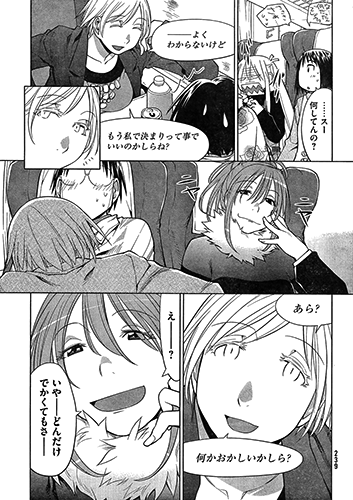
Of course, the other characters get their own moments too. While Yoshitake is the one moving things about, it’s the others’ lives that are the concern. Angela makes her appearance after a long while, and in a few moments she gets tied directly into the developments of the previous chapters. Specifically, she has a duel of confidence with Keiko, which references the close call that Madarame had with her, and she gets her breasts fondled by Sue, who is still mad about Madarame’s comment about breast size. Despite being so far away, she still perhaps has a “chance.”

Another character makes her return in Mimasaka, Yajima’s old friend, only this time she has tiny hearts literally emanating from her being. Previously I had considered the possibility that her affection for Yajima might merely be platonic (or at least something like what Sue feels towards Ogiue), but this little detail changes things. For one, it makes for a complex chain of romance where a girl likes another girl who likes a boy who dresses like a girl who likes a guy who recently had his heart broken and is currently popular with the ladies. We also get to see Yajima’s mother, who clearly resembles her. The chapter mentions something about genetics in terms of appearance, but I do find it interesting that Yajima’s mom is so much more cheerful than her daughter. Obviously their lives and circumstances are different, but it does make me a bit curious what her home life was like.
Ogiue literally took a backseat this chapter, staying out of the storm while on the train. One notable moment is that you can see her internal speech is still Tohoku-ben (Watashi wa zutto Sue to issho nandabeka…).

As for next chapter, the preview mentions that it’ll be centered around the Yajima household. I for one am curious when that Angela-centric chapter will happen. It’s really on a matter of when.
One last thing to mention: a new volume of Genshiken came out in Japan, and once again it comes with different store exclusives. This time, they’re Christmas-themed, and they feature Sue, Hato, and Angela, as well as a group shot.

Once again I’ve participated in the Reverse Thieves’ Anime Secret Santa, where various bloggers, podcasters, etc. anonymously recommend anime to other people. This year, the show I will be reviewing is Plastic Nee-san (aka +Tic Elder Sister) a comedy series that somewhat defies description.

Ostensibly an anime about three cute girls in a high school plastic model club, Plastic Nee-san thrives on being utterly bizarre yet just familiar enough to make it difficult to label it as simply “wacky.” Even as the girls eviscerate each other physically and mentally, it can be difficult to predict where the show will go next. Episodes are extremely short, amounting to about two minutes each, and the jokes are rapid-fire while never overstaying their welcome.

Of all the anime and manga I’ve seen, the show that comes closest to Plastic Nee-san is probably Ai-Mai-Mi! Both series utilize their settings as the absolute loosest of pretenses to engage in strange, often non-sequitur humor, revel in watching their characters suffer while generally deserving it. The key differences between the two would be that Ai-Mai-Mi! goes places that Plastic Nee-san doesn’t even dream of (Plastic Nee-san at least tries to keep things in and around their school), and that Plastic Nee-san gets more over the top with its facial expressions.
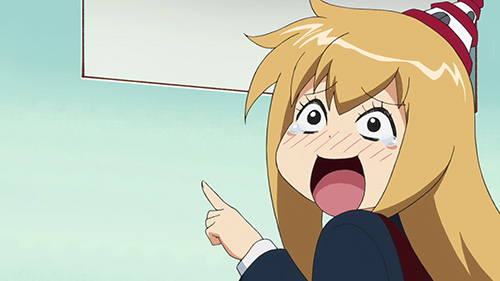
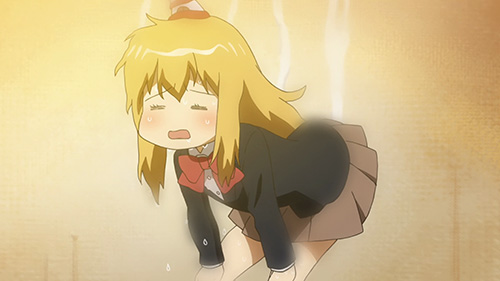
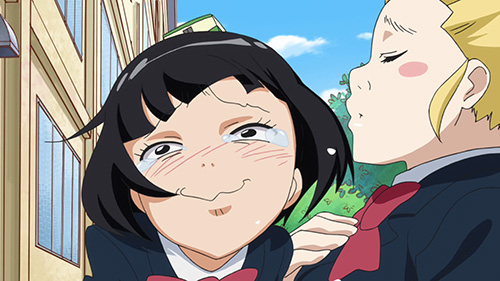

On the Kurumi Erika scale of amazing faces, Plastic Nee-san is clearly a 10 out of 10.
Another show that Plastic Nee-san is Nichijou, particularly in terms of the Kyoto Animation adaptation. At some point on your internet travels, you may have come across the following animated gif:
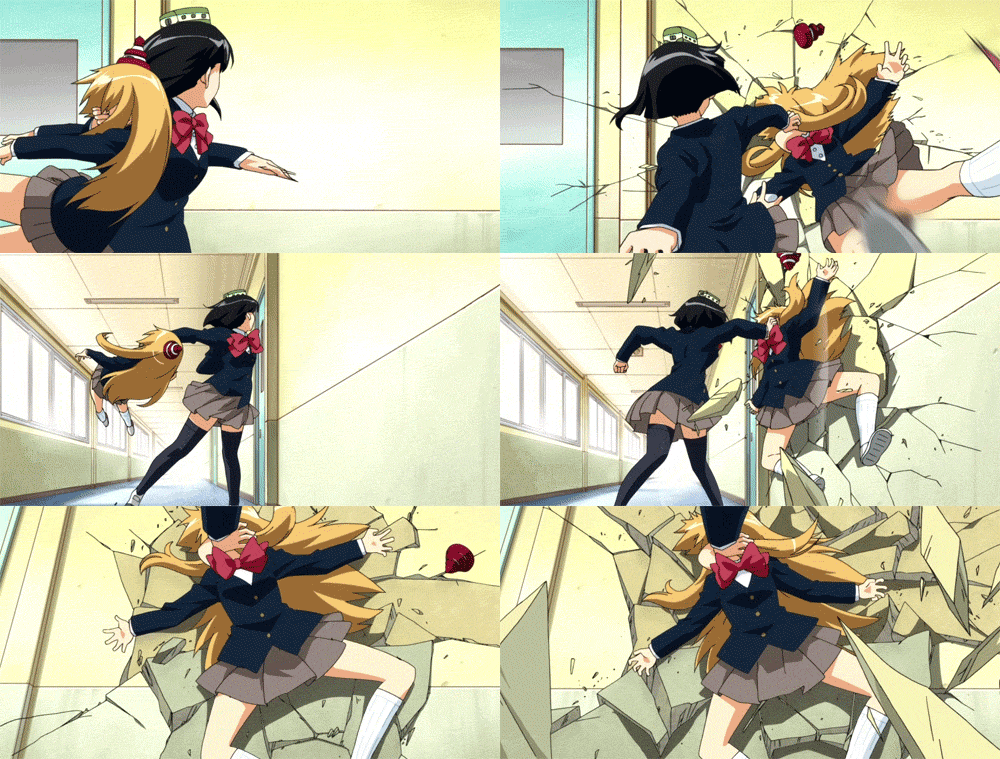
This lovingly animated moment is from Plastic Nee-san. In fact, this is how an episode starts. While the rest of that episode isn’t quite so violent, it still does a brilliant job of building from that initial shock to leave you dazed, confused, and asking for more. This is what makes the anime, strangely enough, very accessible to even those unfamiliar with anime, as the impact of the humor is unforgettable. Even if they don’t know the name of the series, it will inevitably go down as “that crazy anime you showed me.”
The last thing I want to point out is that while a number of shows have super cute girls doing obnoxious things, in the case of Plastic Nee-san this is greatly improved by the fact that just about every individual in this series gets what’s coming to them quickly and mercilessly. Unlike other series where characters never get their comeuppance and continue to expand their irritating and annoying personalities (which I know can be a deal breaker for some), Plastic Nee-san rains slapstick vengeance on them like there’s no tomorrow. In some cases, characters don’t even realize that they’ve paid their price, which makes things all the better. In this respect, it’s like Nichijou with all of the warm, heartfelt moments excised.
In short, if you were to watch Plastic Nee-san and Ai-Mai-Mi! in the same day, you’ll probably either solve world hunger or doom the planet to an eternity of plagues.
As Hato and Yajima struggle to make more manga, Kuchiki announces that he’s finally finished his senior thesis and wants to have a club trip in celebration. Though Kuchiki would prefer to travel abroad, the other members can’t afford to do so and they ultimately decide on going to Nikkou, and to stay at Yajima’s parents’ house, which is close to Nikkou. However, the club soon finds out that not only is Madarame coming along but so are some of the girls interested in him—Angela and Keiko. Moreover, Yajima somewhere deep inside sees this as an opportunity to get closer to Hato.

I feel a bit sorry for Kuchiki at this point. Think about it: Genshiken is the closest thing he has to friends, and all of them barely tolerate his existence. They have good reason for treating him that way, of course, but even what’s supposed to be a farewell vacation in celebration of Kuchiki finishing his senior thesis is secretly a “finally Kuchiki will be out of our hairs for good” adventure. On some level, I respect Kio for keeping Kuchiki around all this time, even if he’s rarely present. I feel that with a character this grating, most manga would have jettisoned him for the sake of popularity, but there Kuchiki was, being “that guy” after Haraguchi graduated long ago. It’s as if there’s a need to remind people that being a dork isn’t always endearing, but that the issue comes less from just being socially awkward and more from lacking consideration for others in your words and actions. The only question is, if this manga continues, will someone new and equally irritating eventually take his place?

As for the real meat of the story this month (sorry Kuchiki but you’re a side note even in this chapter), it looks like the feelings of jealousy (?) expressed by Hato towards Yajima and her superior manga-making skills are blossoming into something more. Though, to be accurate, it’s more like Yajima is trying to passively seize this opportunity to get closer to Hato in a way she never could, as an equal (or perhaps even a superior). It wasn’t so long ago that Yoshitake was barely able to get Yajima to admit that she has feelings for Hato, and to see her begin to sort of, kind of make a move is nothing if not impressive. I think the idea being expressed through their interaction is that, for Yajima, being able to see Hato as imperfect boosts her own confidence and thus her ability to see Hato as a “possibility” in her life. This comes across clearly when Yajima gives Hato advice on his manga, saying that it’s only half-done. Yajima has never acted like that around anyone, let alone Hato, the closest being when she acts as the “big sister” (or maybe something more?) to Mimasaka, or when she’s looking to strangle Yoshitake. There’s also something very real about the creator’s blocks that Hato and Yajima are experiencing, as Hato is struggling to get his story out in a cohesive sense while Yajima’s brilliance came from a lot of pent up emotion and a situation that is just difficult to replicate.

One of the main factors in the trip to Nikkou is Madarame and the Girls Who Love Him, which is not only a cruel joke against Kuchiki but also evidence that, despite some traumatic experiences with them, Keiko and Sue’s stories aren’t over yet (Sue isn’t mentioned but I’m sure she’ll be a part of the trip somehow). On top of that, it’s now Angela’s turn to have her chapter, and the fact that the setting is a trendy tourism spot makes me wonder if it’ll be Angela’s flirtation cranked up to 11 (especially if she catches wind of what Keiko attempted), or if she’ll go for a more subdued approach in her (mostly accurate) assessment of how to nab an otaku boyfriend.

As a final, Ogiue-related note, Ohno’s comment on the Karuizawa trip being the start of Sasahara and Ogiue’s romance made me realize that, probably much like Ogiue herself, I had always associated that whole thing with trauma and pain. You can even see Ogiue’s reaction to this when Kuchiki mentions Karuizawa and she’s the only one with a sweatdrop. However, Ohno has a point, and it really is the turning point for Ogiue, her sense of self, and her happiness. Karuizawa is when she managed to finally let it all out, whether in a long and sad drunken rant to the other girls, or to Sasahara as they were walking. It’s kind of amazing that the meaning of such a significant moment in Genshiken, for Ogiue, and by extension for this blog Ogiue Maniax, could still continue to change.
When Disney announced that they had purchased Marvel, they opened themselves up to three things: jokes, cross-promotional opportunities, and new material from which to create new stories. The first two have been well in supply, while the third has just made its debut in the form of Big Hero 6, a 3DCG film loosely adapted from a Marvel comic series of the same name. The result is a movie that wears its lineage as the offspring of Disney and Marvel upfront, and which for the most part benefits from combining the raw, simple excitement of superheroes with the old Disney desire of creating family-friendly and uplifting animated films.
Story-wise, Big Hero 6 is an overall strong affair. The film centers around a 13-year-old boy named Hiro Hamada, a young robotics prodigy from the awkward portmanteau of “San Fransokyo” who mostly squanders his talents. Due to the influence of his older brother Tadashi, as well as Tadashi’s own creation in the form of a gentle healthcare robot named Beymax, Hiro is set on a path that leads him to not only pursue his ambitions but become a full-fledged superhero in the process. Big Hero 6 balances humor with action and a bit of tragedy, and it’s amazing how much can be done with a simple fistbump joke. On top of that, though, there are two qualities in the film, or I should say the protagonist, that stand out to me.
First, Hiro is an Asian protagonist in a field that is classically connected to the image of white heroes. At first, this might not seem that important because both Disney and Marvel have histories with Asian characters. Disney has Mulan and American Dragon Jake Long, and if we’re counting the Middle East as part of Asia as well, then there’s also Aladdin. Marvel has numerous superheroes that are ethnically Asian, such as Sunfire and Jubilee. However, I what’s special about Hiro is being able to see an Asian hero at the center of a big, important Disney + Marvel movie as someone whose abilities are not derived from his “Asian-ness,” especially because of how both companies have historically projected an image of “whiteness,” intentional or otherwise. Both companies have most recently shown a greater concern for diversity in characters (see Princess and the Frog and the new Ms. Marvel for a few examples), and while Big Hero 6 may not be the first, it is a clear and concerted effort to further show heroes of all kinds. To have powers derived from some mystical East Asian aspect is not inherently a bad thing, but it is quite overdone. While there is the risk of the association of Japan with technology and thus a kind of Techno-Orientalism, it never comes across that way even as San Fransokyo greatly resembles a Disney-fied Blade Runner Los Angeles.
The second important aspect of hero, which I’ve already mentioned, is that he’s a nerd. At this point nerd chic is old hat, and we’re at a point where so many people play video games that there’s little of the stigma that used to be there, but I think this is still important because of the portrayal of nerds in media, especially in Disney and Marvel properties. Again, both companies are not inherently against hyper-intelligent characters; Phineas and Ferb, a comedy about two genius kids, is one of Disney’s most successful properties in recent memory, while Marvel has characters like Professor X leading the X-Men. However, in both cases the go-to formula for hero vs. villain primary conflict has been some form of brawn vs. brains, where intelligent characters are scheming connivers: Scar to Mufasa, Jafar to Aladdin (who granted is more clever than anything else, but it’s a different type of smarts), Captain America vs. the Red Skull, Hulk vs. Leader. Big Hero 6 doesn’t just flip this into a good brains vs. evil brawn scenario, but actually makes it brains vs. brains. At the climax it’s a matter of pitting intellects against each other (albeit intellects redirected to look a whole lot like brawn) which are doing battle.
Of course, the brainy Asian who’s good at math is still a prominent stereotype, but this is mitigated by the fact that many different characters, Asian and non-Asian, are shown to be intelligent and into robotics. The rest of the core cast, which is mostly comprised of Tadashi’s college friends, are Asian, Black, White, etc., who are all so enthusiastic about developing technology that they went to college to accomplish that. Additionally, these characters have not just ethnic diversity but also a kind of physical diversity as well. While it doesn’t go as far as to include, say, handicapped or transgendered characters (which is still probably a risky step for a company like Disney and so unlikely to happen), the characters have a wide range of body shapes and sizes. Compare for example the difference between the tall and thin Honey Lemon and the shorter and rounder Gogo, both of whom are portrayed as beautiful in their own ways without their beauty being their most defining features or their primary functions in the narrative.
Speaking of diversity, the character Wasabi, who in the context of the film is the nickname for a black character, was originally a source of some controversy because his name was “Wasabi-no-Ginger” for an Asian character. I can see why this got a bad reaction, but I do wonder if it was supposed to be a reference to how manga characters are sometimes named. Most famously, Toriyama Akira, creator of Dragonball Z, names most of his characters after food (Vegeta), food-related products (Freeza), or underwear (Trunks). Here, the choice to change a Japanese character with a potentially offensive name into a black character might in a vacuum be considered on the same level as turning a non-white character into a Caucasian, but I think the contexts are different. My opinion on this is still undecided, but I think it’s the result of both an increasing awareness of cultural sensitivity and how important that can be, along with Disney responding to a market that increasingly cares about this issue.
This being primarily an anime and manga blog, I also want to mention all of the references and similarities to anime and manga that litter the film. From Hiro’s not-Mazinger Z wall clock to the fact that his superhero outfit looks awfully similar to Priss Asagiri’s hardsuit in Bubblegum Crisis, there’s much love paid to mecha in a way similar to Pacific Rim and even anime like Robotics;Notes which are also love letters to robot shows. Having seen it only once in theaters I couldn’t go over it with a fine-toothed comb, but attention is paid to Japan and its own history of animation. Given Frozen and its enormous success in Japan, I wonder if Big Hero 6 with its Japanese protagonist can perform similarly
Overall, Big Hero 6 is a strong first step in a lot of different areas. It’s good as the true debut of the Disney-Marvel alliance, and even better as a product of both companies’ increasing efforts to represent and inspire a multicultural environment. There’s clear intent at franchising this film, so I’ll be curious as to where it all goes.

Monthly Girls’ Nozaki-kun was one of my favorite anime of last season, only I never got around to talking about it. Fortunately, I’ve gotten a second chance thanks to one Mr. Bradley C. Meek, who has started up a new show, the Anime Now! Podcast. You can listen to us talk about one of the funniest shows in recent memory, where perpetual misunderstandings make would-be romances even more charming at the same time that the series riffs on shoujo manga tropes.
Note: This post contains spoilers.
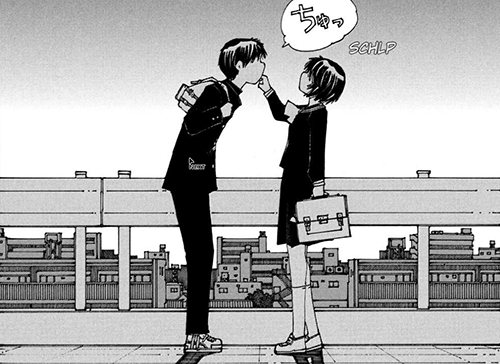
When you look at the manga Mysterious Girlfriend X, it’s hard to believe that it lasted for over eight years. Sure, it’s not much compared to Ah! My Goddess, which also ran in Monthly Afternoon but for an astounding 25+ years. Yet the everyday romance of a boy and a girl connected by, of all things, a literal swapping of saliva, feels less like it should have been a consistent presence in manga and more an odd one-off (which it originally was). But last Mysterious Girlfriend X has, getting over the years not only an animated adaptation that is available both streaming and on home video in the US, but even seeing the actual manga itself available in English.
Given its long publication history, I’ve found that my life has naturally progressed since I began reading it all those years ago, and that when I come back to the title it’s from a different place. Yet, I still remember my feelings towards Mysterious Girlfriend X from back then, and it’s interesting for me to compare both the feeling of reading it one month at a time versus all at once, and from a person about 8 years younger to where I am today.
Mysterious Girlfriend X is the story of a young couple. Tsubaki Akira one day meets the eccentric Urabe Mikoto, and on some bizarre impulse decides to taste some of her drool that had been left on her school desk. Afterwards, he finds himself ill in a way inexplicable to doctors. Eventually, he learns the cause from Urabe herself: he’s having withdrawal after not being able to taste her saliva after a few days. The reason? Love, simple as that. According to Urabe, Tsubaki has fallen in love with her, and their only choice is to become a couple, especially given how Urabe herself reciprocates his feelings. However, their relationship is an unconventional one, and though they won’t even kiss or hug, they’ll taste each other’s drool. For some strange reason, this “bond of drool,” which allows them to communicate unspoken thoughts and feelings with each other, is a connection beyond typical human comprehension, brought about by love and desire.
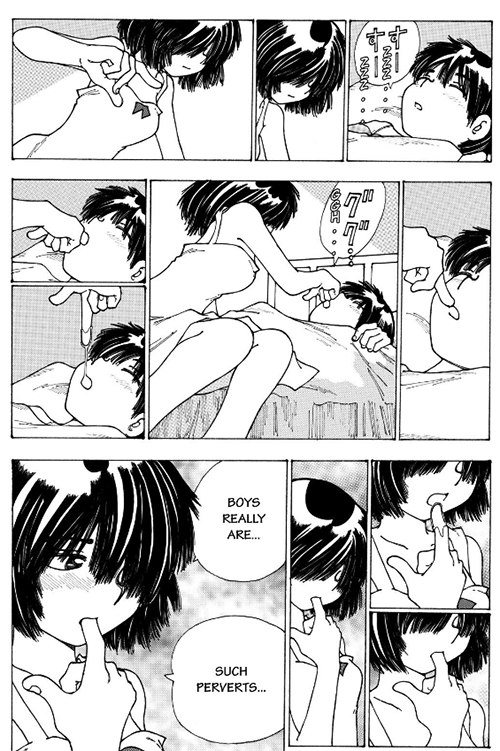
Given this description, it would be very easy to assume that Mysterious Girlfriend X is some kind of saliva fetish manga, but in that regard the title is often misunderstood. What I described above is the initial premise to get things moving, and rather than having the manga consist of different ways to present drool lust as some sexual deviancy, it’s more a means to an end to explore various facets of their relationships, from Tsubaki learning about Urabe, to Urabe understanding her own feelings better, to the growth of their relationship in comparison to others’. In Bakemonogatari, the character Senjougahara comes up with a word to describe the main character Araragi’s feelings towards her: not moe or whatever, but captivation. Tsubaki’s view of Urabe is a similar phenomenon.
Having re-read the entire series recently, I noticed that marathoning it results in quite a different experience. This is obvious to a certain extent, but what I mean more specifically is that when I originally read the series month to month, it was easier to notice long trends (some might even call them ruts) that the manga was going through. However, reading it all at once made me aware that Mysterious Girlfriend X has rough arcs and turning points for Tsubaki and Urabe. I doubt the series had some kind of intricate forethought behind it (Legend of the Galactic Heroes this manga is not), but some seeds were sowed along the way, and by the end they bear fruit.

At the start of Mysterious Girlfriend X, the narrative is mainly about Tsubaki trying to learn about firstly what it means to have a girlfriend and secondly the utter enigma that is Urabe. Here, both he and the reader get to see for the first time not only the bizarre “bond of drool,” but also Urabe’s superhuman skill with a pair of scissors that she tucks into her underwear, her willingness to swap spit but not kiss, her refusal to ever let Tsubaki have a photograph of her smiling, and other eccentricities that separate her from others. She comes across as alien both literally and figuratively, perhaps even occult, especially when compared to the relatively normal relationship between Tsubaki’s best friend Ueno Kouhei and his girlfriend Oka Ayuko. We also learn about Tsubaki’s family, particularly his very motherly sister.
Gradually, the layers of mystery surrounding Urabe are peeled back. The first major turning point comes amidst this relationship between Tsubaki, Urabe, and the reader, as we learn about Tsubaki’s late mother through the fact that Urabe can read his latent memories from when she passed away (through his drool of course). Though Tsubaki is unmistakably a reader-insert character to some degree, here he becomes an individual of his own, and the connection between the two deepens.

From there, we get to see how Urabe herself changes, how she sees the relationship from her perspective. In particular, the manga begins to present Urabe’s own character flaws, such as her possessiveness (which turns out are also shared by Tsubaki), as well as her own growing desire to be with Tsubaki. Here, she becomes more human, and while still an unusual person is less mysterious by virtue of how much time the two spend together. The most notable events in this part of Mysterious Girlfriend X occur when Tsubaki’s bond with Urabe is put to the test. First, an old crush of Tsubaki’s comes back to try and seduce him. Second, an idol who bears a striking resemblance to Urabe (and thus a source of jealousy for Urabe when Tsubaki begins to secretly collect magazines of her) trades places with Urabe. When I first read these storylines, they felt like mini-arcs much like what came before, but now I realize that they are more or less milestones for Urabe and Tsubaki, the points at which their feelings resonate more strongly than mere appearances or past loves.

At the same time, the introduction of the Urabe look-alike, Imai Momoka, also signals another turning point for the series, towards what might be the most meandering and out-of-control part of the manga. Here, Mysterious Girlfriend X begins to enter a realm of fantastic occurrences and even stranger fetishes. While Mysterious Girlfriend X is not exactly a realistic series in certain key aspects, it starts off feeling somewhat grounded in an almost palpable sense of intimacy and desire between Tsubaki and Urabe. In early chapters, the dark attractiveness of Urabe is expressed in moments such as this, which are weird but understandably thrilling for Tsubaki:

In contrast, immediately after Imai Momoka we get, of all things, “eating bacon while wearing cat ears”:

Other questions from this part of the manga include “Wouldn’t it be great to count the moles on your girlfriend’s body?” and “What’s more attractive, droopy eyes (like Nozomi from Love Live!) or slanted eyes (not in the racist sense, but like Ogiue)? Eventually the series is able to parlay this into some forward progression between the two, introducing another rival for Urabe in the competition for Tsubaki’s affections (the aforementioned “droopy eyes”), but when you’re reading from month to month it can feel like a kind of narrative limbo. I do want to point out once again though that all of this has more or less nothing to do with saliva, further reinforcing the fact that the drool in Mysterious Girlfriend X is more a kind of means to an end, and representative of many more things than simply a fetish. It’s a substitute for kissing but also much more, a way to access each others’ feelings and to capture the otherworldly feeling of being young and in love.
Even with the holding pattern that the series suffers, one thing that becomes especially clear during that most unusual section of Mysterious Girlfriend X is the evolution of the creator Ueshiba Riichi’s art style, which becomes less round and cute as was his way in his previous manga, and a bit sharper and more angular. Whereas his characters looked shorter and rounder, by the second half of the series they begin to look not only more mature but more expressive as well, especially with Urabe’s cat-like eyes. Even Ueshiba himself points this out when he discusses how his changing art style might make things difficult for the character designers.

Another clear indication of Ueshiba’s improved character drawing skills is Oka, who physically is supposed to be as small as an elementary school student but with the body of an adult. The way this is originally portrayed is rather jarring, as Oka looks more like a human being who was hit by a shrink ray, but as the series progresses she ends up looking more properly like a girl who’s simply really short.


Eventually though the series begins to wrap up, and I think the most telling thing about Mysterious Girlfriend X and its motivations as a bizarre romance come from how it builds up towards its conclusion. The most significant developments at this point are not characters taking the next step physically so much as them sharing more information with each other. We learn how Oka and Ueno became a couple. More and more characters learn about Urabe and Tsubaki’s relationship, notably Tsubaki’s sister, who throughout the series has run into Urabe multiple times under the pretense that she is merely one of Tsubaki’s classmates. As Urabe reveals the truth about her connection with Tsubaki (conveniently leaving out the drool thing), there is a passing of the torch as Tsubaki’s sister, who has pretty much been a mother to Tsubaki all his life, acknowledges Urabe as the one who will become the most important woman in his life. Whether reading on a monthly basis or altogether, the way in which Mysterious Girlfriend X heads towards its ending is somehow surprisingly tame yet still quite appropriate for how the series has been throughout.
There’s a bit of controversy surrounding the ending to Mysterious Girlfriend X, as the manga throughout its 92-chapter run has teased a kiss between Tsubaki and Urabe while also showing many other couples kissing. Even in the final chapter a kiss never happens, as while Urabe finally asks for one, Tsubaki refuses upon learning that it would mean the end of the ritual that has defined their relationship up to this point (kissing is basically exchanging saliva, so there would be no need to do it the other way). Instead, Tsubaki asks if they can’t just keep doing their routine as they always have, at least until they graduate high school. For some readers, this ending is the ultimate denial of what the series had building towards, and indeed the series appeared to be working its way towards their first kiss. However, I find that it’s clear, given how much their relationship grows over the course of the manga, that their first kiss will happen, they will have sex for the first time at some point, but these events will happen off the page, in a future that the manga does not allow us to witness except in our imaginations. By keeping their kiss away from readers’ eyes (but at the same time showing plenty of other characters kissing throughout the series), it is the final emphasis the bond of drool as representative of their strange love as indicative of not just how love looks when you’re young, but also how it feels. Following that, one might say that the point of those almost-kisses is purely in the tease and enjoying that tease is fun in its own way.
The final chapter also has a number of callbacks to significant events throughout the series, including Tsubaki’s late mother, and the excitement that sparked Tsubaki and Urabe’s relationship in the first place. The example below also of course shows off the difference in art mentioned above.

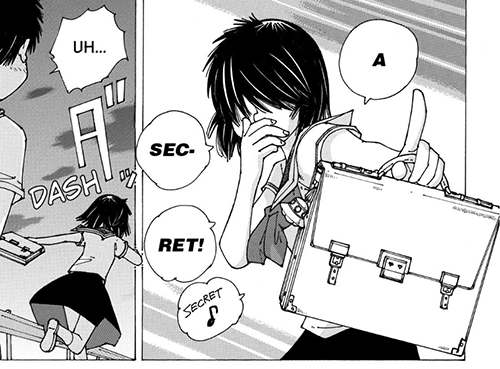
Ueshiba writes at one point that he never had a high school romance, let alone something as unusual as the one depicted in Mysterious Girlfriend X, but as I’ve gotten older I’ve begun to find that the quirks that were seemingly brought forth through sheer fantasy on Ueshiba’s parts are closer to reality than perhaps he even realized. Moments which seemed ridiculous five to eight years ago are not so far from actual reality as I’ve witnessed it. Sure, I haven’t seen anyone stick their finger into someone’s mouth and eat their drool, but the meaning and intent behind those actions also exist in reality, or at least the “realness” of one’s emotions.

I’m not a dancer. In fact, I don’t have a single rhythmic bone in my body, and the only reason I can or will ever dance is because I’m fairly shameless when it comes to humiliating myself. That’s why it might come as a surprise that my favorite anime out of the current season is Tribe Cool Crew, a show about street dancing. Though only a few episodes have aired, I find myself looking forward to Tribe Cool Crew every week because of how it combines the best of boys’ anime and girls’ anime for children.
The thing that really drew my attention to Tribe Cool Crew from the very beginning is the dynamic between the main characters, a boy named Tobitatsu Haneru, and a girl named Otosaki Kanon, both of whom love to dance. The two complement each other well not only in terms of personality and style, but also because they’re essentially the typical morning boys’ anime protagonist and typical morning girls’ anime protagonist who have met up in a single show. Haneru is small but energetic with a constant in-your-face attitude, and his burning desire to be the best and to meet his idol, Jey-El, wouldn’t be out of place in shows like Mushiking or Yu-Gi-Oh! Zexal. Kanon is shy but comes alive while dancing as the anonymous internet celebrity “Rhythm,” utilizing her great height and long limbs to accentuate her moves. In many ways she reminds me of Hanasaki Tsubomi, the main heroine of Heartcatch Precure!, especially because the show takes time to focus on her gradually building confidence.


Essentially, I find that it combines the ambition of the boys’ anime with the care and consideration of the girls’ anime. Though Tribe Cool Crew is still incomplete, it gives me the same general vibe as anime such as Battle Spirits: Shounen Toppa Bashin and Ojamajo Doremi, both of which I consider to be among the best of children’s anime. As the dances are all done in motion-captured CG, it’s also clear that the show is a response to popular CG dance anime such as Pretty Rhythm and Aikatsu!, taking what was previously solely the realm of idol anime and giving it a bit of a hip hop twist. It’s the kind of expansion of a genre or trend that I can really get behind, even if I don’t quite understand dance.

One aspect of the show that might be difficult for people looking for more plot-centric or character aesthetic-focused shows is that Tribe Cool Crew is still a show meant for kids at the end of the day. For example, the show sometimes features lessons for young, aspiring dancers on topics such as isolation. That said, the anime does feature some characters that an older audience might relate to better.


The look of the show might also take some getting used to, as the character designs are somewhat unusual for anime. They appear to take lessons more from Disney or other American cartoons that emphasize heavy variation in silhouettes to a heavy level of caricature, which can be a bit jarring. It has its own charms, however, such as in the case of Kanon, who is portrayed as an awkwardly lanky girl that perfectly fits both her personality and age, looking as if she just hit puberty and is beginning to feel conflicted between how she believes her upper-class family wants her to be and her inner passion for dance.
You can watch the show on Crunchyroll. Overall, I think Tribe Cool Crew is a really solid show and perhaps the sleeper hit of the season. It has a lot of potential, and I look forward to seeing where it all goes.

This month, we have our first ever Madarame and Sue-exclusive chapter. Sue tries to jettison her feelings for Madarame as only Sue can, by handcuffing him to a chair and putting funny masks on him until her perception of Madarame changes and encouraging him to date Hato. At the same time, Madarame, still reeling from his nearly physical encounter with Keiko, is trying to comprehend women’s behavior, which might as well be an ancient and inscrutable language to him. In the end, a poor of choice of words on Madarame’s part, a comment on breast size, may have resolved Sue’s problem for her.
Back in 2010, I wrote a small post on how interesting it is that Sasahara and Madarame essentially “traded preferences” when it came to their real-life vs. anime love interests. Namely, despite Madarame being into the character Renko (who is closer in personality and looks to Ogiue), he was head over heels in love with Kasukabe, who was closer to Sasahara’s favorite character Ritsuko. In Chapter 105, Madarame mentions the fact that, in a harem series, Sue’s type, a young-looking westerner with slender limbs and small proportions, is his favorite kind of character, and I think it’s quite notable that Madarame is only now realizing this himself. The explanation Madarame gives in this chapter is that Keiko and her attempted sexual advance on him has messed with his view of the world and how he approaches the subject of women, and it makes total sense, seeing as how the worlds of 2D and 3D have begun to blur in his head.

This is not to say that his confused behavior is Keiko’s “fault,” however, as Madarame himself sees it, but that the younger Sasahara putting the moves on Madarame has forced him out of the warm and comforting shell of his 2D complex. To Madarame, his former distinction between 2D and 3D is that 2D is where he can channel his desires both emotional and sexual, and 3D, the land of the mysterious creatures known as “actual women,” was so inaccessible to him that the best he could do was fawn over Kasukabe from a distance. When Angela was trying to get in his pants, Madarame likely saw that as so far outside reality that it might as well have been a dream within a dream. Keiko’s actions introduced the word “possible” to his real-world (meaning real women) vocabulary, and so in a way his protective layer of ignorance has been shattered in a manner different from Kasukabe rejecting him. Now, Madarame is conscious of the idea that women might be trying to send signals, but he’s basically a man who has been living in a cave all his life seeing sunlight for the first time. It is probably to his benefit that he becomes aware that women who like him can exist, but for now he’s merely blinded and clawing at open air.
Thus, Madarame tries to “read” Sue, given his limited context. “She’s on my bed! We’re by ourselves!” It’s very possible Madarame could have made a big mistake if not for Sue immobilizing him with those handcuffs, but it’s also understandable in that, when it comes to the opposite sex, he’s more or less a baby who has just learned to crawl, let alone walk. His comment to Sue that, well, Hato doesn’t have any breasts, is born from a brief moment of overconfidence (one might say even hubris) and a relative lack of interpersonal communication skills. Earlier in the chapter, Madarame notices that Sue is not completely flat-chested, and so in stating that Hato “doesn’t have any breasts, huh,” he tries to make a distinction between Hato and Sue. However, Sue has been shown to be sensitive to this subject, so it comes across as more of an insult. And even then, this sort of detail which otaku can elaborate upon extensively, the difference between an AA and an AAA cup or whatever, is not exactly going to win any points when talking to an actual girl.

As for Sue, I find that she’s trying to do what Hato himself had attempted before. Sue asks Madarame to date Hato, much in the same way that Hato was pushing Madarame towards being more assertive with his feelings for Kasukabe, and in both cases they were ways to distance themselves from their own feelings. “If he’s in a relationship, I can get over him!” For that matter, Madarame sort of did the same thing to himself with respect to Kasukabe, and even Yajima, who is not in this chapter, has been shown cheering for Hato x Mada as a way to keep her own attraction to Hato bottled up. With Sue specifically, however, it looks like this is her first ever crush, unlike the others who appear to have some unrequited feelings in the past, and so much like Madarame it is also Ms. Hopkins who is learning to crawl. However, Sue is arguably even more of an otaku than Madarame is, and in that way I can really see the perspective of Sue x Mada supporters. They even have that consistent interaction where Sue will pull out a reference and Madarame will instantly recognize it (this chapter it was Saitou Hajime from Rurouni Kenshin). While there are those who believe this swing and a miss on Madarame’s part is the death of this pairing, much like Keiko x Mada I find that it only opens things up more.
I don’t know if this actually a reference or not, but I find Sue’s “funny mask therapy” to be similar to one of the storylines in Space Brothers. At one point, the younger brother Hibito suffers from panic disorder due to a near-death encounter on the moon, which leaves him unable to wear a spacesuit. The treatment recommended to him is to wear various outfits, from football uniforms to animal mascot costumes, in order to gradually lighten the pressure his mind puts on him when in a spacesuit. Obviously, it doesn’t work the same way seeing as Sue is not the one wearing those ridiculous masks, but a similar effect is desired on her part.
The chapter ends with Hato struggling to draw manga. It might be setup for the next chapter, but what I find interesting is that Hato is having difficulty making his manga more interesting, as opposed to being unable to draw BL. Progress!
 OGIUE MANIAX