You’re Already Red: Genshiken II, Chapter 97

Chapter 97 of Genshiken II has quite a few significant developments, but they appear almost when you least expect them.

Yoshitake and Yajima decide to check out Hato’s new apartment, which is closer to the university. As they relax together, Yoshitake persists in trying to get Yajima to make a move on Hato or at least do something. The conversation goes to the topic of Madarame (who’s been looking for a new job), who then turns out to have a cold, prompting a visit.

While Hato uses his spare key to check up on Madarame and returns it, Yoshitake finally gets Yajima to admit that she has some feelings for Hato. As they discuss the fact that there’s actually an open apartment in Madarame’s building, Sue pulls up in a moving truck revealing that she will be living next to Hato (edit: not Madarame like I previously thought) from now on.

I find this chapter fairly difficult to process because it progresses so deceptively. What appears to start out as a Hato-centric chapter slowly reveals itself to be actually more of a Yajima and Yoshitake story, while the idle chit chat of the beginning eventually transforms into probably the most serious conversation about sexual orientation seen thus far in Genshiken. This unusual pacing makes it so that when Yajima finally quietly and grudgingly admits that she has some feelings for Hato (“…I don’t not like him”), it’s so subtle yet upfront that at least for me personally it feels like there’s a delayed response, like I’ve been hit by Kenshiro and am just waiting for my head to explode once it fully processes all of the implications.

Yajima’s moment plays out in the page below, and just the juxtaposition between her face and Yoshitake’s delightfully beaming face over getting her friend to finally come out with what Yoshitake herself has known all along is probably the highlight of the chapter. I know that manga sometimes gets ragged on for focusing too much on faces and not trying to draw more anatomically realistic characters or backgrounds, and then that the common response is to whip out something with really nice rendered art like Berserk. However, I think it’s important to appreciate skillfull use of faces in terms of creating a strong sense of flow and composition, even when it’s just two panels.

There’s also this sense of a narrative passing of the baton as while Hato has come to accept his feelings for Madarame, now it’s Yajima’s turn for conflict and confusion. In Yajima’s case it has nothing to do with her own sexual orientation. Instead, as far as I can interpret things, it has a lot to do with her own poor self-image mixed with some guilt over how she’s treated Hato and the realization that Hato feels something for Madarame. More than her appearance or her fondness for Shounen Jump analogues, it’s moments like these, where Yajima diminishes the value of her own romantic affections in favor of what’s already where, that makes Yajima feel really and truly like an awkward otaku.

As an aside, as much as I like Kinnikuman myself, I’m always a little surprised to see it referenced so readily in anime and manga, a reminder of how popular and beloved it really is. In this case, it’s Yajima using the Hell’s Guillotine, a signature move of the villain Akuma Shogun when she retaliates against Yoshitake’s antics.

When Yoshitake discusses sexuality, she mentions the idea that the fujoshi fantasy world of BL pairings is far different from the reality of a homosexual relationship and that there are (social) challenges awaiting anyone who accepts being part of a sexual minority. Not only is this rather poignant and serious, but together with the fact that she considers the likely reality that someone is going to get hurt in this no matter what, this chapter really highlights the fact that Yoshitake really thinks a lot of her friends. That said, she also kind of brushes aside her high school friends in a comment to Yajima and Hato, thought I take that as her having different types of friendships with different people. Even her friendships with Yajima and Hato individually aren’t quite the same.

As for Sue, the comedy potential for her living next to Hato  is obvious, but it casts an interesting context in retrospect on Sue’s appearance in Chapter 95. While Sue being surrounded by mountains of merchandise epitomizes her as a mighty otaku, it also gives off this stark image of loneliness and isolation, which might explain in part the decision to move.

The last thing I want to do is go back to the faces, because this chapter has some of the best I’ve ever seen in Genshiken. You can already see in the Yajima-Yoshitake image above. The series has always been pretty good with the expressions, especially with the old Ogiue’s intense glares and Yoshitake’s general aloofness, but I feel like they’re on a whole other level here.

Seeing this Ogiue face below fills me with a strange kind of glee. In it, she’s basically refusing to get anywhere near a beauty salon. It’s interesting but also completely in character for her to be especially uncomfortable going to that sort of place even though she’s become much more fashionable over time.

And Yet the Digital Manga Moves: Soremachi is Back

Back when JManga was still alive, Soredemo Machi ga Mawatteiru, aka And Yet the Town Moves, was one of its most popular titles. While that didn’t mean much in the grand scheme of things, it’s clear it did have at least something of a fanbase. When JManga went under, it was a big loss in my opinion, but fortunately Crunchyroll Manga has brought it back.

Soremachi (as it’s called by fans) is a manga ostensibly about a maid cafe, which is better described as “a coffee shop which happens to have maids.” Its main character is a teenage girl named Arashiyama Hotori who has a love of detective fiction and a knack for thinking outside the box but is otherwise dumb as bricks. The humor is clever and varied, and it shares a number of qualities with Yotsuba&.

As far as I can tell, it’s the exact same translation as the one that was on JManga. Also, though it doesn’t really matter that much, one casualty of the switch to Crunchyroll is the original Japanese version. JManga originally allowed readers to switch back and forth between English and Japanese text, and it was fun seeing what certain jokes or puns were originally. Hotori mishearing “calculus” as “calculator” was, in Japanese, confusing “bibun sekibun” (calculus) as “sebun irebun” (Seven-Eleven).

That said, I’m willing to make that “sacrifice” for Crunchyroll’s more sensible pricing structure.

Galilei Donna Should Have Been a Movie

Galilei Donna is an anime which knew very well how it wanted to begin and end, but it’s clear there was not much forethought put into the middle. There are elements in the first episode which pay off satisfyingly in the end, such as the condition of the Ferrari sisters’ mother, but the length of time in which they went largely unmentioned compromises the impact. The amount of meandering that happens in the show (and I’m not against meandering per se, it’s just that it often seemed to contradict itself), certainly did not help, and it made the whole thing feel like it should have been 5 episodes shorter.

Given this, I really feel like Galilei Donna would have benefited from being either a film, or an OVA, or something along those lines. I think one of the key issues is that the beginning and end feel too far off from each other (even though it’s only 11 episodes), and the fact that the way they go about finding the Galileo sketches seems abrupt and without much conflict around the actual objects. This is the kind of thing that would be more forgiving in a movie or maybe 1-3 episode anime where the act of searching for the sketches could be done in montage and would not lead the series to feeling like the sketches had no true narrative weight to them. Also, when the conclusion is only 90 minutes away, it would not feel like the middle was largely wasted.

They’re Better Than You: Dokidoki! Precure

If there’s one thing about Dokidoki! Precure that really stands out, it’s the characters.

You might be thinking, “But isn’t that true for just about every other Precure you’ve reviewed?” It’s certainly true that the characters tend to be a substantial part of Precure, and with its “enemy transforms people’s selfish desires into monsters whom the heroines must fight with the power of magic sparkles and martial arts action” premise Dokidoki! Precure is pretty typical for the franchise. However, with respect to its heroines, Dokidoki! Precure differentiates itself from its predecessors in that it really pushes the concept of its main cast as role models and targets of wish fulfillment. The girls of Dokidoki! Precure are larger than life even before they transform into magical girls.

Take Hishikawa Rikka, Cure Diamond. She’s a level-headed student council vice president, the best friend of main character Aida Mana, and the top student at their school. Her dream is to become a doctor, and the fact that she’s already studying medicine in middle school is pretty amazing. In terms of ambition and power, she’s already at a level higher than most previous Precure characters, who are usually just the ace of their athletic teams or club heads or whatever. She’s also in a way the least impressive of the Dokidoki girls.

Left to right: Kenzaki Makoto, Yotsuba Alice, Aida Mana, Hishikawa Rikka

Mana, Cure Heart, is student council president. She also gets high grades (though not as high as Rikka), and is sought after by all of the sports clubs because of her all-around amazing athletic skills. On top of that, Mana is relentlessly energetic yet cool under pressure, able to handle the work of ten people without breaking a sweat. Mana is perhaps the most effective leader in Precure history, and yet even she’s no match for Yotsuba Alice (aka Cure Rosetta), who is the kind-hearted heiress of a powerful business conglomerate, well-versed in a variety of martial arts, and is basically what you’d get if Daidouji Tomoyo mega-evolved into Batman (complete with badass butler). And even that arguably pales in comparison to Cure Sword, the last surviving warrior of a kingdom destroyed by evil and greed, who has escaped to the human world in the guise of Kenzaki Makoto, pop idol sensation, while bearing the burden of having to restore her fallen homeland.

All of the central characters in Dokidoki! Precure are outstanding beings, and the degree to which the anime is able to live up to that standard is essentially what dictates the strengths and weaknesses of the series. Dokidoki! Precure follows a pretty typical children’s anime pacing, where there’s a lot of episodic content and then a swell of story during the end of each approximately 13-episode chunk, and although there are plenty of episodes which explore the characters’ impressive qualities, there’s a sense that they could have done more. Alice is  the biggest example of this, as every episode about her ends up being amazing but are also few and far between. Similarly, I thought Makoto’s reverse-identity (her real name is Cure Sword) wasn’t portrayed with as much consistency as the concept could have handled.

Also I really wished they kept using the awesome bows from the middle of the series, perhaps the most impressive Precure toys ever in terms of giving young viewers the chance to wield things that look like actual weapons. …Maybe that’s why they went away.

I’ve seen some people be critical of Mana, saying that she overshadows the other characters, but I never found this to be the case. The issue isn’t that Dokidoki! Precure devotes too much to Mana, or that Mana is somehow too perfect to be a protagonist, but that many episodes are designed to be formulaic and self-contained to a fault. If you look at the episodes which are devoted to the greater narrative, they do an excellent job of pushing things forward, and by the end the story wraps up nicely with a conclusion unprecedented in Precure.

While I enjoyed watching every week, Dokidoki! Precure ends up being one of those shows which benefits from having a list of “important episodes,” especially because the show concludes very well in spite of some large plodding spaces in the middle of its run. At the same time, if you’re comfortable with kids’ show pacing, it’s not much of an issue. Dokidoki! Precure is reliable as an introduction to the franchise as a whole, while its different take on characterization can be refreshing for those already familiar with Precure.

PS: The first ending of Dokidoki! Precure is actually now my favorite Precure ED ever. Maybe it’ll be yours too.

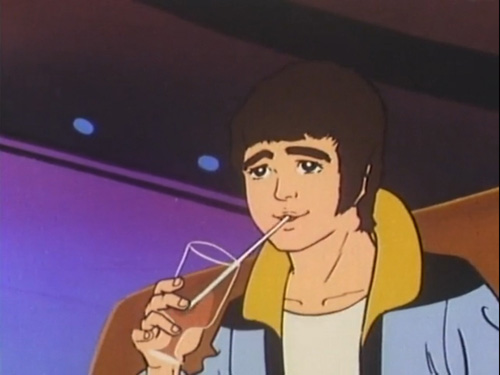
Step 1) Kung Fu, Step 2) Transform into Submarine: Hurricane Polymar

There are about three weeks left in the Hurricane Polymar DVD crowdfund project and out of all the anime on Anime Sols, I think it’s a show especially deserving of attention. It’s fun, it’s wild, and somehow despite the clearly older animation doesn’t feel all that dated.

Some people might be more familiar with the Hurricane Polymar OVA from the 90s, and though I’ve never seen it myself I’ve been told that it is kind of a drab affair. This original 70s Hurricane Polymar TV series however is anything but mundane. In fact, although it’s called Hurricane Polymar, the Japanese used to write “Hurricane” actually means “Shattering Backfist,” while the opening is so vibrant and energetic that I think its style alone is reason enough to at least check out the first episode.

The actual premise is fairly silly but in a delightful way which still leaves plenty of room for action. The main character is Yoroi Takeshi, an assistant for a bumbling yet cocky detective named Kuruma Joe who proclaims himself to be the “Next Sherlock Holmes.” Every episode they fight a different animal-themed criminal organization, and Takeshi, under the guise of a simple yet loyal apprentice, secretly helps the detective’s investigations more than the detective himself realizes.

When things call for some martial arts violence, however, Takeshi can transform into the mighty Hurricane Polymar, who chops and kicks and creates illusions while somehow fitting the word “hurricane” into Bruce Lee-style WATAAAAAAs.

Rounding out the cast are the narrator (a dog), and Nanba Teru, who is perhaps the most stylish female character ever. Actually, like many old Tatsunoko Pro shows, the character designs are by Amano Yoshitaka, best known for his work on Final Fantasy.

Hurricane Polymar essentially acts as a mix of the comedy of Inspector Gadget, the secret identity shenanigans of Superman, and a Hong Kong kung fu flick. It’s not the kind of anime that has a really dramatic impact or a fantastic ongoing story, but it doesn’t really need it either. What Hurricane Polymar excels at is being supercharged entertainment, the kind of thing where you watch an episode just to get invigorated and ready to tackle the world. In fact, it might not be good to watch too many episodes in a row, as you might get too hype.

If you decide that you are so capable of handling Hurricane Polymar that you actually want a physical copy of it (and live in the United States or Canada), you can contribute to the Anime Sols crowdfund.

Things Are Tight: Genshiken II, Chapter 96

Ohno and Yoshitake are thinking about going to a beauty salon, and try to rope Yajima along. Yajima, being the consummate otaku she is, resists to the best of her abilities but eventually concedes. (Un)fortunately, the latest fujoshi-targeted anime hit comes out and all of their plans go out the window as Ohno and Yoshitake spend all of their money on buying the blurays. Yajima gloats.

I enjoy every chapter of Genshiken that comes out, but this month in particular I found myself literally laughing out loud multiple times while reading. Even though most of it is just Yoshitake, Yajima, and Ohno sitting around and talking about whether or not they should go pretty themselves up, the combination of Yoshitake teasing Yajima and the way their conversation always re-emphasizes their identities as otaku makes the whole thing feel delightfully endearing. At one point Yoshitake suggest bringing along Kasukabe and going to a particularly expensive salon, only to be reminded by Ohno that they just all went to ComiFes and are mutually low on funds.

In a way, I find the beginning of the chapter to be kind of a fake-out even ignoring the way Ohno and Yoshitake backpedal, because the fact that it begins with Ohno talking about finally cutting her hair short brings to mind an older conversation where she mentions that the long hair can be an interview while job-hunting, and so we’re led to believe that she’s referring to finally getting serious and moving out into the adult world. It even ties a bit into Tanaka’s implicit proposal back in Chapter 83. Then we find out it’s just so that she can cosplay more character and that goes out the window. Ohno’s refusal to enter the “real world” is an interesting character flaw, to say the least.

(Also notable is the appearance of Kantai Collection references. It had to happen!)

The real focus of the chapter though is Yajima, who once again is feeling the pressure of fashion and appearance, though notably this time Hato is in no way involved outside of a mention by Yoshitake. It’s interesting seeing this topic again after so many other other developments have occurred, like the resolution of Mada/Saki and Hato’s realization about his own feelings, as I think it makes it easier to connect to Yajima who appears to feel almost lost in the madness. Yajima scoffs at the idea of going to a beauty salon initially, stating how she prefers getting 1000-yen haircuts to whatever madness other girls prefer, and it’s entirely understandable. Hell, when it comes to conversations like this, I am mostly on the side of Yajima, and I even recall recoiling in horror at seeing the price of haircuts when I lived in Japan myself.

Of course, as a guy I don’t have to deal with the same societal forces which tell me that appearance is important, and when you look Genshiken it’s clear that even though all of the guys have become more fashionable over time, it’s not nearly the same as what girls have to go through. Like the most significant pieces of fashion advice I’ve received are to not wear clothes that are too large for me, and to never wear yellow (it doesn’t match me apparently), and that’s pretty small potatoes compared to going to a beauty salon. That said, I’m reminded me of what Yoshitake had to say about fashion, which is that she dresses up not to attract men but to intimidate women. Fashion becomes a tool, rather than an identity, though that’s probably still too much for Yajima (or myself for that matter).

Out of all of the funny moments this chapter, the biggest one has to be the reveal of the fujoshi-bait show of the fictional in-universe Winter 2014 season of anime. Suikyuu! is an anime about water polo of all things, a kind of mix between the team competition of sports series (like volleyball manga Haikyuu!!, namely) and the lithe, well-defined fanservice of Free! It even has the exclamation point! From Yoshitake’s reactions to seeing a team of elderly men join in (and thus set up the obvious reveal that Ohno watched it too), I think this is the first time that Nidaime has its own Kujibiki Unbalance, something which is grounded in the tropes and trends of the time that can be a consistent source of discussion for the Genshiken members. At least, that’s the potential, as we’ve of course yet to see more of it.

Busou Renkin, a Good Manga but a Bad Shounen Fight Manga

After attending Kurosaki Kaoru’s Otakon panel on her husband, Rurouni Kenshin author Watsuki Nobuhiro, I felt compelled to read more of his stuff, though perhaps unexpectedly I gravitated towards Busou Renkin, a manga that I had no idea about beyond having some girl with a scar on her face. Now, after having read all of Busou Renkin, I find it to be a rather interesting work in that its strengths and weaknesses like distinctly along the lines between what is “conventional” in shounen fighting manga and what is not.

In the end-of-volume notes in Busou Renkin, Watsuki writes about how this title is his attempt to make a straightforward shounen fighting manga along the veins of Dragonball and its ilk, but even if he had never said anything this would have been completely obvious. Busou Renkin has a typical high school guy protagonist Kazuki who encounters a mysterious power which gives him a cool weapon to fight villainous creatures and evil organizations with the help of a girl who is more experienced than he is but has less overall potential. It’s about as established a structure for a manga as it gets, but what’s especially fascinating is that Watsuki pretty much fails to execute that basic premise well, and we’re left with a kind of hodge podge of shounen-esque elements which either do not have enough oomph to wow aesthetically (like in the weapons for instance), straightforward payoffs which aren’t really satisfying, and just a lack of connective tissue to hold it all together. I think it’s often easy to characterize the shounen fighting manga as simpler or even easier and therefore less worthy of merit, something that should be child’s play for the creator of Rurouni Kenshin, but Watsuki’s mixed success with Busou Renkin reminds me of something said in Bakuman, which is that because it’s the most reliably successful formula, it also gets the most scrutiny.

Just as the series doesn’t quite deliver within the established structure it purposely stepped into, however, it also impresses when it comes to elements of itself which are not conventional shounen. A lot of it is in the small gags, but the main example is the female character referred to above, Tokiko. Her relationship with Kazuki is the absolute highlight of the series, and seeing them grow closer while giving each other strength makes the whole thing just so much more enjoyable than if it were solely about the fight against increasingly powerful enemies. It’s not even that Tokiko is a strong female character (which she is, and which I’ll get to in a bit), but that there’s an active interaction between equals when you see her and Kazuki together. It’s kind of telling that the final chapter (albeit a final chapter which technically followed the intended final chapter which then followed the original end of the manga which got canceled, it’s confusing I know) is about advancing the romance between Kazuki and Tokiko, and about Tokiko’s past and personality.

When I look at Tokiko, particularly in regards to that last chapter, she gives me the impression of being a kind of proto-Mikasa from Attack on Titan. They share a similar kind of intensity and desire to proect, and neither are slouches when it comes to being able to fight. Both are less squeamish than their male counterparts about a number of things, and both are willing to resort to extreme violence to get the job done. Tokiko can be so vicious that she’s eviscerated someone from inside out, and her catch phrase is actually, “I’ll splatter your guts!” like she’s somehow distantly related to the guy from the Doom comic. It’s maybe no surprise that she ended up being the most iconic and memorable part of Busou Renkin, not just for myself but seemingly everyone else.

As a shounen fight manga, you’re probably better off reading Akamatsu Ken’s UQ Holder, which seems to be doing most of what Busou Renkin tried to do but better and more consistently. However, judged on its less upfront merits, Busou Renkin is really strong, and if you’re a fan of Mikasa from Attack on Titan I think the character of Tokiko will hold immense appeal.

Spring 2013 Mecha Anime Retrospective (Majestic Prince, Gargantia, Valvrave)

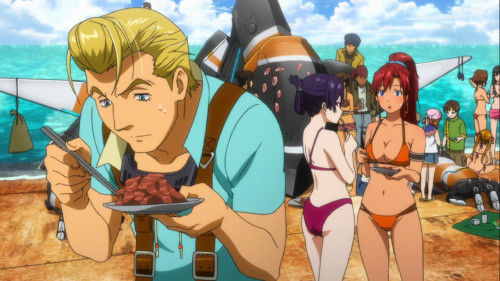
Last spring marked an unusually robot-heavy season of anime where three mecha shows, Gargantia on the Verdurous Planet, Ginga Kikoutai Majestic Prince, and Valvrave the Liberator, took three different angles each of which had their own unique appeal. I originally wrote about them as a package, so now with all three shows finished (aside from the fact that Gargantia has another series on the horizon) I figure it’s best to look back on them all at once.

Ginga Kikoutai Majestic Prince, which had a strong tokusatsu or even 90s anime feel to it, ended up progressing almost as expected, but without it being tedious or losing something in the process. In shows like Majestic Prince, there’s usually some sort of humble beginnings, in this case the main heroes being the “losers” of their class, and comedy gives way to a more serious story as the narrative progresses until it ends up in a giant space battle. It’s par for the course, but while I can’t say Majestic Prince will change the way we think about giant robot anime, I do find that the show is a little bit of everything, nothing in particular that screams, “Wow, this is amazing!” but lots of minor things done well which make for an overall satisfying experience, and a more consistently forward-moving story compared to Gyrozetter. It’s a popcorn anime, something you might show to an anime club or a group of friends to relax, where you find yourself gradually more invested by the final string of episodes. Because of this, Majestic Prince is the show I simply have least to say about, though I do want to point out that it has one of the most memorable death lines ever. You’ll know it when you hear it.

Although Majestic Prince isn’t a show I can talk about too extensively in terms of conceptual or thematic depth (it skims the surface of topics like genetic engineering and human behavior at the very mosy), Gargantia on the Verdurous Planet is the strongest of the three shows in terms of both its ideas and how it presents them. Its initial format, where Ledo, a boy from another galaxy who knows only war, is exposed to the everyday lives of the Earth characters and their concept of family, acts as a part of the science fictional exploration of its world and which become the backdrop for the show to reveal its secrets was somewhat of a source of disagreement and controversy. As people wondered how the story would turn out, there were both complaints that Gargantia spent too much time focusing on the daily lives of characters and that it too much time on its narrative drama. Personally, I think it ended up striking a very nice balance, as we got to learn about the culture of Earth away from the galactic war which they were ignorant of (perhaps for the better), but when it came time to get “serious,” the show effectively used the context it established to make the circumstances and solution directly connected to the characters’ “everyday.”

Significantly, the series did not do the predictable thing and “bring the war to the people.” Instead, it brought the philosophy and ideas which came out of the eternal state of war in which mankind out there in space had become accustomed to, and challenged the people of the Earth (as well as the lead Ledo) to confront and address them. The everyday lives of the characters became the very “weapon” by which they could defy the way of thinking imposed by the world Ledo comes from, and I think there’s a lot to think about in that regard.

Out of the three anime, however, I suspect Valvrave the Liberator will, if not be the most memorable show, stick around the longest in the overall consciousness of anime fandom, though not necessarily for the best reasons. The rape scene in Valvrave is going to remain infamous, and it’s something which is impossible to ignore but also shouldn’t define the entire show. I really think the creators of the show wanted to use it for dramatic purposes but didn’t quite understand what they were getting themselves into, evidenced by the fact that they eventually just drop the subject after some questionable followups. Whether that’s better or worse than keeping at it, I’ll leave you to decide that, but one thing I will say is that having the victim still be in love with her attacker doesn’t inherently make for a bad or “harmful” story, as Watchmen manages to deftly incorporate something similar into its narrative and point out the difficulties associated with such a circumstance.

I was once asked why I kept up with Valvrave even though the show has a lot of odd and nonsensical twists to it, and I explained that the appeal of the show for me was about seeing if Valvrave was trying to celebrate the power of youth or criticize it. Even within the same episode it became difficult to tell if the show was saying, “Kids are the future, a source of new ideas and ideals,” or, “Kids are so damn stupid! Man, I can’t believe we let them touch anything!” I think by Season 2 it leaned more towards the former, but never entirely, and to its credit I think the second season was a huge improvement on the first, as its ridiculous qualities were focused down into a clearer direction while still remaining just as strange. Overall, I think the show turned out okay in the end even with the issues mentioned, if only because it managed to use its social media aspect to great effect, and shows a kind of tempered idealism. It also has a more satisfying conclusion than the Gundam 00 movie despite being fairly similar, but I’m not really sure why I feel that way.

It’s difficult to judge the effect of having so many mecha shows close together has had on anime, if any at all, but it is true that a number of new giant robot shows premiering in 2014, from Captain Earth to the bizarrely named Buddy Complex. I think what I liked most about having each of these shows is that even through their ups and downs, Majestic Prince, Gargantia, and Valvrave all manage to maintain their identities as shows, with developments, characters, endings, and themes which keep the mecha genre from feeling like “more of the same.” None of them are really similar in any way, and I hope this trend continues.

A Message from Another Time: Genshiken Nidaime OAD

Volume 15 of the Genshiken II manga came out in Japan recently, and with it a limited edition featuring an OVA (or OAD as they call it) where they animate a couple of chapters from the original Genshiken. Covering Sue’s stay over at Ogiue’s apartment and the group’s new year’s shrine visit, it’s a part of the story that should be completely familiar territory to Genshiken fans, and watching it has made me want to both consider its role or purpose as the first Nidaime OAD and think a little about the story itself.

When you think about it, this OAD didn’t have to be the new year’s shrine visit, but it is in many ways the most appropriate given Nidaime. Ogiue’s trauma and the trip to Karuizawa would have been too long and arguably too heavy for this. The graduation in the last chapter of the original Genshiken would have been nice but is of course more of a finale than anything else. The no-dialogue chapter would have been an interesting part to adapt, but that would negate the entire new set of voice actors they’ve brought in. With the new year’s shrine visit, however, you get various threads which lead directly into Nidaime, particularly what’s been covered by the anime. Ogiue shows her softer side, which plays into her role in the second series. Sue expresses her desire to study in Japan, thus setting the stage for her increased prominence. The forlorn romance of Madarame is in full swing here, expressed almost painfully in its silence. Though Genshiken is in a sense full of turning points, this is a pretty major one in hindsight.

In terms of adaptation from manga to anime, I find it interesting that the characters were made to look like in the original series. It seems like a no-brainer but they had to do things like switch to older hairstyles and even styles of dress in order to capture the visual sense of how different the club was back then. In fact the entire mellowness of the OAD really stands out, and I imagine for anyone who watches it after having only experienced Nidaime, they would notice first and foremost the relative lack of bombastic energy. Even the references are from a different period of otakudom (“Sit, Nekoyasha!”).

One minor but noticeable change has to do with the fact that Ogiue has her default Series 1 hairstyle in the OAD, which is subtly different from the hair she wore to the shrine in the manga. There, instead of having the horizontal “antennae” on the sides of her head, Ogiue has more pronounced tufts of hair over her ears, and most likely creating another set of character design sheet just for this one-off Ogiue hair would have been too difficult or time-consuming. What’s important is that this specific hairstyle was not a fluke or a shift in judgment in the manga, as Kio Shimoku specifically drew Ogiue with that hair on the the limited edition cover of Genshiken Volume 15. Given her dress-up for Sasahara’s graduation a few chapters later, I feel like the purpose of this hairstyle was to show Ogiue trying to pretty herself up a bit (which in turn extends from a longer trend of her getting more fashionable after talking to Kasukabe).

If there’s one thing I really took away from  watching this, however, it would be a case of self-reflection, so I hope you’ll forgive me as I indulge in some introspection.

When Ogiue is drying Sue’s hair, she talks about how she’d like to be more like Sue, who isn’t afraid to be an otaku and to just be herself, which Ogiue has been trying to learn. This process Ogiue undergoes in the series is part of why she’s my favorite character, and it’s something I’ve tried to live by as well, to my benefite even, but as I get older I increasingly feel this pressure to not display my otaku-ness so openly. It’s not something I try to hide, but I realize that it’s important to know that sometimes other people won’t quite understand, and explaining who you are and why you love the things you do requires a certain sociability and deftness with words which often escape me. On some level, I worry that the essential advice of “be yourself” is something I’ve begun to creep away from even though it’s been so important to me.

Also, because I’ve managed to become more social and more comfortable over the years, I think what I basically am afraid of is becoming the very person I swore I never would, that person who passes judgment on others for being weird or socially awkward, not because I want to but because I might have lost touch with that feeling. That said, if I’m actively concerned about this, then that’s maybe for the best because it means I haven’t forgotten that idealism even if it doesn’t work out, well, ideally.

Anime Secret Santa – Everyday Adventures of the Animest Couple: Acchi Kocchi

This review is a part of the Reverse Thieves’ 2013 Anime Secret Santa Project.

When anime fans throw around the term “slice of life,” they’re generally either enormously broad in its usage (anything that concerns non-fantastical events is slice of life!) or they’re talking about a certain type of slow-paced anime which due to the popularity of certain titles has become largely associated with a cast of primarily girls doing cute things. Acchi Kocchi falls more in line with the latter category, but where often such shows largely eschew the Y-chromosome, Acchi Kocchi decides that guys too can engage in relatively low-key hijinks without pillaging the secret garden of girlish innocence.

Acchi Kocchi follows a group of friends in high school, primarily a quiet, diminutive girl named Miniwa Tsumiki and her crush, a stoic boy named Otonashi Io. Though a lot of the show involves the characters doing silly things, the primary thrust of the humor is about highlighting the mutual feelings between Tsumiki and Io, and the seeming inevitability that they will become a couple (if they aren’t one by default already). Within this context, the gags can range from heartfelt to absurd, like a mix of Precious Moments cards and Roadrunner-esque slapstick. The humor never quite goes beyond the level it hits in Episode 1, so if you’re looking to experience increasingly powerful laughs it’s not going to happen but if you’re satisfied at that point you’ll remain content.

One thing of note is that the show enjoys making fighting game references. Not sure where that comes from but it’s appreciated.

Romance in this type of anime is not unusual, but it’s generally between two girls, and that’s even when putting aside the highly ambiguous shows which invite interpretation as yuri from the fans. Hidamari Sketch has Sae and Hiro, Kiniro Mosaic has Aya and Youko, Yuruyuri is…basically those combinations times ten. This is not a criticism of same-sex relationships in anime, more an observation about the perhaps surprising lack of heterosexual pairings, which Acchi Kocchi manages to not only include but accomplish in an entertaining and refreshing fashion.

I think that often the worry with a boy-girl romance in these shows is that one will act as the audience stand-in and the other will be the ideal (or ideally flawed) potential significant other, but Acchi Kocchi is more like if both of them were their respective anime ideals for the opposite sex. Tsumiki is small and cute, often portrayed with cat-like features, and is sort of like a fusion between Konata and Kagami from Lucky Star. While this is maybe more expected, Io’s low-key personality is less about being bland and generic and more about being an almost butler-esque bishounen. A lot of the gags involving Io involve him speaking with such natural and unconscious suaveness that the girls around him swoon. They’re quite the anime power couple.

My favorite character by the way is the scientist Katase Mayoi. While I could say quite a bit about how her quirky personality appeals to me, I think this screenshot explains it well enough.

Overall, I definitely enjoyed the show, and while it never felt entirely fresh it wasn’t stale either. Pleasantly humorous with a unique take on familiar territory in a genre which thrives on familiarity, Acchi Kocchi can be a nice change of pace for those who enjoy their so-called slice of life shows but want a bit more variety.