Otaku All Stars DX We’re All Friends Miraculous Gathering: Genshiken II, Chapter 75

In Genshiken II, Chapter 75, friends new and old gather together in what may be the largest conglomeration of named otaku characters so far.

It’s time for the school festival at Shiiou University, and with comics done and costumes ready, the Genshiken have set up their own room. In addition to having much of the veterans around (Madarame, Ohno, Kuchiki, Tanaka), old friends from high school come by to reunite with the new generation of Genshiken members. For Yajima, we have her friend Mimasaka, a shy girl who apparently thinks the world of Yajima. For Yoshitake, we get to see her old crew from the History Club. As for Hato, it’s unclear whether or not they’re actually his friends, but Konno and Fuji basically look like a grown-up Pinoko from Black Jack and Mina the bridge bunny from Macross Frontier with her hair trimmed (or perhaps Q-Bee from Vampire Savior with that striped shirt), respectively.

Keiko also appears, and as always doesn’t mince words. She ends up making things doubly dangerous by first asking aloud if Kohsaka and Kasukabe had arrived yet (Madarame didn’t know), and then following it up by asking if Madarame and Hato are dating, unaware of Hato’s true gender, which makes Hato end up feeling even more awkward.

All of that discomfort is nothing compared to the biggest reveal of the chapter, as the mysterious “senpai” from Hato’s past makes an appearance, and it turns out that she looks almost exactly like Hato in his default outfit, long hair and all. Genshiken‘s had some tough cliffhangers in the past, but none are probably as intense as this one.

So, I just have to say, between all the new characters introduced and all of the interesting information and dynamics they bring to the story, there is so much to talk about that I’m not sure I can get around to all of it. I’m not even going to really mention the hilarity of Sue, Yabusaki, and Asada this chapter other than to show this image.

I’m going to kind of work my way backwards and start with Hato’s senpai, Kaminaga. The fact that Hato actually based his entire feminine look on the girl he may have liked back in high school (it’s still unclear what the “trauma” was) is just so mind-blowing that I have no idea where this is going. Together with the fact that he’s a crossdressing BL fan who identifies as straight but who felt strangely down when Madarame mentioned his lack of interest (“It’s physically impossible”), it makes the enigma of Hato’s sexuality all the more complex even just as we began to have a clearer image ofhim. It seems like Kaminaga’s personality is quite different from Hato’s, though, so I’m looking forward to seeing how this all turns out.

As a brief aside, I’ve noticed a trend with trap characters where they often have a nearly identical female equivalent. If it isn’t Hato and Kaminaga, it’s Bridget from Guilty Gear XX, Maria from Maria Holic, and Hideyoshi from Baka and Test each having twin sisters whom they could pass for. I might write a standalone post about this at some point, but I just have to wonder what the exact purpose behind this recurring concept might be.

It totally slipped my mind that Hato and the other freshmen have never met Keiko, but it obviously makes sense. After all, the only time we’ve really seen her in Genshiken II was when she had the man-to-man talk with Madarame, and her dissimilarity with her older brother makes it really easy to not immediately realize her relation to Genshiken, even if they do look alike. Keiko really hammers home the point that all of the interactions this chapter were basically simultaneous reunions and introductions.

Also of note is how Ogiue behaves around Keiko now, which is the subtle sense of fully accustomed nervousness. I like how Keiko refers to Ogiue as “Onee-chan” now, too. Did you know that the first instance of Keiko calling her “sis” came from the extras of the CD release of Genchoken, the Genshiken radio show starring the voice actors of Ogiue (Mizuhashi Kaori aka Madoka Magica‘s Tomoe Mami) and Madarame (Hiyama Nobuyuki aka Gaogaigar’s Guy Shishioh)? It’s true, and also didn’t make sense at the time because in the anime Ogiue and Sasahara weren’t dating yet (a fact which they acknowledge).

As for the other friends and acquaintances who appear in this chapter, one thing I want to point out is that, for Genshiken, the degree to which we learn about the characters’ histories is unprecedented. Think about it: other than Ogiue’s situation (which got its own entire story arc), the most we know about the characters prior to them attending college is that Ohno spent time in the US and made friends with Angela and Sue, Saki once dated some guy, Kohsaka used to have a shaved head, and Madarame was an awkward fellow. But here, we get to see how the relationships that were created back in high school work may have shaped their respective personalities and quirks.

The fact that Mimasaka is even more awkward than Yajima herself kind of puts Yajima’s initial reaction to the ladies of Genshiken into an even clearer perspective. Yajima no doubt did not have a fantastic high school life, but between her and Mimasaka she was the more socially capable one. With Genshiken, however, when she entered a world where the girls were pretty and talented with good personalities, it was probably like when someone with top grades goes to a top school and finds out that as far as geniuses go, they’re pretty typical. In that respect, it also brings to mind the fact that people can have different interpersonal dynamics with different groups of people, like Tenzin in The Legend of Korra, who is both an old and wizened benevolent leader as well as his mother’s son.

I like Mimasaka’s design. I feel like it really captures this sense of cuteness that can only come from being so awkward, and her lack of fashion sense is distinct from the lack of fashion sense that Ogiue had back then. Also, her first appearance this chapter makes it clear that she was the girl from Yajima’s flashback even though we only see her from behind.

Yoshitake meanwhile is clearly the product of being around a couple of extremely like-minded individuals, as Fukuda and Sawatari are quite similar to her. Just from seeing their opening greeting it’s easy to tell how much fun they had in high school, even if, again, the entirety of their lives as teenagers wasn’t particularly fantastic. At the same time, the fact that Yajima certainly isn’t the same but they get along quite well may say something about Yoshitake’s ability to make friends and break ice.

For Hato, well, we don’t really know how Konno and Fuji act around him, but they know he’s an otaku and they sure seem intent on finding him at the festival. Actually, though, I just want to talk more about their character designs. I thought that Asada would be the sole “silly” design in Genshiken, a one-of-a-kind oddity, but I’m strangely glad that isn’t the case. I thought I wouldn’t enjoy having designs this strange, but I find myself feeling just the opposite, especially when it comes to Konno’s hilariously large eyes (which I was tempted to call “peepers” just to emphasize their cartoonishness). Somehow, Kio makes them work.

What’s probably the most interesting part of all this, however, is the fact that they had these close friends in high school in the first place. Again, from what little we know of the previous Genshiken members’ lives, they didn’t appear to retain very many friends from the past. I feel like this might again speak to the generational difference, where even though all of them were nerds in the end who couldn’t find love in their teen years, they still lived in an era where being an otaku doesn’t automatically mean total social reclusion, just maybe partial.

In any case, I actually like the size of the cast now. For one thing, it provides me with more characters for the Fujoshi Files, but more importantly, the world of Genshiken expands further in a really interesting fashion.

Mysterious Girlfriend X is Somewhat Different in Anime Form

I’m actually a pretty big fan of the manga Mysterious Girlfriend X, so I naturally had to check the anime out. While it followed the manga very closely, I still came away with a somewhat different experience (though not necessarily a bad one), and it has something to do with some of the choices they made in adaptation, as well as the very act of adaptation itself.

Mysterious Girlfriend X is definitely a weird concept that just isn’t for everybody. The story centers around a high school couple, Tsubaki Akira and his girlfriend Urabe Mikoto, and their connection through saliva, specifically the fact that Urabe’s drool seems to have paranormal properties related to empathy. As boyfriend and girlfriend, rather than kissing, they exchange saliva by finger. I’ve seen it argued that the series is solely for people who have a saliva fetish, but I think this is really shortchanging the series and its viewers, because the reasons for following it aren’t as overly specific and narrow as “liking drool.” The appeal is more basic than that, as you have this thrilling and bizarre romance between an established couple who share a bond that seems to go deeper than anyone else’s.

That said, I found the experience of watching the whole saliva exchange to be different between the anime and manga in a way I’m not entirely for. In the manga, the drool is kind of a visual motif, drawn very simply, something that while ever-present is almost just like a rendered symbol. In the anime, however, they go out of their way to make the drool glisten and glow, to give it depth and dimension. The real killer is the sound, because in addition to all the effort they put into it visually, they also tried to make it sound as loud and slimy as possible. Again, drool is definitely a part of the series, but I think a little too much attention is given there.

Another thing that makes the anime quite different is the lack of manga-style paneling. This is kind of unavoidable, as anime is a different medium that works along different rules (unless it went out of its way to mimic the panel-based structure of manga), but Mysterious Girlfriend X has really fantastic page composition and paneling, especially in its smart usage of the contrast between black and white. I even used it in my article about decompression in comics. Take a look at the page above, and you’ll see that even if you took every one of those panels and animated them together, it would simply lack the overall structure of the “columns” created by the characters. When you then add color to the film-like style of the anime, it just makes for a different impression.

There are also a couple of more minor things to note. The first is that the elaborate dream backgrounds, which are fully drawn in the manga, are rendered in CG in the anime. A practical change of course, but one which kind of takes away that impressive bit where you realize someone drew all of that. The second is that the voice actor for Urabe doesn’t sound like I imagined she would, though that’s more on my end than anything else. Her voice actor also seems to be quite new at this, showing something of a similar effect to Omigawa Chiaki in her days as Maka from Soul Eater.

I’m still going to keep watching Mysterious Girlfriend X, of course, and I’m probably going to enjoy it. I just wanted to say something about the subtle changes that are present, and perhaps how this speaks to the things that can occur in adaptation from one medium to another.

My Experience with “Fudanshism”

As part of the ongoing project that is the Fujoshi Files, I’ve been reading Fudanshism and its sequel Fudanshifull! By Morishige (of Hanaukyo Maid Tai fame/infamy), the story is about a boy named Amata who can only get close to the fujoshi he loves by crossdressing.

Though at first I didn’t particularly enjoy this series, at some point I found myself growing attached to certain characters in particular, to the point that I looked forward to reading about them more. A natural progression, perhaps, but it’s important to note that this change of heart didn’t happen until about volume 4 (out of 7) of the first series. If you’re wondering why I kept reading despite being pretty unimpressed, when it comes to the Fujoshi Files, I try to read as much as is available. But because I “forced” myself to read through, I have to ask myself, how much of it is me genuinely starting to enjoy the series, and how much of it is the effects of otaku Stockholm Syndrome, where you’ve been with a work for so long despite signs that you should have abandoned ship long ago, and even the below-mediocre starts to be impressive?

One of my favorite characters is Toumine Michika, a ditzy (and ritzy) non-otaku girl who talks about moe like Homer Simpson talks about the internet, as if she’d say, “Oh, moe is in anime now, huh?”

When paired with another character, an always-exasperated male otaku named Matsumoto Senri, it makes for enjoyable comedy. It doesn’t hurt either that Toumine isn’t malicious or selfish; she simply likes to have fun, and she acts as a foil for Matsumoto. Though actually, Matsumoto seems to exist for the purpose of having foils, or maybe it’s better to say that he’s the perpetual tsukkomi character. I mention this because my other favorite character in the series is Matsumoto’s younger twin sister, Setsuna.

Unlike Toumine, Setsuna is very much a fujoshi, which alone wouldn’t make her stand out in a series where there are more fujoshi than male characters, but I really dig the fact that Setsuna always has this strangely diabolical look on her face. Her brother knows she’s a fujoshi, and knows the true nature of the gears constantly turning in her head, and it results in this interesting back-and-forth where he calls her “kimouto” (kimoi (disgusting) + imouto (little sister)), and she mockingly refers to him as “onii-chama.”

Then there’s Rittoku Kanae, resident gothic lolita/crossplayer with some particularly complex and interesting body issues when it comes to her large chest. When she first meets “Amane” (the main character in drag), she’s immediately able to tell that he’s really a guy because she knows from personal experience what hiding a developed female figure should look like. However, because Amane epitomizes her ideal image of how a woman should look, Kanae takes a liking to him. An additional twist is that she also has a crush on Amata but doesn’t realize the two are one in the same.

In any case, I find them a lot more interesting than the main characters, who are kind of bland overall. I get the feeling Morishige eventually thought this too, because there’s much more emphasis on them in Fudanshiful!

Thinking it over, I feel like I have very legitimate reasons for enjoying those characters, and that they make the series itself more enjoyable to read to the extent that, while I wouldn’t call myself a fan, I can say that I liked it overall. The odd part is that I wouldn’t really expect anyone to stick with the series as long as I had to get to the point where I changed my mind about it. At the same time, I can’t deny that it did get better, and not just for the characters but also artistically, as Morishige’s ability to convey information visually improves as the manga goes on. My dilemma isn’t so much if I would recommend the series, but more, what does the very act of sticking through with a series do to one as a consumer of entertainment?

Ogiue, Club Ace: Genshiken II, Chapter 74

The latest Genshiken is big, but in a rather narrow way that requires some clarification. Nothing climactic really happens, and what it sets up for the following chapter(s) is quite significant, but more than that, Chapter 74 is the most Ogiue-heavy chapter we’ve had since the manga’s revival.

This month sees Ogiue personally working to help Hato overcome his wardrobe-based artistic barrier. After a suggestion from Sue (who interrupts some rather personal fun between Ogiue and Sasahara), Ogiue decides that the best thing to do is to literally sit next to Hato and watch him draw to see what exactly goes awry in the process. Though Yoshitake wishes to watch as well, Ogiue decides that this has to be a one-on-one affair, especially because Yoshitake wears her corrupted intentions on her sleeves.

After much deliberation, which includes narrowly avoiding bringing up Hato’s shocking (?) high school love story and Ogiue admitting how impressed/jealous she is of Hato’s skills, Ogiue determines that as a man, Hato confines himself mentally so that when he does draw as a woman, his desires all come out at once and lead to yaoi. Acting as both wise upperclassman and as club leader, Ogiue instills confidence in Hato’s drawing abilities—which he believed to be fake as a result of what seems to be copying the style of a fujoshi he once knew (again, “high school love story”)—by basically saying, if you can draw like this, then you can draw manga as well.

Hato passes the test, drawing a character in a panel without having it descend into outright homoeroticism, but when his old “friend” from the student government comes barging in with another council member, the (imagined) fiery passion between the two compels Hato to draw some BL of them on the spot, essentially undoing much of the progress he and Ogiue had just made.

The chapter closes out by revealing the fact that pretty much everyone from the old guard will be around to attend the school festival this year, and that this includes both Madarame and Kasukabe (with Kohsaka). It’s a recipe for danger, or just a whole lot of mumbling and awkward glances as a result of unrequited love.

Normally I try to come up with a post title which references both the chapter itself and something nerdy, which is also how the actual Genshiken chapter titles work, but even though I don’t expect to win, this time around I can acknowledge a complete loss. Chapter 74 is “Itten Toppa Ogin-Lagann.” I can’t top that. But let’s put that aside.

Even though I said that this chapter is chock full of Ogiue content, my summary can make it seem like it was really a Hato chapter. It wasn’t. Sure, he had his own development, but here, we really get to see Ogiue as a central focus in a manner similar to the second half of the original series. In addition to the Ogiue we’re familiar with, it even ends up showing a couple of sides to her that hadn’t been revealed previously, or to put it more accurately, have developed since.

The chapter actually begins with Sasahara and Ogiue in her room, where Sasahara is shown actually praising Ogiue’s manga draft for the school festival, something we almost never have the privilege of seeing because these “editor review sessions” seem to typically lead to a lot of tension. The room and especially the couch, however, hold significant meanings for the two, and we get to see Ogiue actually tease Sasahara in that restrained “you’ll have to meet me half-way because it’s kind of embarrassing and it’s kind of fun” fashion. Specifically, Ogiue asks Sasahara if it’s okay that she might be in a room alone with another guy (Hato), to which Sasahara replies that it’s fine. Ogiue, on the other hand, was trying to bring out the “strong seme” side of Sasahara which she has a thing for, and which Sasahara picks up on almost immediately after. It’s similar to when Sasahara and Ogiue were alone in the clubroom in the last chapter of the original Genshiken and Ogiue hinted that it would be a good time for a kiss, but here their increasingly red faces combined with their comparatively comfortable (though not entirely awkward) body language show that they both know what’s really going on, and that is a very comfortable familiarity. They want each other, and even though Sue ends up interrupting before anything actually goes down, it’s still a sweet and beautiful sight to behold.

On top of Spotted Flower, this whole sequence tells me that Kio Shimoku has gotten better at portraying romantic relationships. Keep in mind that I already thought he was quite talented at it, perhaps as a result of being so good at character interaction in the first place, but there’s the keen sense of how intimate moments in a relationship really happen, in those quiet lulls where both parties can sense mutual desire.

The meat of the chapter though is the drawing session with Hato, and Ogiue’s thoughts and character fill that scene as well. When Hato shows the inadvertent BL that he made out of Ogiue’s characters, she has an epiphany: “Is this what it would be like if my manga had doujinshi made from it?” Though I may be reading into it too much, I feel like, in that moment, Ogiue has just begun to cross that threshold between the amateur creator and the professional, that realization that perhaps somewhere out there is a fan who’s creating work inspired by her own. Of course, as an artistic fujoshi herself, Hato’s “fanart” creates some complex feelings as well, where she’s turned on by yaoi of characters she created herself, even if they weren’t made expressly for that purpose.

That look of satisfaction on Ogiue when her advice ends up working out has a lot behind it as well. It’s really powerful, not just because it’s coming from Ogiue the older, more experienced otaku and yaoi fan which we’ve seen already in previous chapters, but the way the advice clearly comes from Ogiue’s own experiences in overcoming her own psychological blocks pertaining to drawing and being a fujoshi. Ogiue had to wrestle extensively with her personal demons in order to begin moving past them, and the words of encouragement she offers Hato are ones from the heart, and from knowing that it’s not only important to accept oneself, but that it’s more than possible to do so. I think this is one of the reasons the chapter starts off with Sasahara in the first place. It acts as a reminder of what happened with Ogiue and how far she has come with his help, and how even though the trauma doesn’t seem as dire, that process continues.

With that, I’ll end by mentioning that we even get to learn the name of Ogiue’s manga: Getsu Gankyou. It means something like “Lunar Glasses” or alternately “Lunar Insight.” Chuuni-byou indeed.

Eh, let’s throw in one more Ogiue image for good measure.

Lovely Charming: Genshiken II, Chapter 73

When you ask a group of fujoshi (+1 fudanshi) for personal stories of high school romance, you get anything but. That’s Genshiken II, Chapter 73.

Chapter 73 of Genshiken II opens up right where the last chapter left off. In an effort to both have a story that can complement Hato’s drawing style and to also get out of her own creative rut, Ogiue is looking to write a shoujo manga with a high school campus festival setting. However, just as Ogiue is unable to draw on her own experience to write the story (“Actually, I didn’t even have any friends,” as she bluntly states), the only thing she gets from the freshmen are tiny pockets of sadness.

First up is Yajima, who recalls a boy who used to insult her drawings and then rub salt in the wound by actually being a better artist than her. The closest this gets to anything resembling “romance” is that the guy originally came up with a bizarre and insulting nickname for her (Hetakuso (Crappy) -> Hetappy -> Tappy) but eventually stopped using it. As Yoshitake points out, that seems more like bullying than anything else.

Second is Yoshitake, who went to an all-girls’ school and spent all her time in the history club. There, she debated history through the lens of a fujoshi. While plenty of girls in her school had boyfriends, Yoshitake certainly did not.

Last is Hato, who also claims that nothing happened with him. He’d never confessed to anyone, he was never confessed to, and talking about high school makes Hato increasingly nervous. Yajima tries to stop Yoshitake from prodding further by reminding her of what Hato said about being bullied, but this triggers the inner detective in Yoshitake. According Yoshitake, Hato’s difficulties in high school couldn’t possibly just be the result of revealing his interest in yaoi, but that romance was a factor. Before Yoshitake can pressure Hato into telling everything though, Kuchiki comes in and inadvertently rescues Hato from the interrogation through the power of his embarrassing awkwardness.

The chapter ends with Kuchiki revealing that unlike the rest of them, he actually had a girlfriend in high school (though it only lasted a day), and the shock is so great all-around that any remote chance of continuing the discussion fizzles out entirely. Ogiue declares that the high school romance idea is to be scrapped, and that she’ll be writing the cheesy overwrought stories (chuunibyou, or something an 8th grader would find deep) she usually does. Somehow, this whole fiasco may have inspired her to work again after all.

So at the end of the last review, I predicted that Sue would be the one to stun everyone with a tale of teenage love, but it turned out to be Kuchiki. I don’t think I was that far off, so I’m giving myself partial credit. And who knows, maybe we’ll still learn something about her in an upcoming chapter.

I’ve written a good deal about the generation gap that exists between the old and new Genshiken but seeing Yajima and Yoshitake’s respective pasts makes me feel that as much as things have changed, they’re still quite familiar in terms of the social troubles of being an otaku. Neither of them have had anything even closely resembling a relationship, and while you can chalk up some of the bullying to the fact that Yajima isn’t exactly the prettiest girl out there, it’s interesting to see that Yoshitake had to learn something about fashion along the way. If we compare Yoshitake’s style in high school to her sister Risa’s current look, there’s a noticeable difference, even putting aside their extremely different heights, faces, and body types.

At first I thought that the guy from Yajima’s past bore some resemblance to Risa (in the guise of “Rihito”), and that her initial attraction to the latter was somehow influenced by her experience with the former, but when I look at them side-by-side, I’m not sure if they’re similar enough to warrant that comparison. Perhaps if you consider the fact that they’re both tall and have bangs parted to the side, “Rihito” ends up looking like a more handsome version of that guy. Whether or not there’s a direct connection though, altogether I think it puts Yajima’s unease in the presence of the opposite sex into perspective.

While it’s kind of difficult to interpret the behavior of Yajima’s “friend” as him being attracted to her, I think this scenario is essentially the truth behind Hato’s own hidden teenage years. In the chapter, Sue points out that just as Yajima was mentioning the guy being better at drawing than her, Hato’s face turns a shade of red that would make a certain Zaku II Commander Type look subdued. There’s not much information to go on at this point, but I get the feeling that Hato’s inability to draw well when not in women’s clothing is a product of his failed high school romance, and that telling everyone about it may be the key to resolving his art problems. Perhaps he tried to get closer to a girl he liked by showing her his BL drawings, and his talent made her feel small by comparison.

And then there’s Kuchiki, who I think probably comes from the same lineage as Kimura from Azumanga Daioh. Both are extraordinarily creepy individuals, but they have perks in their lives that make the people around them feel worse. For Kimura, it’s a lovely wife and daughter, and for Kuchiki it’s having had a girlfriend at all, as well as having a well-paying job lined up after college thanks to nepotism.

The last two things I want to talk about are kind of small, but I feel the need to point them out.

First, the above panel is actually the first time we’ve seen the high school iteration of Ogiue in an actual chapter, and the second time we’ve seen her in a Genshiken book at all (third if you count Ogiue’s disguise at ComiFest). If you’re wondering about that other time, open up Volume 6 to the first page, and look kind of carefully.

Second, there are of course a number of references strewn throughout. Ohno mentions “HTT” or “Houkago Tea Time,” the band from K-On! Upon seeing Kuchiki, Sue says, “Hyoro-kun?”, a character from Chihayafuru (translated in the Crunchyroll subs as “Retro-kun”). Finally, the next chapter preview quote this time is “Next time, the Culture Festival draws near! That’s not what happens, but look forward to it anyway!” This is actually a reference to gdgd Fairies, which I reviewed previously. Now if you listened to me and watched the show, then you would’ve gotten the joke.

Probably.

The Adventures of Tsunacon 2012 ~New Wings~

This year was my second time at the Dutch anime convention known as Tsunacon. As a one-day event I won’t have a ton of things to say about it, but there were some significant differences this year, not least of which is the move from the town of Sliedrecht over to the more well-known city of Rotterdam to make room for the ever-growing con attendance numbers.

Naturally, the first difference was transportation. Whereas last year required me to transfer to a rather small and adorable train, Rotterdam is one of the largest cities in the country and so took only one train to get there (getting back was a different story, but more on that later). This also means that for other people living around the country, there is a far likelier chance that the trains will be relatively more convenient for them as well. But unlike in Sliedrecht where it took only a short walk from the station to the convention, going to the new location required an additional bus or tram. Well, you could still walk but it would probably take you over an hour, and if you’re like me and European cities and streets confuse you, then it would take you about twice that amount. The trams and buses are both very close to the train station though, so it isn’t really a hassle.

The actual site of the convention this year was the Social Sciences building of Erasmus University, and it was, as promised, significantly larger than the old place. With three floors available as opposed to just one, and a significant amount of space per floor, it seemed just the right size for the convention, providing enough room for people to move around, but not being so spacious as to dwarf the crowd and make the place seem barren. Cosplayers were naturally everywhere, and as is common here, the dealer’s room is combined with the artists’ alley, with dealers and artists all mixed together. Overall, the university was lacking some of the charm of the old location in terms of its coziness and warmth, but I think it was a fair (and of course necessary) trade.

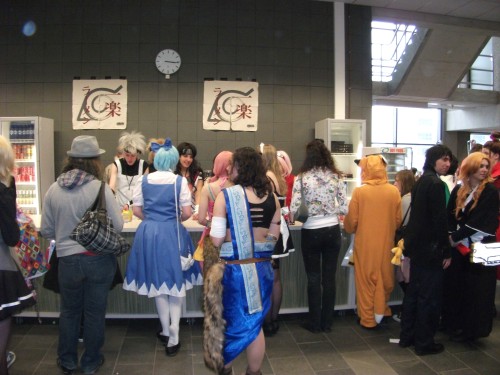
One major difference with the new location was the way in which food was handled. The spot in Sliedrecht was something of a fitness and recreation center, so it had both a small bar in the main area, as well as a bar with seats where karaoke had taken place. One of the most vivid memories for me at my first Dutch con was seeing a fairly large crowd chowing down on cup noodles like they were the best thing ever made (a claim that is supported to some extent by the fact that it has its own museum). This year however, cup noodles were practically a thing of the past, as Tsunacon saw it fit to serve actual bentou and bowls of ramen straight out of Naruto (with signs saying “Ichikaru Ramen” hanging above the serving area). Though the lack of a bar limited the food options (no bitterballen or Japanese beer as far as I could tell), this did not seem to bother the patrons at all, because the line was gigantic.

Even though I passed by the line repeatedly over the course of many hours, not once did the line ever die down, as if the people’s desire for ramen was insatiable. Honestly, I can relate, because unless you live in Den Haag, Rotterdam, or Amstelveen, it can be quite difficult to get a half-decent bowl of Asian noodle soup in the Netherlands, whether it’s ramen, wonton noodles, or pho. I know it’s a hunger that never fully dies down, and maybe on a different day I would have joined them.

There’s some obvious advice for you: serve Japanese food at an anime convention and you’re sure to be a smash hit. Think Pocky is the talk of the town? Why not hit them with some udon?

The larger space also allowed for something new this year: panels. Whereas last year the closest thing you could get to a panel was a cosplay/AMV competiton or an arts and crafts workshop or two, Tsunacon dedicated a room to the endeavor. Seeing as the panels were in Dutch, I couldn’t exactly get the most of them, but I did attend the one panel I could actually follow along with: Name that Anime. Divided into categories such as “openings,” “action scenes,” and “traps” (yes, that kind of trap), the panelists showed footage from a large variety of anime. As far as I could tell, most of the anime were from the last decade or so, with a sprinkling of Ghibli as the primary representation of anime 20 years and older. As I wasn’t sure of the exact nature of the panel going into it, I didn’t participate for fear that my inability to speak or comprehend Dutch would hold me back, but I might try next year. Overall, the panel was 90 minutes, which might either be too much or not enough for this kind of “game show,” but it seemed like it was on a good track to improvement for next year.

The last thing I did at the con was go to the karaoke room, as anyone who knows me is aware of the fact that I enjoy singing anime songs even though I can’t sing. It’s also fun to see people really get into the songs they love, which ranged from Vocaloid tracks to the popular shounen titles to the English Pokemon theme, which seems to be universally popular among singing anime fans. I spoke about this last year, but the people responsible for karaoke at Dutch cons have an entire fancy system set up to mimic a proper set. With a monitor displaying words in-sync with the song, just about anyone can follow along if they know the basics of the song, something that not even Otakon has. As for myself, I recognized a lack of burning passion in people’s selections, so I went with the go-to song for both me and one Astro Toy columnist: Kanjite Knight. Though quite off-key, the crowd was still nice enough to applaud my endeavor.

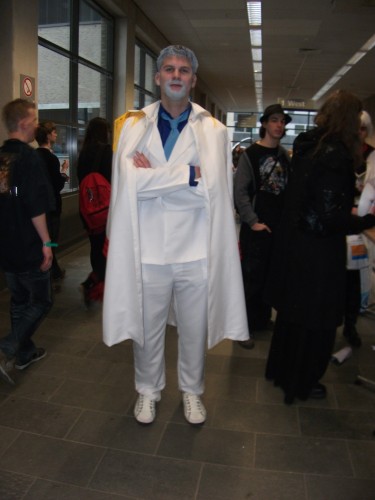
When I look at the attendees at these conventions in the Netherlands, I get the feeling that, while tastes are largely similar between the US and Dutch fans, there seem to be some major differences as well. Most notably, One Piece seems to be more well-loved among the Dutch anime fans. Does anyone else get this impression? People sang One Piece songs at karaoke, One Piece merchandise seemed to be popular in the dealer’s room, and I even saw a Garp cosplayer, which is something I have never seen at an American con (though I may have just not been paying attention). How popular is Monkey D. Luffy and his merry band of pirates among Dutch otaku, anyway?

In any case, cosplay:


(To the cosplayers above who asked me to send you this photo, my apologies as I seem to have lost your card!)


The famous combo of Chii & Stocking

I would have stuck around longer, but by 4pm noticed that it had began to snow. As I have learned during my time here, snow + Dutch trains = not fun, and what was once a 30-minute trip turned into 2 hours. Obviously, that’s no fault of the convention itself, and in hindsight I can only imagine how much worse the delays would have been going to and from Sliedrecht. In spite of those troubles, it was overall a fun convention where people just enjoyed being anime fans.

The Ups and Downs of Suite Precure

With Smile Precure set to debut it’s a good time to look at Suite Precure. I’ve seen the series lambasted a fair amount, and while I believe Suite Precure to be a flawed series and perhaps one that in the end couldn’t quite overcome a good deal of its problems, I find that a good deal of these criticisms kind of miss the mark as to what exactly went wrong, conflating one mistake for another kind. Thus, I intend to give a fairly thorough assessment of the series, especially in terms of characterization and character development.

I will not just be comparing it to Heartcatch Precure! (which is unfair for most shows in the first place), nor will I be trying to ask Suite to be any more than the children’s show that it was meant to be.

Also, this post is FULL OF SPOILERS.

When the previews for Suite Precure started coming out, they advertised the series as being about a couple of girls who have to fight together but have trouble getting along due to being total opposites. While the franchise has always dealt in contrasting personalities, it was never quite to this degree, and the premise stood out to me. And so begins the first episode, where we’re introduced to Hibiki the energetic athlete and Kanade the organized and studious baker, former friends who have since grown apart. Inevitably, they gain the ability to transform into the legendary warriors known as Precure (Hibiki as “Cure Melody” and Kanade as “Cure Rhythm”),  help the good guys (Major Land) defeat the bad guys (Minor Land), and begin to mend their friendship, though not without some trouble.

Hibiki and Kanade’s personalities start the series with a fairly interesting dynamic, and at first it’s fun to see their little clashes here and there. Once the show decides that they’ve become good enough friends, however, the two seem to forget their past tension almost entirely, like it had never happened at all. As the show progresses, the way it irons out the “wrinkles” in relationships once development has occurred turns out to be a major recurring flaw in Suite Precure. This problem is most apparent with the villainous cat Seiren, whose turn to the side of good  as “Cure Beat” is a satisfying story arc, but who suddenly turns into an almost entirely different character afterward.

That is not to say that the show is devoid of strong and consistent characterizations. Kanade, for one, seems to hold onto her personality much more tightly. In addition, there is the character of Ako, who is revealed in the second half of the show to be not only the mysterious “Cure Muse” but also the princess of Major Land. While Seiren had the more powerful story arc leading up to her reveal, Ako’s revelations manage to build on her existing character rather than rewriting it, resulting in a character who not only sensibly knows more about fighting the enemy (being the princess of the land from which the Precures derive their power), but also works hard to make up for the age difference (at 10 years old when the average Precure heroine is 14, Ako is the youngest Cure ever). She also acts as a potential wish fulfillment character for the younger girl audience.

A special mention needs to be made for the mascot character Hummy, whose ditzy and optimistic personality sets her apart from other previous magical companions in the franchise, and honestly makes her one of the more entertaining parts of the show (something I probably would’ve never expected). Still, the fact that this more thorough and long-term characterization was unable to extend to all of the characters, especially Hibiki (who is the lead of the series), remains a problem.

The Precure franchise for the most part has never had “overarching narrative” as its strong suit and Suite is certainly no exception, but past titles were able to use memorable characters to make the plot feel more involving even when its story is paper-thin. The biggest side-effect of the way character resolution in Suite Precure induces selective amnesia is that the characters’ personalities sometimes end up either under-developed or insufficiently defined, which then results in less emotional investment in the characters’ struggles. As such, towards the end when Hibiki as Cure Melody begins to act the role of a serene savior who expresses the idea that music is better for comforting sadness than eliminating it outright, it feels like an abrupt development in Hibiki’s character that just can’t be explained sufficiently by what had happened up to that point. It is certainly possible for a sudden display of maturity to make sense*, but that wasn’t quite the case here.

Overall, Suite Precure is a series that is capable of both good characterization and good character development, but can’t seem to bridge the gap between them. When it tries to, it often ends up compromising both. Because of the way it seems to not have a firm grasp on its own characters, the buildup of the series towards its climax feels weaker, and I think it makes for a show that, while okay, could have been much stronger had it simply been able to maintain a better long-term memory.

———————————

*Episode 40 of Ojamajo Doremi # concerns Doremi’s little sister Pop wanting to play the piano, only to find out that the family had sold theirs years ago. During the episode, we find out that their mother was once a concert pianist whose career was ended by an injury, and whose her lingering regrets ended up making Doremi reject the piano when she tried to learn it. Rather than being against Pop playing piano though, the normally wacky Doremi not only gives Pop the chance the opportunity to practice, but also brings a piano back into their household. Doremi’s mature attitude about the whole thing definitely stands out as unusual for someone who is typically more of an airhead, but comes across as “uncharacteristic” rather than “out-of-character.”

No Objections Except the Good Kind: Miike Takashi’s Ace Attorney

Last week was the beginning of the Rotterdam International Film Festival, and with it came the international premiere of Miike Takashi’s film, Ace Attorney, or “Gyakuten Saiban” as it’s known in Japanese. Based on Capcom’s video game franchise of the same name, Ace Attorney follows a bumbling wet-behind-the-ears defense attorney named Phoenix Wright and is quest to figure out the truth behind a string of murders leading back 15 years (and defend his clients along the way) using a combination of wit, courage, and irrefutable evidence. Opposite him is prosecutor Miles Edgeworth, a former friend of Phoenix’s from childhood whose ruthless approach to justice is a far cry from both Phoenix’s ways and how he used to be.

(Note that the film was English-subtitled with the official English-language names, so I’ll be referring to the characters as such (Phoenix Wright instead of Naruhodo Ryuuichi).)

The Ace Attorney video games utilize a very “anime” aesthetic, and for anyone who saw the preview images or the trailer, the first thing that stands out is the fact that all of the characters’ costumes and even the sets are very close to the original source. Phoenix looks like he practically stepped out of the tiny DS screen, and when someone wins a court case in the film, even the way the background actors clap like stock animation looks like it came straight out of the games. However, what isn’t so obvious from the previews is the fact that, while the faithfulness of the dress results in distinctly spiky hair, frilly collars, and unique color combinations, the actual colors of the backgrounds and even the clothing itself are quite subdued. Phoenix Wright’s suit may be blue, but it’s a very toned-down blue that is a far cry from the bright, primary colors that mark the video games, and rather than clashing with the anime elements in the film, the more realistic use of color actually helps to bridge the gap between the iconic anime elements and the use of live actors. Whereas the original games’ aesthetic presents a world and motif unto itself, with the way the film looks there is a sense that our world could possibly someday turn into the larger-than-life world of Ace Attorney, however small those chances are.

In a way, this gives the film a rather prominent science fictional element, as if it’s asking, “What if the criminal justice system were like this?” Indeed, Ace Attorney even presents the unique gameplay of the video games (using evidence to find contradictions in witness testimony) as a transformation of Japan’s court system. In the story of the Ace Attorney film, the Japanese government has set up a new judicial method in order to deal with the increased amount of criminal cases. This “Bench Trial” is a court where evidence is king and which must conclude after a maximum of 3 days, giving both prosecution and defense a limited amount of time to make their cases before the judge (not a jury) makes a verdict. Moreover, in this court, evidence is presented in the form of Minority Report-esque holographic projections, flown to the center of the courtroom through the signature cries of “Objection!”, “Take That!”, and “Hold It!”, helping to bolster that larger-than-life feel. Just in case I’m giving the impression that the film is mainly serious business though, I have to point out that the movie will make the occasional sudden tonal shift like in a Tezuka manga in order to lighten the mood (and succeeds in doing so without disrupting the pacing of the movie).

The storyline and court cases of Ace Attorney is familiar to anyone who played the original, though it combines a few of them together, both for the sake of time and for all of the characters involved to have their own denouements by the end. As I have played those games and thus pretty much knew how the cases would go, I cannot comment on whether or not the narrative events of the film would be a surprise or difficult to figure out for someone new to the series. However, what I can say is that the actors do a very good job of portraying their characters, conveying a strong sense of both their personalities and their approaches to handling trials. For me, the two most outstanding performances in the film are by Phoenix Wright’s actor Narimiya Hiroki and by Ishibashi Ryou, who plays the wily veteran Manfred von Karma. Narimiya does an excellent job portraying Wright as a very clever and observant but inexperienced attorney; when he sees evidence of a clear contradiction, you can see him struggling to connect the dots that he knows have to be there, gradually forcing the words out until the crucial element comes to the surface of his mind. Ishibashi meanwhile comes across almost perfectly as a man who cannot be fazed, a man with a 40-year undefeated prosecution record, and who can even take some of the anime mannerisms from the game and actually make them look perfectly natural. If that isn’t amazing, I don’t know what it is.

Overall, the Ace Attorney movie is fun and exciting, and never feels all that awkward combining the anime aesthetic with the live-action atmosphere. While fans of the game will almost certainly enjoy it, I think people unfamiliar with the franchise and even people have been turned off by Miike’s work in the past (perhaps due to their ultra-violence) have a very strong possibility of coming out of the theater satisfied.

One thing that made this showing of Ace Attorney special was that Miike himself was in attendance. Before the film began, there was a 15-minute interview session with the director where he spoke about this film as well as his experience in filmmaking in general. Miike had actually last visited the Rotterdam International Film Festival 12 years ago with Ichi the Killer and some other movies, and he claims that the extremely positive reaction he received in Rotterdam back then was actually the launching point for his international success and why he’s able to do bigger-budget movies today. He spoke about his use of extreme violence not for the sake of violence but to show the strong emotions which drive his characters, and his desire to make films which surprise himself (something I find he has in common with the creative process of Getter Robo and Devilman creator Nagai Go). He also showed great respect for the original source material of Ace Attorney, but pointed out that a good deal had to be done to convert that game format to a film. I have to say that he did a good job in that regard, transferring the excitement of figuring out the cases as a player to watching the characters work to reach their conclusions.

After the interview was over, the person next to me turned to me and asked, “Spreekt u Nederlands?” After I responded “Nee,” we then had the following conversation:

“What was that word he said, ‘man…gu?'”

“Manga.”

“Yes, manga. What is that?”

“It’s Japanese comics.”

“Oh, like Pikachu.”

“Yes, like Pikachu.”

Like Pikachu, indeed.

Walk that Aisle with Style and Profile: Genshiken II, Chapter 72

In this month’s Genshiken II, Madarame and Hato have an awkward but heartfelt man-to-man talk and Ogiue springs possibly the worst question could ask a room of otaku.

The chapter opens up right where we left off with Madarame and Hato, with Hato asking to come inside Madarame’s apartment so that they can have a talk. Hato’s main goal is to apologize, as he believes his actions have led to Madarame not coming to the clubroom anymore. Situated right on his desk however is a copy of the game Kohsaka’s company was selling at ComiFest, inevitably drawing the discussion towards it. As they discuss its rather unique contents (though all the characters you romance are actually otoko no ko, you can also get them pregnant and marry them), they also begin touching upon the doubts and dilemmas that are currently bothering them. In the end, Madarame’s nonchalant attitude towards Hato being unable to draw anything but BL (his advice is essentially, “do what you want”) actually helps Hato resolve to work on the planned manga with Ogiue for the school festival.

At the club, both Ogiue and Hato independently decide to do something different and decidedly not BL, going with Sue’s proposed plan of Ogiue on script, Hato on art, with no crossover. Ogiue, looking to do a high school shoujo love story, asks the members of Genshiken if they have any stories of romance in their own high school experiences to share (also making the best face ever in the process). The chapter ends with a collection of dumbfounded stares, which shows that when it comes to teenage romance, no one in there can call themselves experienced.

During Madarame and Hato’s conversation, Madarame wonders aloud if it might be time for him to stop being so attached to his old college life. Hato thinks that he’s the cause for Madarame wanting to leave the club for good, but I think it’s clear that he’s probably one of the less significant factors, if really one at all. Madarame’s lingering feelings for Saki bleed through during their discussion of Kohsaka’s game, and it’s evident from his tone that the decision to move on is more tied to a rather more complex set of feelings. On the one hand, moving on means letting go of Kasukabe and deciding that it’s over. On the other hand, it can also mean that it’s time to “grow up” and stop being the otaku he was during college. Too many strong emotions are bundled together to not make this anything less than a growing concern for Madarame.

The fact that Madarame played a game centered around otoko no ko is both surprising and not. We already knew that his tastes could be pretty off-the-wall, and in terms of what’s out there, girl-boys aren’t anything special by comparison. However, this does further emphasize the idea that what one finds attractive in actual people may not be what they enjoy in their fictional characters, like with Madarame and Saki.

What is bizarre though is the whole thing about one of the characters being based on Kohsaka. Madarame mentions in the chapter that, not only is the character also named Kohsaka Makoto (with different kanji), not only does he look like Kohsaka, but his dialogue also closely resembles Kohsaka’s way of speaking. Now imagine you’re playing a visual novel, and you know for a fact that the character in front of you is based on a person you’ve known for years. It’s actually a step beyond finding out a friend of yours does porn now, and it’s one of the stranger kinds of familiarity that I can imagine.

Hato in this chapter is also revealing more about himself, particularly that his fantasies aren’t necessarily restricted to “just” BL. It may be about 95% of what’s going on there, but he begins to entertain the thought of Kasukabe turning to Madarame, though it ends up being aborted part-way through because of something that the old members of Genshiken determined back at the last graduation party in Volume 9: Saki isn’t moe, or more specifically, Saki’s personality and demeanor are such that it’s hard to turn her into a character type (“chara”) without significant changes. As Hato starts to try and think of something, he immediately remembers his first meeting with her, where she instantly saw through his disguise and called him a crossdresser.

Kasukabe’s too sharp, too real, which again emphasizes the contrast between Madarame as otaku and Madarame as a man of unrequited love. Have I ever said that Genshiken‘s really good at characters? Like fifty times? Okay, just so you know.

Going over to the Ogiue side of the chapter (which still involves Hato anyway, so I guess we could more call this a Hato chapter?), let’s talk about that face. Perhaps more than anything else I’ve seen, this expression is a sign that Ogiue’s changed deep inside, because I could not possibly imagine her making that face even up to the point where Hato, Yoshitake, and Yajima join the club. Even with her current problems, it just seems like a great weight has not only been lifted off her shoulders, but it’s also been tossed far away and mined for ore.

It’s also good to see that Ogiue and Hato have resolved to work together for the school festival, and that in doing so they’ve also resolved to work through their respective mental blocks. The fact that they’ve decided to go with a high school shoujo story is an interesting challenge, not only because it means new and unfamiliar territory, but because they’re otaku trying to write what is (probably) going to be a typical teenage romance. This is obviously where Ogiue’s last question in the chapter is coming from; as someone whose only pre-college romance ended in the worst trauma of her life, she can’t use her own experiences to fuel the story.

I think this chapter leaves with us wondering just who among the people in the club actually dated in high school? While Yoshitake might be the most obvious one given her personality, I’m basing my prediction on those last two panels of the clubroom.

Of all the people in there, only one is not shown to be reacting incredulously to Ogiue’s question.

That’s right. I get the feeling that we’re going to find out about the romantic life of Susanna Hopkins.

Whoo!

#1 in the Forest, G: gdgd Fairies

A couple of years ago when Panty & Stocking with Garterbelt was airing, the show would often be compared to American cartoons on account of its clearly influenced style. People even speculated as to whether or not Panty & Stocking would fit on Adult Swim. Since then, a show has emerged which I think is truly worthy of the moniker of “Adult Swim-esque anime.” That anime is gdgd Fairies.

gdgd (gudaguda) Fairies is ostensibly about three fairies living and playing in the Fairy Forest, but like Aqua Teen Hunger Force (which originally had Frylock, Master Shake, and Meatwad fighting crime), the premise is just an excuse for bizarre conversations and even more absurd misadventures. If the unusual nature of the production wasn’t clear enough by the end of an episode, each episode is initially titled “Title Pending.”

The main (read: only) characters are the naive pkpk (pikupiku, center), airheaded shrshr (shirushiru, right), and darkly humored krkr (korokoro, left). An episode is typical divided into three parts, where part 1 involves a conversation between the fairies that usually spirals out of control, Part 2 has them practicing magic in the “Room of Spirit and Time,” and Part 3 has the three fairies peering into a magical spring to see people in other worlds and then ad-libbing their dialogue.  During these sequences, a discussion about being late turns into one about the tragedy of time slips, the girls challenge each other to see “who can fly over the most old men,” and they even get to see this:

Part 3 (the “Magical Spring Dubbing Lake”) is where the show gets serious and pulls out the big guns. And if a bald man in his underwear farting through the sky or a fat woman in lingerie dancing as the city around her crumbles weren’t enough, after a couple of episodes it becomes very clear that, while the other parts of gdgd Fairies may play fast and loose with the show’s contents, in part 3 the actors themselves are entirely without scripts or preparation. Here, the show takes on a Space Ghost: Coast to Coast or Home Movies vibe, where the actors have to improv their lines on the spot. The actors will fall out of their voices without realizing it, unable to hold in their chuckles long enough to maintain character and will mention other anime roles they’ve done without even considering the 4th wall. These aren’t clever nudges and winks for the audience, but evidence that just as you’re seeing that farting man for the first time, so were they. You are literally hearing them joke around with only the thinnest of pretext, and it makes you laugh whether or not what they said was actually funny or a spectacular failure.


I had a conversation with Dave (of Astro Toy and Subatomic Brainfreeze) and we agreed that gdgd Fairies would actually work on Adult Swim. There’s no need to do anything to it, just put it on the air with subtitles at 2am and let the post-Family Guy and Squidbillies audience enjoy. If you don’t want to wait that long for it, you can actually catch all of the episodes on Crunchyroll.

Carl x Fusako 4ever.