Sho Nuff Himself Would Be Scared

When I think of western anime fanart, the first thing that pops into my mind is something I call the “Deviantart style.” Characters are usually drawn fairly realistically, their bodies becoming canvases for a psuedo-airbrushed look, every shadow and every highlight blended so softly that characters can probably be best described as “glowing.”


Artist: Yanimator

Artist: Ramy


Artist: REIQ (NSFW)

Now I am fully aware that Deviantart is home to an incredible variety of artists, and that even among the anime-style artists this is not anywhere close to the sole artistic style present. Nor am I even saying that this style is bad. However, as far as I can tell, this glowing style tends to be the most popular and ubiquitous, especially at anime conventions.

So my questions are: Why is this style so popular, and how did people learn it?

When I look at the most popular manga artists, none of them actually color their images in this manner, not Kishimoto (Naruto) nor Kubo (Bleach), and especially not Oda (One Piece). Branching out, I can only think of a handful of artists who get anywhere close to that Deviantart style, and most of them cut their teeth in the world of adult doujinshi, such as Satou (High School of the Dead), so their styles end up being closer to visual novel CG than anything else.


Artist: Satou Shouji (aka Inazuma)

One major difference is that the aforementioned Shounen Jump artists all color using real tools, and when I think about it, the Deviantart style seems born out of an almost purely digital environment, where textures can be finely tuned to almost microscopic levels, and stroke lines can be edited down with the utmost precision. It is, perhaps, a style resulting from the ability to hit ctrl-z in Photoshop and Illustrator. Of course, I’m not saying that it’s an impossible thing to overcome, but that perhaps artists who have experience with traditional media may be better at transcending limitations and making that style their own.

When it comes to anime artwork among western fans, I feel like there is an obsession with “realism.” In OEL manga for instance, a great amount of attention is put on screentones for smooth shading and for perspective in building backgrounds. With fan artists, perhaps this manifests itself into a hyper-realism where vibrant gradients rule the land. Not to pick on him again or anything, but it feels like the “five-tone shading” concept taken to the extreme, where the number of tones approaches infinity and the whole thing turns into a calculus metaphor. In a way, it reminds me of superhero comics, where musculature is emphasized greatly because they similarly harken to reality through exaggeration.

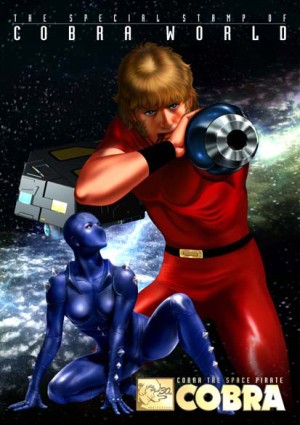
The closest artist I can think of which combines all of these elements is probably Terasawa (Space Adventure Cobra), but I get the impression that not very many artists on Deviantart take their inspiration from Terasawa.

Artist: Terasawa Buichi

But this is all speculation on my part. What do you think of the Deviantart style? Like it? Hate it? Do you use it? If so, what are you influences?

I just want to figure out how it came to be.

The Feminine Touch to the Manly Spirit

Whenever I listen to the full version of the opening to Brave of the Sun Fighbird, a particular lyric gets my attention. Not present in the TV version, the line says, “Kanashimi o kudake, taiyou no tsubasa,” or “Crush sadness, oh wings of the sun.” The way the singer Yasuko Kamoshita emphasizes each syllable of “kanashimi o kudake” sends a jolt of excitement through me.

I think the reason why I notice it so much is because it’s a super robot theme sung by a woman. However, it’s not just because it’s a female vocalist, but because I feel like given the exact same song with the exact same fiery lyrics, male singers and female singers for super robot anime produce different results. Music’s not my strong suit, but if I had to describe the difference, it’s that the male singers tend to sound more passionate while the female singers tend to sound more heartfelt. When Kamoshita tells Fighbird to “crush sadness,” you can hear a twinge of sadness in her voice too.

You might be thinking, “But wait a second, it might just be because this is a 90s anime and at that point anime songs were changing!” And you’d be right on both points, but I think that this feeling extends back towards previous decades as well. Let’s not forget that female singers for super robot anime have been around for quite a while. I get the same impression from Horie Mitsuko’s work on Super Electromagnetic Machine Voltes V and Space Demon Daikengo, as well as MIO/MIQ’s Aura Battler Dunbine and Heavy Metal L-Gaim openings, though those two  are real robot shows so that genre shift factors in as well.

“Men and women sound different!” seems like such an obvious thing, but it really makes me aware of how the same song or piece of art can take on varying emotions once you change certain pieces.

For a fun comparison, let’s look at various openings throughout the decades featuring duets between Horie Mitsuko and anime song legend Mizuki Ichirou.

It’s All in the Execution

Marvel vs Capcom 3 successfully captures the look a fighting game about Ryu fighting Captain America targeted towards American audiences wants to have. It’s a grittier style when compared to the one used in Tatsunoko vs Capcom, which makes perfect sense. MvC3‘s aesthetic step in the right direction however reminded me of a similar attempt not so long ago, Mortal Kombat vs DC Universe.

Mortal Kombat vs DC Universe was an aesthetic failure. Just like MvC3, the game looked to bring together two sets of characters by uniting them under a more realistic visual style, but the end product was just a series of awkwardly stiff 3-d models and jerky animations.

What is going on with that torso?

Worse yet were the Fatalities, that classic trademark of the Mortal Kombat franchise, the violent killing blows which defined the series in the eyes of so many gamers. In MKvsDC, the Fatalities were not only toned down in brutality but also terribly uncreative regardless of the level of violence, especially when compared to the stylish Instant Kills of games like Blazblue.

My goal isn’t to just trash MKvsDC though, and of course I can’t really compare the gameplay to a game that isn’t actually out yet. I just wanted to point out that it’s amazing just how much two different projects came aim for the same basic goal and produce such different results. Marvel vs Capcom 3 is exactly what Mortal Kombat vs DC Universe wanted to be.

For comparison:

The Giant Killing Blogging Phenomenon

All across the Aniblogospheriversemension, an amazing thing is happening.

Episodic bloggers are making really good posts full of interesting content, sometimes even better than anything they’ve written in the past. And they’re all posts about the soccer anime Giant Killing.

I’m not sure why this is happening. Perhaps it’s because Giant Killing is a show with a lot of meat to chew on, or maybe it’s being held up by World Cup fever. For whatever reason though, anime bloggers are producing high-quality Giant Killing posts. They’re analyzing character motives, they’re breaking down the pace of the episodes and the strategies used by each of the teams, and they’re sometimes even eschewing summarizing episodes in favor of transmitting their feel and excitement and discussing the way they themselves relate to the show.

Examples:

The payoff for all of this suffering comes in being able to feel the rush of adrenalin when a play comes together. When that happens, you know the makers of the show did something right, because you believe it.

Abandoned Factory Anime Review

I always thought of Kuro as simply a strong hard player with no particular strengths mentally (other than screaming his guts out and be a total idiot). Hence, it is a huge surprise for me to see that he actually has the ability to read the game more effectively than anything that I expected. A high line will always have a huge danger in the offside trap, and someone who can read the game can reduce the chances of the offside trap being broken.

THAT Anime Blog

The 8th episode of Giant Killing sees the likely conclusion of Tatsumi’s engineering of the squad and probably finding a settled lineup. It also reveals a real method to his madness in the process. However, football is a results business, and Tatsumi will eventually have to get some results out of his vision.

Lower Mid-Table

We despair when an athlete retires at the height of his powers; we want to watch greatness as long as possible. But we also lament when an athlete sticks around past his expiration date. It’s a horrible double standard. I respect a guy who knows the right time to walk away, but I know it’s a difficult choice. How many of us could suddenly abandon our jobs at such a young age?

Unmei Kaihen

And that’s just a handful. The more you explore, the more you’ll find that Giant Killing might be the best thing to happen to episode blogging in a long time.

Oh, and this goes a long way in fighting the image that anime fans are a bunch of sports-hating nerds who look upon the athletically fit with disdain, and it’s done fairly naturally. It’s not like anyone is actively writing these posts to not seem like a geek. We’re anime fans after all.

ETU!

Tubedubber: Reliving High School By Sitting in Front of a Computer

In high school I used to hang out in the computer lab after class, where my friends and fellow anime fans would use the school’s T1 connection to download videos of anime openings. After a while we started mixing and matching opening animations. with opening themes in a relatively crude fashion by having two video windows open and playing the video from one with the audio from the other. It was really fun and while I understand that the human mind will just associate any two things together like that, I still enjoy doing it.

For a while I was using Youtube Doubler to approximate the effect, but now I find out there’s something called “Tubedubber” which does exactly what I was hoping for, allowing you to stream the video from one Youtube clip with the sound from another, and it even has enough settings so that you can time it properly.

I particularly enjoyed combining Gundam X with Gaogaigar back in high school. The only flaw is that the audio ends before the video, so your only choice is to pause the video as the song ends. Currently, I’ve gone with something decidedly more patriotic.

Try it out! It’s also a fairly low-level way to make some super basic AMVs.

Well My Parents Don’t Drive Awesome Flying Cars

For the most part, video games have advanced in a positive direction in terms of artistic progression. Though I don’t agree entirely on how our newfangled advanced realistic graphics are being used or certain trends in storytelling or interaction, I can say that we’re doing okay. At the same time though, I’ve come to realize that when video games look this good and have fully elaborated stories and such, it often leaves less room for creative, off-the-wall adaptations in fiction.

At this point with games looking and feeling closer to the realm of film and animation and other storytelling mediums with characters having concrete personalities, there  are fewer opportunities to make great leaps in interpretation. Yes, I understand that products like the Super Mario Bros. movie are exactly the kinds of disaster that comes from being too “loose” an interpretations, but I believe there is a definite charm.

This applies not just to storytelling but also visuals as well. Although the Tekken OVA of the 90s was awful, could you imagine a Tekken anime today, given the fact that it would be 2-D interpretations of such detailed 3-D characters? Good looking or not, you could see the move from blocky polygons anime designs to make some sort of sense.

Basically, I’d like to still be in a world where a racing game with a normal setting could be interpreted as a futuristic setting with talking computers inside my motor vehicles.

Is that too much to ask, I wonder?

(Ooohhhohohohoho…)

In a dream I found myself watching an episode of a Slayers anime. It wasn’t an OVA or a movie as it featured the TV series cast, though it did make a reference to the OVAs. In the one scene I “watched,” an unidentified character who knew Lina Inverse’s history notices a sleeping Lina and decides to mess with her. She gets close to Lina and then whispers a Naga-style laugh into her ear. No effect the first time, so she tries it a little louder, which startles Lina out of her slumber and puts her on edge.

When I woke up, I thought about my own history as a Slayers fan and recalled that, despite my anticipation I had never finished Slayers Revolution or even watched its sequel, Slayers Evolution-R. I laid there thinking that, for someone who once prided himself on having watched as much Slayers as he possibly could, this was quite a disappointment that needed immediate rectifying.

Then I checked Hulu and saw that both series are on there, and I thought, “This is a pretty good time to be an anime fan.”

First there’s a Du, and Then I Couldn’t Hear the Rest

When it comes to uniting fans, Nico Nico Douga and episodic blogging have quite a bit in common.

Nico Nico Douga is a popular Japanese streaming video site which helped push popular Japanese memes such as the fusion of voice synthesis and moe, Hatsune Miku, and creating a small revival in the career of gay porn actor Billy Herrington by making clips from his videos running jokes among the community. Its most notable feature however is its unique comments system, where user comments are scrolled from right to left as the video plays. For some it’s an annoying feature which gets in the way of watching the video, but for others it’s the very lifeblood of Nico. Despite most of its content not being live, the comment system allows site users to experience a sense of “community” within the comments, by seeing what people had to say about a particular video at exactly the right moment.

Episodic blogging, or the act of reviewing and discussing individual episodes on a blog, usually as they are released, is even more removed from the concept of “real time,” but just like Nico Nico Douga it has the ability to unite fans by actively engaging in the very zeitgeist of internet fandom itself, by experiencing a series almost as it is airing, and having the format feel a little more permanent and a little more focused than simply sharing talk on an internet forum.

However, the ideal of episodic blogging is not often met, and in some cases this has to do with the shows being blogged about not being particularly good for the concept of episodic blogging. These are the kinds of shows where the blogger might simply go, “Eh some stuff happened this episode. It was all right, I guess.” While knowing that an episode of some show might be average is still something possibly worth knowing, after a while it bogs down episodic blogs as a whole.

Now if there is one current show that I think is very well-deserving of episodic blogging, it is Durarara!

Here you have a show where every episode is so packed with information that the normal custom of summarizing the episode extensively can become a great boon, especially when it comes to recalling the events of a previous episode. It’s also an ideal show for episodic blogging because the theme of the show itself is related to “living in the present,” and practically reflects upon the online anime fandom itself (which is no doubt helped by having a couple of characters who are otaku). Most importantly however is that while the show is an on-going story, its structure is such that each individual episode stands as something to be scrutinized and discussed, with the next one building on top of that.

So for those bloggers out there who have been tackling Durarara! episode by episode, keep it up. It’ll be particularly interesting to see just how your opinions and predictions change over time if at all.

Stop Taking Anime Openings Off of Youtube

Ever since Shin Mazinger, I’ve noticed that it’s been getting harder and harder to find anime openings and endings on Youtube. Oddly enough however, the song uploads themselves on Youtube go relatively unchecked.

What gives? I mean, I know the anime companies are getting more concerned about protecting their properties and preventing piracy, but I feel like having the openings on Youtube were some of the best ways to get people to notice shows both new and old. Why can’t fans keep their minute and thirty seconds of Durarara! opening from getting removed? It’s not like they’re entire episodes or even clips from the actual episodes themselves! There, I could see their point of contention, but I feel like this is different. I just want to show someone how cool an opening is without having them load the stream for an entire episode on Crunchyroll. Heck, they even do it for some decades-old shows! I’m tiring of this ham-fisted approach.

Basically, if companies are taking openings off of Youtube, I at the very least would like them to upload it themselves so that we may continue to enjoy it and they can continue to send copyright violation letters.

2000-2009 Part 2: Looking Forward


Make Way for the New Generations

Introduction

Anime and manga continue to change and develop, becoming at times almost unrecognizable from what they once were in the past. Having first taken a broad (but also detailed) look at the significant parts of the decade of anime and manga from 2000-2009, I think it is only appropriate that we also look ahead. As such, I have written out a number of topics pertaining to where I think anime and manga will go in the coming years. They’re half-predictions, half-observations, and all things that I think people should watch out for.

The First Digital Generation

In the previous part, I discussed how the advent of digital animation is one of the biggest markers of the current decade of anime and that anime is affected by this switch. One vital point to consider is the likelihood of a generational shift. In about 20 years or so we are going to see an entire generation of adults in Japan (and around the world) who have grown up primarily on digital animation. When you consider the level to which nearly all people in and out of the industry still look fondly back towards the anime of their youth (or from the time they discovered anime), the style that has begun to grow out of digital animation is likely going to have a profound impact on where anime goes, especially as that first digital generation grows older and the cel generations die off.

Over time, I think that the peculiarities of digital animation, such as the computer-based shortcuts, will become part of the style itself, but less direct about it than, say, Studio SHAFT’s current output, and not necessarily influenced by Shinbo’s work either. But if there are any, they will be making in-jokes and references about the early, nostalgic days of digital animation and not light boxes and such.


SHAFT’s Bakemonogatari is a hint of where anime may go in 20 years.

For better or worse, as a new range of ideas and techniques emerge, parts of animation technique and philosophy born out of cel-based anime will fade away, perhaps forever. After all, Miyazaki can’t live forever.

Flash Animation

In this decade the US animation industry has embraced Flash Animation as a way to reduce cost, particularly by eliminating the need for animation teams in South Korea and other places to do everything for you, as well as being able to create works domestically without incurring the exorbitant costs required to animate things traditionally in the US. The results have been mixed, as Flash as a program lends itself to “flat” animation.

In light of the anime industry’s history of low budgets, I think that more companies, be they animation studios, broadcasters, or otherwise, will start to look at Flash as a viable method to keep things low-cost and at-home. Now I don’t think it will eliminate today’s more “traditional” animation, especially when it comes to bigger-name, bigger-budget works, but it will be an appealing tool for those middle-of-the-road shows, and shows for kids. We’re already kind of seeing it with something like Shugo Chara Party!, where one of the segments feels very much like a flash animation.

There are two key points here. First, is that I do not think, if Japan starts to use Flash more regularly, that they will utilize the same methods the US does, particularly because US animation is generally characterized by lots of movement and Japanese animation is not. Also, I think that animators will be trying to apply their existing principles to flash, rather than trying to master the “science” of it. Second, this will create another bridge between the industry and the internet, where flash animations come out of 2channel periodically and some achieve terrific success. The main challenge from there will be pushing the limits of flash animation in terms of how successfully the visuals can be used to convey a story, as well as the breadth and depth of the subjects explored.

“How effectively can stories be told in this format?”

Changing Views on Hikikomori and NEETs

The chronic shut-in known as the “hikikomori” is a topic that Japan for the past decade has been in debate over, and as with the “NEETs” and the “Freeters” and so on, the focus has been on the future and fate of Japan, especially when factoring in the shrinking Japanese population and the fear that arises from that scenario. “Why aren’t these people going out and making something of themselves? Why aren’t they growing up?” Essays and news reports and even anime, manga, and light novels have been made of the topic, with Welcome to the NHK providing prominent examples of the last three.

But the reality of the economy is such that not having a good job (or a job at all), living at home, and having your parents’ support will be an increasingly common sight. Some will become hikikomori and try to close themselves off from the world, but there may be a sizable group that is only partially hikikomori, who will not completely lose their ability to interact with others or to engage in meaningful activity, and they will have a cultural and social “pulling” effect on the full-blown hikikomori. In turn, those “full hikikomori” may drag some down with them.


Writings on hikikomori will evolve.

The result may be that Japan’s view on the hikikomori and the NEET, especially in the face of having these groups increase in size, will be a mixture of greater panic and greater relief as they will fret once again that this is potentially very dangerous for Japan, while the internet will provide this larger hikikomori population with the group setting in line with Japanese ideas of “group,” where the interactions between partial hikikomori and full hikikomori will take place.

Thematic Responses to the Economy

The anime industry, much like every other industry, is feeling the sting of the poor economy but also has the sting of disappointment and high expectations from the US and other markets. The result is that production of anime is feeling the squeeze, with reduced budget and staff and less wiggle room for creativity. All in all, anime is being affected on a technical level by the world economy. In a certain sense however, this is only the beginning.

In about three to five years, I predict that we will begin to see both anime and manga which address the idea of global recession itself and incorporate it into the themes and settings in these works, to have it become a concept that is to be explored, whether directly or indirectly. Evangelion and other shows were responses to the recession that befell Japan starting in the early 90s, and I don’t think it would be unusual for an international economic downturn to have a similar effect.

Money will matter on more than a practical level.

Some works will be more explicit about the topic, and probably mention governments and businessmen who played roulette with the world’s economy, or businesses which had too much hubris, while others will be Silent Service-style “what ifs” but for the economy. There will also be shows which are more subtle about these elements or will have them as part of the background.

The New Escapes

Fiction, even realistic fiction, is often an escape, and over the course of anime and manga’s histories we have seen the idea of the “escape” take on many forms. More recently, escape has been manifested through the idea of “moe” and all that it entails. Moe however, like every other genre of anime, cannot last at the forefront forever, and in time new escapes will appear. Some of them may resemble older trends, but they will all ultimately still be ways to not approach reality head-on.

There are two basic forms to “escapism.” The first is a type of introverted escapism, that is, to become increasingly insular. The second is an extroverted escapism, where you want to project outwards, to go beyond yourself. Almost all genres have both to some extent in different ratios. Moe for example is very insular in the sense that it seems to want to keep characters and emotions isolated in time, but is also somewhat extroverted in that these shows are generally trying to portray the strong emotions of other characters and the ideal of being able to see these qualities at the forefront.

In that sense, I think that in the near future the escapism for anime and manga will be increasingly introverted, but will soon give way to a more extroverted form as a response to the desires of more and more fans who want to be released into other worlds. Though I don’t think that anime and manga will be reaching that early period where stories tended to feel very “epic,” I think we will see a lot of stories about worlds with wide scope focused through the lens of personal characterization, and in a way in which the former affects the latter significantly and vice versa.


Many series will try to balance daily life with a greater world.

Increased International Integration in Collaborative Efforts

Like all companies, manga publishers want to increase profit every year, and at some point a decade or three ago, Japan began to realize that one direction they had not gone was to appeal to people outside of their fanbase and readership. The classic example at this point is Shounen Jump, which noticed that it had developed a sizable female audience, and so made the move to start releasing series that are designed for female readers (without driving the boys away, of course). The result is Jump‘s approximately 50% female readership.

But then I recalled something Ed Chavez, currently of Vertical Inc. and formally of Kodansha, has said on multiple occasions: The “problem” with the Japanese manga industry today is that it has no room to grow in the nation itself. For all intents and purposes, the Japanese market has been saturated, as manga selling a million copies is completely normal and the fact that there’s pretty much something for everyone.

The only way to go then is outside of Japan, but the problem facing the industry there is that it’s difficult to pinpoint the manga-reading audience for different cultures and nationalities around the world. The same thing applies to the anime industry, which has been trying to really grow outwards for a while but lost its footing along the way. The tricky part in all this is that anime and manga have to achieve a certain level of distinctness, but still have to be familiar enough that people are comfortable with the material, and this is something that is even more of a challenge to achieve when the people making the work are unfamiliar with the culture they’re trying to attract. Naruto, Bleach, and Dragon Ball Z are pretty much the most popular things out there for boys in the US, and when you think about it they’re not that different from American superheroes.

This is why I predict that over the next decade and beyond, we will be seeing collaborations on animation and comics where the staff producing these works will be much more closely integrated. International collaboration isn’t new to manga and especially not to anime, but the work is usually cleanly divided between the countries involved. So it’ll be less Gurihiru drawing for Marvel’s Power Pack and more Oban Star Racers. This way they have a better chance of hitting that cultural sweet spot, though nothing is guaranteed and there’s going to be some serious misses as a result of trying to mix two cultures together at the base level of production.


French and Japanese Collaboration Oban Star Racers

Incidentally, by necessity translators will have to be more closely involved in the process as well.

Age Demographics in Japan vs Age Demographics Abroad

Anime and manga in the US has had a contradictory reputation for the longest time, being viewed both as “cartoons for children” and “raunchy pornography.” These days however, if we were to look at the fandom we would know the truth: In the US, anime and manga are primarily for teenagers with both childish and adult elements in different proportions, and it’s been this way for a number of years now. One concern I’ve seen from people is that they fear that a lot of these works, particularly in manga, will never get brought over here because they will simply never have an audience. And to an extent they’re right, but I believe that in time the manga audience in the US will slowly mature and eventually reach a point where they want something that is more in-line with how they feel about entertainment, their lives, and the world at large.

The key however will be whether or not Japan realizes that age demographics do not map one-to-one between Japan and the US. Not all “seinen” works will appeal to an older audience, and they will have to somehow find a way to understand just what this slightly more matured manga-seeking audience is looking for, possibly through the greater international collaboration I mentioned earlier.


Seinen may become more “shounen-friendly.”

Josei in Japan went through a similar growing pain in that it tried to be more “adult” in certain ways until creators and editors realized that older women still want the shoujo series trappings of their youth, but with more mature concerns and characterizations. In time, I think Japan and the US will get a better handle on it, but it won’t come without some serious bumps in the road capable of taking a company or three under.

Multimedia Customization

When it comes to streaming anime, you can’t please everyone, and methods of distribution and how to turn those view counts into sales is a mystery which eludes even big sites like Hulu, let alone smaller players like Funimation or Crunchyroll. While streaming anime is a step in the right direction, anime finds itself to some extent in the same bind as scanlations: sometimes people want to actually own a hard copy for themselves. However, the cost of printing DVDs for a series that won’t sell can be prohibitively expensive, meaning even if you really like Saki, unless someone decides to pick up the license to produce a box set you’re not going to have it sitting pretty on your bookshelf.


People outside of Japan will be able to own Saki however they want.

I think that starting in the next few years this is all going to start changing until we reach a point of personal customization in our anime and manga: You will be able to make exactly the purchase you want with exactly the things that you want, on-demand. As an example, let’s say it’s 2015 and you’re watching a streaming video of the latest series New Mobile Fighter G Gundam: Second Generation. Sadly the show has no box set you can buy in stores, but you still really want to own it. What you’ll be able to do is specify just how you want to have it in your possession, and you will get that package. Do you want it on blu-ray or DVD? Do you want to shove all the episodes onto fewer discs, cutting out the extras and possibility some of the quality? Do you want to just download the episodes so you can watch them without relying on internet access? Do you want to also purchase merchandise for Neo-Japan’s “Typhoon Gundam?” You will be able to get what you want, weighing cost versus extras, and in a way that doesn’t just limit you to “Normal,” “Super Deluxe,” and “Bare Bones” packs.

Choice is the future.

New Paths for New Talent to Appear

Shinkai Makoto made a big splash on the anime industry when he released Voices of a Distant Star, a science fiction-themed OVA which he wrote, directed, and animated all by himself on his Macintosh back in 2002. More recently, Aniplex has introduced the world to Cencoroll, by another independent writer/director/animator named Uki Atsuya. The idea of the Anime Renaissance Man is appealing, but it’s something that people cannot expect all the time. Skilled creators can be born independently, but it’s clear from Shinkai’s example that, given proper resources and experience, even a genius has room to improve.

Works like Cencoroll will continue to be rare, but lessons can be learned.

I think anime is heading in a direction where people won’t have to be skilled at every aspect of animation production to be considered a Big Deal. One possibiliy I’ve thought of is “anime festivals” for amateur creators, be they industry-sponsored or independent, with competitions and awards for categories such as storyboarding and writing in addition to full-on animations. More importantly however, these anime festivals could take place entirely online.

The primary advantage of having festivals be online would be low overhead costs, and in this age of streaming video (which will only get more efficient over time) people will be able to see each others’ works and comment on them, possibly through chat rooms or Nico-style scrolling text. This will also encourage people to send in works from abroad, as they would be on an equal footing of sorts with those living in Japan, and would be able to enjoy seeing the results all the same. Of course this is not to say that online animation festivals would replace actual ones, but the ease of setting one up would make it an attractive prospect, and it would give amateurs opportunities to be noticed.

Manga too will start to have online festivals. There is already the International Manga Competition, but these will be a little more like Comic Market on the Internet, and will have a lot less pornography. The same idea applies however, in that people will be able to enter in a variety of categories and not just “Overall Excellent Manga Creator.” It’s not so much specialization as it is realizing again that not everyone talented is multi-talented.

Conclusion

Although I have written all of these ideas of the future of anime and manga, I of course do not pretend to be a soothsayer and cannot guarantee that any of my predictions will come true. I’ve always been better at observing the past than predicting the future, and I know my views on anime and manga are tinged by a certain degree of optimism, so in time we will all see  just what I was able to sense correctly and what was just my wishful thinking.

Still, I think that even if I get everything concrete wrong, every single item I’ve written about is something to consider and analyze further as anime and manga reach into the next decade.The main themes I’ve discussed are the ways in which the industry and the fans will handle the significant changes to the economy that have occurred, shifts in philosophy on the creation of anime itself, and new steps towards customizing and tailoring for audiences. Taken all together along with the advancement of technology in society, and even if I’m wrong I think that my ideas all have more than a few kernels of relevance to them.

So let’s approach 2010 with open arms, not so much to simply accept whatever anime and manga may come, but to give the same consideration of the past that we do the future, and to know that no matter how it might change they are still capable of inspiring.