OGIUE MANIAX

Anime & Manga Blog | 50% Anime Analysis, 50% Ogi

What People Want Out of Competitive Games (Part 1)

The purest image of the competitive gamer is the person who “plays to win.” Whereas other players might decry a particular move or strategy as “unfair” or “overpowered,” the true competitor uses every tool available. But while this is the ideal in a certain sense for how a competitive gamer should behave, I find that it’s not actually a reflection of reality. If it is, it’s a reality that has long since passed.

Since the proliferation of the internet in the 90s and into the 2000s, the image of what it means to be competitive in the world of games (particularly fighting games) has been defined by two different resources. One is David Sirlin’s “Playing to Win,” which discusses what it means to not be held back by concepts such as “honor” or “aesthetic.” The other is Seth Killian’s “Domination 101,” which positions opposite the true competitor the figure known as the “scrub”—the player who constantly makes excuses, refers to things they lose to as “cheap,” and chooses to complain rather than learn. Within reason (so no foul play), both are based around the idea that what matters most in competition are the words “YOU WIN.”

Both Sirlin and Killian have changed over the years. Sirlin became a game designer who has to take a greater range of players into account. Killian is now a community veteran, old and wizened and less fiery. However, at the time these series of articles were written, both were most certainly what the Magic: The Gathering developers call “Spikes.” According to the developers of Magic: The Gathering, players of their card game can be roughly divided into three different archetypes. In contrast to the “Timmy,” who loves to make big plays using the highest-damage tools, and the “Johnny,” who loves to innovate new strategies and employ unorthodox tactics, the Spike is defined by the tendency to simply do what is most effective and efficient to beat the opponent.

Because of those articles, I believe that the stereotypical image of the competitive player, in fighting games especially, became the “Spike.” However, what’s curious is that, when you look at even the highest levels of play, that undiluted competitive mentality does not seem as dominant as one might assume. The greatest fighting game player of all time is Umehara Daigo, but in his book The Will to Keep Winning, he writes:

Tournaments are a playground for people who practice for growth. It’s where they show off their achievements. Once I made that realization, I finally started making continued growth my goal, rather than winning. Games enrich my life by allowing me to grow as an individual, and that’s what motivates me to keep on going.

Going from a different angle, Super Smash Bros. Melee player Mang0 has discussed how he’s had to balance changing his playing style to suit more recent developments in his scene with staying true to himself:

What’s clear is that even the best players in the world aren’t necessarily subscribe “pure Spikes.” While anyone who goes to a tournament to get as far as possible is a Spike on some level, hybrids such as “Johnny-Spikes” or “Timmy-Spikes” exist. This is even acknowledged by the Magic: The Gathering developers. However, what I believe is that, not only are “Timmy-Spikes” present among competitive gaming communities such as the FGC, but they are about as prevalent as pure Spikes, and in some communities are the greatest population.

Where once even the biggest competitive gaming communities might have been incredibly niche and might have indeed been comprised of mostly Spikes, I think that world has changed immensely, due to online play, greater publicity, streaming video such as Twitch, the concept of eSports, and so on. Going from the strongest champions in the paragraph above to the lower levels of aspiring competitors and eSports spectators, it is often the case that many people care just as much (if not more) about how victory is achieved than whether it happens at all.

While few people, be they watching or playing, can say they have no investment in wins or losses, what competitive games provide for a great number of players is a feeling of power. This might come from the look of the game itself, or from how it plays. A pure Timmy, at their most extreme, wouldn’t mind a loss, provided he managed to land a breathtaking combo that squeezes the life out of the opponent. They fight for the highlight reel, to be turned into a 30-second Twitch clip or gfycat. Keep in mind that this is not necessarily a “scrub” attitude. Timmy-Spikes, while they most certainly want to win, would prefer to win with style.

There are certain games, I believe, that even encourage Timmy-Spike mindsets more than others. These include the Guilty Gear series, the Marvel vs. Capcom series, and Super Smash Bros. Melee. What they all have in common is that the flashiest, most impressive-looking techniques tend to also be extremely effective in high-level play. Techniques that make you feel like unbridled energy is coursing through your veins, things that the common gamer might never achieve reliably, become yours to control and command, and they just so happen to carry a lot of visual oomph.

None of what I’ve mentioned in this article is fully an “eSports” or “video game”-exclusive phenomenon. People want to see and experience glory, and that image of grand triumph as a dramatic moment is etched into the human experience. It might just be that, because video games are a relatively new form of competition in an age where media and personal interaction become increasingly blurred, we’ve seen eSports grow much more rapidly and visibly than other forms of competition, even if it’s still small potatoes compared to soccer or boxing.

New Year, New Look: Ogiue Maniax Status Update for January 2017

The Year of the Rooster has arrived, but given the tumultuous nature of 2016 it’s hard to be…cocksure.

Bad jokes aside, it’s time to look backwards and forwards. And as we enter this new year, I’d like to once again express my gratitude towards my Patreon sponsors.

General:

Johnny Trovato

Ko Ransom

Alex

Diogo Prado

Viga

Yoshitake Rika fans:

Elliot Page

Hato Kenjirou fans:

Elizabeth

Yajima Mirei fans:

Machi-Kurada

You might have noticed things being kind of different. Half on a whim, half as a result of ruminating on the dated look of Ogiue Maniax for the past year, I decided suddenly to change the look of the blog. While I think ultimately it’s the content that matters, I got the feeling that people were turned away by the fact that the site looks like it’s from a decade ago (which it pretty much is). This is actually the first aesthetic change I’ve made in a very long while. The last time was when I moved from Blogspot to WordPress back in 2007!

I’d like to know you think about the new look, so feel free to drop a comment. In fact, don’t be afraid to tell me what you’d like to see out of Ogiue Maniax. I can’t accommodate everyone, of course, but I’m still keen on finding out what my readers think.

Given that the end of the year just passed, the blog has been full of reflective articles and the like. Check out my picks for best anime characters of 2016, read my Anime Secret Santa review of Queen Millennia, and take a look at what’s in the final volume of Genshiken. I also took a picture showing off in part one of my Christmas gifts: Nendoroid Shidare Hotaru from Dagashi Kashi!

I also finally got around to reviewing the first volume of the fantastic Ojamajo Doremi16, the light novel sequel to the beloved early 2000s magical girl anime. And leading off from November’s post on the latter part of the original Aikatsu!, I wrote something about Aikatsu Stars!

And over at Apartment 507, I discuss both the end of Sabagebu! and what this bizarre survival game-themed manga brought to shoujo manga, as well as some of my favorite anime openings that came at the tail end of 2016.

The last article I’d like to mention is my very first of the new year, about the manipulation of time in adapting manga to anime. I think it’s a good way to start off 2017, personally.


Three-Card Monte: A Melee vs. Smash 4 Analogy

When reading comments from devoted fans of Super Smash Bros. Melee, certain aspects touted as strengths are things I can appreciate as well. Just like theme, I can enjoy the dexterity, devotion, game sense, and speed required to compete in high-level Melee. However, what I find complicates matters is that elements of the game that would be normally be considered a matter of taste are argued as “objective strengths” by its most ardent supporters.

As a result, I’ve wondered why Melee fans love their game to this extent, and why it might appear to them be strictly better to the extent that such a view would be presumed to be “unbiased.” Why do some argue that a game like Smash 4, with a slower-paced neutral but a higher emphasis on more traditional “footsies,” is a disappointment? Why is the idea that a game that emphasizes reads above all else, especially physical skill, is argued to be a simpler and thus less competitive endeavor?

There are two key points that I see come up repeatedly. First is the idea that, because Melee has fewer neutral interactions per game than its sequels, Smash Bros. Brawl and Smash Bros. for Wii U, this means each neutral interaction matters more. When it’s pointed out that having more resets to neutral means having to predict the opponent more often, this is considered a knock against other games because their neutrals are “less complex.” This then extends to everything else. The punish game is deeper because it has some sort of goldilocks level of just enough control on the part of the opponent being combo’d, but not so much that they can reset to neutral easily. In short, arguments in favor of Melee often come down to the idea the game has more to do at any given moment and is faster, and is therefore better.

After some thinking, an analogy occurred to me. Imagine that you’re playing two different games of “guess the right card.” The first one is Three-Card Monte. The dealer shows you the three cards in advance, tells you that you get to play five times, and your goal is to find the ace of spades. Then the dealer starts to move the cards around, shuffling them and employing various forms of sleight of hand to trick you into picking the wrong one.

In the second version of the game, the dealer simply presents you with three cards face down, and again, you have to find the ace of spades. No shuffling, no movement, just “you have a one in three chance of guessing the right card.” However, instead of playing only five times, you get to play 20 times.

In the case of the first example, Three-Card Monte, the fact that there is a process by which the player is allowed to observe the dealer rearrange his card implies that, if a player is observant enough, they can completely circumvent the need to guess. If their eyes can correctly follow the movement of the ace of spades, even through all the tricks, then they will win 100% of the time. Though trying to figure out the dealer’s decision-making quirks can help, and if you’re not fast enough then the game pretty much becomes somewhat “random,” there is a kind of physical/technical ideal that a player can potentially reach that guarantees a path to a right answer. This, I think, is the appeal of Smash Bros. Melee to many of its diehard fans. That is not to say that it requires no thinking or prediction, but the possibility that one can always pick the right choice if one is fast enough and sharp enough, makes it feel like the sky’s the limit when it comes to competition.

This is where I think many Melee fans start to lose sight as to how “simpler” games can go about still prioritizing certain factors that a game that “has everything” might not necessarily be able to achieve. Going back to the second example, the “face-down, guess the card” version, it can appear as if the game just has less to do. After all, the “only” thing you’re doing is making 1-in-3 guesses, and there are no extra layers of interaction such as trying to see through the dealer’s chicanery. But the fact that there is no upper ideal of being able to see “through the game” means something. Even if there are fewer avenues for improvement, the very fact that your ability to dissect the dealer’s decision-making based on past turns changes the dynamic of what skills and abilities are prioritized by the game, especially when one is given more chances to win. With 20 tries instead of five, the player must rely on their ability to pick up on any tendencies the dealer might possess. They also must understand that, no matter how far they’ve read into the dealer’s mind, there’s also a chance they might be wrong. In other words, your main tools are the ability to make reads, and your ability to make decisions even knowing that in some cases you will inevitably be wrong.

This isn’t to say that the Three-Card Monte approach is bad, or that it isn’t something games should strive for (if they choose to go in that direction). Neither Melee nor Smash 4 actually fall into the two extremes listed above. Both games require some degree of physical skill, and both require at least a certain amount of getting into the opponent’s head. Because Melee has that Three-Card Monte appeal, where a sense of uncertainty in one’s decisions can be washed away with enough technical prowess (at least up to a certain point), it encourages the active building of physical skill that can make training feel more directly rewarding. In the end, it’s not a matter of which game has “more”, but rather how the values of gameplay and competition emphasized in each game attract players differently.

The Transformation of Time from Manga to Anime

jotarovssheerheartattack

How much does time pass when the mighty Star Platinum punches an enemy Stand in JoJo’s Bizarre Adventure? There are many factors to consider, such as how much time has passed in the show itself, as well as how time is being manipulated within the series’ universe itself. Another important element is the fact that the anime is an adaptation of a manga, where the flow of time is abstracted by manga’s existence as a 2-D paper medium.

As far back as Tetsuwan Atom, adaptations of manga have been a common mode of anime production. Manga act as a spring of new stories to present, and the jump from the comic book format to animation opens up many opportunities. An anime can try to forget its own path through interpretation or divergence from the manga (such as both the Ghost in the Shell films and Stand Alone Complex), or they can faithfully attempt to recreate what exists in the original. However, while the latter cases might often appear to be “direct transplants” of the manga to the screen, the act of having to take a physical and spatial image such as a panel and assign to it a finite amount of time can greatly change the impact of a given scene in spite of the desire for faithfulness to the source material.

In a general sense, having to time dramatic beats for an anime often requires playing around with the contents of the manga. For example, in an episode of Dragon Ball Z, filler sequences (such as the infamous minutes-long powering up spots) not only save budget, but can also be a way to make sure the episode ends on a cliffhanger. On a broader multi-episode scale, Initial D: Fourth Stage does something similar by reversing the order of the final two opponents. Originally, the manga has protagonist Takumi race against a man known as “God Hand,” while his teammate Keisuke races against “God Foot” afterward. In order to make sure the series ends with a climactic battle for its hero, the show has God Foot go first instead.

One consequence of this is that there can be moments when a series feels as if it’s dragging. Sometimes it’s successfully padded out or rearranged so that nothing feels particularly off, but in other instances it is possible to sense an uneven rhythm or pacing.

This notion also extends to the transform of panels into time. Consider that there is generally no specific amount of time that is said to pass in a given panel in manga, or indeed comics in general. What makes a panel feel “fast” or “slow” is partially about how long one’s eyes linger on a panel, and it’s dependent on the amount of content there and the flow of the page. But because time exists differently in manga, things that seemingly pass quickly on the page take much longer on the screen.

shoujofight-hit-small

A common example of this would be the frantic explanations of special moves in an action or sports series. Because we tend to read more quickly than we speak, it is possible to believe that an elaborate speech or thought is being made within the span of a ball being passed from one player to the next. However, commit that to concrete time in an anime, and suddenly you begin to wonder why no one is doing anything as they talk for 30 seconds. To appreciate those moments, it requires a viewer to understand that time portrayed is not literal. This is the case even with series not adapted from anime. It does not “really” take Voltes V two or three minutes to combine together, or for Erika to become Cure Marine.

So when what is a single, snappy panel in manga gets stretched out into an extended scene in an anime, it can dramatically effect how a person can feel about a particular title. I find this to especially be the case with comedy series. Take Azumanga Daioh, a four-panel series. In the manga, there will be a comedic moment that lasts for only one or two panels, such as Sakaki rolling on the floor while holding a wild Iriomote cat. In the anime, this becomes a full-on extended display of non-stop rolling with musical accompaniment. A small moment becomes a big one thanks to time. A more recent title would be Nichijou, where the staccato presentation of the manga’s gags are the equivalent of sharp, quick jabs. In anime form, however, the characters’ movements are exquisitely animated and exaggerated, and the result is a series that is in a way much more physical and almost “luscious” in a sense. While the Nichijou anime pretty much takes things directly from the manga, the two turn out to be pretty different experiences.

My belief is that the unusual handling of the (broadly speaking) space-to-time transition of manga to anime is a likely culprit of why someone might love a manga but hate its anime (or vice versa!) even if the adaptation process is largely faithful. It’s kind of like when an actor is cast in a movie based on a book; what was once a nebulous image reliant upon visual/mental interpretation becomes a little more solid and finite.

Save

Save

Save

Save

Best Anime Characters of 2016

BEST MALE CHARACTER

bestanimecharacter2016-yurakuteiyakumo

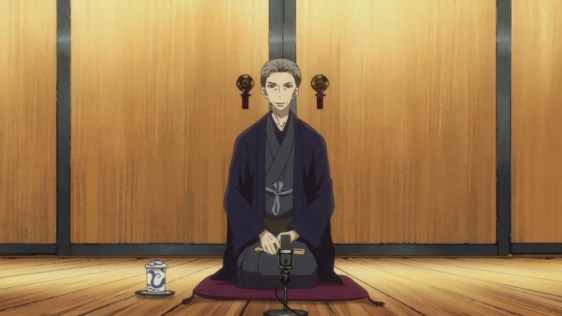
Yurakutei Yakumo, aka Yurakutei Yotarou (Showa Genroku Rakugo Shinjuu)

I’m fascinated by the idea that people change when they’re onstage, that they can almost see their “performer” self as a wholly different persona. There are plenty of real-world examples of this, from Freddy Mercury to Magic Johnson to Umehara Daigo, and within anime this past year we saw a couple as well. The best most recent example is probably Katsuki Yuri from Yuri!!! on Ice, but I think an even more amazing case of this is the eighth Yurakutei Yakumo.

Whether it’s as a young, frail boy, an overly serious adult, or a sneering wizened old man, Yakumo lives a compelling life full of equal parts friendship and struggle with his own identity. But when he’s performing his rakugo, it’s clear that there are elements buried deep within himself that come to the surface. His performances, the subtle changes he makes to play different characters within the same story, feel especially real. The fact that he’s so reserved in his actual life but excels in telling dirty stories when in front of a crowd encapsulates all that he is.

BEST FEMALE CHARACTER

bestanimecharacter2016-shidarehotaru

Shidare Hotaru (Dagashi Kashi)

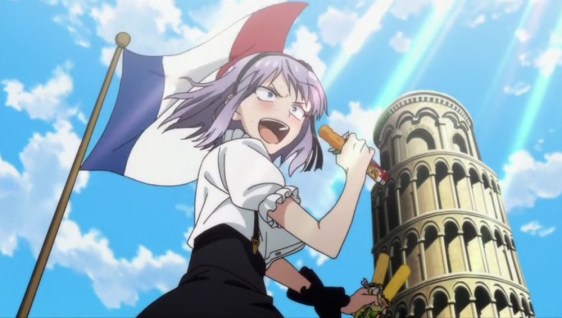
Appearing in the very first anime season of 2016, Shidare Hotaru made an immediate impression on me. Her striking appearance and intense expressions struck me like lightning. More importantly, her endless fervor for inexpensive Japanese snacks is something I relate to on an equally deep level. All too often, when people are interested in food, it comes more from a desire is to chase only the best eats, to become one of the elite, instead of appreciating everything the world has to offer. Hotaru isn’t like that. She truly loves all dagashi from the bottom of her heart.

Ironically, she’s a rich girl, which plays on one of the classic tropes of Japanese fiction.

What’s more, thanks to Dagashi Kashi, my recent trip to Japan this year involved searching for all sorts of Japanese munchies. Let it be known that Corn Potage Umaibou are one of mankind’s greatest inventions, and that we have Shidare Hotaru to thank for helping to spread the gospel of dagashi.

Final Thoughts

2016 was actually full of excellent characters who went the full gamut from realistically subtle to hyper-real dynamos. It’s what made deciding best characters especially difficult, and something I mulled over until the very last second. Even after solidifying the picks in my head, I could still sense my own hesitation. However, what I think ultimately brought me to pick Yakumo and Hotaru is that, even though they’re very different people, the flames within their souls burn brightly for their chosen passions. Incidentally, those passions are quite similar themselves. Rakugo and dagashi are traditional enjoyments of the common man in Japan that have both become dying arts in a certain sense with the movement of the times. How does one adapt and change while preserving the spirit of these cultural artifacts? That’s the fight both Yakumo and Hotaru are in, and they’ll go down swinging if they have to.

Save

Save

Save

Save

Save

Save

Save

Save

Understanding “Safe Spaces” as Expressions of Ideals

In observing the interactions and conversations about social justice and related topics, one thing that becomes increasingly apparent is the stark difference in perspective that can come from being a minority vs. a majority. In particular, the criticism of “overreaction” is a fascinating one to explore, because of how it can lead to the idea that “political correctness” is causing more problems than it solves. However, what I find is that the issue isn’t so much that people are oversensitive, or even that the other side is composed of monsters, but that there is a particular approach to life that is implicit in the actions of many who take can be thought of as “overreacting.” I call this “externalization of an internal ideal.”

Before I continue, I want to say this: although I’ve actually been thinking about this subject quite a bit, it’s Duncan “Thorin” Shields’s recent video above arguing how the media is all too eager to create outrage that has prompted me to really commit my thoughts to text. This is because, while I don’t agree with some of the key points of his video, he at least lays it all out such that it promotes debate and discussion. And even if I’m not of a similar belief to him in certain respects, I still highly value his work on eSports and continue to watch his videos regularly.

At one point in Thorin’s video, he mentions the Donald Trump “pussy grabbing” scandal, arguing that the outcry against it was exaggerated to an absurd extent. This is not because Thorin is defending sexual assault, but that the way in which Trump was speaking was in the context of a private conversation between men where the objectification of women is par for the course. The idea laid out in this minor point is that Trump’s words should have been a surprise to no one, so to respond with shock and horror is to willfully ignore reality.

I think Thorin is right in a certain sense, but I also don’t think that this is automatically a problem. Although some might navigate their lives by saying, “This is how the world is, so I’d better figure out how to best work within those restrictions,” others might instead think, “I want to live my life as if the world is at the point I wish it to be.”

Let’s put this in the context of minorities. When it comes to the dictionary definition of a “minority,” it would only make sense that they would feel like the world does not cater to them. If there was a world where the population was 99% majority and 1% minority, then mathematically it would be unlikely for this minority to gain much traction. And yet, that does not mean someone who is a member of a minority should only ever be able to feel like they are excluded from the majority, that they cannot act as if they are the default or standard. If there is a black person, or an Asian person, or a gay person, or a transgender person, and their mindset is to behave as if they are not an outsider, that they are not the “other,” then I think that is a perfectly fine way to live.

This is also why I think the idea of “safe spaces” is often misunderstood. Sometimes you’ll see them characterized as “hug boxes,” or places that prevent people from learning to overcome adversity. If the “real world” is where iron sharpens iron, then safe spaces are supposedly sites of stagnation for individuals and groups. But their ideal function is to be a place where one can feel “normal,” that they are not some deviation that must inevitably be compared to what is most common in society. Why shouldn’t women want a world where they’re not judged first by their looks, even if the first thing we tend to notice about people is how they look? Why shouldn’t a racial minority get to spend some time without being implicitly judged by their skin tone and the cultural stereotypes they carry?

There is a downside to all this. If you live by trying to externalize your ideals, you risk creating a false perception of the world, especially if you ignore the need for reality checks. However, if you take the world “as it is,” then you might end up reinforcing hierarchies if the desire to fight is absent. What I think is especially important in the former’s case, and why I think the notion can seem so foreign to certain people is that it carries a kind of utopian desire. Rather than simply imposing one’s will upon the world and forcing it to obey, it’s a mark of a hope for a better world. Instead of the world telling you how you are, you tell the world how you are. Even if people “shouldn’t” have been outraged at Donald Trump’s words, they want the world to be one where implied sexual assault is admonished. Only by understanding this perspective can discussion really begin.

I am not someone who believes “overreaction” does not exist, or that it is a wholly unfair criticism towards liberals. It is all too easy for even well-meaning people to have knee-jerk reactions, not understand the context of a situation, and then ride their anger without looking back. Nevertheless, I do think that this desire for an ideal world is not simply a pipe dream or a refusal to acknowledge reality. The better way to look at it is as a wish for the world to be a better place starting with one’s own mind and body.

Ichigo x Rukia: The Victim of Soap Opera Tactics?

Warning: Bleach Ending Spoilers

I’ll be upfront: I shipped Ichigo x Rukia.

From the very start of Bleach I loved their dynamic. The continuously growing friendship, the humorous arguments, and both the establishment and reinforcement that their bond was something special made me feel that, if anything was true about Bleach, it was that they would end up loving each other and being closer than anyone could possibly imagine.

While romantic love is not the only kind out there, it’s clear from the ending of Bleach that creator Kubo Tite had a different idea in mind. As seen in the final chapter, Ichigo ends up with childhood friend Orihime, and Rukia ends up with a childhood friend of her own, Renji. While those two relationship paths were certainly developed throughout the series, it still seemed jarring to me because I still found the connection between Ichigo and Rukia to be so much stronger and more profound. Because I wasn’t deeply invested in Bleach by the end, these canon pairings didn’t jar me into any sort of indignant fervor, but they nevertheless left me a bit puzzled.

In a conversation with Kate from the Reverse Thieves anime blog about when fans and creators disagree in terms of romance in particular fictional titles, she pointed towards the soap opera community. As love triangles and changing relationships are hallmarks of soap operas, they inevitably create strong groups of shippers for any and all combinations. However, when there is a particularly fervent fanbase that the creators disagree with greatly, one common tactic is to separate the two characters so that they are not allowed any on-screen time together. The hope (though often a futile one) is that it will quash the support base for that particular pairing and promote the ones that are being shown.

Upon first hearing about this, I laughed at it as an amusing quirk of soap operas, but the more I thought about it the more it started to sound like exactly what happened with Bleach. If you look at early chapters of the manga, Ichigo and Rukia are around each other often, and their interaction is the core of what what makes the series endearing. When Rukia gets taken to Soul Society and Ichigo follows to rescue her, there’s a sense that something has been kindled between them, even if it might not necessarily be romantic feelings. It’s no wonder so many fans (including myself) latched onto this idea.

However, when looking at later developments in Bleach, Ichigo and Rukia are rarely seen together. I might be mistaken, but I think the last time that they spent any significant time together is after Soul Society when Rukia is supposedly gone but shows up at Ichigo’s high school once more, new and improved. While seeing Ichigo’s reaction to Rukia’s return is another “evidence” moment, what’s more important here is that, in just about every arc after this, Ichigo and Rukia are usually fighting separately. More often than not, Ichigo is with Orihime, and Rukia is with Renji. While Rukia had her own arc of being taken away to another world, Orihime gets the same treatment in Hueco Mundo. Even in the final battle against the ultimate villain of the series, Yhwach, these combinations are perpetuated.

Of course, I don’t actually know what went into Kubo’s thinking, but it just plain stands out to me that Ichigo and Rukia have so little page time together after a certain point in Bleach. Although ultimately how a relationship develops in fiction is the product of how creators write the characters, it’s as if Kubo had ended up smothering any additional opportunities for fans to enjoy and revel in the Ichigo/Rukia dynamic which made the series so strong initially. It feels like the only time we see them together again is in that final chapter when the two are already happily married to others and with kids of their own. The other remnant of their bond is when their respective children meet, but that is only a fragment of a new potential beginning between two similar-yet-different characters.

If you liked this post, consider becoming a sponsor of Ogiue Maniax through Patreon. You can get rewards for higher pledges, including a chance to request topics for the blog.

‘Tis the Seasoning: Ogiue Maniax Status Update for December 2016

Is it December already?! It actually feels like I just got done writing the update for November, and now we’re at the end of the year. Much love to all of my sponsors on Patreon for being with me for the entire year!

General:

Johnny Trovato

Ko Ransom

Alex

Diogo Prado

Viga

Yoshitake Rika fans:

Elliot Page

Hato Kenjirou fans:

Elizabeth

Yajima Mirei fans:

Machi-Kurada

November was the 9th anniversary of Ogiue Maniax, so I wrote my thoughts on how the blog’s been going and where I think it’ll head next. I’ve since reflected a bit further on what I said there. While I primarily look at Ogiue Maniax as a place to share thoughts and ideas, I think I’ve been a little sparse in terms of denser, heavier content as of late. I’m looking to write better and with greater insight as I move forward, but also balancing it out with shorter, lighter posts, much like a three-course meal.

It was a long time coming, but I finally posted my feelings on the dismissal of Precure as insignificant because it’s not Sailor Moon. As a fan of both I feel like this is a recurring issue, and I hope that magical girl enthusiasts and just anime watchers in general can come to appreciate Precure better.

I also began my pseudo-series of posts about characters I love, with Inukami Kyouko from the volleyball manga Shoujo Fight. As Ogiue Maniax was built on a foundation of character appreciation, I felt that it was kind of a nice return to my roots, so to speak.

This month’s Patreon-sponsored post sees me tackle the third season of Aikatsu!, which passes the baton from heroine Hoshimiya Ichigo to young upstart Oozora Akari. I mostly talk about the idea of switching protagonists and how the series handles it.

Finally, I want to give attention to something I wrote the day before the US presidential election. Even after all the chaos that has ensued, I want people to read it and perhaps take it to heart. I think it is all too easy to want to silence others if one believes others to simply be hateful and ignorant, but that merely creates greater animosity in my opinion. It’s ostensibly an anime-related post because I talk about Legend of the Galactic Heroes!

Look forward to the rest of December’s posts! I’ve got a new Anime Secret Santa review on the way, my annual “best characters of the year” post, and more!

Sound! Euphonium, Tesagure! Bukatsumono, and Intimate Conversations

soundeuphonium-kumikoreina

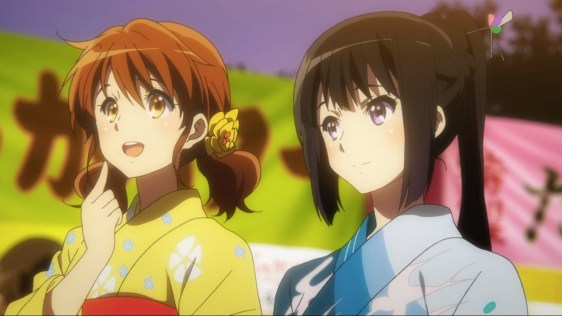
Ever since the end of Sound! Euphonium Season 1, I’ve found the conversations between protagonist euphonium player Kumiko and trumpeter Reina remarkable in their intimacy. While the acting is overall solid as each member of the Kitauji High School music club brings personality and history, there’s something noticeably different when it comes to those two.

Often when voice actors in anime are playing their roles, there is a sense of performance. This is not a bad thing, at least not inherently. They are, for all intents and purposes, actors on a stage bringing their characters to life. When Taki-sensei speaks with this slightly hoarse yet alluring voice, for example, one gets the sense of a teacher who’s dedicated, clever, and expects the best of his students, but seems to carry an internal emotional pain at all times. When Kumiko and Reina are talking to other characters, one senses the way in which Kumiko is constantly trying to find herself while Reina’s dedication and drive are ever-present. Together, howver, it’s as if their outer-facing selves begin to crumble, and we’re witness to the hush tones of a more naturalistic conversation between close friends (or something more).

I do not know how Sound! Euphonium accomplishes this. Perhaps they do something different in terms of the recording environment or the voice direction. What I can say is that this style of dialogue reminds me of a certain type of Japanese animation: the off-the-cuff humor shows that began with gdgd Fairies and include series such as Straight Title Robot Anime and Tesagure! Bukatsumono.

tesagure-cantsee

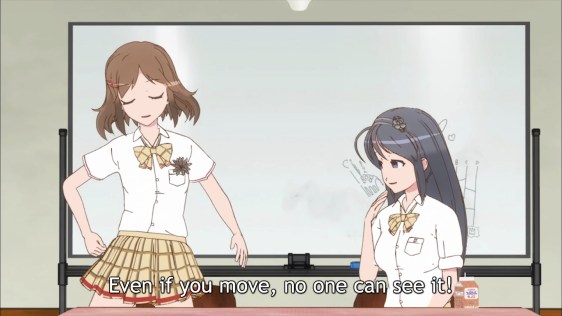
Made “on the cheap” using the 3D modeling and animation program “Miku Miku Dance,” these shows tend to feature offbeat comedy culminating in a special “improv” section. For example, in Tesagure! Bukatsumono (currently the best show of its kind in my opinion), the show is about a club where characters try to imagine what other school clubs would be like. In the middle of every episode, there is always a scene where the girls are supposed to come up with never-before-seen version of familiar clubs (like a baseball club where everyone has to dress fashionably), an in these moments the audio noticeably changes. To start, here’s a lot more mumbling. And where anime normally has characters speak and even interrupt each other so perfectly that you can’t call it anything but “staged” (because of course it is), these improv scenes have characters talking over each other like it’s a radio show. The fact that the actors often end up breaking character because of the success (or failure) of their own jokes makes it feel that much more like a private conversation that we the viewer are happening to eavesdrop on.

That’s more or less the feeling I get when I listen to Kumiko and Reina talk to each other. Whenever they’re together, it’s as if the rest of their world vanishes, and we’re privy to a space where only they reside. In it, even their outer selves fall away, and what we’re left is with is openness and comfort.

If you liked this post, consider becoming a sponsor of Ogiue Maniax through Patreon. You can get rewards for higher pledges, including a chance to request topics for the blog.

Save

Save

Save

Democracy and Freedom of the Speech Go Hand-in-Hand

In an environment where a celebrity-turned-politican can rouse up support through anger and vitriol, I think it is only natural to be wary of how people use speech. It becomes viewed as a tool of fear, a force to fight against, and this can lead people down the dangerous path of trying to fight fire with fire. From that sentiment springs the dichotomies of right and wrong, as well as the idea that the ends justify the means: if you’re so clearly and obviously right, anything you say or do should be for a just cause, even if that means silencing the opposition, right? But such thinking is on the precipice of censorship, and a sense of righteousness can blind people to that.

Whenever I think of the core functions of democracy, I think back to Yang Wen-li in the Japanese novel/anime series Legend of the Galactic Heroes. When comparing  democracies and dictatorships as forms of government, Yang emphasizes that while a good, strong, and just dictator can create more sweeping changes and reforms at a quicker rate, a terrible dictator is beyond dangerous. They can seize and maintain power forever, suppress the people, and can only be removed with a great deal of effort. In contrast, it may be harder to get things done in a democracy, but the constant renewal of leadership means that, even if we get some bad politicans, they can only last so long. Democracy has greater potential for change, even if that change comes only in fits and starts.

I think freedom of speech serves a similar role in society, and that in order to have democracy you need to have an environment where people are free to speak their minds. The risk that comes with this is that people may not always say things we’re comfortable with or agree with. This does not mean that we cannot criticize ideas, or how they’re delivered, or that something like hate speech should just be allowed to flourish. However, this also does not mean that the solution is to shut them up or to try and “overpower” them. I do believe that, on some level, part of the reason racism keeps rearing its ugly head is that people are shamed into silence, and they harbor these feelings so that they take the first opportunity for them to voice their feelings in a way that feels empowering. If people speak at each other, it cuts off avenues for dialogue. It’s perhaps no surprise that American politics seem to often be games of one-upsmanship and stifling the opposition, as opposed to trying to find compromise and promote candid conversation.

As an anime and manga blogger, I know this isn’t the sort of topic readers would immediately expect, but I think it is relevant to how fans as people interact with the various worlds they engage in, be they discussions of fiction, participation in their local communities, or engagement in political forums. I hope that we remember that democracy and freedom of speech are not static tools, and they are best utilized as dynamic, ever-changing entities.