OGIUE MANIAX

Anime & Manga Blog | 50% Anime Analysis, 50% Ogi

‘Tis the Seasoning: Ogiue Maniax Status Update for December 2016

Is it December already?! It actually feels like I just got done writing the update for November, and now we’re at the end of the year. Much love to all of my sponsors on Patreon for being with me for the entire year!

General:

Johnny Trovato

Ko Ransom

Alex

Diogo Prado

Viga

Yoshitake Rika fans:

Elliot Page

Hato Kenjirou fans:

Elizabeth

Yajima Mirei fans:

Machi-Kurada

November was the 9th anniversary of Ogiue Maniax, so I wrote my thoughts on how the blog’s been going and where I think it’ll head next. I’ve since reflected a bit further on what I said there. While I primarily look at Ogiue Maniax as a place to share thoughts and ideas, I think I’ve been a little sparse in terms of denser, heavier content as of late. I’m looking to write better and with greater insight as I move forward, but also balancing it out with shorter, lighter posts, much like a three-course meal.

It was a long time coming, but I finally posted my feelings on the dismissal of Precure as insignificant because it’s not Sailor Moon. As a fan of both I feel like this is a recurring issue, and I hope that magical girl enthusiasts and just anime watchers in general can come to appreciate Precure better.

I also began my pseudo-series of posts about characters I love, with Inukami Kyouko from the volleyball manga Shoujo Fight. As Ogiue Maniax was built on a foundation of character appreciation, I felt that it was kind of a nice return to my roots, so to speak.

This month’s Patreon-sponsored post sees me tackle the third season of Aikatsu!, which passes the baton from heroine Hoshimiya Ichigo to young upstart Oozora Akari. I mostly talk about the idea of switching protagonists and how the series handles it.

Finally, I want to give attention to something I wrote the day before the US presidential election. Even after all the chaos that has ensued, I want people to read it and perhaps take it to heart. I think it is all too easy to want to silence others if one believes others to simply be hateful and ignorant, but that merely creates greater animosity in my opinion. It’s ostensibly an anime-related post because I talk about Legend of the Galactic Heroes!

Look forward to the rest of December’s posts! I’ve got a new Anime Secret Santa review on the way, my annual “best characters of the year” post, and more!

Sound! Euphonium, Tesagure! Bukatsumono, and Intimate Conversations

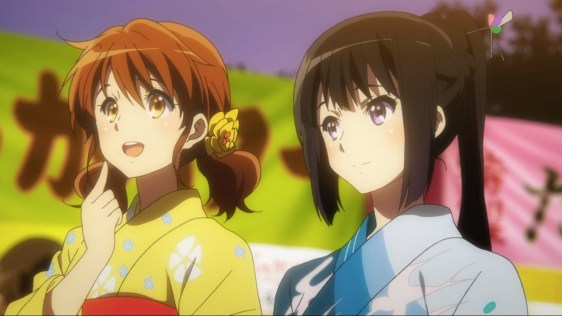
soundeuphonium-kumikoreina

Ever since the end of Sound! Euphonium Season 1, I’ve found the conversations between protagonist euphonium player Kumiko and trumpeter Reina remarkable in their intimacy. While the acting is overall solid as each member of the Kitauji High School music club brings personality and history, there’s something noticeably different when it comes to those two.

Often when voice actors in anime are playing their roles, there is a sense of performance. This is not a bad thing, at least not inherently. They are, for all intents and purposes, actors on a stage bringing their characters to life. When Taki-sensei speaks with this slightly hoarse yet alluring voice, for example, one gets the sense of a teacher who’s dedicated, clever, and expects the best of his students, but seems to carry an internal emotional pain at all times. When Kumiko and Reina are talking to other characters, one senses the way in which Kumiko is constantly trying to find herself while Reina’s dedication and drive are ever-present. Together, howver, it’s as if their outer-facing selves begin to crumble, and we’re witness to the hush tones of a more naturalistic conversation between close friends (or something more).

I do not know how Sound! Euphonium accomplishes this. Perhaps they do something different in terms of the recording environment or the voice direction. What I can say is that this style of dialogue reminds me of a certain type of Japanese animation: the off-the-cuff humor shows that began with gdgd Fairies and include series such as Straight Title Robot Anime and Tesagure! Bukatsumono.

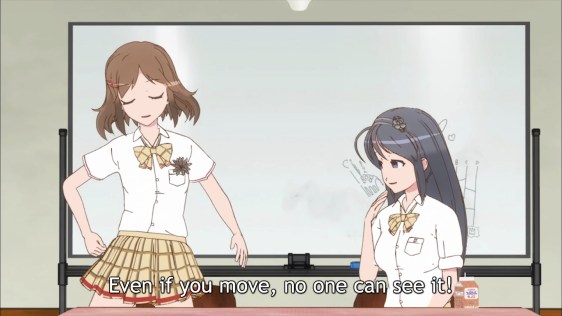
tesagure-cantsee

Made “on the cheap” using the 3D modeling and animation program “Miku Miku Dance,” these shows tend to feature offbeat comedy culminating in a special “improv” section. For example, in Tesagure! Bukatsumono (currently the best show of its kind in my opinion), the show is about a club where characters try to imagine what other school clubs would be like. In the middle of every episode, there is always a scene where the girls are supposed to come up with never-before-seen version of familiar clubs (like a baseball club where everyone has to dress fashionably), an in these moments the audio noticeably changes. To start, here’s a lot more mumbling. And where anime normally has characters speak and even interrupt each other so perfectly that you can’t call it anything but “staged” (because of course it is), these improv scenes have characters talking over each other like it’s a radio show. The fact that the actors often end up breaking character because of the success (or failure) of their own jokes makes it feel that much more like a private conversation that we the viewer are happening to eavesdrop on.

That’s more or less the feeling I get when I listen to Kumiko and Reina talk to each other. Whenever they’re together, it’s as if the rest of their world vanishes, and we’re privy to a space where only they reside. In it, even their outer selves fall away, and what we’re left is with is openness and comfort.

If you liked this post, consider becoming a sponsor of Ogiue Maniax through Patreon. You can get rewards for higher pledges, including a chance to request topics for the blog.

Save

Save

Save

Democracy and Freedom of the Speech Go Hand-in-Hand

In an environment where a celebrity-turned-politican can rouse up support through anger and vitriol, I think it is only natural to be wary of how people use speech. It becomes viewed as a tool of fear, a force to fight against, and this can lead people down the dangerous path of trying to fight fire with fire. From that sentiment springs the dichotomies of right and wrong, as well as the idea that the ends justify the means: if you’re so clearly and obviously right, anything you say or do should be for a just cause, even if that means silencing the opposition, right? But such thinking is on the precipice of censorship, and a sense of righteousness can blind people to that.

Whenever I think of the core functions of democracy, I think back to Yang Wen-li in the Japanese novel/anime series Legend of the Galactic Heroes. When comparing  democracies and dictatorships as forms of government, Yang emphasizes that while a good, strong, and just dictator can create more sweeping changes and reforms at a quicker rate, a terrible dictator is beyond dangerous. They can seize and maintain power forever, suppress the people, and can only be removed with a great deal of effort. In contrast, it may be harder to get things done in a democracy, but the constant renewal of leadership means that, even if we get some bad politicans, they can only last so long. Democracy has greater potential for change, even if that change comes only in fits and starts.

I think freedom of speech serves a similar role in society, and that in order to have democracy you need to have an environment where people are free to speak their minds. The risk that comes with this is that people may not always say things we’re comfortable with or agree with. This does not mean that we cannot criticize ideas, or how they’re delivered, or that something like hate speech should just be allowed to flourish. However, this also does not mean that the solution is to shut them up or to try and “overpower” them. I do believe that, on some level, part of the reason racism keeps rearing its ugly head is that people are shamed into silence, and they harbor these feelings so that they take the first opportunity for them to voice their feelings in a way that feels empowering. If people speak at each other, it cuts off avenues for dialogue. It’s perhaps no surprise that American politics seem to often be games of one-upsmanship and stifling the opposition, as opposed to trying to find compromise and promote candid conversation.

As an anime and manga blogger, I know this isn’t the sort of topic readers would immediately expect, but I think it is relevant to how fans as people interact with the various worlds they engage in, be they discussions of fiction, participation in their local communities, or engagement in political forums. I hope that we remember that democracy and freedom of speech are not static tools, and they are best utilized as dynamic, ever-changing entities.

Yowamushi Pedal: Brains, Heart, and Body

yowamushipedal-firstyears

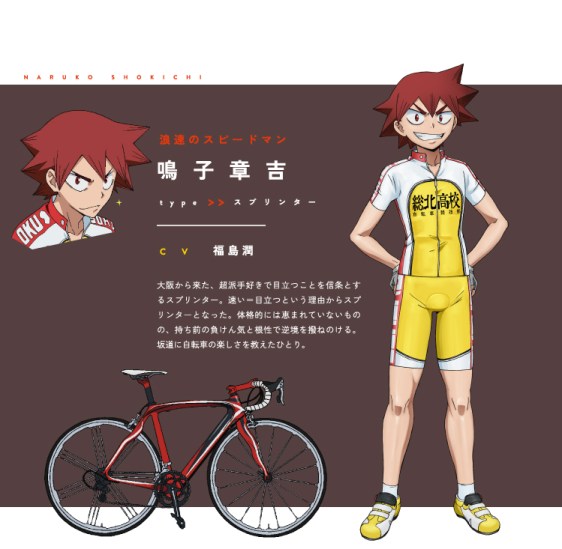
As a sports manga and anime with an enormous cast, Yowamushi Pedal is home to a variety of characters designed to contrast with each other in terms of personality and approach to competitive bicycle racing. This certainly applies to the first-years when the series begins, as all-rounder Imaizumi Shunsuke, speedy Naruko Shoukichi, and high-cadence protagonist Onoda Sakamichi are all differ from one another significantly. In looking more closely at these three characters, however, I find that they resemble professional fighting game player Laugh’s theory of the Three Fighting Game Player Archetypes. My aim here is to elaborate why I believe this to be the case, and which archetypes apply to these three.

As described by the video above from Core-A gaming, the three categories of players are brains, heart, and body. While this distinction is not exclusive to fighting games or even gaming or competition in general, I find that Yowamushi Pedal with its theme of cycling has a lot of parallels with fighting games. Although fighting games are typically 1-on-1 matches and bicycle racing is shown to be a team sport on the biggest stages, the emphasis on how a human being competes through the use and fine-tuning of their equipment is a point of commonality. At one point, a character in Yowamushi Pedal even talks about how, unlike other sports, you don’t need to be the biggest or the strongest because what matters is how you work with your bike. Replace that with “joystick” or “controller,” and the similarities start to become clearer.

In the training camp arc of Yowamushi Pedal, where the characters compete to see who will represent Sohoku High School in the Inter-High National Tournament, club captain Kinjou purposely messes with the first-years’ bicycles in order to challenge them to work on their major weaknesses. In doing so, he reveals the archetypes that Imaizumi, Naruko, and Onoda embody.

imaizumi-shunsuke-full-1565241

Imaizumi is a “brains” type, or someone who relies on superior knowledge and study to win. When Kinjou removes his ability to shift gears, it initially throwsImaizumi for a complete loop. Just as a brains-based fighting game player knows frame data like the back of their hand, Imaizumi had up to that point relied on his optimal knowledge of gear shifting to tackle any level of slope while cycling. Although he eventually overcomes this flaw during the training camp, his sheer joy when he’s finally able to reunite with his cherished gear shifters shows just how much the “heady” part of bicycle racing factors into Imaizumi’s approach to the sport.

naruko-shoukichi-full-1565240

Naruko, then, is a “heart” type, who prefers to “feel” things out. In fighting game terms, this is someone who is confident they can outmaneuver you in unorthodox situations and “mind game” you. His advice to Onoda to surprise Imaizumi with a technique in a previous race, as well as his own “Sprint Climb” maneuver, are indicative of a similar quality. At the training camp, Kinjou removes his lower handle bars, thus limiting Naruko’s ability to adapt and be as creative as he’d like. Unable to do things “in the moment” as a result, Naruko is forced to work around it.

onoda-sakamichi-full-1565236

That leaves Onoda as the “body” type. While this might not make sense given how Onoda is the “heart” of the team, that’s a different kind of conception of heart as a spiritual center. Instead, the reason why Onoda is a “body” cyclist is because of the fact that his high cadence is the linchpin of his riding style. Just as a “body” type in fighting games always has things like technical precision and perfectly executed high-damage combos to fall back on, Onoda’s ingrained ability to raise and lower his cadence like the pedals are an extension of his body lets him overcome situations where he might be “strategically” beaten. And just like the other two, when his ability to freely pedal as quickly or as slowly as he’d like is interfered with, he starts off feeling utterly helpless.

Imaizumi the brains, Naruko the heart, and Onoda the body. Together, they create a complete being, which is perhaps why they work so well together. What about the other characters, then? I’ll leave you to figure them out.

If you liked this post, consider becoming a sponsor of Ogiue Maniax through Patreon. You can get rewards for higher pledges, including a chance to request topics for the blog.

Giver of Thanks: Ogiue Maniax Status Update for November 2016

November is anniversary month for Ogiue Maniax, but I’ll be saving that for its own dedicated post (if I remember, that is. Someone please remind me!).

A big thanks to this month’s Patreon sponsors. You might not understand how much I appreciate your help, but I’ll explain at the end:

General:

Johnny Trovato

Ko Ransom

Alex

Diogo Prado

Yoshitake Rika fans:

Elliot Page

Hato Kenjirou fans:

Elizabeth

Yajima Mirei fans:

Machi-Kurada

Before going into an overview of my favorite posts of the month, I want to talk a bit about my appreciation to my readers for being curious as to what I have to say. As I go through life, I meet more and more anime and manga fans of different tastes and philosophies, but often I feel it can be difficult to engage in conversations about the nitty-gritty of anime and manga as ways to explore thought, society, emotion, and more. Talk about anime and manga floats at the surface, or, if it delves deeper, is often connected to value judgments or inside looks at the mechanics of industries. I know my audience isn’t especially large, but I am grateful that the topics I’m interested in at least pique your curiosity.

That being said, I know I’m really bad at responding to comments on a frequent basis, and I intend to work harder at fostering actual conversation on Ogiue Maniax. Also, because I’ve been more review-heavy as of late, I’m wondering if this is steering away from the strengths of the blog.

As for this month’s post highlights…

First, at long last, is a final review of one of my favorite manga in recent memory: Mogusa-san. If you love food manga, this is right up your alley.

Second, out of the many films I watched over October, Miss Hokusai has to be the one I enjoyed the most. ALso, check out Kizumonogatari Part II and Shin Godzilla.

Third, I took a different approach to covering New York Comic Con this year, and have been writing response essays to things that caught my attention. If you like giant robot toys, check out my thoughts on Soul of Chogokin Voltron and Megazord.

Lastly, I wrote a bit about Star Ocean EX, and just how 2003 it is.

I’m not sure what I’ll have in store for November, but I’m thinking of devoting a significant chunk to talking about some of my favorite recent characters.

New York Comic Con 2016 Essay #2: Lucha Underground and Scripted vs. Unscripted Promos

I don’t talk about wrestling all that often on this anime and manga blog. Pro wrestling hasn’t been a staple part of my pop culture experience in over a decade. That being, said I do maintain a curiosity towards the state of its industry and its viewers. Who are the popular heroes (faces) and villains (heels)? What wrestling promotions are currently out there? What do the fans think? It’s this desire to keep a finger on the pulse of wrestling that prompted me to attend the Lucha Underground panel at New York Comic Con 2016, despite the fact that I had seen less than 30 minutes’ worth of material.

Lucha Underground is a current American television program that focuses on the high-flying acrobatics style of Mexican wrestling called lucha libre. The panel featured both writers and performers for Lucha Underground, most notably Rey Mysterio, Jr., the man who has become the icon of lucha libre itself in the United States. The panelists discussed what it’s like to work on the show and what Lucha Underground does differently compared to other promotions. Of these various comments, what stood out to me most was the fact that Lucha Underground is produced more like a traditional television series. Storylines are plotted out, many characters are created well in advance (with wrestlers having auditioned to fulfill those roles), and a lot of post-production is utilized to create a more cinematic experience. In other words, Lucha Underground is neither “live” in the traditional sense nor “live to tape.”

The reason I find this notable is that if you ask many current wrestling fans (and I imagine even fans of Lucha Underground) what’s wrong with WWE today, it’s that the show is too scripted. Individual wrestlers have their promos written for them, and only a select few are allowed to go off the cuff. This is a very different world from where wrestling was in eras past, where things like “Austin 3:16” and Macho Man’s “cream of the crop” were their own creations. It makes sense, given that wrestlers are in general not the greatest actors, but that they can be very good at crafting their own characters based on their own personalities, or taking a gimmick given to them and going the distance with it. The fact that Lucha Underground goes even further in the direction of being scripted (not just in outcomes, but also in long-term story planning) seems to fly in the face of this criticism.

However, I wonder if the issue is that promotions like WWE are caught in the middle, such that it lacks both the improvisational feel of old and isn’t refined enough in its narrative elements to really make sure its scripted elements are as tightly plotted as possible. This might just be a symptom of still being a live show on top of being the biggest wrestling show on air today. There’s a desire to avoid taking too many risks at the same time they understand that new blood and new opportunities are necessary, and if something awry happens they can’t just make it so that it never happened (even if wrestling storylines are always incredibly fluid). At the Lucha Underground panel, they mentioned how not having the show be live allows them to do multiple takes, and try crazy and untested ideas because anything that isn’t effective can go on the cutting room floor.

Given that this is how Lucha Underground is made, I find that this format ends up veering closer to sports anime, such as the current wrestling series Tiger Mask W. They can emphasize emotion and power in ways that don’t have to adhere to the semblance of realism (kayfabe) that still persists in other places even though everyone knows wrestling is “fake” now. By using creative camera angles, by making sure the mystic or occult elements of their universe don’t require you to suspend disbelief any more than you would a late-night drama, it perhaps allows Lucha Undeground to create an experience where its luchadores are truly “characters.” And by being characters, they can feel even more real.

If you liked this post, consider becoming a sponsor of Ogiue Maniax through Patreon. You can get rewards for higher pledges, including a chance to request topics for the blog.

The Limits of the Fujoshi Files

mio-ugghh

In 2008, I had an idea: archive every fujoshi character I could possibly find. At the time, it seemed like an achievable task. Fujoshi characters were around but fairly rare, especially compared to the “girl otaku” that tended to share the same interests as the guys. However, a lot can change in eight years, and over this period the position of the “fujoshi character” has changed tremendously, leading me to think about all of the limitations imposed on the Fujoshi Files as they currently exist.

First, while the 2007-2009 period featured a kind of “fujoshi boom” as the term came into prominence, if you look at the fujoshi character today she’s basically been kneaded into anime and manga as a whole. The archetype doesn’t exist in its own universe, and she’ll appear in works more disconnected from the realm of hardcore fandoms. I mean, a yuri school detective comedy? A weird political satire light novel?

Where once the Izumi Konata-style female otaku was taken as the standard, now the de facto girl fan in anime and manga is the fujoshi. They’re basically everywhere, and it can be hard to keep up with all of them, which is why I’ve slowed down the pace a bit. Perhaps this means I should be doing more for the Fujoshi Files than ever before (and believe me, I’m still on the look-out), but I also want to make sure that the blog remains diverse thematically, as I think that’s one of its strengths. In other words, I don’t have the time to tackle every single work with fujoshi characters, but I wish I did.

Of course, if you find any fujoshi not currently on the list, by all means please leave a comment.

fudanshikoukouseikatsu-keyimage

Second, the number of fudanshi (rotten boy) characters steadily increases. Back when Genshiken Nidaime first came out, I was faced with a decision: do I include Hato in the Fujoshi Files? Ultimately, my decision was to not give him an entry because he identifies as male, and the list is for female characters. Then I found out about the series Fudanshism. A brand new series, Fudanshi Koukou Seikatsufeatured prominently in the summer season. Now the fudanshi is in the position the fujoshi once was, and to ignore them seems something of an issue.

Third, these Fujoshi File profiles I’ve written are very basic, and tend to be in-universe, but there are are often interesting aspects to these characters, like how they’re utilized in terms of narrative, elements of their designs, etc. Not including these factors leaves the Fujoshi Files without any real analytical teeth, though I’m not sure if that should change.

So I’m left with a few questions.

Should the Fujoshi Files branch off into a “Fudanshi Files?”

Should the Fujoshi Files go from being a series of small blog posts here to an entire Wikia?

Has the Fujoshi Files served its purpose already, in that it’s already over 150 characters strong?

If you liked this post, consider becoming a sponsor of Ogiue Maniax through Patreon. You can get rewards for higher pledges, including a chance to request topics for the blog.

The Smash 4 Tier List, and the Chaos of Viability

4brtierlist2

Smashboards recently released its second ever Smash Bros. for Wii U tier list, which comes after a string of big summer tournaments. With movements throughout the rankings both big and small, Tier List 2.0 notably features the inclusion of Corrin and Bayonetta (both of whom were previously absent), and the dramatic rise of both Mewtwo and Marth thanks to a slew of patches as well as advancement in their development by the players themselves. It’s also worth mentioning Mega Man would find himself in high tier. As a character that has been rated both well and poorly throughout the game’s life, it’s quite interesting that Mega Man has barely had any direct buffs.

For the most part, I’m not here to argue placings of characters. If pressed, I’d say the only placings I’m unsure of are Mr. Game & Watch and Charizard.

One thing that this tier list brings to mind is just how balanced Smash 4 is, especially compared to its official predecessors in Smash Bros. Melee and Smash Bros. Brawl. Now, the roster is not perfectly balanced by any means. There are some characters who are clearly better than others. However, there are just as many where their placement is up for debate, and the fact that you’ll have multiple top players disagreeing greatly with the power level of any given character means we have a long way to go in understanding the game fully.

What makes Smash 4 so balanced? While Melee is often touted as the technically more complicated and advanced game because of its strict mechanical curve and plethora of options for constantly threatening the opponent, and I will disagree with anyone who says this makes Melee an inherently better game, the fact that there is no “sky’s the limit” character like Melee Fox or Brawl Meta Knight helps to restrict the possibility of such a dominant character running so roughshod over the weakest characters that you might as well put the controller down. Bad match-ups exist, but you know that Sheik or Diddy Kong are a couple levels below ridiculous.

Moreover, even when you look at some of the characters frequently cited as being terrible, you can often find that they can go toe-to-toe with some of the characters way above them. Take Shulk, who according to the 4BR tier list is the 12th worst character not counting Mii Fighters. Though his flaws are well-known (slow startup on attacks, dependence on Monado Arts that don’t ever fully solve that lackluster frame data), a number of top players on both sides of his match-ups place him as going even with Mewtwo and Cloud, ranked 10th and 2nd respectively. This is just because of how their tools interact, and how their strengths and weaknesses—again, none of which are ever to any utter extreme (no, not even Cloud)—play against each other. If you look at the lesser characters in Melee and Brawl, the best they can hope for is maybe one matchup against a top tier where they don’t get wrecked five ways from Sunday.

Smash 4 is currently seen as having a very volatile competitive scene, as players can be on top of the world one moment and then drown in the early stages of a tournament the next. While some argue that this is a sign of the game being competitively robust while others argue it being a flaw, I think that either argument is too simple and too rooted in whatever individuals value most as “fostering competition.” Rather, I think that a 58-character roster and a balance that’s good enough combines with the fact that not everyone goes to a tournament aiming for 1st to create an interesting formula that leads to volatility.

If everyone was purely dedicated to being the best, they would be pick the characters they believed to be the strongest. As more and more people play these characters and advance their development, the pool of “best characters” would likely narrow. For tournament-goers, it would become more and more necessary to study only a handful of matches to maximize your limited time for practice and study. However, because there are people who want to use their character for reasons other than pure victory, and those characters aren’t abject failures, the top players’ attention is inevitably divided, leading to the greater potential for upsets.

Put differently, imagine a world where everyone maximizes their chances for winning in any given endeavor. Now, let’s say that, one day, a visitor comes whose goal is not to make himself win, but to create as much uncertainty as possible in others. It would end up disrupting the metagame between the original inhabitants, leading to more unpredictable results.

It’s a beautiful place to be.

If you liked this post, consider becoming a sponsor of Ogiue Maniax through Patreon. You can get rewards for higher pledges, including a chance to request topics for the blog.

Master of Puppets: Thunderbolt Fantasy

The latest great anime isn’t even animated. Thunderbolt Fantasy is a Japanese-Taiwanese co-production that is best described as a puppet show that combines Wuxia martial arts, fantasy anime, and tokusatsu. As someone who doesn’t watch that many martial arts films, isn’t terribly into Super Sentai or Kamen Rider, and was never a big fan of old action-oriented puppet shows like Thunderbirds, it surprises me that this series has actually become my favorite of the season.

I’ve been thinking of Thunderbolt Fantasy as a kind of 2.5D show. It has a lot of the flash and flair of anime, and one might even say the detail-oriented anime-inspired games such as BlazBlue, but of course it’s all intricate puppetry, miniature set design, with a smattering of CG special effects. What strikes me about the series is that the standards by which one judges the quality of a show like this doesn’t quite fit into the criteria of anime or live-action series. It’s not like there’s “animation quality” to consider, or the idea that the series might be cheaping out during dialogue scenes. Because they’re puppets, it’s not like typical notions of “good acting” necessarily apply either. It ends up falling somewhere along the lines of a tokusatsu show, or perhaps even pro wrestling, where subtleties are conveyed through exaggerated gestures.

As a result, I find that while the fight scenes are intense and entertaining, even entire episodes of characters standing around and talking to each other have much to be impressed by. When the characters are speaking, their mannerisms come out in the puppets’ actions. When they’re fairly stationary, then that invites the opportunity to really admire how amazingly the puppets are designed. The show just has a lot to visually chew on, and that’s on top of charismatic characters, a story that moves at a brisk yet comfortable pace, and interesting lore.

Another aspect of the series I’ve been considering is the idea that Japanese animation has sort of come full circle with Thunderbolt Fantasy. Some of the earliest attempts at Japanese animation were more akin to puppet shows. The late director Ishiguro Noboru (Yamato, Macross) was influenced by Czech puppet shows, while the also-late director Nagahama Tadao had his start in puppet theater as well. However, I’m saying this not just because Thunderbolt Fantasy utilizes puppets, but also because so much of its aesthetics comes from contemporary hyper-stylized anime akin to Madoka Magica or Fate/Zero. This shouldn’t be too much of a surprise, as the co-production is by Nitro Plus, creators of those two series, as well as Good Smile Company, creators of Nendoroids and Figmas.

The last piece of the puzzle is PILI International Multimedia, the Taiwanese company that actually makes the show. I don’t know nearly enough about them yet, so I don’t want to just spout nonsense. That being said, the making-of episode on Crunchyroll is very insightful, and it makes me want to learn more.

If you liked this post, consider becoming a sponsor of Ogiue Maniax through Patreon. You can get rewards for higher pledges, including a chance to request topics for the blog.

[Apartment 507] Teen Girl Sherlock Holmes Novel “A Study in Charlotte” Gets Manga-style Cover: US vs. Japan Marketing in Action

news_xlarge_charlotte_jokan_karu_cover

So A Study in Charlotte, an American novel about a young female descendant of Sherlock Holmes, is getting a Japanese release, and it has a cover from a manga artist. I’ve written some thoughts about this method of marketing, which you can read here. Namely, can a cover like this influence people’s perception of the contents inside?