The Relationship Between Classic Toei Heroines and Moe Characters

Not too long ago I half-jokingly suggested that the first moe character was Hilda (pictured above), the heroine from the 1968 animated film Hols: Prince of the Sun. The basis of this was that Hilda was the creation of a young Takahata and Miyazaki, who would later go on to form Studio Ghibli, and if you’ve ever read Miyazaki’s recollection of his first time watching Legend of the White Serpent, you’ll not only see similarities between Hilda and Pai-Nan, the heroine of Legend of the White Serpent, but also between his reaction and the way fans of Key games talk about their beloved works: Miyazaki actually cried the whole night, and fell in love with Pai-Nan. Of course, if Pai-Nan had such an impression, then it’s possible to argue that she’s the first moe character, but regardless of what character has the distinction, I suspect that the tragic element which defines both of these characters also has an influence on the development of female characters in anime and manga, and by extension the idea of moe.

In the trailer to Hols: Prince of the Sun, Hilda is introduced, accompanied by on-screen text saying, “Am I a demon, or a human being?” This highlights the inner conflict of her character, as Hilda is both the sister of the main villain as well as the love interest of the hero. She plays both a romantic and an antagonistic role, and the fact that she struggles over which is her “true self” is the inherent tragedy of the character. Star-crossed lovers are nothing new to media, of course, but according to The Pretty Character Chronicles: The History of Animation Heroines, 1958-1999, the early Toei animated films, of which both Hols and Legend of the White Serpent are included (though these titles are themselves about a decade apart), often feature heroines who begin the movies as antagonists.

Pai-Nan doesn’t quite fit this concept, as she’s more of a tragically cursed character, a princess in need of rescue in the vein of  a classic Disney Princess. This makes a degree of sense, given that Toei’s goal was to try to be the “Disney of the East,” but when you look at heroines in classic Disney films, none of them fulfill the role that Hilda or other similar Toei heroines play as partial antagonists. In fact, if you look at Disney animated films as a whole, there’s pretty much only one character who does fit this bill: Megara from Hercules, a film from 1997. In other words, “damsel-in-distress” is not quite the function of these Toei heroines.

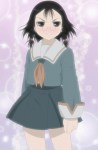
What relevance does this have to current anime and the presence of moe, then? My argument is that the tragedy component of heroines such as Hilda has been reduced or compacted to varying degrees, so when you have a character who has traits commonly considered moe, such as a character who suffers from being short in a slice-of-life comedy, what you’re seeing is an on-going series of tiny tragedies, like with Yuno in Hidamari Sketch. The tsundere, especially the more contemporary tsundere type, is another example, as a character who struggles with being true to her feelings can be considered tragic in her own way. Hidamari Sketch also provides one such character in the form of Natsume, whose feelings for the character Sae remain unrequited due to Natsume’s own stubbornness.

While I think the criticism of moe characters as feeding off the desire of men to want to rescue the poor female victim is valid to a good extent, I think that the quality which has transmitted itself from those early Toei days all the way to the current age is not so much that of the “helpless girl” but that of “helplessness.” A girl tragically trapped in a situation can be moe, but what’s considered even more moe is the heroine who can’t be helped no matter what. In such a case, powerlesssness becomes not so much the half-way point in an elaborate power fantasy, but the end point in and of itself, with the potential for empathy between not just the viewer and the hero, but the viewer and the heroine. Of course, that’s somewhat of an extreme case, and the end result really depends on how individual works wish to resolve the inner conflict of the descendants of the tragic antagonistic heroines.

Genshiken Second Season Anime Initial Thoughts

The new Genshiken anime has begun airing, and with it comes not only a time skip over the conclusion to the original manga, but also a new cast of characters. Seeing as the anime is pretty much covering the manga panel-by-panel, and I’ve already reviewed the individual comic chapters along the way, there’s not much need for me to do a thorough analysis, but I do want to give some thoughts about the adaptation process at least. If you do want to see my thoughts on the events of episode 1 of Genshiken Second Season (or Genshiken Nidaime, or as I prefer to call it, Genshiken II), you can find them here and here.

By the way, the title of the first episode is a reference to the Japanese title for the Shinkai Makoto movie known in English as The Place Promised in Our Early Days.

While the anime is faithful to the manga so far, in watching the first episode I feel that the pacing of this newest anime is a good deal more frantic than what I’m used to seeing from Genshiken anime. While the series was never quite subdued moe comedy or Maria-sama ga Miteru levels of “slow,” there was always a kind of mellowness to them even in the sillier situations. Think of Saki talking to them about how Kohsaka (probably) watches anime while they’re having sex. The humor crescendoes, coming out gradually. With the new series, it feels like one gag after the other with little room to breathe in between.

The thing I’m not as sure about is to what degree this has to do with the adaptation itself by Production I.G. (and along with it the new voice actors), and to what degree this is because of the new cast of characters and their different personalities. Certainly as much as Madarame could get rather crazy in the old days, he’s no Yoshitake, whom Ogiue accurately describes as like Kuchiki, only with tact and sense. At the same time, I’ve re-read the manga recently and I didn’t get the impression that the pacing is different, even if some of the energy shown by its characters is.

If I had to pick out a major difference, I think it may have to do with the fact that the manga often presents varying pieces of information such as different dialogues and facial expressions at once, from panel to panel, while the anime presents the same stuff isolated from its connective moments. Of course, the fact that I’ve seen all of this already may also mean I’m more sensitive to this, and someone entirely unfamiliar with the new Genshiken might be taking in the crazy world of a girl-dominant Society for the Study of Modern Visual Culture first and foremost.

I do also want to say just a couple of things about the voice actors. First, although they’re fine (but will take some getting used to), I experience cognitive dissonance when hearing Yukana as Ohno. No matter what, I can’t shake Cure White from my head. The other thing is that, in addition to finding Yamamoto Nozomi’s Ogiue performance to be somewhat similar to Mizuhashi Kaori’s other non-Ogiue roles, her Ogiue is actually closer to how I first imagined the character’s voice back when she appeared in the manga. At the time, I heard her voice as just the tiniest bit high-pitched with an equally small amount of nasalness, which Yamamoto has.

Speaking of Ogiue, one thing that didn’t occur to me while watching but I realize may be an issue with the animated Nidaime is that, for someone who had stuck only to the anime adaptations previously, Ogiue’s character might come across as way different from what they remembered. Whereas the last time we left Ogiue she had a tendency to stare daggers into everyone she met, now she’s kind of good-natured and filled with a good deal more joy, and without the Karuizawa arc from the manga showing both what her traumas were and how she eventually overcame then, this contrast in her old and new personalities is potentially jarring.

Anyway, to end things off, here’s a fun comparison for Ogiue fans everywhere.

NiGHTS into dreams… HD is my Wonder-Drug

After much delay, I finally started playing NiGHTS into dreams… HD. I’ve never played too many games on my PC just because I didn’t even have a proper controller for a lot of the genres I normally play otherwise, but I decided to just go, “To hell with it” and purchase an X-Box 360 controller. I know I was hankering for some retro gaming when I decided to buy it in euros even though it’d cost me a little extra.

I’m not really going to review NiGHTS here just because the game has such a powerful reputation, a cult classic that all Sega Saturn owners either remember fondly or always pined after. It is indeed an exquisite game, especially in its visual presentation and its smooth controls, but what I’ve found upon returning to my old favorite is that the game occupies this strange space for me where it is both somehow therapeutic while at the same time motivating and challenging.

Actually, I will say one thing about the game: it doesn’t control quite like the original Sega Saturn NiGHTS, and while the difference isn’t huge, it’s still noticeable for someone like me who poured hours and hours and hours into the old one. Playing widescreen can also throw off my sense of timing because the camera changes at ever-so-slightly different points.

I’ve written previously about how a current hobby of mine, Japanese mahjong, is a combination of luck and deception, and is thus enormously nerve-wracking. NiGHTS isn’t this, but it also doesn’t feel “casual” or “mindless.” Rather, it’s a game with a simple, clear-cut goal (get the highest score while beating each stage and boss), but I always feel like the game is only as intense as I want it to be. Unlike another perennial favorite of mine, Pokemon, it also isn’t hampered by the permanence of decisions (can’t use your single-player team because it wasn’t EV-trained properly!!!) If I want to just enjoy the bright colors and scenery, I can. If I want to push myself to get as close to perfect as possible, I can. If I just want to fight the bosses over and over again (and I do love doing that), I actually can now, thanks to NiGHTS HD. I can kill Gulpo in 10 seconds.

That reminds me that, even back then, my biggest complaint about the game is that the bosses are simply too easy regardless of whether you’ve played the game a ton or not. It’s the one thing that I think the sequel, NiGHTS: Journey of Dreams, improved upon tremendously (except for that stupid and frustrating fight against Bomamba).

Alpha vs. Omega, Awai vs. Koromo

As a manga about cute girls with mahjong superpowers playing in tournaments, Saki constantly adds new characters as opponents for its heroines. We’re getting to the point where the cast is not just large but enormous, which has me wanting to see characters who are not normally associated with each other paired together. I don’t mean that in the yuri sense, but in the mahjong throwdown sense.

The two characters I really want to see square off against each other, possibly in the national individuals tournament, are the lunar-powered Amae Koromo, Miyanaga Saki’s final opponent in the Nagano prefectural team tournament, and the double-riiching Oohoshi Awai from Shiraitodai, who is a teammate of Saki’s sister Teru. The reason why I want to see a mahjong match between them is because their respective abilities appear to function almost opposite to the other’s.

Koromo has two main abilities. The first is that she can consistently win by drawing the last tile in a game, also known as Haitei Raoyue, or “scooping the moon from the bottom of the sea.” When combined with her second ability, which is that she can bog down her opponents’ hands, making them unable to reach tenpai no matter how hard they try, it means a slow, painful death to her adversaries.

Awai also has two abilities. Rather than winning on the very last tile Awai is firstly able to reach tenpai on her opening hands and call a double riichi, and then combo off of it for big points. Along with her second ability, which is to induce awful starting hands in her opponents, it means she’s able to reach victory more quickly while everyone else is scrambling to assemble even a semi-decent hand.

So you have a character who wins by giving herself a large advantage at the start, and who aims to win early, versus a character who stifles opponents’ progress throughout the game and wins by dragging them down. If you look at those power sets, it would appear that Awai has the advantage as she can get to tenpai at the very start, and win well before Koromo gets to the last tile. However, this also means that Awai’s negative influence on her opponents’ starting hands affects Koromo less because she generally aims for Haitei anyway (though neither of them have to use their powers). The impression I get from them is the unstoppable force vs. the immovable object, and it all hinges on whether or not Koromo’s ability to prevent hands from forming affects someone already in tenpai. Other factors that might contribute to how this plays out are that Awai doesn’t win off of her kans but simply uses them to bolster her hand in big ways, as well as what appears to be a limitation of Awai in that she can’t use her powers simultaneously while Koromo can. I suspect that the degree to which one character’s abilities outrank the other’s will have to do with Koromo’s tendency to be influenced by phases of the moon.

I’m aware how ridiculous this all sounds, and at the end of the day Saki abilities don’t actually make sense. However, I do think this confrontation is likely to happen as Saki continues, so I remain hopeful towards seeing it happen in the actual story.

Non-Desire for Exoticism in Anime

The impression I generally have of My Little Pony: Friendship is Magic is that it possesses attractive qualities similar to anime, especially when it comes to the more episodic types of magical girl anime. The way MLP respects its assumed younger audience while presenting a variety of characters with fleshed-out and admirable personalities who show many valid ways for girls to be girls and more generally for people to be people reminds me most strongly of Ojamajo Doremi. However, it is the case that not every MLP fan is an anime fan nor vice versa, and it is even the case that some anime fans found themselves more attracted to My Little Pony, undergoing a transformation from otaku to brony. While this could be argued as a failure of anime to retain its audience, and sometimes fingers are pointed at whatever current trend there is, I think it is important to not just look at what anime “had then” and what it “lacks now,” but to also consider the possibility that different anime fans came to anime in the past with varying expectations and areas of adaptation.

Picture two anime fans of the same show who love the story and the characters equally much. The first fan loves the fact that anime is from Japan. It’s different, perhaps even exotic, and to view animation from another country with its own tropes and cultural assumptions and elements is part of the fun. He’s not necessarily a Japanophile, nor does he think that things are better if they’re from Japan, but the fact that it isn’t his own culture adds to the appeal.

For the second fan, however, that cultural difference feels more like a barrier. Rather than it possessing an inviting quality, the culture gap is something which the second fan feels he must work through in order to get to the story underneath. Certainly this fan genuinely enjoys this anime, but if he could get the same show only with the cultural elements naturally familiar to him, then he would much prefer that.

There’s plenty of middle-ground between these two types, but I think this hypothetical scenario is one example of what has happened with people who might have been anime fans but aren’t, or at least anime fans who have found greater resonance with cartoons which are not anime. My Little Pony is similar to Ojamajo Doremi in a number of respects, but MLP assumes an American audience first where Doremi assumes a Japanese one, and having the characters behave in ways more culturally familiar can have a significant impact on the connections people make with a show, even if it were basically the same work as the one that is less culturally close. This can even be as simple as information and access just being easier in your own language.

I can’t find the source, but I recall at an interview or a pnael for Avatar: The Last Airbender and its sequel The Legend of Korra, the creators stated that when making the series, they specifically had their Korean animators look at American body language and mannerisms. Like MLP, Avatar is a show which bears similarities to anime in a number of ways, but this cultural consideration was seen as a way to convey some of those “anime-like” qualities to people who are not necessarily receptive to anime, and perhaps by extension, those who are tolerant of anime’s differences but could do without them either way.

This is not an indictment of the first fan for prioritizing Japan too much, or the second one for not being open to other cultures, nor do I think that this explains everything about the landscape of fandom between anime and other cartoons. There is plenty more to discuss, including fans of both anime and American cartoons in other countries (including Japan!). Instead, I wanted to just bring up the idea that fandom can be quite a malleable thing, and that we may assume there are more connections within a fandom than there might actually be.

Proof-of-Concept Singapore Mahjong Manga

Note: the page is is read left to right.

Further reading:

For my thoughts (and a summary) of Singapore-style mahjong, go here, as well as here.

The American-style mahjong conceptual narration and comic page (the two are somewhat unrelated).

My initial idea of having manga about all styles of mahjong.

Attack on Titan is the Mobile Suit Gundam of Shounen Fighting Manga and Anime

Attack on Titan, the manga and now anime about a world where humans live in walled cities for fear of being eaten by nigh-invulnerable giants, is an interesting and unique title in that it goes against the grain of shounen action series and their conventions, especially when it comes to heroics. In particular, I find that Attack on Titan emphasizes people as a group over individuals in a way which doesn’t really happen in other popular titles.

When it comes to shounen fighting series, especially over the past ten years or so, gigantic ensemble casts are the norm. In something like Inuyasha or even Hajime no Ippo, you have the main characters, their friends and family, rivals, enemies, enemies turned allies, and so on until they require multiple volumes of guide books to keep track of them all. It’s even more the case that titles in the shounen fighting genre will emphasize group-oriented concepts, such as friends (One Piece) or fighting for a greater cause (Saint Seiya), but ultimately it boils down to unique characters cooperating. Where Attack on Titan differs, at least initially, is that it gives you a sense of a world where individual heroics are much more ineffectual, and it is only through the massing of people that they can have any hope of surviving in their world, and a slim one at that.

The reason why I make the comparison to Mobile Suit Gundam (though I understand that the comparison is not perfect) is that Gundam is known for bucking the trend of giant robots as metal superheroes, instead positioning it as an individual war machine as part of a greater force. The Gundam is still glorified to an extent, but compared to the shows which came before it, this is much less the case.

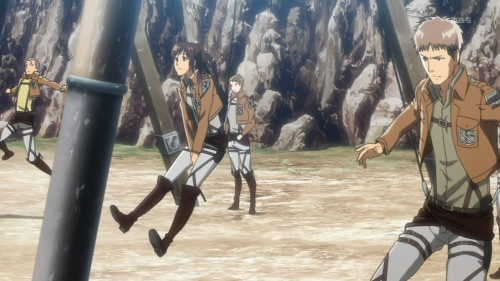
I think my point can be seen by just looking at the opening to Attack on Titan and comparing it to intros from other shounen fighting anime. Popular and long-running shounen fighting anime go through a process where their first openings emphasize a core group of characters, but as the cast expands they find it important to at least show a bit of each remotely significant characters. Whether it’s those slower-paced initial openings or the later frantic ones, though, there is still that focus on a multitude of individuals. In Attack on Titan‘s opening on the other hand, you barely get glimpses of the core cast, who are shown running and jumping from one structure to the next, almost as if the camera can’t stay on them for too long. Even Eren receives only a few brief moments centered on him, and in some of those cases he’s still seen as part of a group of fighters. The fact that the soldiers are all similarly dressed, male or female, instead of wearing unique outfits, and the fact that they all use standardized weaponry, creates a sense of them as a unified army.

That’s not to say that Attack on Titan lacks individualized or unique characters. There’s a clear protagonist in Eren, and there is a core cast of characters who are given personalities and particular skills such as sound judgment and lack of mercy. I’ve also read enough of the manga to know that there are developments which change things up significantly. However, the sense of group which Attack on Titan portrays goes beyond the typical shounen concept of such, and it lends an atmosphere which almost (but not quite) puts more attention on the military force than the people who comprise it. They swarm the titans like ants, which is about as un-shounen heroic as it gets.

Thoughts on Casual Gaming

I once had a conversation with friends where they expressed bewilderment that people could enjoy casual games. To them, games are about challenges, puzzles, something to figure out in order to overcome or outwit an opponent be they computer-generated or another human being. As a gamer myself it’s something I understand, but I also know how daunting or even draining the “gamer” mindset can be, and I feel the ups and downs of “true gaming” in my experience with online mahjong.

I’ve been playing Japanese-style mahjong for a few years now, and it’s a game I find fascinating for a variety of reasons. In mahjong you have this mixture of skill and luck which creates a dynamic interaction between its players. The game is such that it’s possible to create complex plans and intricate webs of deception to upset your opponents, but the random component means the best-laid plans can go to waste, and adapting to the “unfairness” of the luck elements by knowing when to call it quits becomes part of the strategy. In other words, when playing mahjong your mind has to be sharp and focused, but what happens when you’re not at your best?

This is the problem I run into with mahjong sometimes, and why I feel able to understand the casual game mindset. I love mahjong at this point, but there are times when the day was long and I’m all worn out mentally, and I’m looking for just a way to relieve stress. At times like this, I’ve made the mistake of trying to use online mahjong as a way to relax and I’ve been punished nearly every time. In those instances, I want to treat mahjong like a punching bag, except that in this case the bag punches back. Mahjong is the type of game where trying to win a hand at all costs just makes you vulnerable. In these situations when one’s mental condition isn’t the best, decent opponents can exploit it without even trying because it’s basically the equivalent of running straight at them in the hopes they won’t fire first. Naturally, watching my rank drop as I make this simple mistake over and over again causes more stress instead of less.

It’s not mahjong’s fault, though, that it fails to do what I want it to in those instances, and that’s where casual games come in. They can be your reward for a hard-fought day, as just a way to escape from pressure. The games might be even more random than mahjong, but clicking a lot can basically be the mental equivalent of punching a pillow over and over. This is not to say that casual games can’t have any skill or challenge component (Angry Birds being perhaps the most prominent example, and you can pretty much auto-pilot Tetris), but that it can be tough to feel like life is beating you down and then a video game is too. Sometimes, people might just want to have the comfort of knowing they’ll always win (or at least win eventually), and they might even be willing to put down $5 just for that luxury.

Chop Chop Chop, Judo Flip: Genshiken II, Chapter 86

Genshiken II, Chapter 86 looks to possibly be a turning point. We’ve had quite a few of those already though. Also, next month there might be more news about the upcoming anime! It’ll be a long 30 days or so.

Sue visits Hato’s place, using Janglish to ask if he likes Madarame. Hato denies, but is clearly hiding something. After a tussle pitting Hato’s judo training against Sue’s freestyle which ends in a win by submission for the American, Sue discovers Hato’s secret Mada x Hato (in drag) drawings. Hato, who is increasingly confused about his feelings for Madarame (he feels that at this rate he might actually start liking Madarame), decides to just stop crossdressing and go back to being “a normal otaku.” This clearly makes Yajima uncomfortable despite her previous objections to Hato’s crossdressing.

With this chapter, I think I finally understand one of the big overarcing themes of Genshiken II. Yes, there’s the generation gap and the otaku/fujoshi distinction, but even more fundamental to the manga is a concept I’d describe as “the complexities of personal perceptions.”

The foremost example is Hato. He is getting to the point where he likely feels something for Madarame. I want to point out, however, the fact that Hato had no problems showing his “Hato x Mada” art to Sue, declaring that it was just the realm of fiction, but for some reason he also felt it necessary to keep his “Mada x Hato” hidden. I think the distinction between the two pairings is extremely important because it indicates a denial of clear-cut narratives about sexuality in describing otaku.

“What’s fiction is fiction, and what’s real is real” is a clear and concise argument. So is “what you’re attracted to in fiction can influence your real life preferences (and vice versa).” The former argument is used by Hato, while the latter was suggested by Kaminaga. With Hato and his feeling towards Madarame, however, it might actually be the case that his yaoi delusions are separate from his real feelings, but he began developing feelings for Madarame anyway due to their growing friendship, and that this manifests as Hato x Mada vs. Mada x Hato. I wonder if this is the case just because Mada x Hato for some reason apparently has to involve Hato crossdressing, as if to say the idea does not “make sense” to him otherwise.

In anime and manga about (or including) fujoshi, often there is significant time spent explaining how important the orders of pairings are important. “It’s like saying ‘curry on rice.’ No one says ‘rice on curry!’ says a character from the 4-koma series Doroko. This is generally played for laughs while trying to introduce to the reader the “mysterious” mind of the fujoshi, to allow the reader to say, “Oh fujoshi, you’re so lovably wacky.” I think that with Genshiken, Kio is trying to discuss that mindset a little more seriously.

I predict Ogiue is going to start playing a bigger role in this, just because Hato looks like he’s trying to run away from his current situation at all costs. Ogiue is more than familiar with this situation, is aware of how much trying to deny oneself can generate a festering wound of self-loathing, and just how complicated the real/fiction distinction can get. I think, or perhaps I simply hope, that Ogiue will manage to be Hato’s mentor, like how Ohno was there for her. Also, Hato says he’s “going back” to being a normal otaku, but was he ever a normal otaku? He discovered yaoi in junior high, so it’s been with him for a long time, which makes me think that Hato is trying to simply act like how a “normal otaku” is supposed to without truly direct experience, somewhat like how Ogiue sometimes tried to approximate a “non-otaku.”

If the Hato example is a little too crazy, I think Yajima in this chapter also provides an interesting case of personal perception. Clearly the reason why Yajima blushes at the end is because she still associates male Hato with the time she accidentally saw him naked, in addition to just the fact that he’s a guy. She doesn’t react this way so much to Hato in her female guise, which means that the wig and dress is enough to “trick” Yajima psychologically so that the first thing she thinks about is Hato’s clean-shaven personal area. What Yajima thinks of Hato is of course its own puzzle having at its origin her own self-image and her lack of experience interacting with men.

I don’t know if Sue counts towards this as well, but I do find it interesting that Sue’s embarrassment over kissing Madarame has nothing to do with him and everything to do with the fact that Kasukabe saw her doing it. On some level, I feel like I can really understand that distinction. Somewhat like that famous scene in His and Her Circumstances when Miyazawa accidentally runs into Arima while out of her “perfect student” guise,” there are people you feel like you can be a fool around and people you don’t. I also continue to think that it’s kind of brave of Kio to give Sue a larger role, as semi-fluent foreigner is not the easiest thing to pull off without reverting to very basic stereotypes. Sue is many things, but “basic” isn’t one of them.

By the way, there’s something I find really impressive about Sue and Hato’s fight scene, particularly the panel where Hato drags her and sweeps the leg. It captures that one moment so incredibly well, while allowing it to transition into the next set of panels. It actually makes me want to see Kio draw an action series.

To end, I want to ask a simple question: Sue x Hato, what are your thoughts? If this were a more popular series, I’m sure that neck-licking thing would have people talking.

On JManga’s Closure, and the Movement of People and Technology

JManga, the digital manga service backed by a number of Japanese publishers, is shutting down. No more points may be purchased, and all titles will be taken down by May 30, 2013. Any remaining points on users’ accounts will be refunded to them in the form of Amazon Gift Cards.

JManga, unlike so many other official manga sites, was at least partly accessible in regions outside of the US, and it was for this reason that I initially supported it in spite of its initial convoluted pricing scheme. Eventually, they changed the pay format to something a little more enticing and easy to understand, but when a friend told me that he wished he could purchase a title that was already on JManga, it made me realize just how unknown the site was. I tried to do my part and encourage others to use JManga, but for one reason or another it apparently wasn’t enough. It’s a shame, because I think they really made some excellent strides in getting manga to a digital format, even if their reader left something to desire in terms of functionality and ease of use.

The news of JManga’s impending demise brought up conversations about piracy and users’ rights that is affecting industries well beyond manga at this point (the Sim City server problems being currently the most prominent), and one of the arguments being made is that it’s in the end the fault of scanlations. I have a problem with this. While I don’t doubt that scanlations impact sales, especially when it comes to the popular titles, the fact is that none of the manga on JManga were heavy hitters. Their famous titles were things that simply don’t sell too well, like volume 1 of Golgo 13. I believe their most successful manga was Soredemo Machi wa Mawatteiru (some of which I purchased and am kind of miffed that it’s going to vanish in a couple of months), which to put it lightly is not a Naruto or a Sailor Moon.

The lineup at JManga was extremely esoteric, and while this had a great amount of appeal for me personally, I’m also aware that the average manga fan, whether they read free manga online or not, is not going to chomp at the bit to go read about a Heian era fujoshi (another purchased title I will miss). Essentially, the titles on JManga were so out there that for the most part they were not the things people would look to scan and distribute, so the traditional argument of piracy doesn’t really apply here. Also, JManga was apparently shackled by the fact that publishers would not hand over their A-List titles. Tokyopop tried the flood of mediocrity approach as well, and that didn’t go so well in the end. While it is possible to say that fans should have subscribed anyway in order to give JManga the opportunity to go after the big titles, as Narutaki over at Reverse Thieves and the Speakeasy podcast pointed out, you can’t expect people to pay money in the hopes that they might someday get the titles that they want, especially if they’re from wildly different genres and demographics.

I could see it argued that manga scanlations created the environment which made publishers fear handing over their major titles, and by extension was the cause for JManga’s demise, but I think this would be overlooking the fact that media companies tend to be conservative about trying out new platforms until they absolutely must. HBO’s business model, for instance, is based on subscriptions to their premium cable service. This is fine and all, but it turns out that people who only want to watch online (legally, mind you) must also buy cable and HBO anyway. Media companies, if they can help it, will dig their feet into the ground to the point that they pretty much have to be dragged kicking and screaming to evolve alongside their potential customers’ habits. As a classic example, would the music industry have even bothered with digital distribution and the mp3 format if something like Napster hadn’t forced them to do so?

This is not me defending piracy as some kind of noble endeavor, but merely making the point that if scanlations did not exist and were not so ubiquitous, then I highly doubt that Japanese manga publishers would have simply decided to put manga online “just because.” In other words, to say that JManga would have been fine had readers of manga behaved all along is I think a flawed argument because there’s a good chance we wouldn’t even have sites like JManga or J-Comi. Valuing creative talent and creative output is still important, but defining that value according to current conventions and blindly accepting the current distribution methods (or lack thereof) is problematic itself. That’s not to say that one must rebel against the system in order to “save manga” or “stick it to the man,” but it would be beneficial to acknowledge where it is flawed, and to also not put blame squarely on the shoulders of readers, especially when the site was not giving them what they want.