I wrote a bit about the change in fan opinion over Love Live! Sunshine!! character Matsuura Kanan over at Apartment 507. I know she became one of my favorite characters by the time I finished the anime, but did you find your impressions changing as well?
An emotionally complex tale of humanity’s connection to both itself and the environment, Your Name marks Shinkai Makoto’s transformation from critically acclaimed director into social phenomenon. Breaking the box office record for animated films in Japan previously held by Miyazaki’s Spirited Away,Your Name is a kind of culmination of Shinkai’s films, carrying many of its predecessors’ ideas and themes (lush background environments, adolescence, time and space) while also gearing them towards a more mainstream audience.
Your Name follows two teenagers who, one day, discover that they’ve been switching bodies without memory of doing so. Part-time waiter Taki is a resident of Tokyo, while shrine daughter Mitsuha lives in the small, rural town of Itomori. As they continue to get a very personal look at each others’ lives, the two find themselves growing closer despite being physically located on opposite sides of Japan.
Shinkai’s previous long film, Children who Chase Lost Voices from Deep Below, can be described as an attempt to make something more mainstream, even Miyazaki-esque. However, the film’s emphasis on atmosphere and scenery could not quite support the plodding narrative, leaving Children a significantly flawed work. Your Name, in contrast, ucceeds in tapping into the mainstream not only because of its thematic responses to the events of 3.11, but because he keeps the characters much more front and center compared to his previous works. In most Shinkai films, the backgrounds—especially the clouds—are so brimming with life that the environment becomes a kind of character in itself. With Your Name, however, the backgrounds are regressed just enough that Taki and Mitsuha stand at the forefront, while maintaining their signature luster or its aesthetic and narrative impact. Notably, the film does an excellent job of showing off both the cosmopolitan energy of Tokyo and the splendorous beauty of Itomori.
A few thematic concepts persist throughout the entirety of Your Name. One is “twilight,” written in Japanese in various ways but invariably consisting of the kanji for “who” and “he.” Twilight is viewed as a convergence point. Another is “threads.” According to Mitsuha’s grandmother, when their family weaves, they are copying the behavior of the gods. People can be viewed as threads that are woven, tangle up, break apart, and come together again. Mitsuha is known for the ornately tied ribbon adorning her hair, while Taki’s inability to replicate Mitsuha’s skill acts as one of the visual markers for their body switch. Multiple scenes of train stations in Tokyo draw parallels to threads, as they gather up on tracks, allow people to transfer, and then head out in separate directions. Dragons and their divine place in Japanese folklore also play a prominent role. Taki’s name means “waterfall,” which is associated with dragons, while the comet Tiamat that figures heavily in the narrative also alludes to the mythical creature.
Your Name deftly juggles a variety of elements without feeling overly complex. Its story tugs at the heart but also inspires, rendering it an unforgettable film. It may very well become the defining film of an entire generation.
Name: Kankiri (かんきり) Alias: Kan-san (かんさん) Relationship Status: Dating Origin: Happy Fujoshi: Otaku no Onee-san
Kankiri is a university student who tries her hardest to hide her identity as a female otaku. However, it turns out to be futile as almost everyone she meets either is an otaku themselves or is familiar enough with otaku and fujoshi to recognize the signs of one.
She first got into BL because of the anime Mashin Eiyuuden Wataru. Prior to that, she started becoming an otaku in elementary school, and by middle school discovered that she has a thing for age gaps. Kankiri is also critical of impossible shirts on women in anime and manga, comparing them to pants that cling to a man’s erection at all times.
Fujoshi Level: Kankiri believes couplings and reverse couplings are fine, which puts her at odds with other fujoshi.
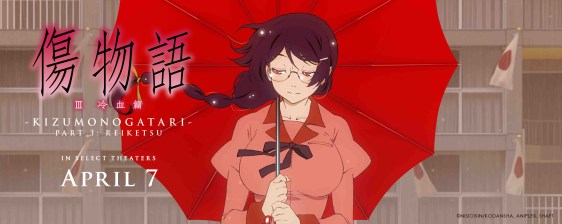
Monogatari protagonist Araragi Koyomi is a flawed and immature yet ultimately heroic figure. A teenager influenced heavily by his hormones, Araragi is nevertheless more interested in helping the weak and not succumbing to his loins. The Kizumonogatari prequel films tell the story of Araragi’s first foray into becoming a horny savior, with Kizumonogatari Part III: Reiketsu, completing the trilogy. Reiketsu provides plenty to chew on in terms of Araragi’s relationship to the other characters (both those in the movie and seen elsewhere), particularly the uniqueness of his “harem lead” position.
In the previous two films, Tekketsu and Nekketsu, a sympathetic Araragi agreed to become the undead servant of a dismembered vampire named Kiss-Shot Acerola-Orion Heart-Under-Blade (later known as Shinobu). With his newfound immortal abilities, Araragi retrieved Heart-Under-Blade’s defeated her attackers and restored her limbs. Along the way, he befriended two individuals: the wise, buxom classmate Hanekawa Tsubasa, and the sly occult specialist Oshino Meme. In this third film, Araragi looks forward to regaining his humanity, but upon realizing that he’s restored a powerful 500-year-old vampire and thus a significant threat to humanity, Araragi resolves to put a stop to his own master.
Given the prequel status of Kizumonogatari, there is no mystery as to the outcome of this battle: both survive, though in significantly reduced fashion compared to how they’re depicted in this trilogy. However, just exactly how they reach these states of being is one of the goals of Reiketsu, and the conclusion is a kind of denial of resolution. It’s the sort of chicanery Monogatari is known for, where the wrap-up feels both neat and dirty, and your’e not sure if you’ve had enough or you want more.
For viewers of the various TV series, Shinobu appears to go through a fairly unusual personality change, from a silent background presence to a constant companion for Araragi, residing in his shadow. The final film of the Kizumonogatari trilogy, titled Part III: Reiketsu, provides the answer in full. However, given the timing of this film it (presumably) functions differently compared to its placement in the novel series. Whereas Kizumonogatari the novel introduces the foundation of Shinobu’s personality and its gradual restoration, the Kizumonogatari films act as the missing puzzle piece that finally brings sense to an incomplete anime image.
Shinobu and Araragi’s master-servant relationship (later reversed in the TV anime when she starts to refer to him as the master) essentially positions their relationship as being impossible to replicate by any other girl. They’re bonded by something far beyond love and romance. Unlike many harem scenarios where certain characters have a clear “lead” over the others, Shinobu as the “dependent master” becomes one of many equal female partners for Araragi, alongside his eventual girlfriend Senjougahara, his first (?) friend Hanekawa, and others.
Both Heart-Under-Blade and Hanekawa feature prominently throughout the Kizumonogatari films, but it is in Reiketsu that their differences in terms of their emotional/spiritual connections to Araragi are fully highlighted. In one scene, Araragi claims that he needs to fondle Hanekawa’s breasts in order to steel himself against Heart-Under-Blade’s tremendous bosom, but as much as Araragi tries to embrace the role of the stereotypically aggressive male in Japanese pornography—and as much as Hanekawa is ready for things to escalate—it’s ultimately only an act for him. In contrast, both Heart-Under-Blade and Araragi are more than willing to engage each other physically, albeit in the form of a violent battle instead of something sexual (though the smiles might imply otherwise). One is a very human relationship (albeit filtered through an assumed “right” behavior instead of lived experience) the other built on the supernatural. It’s telling that the most exquisitely animated moments in the entire film are Hanekawa removing her bra and the battle between Araragi and Heart-Under-Blade.
In Owarimonogatari, the latest Monogatari TV anime, Hanekawa is highly suspicious of the character Oshino Ougi. In order to convince Araragi not to go along with her, Hanekawa offers Araragi a chance to fondle her breasts. Araragi agrees to listen to Hanekawa, but when asked about it, responds that his decision to go along with Hanekawa was less about the prospect of feeling her up, and more about the realization that, if Hanekawa was saying this, it meant that she was deathly serious. With Reiketsu, I now understand that this entire scene is a callback to the events of Kizumonogatari.
I’m still not sure if splitting Kizumonogatari into a trilogy was the right idea, as I don’t feel like each film quite stands on its own without assistance. At the same time, I suspect 3+ hours of full-on Nisio Isin + SHAFT would feel a bit too overwhelming. Given that the films are all relatively short, it might be ideal for marathoning.
Gundam is a massive and unwieldy franchise. With a history spanning over four decades of anime, sequels, spin-offs, alternate universes, and more, after a while the distinctions between each Gundam series starts to blur. Each time there’s supposed to be a “unique” take on Gundam, they will often carry enough of the common tropes to be familiar, or will slowly jettison the new elements in favor of going with the tried and true. This is the perpetual challenge that Gundam faces, so it is to my surprise that not only did I enjoy the recent Mobile Suit Gundam: Iron-Blooded Orphans TV series (which is not the shocking part; I love Gundam in general), but that I felt it maintained its identity and its high quality despite it being just the kind of series set up to derail itself.
Iron-Blooded Orphan (IBO) takes place in a futuristic world where battles are waged using giant robots called mobile suits. The story centers around the characters Mikazuki Augus and Orga Itsuka, two boys who belong to the bottom-most rung of society, uncharitably called “human debris,” and who at the start of the series are essentially indentured child soldiers for a mercenary group. Early on, they and their fellow human debris rebel against their masters, create their own mercenary group called “Tekkadan,” and fight to try and find a place in a world that literally calls them garbage. Along the way, they meet a number of allies, notably Kudelia Aina Bernstein, a young aristocrat from Mars with lofty ideals of justice and equality, an encounter which changes their lives.
On the surface, Mikazuki as the pilot of the Gundam Barbatos appears to be cut from a certain cloth of Gundam protagonist. As a highly skilled pilot who has fought from a very young age and whose lack of expressiveness makes him appear emotionless, Mikazuki is descended from previous characters such as Heero Yuy from Gundam W and Setsuna F. Seiei from Gundam 00. Where Mikazuki differs from the other two is how IBO highlights his connections with Orga.
Mikazuki is cold and merciless to his enemies, but within his friendship with Orga (it’s perhaps better to call them “brothers”), there’s a very unique connection. Mikazuki is not an empty shell, but he sees in Orga a strong ambition, and he essentially acts as a right arm for the sake of his long-time companion. Similar relationships exist between Mikazuki and Kudelia, as well as between Mikazuki and a long-time female friend named Atra Mixta. Other notable characters are Naze Turbine, a man who literally has a harem of women as his ship’s crew but is actually more about empowering women by giving them skills and educations, and McGillis Fareed, a high-ranking officer who shows what happens when friendship and ambition collide. These characters and relationships are among the many that collectively create a narrative where camaraderie and family persist in the face of harsh odds. IBO never abandons that sense of family, and it is crucial to understanding the role of Tekkadan in all of the conflicts that occur as the series moves towards its conclusions.
One notable aspect of IBO relative to past Gundam series is that, in spite of the series being subjected to the dreaded “split-season” approach, it remains remarkably consistent. One of the major pitfalls of many mecha anime from Studio Sunrise over the past 10 years or so is a tendency to try and improve aspects of the series based on marketing and merchandising feedback. Often times, the series end up losing much of what made them special in the process, but this never really happens with IBO.
In terms of emphasizing toy sales over story, IBO actually shows a great deal of restraint. According to series lore, Gundam Barbatos is just one of 72 different Gundams used in a previous conflict known as the “Calamity War.” In another series, especially one more focused on profits from merchandise, it’s likely we would have seen all 72 show up onscreen. However, even at the conclusion of IBO, only a handful appear. The Barbatos itself is also supposed to have a feature that allows it to integrate the weapons and abilities of other mobile suits, but the anime never really puts this front and center. Changes that occur in the Barbatos more reflect the changes and traumas that Mikazuki goes through as the series progresses.
Because IBO keeps its feet firmly planted and doesn’t fly off-track in a desperate attempt to cater to market research, Tekkadan never stops feeling like Tekkadan. No matter how powerful Mikazuki becomes, and no matter how much Tekkadan’s forces are bolstered, they never stop feeling like an underdog. The steps they take to get further are microscopic compared to the vastness of what surrounds them, especially when it comes to the realm of human society. One of the recurring aspects of IBO highlights this well. While Tekkadan gains military power, their approach to life, which is to treat themselves as a family first and a mercenary group second, often leaves them lacking and inexperienced in terms of diplomacy. On multiple occasions, success on the battlefield is contrasted with failure politically.
The story told in Mobile Suit Gundam: Iron-Blooded Orphans feels like just a small slice of a vast world and history. Whether this is the end of the IBO universe or the start of something more, I come away immensely satisfied.
Whenever a group of people share a common interest, it’s easy to think of them as a cohesive unit of similar minds and opinions. Then reality sets in, and it becomes clear that they’re often from different homes, have different personalities, and even perceive their hobby or passion differently. For the music-themed anime Sound! Euphonium, I find that its character portrayals go a long way in emphasizing the subtle peculiarities of the members of the music club. Friendship and other complicated relations arise from these differences and help to further emphasize the fact that music is what unifies them.
There are large gaps in talent and experience between the core group of four in Sound! Euphonium, and each of their stories are made further complex with their reasons for playing. Reina is by far the most dedicated to the art of music, but it’s not from a pure love of song, as evidenced by her crush on her teacher. Sapphire (“Midori”) is not quite as skilled as Reina but still very strong, and her fondness for instrument mascot characters makes music a lifestyle of sorts. Kumiko has a love-hate relationship with her euphonium, which is gradually revealed to come from a love-hate relationship with her older sister. Hazuki starts off as a complete newbie in all respects who learns the tuba as a social experience.
In spite of these differences, all four characters feel like equals. Their individual relationships might not be evenly developed (Reina is more connected to Kumiko than the others, for instance), but they come across as a close group of friends whose perspectives play off of each other. There’s a vast chasm in ability between Reina and Hazuki, but the paths they take when it comes to their journeys with music feel just as emotionally significant to the individual characters. Although Kumiko is clearly the main character of the story, and Midori is never shown to be in any of the same awkward situations, she still comes across as vital to the quartet.
Sound! Euphonium has a lot of strengths, and chief among them with respect to what was written above was the balance between the development of its narrative and the environment created by its character interactions. Unlike K-On! (a series to which it is often naturally compared), which had being in a band as a theme but was more dedicated to showing slice-of-life comedy hijinks, the goal of reaching Nationals centers and grounds the story in a momentum of forward progression. Having its characters at widely varying skill levels helps to give that challenge of coming together a greater importance, while the sense of equality that exists between them in spite of those gaps creates an almost palpable sense of intimacy.
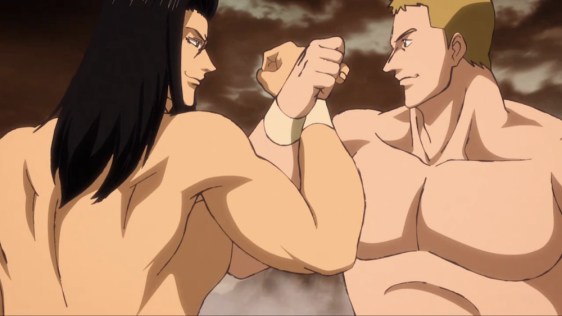
Both anime and pro wrestling are larger-than-life fantasy worlds, so it’s inevitable that a wrestling-themed anime like Tiger Mask W would be populated with big, bombastic personalities… some even based on real-world wrestlers! Among these characters, there’s one that at first seems easily forgettable, but as the show has progressed reveals himself to be the best man around: Kevin Anderson.
Kevin is a wrestler for the dastardly Global Wrestling Monopoly, the largest wrestling federation in the world and front for the Tiger’s Den, a clandestine organization that trains evil wrestlers. He does not have any appellations, like “Hitman,” or “the Ace,” or “Bigfoot.” With generic tights and a generic look, Kevin’s just Kevin. At best, he’s the guy always next to the GWM’s hot new wrestler, Tiger the Dark.
But it’s in the background where Kevin shines. Through thick and thin, Kevin rises to the occasion, especially when helping out Tiger the Dark. He knows he’s not quite as strong a wrestler, especially compared to the top echelon of GWM big-shots, but he’s loyal to this friends and will lend a hand in times of need. Over and over again, Tiger Mask W makes it seem like Kevin is just going to fade away into irrelevance as the other characters grow in power and intensity, but Kevin’s actually never far behind. When others look out for themselves, Kevin has an eye for the bigger picture.
In the anime and manga Monthly Girls’ Nozaki-kun, there’s a scene where the characters are playing a dating sim and trying to genuinely find the right partner for the protagonist. As they go through all the girls, they find in every single one of them a deal breaker that makes them not good enough for their precious player character. Suddenly, it dawns on them: it’s the best friend, a guy who’s always there to help out, lend an ear, and even give a shoulder. Kevin is Dating Sim Best Friend.
Kevin Anderson is a seemingly milquetoast character who defies his own design. In doing so, he might just secretly be the greatest supporting character around.
Did you know that Kinomoto Sakura’s birthday is April 1st?
Upon learning this, I realized that major spoilers for Watanuki in XXXHolic were staring me right in the face all along (his name means “April 1st”).
Do any of my Patreon supporters have an April birthday? Whether they do or not, I’m still just as grateful for their support:
The runaway hit of the last season was definitely Kemono Friends. It was such a big deal I had to write about it twice… sort of.
I also got back on track on my chapter reviews of Kimi xxxru Koto Nakare. The series looks like it got delayed for a little while, but I hope it’s coming back. I really do think it’s an excellent series.
Lastly, it was a close call, but I wrote my thoughts on March Comes in like a Lion. I knew I’d like the show, but I’m even more impressed with how well the show makes its protagonist Rei relatable.
April means the end of the winter anime season and the start of some new shows. That means you’re likely going to see a bunch more reviews for anime that concluded this past season. Early on, I saw quite a few people online expressing their opinions that the winter was something of a disappointment. While this has turned around somewhat, thanks to the rising popularity of shows such as Kobayashi’s Dragon Maid and Kemono Friends, I feel like that idea still persists.
As for new shows, I’m looking forward to Love Rice a show about rice-themed idols. It’s as if Hanayo was allowed to make her own anime.
“Any sufficiently advanced technology is indistinguishable from magic.”
There are few quotes in science fiction more famous than Arthur C. Clarke’s above. While the idea largely has to do with how science fiction extrapolates the possibilities that can be envisioned from scientific development, Kamiyama Kenji’s new animated film, Ancien and the Magic Tablet, plays with the notion in an interesting way, using a blend of dreams and reality to fuse technology and magic together throughout its narrative.
As a warning, while I’ve done my best to avoid spoilers, the fact that this film is full of surprises only five minutes in means I can’t avoid talking about at least a few of the twists.
Ancien and the Magic Tablet begins with the story of a princess of a kingdom, Ancien, who is trapped in a cage above the royal castle. Her kingdom, known as Heartland, is ruled by her wise father, who is responsible for spreading the use of automobiles throughout their land. The reason Ancien is locked away is because she has a mysterious power to bring inanimate objects to life, including dolls and cars, an ability that would turn all of Heartland upside down.
…Except that it’s all a dream and the actual story is about a girl named Morikawa Kokone, a perpetually sleepy Japanese high schooler living in Okuyama Prefecture in the “far flung” future year of 2020—shortly before the Tokyo Olympics. Living with her widowed father, who works as a mechanic and programs self-driving car AI for the elderly residents of their town, Kokone learns that her father (or rather his computer tablet) holds valuable secrets worth a lot to some very important people. Kokone ends up on an adventure to Tokyo to get to the bottom of all this, all while she keeps having dreams about Ancien and Heartland—a world based on stories her father told her as a child—that mysteriously play out in reality as well.
One of the main thrusts of Ancien and the Magic Tablet (known in Japan as Hirune Hime: Shiranai Watashi no Monogatari, or “Napping Princess: The Story of the Unknown Me”) is a treatise on the benefits of self-driving cars. Ancien and her tablet are overt parallels to the AI technology that Kokone’s father possesses, and it’s portrayed largely in terms of its benefits. In regards to this stance, the film impresses me because it doesn’t try to remain neutral or passive in terms of the beliefs it’s trying to convey on such a controversial topic.
Given the writer and director Kamiyama’s previous works (Ghost in the Shell: Stand Alone Complex, Eden of the East), a certain level of love and faith in technology is expected. While Ancien could do more to address the repercussions self-driving cars could have on the global economy, I don’t hold it against the movie too much because it does emphasize certain benefits that don’t come up as often. For example, it can be argued that self-driving cars aren’t only about taking away control, they can be about ensuring safety because of loss of control or disability. A more nuanced approach would’ve been interesting in its own way, but I can live without it at least for one film.
Going back to Arthur C. Clarke, the dream world of Ancien, particularly the “magic tablet’s” ability to “bring things to life,” are basically a fairy tale metaphor for real-world technology. However, because the events in Ancien’s and Kokone’s sides of the story mirror each other and even seem to influence each other, it’s an ongoing mystery as to how the two narratives are related. Is it somehow possible that Kokone is tapping into an alternate reality? The film keeps you wondering right until the very end, and the ultimate explanation for the relationship between Ancien and Kokone’s worlds is actually very satisfying and makes absolute sense.
Ancien and the Magic Tablet feels like the start of a conversation rather than a definitive conclusion. I hope we continue to see its themes in future animated films.






 OGIUE MANIAX