Kakazu Yumi is a voice actor arguably best known for her role as Yuffie Kisaragi in the Final Fantasy franchise. I had the opportunity to interview her at Otakon 2024, where my questions focused primarily on her work in mecha anime.
One actor you seem to work with pretty often is Hiyama Nobuyuki, such as in Gaogaigar, Godannar, and even Initial D. Do you have any fun memories of performing alongside him?
Thank you for coming to this interview. I’ve been a fan for many years, and I want to start off by asking about one role I know you for that others might not think about: Shizuru in Godannar. Do you recall what it was like working on that series, and how you approached the character?
Kakazu: Shizuru is a very grounded, very mature character, and she was also a commanding officer. It is a characteristic that’s unlike me, so I tried to perform that part when I was voice acting.
Another staff member who was on Godannar was Kimura Takahiro, who recently passed away. He also worked on another series that you were involved with: Gaogaigar FINAL. Did you ever get to know him, and do you have any memorable stories about him?
Kakazu: Actually, Kimura-san came to visit the studio when we were recording, and we also spoke together on stage. At the event, he tried to apply his own makeup, but he had never done it before, so he asked, “Kakazu-san, can you help me with this?” So behind the stage, I was doing it for him.
I never knew that he cosplayed! Do you remember who he cosplayed as?
Kakazu: I think he had a white wing…? Or maybe it was Shishioh Guy. I forget.
On the topic of Gaogaigar, you returned to the role of Renais a few years ago in Super Robot Wars 30. What was it like playing Renais back when you first worked on FINAL, and did anything change for you playing the role over the years in SRW?
Kakazu: Not a lot changed.
Related to that, I was actually at the Final Fantasy panel earlier, and you mentioned playing Yuffie since Ehrgeiz. So, similar question: Do you think your performance has changed, or has it been pretty solid throughout?
Kakazu: I said this on stage, but when I first started voicing Yuffie, she was one character in a fighting game. The only sounds she had were “Hahh! Hahh!” type noises.. But over time she’s gotten more chances to speak and more lines, and now she stands alongside the other characters, showing how mainstream she’s become. I’m grateful that I was able to meet Yuffie all the way back in the beginning, and also even more grateful to the people who have supported her up until now.
Another anime you worked on is a series called RahXephon, and your character, Hiroko, has a very powerful and tragic death. And do you have any advice for voice actors on how to approach such a challenging scene?
Kakazu: So I remember getting the script when I was recording, and I remember being very focused on reading and trying to understand it. Also, I remember the pain I felt when I was recording. When I’m acting out these tragic scenes, I try to recall my personal experience, and also use my imagination to expand the performance. So maybe this isn’t advice, but I realize that everything I’ve experienced in my life has become a resource that fuels my acting and performance. So maybe the advice I would give another voice actor is to find meaning in everyday life.
You seem to act alongside the actor Hiyama Nobuyuki pretty often. Do you have any fun memories of performing alongside him in any of the shows you worked on together?
Kakazu: I actually have a lot of fun memories with him. When Hiyama would say the line, “GAO! GAI! GAAAAR!,” he would shout the line in a great big voice, and it would reverberate through his entire body. I remember the first day of this recording, he did the line, and the mic actually broke!
Oh, I found the cosplay that Kimura-sensei did. [Shows a picture of Guy from Gaogaigar.]
Ah!
I interviewed the director of Gundam X, Takamatsu Shinji, at Otakon nine years ago. Do you remember what it was like working on that series and playing the character of Sala?
Kakazu: Sala was actually my debut role as a voice actor. She’s actually second-in-command and has an important role, but she’s only 17 years old. So there’s a difference between how she has to behave as second-in-command versus how old she actually is. So it was really difficult to figure out the balance between her age and her having this mature, heavy responsibility as second-in-command. I remember working very hard figuring that out, and this contributed to learning more about voice acting.
Kio recently had a talk at Umeda Lateral, an Osaka-based live music house and talk venue, to celebrate the release of his new artbook. Below are my notes from watching it.
(Unfortunately, the VOD is no longer available. Also, screenshots are not allowed.)
There are three people: the host, Kio, and his editorial manager Moteki.
For the event, Kio drew special signboards featuring the Genshiken characters, one per character: Ogiue, Madarame, Sue, Ohno, and Saki.
Apparently, it’s normal for the hosts and speaker to drink on stage at this venue. Kio’s first order was draft beer.
He has been to Osaka before, for work and for sightseeing. Was on the train for 9 hours to get there.
The artbook was not his idea. It was Moteki’s, who brought it up because it’s Kio’s 30th anniversary. Kodansha wouldn’t do it themselves? Moteki actually reached out to him through Pixiv.
Kio wanted to reply, and he got motivated to actually make the book happen.
There were cases where Kio was looking through his old work and thought, “Did I draw this?”
Starting doing digital after Genshiken, starting with Jigopuri. At the time, he still scanned in his pencils, though.
Works prior to that transition were newly scanned for the artbook. He had a bit of experience doing it for the Shinsouban (the special edition that has new covers and changes the nine volumes of the original into five).
Kio admitted that he doesn’t actually remember much of his works before Genshiken. Moteki jokingly expresses concern that this pre-Genshiken period was eight years.
Moteki: Ogiue is a character who really takes the story places, but is there anyone from before Genshiken like that?
Kio: Nope, I don’t think so.
Kio actually doesn’t think Ogiue is that much of a driving force. Madarame was originally planned to be there from the start in some form.
Kio showed early concept notes about Genshiken. At the time, it was still written in kanji.
The original 3 characters were early versions of what would become Saki, Kohsaka, Madarame.
Saki (or her prototype) was the original protagonist. Prototype Kohsaka’s gender hadn’t been determined yet—the character was labeled “Hero (Heroine?)” One note mentions that he maybe looks like Squall from Final Fantasy VIII.
The school setting was based on Chuo University, just like in the actual Genshiken.
Kio wanted to make the series focused on character gags.
Prototype Madarame looked very different. Labeled as the “Rival.” Second-Year, otaku.
All the characters are listed with a specialized otaku genre. Proto-Kohsaka and Proto-Mada are both labeled as being into “everything.”
All the characters are labeled as virgins.
Prototype Kugayama was labeled as being a third-year, having a good personality, and also being a lolicon. Otaku genre: anime.
Another character with glasses specialized in games, and another shorter character has manga.
One unused design was a girl who was a second-year. She was a little unattractive, but with big boobs. (This might be the prototype for Ohno, but they look quite different.)
Kio does not actually particularly like kujibiki lotteries. But it is funny that Kujibiki becomes a plot device in Nidaime when all the girls are drawing straws for the order in which each girl has their date with Madarame.
Kio ordered octopus karaage next.
The first gunpla he built was probably the Guncannon. He built it right before the Gundam boom, when he was in elementary school. He has an older brother who was buying gunpla before him. Actually, it might not have been the Guncannon. Kio mentioned not having a good memory.
Did Kio have an inscrutable senpai like the original club chairman? He had senpai, but he wasn’t sure if they were quite like that. But Tanaka was based on someone Kio knew—a person who loved plastic model kits.
Kio used to build a lot of gunpla and kits, and broke them at the joints all the time. But with more recent models, he remarked that they really don’t break easily. He also compared the old days of gunplay that used polycaps to the improvements of modern kits.
For the scene in Genshiken with the gunpla, Kio tried to break the hip joint of a real model for reference, but it wouldn’t snap. But he wanted to do the scene, so he had to force a break.
He checked with Bandai if showing a busted gunpla would be okay, and they said as long as the break was shown to be by accident and not on purpose, it was okay.
Kujibiki Unbalance was made to be an original parody series because getting permissions for actual things was difficult.
Host mentions that he wasn’t a pure otaku, and it’s because of Genshiken’s numerous reference lines that he got to be one. Chapter titles are references, and Kio had to constantly rack his brain for them. Kio does not consider himself a high-information-retention otaku.
He had a desire to draw and write about the old-style 90s-era otaku of his own generation.
When Kio got Genshiken serialized, it made him feel like a real pro. When it got an anime he was ecstatic. “It felt like I had won at life.”
Kio was worried that if he tried to make a manga about the newest things, it would quickly feel dated, so that’s why the otaku stuff was more 1990s.
In that time, video tapes were still the standard, and official recordings of the anime were still done on tapes. He was okay with the work, but saw the struggles of the anime’s production in the anime, accepting that those are kind of inevitable.
The host asked about the OVA, believing that Kio wrote it himself, but Kio himself didn’t remember if that’s the case. He did work closely with Genshiken 2, as well as the original Kujibiki Unbalance anime.
Kio mentioned being involved with a scene involving Tanaka and Ohno, and the host instantly guessed correctly that it’s the spicy scene of them getting together. In response, Kio asked, “Why did you know what I was talking about?” It was later that he realized the scenes he drew for the fictional eroge Ohno made Tanaka play were just used straight-up in the anime.
Kio showed his actual old notebooks.
“It’s not your dark history.”
Kio: But it is.
Kio loved Famicom Detective Club, and made his own story based on Famicom Detective Club II.
He wanted to make a manga of Ghibli’s Laputa in middle school, so he drew one. Here, he showed it to the audience, page by page. He even did the title logo. However, as he turned each page, he would have his eyes closed because he didn’t want to look at them.
(It actually looks really well drawn for a middle schooler.)
Kio actually wanted to change the story partway through in a way that would make it more interesting, but he couldn’t quite decide on where to take things after they get to the fortress, so he stopped drawing it.
Another notebook is filled with his attempts to draw like Miyazaki, clearly copying famous Nausicaa images. He also feels embarrassed about these.
He also showed that he made lots of drawings of Elpe Ple from Gundam ZZ.
He didn’t watch Gundam as it aired, but he did keep up with Dunbine and L-Gaim in elementary school (4th grade, 6th grade, thereabouts).
Also showed a piece of fanart for Metal Armor Dragonar in there, along with a drawing of the Queen Mansa from Gundam ZZ.
Because Kio was clearly into fantasy-like settings as a kid, the host asks if he ever wanted to make manga along those lines. Kio says that he actually worked on a real manuscript from high school to college. “Any plans to announce it?” “None.”
After the break, Kio got a lemon sour. Host a highball. Moteki got another draft beer.
Host talked about how some people considered Nidaime to be like a fan sequel. After the first series ended, everyone tried to imagine what would come next.
Kio got back to drawing Genshiken after doing the art for a budget edition box set of the anime (the ones with the white cases), which led to the one-shot, and then he was asked by Kodansha if he could come back for a short run, like a single volume. (Nidaime ended up running for 11.)
Kio hadn’t planned to resolve Madarame and Saki. Couldn’t it have just ended at the school culture festival?
The second half of the talk was Kio answering questions they had received from fans.
Will Spotted Flower get an anime?
Kio: That’s not up to me.
There are also challenges to getting a story like that made into anime. If he had to say whether he’d want one or not, he’d say yes.
What was a gathering spot for otaku in your days?
Kio was only in a circle for half a year. But there had to have been a place where people gathered to draw.
Kio was in the art club in high school, but it didn’t have an otaku feel. Same for middle school. But the otaku in middle school did meet up after school.
Kio actually bought his own Neo-Geo machine! They reminisced about the massive cartridges.
What works are you into recently?
Manga: A current work in Harta magazine by the author of Hinamatsuri, Ohtake Masao, called J⇔M.
Doesn’t watch dramas. Closest is taiga historical dramas like Kimi Hikaru e.
Couldn’t decide for anime or movies (mainly watches anime movies).
If you drew Genshiken now, what would the characters be into?
VTubers, not that he knows much about them.
Moteki mentioned that Kio must have done research about fujoshi circles and slang for Nidaime, but Kio said he was doing it since the first series. He got some things wrong, though. In college, Kio was surprised to discover fan-derivative works and 18+ doujinshi in college (much like Sasahara).
How did you decide who Madarame would end up with?
Kio didn’t even know who it would be as he was drawing it. He was thinking of having it conclude with Madarame alone, but he actually said to himself, “Are you really going to end it this way?” Even he as the author couldn’t accept that.
Moteki: When it comes to The Fifth-Year and Genshiken with Ogiue, these characters realized about the kind of people they are, and it helped them decide on their feelings. But Madarame even to the very end did not have that self-awareness.
Also, lots of people thought it’d be Sasahara’s sister, because she’s so similar to Saki.
Kio: Yeah, even now. When you mention it, that pairing could’ve worked. But I wasn’t thinking about Saki (or Keiko’s similarities to Saki).
Kio-sensei switched to tablet in Nidaime. How was it?
Actually, Kio switched during Jigopuri. Back then, he still drew the manuscripts on paper and scanned them in before doing digital drawing over them. Eventually, he switched to all digital.
Is there something you feel about the Otaku of the 2010s and 2020s?
Based on what he sees with his daughter and her classmates, it’s almost like there’s not really a distinction between otaku and non-otaku.
Host: Even gyaru are into Frieren.
Kio: Maybe there’s no need for a series like Genshiken anymore.
Kio wanted to do Nidaime as a series where there were more members of the club who were like Ogiue and Ohno along with one new male character. However, he actually thought up a version with a more typically masculine guy, but thought it felt a little too normal.
Host: It’s like the barrier between otaku and non-otaku is gone.
What’s important to remember while making works?
Kio: I can’t really think of anything. Maybe, if you think of it too much like work, you’ll lose what makes it unique. Don’t try too hard to make a “manga-like manga.” Don’t focus on how things are supposed to go at the expense of making it interesting.
Genshiken wasn’t intended to capture the zeitgeist, but it ended up doing so.
Did you see the online reaction to Genshiken or the doujinshi during serialization?
Kio did not look at comments. The people at Kodansha looked at it though.
Kio bought all the doujinshi of Genshiken he saw. Didn’t have any problems with any content, knowing that it’s up to the doujin creators. He might occasionally check out the website of one of the artists.
He got some of them for the Genshiken 8.5 doujin project.
What was it like working for Afternoon?
Thought of Shounen Sunday first for Kodansha, but Kio remembers Parasyte being a big title. Minor no Pride, Major no something (a cooking manga).
In response to Ogiue is drawing for Afternoon in the manga: “It’s meta.”
What do you think of making H-manga?
Kio always wants to do it. He’s working on Part 2 of his doujinshi project, and the manuscript has gotten to 134 pages.
Moteki: What was the reaction to you announcing an 18+ doujinshi? Was it like, “Here we go!!!”
Not a particularly strong response, but when Kio posted it on Fanza (an adult site), some people who were fans asked him if it’s okay to do this at his age (he’s 50).
Can you do a live drawing?
He was unsure of his live drawing ability. Before the talk, Kio ended up putting a lot of time into the five signboard drawings at the talk, as well as the 30 that were included in specific copies of the artbook.
Host and Moteki tried to convince him, but no go.
Will there be more Genshiken merch?
It’s not up to him.
A lot of questions about how Kio decided who Madarame would be with, actually.
Are there any characters who acted in ways you didn’t intend?
All of them.
During the nose hair chapter (with Saki and Madarame), Kio planned to have a story about that, but went at it by thinking “What would the characters do in this situation?”
Before a manuscript, he’ll draw freely. For Genshiken, it’s like the ideas would just readily come. When drawing the characters, he would think about how they would behave. He compares figuring character’s lines to taking a dust cloth and wringing it tightly until the exact words drip out.
Moteki: In terms of characters moving on their own, Ogiue is a well-known example, right?
Kio had considered sticking her with Kuchiki as a kind of “mutually cringe couple.”
Kio is unsure of what he needs to do in serializations. With one-shots, in contrast, it’s harder to play around. He’s still not sure what to do.
At first, Kio didn’t use any assistants. But that’s when he was young. Now he’s 50 and he can’t do the same anymore.
Weekly serialization is the “territory of monsters.” Knowing what weeklies are like, he understands the need for assistants there. But if someone came to him asking if he could do one, he’d consider it and try to figure out a way it could work.
Kio worked as Takano Fumiko-sensei’s assistant, but for only one day.
What otaku works or genres have you been into recently?
He watched some of Usada Pekora playing Elden Ring. He’d have her on as background noise while working on manga.
He also listens to music while thinking up ideas and working on manga. When he’s doing tasks with not a lot of information, he uses ambient noise. When doing the initial drawings, he listens to stuff like J-Pop. After that, more editorial/critical Youtube channels.
What have you enjoyed recently?
Kio has a hard time thinking of anything, but he did travel to Gunma recently. He went to Ninja Gakkai, a ninja education camp.
Among your works, are there any scenes that stick out most in your memory?
The first thing that came to mind is the nose hair story, particularly when Madarame leaves the clubroom and is looking back at it from the outside across the courtyard, and you can see the light in the clubroom still on.
Moteki: Which character is your type?
Ohno, in terms of sexiness. The scene when she first appears in a mask is an example of her heroine appeal. Though Kio’s been told that the shifting heroine focus for Genshiken is unusual: from Saki to Ohno to Ogiue.
I decided to re-read some of my posts from the last year or so, and I noticed that my writing has been lacking in certain areas. In particular, I think I could do a better job with VTubers, and that what I write can sound a bit too uncritical. There’s nothing inherently wrong with saying “I liked this,” but it’s not being executed well.
A few months ago, Youtuber Dan Olsen released a new video essay called “I Don’t Know James Rolfe.” It’s difficult to describe succinctly, but it’s essentially a look at how Rolfe, aka the Angry Video Game Nerd, occupies a position where people project onto him their desires for what a veteran internet celebrity should be. The essay is also introspective, as Olsen struggles with the fact that Rolfe the creator seems to be both an ingenious pioneer of online media and someone whose knowledge of the filmmaking process is a little half-baked, only for Olsen to point the lens at himself and reveal his own insecurities about not being a “real filmmaker either.”
I watched AVGN almost from the start. I remember visiting the Cinemassacre site over the more unreliable YouTube of the late 2000s. One of my most popular posts ever was finding a reference cameo of him in an anime. For years, I kept up with every release and update, so I am very familiar with the character. But the video is less about the biography of Rolfe and more designed for the viewer to bring themselves into it. And in this instance, I had my baggage in tow: my concerns over where I am as a writer, the difficulty of writing about creative people in a world increasingly full of extreme opinions, and a growing concern for media literacy. As a blogger for over 16 years now, I feel a connection to Olsen and Rolfe as creators, but also to Olsen and Rolfe’s followers as commentators.
To put it differently, I realized that I’m walking on eggshells a bit when it comes to VTuber commentary, and it’s because, like Rolfe, their fans and anti-fans can be rather intense. You go from effusive praise to just toxic hatred that veers into both misogyny and misanthropy via bizarre conspiracy theories. If I want to do a comparison or say something came across as weaker than I expected, I don’t want to give ammo to the caustic haters even if it only amounts to a single tossed pebble (and not the fun Biboo kind) in the grand scheme of things. The parasocial aspect is even stronger with VTubers, and it can be worrying, even if I think there are lot of positive aspects to that community.
Adding to all that is a constant worry that I’m stagnating as a writer, that I overly rely on the same basic structures and phrases. I definitely think I’ve improved in some respects over the years, but I’ve never dedicated myself to improving this as a craft, and I think it shows. And because VTubers are such a new topic, I feel myself under-equipped to discuss them, especially compared with how much I’ve dedicated my time to anime and manga.
I think I just want a space where discussion of VTubers (or any other topic) can be somewhere in the middle between the two extremes of obsessive love and all-consuming hate.
Ever since the original Mobile Suit Gundam, works in the Gundam franchisehave tended to end in space. Whether it’s a sequel or an alternate universe, they typically leave the confines of Earth for a big battle among the stars. But Gundam: Reconguista in G is different: It starts on Earth, has its characters venture into space, and then returns home for the final battle. This is where we find the characters in the fifth and final movie, Crossing the Line Between Life and Death, and I think the decision to conclude the series there ends up emphasizing all the messages laid through G-Reco from the beginning. Whether those messages are clearly conveyed is another matter.
Bellri Zenam and the rest of the main cast have been to the far-off Venus Globe, the collection of space colonies near Venus. They saw a society far removed from the ravages of Earth, where people are taught that war is barbaric, but who sometimes fail to see the latent barbarism in themselves. Having gone back through Towasanga on the far side of the moon, they now are in Earth’s orbit where, once again, the different terrestrial supernations are all vying for control of resources. At this point, characters and groups have switched sides so many times that it can be difficult to keep track of who’s fighting for what, but that’s less important than the simple reality that factionalism still persists. Bellri, Aida, and the others aim to head their own direction and fight their own way, neither entirely separate nor fully entrenched in any one side.
There’s one scene in particular that I think encapsulates the final film and the series as a whole: As the various forces battle in Earth’s orbit, they’re forced to undergo atmospheric entry. It’s a return to one of the more iconic scenes from the original Gundam, where rival character Char Aznable has to give the unfortunate news to one of his troops that the poor guy and his ill-equipped mecha have gotten too close to the planet and their death is inevitable. We see history repeat itself as various characters have to decide what to prioritize (attempting a safe landing, trying to get an upper hand in battle, retreating, etc.), and it feels like the folly and hope of humanity both never die.
Speaking of death, there is no shortage of lives lost. Some are more fascinating to me, like a certain character who might have actually been a Newtype. The important thing is that this person is also a dumbass, as if to say that we shouldn’t worship Newtypes or anyone who’s supposedly the next evolution of humanity and its savior. The biggest death is also so unceremonious and kind of random that it feels very fitting—a warmonger hoisted by his own petard.
One major change from the TV series is the actual epilogue, which has been expanded greatly. The new scenes emphasize the fact that changes come only in bits and pieces. Human beings, whether born on Earth or in space, seem to adapt to their circumstances, and beliefs don’t just change overnight. On top of that, many of the characters are young, so while they may have fought in many life-or-death battles, that doesn’t have to fully define who they are or will be. The ultimate message might be that people, but especially those still possessing youth, can break through all the entrenched barriers that previous generations have erected.
In looking at the Gundam: Reconguista in G movies in total, it’s safe to say that they should be the definitive way to experience the series. It clarifies and expands on the TV anime, is better paced, and just conveys more of the world and its complexities. G-Reco is able to show itself in the best light, and for those who dismissed it the first time, I think this is a great opportunity to experience one of the most unique entries in Gundam.
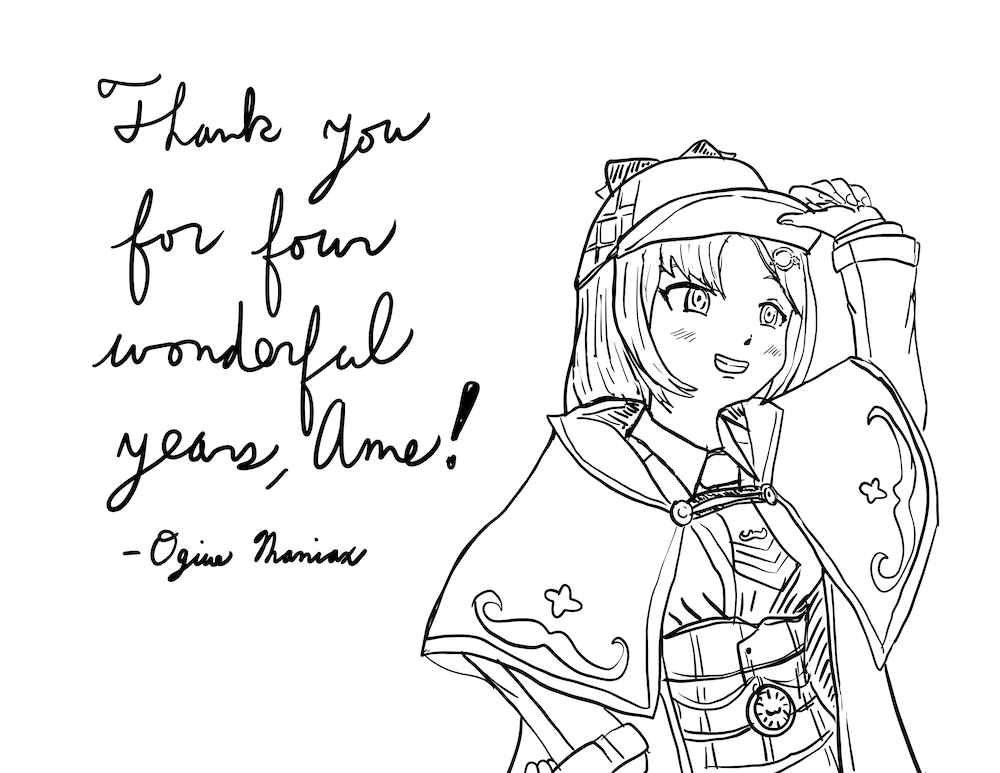
This past month was a real rollercoaster, not least of which was due to hololive talent Amelia Watson announcing that she will be stepping back from actively being a part of the company, and then following that with a marathon of streams. The 4th anniversary of Myth and the 3D debut of ReGLOSS were eventful enough, and now we had this. I even drew on my tablet for the first time in years. If I thought my brain was pretty filled with VTubers last month…
Amid my turbulent emotions, a new anime season is here! The amount of interesting-looking shows is actually overwhelming: Mecha-Ude, Trillion Game, A Terrified Teacher at Ghoul School!, Thunderbolt Fantasy Season 4, Love Live! Superstar!! Season 3, etc. On and on and on. I’m worried I won’t have time for it all.
And I’m still trying to watch through some old anime, like Blue Comet SPT Layzner.
I hope my supporters on Patreon are okay with how I’m doing. Thank you as always.
Having seen the anime movie The Colors Within, Kio points out how the images look euphoric and characteristic of director Yamada Naoko. There are also very few long shots, making the movie feel very personal and character-focused.
Kio describes being happy to discover that manga artist Nakano Deichi is able to make a work like h na h to A-ko no Noroi, which has a different feel from his previous works.
Fantasista mascot Sis-tan really likes Hashikko Ensemble, and shetells Kio why she likes the character Hachida Shinji so much (she also likes Orihara). Essentially, Hachida can’t seem to leave others alone, like when they’re going through hard times (e.g. Orihara, Masshy).
Kio replies that he pictures Hachida having an older sister who’s actually a yankii, and that he actually has a lot of experience with tough guys. Also, Masshy has light footwork, and knows how to interact with those who take singing very seriously.
Kio loves the Turn A Gundam novels so much, he’s read them countless times. He was originally shocked at where Tomino concluded the anime, so he was glad the novels show what happened after that. The fact that the series is all about the consequences of the foolishness of humanity is very “Tomino.” He has felt that this is the kind of thing he could not pull off as a manga artist. He also praises Turn A mecha designer (and legend) Syd Mead.
Kio did not tweet his own reaction to the death of voice actor Shinohara EMi, but he did retweet these drawings from Togashi Yoshihiro, author of Hunter x Hunter and husband of Sailor Moon creator Takeuchi Naoko.
He also had to gather a lot of old material for the talk, including work he finds embarrassing. He wonders if this is going to turn into a cringe session for him.
With summer ending and some work concluded, Kio is feeling that he should start something new. In the meantime, he declares that he will finish his doujinshi.
Kio read Volume 2 of The Kinks, a manga by Enomoto Shunji. While reading the serialized version Kio, always finds himself going “Well, that’s a first!”
The talk at Umeda Lateral also had a raffle for special signboards with art by Kio. The person who won Saki’s also happens to be an artist. Here’s Kio thanking him for some Saki fanart.
Creating a story with a good antihero lead can be a challenge. It’s all too easy to end up with a character who’s more of a shallow reactionary and whose only redeeming value is that they do bad stuff to worse people. Other times, they come across as a simple conduit for revenge fantasies against grievances. But Go! Go! Loser Ranger succeeds by establishing its antihero firmly and then having him discover a personal sense of conviction that even he isn’t fully aware of.
The backstory of Go! Go! Loser Ranger starts off like a typical sentai series: Years ago, a group of heroes called the Dragon Keepers defeated an evil organization that tried to conquer the surface world. The only remnants were the basic goons that typically attack the heroes in large numbers and get their asses handed to them before the real villains show up. Now, they’re forced into a pro wrestling–esque kayfabe where they pretend to fight every week in front of a stadium audience, not unlike the shows that take place on mall rooftops in Japan. But one mook, Fighter D, refuses to let his monster pride fade away. Despite the odds, he wants to fight back for real against the Dragon Keepers, and maybe even get revenge for all the humiliation they’ve inflicted.
In Power Rangers terms, this is basically “What if a Putty was the protagonist? And it ends up working really well, not only because it’s an interesting premise but because it’s not content to just flip the roles and leave it at “bad is good and good is bad.” Sure, the Dragon Keepers feel like they’d fit in with the highly dubious capes of Alan Moore’s Watchmen, and the generic Fighters are portrayed with lots of personality. There are a lot of gray characters in this series, and not in a boring or predictable way.
What I think holds it all together is that Fighter D is a perpetual underdog whose only skills are that he’s hard to kill and he can engage in a degree of subterfuge by changing shape. He’s not the ultra-powerful badass but someone who has to win through wits and creativity. He has to use his head, and this thoughtfulness (albeit colored by the huge chip on his shoulder) is one of the key factors for what makes Fighter D a compelling protagonist.
One key aspect of Fighter D is that his core beliefs aren’t quite what he thinks they are. He assumes that his sense of worth comes from being a loyal foot soldier who carries on the legacy of his evil masters. But as the events of the series unfold, it becomes clear that what drives Fighter D is a desire for him and his fellow goons to be treated with respect and value. He simply conflated one with the other, and this confusion leads to some great developments.
Go! Go! Loser Ranger ends up being a series that defies expectations, and it all centers around a weakling challenging the strong, albeit for less than noble causes. But while Fighter D is not a paragon of virtue, he is at least a sentient being looking to carve his place in the world. I’m curious to see what heights (and depths) he reaches next.
This interview was conducted at Otakon 2024. Uchida Aya is a Japanese voice actor, famous for playing the character Minami Kotori in Love Live! School Idol Project.
Many of my questions will be Love Live!–related because I’m a fan, but coincidentally, I was in Tokyo last December, and I visited the Love Live! cafe.
Uchida: Ahhh!
I just happened to sit at a table you autographed.
Uchida: In Akihabara!
I was wondering, for my own curiosity, do you remember when you visited to sign the table?
Uchida: I think it was December!
Love Live! Is now a worldwide phenomenon; people know it everywhere. But I know it was much less popular at first. How did you get started in Love Live!?
Before I was on Love Live!, I got my first regular role on an anime project, and the music director told me that his next project was something called Love Live! That’s how I got into it.
What was it like when you first started, and at what point did you realize it was starting to get huge?
Uchida: Love Live! was a very new creation, so there was a lot of motivation across the time. And personally, I love anime and also idols, and the fact that both those things are core to this project made me very excited. This made me want to really want to take the lead and bring it to the next level, and make this work even more fun. As it gained more popularity among fans, and as I realized more and more people were listening to the songs, it made me feel very, very happy. But because it started very small, I feel like I grew with this project, and that makes it more special.
Speaking of growth, that’s something I also noticed. I first became a fan of Love Live! through the anime, and when I looked at the prior material—all the song performances and recordings and such—I noticed that you and the other members of μ’s had grown a lot as performers. In what ways do you think your performance as Kotori, in acting but also singing and dancing, had evolved over time?
Uchida: I’m not so sure about my skills improving…I was always aiming to become a voice actor and didn’t necessarily want to be an idol, standing in front of a crowd smiling and dancing. I didn’t have any intention of doing it professionally, and it was something I had to get used to and was hesitant about in the very beginning.
At some point in the middle, we started doing more live performances, and it was a challenge. But because the other members were there and we were a team, we taught each other things—dancing, practicing, etc.,—and gradually, we acquired those skills and got better. I’m glad I had friends in the same boat with me who I could strive with and improve with together.
So you’ve performed many songs with the others, including with Hanayo’s voice, Kubo Yurika. One of your songs, “Suki desu ga, Suki desu ka?” Did the ’70s feel of the song change how you two approached it?
Uchida: It’s been quite a while, so give me a moment! So it’s a song featuring our characters, Koizumi Hanayo and Minami Kotori, and it was a duet of a kind we had never done before, so it was very fun. Hanayo-chan’s voice has a very “howaaah” fluffy and cute feel, and Kotori is a very cute character herself. So I was confident it would be a cute song.
Thank you for this interview!
Postscript
Two days after I interviewed Uchida, I managed to get an autograph from her. As she signed my copy of Love Live! The School Idol Movie, she actually recognized me from the interview. I point this out because I’ve had cases where the guests do not recognize me despite having spoken to them, and it made me realize that Uchida is indeed a pro at this, be it through her experience as Kotori or in her voice acting career. I left with an even more positive impression of her.
A few days ago, I felt an urge to write an essay dedicated to Amelia Watson. It’s something I’ve been doing for all my favorite VTubers over the past few years—using my humble platform to celebrate these talented individuals that I’ve grown to adore. However, between Breaking Dimensions, Anime NYC, a whole host of big hololive happenings in September, and me just being busy in general, I had decided to wait.
I mistakenly thought I could take my sweet time penning a post dedicated to an active, ongoing career.
Today, Amelia (Ame to fans) has announced that she will be concluding her streaming, participation in events, and periodic merchandise. While something akin to a graduation (i.e. an idol/VTuber leaving a company on relatively good terms), it is not actually one. In fact, Ame herself has mentioned in a Youtube comment that she might still show up on occasion, though this does not count as a transition to staff.
So here we are.
The Story of Myth
Let’s rewind to September of 2020, at the height of the COVID-19 pandemic and with many people around the world staying at home to prevent the spread of the virus. It was in this environment that the Japanese VTuber agency hololive announced their first English generation: Myth. At a time when so many were cooped up at home and in need of some joy, when the ability to even see other human beings in person came at a real risk to one’s life, Myth breathed life into people. The success they found might very well be forever unmatched.
Four of that first EN generation were shown to carry ancient and supernatural motifs—Calliope Mori the grim reaper, Takanashi Kiara the phoenix, Ninomae Ina’nis the eldritch priestess, and Gawr Gura the Atlantean shark. The fifth was Amelia Watson, a “mere” human detective investigating the others. Not only did she stand out as unusual in terms of her theming, but she was the last to officially debut. And from the very beginning, it was clear that she was bringing something unorthodox. Whether it was starting off with a tongue-in-cheek joke about actually being British but needing to put on a “fake” accent, or her inducing “hallucinations” in the audience through an injection of her “Watson Concoction,” Ame’s wit and imagination were on display.
The AmeWay
Ame didn’t reveal her entire character concept at debut: She’s not just a detective but also a time traveler. In the severe extenuating circumstances of a global pandemic, she began to express this facet by playing around with 3D models, VRChat, and other interesting software and technology. As fan works of Ame poured in, she commissioned artists to make variations of her: a chibi (that went on to become a mascot of hololive called “Smol Ame”), a bee, a mountain of muscles, and even recently a hand puppet.
Ame is often referred to as “creative,” and while that’s certainly true, a more detailed description would be that she pushes the boundaries of what is possible in any space she’s in through a combination of out-of-the-box thinking and sheer stubbornness. Sometimes it’s in her approach to video games. Just yesterday, she started playing on hololive’s Grand Theft Auto Online server, where she successfully got past a fence on her unicycle by riding downhill to build up momentum and crash through. During Part 1 of the hololive Minecraft roleplaying event “Enigmatic Recollection,” she could be seen trying to glitch the block mechanics to create shortcuts for herself, while also being one half of the wild “Jyonathan and Gonathan” romance story with Gigi Murin that captivated fans. Other times, it’s through her exploration of the technical aspects of VTubing. Fans call this the “AmeWay,” and it speaks to the notion that if two paths diverged in the woods, Ame would cut her way through the trees in the middle.
During that dark period when Japan was locked down and travel into the country was impossible, Ame found a way to give her and the other Myth girls their own “3D event” of sorts through VRChat, and by giving everyone a “Smol” model of their own to pilot.
Even later down the line, as the world opened up, Ame continued to push the envelope. For Myth’s 2nd anniversary, Ame set up a special 360 degree view where fans could move their phones around to explore the 3D space with her and the other girls.
One of Ame’s strengths is her interest in technology—even building her own 3D studio at home—and she provided a lot of behind-the-scenes support for her fellow talents, both peers and later generations alike. It wasn’t uncommon to hear other EN members mention her giving them computer tips or advice on what equipment to buy, or to catch a glimpse of her acting as the cameraperson in VRChat streams. Even when she wasn’t on screen, her presence could be felt.
The Road to Idol Ame
If there was one thing I really missed while staying at home during the pandemic, it was the ability to go out for karaoke. So when I started seeing that VTubers do their own karaoke sessions, I would tune in. I don’t know if Ame’s was the first, but it’s one that sticks out in my memory in a big way.
In that first karaoke stream, one thing was apparent: In a VTuber generation filled with musically inclined peers, Ame was by far the weakest singer. Constantly off-key and unable to keep the rhythm, Ame could not carry a tune at all.
It was beautiful.
For those who don’t karaoke, one thing that might be hard to understand is that singing ability doesn’t matter all that much—at least around good people. It’s about finding songs that you enjoy, giving it your best shot even if you sound like ass (speaking from personal experience here), and just having a good time with others. And if someone’s got pipes, that’s cool too—karaoke isn’t about hating. What Ame brought to that singing stream, and all subsequent ones, was that “karaoke with friends” energy. And in 2020, that energy was all the more powerful.
That spirit alone would have been enough to make me a fan, but then she hit me personally deep in my soul by singing Sixpence None the Richer’s “Kiss Me,” a favorite song from my childhood. The fact that it would become one of her go-to songs over the past four years is something I’m grateful for. And if that’s where Ame’s musical performance journey ended, I would have been satisfied. But that’s not the whole story.
Ame kept singing over the months and years, and bit by bit, something happened. She started hitting those notes a little more cleanly. Her voice wouldn’t squeak as much. She was actually improving! And while Ame had set up a bleeding-ear emote as a self-deprecating joke, fans eventually stopped using it entirely.
In the time since that first karaoke session, so much has happened. Ame got to appear on the big stage with her official 3D model at 3rd fes, putting on a memorable cover of the cute and bizarre “Puru Puru Pururin” from Welcome to the NHK! She released her own original song, “Chiku Taku” (accompanied by a video game based on it), and then performed it at two separate live events, including the first EN concert. The latter was even a ska rendition that reflected her own musical tastes, which she accompanied by skanking on stage. She had her official 3D showcase, where she got to show off her detective’s office, do cartwheels, and collaborate in person with Japanese hololive members like Haachama and Yozora Mel. At 5th fes, Ame upped her choreography game too.
Just recently, her “IDOL” duet with Gura was one of the absolute highlights of last month’s Breaking Dimensions concert. And in their recent 4th anniversary online concert, she was able to keep up well with the other strong singers of her generation and help make “The Show Goes On” the best Myth group song ever. Each step of the way was evidence of her improvements as a performer, and while she never embraced the shining lights, that’s also why she embodied the “idol journey” so thoroughly.
The Hiccup
I want to just mention this brief thing that has little to do with achievements and interests, but is inextricable from Ame’s story. There are a lot of unique things about her, but perhaps none are more iconic than her chronic hiccups that can often be heard on her streams. It’s not clear if it’s a hiccup exactly or something else, but whatever it actually is, the result is something that is identifiably Ame. What’s more, unlike a particular way of talking or laughing, it pretty much can’t be replicated. Even in this simple way, there will never be another Amelia Watson.
The Closing of a Chapter
While hololive isn’t a piece of fiction in the traditional sense, Amelia Watson is often positioned in fan works and headcanons as the “protagonist” of Myth and possibly hololive EN as a whole. A lot of it has to do with her motif as a completely human detective (albeit one unbound by time), but I think it’s also because she also comes across as very human in a different sense. She’s not anywhere near the best singer or dancer, she doesn’t have that non-stop gift of gab that others might, and while she’s definitely one of the strongest gamers, it’s not her main focus either. But Ame has ingenuity, and in a way, she’s sort of like the Batman of hololive.
I have a tendency to like creators, VTuber or otherwise, who experiment and expand the range of what is considered “possible.” That’s where Ame has thrived and why I became so fond of her, and countless others feel the same way. It’s hard to overstate just how much of an influence her tinkering and her ideas have had on the VTubing scene, especially in the English sphere. There has been a constant outpouring of love from other VTubers, many of whom are citing her as a real inspiration—especially for those who wanted to do something different than the established norm.
Personally, the timing of Ame’s announcement is kind of funny. Until literally last month, I didn’t own that much of her merch. Now, as she begins her retreat from the spotlight, I find myself coincidentally with more than I ever expected: a desk mat, figures, keychains, and so on. I even just uploaded a video of her to my Youtube—one of only two VTuber clips on my entire channel.
One thing I haven’t done is try to draw her. After all, I had assumed there was plenty of time to get around it. Maybe I need to change that.
In a way, we Teamates and Investigators are very lucky. Not only did we get four years of one of the best to ever do it, but the fact that this isn’t a full-on graduation means there will likely be opportunities to reunite with her in this familiar form. And no matter what, the thing that really matters is that the person behind the virtual avatar can find happiness in whatever form it takes.
(And there’s always the off chance we might see her without her coat in 3D.)




 OGIUE MANIAX