Otakon 2011, occurring over a blistering 100-degree weather weekend, was a unique anime convention for me because it was the first US anime convention that I have been able to attend since my departure to the Netherlands. In the context of my vacation back in the US, it was an odd little break within a break that felt all the more special as a result.
There was also just a lot to do at Otakon, even more than previous years.
Premieres
Otakon this year was packed with premieres, anime that had never officially aired outside of Japan. In an age where convention viewing rooms have lost their importance compared to when they were the main reason to go to a convention, the willingness for Japanese companies to debut their works at cons brings back a bit of old school flavor.
I attended the showing of episodes 1 through 3 of Puella Magi Madoka Magica, the dark, subversive magical girl anime which this past year took the Japanese internet by storm. Though normally I would not watch at a con something I’d seen already, especially a series which doesn’t rank among my top favorites, I attended the premiere in order to gauge the audience reaction to the show. Who exactly was attending this premiere? Despite its popularity among fans on the internet, how many people had actually seen Madoka Magica?

Though there were a number of people who had obviously seen the show already, it was clear that for much of the audience, this was all-new. The crowd cheered and clapped not at the moments where you expect someone with full knowledge of the show would, but at points in the episodes where new and exciting things happen, such as when a magical girl transformation happens for the first time. Also, in re-watching these early episodes, I noticed some particular details, such as how Mami’s transformation sequence is different every time. Overall, I think the show made quite a good impression on the viewers, and I expect the series to reach some degree of success.
Another of the big showings was for the film Trigun: Badlands Rumble, a follow-up to the enormously popular Trigun series. Trigun is probably one of the most beloved anime titles among American fans. I’ve known a lot of people both personally and through observation who had been itching for more Trigun anime for years, and Badland Rumbles scratches that itch pretty well. Centering around Vash the Stampede’s confrontation with a robbery-obsessed villain named Gasback, who only ever takes money so he can use it to fund his next heist. The film features all of the main Trigun cast, and acts as a good reunion for fans, though I’m not sure how well it would do for someone who’s never seen any Trigun before. If I had to make a guess, I think it could still do a decent job because of how action-packed and fun it still is.
The last premiere I attended was for Shinkai Makoto’s new film, Hoshi o Ou Kodomo: Children who Chase Lost Voices from Deep Below. Known for deeply introspective works such as 5cm per Second and The Place Promised in Our Early Days, Hoshi o Ou Kodomo is a first for Shinkai, a more mainstream-feeling title that, although possesses a good deal of introspection, has a greater emphasis on adventure and exploration. Focusing on a young girl named Asuna who gets drawn into a mysterious world, the film has a number of flaws, feeling like it tried to introduce too much all at once and so occasionally lost focus. It manages to mostly overcome these problems, though they’re still a sticking point. This may be a sign of Shinkai’s inexperience with this type of film.
Regardless of the film’s strengths and weaknesses however, the showing of Hoshi o Ou Kodomo was made all the more special by the fact that Mr. Shinkai himself was a guest at Otakon 2011, his first ever American anime convention.
Guests, Directors, Producers

We were given a number of opportunities to interact with Shinkai, with a Q&A directly after his film on Saturday, an additional Q&A later in the day, a press conference on Sunday, and then a final Q&A with a bunch of directors and producers. Due to certain conflicts, I was only able to attend the first and last Q&A but both were extremely informative. Shinkai is not just simply polite but actually very humble, giving detailed answers to every question asked. At the first Q&A, Shinkai elaborated on his desire to create a more mainstream film that is visually accessible not only to a Japanese general audience but an international one as well. I was able to ask Shinkai a question myself:
Q: In the film, Agartha is in decline and the people there think it’s best to accept it, but others struggle not just against death itself, but struggle to live their lives. What are your own thoughts on to what extent a person should struggle against that fate or accept it?
To which he responded:
In the film, there are those who have accepted that they are not long for this world. But Shin, a resident of Agartha, hasn’t accepted it. If asked this question 15 years ago, I would have definitely sided with Shin, but now that I’m older I can’t help but say I understand the view of the other people. In this film, I didn’t want to side with either side. I didn’t want to deny either side.
I had originally wanted to ask Shinkai about digital animation, but after seeing the film and the concept of accepting the decline of one’s own civilization, it had me thinking about the way in which all of the various characters struggle in different ways and to varying degrees against their circumstances, and it spurred me to ask this question instead. Fortunately, I would have another opportunity to ask Shinkai about the animation process itself at the Directors Q&A Panel.
The Directors Q&A was nothing short of amazing, as it brought together directors Ishiguro Noboru (Macross, Legend of the Galactic Heroes), Murata Kazuya (To Heart, Full Metal Alchemist: Sacred Star of Milos), and Shinkai, and every answer showcased just how different these three were in terms of age and experience. The best example might be when someone asked what series would be considered the directors’ top must-watch anime. Whereas Murata picked a good, yet fairly expected response in Future Boy Conan, Ishiguro mentioned old Czech puppet shows, Canadian animator Norm McLaren, and a Chinese sumi-e-style animation from decades prior called Muteki and Shinkai actually selected Ishiguro’s own Legend of the Galactic Heroes. This generational difference was also evident in their responses to how the recent earthquake and tsunami might affect the industry and its people, with Ishiguro mentioning that the lack of escalators and power outages were something that he remembers and is familiar with from decades ago, while Shinkai talking about how he thinks that there is definitely potential to use this event to fuel the creative process but doesn’t quite know yet how to do so.

Keeping in mind this living history of directors available, and also remembering a comment from Ishiguro earlier in the panel about how he has had trouble adjusting to digital animation, I crafted my question accordingly: I asked if Shinkai and Murata, who both worked in digital animation, had any advice for Ishiguro in terms of working with digital animators. If you think about it, Ishiguro worked primarily in an age of analog animation, Murata worked in the transitional period between the two, and Shinkai is purely digital, this meant that each of their responses would embody different experiences and values. Knowing that Ishiguro is a living legend and that neither Shinkai nor Murata would want to show any disrespect towards him, I tried to phrase the question to give them as much leeway for politeness as possible, but it was still clear that this was going to be a tricky situation when the translator actually said, “I’m not going to touch this one.” Fortunately, Ishiguro, upon learning what I asked, actually encouraged the younger directors to give answers, sincerely willing to set aside seniority for some help.
Murata spoke of his own initial thoughts towards digital animation. Having worked with cel animation and remembering the hardship of lining up cels and taking photos of the compiled images one by one, Murata saw the move to digital as an opportunity to do more with more freedom. Shinkai, however, actually said that today’s digital animators should be learning from the older cel animators because, at the end of the day, as long as the initial images are still drawn with pencil on paper, those experiences and talents are still very important. Another interesting conversation arose when Shinkai mentioned working with older animators and how they worked in “millimeters” while digital animators think of space in terms of “pixels,” to which Ishiguro responded that he had to deal with the opposite problem, seeing the term “pixels” for the first time and wondering how many millimeters that was supposed to be. My question was the last one and it felt good to end the panel that way.
I was also able to get Evan Minto from Ani-Gamers to ask Shinkai a question at the press conference, about what it’s like to work with computers in animation. Interpreting the question as to mean 3DCG, Shinkai remarked that he actually prefers 2D animation despite his background in games, and would only go back to 3D if 2D faded away. Given the number of great anime creators who only started working in anime because they couldn’t find more “legitimate” work, I have to wonder if this could be another case for allowing 3D anime to fully mature.
There were Q&A sessions with both Ishiguro and Murata, as well as Madhouse founder and perpetual Otakon guest, Maruyama Masao, but unfortunately they conflicted with just about everything else. Notably, Maruyama’s and Ishiguro’s panels ran during the showing of Shinkai’s film. Still, I am glad I got the opportunity to see Ishiguro on the Directors/Producers panel, and I managed to get autographs from both Ishiguro and Maruyama. Speaking of Maruyama, the man has worked on so many things it’s actually kind of hard to be completely unable to find merchandise related to his work. In my case, I had him sign my Cardcaptor Sakura movie DVDs.

Industry Panels
This year’s Otakon included a Sunrise industry panel, which might not seem all that special compared to other companies’ panels until you realize that Sunrise never holds industry panels. Usually, there stuff goes to Bandai Entertainment, but this time it was Studio Sunrise, creators of Gundam, coming straight out of Japan to talk to the fans at Otakon about their shows. The panel began with an introduction from Sunrise producer, Ozaki Masuyuki, and then continued with a video showing called “The World of Gundam,” giving a brief history of the franchise and how it has affected Japanese animation. The video delivered on two points, first of which is that it fulfilled my wish for it to have a hilarious English-language narrator, and second of which is that it managed to result in a few surprises. Ozaki was clearly expecting the cheers for the original Gundam and titles like Gundam W, but when the crowd went into a roar over G Gundam, I could literally see that Ozaki didn’t expect it, with his body actually being taken aback by it.
From there, they showed a recap of the first season of Tiger & Bunny (which contained spoilers!), and it was also evident that the show was extremely popular. I also had a bit of a realization during that section, as Ozaki asked one by one if each hero was the crowd’s favorite character. Naturally, characters like Wild Tiger, Barnaby, and Blue Rose got good reactions, but when he asked about Dragon Kid, I found myself to be the only one clapping and hollering.
(Dragon Kid is the best, forget y’all.)
The panel also had a bunch of new show previews, the most interesting of which is probably (Gundam AGE aside) a series titled Phi Brain Puzzle of God. Apparently, it features a kid who is good at solving puzzles. The title alone makes me want to check it out.
Speaking of Gundam, the Tamashii Nations booth in the Dealer’s Room featured this:

Being that this was the first and possibly only time we’d ever see an official Sunrise panel, a lot of questions were asked about a lot of series. Patz from Insert Disc for example asked about the possibility of streaming older shows, especially the Yuusha robot series, and the answer there was that they were looking into streaming as much as they can but that there were no definite plans. I asked about the possibility of reviving significantly older giant robot franchises such as Zambot 3 and Daitarn 3, to which the response was that Sunrise prefers to create new concepts rather than going back to older ones, unless there is significant fan demand or a director/producer has interest in doing so. Gundam, I assume, falls under both the former and latter. There was also a lot of praise for Tiger & Bunny and hope from the fans that there would be more. Probably the question that sticks out to me most was the lone girl who politely asked them for more My-HiME/My-Otome in a thick southern accent, if only because that franchise didn’t seem to be on anyone’s radar. Interestingly, Ozaki said that the My series is designed to have sequels. These are certainly not concrete answers, but more than I typically expect from a company official.
If you want real answers at an industry panel though, look no further than Vertical Inc., publishers of Twin Spica, Chi’s Sweet Home, and a plethora of classic Tezuka titles. While going through all of their upcoming titles, marketing guy Ed Chavez (who you may remember from the old Vertical Vednesdays) would talk about his own feelings towards them, giving a genuine sense that he had a personal investment in all of their licenses, which include a manga adaptation by Furuya Usamaru of No Longer Human, Princess Knight, and The Drops of God. In answering a question of whether or not the manga would be flipped or unflipped, Ed remarked for instance that The Drops of God would remain unflipped despite its potential for success outside of manga readers because of how the intricate labels on wine bottles would be excessively difficult to correct afterwards.
The Bandai After Dark panel tried to be a somewhat free-flowing, “casual” panel as well but didn’t quite come across that way. That said, there were a number of highlights. The Gosick and Nichijou anime have been licensed for DVD release, as has the Nichijou manga, which according to one person I know is far superior to its adaptation in terms of comedic timing and such. The composer for The Disappearance of Suzumiya Haruhi was also present, and he played a violin solo of that movie’s main theme, Yasashii Boukyaku. I really love that song, and I think that was one of my favorite moments from Otakon.

In terms of industry panels, last but not least must be the Angel ScandyS Q&A, which centered a show that isn’t even actually in production yet. Ishiguro, the aforementioned director of Macross, has thrown his hat into the ring that is the moe idol genre. Planned to be a story about angels, devils, and human idols competing over a young man’s soul (or something), what’s fascinating about this project is that they bothered to show it at Otakon at such an early stage, something I’m certain has never been done before. The voice actors, who were selected first and had characters based on them rather than the other way around, had prepared a skit as well, both in valiant Engrish and in Japanese, to give the audience an idea of what the show might be like. When asked about the music, we were told that Ishiguro himself wrote the lyrics for the music. Ishiguro meanwhile, had been sneaking around the panel itself, preferring to film the panel from an audience perspective. I asked them about the character designs, which seem oddly familiar despite being so generic, but was told that 1) it was done by an unnamed Artland (Ishiguro’s studio) employee and 2) that the character designs aren’t even final. I don’t know, seeing a project so early in its life piques my interest.

Fan Panels
Due to the sheer amount of premieres and unique industry panels this year, on top of the scheduling conflicts that caused similarly themed panels to run at the same time (Gundam Unicorn showing vs. Sunrise panel vs. Gundam panel vs. Underrated Mecha panel), I unfortunately was unable to attend very many fan panels. Still, of what I saw I certainly enjoyed.
The Reverse Thieves ran two panels this year, “The Best Manga You Never Read: Tokyopop Edition” and “Investigating Detective Anime.” The former pointed out titles that the two considered to be underrated titles, many of which did so poorly in the US as to be canceled even prior to Tokyopop’s demise. One good reason to go that panel is actually the Q&A section, not because they give out free stuff, but because they’re actually really good at answering questions and taking suggestions. The Detective Anime panel showed the sheer range of genre fiction available in Japanese animation, and focused less on finding the most obscure titles possible. Again, their Q&A session was excellent.
I also made a quick stop at the “Moe Moe What?” panel, curious about how exactly they were going to approach the subject. Though I cannot say how the panel turned out by the end because I had to leave early, I found the panel to be informative enough, though obviously geared towards fans of moe who are looking for an intelligent way to defend the idea.
I attended both of Daryl Surat of Anime World Order‘s panels, “Remembering Satoshi Kon” and “Anime’s Craziest Deaths.” As someone who knows Kon but doesn’t really know Kon, it was a highly informative panel which showed his influences and his connections to other great names in manga and anime. In particular, Kon began his career as a manga assistant for Otomo Katsuhiro (Akira), and even worked with Oshii Mamoru (Ghost in the Shell) on a number of occasions. As for Anime’s Craziest Deaths, I had talked to Daryl when he was originally planning it a couple (?) of years ago, and even contributed some examples, but was just unable to see the final result for a long time. Now that I’ve experienced it, I can say that it’s really worth its own title, though I realized that my suggestion of Zambot 3 felt a little weak compared to the blood-and-guts violence of the likes of Baoh and Violence Jack. Perhaps something from later on in the series would do it more justice, though I think it more has to do with the fact that the “craziness” of the deaths in Zambot 3 are more contextual than visceral.
The last fan panel I attended was the Otakon Game Show, which had four contestants on-stage showing off their anime trivia skills, one of whom was an aforementioned Reverse Thief. The format of the game had it so that the audience could participate as well, and keen panel attendees might have noticed that I reached second place in Round 1 of the Game Show, just about 30 points shy of the #1 spot.
I realized my own frightening power during that panel. One of the categories in the second round was “Shower Scenes,” and for one question, even before the clip started playing and all the only thing visible was a shower head, I said “Chun-Li” to my friends and was eventually proven to be correct. Sadly, none of the contestants actually got it, though any arguments I make about that shower scene being really distinct and iconic does not help me in any way. Still, for one moment I shined in the most brilliant yet dark way imaginable.
Though that was the last panel I participated in as an audience member, I was also a panelist on “Anime and Manga Studies,” which had us answering questions from both the moderator, Mikhail Koulikov as well as the audience. It was a Sunday 9am panel, which meant that attendance would inevitably be somewhat sparse, but I was still glad to see quite a few people show up. I hope we provided a good panel for you all!
Cosplay
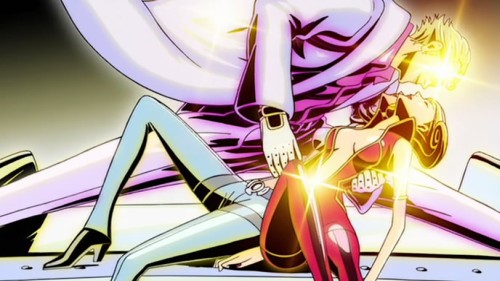
I’ll let this section more or less speak for itself, but I do want to say that the three of the biggest cosplay this year were probably Madoka Magica, Panty & Stocking, and especially Tiger & Bunny. Sadly I did not get any photos of Tiger & Bunny, and the only Dragon Kid cosplayer I managed to find was when I was waiting for the bus on the way home.


Miscellaneous Noteworthy Things

The artist’s alley this year had some really interesting features, an “Art of Akira” exhibit that features the animation cel collection from a diehard Akira fan and did a really good job of showcasing the visual excellence of that film.

A couple of artists also caught my eye, especially one Ashwara, who I commissioned to draw a piece of Ogiue fanart for me. Amidst a number of artists who draw well but pretty much look the same in style, his work really stood out and I was glad to have seen it.
There was also a wall at the Aniplex booth where people could ask Kyubey for a wish. Seeing it, there was one wish I knew I had to make.

 Is it a cat?
This year also gave attendees the opportunity to donate to Japan in light of the recent disaster, to which they gave merchandise. I received this Madoka poster for my efforts.
In terms of cheap and simple food, a Jimmy John’s had opened up since the previous year, which had me jumping for joy (you can ask others about it). Back in college, I frequently visited the local Jimmy John’s, and had not been able to partake of it in over five years. Now that I know that there’s one to greet me every Otakon, I know where I’ll be eating at least once. It’s nothing fancy, but it’s really quick and I think it tastes better than Subway.
In terms of more expensive food though, the place to go this year was Abbey Burger Bistro, which features a number of exotic meats in burger form. My burger ended up being a medium-well Kangaroo burger with mushrooms, onion rings, chili mayo, herb yogurt, swiss, and pepper jack. The only thing that made it better was being in the company of good friends, including Daryl and Gerald from Anime World Order, the Reverse Thieves, Patz, the crew over at Ani-Gamers, and many more. Same goes for everyone I met over the weekend. You know who you guys are.
A Special Message
In the sweltering heat of Baltimore in July, when humidity and temperature worked together as an unpleasant duet, only one man was truly able to save us from the sun. He sold cool, freezing temperature water for a mere dollar, and he had a powerful advertising jingle to go with it. Apparently around last year, the addition of the megaphone made his presence fully known. Even for those who did not buy his goods, he was quite possibly the most refreshing part of Otakon 2011, his pitch quickly becoming a popular tune to sing along with for the attendees. I found myself in that group as well.

Ice Cold Water cosplay is inevitable.




 OGIUE MANIAX