Super-Expressive Faces

I’ve been reading the manga Coppelion lately, about three teenage girls who are genetically engineered to be immune to radiation in a post-nuclear apocalyptic Tokyo. One of those girls is Fukasaku Aoi, whose most prominent feature is that she has an incredibly expressive face compared to the other characters around her. It kind of makes her an endearing character even when she complains (which she does often), and I feel like she can really liven up scenes as a result. She shares this trait with Kurumi Erika from Heartcatch Precure!, and as is evident from previous posts, I like Erika quite a bit as well.

I find myself wondering about the candidness of such characters and why they can be so appealing, particularly when they’re grouped with characters who, while not necessarily reticent, still don’t have quite the range of expressions that someone like Aoi or Erika does. In thinking this through, possibly the best explanation I can find is not from manga or anime but from bande dessinée, Franco-Belgian comics. Though all sorts of things have been written about the expressive nature of eyes in manga, I think I might be best served by The Adventures of Tintin.

At the Belgian Comic Strip Center museum in Brussels, there is a Tintin exhibit which features profiles on all of the major characters. Among them is Haddock, a ship captain and friend of Tintin. Like Erika and Aoi, one of his most distinguishing features is his capacity for making wild facial gestures, and a display in the museum talks about the relationship between Captain Haddock and Tintin, who is usually much more calm in his demeanor. I don’t quite remember everything it said, but it mentioned something about how the visual contrast between the two makes for an ideal scenario where both characters complement each other with their respective approaches and make the comic better as a result.

If that’s the case, then taking that idea and applying it to the three-character structure of Coppelion‘s central cast, I have to ask myself what purpose does that middle character serve, the one who is less expressive than the Haddock but more expressive than the Tintin. My initial thoughts towards this is that the middle character, who in the case of Coppelion is its protagonist Naruse Ibara, is that if you think of the three characters as a spectrum to gauge the direness or excitement of a situation, the point at which Ibara starts to get facial reactions close to par with Aoi’s is when you know things are really getting serious. If it gets to the point where the third girl Taeko is freaking out, then it’s doubly so. Proper use of characters with different capacities for strong facial expressions can potentially control the level of excitement in a comic while also distinguishing the characters for variety.

I get the feeling that much of what I said was pretty obvious, but I still wanted to write it all down.

Lack of Variation, or Lack Thereof

I think it’s common when discussing anime and manga with people who are perhaps only barely acquainted with those subjects to hear from them that “anime all looks the same.” You can point to plenty of titles with variation in theme, art style, writing, you name it, but there is still that sense that all anime has a similar feel. Usually I’m the one trying to explain how diverse those comics can be, but in a recent visit to a comic shop, I found myself somewhat on the receiving end.

In this case, it wasn’t manga but rather American comics that gave me pause to consider. Not really keeping up with those comics as I had in the past, I was looking at the rack where they have the weekly 32-page (or so) issues, your Avengers and Batman and what-not mixed with titles from smaller publishers, seeing what might be interesting. Then it hit me. Everything kind of looked the same. I could obviously see that there were many different artists working on each comic, but there were just certain shared elements that made it feel like one big monolith of a wall.

I’m not sure exactly what it is, but I feel like it might just be the sheer emphasis on Olympian physiques which exists in not only superhero comics but other action-type works as well. Be it male characters or female ones, what I can mainly remember from those covers is just how prominent the toned bodies on them are. It could also be something about the characters’ facial expressions.

I know better, and I can point to this or that indie title or graphic novel to show that’s why it isn’t the case, but I think that my reaction might not be that far from the person, let’s say an anime fan, who takes one look at the American comics section and finds little variety in it. At the same time, I’m also aware of how easily something like manga can be perhaps unfairly summarized by just a glance.

Father Gonna Knox You Out

In my childhood I read a fair amount of mystery novels, but it wasn’t until I listened to the Speakeasy podcast that I became acquainted Knox’s Rules, a 10-point guide designed to make sure that a detective story does not violate the mystery’s logical structure and thus remove the reader’s desire to solve the case as well. That said, at least one or more rules are broken in every detective story, but the idea is that they should be kept in mind. More important though is the fact that adhering to those ten rules does not guarantee a good story.

The reason I bring this up is that the more I read about and examine the structure of comics, particularly manga, the more I find myself having to make sure that my reading of comics theory does not then overwhelm my reading of manga as I am looking at each page. The potential pitfalls here aren’t limited to just “overthinking” things or being too distanced from the work at hand, but that it risks making my viewing of comics, manga or otherwise, an exercise in dissection for the sake of dissection, and also can possibly lead me to believe that a comic is “better” if it follows those rules. That’s not to say you should just turn a blind eye to the things you learn, but in my experience, it can poison both the well of analysis and the well of enjoyment if mishandled. For example, in being more aware of the Ki-Shou-Ten-Ketsu (Introduction-Development-Twist-Conclusion) 4-part structure commonly used in manga (especially 4-panel manga), I have found myself looking for it everywhere in manga, and I have to make sure I don’t force it to appear in places where it does not necessarily exist just because I want it to be there.

Perhaps letting my own emotions towards a story mix in with the more distanced viewing is key to mitigating these situations.

The First Ever Ogiue Maniax Contest…with a DVD Prize!

The 1979 Galaxy Express 999 film is my favorite anime (and favorite film) ever, so when Discotek Media licensed it for Region 1, I knew I had to have it. More importantly though, now others could have it as well.

I just so happen to have an extra copy of Galaxy Express 999 and its sequel, Adieu, Galaxy Express 999, and I figured, why don’t I let someone share in the love as well? That’s why I’m holding a contest, something which is entirely new to Ogiue Maniax. Whether you’ve never heard of it before and are looking for a classic to watch, or whether you’re already a long-time fan and just weren’t able to pick up a copy, this is open to anyone. Well, at least to anyone in the United States and Canada.

Here’s how you enter: Leave a comment below with an answer to the question below. From there, I will pick what I consider to be the best answer and that commenter will be the winner. There are no word minimums or limits, and I want to hear exactly. The contest ends on September 9th, 2011. I’m not going to give a specific cut-off hour because things don’t have to be that ridiculously strict. This is supposed to be fun!

THE QUESTION

What is your favorite example in anime/manga of a character growing up, whether literally or figuratively, and why?

Kitchen Sinking: Pretty Cure All Stars DX 3

Pretty Cure All Stars DX 3: To the Future! The Rainbow-Colored Flower that Connects Worlds celebrates the 10th anniversary film of the series, with eight TV series and a whopping 21 Magical Girls featured. Three franchise-wide crossover films. Three instances of combined attacks. Three opportunities to focus on everyone working together, because as the number of Precure shows increases it becomes increasingly difficult  to actually have any breathing room or down time in these things.

The plot is that of every big crossover movie ever, where the girls have to join forces to defeat a powerful opponent. This time it’s Black Hole-sama, an amalgam of all of the evil energy from all of the defeated final bosses so far. Its minions are villains from the various Precure movies. Aware that being a Precure means having strong teamwork, the villains split the Cures up from their respective partners to limit their effectiveness, while pursuing the “Prism Flower” which connects all of their worlds together, like a cosmic treadmill.

These types of movies simply have no time to develop any real plot, so the main appeal is generally to show all of the characters interacting with each other and appealing to fans of the franchise. I found the splitting up of the various Cures to be an interesting mechanic to accomplish this, and though it’s been done to an extent in the previous films, this time around it’s done thematically. The first group is comprised of the leaders, the second group is comprised of the smart and supportive ones, and the third group is best described as a mishmash of the rest. Very quickly, the leader group finds that while everyone is good at taking charge, they don’t exactly understand each others’ dynamics, while the secondary group thinks before they act but realize they’re accustomed to having someone else act first. The third group is the most balanced, and seem to have the least trouble overall.

That said, even within those similar groups, the character’s individual personalities highlight a number of differences among the similarities. Among the leads, Cure Black is the first to try and come up with a plan, while Cure Blossom is a little more thoughtful. Cure Marine is more headstrong than the other “cool blue” characters, which makes her the catalyst to inspire the others in the second group to not give up. Cure Berry is a little more devious than the other cool Cures. In the third group, Cure Lemonade is the most serendipitous, whereas Cure Moonlight is the most mature. It all works pretty well.

Speaking of Heartcatch, I’ve noticed that in these crossover movies, the heavily stylized character designs have to be toned down to fit in more with the rest of the series, which removes some of their charm but is also necessary in a way. The only time you get to see the “proper” style is when they’re fighting a Heartcatch villain.

A crossover also means big fights, and the movie both delivers and doesn’t. One notable scene involves the various teams doing what would normally be stock footage special attacks, but in fact are newly animated. Rather than doing what’s expected for example, Cure Black and Cure White deliver a Marble Screw while running in unison. On the other hand, with the final combined attack, it just uses the familiar poses and footage, and the attack itself just combines into a rainbow-colored beam. It’s a pretty good looking beam, but given the variety of attacks, it feels kind of lacking because it fails to live up to the potential for a truly epic combination attack. Part of the thrill of seeing a Final Dynamic Special is seeing how all of the finishing blows interact with each other.

One problem in the previous crossover film, Precure All Stars DX 2, was that it didn’t give enough respect to the rookies at the time, which was Heartcatch Precure! Blossom and Marine often looked weak and ineffectual, and it diminished their appearance. This time around the newbies are the girls from Suite Precure, and they feel nice and strong, still the most inexperienced by far but also clearly able to hold their own. They might take it too far though, as some of the more emotional scenes seem odd when they’ve only just begun doing this.

This film also has millions of mascot characters, and that can be a difficult thing to watch for people. The audience-interaction magic wands (the kids in the theater are supposed to wave them to power up the girls) are also back.

Since the first crossover, these films have felt like they’ve been phoning it in a good deal, but it’s overall acceptable. Obvious this movie is for existing fans, and is not really recommended for people unfamiliar with Precure, as it again doesn’t really bother to have a cohesive story and is only really decent for fans who understand the existing character dynamics. A fun watch, but try the first crossover first.

Study Up for Otakon 2011

This weekend from July 29th to the 31st is Otakon weekend and I will be in attendance. Otakon this year is packed with guests and premieres, and I’ll most likely be attending as many of those as I can, as well as a bunch of other panels in between.

I’ll be wearing this:

I’ll also be participating in one panel, which is “Anime and Manga Studies” on Sunday at 9am. If you’ve ever thought about using anime or manga in a school paper, or if you’re interested in becoming a research of anime and manga, this is the panel for you. Don’t worry about not being “academic” enough, either. I’m a fan who became an academic, and as anyone who knows me is aware, my fandom is stronger than ever.

I also recommend attending the Masao Maruyama Q&A (even though I probably won’t be so I can see Shinkai’s new film). He comes every year but those things are always incredibly, incredibly informative. Ask him about the new Kaiji Season 2 that’s currently airing!

This is only a tentative schedule, and my plans might change on a whim or because I’ll be hungry, but here are just some of the things I am considering attending. I’ll also be trying to get a bunch of autographs.

Friday

  • 9:00am: Best Manga You’ve Never Read (Panel 4)
  • 10:30am: Moe Moe What? (Panel 4)
  • 11:00am: Remembering Satoshi Kon (Panel 1)
  • 12:00pm: Becoming a True Pokemon Master (Panel 4)
  • 1:00pm: Opening Ceremonies (Panel 3)
  • 3:00pm: Aniplex of America Panel (Panel 1)
  • 5:00pm: Madoka Magica + Q&A (Video Room 5 HD)
  • 8:00pm: Chemistry Concert (Hall D)
  • 9:30pm: Fukushima Dai-ichi (Panel 1)
  • 11:00pm: Bad Anime, Bad!! (Panel 5)

Saturday

  • 9:00am: Unusual Manga Genres (Panel 2)
  • 10:00am: Hoshi o Ou Kodomo +Q&A (Video Room 5 HD)
  • 1:00pm: Special Surprise Premiere (Video Room 5 HD)
  • 2:30pm: Trigun: Badlands Rumble (Video Room 5 HD)
  • 4:00pm: Vertical Industry Panel (Panel 5)
  • 5:30pm: Full Metal Alchemist: Sacred Star of Milos (Video Room 1)
  • 7:30pm: Sunrise Industry Panel (Panel 3)
  • 10:00pm: Dubs that Time Forgot (Panel 1)
  • 12:30am: Anime’s Craziest Deaths (Panel 6)

Sunday

  • 9:00am: Anime and Manga Studies (Panel 2) <– I will be on the panel
  • 12:00pm: Kylee Concert (Hall D)

See you at Otakon!

Angela Attack: Genshiken II, Chapter 66

I’ve been waiting for a month to use that title.

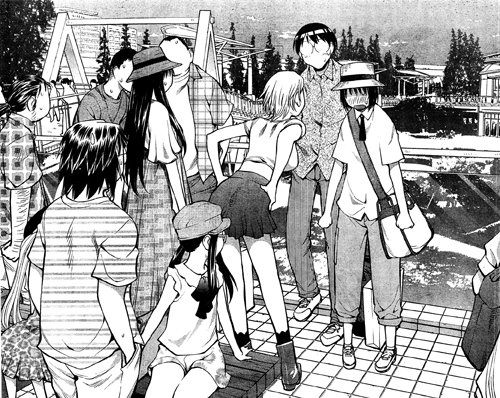
The final day of Comic Festival is nearing its end, and Madarame is in deep trouble, at least from Hato’s perspective. First, Madarame and Hato encounter Kohsaka, whose picture-perfect crossplay (to promote his company’s new 18+ game) blows away both of them. Hato remarking with amazement that Kohsaka, unlike himself, doesn’t even need makeup to complete the gender illusion, wonders why things aren’t more uncomfortable between Madarame, who likes Saki, and Kohsaka, her boyfriend. Hato comes to the conclusion that Madarame’s just isn’t able to compete for Saki’s affections. Madarame and Hato comfort each other over their respective areas of inferiority relative to Kohsaka, though Hato points out that he’s much better at undergoing the cross-gender transformation by using his feminine voice.

Angela strikes, laying on the flirt as thick as humanly possible, with Madarame naturally not being sure what to do. Hato jumps in for the rescue, pointing out that Angela is flying back the next day, so obviously there’s no way anything could happen between them, but Angela doesn’t quite agree.

Knowing that the actual reason Madarame can’t even begin to think of Angela is because Saki is still in his heart but not wanting Madarame to know that he is aware of Madarame’s unrequited love, Hato changes his thought midstream to try and find a safer reason. In doing so, he blurts out that Madarame is such an uke that there’s no way he should be with a girl, though unbeknownst to Hato, Angela is a big fan of Madarame as “sou-uke,” and instantly bonds with him. Wanting to point out however that real life and fiction are different, physically different, Angela tries to give Madarame his Very First Boob Grab, but is deflected by Sue, who then admonishes Angela’s rash action with a roundhouse kick.

At the end of the day, Angela still has her eyes set out on the 72-year-old Pit Viper, Madarame and Hato grow in their friendship, and Madarame comes to the shocking realization that he is in fact perceived as the catcher in yaoi imaginings.

Angela’s forwardness and acknowledgement of previous experience with one night stands sets her far apart from the nerds of Genshiken and at first it might come across as too far out there from how Genshiken has been in the past, but given what has happened in the manga before, it doesn’t seem so inappropriate. If you think about it, the awkward expression of sexuality has been a big part of Genshiken from day 1, whether it’s Saki having to come to terms with Kohsaka’s 2-D complex, the Sasahara x Madarame doujinshi that underscores Sasahara and Ogiue’s relationship, or even the fact that every ComiFest ever has been about buying comics not to “read” but to “use,” and the understanding that everyone else you know is doing the same. In this regard, the most awkward moment of all might just be seeing Angela’s “sex on the first date is okay” viewpoint collide with Madarame’s otaku chivalry, the same noble attitude that at first kept Madarame from taking a seat on the train in place of Saki back in Chapter 32.

That said, it is still a bit of a shock to just see Angela just blast down that implied wall of silence that surrounds the topic of sex, a wall that normally is talked around  or through tiny holes, but is rarely trampled over so easily. It’s a kind of bluntness similar to Sue, and I have to wonder if this is a shared American trait for the purpose of the story. On the other hand, Angela and Sue’s aggressive attitudes aren’t quite the same, and while we see Sue expressing her fondness for yaoi or making references all the time, I can’t really ever see her coming on to a guy as nonchalantly as Angela does. It makes me want to see their friendship in action outside of the context of a visit to Japan.

While that might be considered an inter-otaku cultural gap between Japan and America (and even only somewhat so), the inter-otaku generation gap is also clearly  present in this chapter with Madarame and Hato. At first when Hato sees Madarame talking to Kohsaka. “Why isn’t Madarame seeing him as a rival?” Hato wonders, but just the fact that Hato is asking that question shows a different mindset from the older members of Genshiken. Going after a girl who’s already in a relationship when, on top of that, you’re friends with the both of them? That stuff is for fiction, man. How differently might this manga have turned out had Madarame gone for it from the start, or if Ogiue and Ohno already had boyfriends prior to meeting Sasahara and Tanaka? Would those two have even bothered? But that’s just not how Genshiken is, because that’s not how the characters are. After all, I’m sure that people besides Tanaka entertained the thought of having a relationship with Ohno after she joined, but once it was established that she had a thing with Tanaka, that ship sailed. It’s not a matter of monogamy or anything like that, but simply that someone like Hato (or Yoshitake) carry an extroverted attitude and awareness of interpersonal relationships romantic, sexual, or otherwise, that only the non-otaku Saki and Keiko could see as clearly.

It’s also nice to see the friendship that has formed between Madarame and Hato. Could it be something more? I doubt it, given that both have said outright that they are not into same-sex relationships, at least outside of the world of BL, but I could see the idea continuing to make things a little awkward for them, especially given the number of (too much) high-power fujoshi populating the club.

There was only one small Ogiue cameo this chapter, so let’s close out with it.

Robot Cops Are Cool Dudes: Ogiue Maniax on the J-Decker Episode of Podlabor

I was recently on the Podlabor podcast, where host Patz, fellow guest Narutaki from the Reverse Thieves and the Speakeasy, and I discussed the 90s super robot anime, Brave Police J-Decker. For those unfamiliar with the series, it’s from the same franchise as the more well-known Gaogaigar, and features giant robots who are also detectives. If that didn’t scare you off, have a listen, and if it did, you might be surprised to find out how much heart J-Decker has.

We also discuss a bit about Otakon, which is this weekend.

Podlabor Episode 6: Brave Up J-Decker

The Manga Amber of Otaku Hardcore

Sometimes the really hardcore otaku manga out there are criticized for holding back anime and manga, for catering mainly towards maniacs who want their series to look and feel a certain way, and in doing so restrict the respectability that comes with artistic variety. But as much as topics like fanservice and moe exist prominently in these sorts of criticisms, and as much as there’s the image of the anime fan with seasonal short term memory, I feel that having hardcore devotees of anime and manga allows certain drawing styles to exist in comics even well after their heyday has passed.

70s-style shoujo manga is called such for a reason, and unless you’re Miuchi Suzue drawing Glass Mask and you’re literally a 70s shoujo manga artist still drawing to this day, it’s hard for an artist to draw in that manner and succeed on a mainstream level, especially if they’re a younger artist. Sure, you could put some blame on otaku liking more modern styles, but it stretches well beyond that demographic to the average reader, and the otaku magazines also seem like the only places left where someone can draw 70s shoujo-inspired comics and be appreciated for it.

One example I can think of is the title Christie High Tension, a detective series centering around the niece of Sherlock Holmes. She learned the game from her Uncle Holmes, and now she’s heir to the name Jaaaames B- uh, in any case it has an art style straight out of that Candy Candy/Rose of Versailles vein, and it runs in the same magazine as Dance in the Vampire Bund of all things.

Certainly you couldn’t call it “progress,” as it’s more a kind of preservation of the past, but I know that I always feel a little sadness when I look back to older manga art, and ask where this all went. It’s not really about lamenting the changes that have happened to manga, so much as it is wishing that as trends develop, the old ones still don’t end up being forgotten, that manga continues to increase its variety.

Less-Than-God Voice

The other day I had the opportunity to karaoke again, and I took full advantage of it, singing anime songs from all decades and genres (but mostly giant robots). It had been, what, over a year? since I was last able to belt out some tunes and it felt pretty good.

Ever since the last time, I’d developed another favorite song to karaoke: “Tatakae! Reideen” from the 70s robot show Reideen, if only because there’s a part where you just start shouting aggressive words of encouragement.

IMA DA (NOW)! FIGHTO!

YUKE (GO)! FIGHTO!

TATAKAE (FIGHT)! FIGHTO!

And so on and so forth. Try it some time, it’s good for blood flow and for relieving stress.

Sadly I’m unable to provide a proper link for it at this moment, but at the very least you can see listen to its singer, Shimon Masato, and his most famous song ever, about a piece of Taiyaki which escapes into the ocean.