Nahuel and the Magic Book is a 2020 Chilean-Brazilian co-produced animated film whose down-to-Earth yet wondrous approach to fantasy I really enjoyed. In certain ways, it reminds me of The Lord of the Rings, despite the markedly different setting of a more contemporary real-world setting.
Nahuel is a young boy afraid of the sea, which causes problems for his fisherman father. Worried that he’ll never be of help to his dad and will always be seen as a screw-up, he desperately wants to overcome his phobia. When he discovers the Levisterio, a magic book said to be the most powerful of all, he steals it in order to use the bravery spell contained within. However, bringing the book out into the open makes it a prime target for an evil sorcerer who has been seeking the tome for a long time.
Likening anything to The Lord of the Rings might seem trite and a little meaningless, but the reason I make the comparison is because of the humble qualities of each story’s protagonist. Frodo is characterized as being no one special, especially not compared to the figures who accompany him on his quest, but it’s that lack of remarkableness that makes him suitable to deliver the One Ring to Mount Doom. Similarly, Nahuel’s ambitions are anything but grand—overcome a fear of the sea and help his father—but that’s also what makes him the right bearer of the Levisterio. Where others would abuse its near-limitless powers, his desires are from a simpler and kinder place. Anybody can imagine themselves as Nahuel, and his story and characterization are no lesser for it.
I don’t know much about South American folklore and religion other than that magic and witchcraft are such a part of the region that they’re even incorporated into the way Christianity is practiced. From that perspective, the way the magical and fantastical are portrayed in Nahuel and the Magic Book feels very natural and almost effortless—which is usually a sign that a great deal of effort was involved. There is a sense that magic is indeed far removed from Nahuel’s normal life, but is also just there and ever-present if only one looks.
Although I’m not a kid, I feel that Nahuel and the Magic Book has real potential to resonate with young viewers. That worry of being a disappointment to one’s parents is also a powerful and relatable fear for children as well as adults, and the world it portrays is one where love shines through even when things get dark and scary.
A new chapter shows Jin’s mom, Reika, in all her glory. But before I dive into the review, a few important pieces of news:
First, Volume 6 of Hashikko Ensemble is currently on sale in Japan. This volume doesn’t appear to have any limited edition extras, which is good for my wallet.
Second, Kio Shimoku is finally on Twitter! Follow him @kioshimoku1. In addition to posting art on occasion, he also tweets stories about his life both past and present. For example, did you know his family only had Betamax instead of VHS growing up, and he used the money from winning the Afternoon Four Seasons Award in college to buy a VCR? I’m thinking of making occasional posts summarizing interesting tweets from Kio.
Third, today is Ogiue’s birthday! Happy birthday to the best girl ever.
Now, on to Chapter 38!
Summary
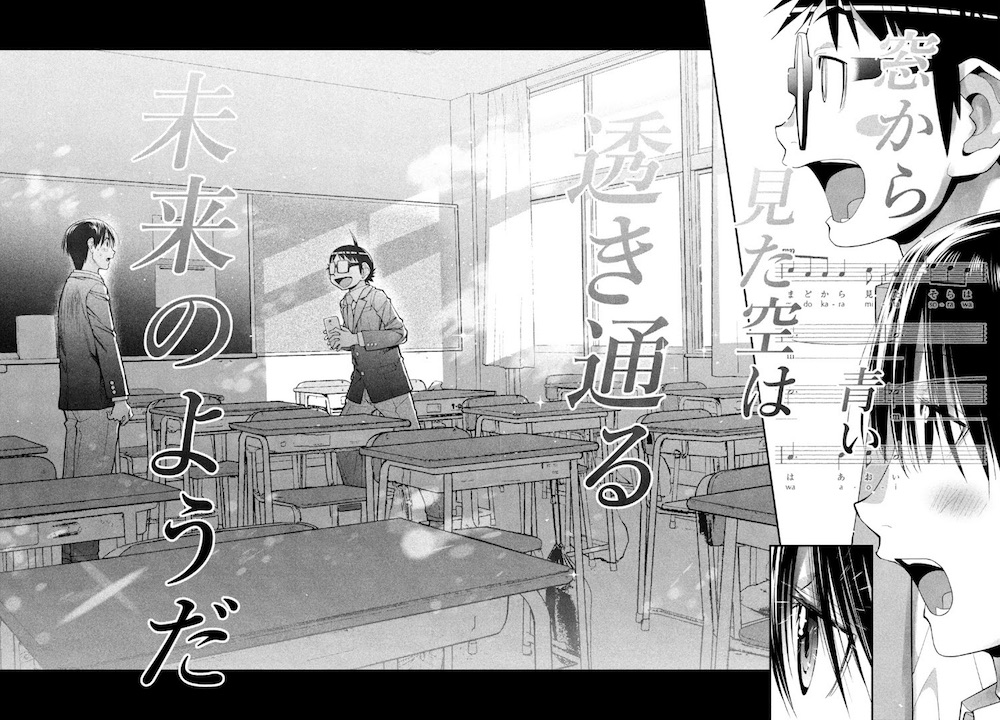
Despite a fantastic performance by Mai and her group, Noi Majo, the Chorus Appreciation Society beats them and moves on to the finals of the School Culture Festival tournament. Stepping away from the stage to take a break, Jin’s mom (with Yumerun) finally arrives at the high school. Shuusuke immediately recognizes her as the world-famous soprano, Kimura Reika, who has sung in operas across the globe. She’s also infamous for her selfish attitude that has earned her the nickname “Breaker”—a portmanteau of burei (rude) and Reika. The members see a lot of her qualities in Jin.
Jin is bothered by his mom’s attitude, feeling that she allows her immense talent to be her excuse for poor behavior. Jin tells a story from middle school, about Reika agreeing to sing with his boys’ and girls’ choir—only to never come to practice until the very last day, put on an astounding performance at rehearsal, recognize Yumerun’s ability, and then skip out on the actual day of the recital in order to perform for an Italian conductor.
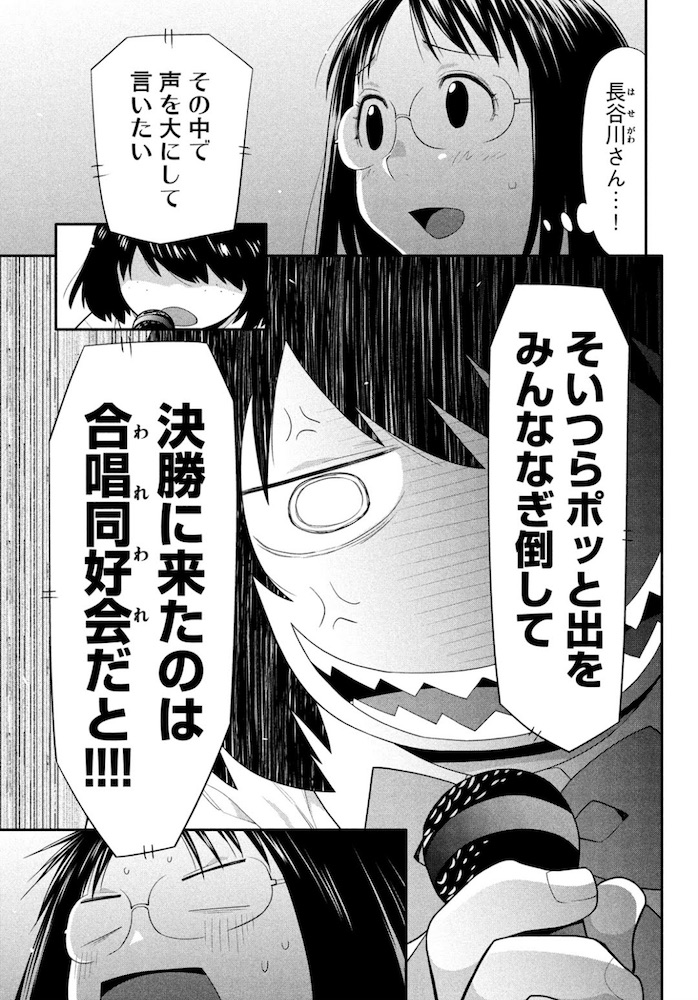
While Reika explains that she 1) called to cancel rather than bail without warning 2) ended up making way for Yumerun’s rise 3) didn’t want to take away from a performance that was supposed to focus on the kids, Jin still can’t accept how much she inconveniences others because music is something people create together. Reika responds that music is about self-expression and the passion of the moment, and points out that there are no “chorus majors” at any music colleges, showing how important individuals are in the field. But when she questions the usefulness and motives of Jin joining a technical high school just to form this group, Akira comes to his defense to talk about how much discovering singing thanks to Jin has helped him change and grow. Reika then decides on a deal: if they can win the entire competition, then she will let Jin go to a music college. Jin seems more confused than pleased.
Giga Drill
Reika was introduced two chapters ago, but her “true” debut (i.e. meeting Akira and the others) exceeds my expectations in nearly every way. This manga has great moms, and I don’t mean it in that way.
In my Chapter 36 review, I mentioned how I had originally imagined Reika as much more strict and demanding, but everything about her screams the opposite. She’s like pure “id,” doing whatever she wants whenever she wants. And while she seems to have this in common with her son, the finer details of their respective approaches and philosophies regarding music do reveal a profound divide between the two.
Jin sees music as a product of effort, and cooperation; Reika sees it as spontaneous artistic expression. Whereas Jin has broken down music scientifically in order to master its ins and outs, Reika utilizes intuition and natural sense. There’s a part in the flashback where Jin thinks, after hearing his mom sing with the group during rehearsal, “Why couldn’t I have inherited that talent?” To put it in Naruto terms, it’s sort of like if Neji had a Rock Lee for a kid.
(Though, incidentally, Rock Lee’s actual situation in Boruto is the opposite of Reika’s. His son, Metal Lee, is a born genius. But I digress…)
I really love this conflict in the Kimura family because it’s simple on the surface yet has so many layers in terms of the characters’ respective personalities and views of the world. Neither of their respective views on music are necessarily wrong, but they’re clearly a product of what does and doesn’t come naturally to them. Yet, while Jin is trying to make up for what he lacks and doesn’t have that innate understanding of song, his ability to thoroughly analyze and break down music can be considered a talent in and of itself. Jin’s forcefulness doesn’t fall far from the tree, further highlighting the ways Kimura is influenced by his mom both consciously and subconsciously.
I also am beginning to wonder if I should reevaluate my thoughts that Jin might be somewhere on the autism spectrum. It’s not been stated outright at all, but Jin’s personal admission to not being able to interpret song lyrics without outside help, his scientific breakdown of music, as well as his seeming ignorance about social mores all seemed to point in that direction. However, now that we’ve seen Reika on full display, there’s a chance that he’s comparing himself to the ridiculous standard set by his world-renowned operatic soprano mother. Of course, there’s a chance he could be neuroatypical and also have to deal with a genius mother, so the jury’s still out.
Romance Odds and Ends
While Reika dominated the chapter, Akira does get some small moments. When seeing Mai perform, he’s in awe of her ability to sing both boy’s and girl’s roles. He even blushes a little, but he seems to blush all the time. And when Akira begins to defend Jin in front of Reika, Shion can be seen enthralled by Akira’s passion, giving him more courage as well. I don’t know how that love web is going to end up, but I hope they’ll all be happy.
Songs
Noi Majo: “Zenryoku Shounen” (“All-Out Boy)” by Sukima Switch
Electrical First-Years: “Moonlight Densetsu” (aka the Sailor Moon opening)
The recent mass shootings at Asian-owned massage parlors in Atlanta brings to the forefront of our consciousness the increase in hate crimes and violence towards Asians in the United States since 2020. As an Asian-American myself, I have been thinking every day about both the anti-Asian racism that has always been around and the current crisis we are seeing. It forces me to realize how easily sentiments toward people who look like me can flip, as if the respect I’ve experienced has always been paper-thin.
A lot of the attacks against Asians have been against women and the elderly, and it’s clear why: they’re presumed to be easier targets. While there have been stories of Asians fighting back, including a 70-year-old woman who beat her assailant with a cane, the fact that she was assaulted in the first place is cause for concern. I am lucky to be a fairly large cisgender man, and thus not an ideal target for those looking to exact some vague sense of revenge on Asians for supposedly bringing COVID-19 to the US, but I do remember what it was like to be small and a victim of bullying. Before I hit a growth spurt in my teen years, I was perpetually one of the smallest kids in class while living in a neighborhood that was not predominantly Asian. I don’t think the kids who picked on me back then were filled with the exact same mix of emotions as what’s going on today, but it’s pretty close, and I do think that the bullying mentality is still a significant factor in what we’re seeing now. Ultimately, it’s a form of control, and rarely have we seen times where people feel less in-control than during a pandemic that has altered how we go about our lives. That’s not to excuse such behavior, of course.
The rise in anti-Asian crimes also has me thinking a lot about that veneer of respectability that Asians in America supposedly have, and how easily it seems to fall away—as if it’s something granted to us by those in power rather than something we own ourselves. I’m not so naive as to think that courtesy and genuine compassion and love can’t exist in those who are racist. To do so would be to ignore the racism that exists within Asian communities against outsiders, let alone the racism inflicted upon us. But what all this has made me realize is how quickly a little bit of fear of the unknown or an act of othering can quickly swell into a full-blown hatred. Star Wars is not exactly the go-to entity for robust philosophical discussion, but Yoda’s classic line seems to ring true here: ”Fear is the path to the Dark Side. Fear leads to anger. Anger leads to hate. Hate leads to suffering.” That small negative feeling is just looking for an excuse to burst forth, which is why all evidence to the contrary that Asians are somehow primarily or uniquely responsible for COVID-19’s spread can be ignored, and all it takes is a simple association of “China = Chinese = Asian” to trigger deadly violence.
It’s not so much that fear is inherently bad, but even the small amount of fear in one’s heart, especially towards another group, has dangerous potential if that fear is fed a steady diet of scapegoating. And lest it be assumed that I’m primarily criticizing individuals for not behaving well or daring to have negative thoughts, I place much of the blame on both the systemic racism that affects all people, Asian and non-Asian, as well as the foul rhetoric of the previous bigot of a president who sought to give his supporters a target to direct their hatred. His stubborn insistence on referring to COVID-19 as the “China virus” is largely responsible for inflaming anger and resentment in people, and the result has been both tragic and clearly intentional. Hate is a potent unifier, and those in power are insulated from the price we all pay for encouraging it.
If you’d like to learn more about what you can do to help, go to Stop AAPI Hate.
Calamity is a 2020 French-Danish animated film that tells the fictionalized childhood story of the real Martha Jane Cannary, showing how she took her first steps toward becoming the renowned Calamity Jane. Having been a fan of director Rémi Chayé’s previous film, Long Way North, I had fairly high expectations that Calamity easily surpasses.
Martha Jane Cannary is traveling with her family as part of a wagon train to Oregon, where they hope to find land and a better life. While not much is expected of her because of her gender, Martha Jane believes she’s capable of doing more. When her father is severely hurt trying to rope a runaway horse, Martha Jane takes it upon herself to learn the skills necessary to keep their wagon going, but her fellow travelers (including her own dad and sisters) don’t take so kindly to her trying to behave like a man.
I only know the barest details about Calamity Jane (and mostly from a 1990s cartoon), but I know she has a place in the United States’ cultural legacy as a feminist icon: someone who could keep up with the boys and who is as much a legend of the wild west as Billy the Kid or Buffalo Bill. Within the context of the film itself, although I can’t relate to her specific circumstances, Martha Jane’s struggle with the expectations foisted upon her by a society with very rigid gender roles, really hit me deep inside. Martha Jane lives in a world that tries to box her into a certain way of being, a world that would rather keep her tied down even if letting her free would be beneficial. When others see Martha Jane wearing pants, they are shocked and outraged. This might seem like a relic of the past, but that view persisted deep into the 20th century—a reminder that the fight for equality is ongoing.
The film is visually rich and stunning, giving a sense of the outdoors that is beautiful yet expresses the terror that an unknown trailer to an unseen land can bring about. Everything animates naturally yet not confined by excessive realism, with particularly impressive detail given to the high-paced movement of horses and the mischief of Martha Jane alike. I’m especially fond of Martha Jane’s thick and powerful eyebrows, as they alone seem to stand in defiance of what everyone else tells her is “proper,” and the rest of her character proceeds beautifully from that rebelliousness.
Sometimes a film with a similarly empowering theme will mean well, but seems to get too caught up in the messaging at the expense of execution. However, Calamity avoids that pitfall in a most impressive fashion. The ups and downs experienced by Martha Jane as she tries to learn and master all the skills that aren’t “supposed” to be hers feels genuine—the right amount of grit combined with a lack of experience and a desire to achieve more. It makes her strides and her challenges all the more poignant, and by the time the film is over, the path she marked for herself feels like it can lead to greatness.
Greatest M ~Mahjong Tournament of Eminent Figures~ is a manga about Helen Keller playing Japanese mahjong co-written by one of the creators of Kakegurui. No, seriously.
If that’s not enough, it’s actually about Helen Keller competing against other famous historical figures in order to determine who will become the next God, as the current Almighty has decided to retire and needs a successor. The solution, provided by other deities: use a test of luck, i.e. gambling, to determine who is best suited for the role. Also, contrary to mainstream conceptions, He is actually a She, and basically acts like a Japanese idol—it’s unclear if that last bit of irony is intentional.
Over-the-top mahjong manga is not all that uncommon. Saki is about yuri and ridiculous mahjong feats. Mudazumo Naki Kaikaku: The Legend of Koizumi is about superpowered politicians instead of superpowered lesbians playing the game. Greatest M is no exception, and indeed bears considerable resemblance to Mudazumo in many ways. But while the essence is very similar, this particular manga presents its players’ abilities as only seemingly magical. No one’s bending reality to cheat—they’re just so impressive that it looks that way.
For example, one of Helen’s opponents is the Japanese artist Katsushika Hokusai (famous for “The Great Wave Over Kanagawa”), and while it seems like he can see what every tile is going to be, it’s actually because he’s such a master of capturing everything in a single moment that his observational skills allow him to metaphorically “freeze” time. As for Helen herself, her life spent both deaf and blind makes her skilled at navigating tricky table situations, owing to the strength she possesses to move forward in total darkness.
I should mention that I’m merely assuming that Helen Keller is the main heroine of the story because she’s on the cover of Volume 1, and it’s been promoted on Japanese manga news sites as the series featuring Helen Keller playing mahjong. Given the tournament format of the story, it might very well be Zhuge Liang who goes ahead. Because Helen would be the most intriguing protagonist, my hopes are that she remains in the spotlight, not least of which is because the manga’s portrayal of Helen’s teacher Anne Sullivan is absolutely perfect.
Greatest M is a fun manga and I like the not-too-serious matching of wits and deception that comes part and parcel with a manga that depicts both theatrical competition and the game of mahjong. I’m not sure how those with disabilities might regard Helen Keller’s portrayal—both in terms of her being a cute anime girl and how her blindness and deafness is depicted in the series. Nothing seems especially offensive to me as of yet, but it is curious to see her drawn like a blind girl you’d see in an older visual novel. Also, while the first volume is a wild ride, I’m not certain that this series can maintain its momentum before the gimmick runs a little dry. I’m going to keep up with it in the hopes that it goes somewhere interesting, even if it doesn’t include Super Saiyan Hitler as a final boss.
Sometimes I watch an anime where I think, “Man, that would make one hell of a video game.” Id: Invaded is one such title. It’s a kind of Inception meets Minority Report, where the main character’s ability to jump into a serial killer’s vague subconscious sets up the story as a series of “puzzles” that bring a different flavor to the idea of a “psychological profile.”
The basic premise of ID: Invaded is that an advanced form of technology allows the police in Japan to pick up psychic traces of a serial killer’s mind, and to send someone in to try and figure out the culprit’s identity. This task is given to Narihisago Akihito, who enters these “id wells” and transforms into an alternate persona known as the brilliant detective Sakaido. The major caveats of this process are that entering these mindscapes means you do not have memories of your real self, losing your life inside feels as bad as actual death, and you cannot retain what you’ve experienced in between sessions. It’s up to the officers on the outside to process the information they receive from Narihisago, and to make moves in reality. Underlying all this is Narihisago’s own traumatic past and the ways he attempts to atone by working through this bizarre system.
What got me hooked onto ID: Invaded is that the mystery is not just the identity of a given serial killer, but trying to figure out how their mind works from within without any direct signs as to who they are. The limitations of the system, as described above, are like a crueler version of a Rogue-like, where you don’t just lose all your material progress but the things you learned in the previous session. I also like that it involves having two tracks working side by side: the “subconscious game-like world” and the world of flesh-and-blood detectives. The character of Hondomachi, a young rookie on force, grows in interesting ways as she increasingly toes the line between the two realms.
But fantastical elements or not, a mystery series comes down to how well it sticks the landing. I In the case of ID: Invaded, I think it does adequately but there are some downsides. For one, I think the series escalates a little too quickly from one storyline to the next, and the big case that defines the later episodes makes it hard to imagine what could top it in the potential sequel that seems to be implied by the end. Also, the second half starts to break some of the rules established in the first half as another way to show how the stakes have gotten higher, but it stymies that excellent puzzle game-like quality established early on. The rules of detective fiction aren’t iron-clad, and I wouldn’t mind it down the road, but it just feels like it came too soon.
Still, the characters, the basic conception, and the overall story of ID: Invaded are excellent. I’d love to see more; I just don’t quite know how they’re going to keep the “boundaries” intact enough to let the logical limitations presented by the narrative shine through stronger than before.
This is a review of a film in the 2021 New York International Children’s Film Festival. This year’s virtual festival technically ended on the 14th, but there’s still time to buy tickets or an all-access pass—a $100 pass extends the viewing time to March 21st.
I’m by no means an expert on Chinese film, animated or otherwise. However, when I’ve watched animated features from China at the 2021 New York International Children’s Film Festival, I’ve often gotten the sense that they were trying to prove something, e.g. China’s ability to do mainstream animation all self-contained within itself, and not as outsourced work from other countries. It’s a situation where that desire can end up interfering with the pacing of a film, as if creators are producing demo reels disguised as movies.
The Legend of Hei (2019) largely does not fall into this trap. It’s a visually impressive work whose splendor in the form of large environmental backgrounds and quick-paced supernatural action ultimately does not end up sabotaging its own narrative effectiveness.
The main character of the story is a young spirit resembling a cat named Hei (or Luo Xiaohei), who winds up away from its home and who ends up getting picked up by another spirit named Storm’s End (Fengxi), who offers Hei a new home. When a human “enforcer” of the Spirit Guild named Infinity (Wuxian) shows up, Hei ends up being taken by Infinity. Forced to travel together with his captor, Hei learns that notions of “good” and “bad” are not as simple as he assumes. For much of the film, it can be kind of hard to tell where exactly everything is going, especially because it’s easy to confuse the many similarly handsome-yet-stoic characters for one another, but it all ends in a satisfying manner.
While watching, I kept thinking, “This really has a Line/Naver Webtoon aesthetic.” It’s a somewhat broad generalization, but the flat colors and rounded designs make for a look that resembles many of the comics on the online platform. Combined with numerous brief appearances by characters who seem like they’re supposed to be recognizable to a knowledgeable audience, and I began to wonder if the film was based on some existing work. I later found out that it was originally a flash animation by Chinese creator MTJJ and, indeed, a later webtoon. The fact that The Legend of Hei has such humble origins lends credence to my feeling that this film had some real passion behind it that keeps it honest.
As mentioned, the fight choreography is downright amazing, and is one of the film’s best features. The action is never confusing or feels bogged down by too much flourish or not enough, and everyone moves with a sense of purpose. Everything flows very well, and if you’re someone who enjoys having lots of battling from beginning to end, it really doesn’t disappoint. More importantly, the fighting also doesn’t come at the expense of the narrative, with the two weaved together well.
The NYICFF’s showing of The Legend of Hei is dubbed in English, and the English names provided above are all used within the film itself, with the exception of Hei. It’s an interesting choice, to give the viewers the understanding that the characters’ names mean something, as media from China and Japan will often do the opposite for English translations—how many people know that “Naruto” means “Maelstrom”? Also worth nothing is that the English cast features many Asian voice actors, an action that flies in the face of the marginalization of Asians in Hollywood and mainstream entertainment media. As for the acting itself, it was overall decent, but I couldn’t shake the feeling that listening to the original Chinese voices would convey noticeably different impressions of the characters despite not being able to hear them until later. When I later looked up the Chinese trailer, it confirmed my suspicion. There’s something about the delivery that makes them almost feel like different people, whether it’s Hei himself sounding more Steven Universe-ish in English than kitten-like, or how the delivery among the more stoic characters seems to convey a greater emotionality in Chinese.
I also found out that there’s a Japanese dub version, and they really pulled out the big guns for that voice cast: Hanazawa Kana, Miyano Mamoru, and Sakurai Takahiro all headline the film in Japan, and I suspect it makes for another interesting and slightly different experience.
While I don’t think The Legend of Hei is the total package, the film has a lot of merits that bring it all together into a satisfying and rewarding experience. It’s the best Chinese animated film I’ve seen yet, and it comes across as a work that, rather than trying to prove the worth of Chinese animation, wants to tell a story all on its own. The Legend of Hei exudes a confidence that avoids the pitfalls of arrogance and desperation, resulting in a strong and accessible work.
As the days go by, I increasingly find myself looking into the world of Virtual Youtubers. I watch the clips and highlights that go around, and I sometimes tune into the live streams of my favorites. I wouldn’t consider myself a devotee of the whole concept, but I’m entertained. I know I’m not alone, as the increasing success of VTubers is a sight to behold—Gawr Gura, one of the first members of the Hololive agency’s push into English-language streaming, hit one million subscribers in just a little over a month and has since surpassed two million.
The more I think about it, however, the more I realize that the success of Virtual Youtubers shouldn’t come as a surprise. They’re in many ways a perfect storm of things that appeal to people on the internet, bringing together different groups who tend towards obsession and converging them onto this amalgam of elements.
The first group is weebs. I generally avoid the term, preferring things like “anime and manga fans,” but I feel that its usage is accurate here—it’s not just about being into the media but being into that strain of Japanese pop culture. With few exceptions, Virtual Youtubers go for that anime aesthetic, recruiting famous artists and character designers to create these avatars. In a sense, they’re anime characters come to life, and that gives them a certain charm and universality that comes with being less realistic in terms of appearance. And while VTubers now exist across the world, they’re firmly rooted in that anime/manga/light novel realm, and expectations derive from the tropes found there.
The second group is gamers. While streaming has had some presence on the internet for decades now, gaming has become one of its absolute pillars. Between the transformation of Justin.tv into Twitch, the prevalence of esports, the enduring popularity of Youtube channels like Game Grumps, and the rise of speedrunning as a spectator activity, there’s no denying the draw. Live streaming your play session is just an easy and reliable way to connect with potential fans, and while streamers usually need some kind of physical or personal charisma to get things going, the sleek designs of VTubers help bridge that gap.
The third group is idol fans. While it’s like every one of them eventually gets their own original songs, what attracts people to idols is that they feel somehow distant yet accessible, and Virtual Youtubers greatly exaggerate both sides of the fantasy by their very nature. The use of character avatars means there’s no mistaking their visual appearances for being the “real” individuals, but that also means being able to project onto them an idealized version. At the same time, unlike Hatsune Miku, they’re real people interacting from behind the curtain. Depending on what level of performativity vs. seeming authenticity a viewer wants, or popularity vs. obscurity (what’s more exciting than seeing your favorite personality grow from small-time to wild success?) there’s probably a VTuber for them. What’s more, the concept of superchats on YouTube allows fans to get instant gratification by giving money to have their messages read and acknowledged.
The fourth group, and there’s plenty of overlap with the other three, is those who are into celebrities. This is a more vague and generalized group, but it’s the same energy that fuels people to follow the goings-on of their favorite movie stars and singers.
A weeb might love all things anime-adjacent but dismiss Western-style game aesthetics. A fan of first-person shooters might love watching anything and everything related to their favorite games but think anime stuff looks weird as hell. But then a Virtual Youtuber who looks like an anime character come-to-life might play Apex Legends, and so now the weebs get their real-life anime girl and the Western-focused gamers get to connect to her through their favorite game. At the same time, even if she isn’t particularly good at what she’s playing, that gives her a kind of element of relatability that an idol fan might be drawn to. And even if someone isn’t an idol fan, seeing someone suffer through a game has an established history of bringing in eyeballs. The crossover appeal is hard to deny.
Thus, when the VTubers branch into areas other than gaming, they can bring all those different groups together. It’s why they can karaoke Japanese, English, and even German songs, all to praise and fanfare. When they do something completely out of the realm of entertainment, like cook, it doesn’t seem out of the ordinary even if the results can range from bizarre to horrifying. The fact that their fans don’t just come from one place also gives the VTubers the flexibility to try new things and see what sticks. Non-virtual streamers who get popular because of one game can sometimes have a hard time playing others because they might not get the viewer counts they normally would, but what makes people want to see Virtual Youtubers goes beyond specific games or titles.
I think the concept of the VTuber allows it a certain degree of freedom that flesh-and-blood streamers do not. By virtue of their virtual natures (pun intended), they invite viewers into a kind of alternate reality. From there, the ability to take that anime character identity and apply it to various domains or interests means that even activities that normally might not appeal to a person can suddenly seem interesting. It’s a lot like how manga can make certain topics more appealing to those who are unfamiliar, but with Virtual Youtubers you get both the slice-of-life hobbyism and the gutsy competition at the same time. And unlike in manga, the wins and losses are real—even if everything is ultimately made up and the points don’t matter.
Splatoon 3 was recently announced for 2022, and one question I have about the new sequel is: who will be the new musical mascots, and what will their style of music be? I have a hope/prediction: I believe that Splatoon 3 should have a sound that incorporates Cantonese pop.
One of the big changes compared to the previous games is the shift away from sleek urban environments and towards what seems to be a more post-apocalyptic one. This can even be seen in the central hubs of all three games. Splatoon’s Inkopolis Plaza is based on the trendy Shibuya area in Tokyo, Splatoon 2’s Inkopolis Square is Times Square in New York City, and now Splatoon 3’s Inksville greatly resembles Hong Kong, particularly the Mong Kok area of Kowloon—the busiest urban center in the world. Given the current controversies going on in the area, I’m actually kind of surprised they went this angle, but the densely packed and awkwardly placed buildings have evoked dystopia in the imaginations of many. It acted as the basis for Ghost in the Shell’s setting, plays a central role in G Gundam, and in terms of the cultural legacy, the lawless nature of the Kowloon Walled City is rather infamous.
A model of Kowloon Walled City located at its former site
The musical mascots of the first two games reflect their urban spaces. The Squid Sisters are patterned after Japanese idols. Off the Hook is a rapper-DJ combo, and NYC is the birthplace of hip hop. Therefore, if Splatoon 3 were to have characters to represent that Kowloon-like setting, few things would fit better than a squid-and-octopus-garbled take on Cantopop. While its star has waned in recent years, Cantopop was once the premier form of Chinese popular music throughout Asia, and Hong Kong was the center of it. And if they wanted to capture both the retro and futuristic aspects of Hong Kong through Splatsville, perhaps they could even take from different eras of the genre.
One potential problem with this approach is that a lot of classic and modern Cantopop songs don’t exactly “feel” like Splatoon, as the genre is primarily known for its love ballads that wouldn’t quite fit the high-pace gameplay. Still, I think there are examples of high-tempo songs that could be inspiration for a soundtrack that captures the spirit of Cantopop and the Kowloon setting without necessarily feeling dated.
“Ji Guang Zhong” by Roman Tam
“Journey to the West” by Dicky Cheung
“Miss Similar” by G.E.M.
Is it a bit of a long-shot to expect Cantonese pop in Splatoon 3? Maybe. I also wouldn’t expect the composers to wholly abandon the sound it’s known for, as the music is one of the best parts of the series. Even so, I think it’d be more than possible to draw influence from one of Asia’s most popular genres of the last 50 years and make something that comes across as unmistakably Splatoon-esque. Most importantly, it would perfectly complement the Mong Kok, Kowloon visual aesthetic that Splatoon 3 is going for.
Attending the New York International Children’s Film Festival has been something of a tradition for myself, and many of my reviews over the years on this blog have come from it. Due to COVID-19, NYICFF 2021 is a virtual festival, with individual tickets and two all-access passes available at extremely reasonable prices.
As someone who loves cartoons, my usual focus at NYICFF is on animated features including but not limited to those from Japan. For whatever reason, there’s no anime this year, but we’ve got the next best thing: a live-action film about Japanese pro wrestling. My Dad is a Heel Wrestler stars actual New Japan Pro-Wrestling veteran megastar Tanahashi Hiroshi as a washed-up wrestler named Omura Takashi whose son Shota discovers that Takashi is a “bad guy” called Cockroach Mask. The film was previously temporarily available on NJPW’s own streaming service, but I had missed my chance to see it then, so I’m glad that NYICFF brought me this opportunity.
My Dad Is a Heel Wrestler is based on a Japanese children’s picture book, and by amazing coincidence, I actually happened upon a copy while at Bookoff years ago before the film was announced. Both versions follow the same basic premise described above, but the difference between 32 pages of large text with illustrations and a feature-length movie inevitably means changes and additions. In this case, the film is fleshed out with a greater exploration of both Takashi and Shota’s feelings about Takashi’s role as Cockroach Mask. For Takashi, his passion for wrestling is juxtaposed with the knowledge that his heelish gimmick is the only way he can continue his career. Shota meanwhile has to reconcile his image of his father as a caring man with the scheming and cheating he sees in the ring.
A larger cast of characters—Takashi’s wife Shiori, Shota’s classmates, Takashi’s fellow wrestlers, and a hardcore fangirl who lives and breathes pro wrestling—also help to establish a greater world. The fangirl, Michiko, speaks to the fact that Japanese wrestling has managed to pull in a serious female following in the past ten years (known affectionately as pujoshi), and her love of Cockroach Mask/Omura is a reflection of Tanahashi’s own popularity among the ladies.
The film does a great job of showing Shota’s complex emotions from his perspective as a small child, and how Takashi struggles with the desire to both be a dad his son can be proud of while doing what he can to extend his career in spite of chronic injuries. Tanahashi playing an older wrestler is naturally in his wheelhouse, so this role isn’t exactly challenging his acting range, but he pulls the character off quite convincingly.
One of the main messages of the film, as stated by Michiko, is that pro wrestling is about more than winning and losing. Much like that one scene in Wreck-It Ralph, it’s about Shota realizing that just because Takashi is a bad guy “doesn’t mean he’s a bad guy.” Curiously, however, in the world of My Dad Is a Heel Wrestler, the gimmicks are fake but the actual wrestling is real—a kind of semi-kayfabe where wins and losses are legitimate but the wrestlers’ personas themselves are primarily performance. The film uses a lot of other NJPW stars to fill out the ranks, including Okada Kazuchika as the world champion, and the feeling I get is that a film with so many actual wrestlers wants to maintain some semblance of the “realness” of pro wrestling even in a fully acknowledged fictional setting like a movie. Speaking of wrestlers, I was actually most impressed by the acting of Taguchi Ryusuke, who plays Cockroach Mask’s henchman Blue Bottle. Taguchi in recent years has been more of a comedy wrestler in NJPW, and his ability to be serious and silly is a great asset to this film.
While the film uses a lot of wrestling terminology, My Dad Is a Heel Wrestler is a very accessible film that has a lot of interesting things to say about many different topics—from aging, to doing what it takes to keep a dream alive, to how theatricality is in itself a valuable quality that brings people excitement. From beginning to end, it feels like a production where everyone involved both respect the subject matter of pro wrestling and want to tell a heartfelt story to which anyone can relate.