In 2016, I found out about Rokudou no Onna-tachi, a new manga that was a fresh and interesting take on the well-worn harem genre. As I continued, my opinion of it only grew. Even now, I find myself regarding Rokudo no Onna-tachi more highly than ever. There are many aspects of this series that contribute to its success, but fundamental to all of it is the portrayal of its protagonist, Rokudou Tousuke, as a true underdog. In a sense, he’s the Krillin of the series, but Rokudou no Onna-tachi is a story where Krillin is the main character, and he succeeds because he’s not the strongest, or the toughest, or the smartest.
To recap, Rokudo no Onna-tachi is about Rokudou Tousuke, a meek high school kid who casts a spell on himself to be more popular with girls. However, what he didn’t know was that the spell was very specific: it only attracts delinquents and “bad girls.” Most notable among them is Himawari Ranna, the strongest and most terrifying brawler in town. It turns out that bullies are a lot friendlier when your ostensible girlfriend can shatter concrete with her fists, but Rokudou is the last person to want to encourage violence, so he actively tries to prevent Ranna from sending every person they meet to the hospital. Along the way, Rokudou manages to befriend an eclectic group of people and through a combination of friendship, guts, and kindness, accidentally becomes the “shadow boss” of his school.
I call Rokudou no Onna-tachi a delinquent harem work, but it leans much more toward the former descriptor than the latter, and I think the series is all the better for it. While there is a romantic aspect of sorts, as the series has progressed, a majority of the focus has been on Rokudou’s shounen protagonist-esque ability to win over his antagonizers with or without the attraction spell (which he can’t get rid of, no matter how hard he tries). And even when it comes to the delinquent girls who fall head over heels for him. What’s more, “being hot to bad girls” doesn’t give him much of a leg up in a fight, so his ability to stand up to bigger and bigger threats speaks more to his qualities as a human being than anything else.
And yet, while romance doesn’t define the series, the central relationship between Rokudou and Ranna is still interesting and vitally important to the tone of the narrative. If Rokudou is indeed a Krillin, that sort of makes Ranna the Android 18 of this story in that she’s the more powerful of the two. However, her role is arguably closer to that of Goku, or even Saitama in One Punch Man. She’s an unstoppable force in a fight, and many physical conflicts in Rokudo no Onna-tachi are a matter of anticipating the carnage to come as soon as she gets where she needs to be. She’s not a heroine with a tragic backstory or a brash amazon with a hidden soft side, and even those moments of loving infatuation toward Rokudou humorously highlight a central tenet of Ranna’s being: violence is everything. That dynamic of contrasting personalities between Rokudou and Ranna fuel both the comedic and the dramatic parts of the manga, and it’s all the better for it.
If Rokudou no Onna-tachi had just stuck to pure silliness, making jokes about how an endless parade of nasty girls were getting googly-eyed over a tiny loser, then it would have worn out its welcome far too quickly. But if it had swung too deep into the serious and dramatic, then I believe it would have had a harder time standing out from the pack. It’s because Rokudou can be portrayed as this unlikely hero, and that the series can swing between silly and serious so effectively by using his constantly being out of his depth, that the manga is such a rewarding and enjoyable experience.
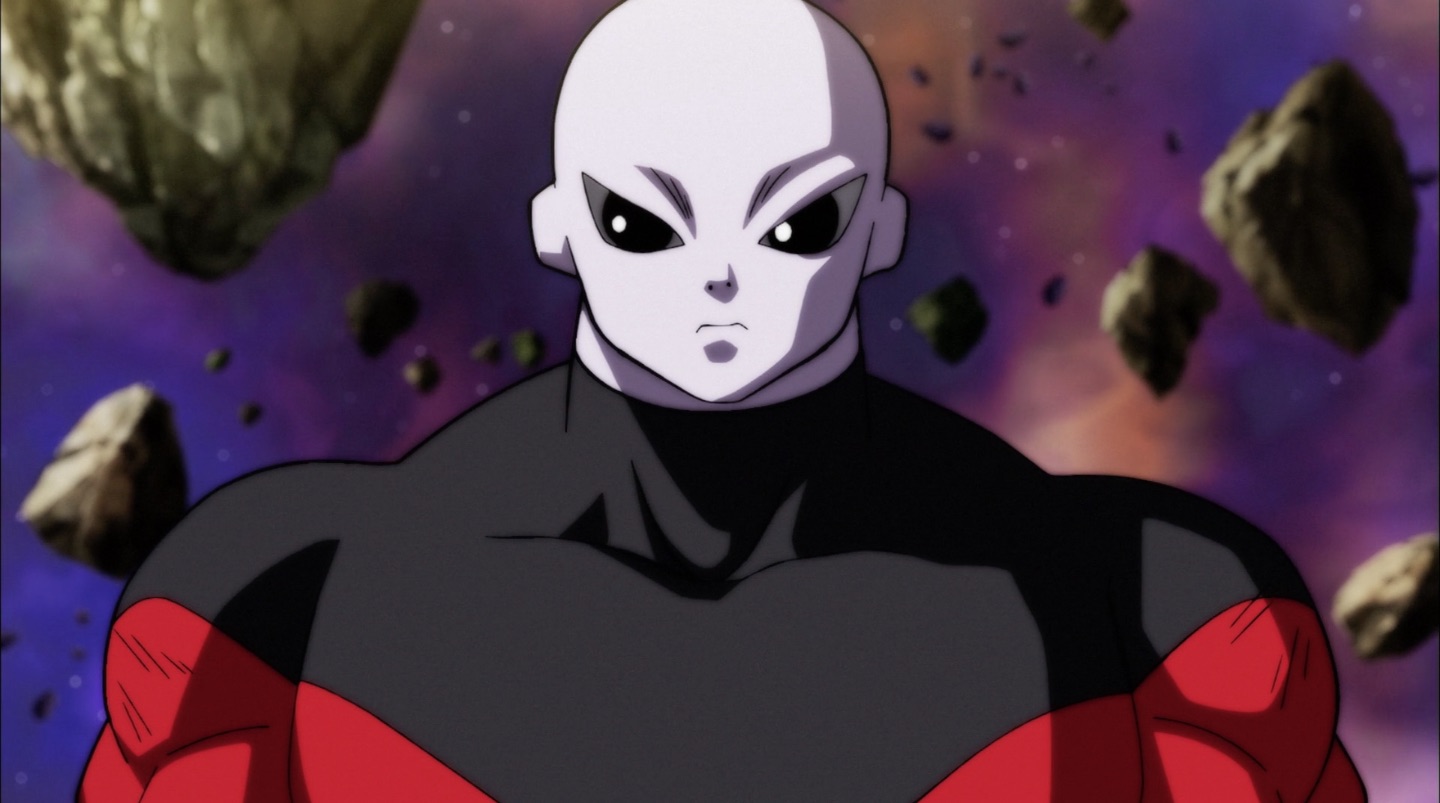
The Dragon Ball franchise is famous for many things, and one of them is its gallery of iconic antagonists. Piccolo, Vegeta, Freeza, and Cell are some of the big names Goku has faced over the years, and they each make a lasting impression. The recent Dragon Ball Super series introduced a major antagonist in its multiversal “Tournament of Power” arc, a mighty warrior from another universe named Jiren. But unlike the others, Jiren is considered by many fans to be a disappointingly generic villain. It’s an argument I can see, but in the end one I don’t quite agree with.
Indeed, if you take Jiren as a villain, he seems to just be generic in his obsession with power and sacrifice–just another big body for Goku to overcome. However, this approach to Jiren’s character isn’t quite accurate: Jiren may be opposing Goku, but he’s not a villain. He’s a hero of his own world, one he presumably has defended from threats comparable to the ones Goku has faced, and he gained his power through the circumstances and decisions that comprise Jiren’s experience.
The crucial difference between Goku and Jiren is that the latter’s life is full of pain and loss that made him choose a life of isolation and rejection. Where Goku would defeat and befriend those he faced, Jiren would destroy. Where Goku attains power for self-improvement and new experiences (i.e. fight stronger opponents), Jiren does it almost out of a sense of obligation or duty. Where Goku is goofy, Jiren is dead serious. What Goku has to overcome when fighting Jiren is not some evil machinations or even a chaotic force like Majin Buu, but a different in philosophy borne from a universe that did not have a Goku.
Put another way, Jiren could have been the protagonist of his own anime or manga, one where suffering and cynicism dominate. Perhaps you can think of a couple of titles that fit the bill. But just like how Goku embodies certain values as the core of Dragon Ball, Jiren would be the center of his own narrative and all that such a scenario entails.
So Jiren might come across as “uninteresting,” and he might not necessarily be as compelling a foe as the most well-known villains of Dragon Ball, but he acts as a different kind of foil. If ever he shows up again, there’s plenty of room to explore his character.
The concept of “privilege” is a tricky one, because it’s extremely apparent to those who lack it, and yet often unnoticeable to those who possessed it. And given the dominance of the white male in gamer culture, others have attempted to make video game-based analogies to help the unaware comprehend “privilege.” But the most prominent comparison, the idea that being privileged is like playing a game on easy mode, is ineffective for multiple reasons. While its simplicity gets the point across easily, it’s also pretty antagonistic and liable to make people defensive. “How dare you say my life is easy, just because I’m a man?”
So I propose a different analogy: being privileged is like starting each round of a fighting game with a full super meter.
Not everyone is familiar with fighting games, so this bears some explanation. Typically, when you start a match, both characters have full health, maybe somewhere between zero to 50% super meter, and placed at a neutral distance where neither has an automatic leg up on the other. Super meter is a gauge that, when sufficiently full, gives access to powerful moves that can aid players in various situations.
A full super meter at the start of a round does not guarantee a win. It does not replace or remove the need for skill, hard work, or experience. It can be squandered to the point of being useless. Some players might end up perpetually unable to truly take advantage of it. However, even if it never gets explicitly utilized, the presence of that full super meter at the start of each round influences player and character interactions from top to bottom. Just by its existence, that meter affects how your opponent perceives you.
If all you ever do is fight other people who also start with a full meter, you might never notice that there’s an issue. But as soon as you fight someone who doesn’t have this perk, the dynamics change. Imagine two players with the exact same talent and skill, playing the same character, but only one of them has that meter. The two should be able to do the same things, but one starting with more resources makes it so that what should be even exchanges are always potentially lopsided. The player with the super meter has access to additional options. That means not only does it let that player get out of tight spots they wouldn’t otherwise, and press advantages that they already have, but when only one person has that starting meter, a “neutral start” isn’t actually neutral.
That’s the thing about privilege: it subtly affects how you are perceived in the world and what you are thought to be able to get away with. It doesn’t automatically mean those who are privileged have a leg up in every situation compared to those who aren’t, but its influence permeates aspects of life big and small without anyone even having to try. It’s why assuming that everyone is on a level playing field is the classic sign of someone who is privileged and unaware of it, but also why it can be so hard to grasp for those ignorant of its existence.
One of my favorite manga in recent memory has been Mogusa-san by Ootake Toshitomo, about a girl with an unstoppable appetite. Its sequel, Mogusa-san Fights Against Appetite, concluded last year, leaving me to wonder where I might see Ootake show up next. The answer is his brand-new series: Teasobi, or “Hand Play.”
Plain-looking Shijima “Shijimi” Nagisuke seems an unlikely boyfriend for the attractive and popular Fuchizumi, but she sure doesn’t see it that way. After all, in her eyes, he’s gorgeous and manly—or at least his hands are. That’s right: Fuchizumi is really, really into hands and fingers, to the extent that Shijima’s not sure if she even sees him from the wrists up.
To a degree, Teasobi resembles Mogusa-san—a normal guy, an eccentric girl, and a strange connection between the two. However, it actually reminds me more of the bizarre romance manga that I’m rather fond of, series that focus on the idea that a unique bond between two individuals is somehow deeper, more powerful, and more sensual than just a normal physical relationship. Think Nozoki Ana (centered around a peephole), Sundome (about avoiding climax), and one of my absolute favorites, Mysterious Girlfriend X (features literal spit swapping).
But whereas those series all delve into the sensual in graphic or at least eyebrow-raising ways, what sets Teasobi apart is that it’s focused on that most seemingly innocent of loving interactions: hand-holding. There’s nothing rated X about the physical contact between Shijima and Fuchizumi, which ranges from clasping fingers to thumb wrestling to high fives, but Fuchizumi’s enthusiasm makes it seem somehow more taboo. It’s fun, silly, and a bit thrilling.
Only a few chapters are currently out in Japan, but I’m definitely enjoying Teasobi. It brings a new meaning to the concept of “secret handshakes.”
Ten years ago in late February, I went on my first date with the woman who would become my wife. For those who don’t know, we actually met in part thanks to Ogiue Maniax, so the blog is truly special to me in more ways than one.
In that respect, I’ve been thinking a lot lately about how this blog is a comfortable space for me where I can more or less write about whatever I wait. I’m feeling especially grateful to my Patreon sponsors. Not much is demanded of me from you guys, so you have my deepest thanks.
General:
Johnny Trovato
Ko Ransom
Diogo Prado
Sue Hopkins fans:
Serxeid
Hato Kenjirou fans:
Elizabeth
Yajima Mirei fans:
Machi-Kurada
At the same time, I do wonder if I’m not doing enough for my patrons, or if I’m getting complacent. Perhaps I should shake things up a bit, but I’m not exactly sure how. I’m entertaining the idea of restructuring my Patreon rewards, and I’m open to suggestions. I guess I want to do a little more giving.
These shows are Ogiue Maniax-approved! …For the time being, at least.
Closing
This is unrelated to the state of the blog, but some big robot news:
First, Super Robot Wars T comes out this month! You damn well better believe I’m gonna be rocking the Rayearth girls.
Second, did you know that they’re making a Soul of Chogokin for Vehicle Voltron??? I don’t know if I’ll get it, but I do know I’ll be watching every video review of it I can find.
The club finally comes together, sort of. What lies ahead is to find a common goal!
Summary
With Shion joining in and Mimi-sensei as their advisor, the Chorus Club is officially formed! …Except technically, they’re an appreciation society, one step below a true school club in terms of legitimacy. So the Chorus Appreciation Society doesn’t even have access to the music room.
On top of that, to keep Shinji in the group, the Chorus Appreciation Society’s members all join his Mountain Castle Appreciation Society…but with one exception: Shion refuses because she doesn’t care about that sort of thing. In order to make everyone happy, two sideline spectators decide to join Shinji: Hasegawa–first name Kozue–and her previously unnamed friend, Katou Kanon.
Even the “appreciation society” status is tenuous, so Mimi-sensei suggests that they get some results by entering the MHK Chorus Concours (aka M-Con). While Jin doesn’t really care one way or another about it (there are separate competitions throughout the year, so it’s not like one big tournament, baseball-style), Akira actually does, to everyone’s surprise. He can notice how unpracticed and limited he is, and he wants to improve. His quiet enthusiasm manages to convince everyone else, so they agree to try. The only problem, as Mimi-sensei points out, is that the deadline for submitting songs is today!
Katou Kanon
At last, we have a name! A couple of chapters ago, I had to write about her interactions with the other characters, and I kept having to say “Hasegawa’s friend” and the like while hoping it wouldn’t seem awkward. Thankfully, that’s finally over–and Hasegawa got a first name too! This certainly isn’t the first time that a manga, let alone a Kio Shimoku manga, has withheld character names until later. The bully trio in Eyeshield 21 took forever and a half to get names, and Asada Naoko in Genshiken was known for the longest time as either “Nyaako” or “cat-mouth girl.” At least Kanon got her name revealed in the original manga, and fans didn’t have to suss out Asada’s name in one of the anime’s episode credits!
In any case, this probably means Kanon is going to be a more prominent character. Still, I wonder how often are the Kanons of the world are just background characters who happen to fall into more involved roles, and how often that’s planned well in advance.
Chimera Clubs
I’m quite fond of the trope where two clubs with insufficient members have to join together to stay alive. It was fun in Chuunibyou demo Koi ga Shitai!, and while a group that discusses mountain castles isn’t as absurd as a napping society, I’m confident Hashikko Ensemble will make it entertaining. I do hope we get to see them visit a castle at some point in the story–maybe as part of a training camp?
As for why they have be an Appreciation Societies, it’s rather telling to me that the real reason is basically a transfer of burden. According to the Wood Ensemble Club’s advisor, Ochi-sensei, it took them forever to get that coveted “club” status, so Mimi’s new club should have to go through a similar ordeal. In a way, it’s like an extremely light form of hazing that you’d see elsewhere–earning your place and all that–only applied on a slightly broader scale.
Where Do Their Motivations Lie?
Jin’s initial rejection of M-Con is one thing, but his reasoning for agreeing provides even more insight into his mind. He cares little for competitions, but the sheer amount of singing a group has to go through to even get ready for one is more or less his idea of paradise. To him, the actual recital portion is just icing on the cake. In other words, here you have a guy who just loves singing for the sake of singing.
But on the flipside, I’m not sure how much Akira is motivated by a simple desire to improve and how much he’s being influenced by guilt. As shown in the chapter, Akira still remembers being in middle school and only pretending to sing, and he still feels pretty bad about it. He’s slowly learning to embrace his extremely deep voice thanks to all his singing, but I wonder if he’ll grow to appreciate music and singing all on their own.
Music
Continuing from last chapter, Akira and Jin continue to sing “Kanade” by Sukima Switch. While that particular song has been featured multiple times throughout the manga so far, it’s interesting to note the part that’s highlighted in Chapter 12.
君が僕の前に現れた日から
何もかもが違くみえたんだ
朝も光も涙も、歌う声も
君が輝きをくれたんだ
Ever since the day you appeared before me I see everything differently Morning, light, tears, even a singing voice You gave me your shining brilliance
In other words, the lyrics of “Kanade” pretty much set the theme for all of Hashikko Ensemble.
Final Thoughts
Two last things, each about a different character:
The more I see Kurata Shion, the more I realize that she’s a ponkotsu character–essentially someone who seems capable on the surface but is really a comedic wreck. Just about everything she does in this chapter makes me laugh, from her goofy face while playing piano to her innocently mentioning how lacking Akira’s singing is without realizing how tactless she’s being.
Orihara appears in this chapter to talk about how he won’t do any dumb songs (which means he’ll do them if they’re not dumb). When I see him talking, I picture a specific voice in my head: Jotaro from JoJo’s Bizarre Adventure. If ever there’s an anime adaptation of Hashikko Ensemble, I hope they get Ono Daisuke.
We’re a couple of months into the winter 2019 anime season, and I was asked by Johnny, one of my Patreon sponsors, for my thoughts thus far. Here are the current highlights, in my view.
Based on a popular Shounen Jump thriller/psychological horror manga, it’s very notable that this adaptation is airing during the Noitamina timeslot–a space generally dedicated to appealing to older audiences. While I follow he original comic and thus know many of the spoilers, it’s still an incredible watch. If anything, The Promised Neverland is strong enough to carry the entire season by itself.
I was surprised to find out that the anime’s director is Kanbe Mamoru, who also directed one of my favorite anime ever, Cosmic Baton Girl Comet-san. Both shows have an amazing sense of almost palpable atmosphere, so maybe it’s not so unusual after all.
I recall the 2000 Boogiepop Phantom anime being amazing, but it’s been so long since I watched it that I barely remember what it was about. Thankfully, the current Boogiepop and Others (which is actually a prequel to Boogiepop Phantom) is plenty strong. It’s a bizarre occult mystery series where it feels like each discovery is just one small step in an infinite void of darkness. Even the characters themselves have this almost numbing quality that makes you want to sink further in. There are few characters I want to simultaneously know more and less about than Boogiepop.
Elite, super-rich schools are a fairly common trope in anime, from Boys Over Flowers to Ouran High School Host Club, and they can be pretty hit or miss. I was pleasantly surprised by Kaguya-sama: Love is War because while it’s pretty much a “will they or won’t they” romcom, the premise is almost backwards compared to expectations. Rather than it being about hopelessly oblivious teens not realizing their own feelings for each other, it’s about two characters who are clearly interested in each other but see romantic confession as a sign of weakness. Thus, they’re constantly playing a game of chicken to see if they can get the other to ask them out first.
I like to think of it as like a mirror version of Monthly Girls’ Nozaki-kun. The only thing is that while I’ve enjoyed the episodes I’ve watched, I wonder if the joke might wear itself thin eventually.
Adapted from a manga that ran in Monthly Afternoon, Rinshi!! Ekoda-chan is an eccentric series about a single woman living in Tokyo. The anime is made all the more absurd by a Pop Team Epic-esque approach, where each episode is animated and directed by a different staff. The after-episode interviews last a liiittle too long, but it’s almost supplemental so not a big deal.
Star Twinkle Precure
Does this count as a winter 2019 season anime? The year-long franchise always runs on Precure time (starts and ends in February), but I’m going to include it because the series is already awesome. It’s taking a different approach compared to its predecessor, Hugtto! Precure, but I appreciate that. The outer space/aliens theme is a welcome first that I hope they explore in greater detail. The main character, Hoshina Hikaru, fulfills the “energetic and enthusiastic lead” role like so many other central Cures before her while still managing to feel unique. The show is vibrant and fun, and I expect good things from it.
So what series have been catching your attention? Which have you stuck with? Let me know in the comments, if you’d like!
—
This post was made possible thanks to Johnny Trovato. If you have any topics you’d like to see on Ogiue Maniax, check out the Patreon.
In the world of competitive Super Smash Bros. Melee, there’s an ongoing open debate as to how to keep the game thriving in the long term. What’s the best way to present the game to a larger audience? How do you maintain tournament integrity? What should competition even look like? With a reputation for being fast-paced and technically involved, Melee often attracts a certain audience of thrill seekers, whether as players or as viewers, which is why there’s been a recent movement to potentially ban or restrict certain techniques and perhaps even characters under the pretense that they harm the longevity of the scene.
Current arguments are centered around a powerful technique known as “wobbling” and whether or not it should continue to be legal in tournaments. The surrounding discourse is fascinating because of how it reveals the values that are deeply entrenched in Melee and its history, and how they can at times be at odds with each other.
What is Wobbling?
For those unfamiliar with wobbling, it’s a maneuver exclusive to the Ice Climbers that takes advantage of their unique “twin-character” properties to virtually guarantee a KO no matter how healthy the opponent is, with few exceptions. While other characters have vaguely similar throws that allow them to rack up tons of damage, nothing in isolation truly compares to the sheer power that wobbling brings to the table. In fighting game terms, it’s essentially an “infinite,” or a move that can be looped potentially forever. There are actually tournament rules already in place to prevent Ice Climbers from just beginning a wobble and running the clock.
Strength is Relative
An argument I see thrown out fairly often is that infinites and guaranteed death combos are generally patched out or removed from games if the developers can help it, which is mostly true. But it’s also not as cut and dry as proponents of this reasoning use. Infinites are only as powerful, unfair, or game-breaking as the game around them allows them to be.
Take the 2005 Hokuto no Ken fighting game, where an infinite or 100% damage combo by no means guarantees a character to be top-tier…because almost every character in the game has at least one or two of them. Instead, the game revolves around these absurd, high-damage combos and potential infinites, and become the reason the game has a scene in the first place. Crazy, elaborate combos are accepted as core to the game.
Of course, Hokuto no Ken is not Super Smash Bros. Melee, but if one were to go along with the “infinites are removed by developers” stance, this also means examining two points. First, how powerful/game-changing is wobbling in relation to everything else in the game? Second, if developers did actually patch Melee after all these years, would they only remove wobbling, or would other, more beloved aspects of competitive Melee end up on the chopping block as well? The answers to these questions are subjective and speculative, respectively, but the ambiguity of possible answers also speaks to the relationship between the competitive players and the game itself as both a passion and a proving ground.
Perception of Strength is Also Relative
Ice Climbers, even with wobbling, are not considered the best character in the game. Records prove out that the tools of the true elite—Fox, Falco, Marth, Jigglypuff, etc.—outshine theirs. Although those other characters might not have anything as singularly powerful as wobbling, they have a plethora of almost-as-good options. And while a wobble that has been successfully initiated cannot be stopped outside of an input error, top players have developed anti-Ice Climbers strategies that revolve around prevention. Fighting Ice Climbers involves removing or halting the elements that lead to getting wobbled in the first place: avoiding grabs and separating the two Ice Climbers characters from each other. If one is going by dominance as a criteria for banning Ice Climbers or wobbling, it doesn’t apply, excepting the argument that it’s a steep wall for newer players to scale—a soul-crushing experience for those less honed..
Wobbling is most likely unintentional, given that the current Super Smash Bros. Ultimate has actively removed the ability for chain grabs and grab infinites to occur in the first place. However, there are many things about Melee that would likely get removed alongside wobbling if a balance team were given the chance to redo things. For example, certain characters have what’s known as an “invincible ledge dash,” a technique that lets them get up from the ledge and move forward while retaining full invincibility. What makes an invincible ledge dash different from wobbling? The answer in the eyes of many players and fans is execution and effectiveness. Wobbling’s opponents view it as too easy to pull off for the reward it brings, and that it’s potentially antithetical to the community’s general love for difficulty and precision of execution. The same issue has come into play with the Smashbox, a stickless controller meant to be gentler on the hands, whose easier execution is a point of contention for a competitive community that values complexity of physical performance.
Therein lies the real heart of the argument for and against wobbling. A vocal dislike of defensive, non-flashy play permeates the Melee community, and you’ll find fans tying the health of the game to the high-octane excitement it can generate. This is why the argument against wobbling somehow began to drag in the topic of Jigglypuff, the chosen character of current #1 player Juan “Hungrybox” Debiedma, and the very symbol of slow and careful play. It’s the same struggle that boxing has had with Floyd Mayweather’s defensive style or the way Royce Gracie would seemingly “hug” opponents into submission in early UFC bouts. It’s an argument between the two facets facing any competition with an audience: do you prioritize visual flair, or the win-at-all-costs mindset—especially when competitors’ livelihoods are tied to both audience appeal and legitimacy of competition?
But What If It Actually Harms the Game?
It’s not as if competitive fighting game communities never ban things. In Street Fighter II, or more specifically Super Street Fighter II Turbo, the character of Akuma (Gouki in Japanese) is forbidden. Designed as a hidden, unlockable boss, Akuma comes with advantages that no other character has: invincible limbs (absurd in a game built around punishing arm and leg over-extensions), an air fireball (in a game not built to handle projectiles coming from certain angles), and dizziness immunity, among other perks. Put differently, he countered all of the things that Street Fighter II was built around. He’s such a clear-cut #1 that other characters might as well not exist, and the extreme lack of diversity threatened the life of the game.
Even in Hokuto no Ken, where 100% death combos are lauded, there are also a few banned moves. For example, character Rei can perform an infinite rising uppercut to send himself and the opponent into the sky without any ability to fight back.
In relation to wobbling, the Street Fighter II example doesn’t really apply. Ice Climbers are nowhere near the being the best or killing variety among character choices, and in fact it’s the other better characters who keep the low tiers of Melee down. As for Hokuto no Ken, there’s arguably a closer parallel with wobbling. Both are infinites and both are relatively easy to execute (at least, if you ask competitive players). However, the fact that there are preventive countermeasures players can practice and implement to mitigate the threat of wobbling, and that wobbling isn’t being done by one of the Top 2 characters in the game (Rei is either the best or second-best in Hokuto no Ken) changes the dynamic. One can learn to defeat wobbling, but it’s more about planning in advance how to avoid the Ice Climbers’ deadly mittens.
If we go back to an earlier point—that wobbling is especially harmful to low- to mid-level players—then there is some weight to that statement. It’s only a matter of course that weaker players aren’t as well equipped to defend against such a powerful technique. Does it scare off newer players enough to kill off the pool of new players coming into the Melee scene? Perhaps, but I think it also speaks to the kind of player base Melee tends to attract, i.e. interested in aggressive and flashy gameplay, and the potential failure of the Melee community to encourage its base to accept and appreciate defensive play.
A Community that Fails to Accept Defensive Play is Punished for It
If you’ve been wondering where the term “wobbling” comes from, it’s actually named after an Ice Climbers player who popularized the technique: Robert “Wobbles” Wright. However, more impressive than his ability to push the character is his intelligent analyses of gaming and the competitive mindset. On a recent Twitch stream, Wobbles discussed the controversy over wobbling, bringing up a couple salient points.
First, he tells the story of a tournament that ended up with a top 3 of all Fox McClouds (the character synonymous with “exciting Melee”), only for the commentators to complain that the more defensive Fox tends to win the mirror matchup. In other words, the pursuit of an “ideal” way to play leads to attacking even that which was once viewed as “acceptable.” Second, he argues that no single character has ever threatened to kill Melee. Instead, the real culprits are stagnation and perception. When wobbling is used to dominate a scene’s perceived heroes, it is regarded with disdain. However, as soon as it’s a villain on the receiving end, fans are eager to cheer for it. Third, he posits that removing wobbling can very well remove Ice Climbers as a viable tournament pick, actually reducing diversity and increasing the risk of stagnation.
But in spite of being the technique’s namesake, Wobbles is just one of many voices out there. And while many prominent members have argued against banning wobbling—including players and tournament organizers—it’s more a begrudging acceptance than anything else. “I hate wobbling, but it’d be wrong to see it banned” is a half-spirited defense that I believe speaks to the lack of major figures in the Smash community as a whole who are ready to argue in favor of doing what’s effective, not just what looks good.
Compare with the Street Fighter competitive scene, which has had “lame” players practically baked into its essence. On a recent episode of the UltraChen Tuesday Show, Gerald “LA Akira” Abraham recounts the very earliest days of the fighting game community surrounding Street Fighter II in the 1990s, and the fact that one of the best players in the US at the time and a major mentor, Jeff “LA Akuma” Schaefer, is one of the all-time kings of lame play. In this environment, getting past that defensive, minimalist style was practically a rite of passage. Anyone who complained wasn’t strong enough to survive. Following his lead have been big names such as David Sirlin of “Playing to Win” fame and all-time great Justin Wong, who just released a video called “The Art of Lame.” In it, Wong emphasizes the idea that “playing lame” is not intrinsic to any specific character, but a philosophy that can be applied to any character. Street Fighter has had a support structure from practically day one to teach players to accept non-flashy, defensive play—something missing from Melee.
The Anti-Defense Bias Will Still Exist, Regardless of Wobbling
While there exist some guides to fighting Ice Climbers and the threat of wobbling, there are remarkably few for what is supposed to be a major problem in the Melee scene. It’s understandable that the kind of preventive counterplay required is harder to teach, and perhaps banning wobbling ends up being the cleaner and easier solution. However, it still doesn’t address the deeper problem, which is that something needs to be done about educating players instead of just feeding into their biased desires for a certain type of “ideal” game they might never reach.
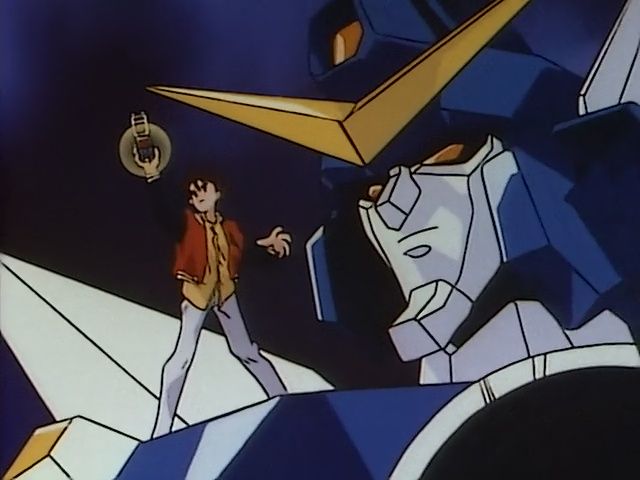
The 1990s Brave franchise—most famously known for its swan song, King of Braves Gaogaigar—is a series of children’s anime centered on boy heroes and their heavily merchandisable giant robots. While the overall quality varies, each show indicates a push and pull between being half-hour toy commercials, displaying impressive mecha animation, telling stories that kids enjoy, and imparting important lessons for young viewers. Over the years, I’ve been told multiple times that one of the turning points is 1992’s Brave Fighter of Legend Da Garn: the third entry and first to attempt a more mature and long-form story. Having finally watched it, I can see a more serious yet also a scattershot approach that belies the competing forces dictating the direction of Da Garn.
Takashiro Seiji is a normal ten year old boy whose mother is a news anchor and whose father is a member of Earth’s Global Defense Force. When a mysterious robot attacks the city, he comes across a power lying within the Earth itself that manifests itself as a giant robot guardian known as Da Garn. As the masked commander, Seiji leads Da Garn, and eventually other robot allies who emerge, against ever greater threats—especially the enemy’s ongoing attempt to rob the Earth of its “planet energy.” There’s an ongoing environmentalism and world peace theme underlying everything, exemplified by a line from the opening theme: “This planet is our cherished ship.”
Due to this show’s opening, I once had a very mistaken impression of Seiji. The way he’s drawn and animated in it, there are times when he looks like an adult. It’s almost as if they either hadn’t decided his age, or figured that making him look 6 feet tall and muscular would make for a more exciting intro regardless of how odd it looks. Whatever the case, my expectations had to be modified, though Seiji’s quality voice acting from Matsumoto Rica (best known as Satoshi from Pokemon) helps keep him an endearing if somewhat typical protagonist.
The robots, in typical Brave fashion, are all about combining. Da Garn combines with a plane and a train to become Da Garn X. Later robots combine together and then get additional partners to combine together. However, they’re also kind of a thematic hodgepodge. Da Garn himself is a police car. He gets plane allies and motor vehicle allies. Then they start introducing robots based on animals, even making it seem like one is going take over as the star of the show, as if someone said, “The surveys say kids like lions!!”
There are so many mecha, and they’re given so few opportunities to show their personalities, that only a handful ever get highlighted, leaving many to be less memorable. In contrast, it’s hard to forget any of the robots in Brave Police J-Decker or Gaogaigar. Even compared to a series like Girls und Panzer (which also groups a gigantic cast into “squads” with collective personalities), Da Garn can feel sparse in terms of characterization. The main exception to this glut is an antagonistic robot named Seven Changer, who (of course) has seven different forms, and whose cool arrogance is delivered effectively by Koyasu Takehito (Dio in JoJo’s Bizarre Adventure).
Speaking of villains, I’m not sure if I’d call them particularly strong, but they are definitely memorable, and they’re explored in great detail. Many of their identifies are initially a mystery, and they’re woven into the simultaneous small-town/global atmosphere in interesting ways. As the series progresses, their stories are increasingly a part of the narrative, and it allows Da Garn to touch upon ideas that would make less sense with Seiji or any of his friends. In fact, I’d argue that the anime doesn’t really find its footing until it starts to do more with its villains.
Brave Fighter of Legend Da Garn ends up being the kind of work that is best viewed as taking a step beyond its trappings and its immediate predecessors while still somewhat beholden to them. It’s polished in some areas like visual presentation and general momentum of its narrative, but it sometimes succumbs to the weight of all the different expectations placed upon it. But while it may be outdone by later Brave series, it’s still a joy to experience, quirks and all.
As a general rule, I try to avoid discussing love and relationships on this site. This is an anime and manga blog first and foremost, and trying to dispense human advice on a regular basis would be too off-topic for my liking. However, I’ve noticed that there is an increasing sense of hopelessness, anger, and frustration among guys who feel alone, and attribute their loneliness to either structural issues about society or unchangeable flaws in themselves. I want to help, and my hope is that anyone who feels themselves teetering on the edge of destructive hate (either for themselves or for others) might consider otherwise.
When I was younger, I had convinced myself that I was inherently unattractive, that I was somehow lacking an inherent “it” factor that everyone else around me possessed. It was lack of confidence, a lack of looks, a fear of my own awkwardness—anything that fit my internal narrative. Whatever the “rules” of attraction were, they deemed me less than adequate. If love is like a video game, then I felt as if I was missing a controller to even begin to play.
However, I came to a realization long ago: attraction is only predictable to a certain point, and one’s ability to navigate uncertainty and empathize with others is what leads to genuine love. Indeed, if love is a game, then it’s not a video game RPG where you can level up, grind for the best equipment, and ensure success—it’s more akin to running a classic tabletop RPG such as Dungeons & Dragons.
In D&D and other games of its kind, the basic goal is to go on some kind of adventure, and the role of the GM (game master) is to oversee the journey. They provide a setting and a continually evolving story in the hopes of giving players an enjoyable experience. However, a good GM eventually learns that different people have different ideas of what it means to play a tabletop RPG. Some want to be heroic dragon slayers. Others want to explore the culture of the world. Certain players love to analyze the game mechanics themselves and optimize their characters for maximum effectiveness. Some might even love performing their character for an audience. Everyone has their own yardsticks for what is a “good” campaign, and the GM ideally works with the player(s) so that it feels more like fun than work. In other words, the “rules” of what works are subjective, and will vary not only from person to person but even sometimes from one moment to the next.
Human relationships are a very similar phenomenon. Some prioritize looks more than personality, while others might be the opposite. Tall and willowy might be one person’s ideal, while another might prefer hairy and burly. Shy and contemplative might win one heart, but fail to reach those who seek the bold and the daring. There might not even be a single ideal for a given person, and some don’t even realize what they truly want until they see it. Trying to see if there’s a mutual attraction is akin to figuring out what a player wants out of their D&D sessions—it’s a feeling-out process that involves understanding individuals as individuals. Yes, there are broad patterns of human behavior, but it’s the differences that become especially important. In other words, love might appear to be a rigid game beholden to codified rules, but all that really exists is a bare template that can be molded according to what the people themselves want. That foundation provides an environment for free-form interplay and reciprocation between those willingly adapting themselves to each other, and who want to create a shared and greater sense of enjoyment.
Sex and relationships aren’t “goals” to be achieved or a box to be checked off, or milestones that one must pass in order to graduate into true adulthood. They’re also not going to instantly repair whatever problems exist within yourself. Relationships can heal the pain inside, but it’s not about fixing what’s broken—it’s about people helping each other rise to greater heights.





 OGIUE MANIAX