The Facades We Wear: Oshi ga Yameta

I follow the VTuber La+ Darknesss, who reads a lot of manga on a regular basis. Every so often, she throws out a recommendation, and one such title that caught my attention was Oshi ga Yameta, or My Fav Idol Quit

Miyabi is a 25-year-old woman who is obsessed with a male idol, the 22-year-old Miku. She devotes her entire life to supporting him, even going as far as doing sex work to fund her fandom. Miyabi also meets up with a group of like-minded women, each of whom have their own favorite idols, and each of whom have their own secrets about their personal lives. But when Miku announces that he’s quitting the business, Miyabi ends up like a boat adrift in the ocean. What she doesn’t realize is that Miku’s retirement is the catalyst for drama, turmoil and discovery—not only for Miyabi and Miku, but also the people around them.

The world of Japanese idols is a great subject for stories because the clash of fantasy and reality is inherent to it. Oshi ga Yameta focuses on the drive of fans to keep living in an illusory world, but not solely in a negative manner or judgmental manner. Individual and societal circumstances, like the pressure put on Japanese women to marry young, undergird the seemingly foolish decisions being made by idol fans. At the same time, the manga also portrays the idols themselves as being of all stripes, from those who genuinely buy into the idol image to those who enter the industry with ulterior motives. The lives depicted feel both ugly and beautiful, and it’s not always clear which aspects are which. Is Miyabi’s main sex client any better or worse than Miyabi herself in terms of how passion, love, and lust intertwine?

Comparing it to the biggest idol drama work of the day in Oshi no Ko, Oshi ga Yameta entirely lacks the supernatural elements as a plot hook. The latter also maintains its heroine’s perspective as a fan and nothing more (as opposed to having her enter the industry), and puts greater emphasis on the torrent of complicated emotions arising from a lifestyle that is both self-affirming and self-sabotaging. The art in Oshi ga Yameta is also very different, showing a messier style with less distinct differences in character designs, but which emphasizes its characters’ own dysfunctions and roiling emotions. The two series do resemble each other more in certain ways, but it’s not immediately obvious how.

I originally planned to read all of Oshi ga Yameta a lot sooner, so it’s funny that I would finish after the news about the Fuji TV scandal involving the former leader of the idol mega group SMAP. Juxtaposing this real scandal with that of the manga’s, it becomes clear that there’s still an element of fantasy even as stories feel “too real.” But the ability to approach sensitive topics while cloaked in fiction helps to provide plenty of food for thought, and this particular manga provides a hell of a buffet.

A Lasting Legacy: Love Live! Superstar!! 3rd Season

11 anime schoolgirls in gray uniforms holding letters in their hands that spell "Liella!"

Love Live! Superstar!! is one of my favorite entries in the Love Live! franchise, but even I was unsure if the third season was necessary. The previous season ended on a high note, and the girls of Liella! could have ridden off into the sunset for a satisfying conclusion. But despite some misgivings, I decided to stick with it. Fortunately, my faith was rewarded once again, and by the end, I found that this season solidified my ongoing belief that Superstar!! is the absolute best of Love Live! from a storytelling perspective.

Love Live! Superstar!! 3rd Season begins with protagonist Shibuya Kanon and the rest of Liella! coming off the high of finally winning the Love Live! national school idol competition. They start the new school year determined to be first back-to-back champions, but a few hurdles stand in their way. First is the pressure of being the reigning team. Second is the presence of one Wien Margarete, a transfer student from Austria who competed against Liella last time and decides to form her own school idol club at their school instead. Third is the fact that Kanon decides to pull a surprise heel turn (of sorts) and join Margarete’s side along with another girl, Onitsuka Tomari. Now, instead of everyone working as one, the two sides must compete to see who will represent their school.

The idea of rival clubs is an intriguing one, but Love Live! is not really a franchise that can make it particularly intense. Or rather, the last time they tried with the (now-defunct) Love Live! All Stars mobile game, it backfired among the fanbase, and the anime adaptation had to tone things down. And so events proceed fairly predictably, with the two sides eventually coming together and any animosity being just caring and affection in disguise. In that sense, Season 3 is a bit of a disappointment, but I eventually realized that this was the wrong angle to look at the whole thing.

The Love Live! competition itself isn’t actually the main focus in 3rd Season. Even the desire for a repeat victory and the challenge of getting there is merely a backdrop than the driving force. Instead, the real story is about how everyone deals with the inevitability of change that comes with the fact that Kanon and the other founding members will be graduating from high school. All the third-years are thinking about what their adult lives will look like and what careers they want to pursue. The second-years will be the ones to inherit the club, and they must go from being the newcomers to becoming the core. And the first-years, Margarete and Tomari, see their participation in more cynical terms. They’re all at different stages.

Superstar!! is also the first time we’ve followed a core cast from the start of high school all the way to the end. In the first season, Kanon’s main struggle is overcoming her trauma that prevents her from singing. In the second, it’s figuring out how to help others overcome their own fears and doubts. And in the third, it’s about leaving behind a system and legacy that will encourage even more in the future to have courage and chase their passion. This might seem par for the course compared to previous generations of Love Live!, but there is a significant difference. 

In every other case, the story begins with a collection of first-, second-, and third-years all coming together. While characters develop in their own ways, they’re also limited to a degree by this format in one way or another. Often, the specific roster is portrayed as lightning in a bottle—something that cannot (and maybe even should not) be replicated. In contrast, all three seasons of Superstar!! collectively work to show that even as Kanon and her classmates leave, the club will continue to grow and change. Each iteration of Liella! has been important in its own way, and the anime implies that this won’t stop even after the original five are no longer there. This flow of time is what sets this series apart, and ultimately makes this third season satisfying to watch.

So that’s Love Live! Superstar!!…or at least until the series gets a feature-film send-off. While I have great fondness for all generations of Love Live!, I really do think that this one is special because of how strong it is as an overall piece of narrative fiction. Superstar!! relies the least on expecting from its audience an inherent receptiveness to idols (and by extension the “school idol” concept), and I think this versatility helps make it a very rewarding series overall.

Ultimate Character Combo: Idols, Gals, and the Jougasaki Sisters

As character types, the “idol” and the “gal” (or gyaru) have both been around in Japanese media for decades. However, they seem to have hit even greater notoriety in recent times. On the idol side, there’s been heavy hitters like Oshi no Ko and Love Live! Then there are works like Hokkaido Girls are Super Adorable and An Otaku Who’s Kind to Gals, where gals are the main heroines or the central focus.

The idol is an idealized symbol of pure devotion to the fans, for better or worse. Fan support is why she’s able to grow as a performer. The gal is attractive, forward, and runs up against traditional Japanese beauty standards. When portrayed with a heart of gold (or as someone who’s secretly a virgin), she transforms into dork kryptonite. 

What happens when the two are combined? Naturally, it would make for a powerful character.

In thinking about the relative success of both archetypes, I began to wonder if there are any examples of such a convergence. Then I remembered that there are indeed a couple of characters who occupy that intersection: sisters Jougasaki Mika and RIka from The iDOLM@STER.

I am by no means an expert or even a dedicated fan of The iDOLM@STER. What I do understand, based on my limited knowledge, is that 1) Mika and Rika were introduced in the Cinderella Girls mobile game in 2011, and 2) I’ve been seeing their fanart for what seems like forever—Mika’s especially. In all instances, they exude “gal” energy. According to the popularity polls, Rika was initially ranked higher, but Mika emerged as more of an enduring mainstay. As if to reflect Mika’s notoriety, the Cinderella Girls anime portrays Mika not as one of the main characters, but an established idol whom others look up to.

One thing I don’t know is whether Mika and Rika have been merely a reflection of the two trends or if they actually contributed to their presence in significant ways. In other words, while I can guess that their popularity has come from being gal idols, how often is it the case that the Jougasakis are the reason people got into one or both sides? Gal subculture has been around for a long time, but I don’t recall them being nearly as prominent as characters in 2011—at least, not in the way they are today, and not in terms of their cultural presence around in the 90s and early 2000s.

While one can hardly attribute the increased visibility of idols to primarily Jougasaki Mika or Rika (they are from games where nearly everyone is an idol, after all), I can’t help but wonder if they’re significantly responsible for shining a greater spotlight on “gal characters” in a way that has persisted over a decade later. If the sisters have played a large role, it would make them influential in a way few other characters can match.

And if there are any other examples of gal idols, I’d like to learn about them.

The Role of Unique Voices in VTubing, K-Pop, and More

“Is it more important to me for a group song to sound good or have distinct voices?”

This is something that’s been on my mind lately as I’ve been exploring my own feelings about music- and idol-adjacent worlds.

I have an odd relationship with K-Pop. I think it can be good, but it’s also definitely not my preference generally, and as someone who seeks to be open-minded, I keep resisting the urge to write off huge swathes of it. The last thing I want to be is dismissive, so I listen and listen, but it just never seems to fully click. Even with songs that I enjoy, something bothers me in the back of my head. Also confusing is that I seem to end up enjoying songs inspired by K-Pop more than K-Pop itself. Case in point: “Dark Breath” by hololive VTuber La+ Darknesss. That includes both the song itself and the accompanying dance (which I know is part of the appeal of K-Pop).

Speaking of, La+ has been crossing over in all sorts of places: notably performing with non-hololive VTubers, doing covers of songs by the League of Legends K-Pop-style group K/DA (alongside her fellow hololive members) for Riot Games One, and being one of two VTuber ambassadors for the very first The iDOLM@STER/Love Live joint concert. 

And here, despite the hololive performances of “POP/STARS” and “Baddest” being less polished, I also enjoy them more than the originals. I don’t think it’s merely because I know the VTubers, so I’ve been doing a good deal of listening to K/DA for the first time, and revisiting Love Live! in between VTuber songs.

Different franchises and media projects have their own priorities. Love Live! and The iDOLM@STER are both just as much about voice acting as they are music, and being able to easily distinguish between individuals based on how they sound is a big part of helping each character/performer to garner their own fandoms. 

For example, I don’t think you need to have any familiarity with Love Live! to notice that “Cutie Panther” features three very distinct voices. The differences can be exaggerated, but they’re present nevertheless.

Similarly, the start of ReGLOSS’s “Shunkan Heartbeat” has each of the five hololive members singing a part of the beginning by themselves, and it’s because the song is as much an introduction of them as five distinct entities (each with their own Youtube channel). That’s part of the VTuber business model. 

This is not to say that songs need distinct voices to be good, and there’s plenty of music with easily differentiated voices that is lacking in other ways, including within those voice-acting/VTuber/idol domain. But when I listen to Blackpink, for instance, I find it is nowhere near as easy to tell the singers apart. It might just be a lack of familiarity on my part, but I also feel that it might not even be the fault of the singers themselves. After all, if you picked three random people out of a room and told them to all sing, there’s a good chance they’d all sound different from one another, even if they weren’t good.

The culprit, I believe, could be how K-Pop is produced. That industry seems to be built on projecting images of perfection, and the result is that everyone sounds flawless. However, this has the drawback of also removing the quirks in people’s voices and by extension their individuality. And even with K/DA, I feel that their songs do a relatively better job of keeping these qualities, perhaps because the source material was a game with over 150 unique playable characters.

Which is to say: 1) While I don’t think distinct voices can be the only thing a song has, nor a lack of such a quality to be a deal breaker, I think it can add a lot to a song. 2) I think part of the reason K-Pop feels so overproduced to me is because of the way it seems to hone and chisel the music to such an extent as to wipe out those interestingly unique qualities that singers possess. 

And all this leads me down another rabbit hole, which is thinking about the different roles a singer can have when it comes to music. Does the song serve them, or do they serve the song? Are they the centerpiece, or part of a greater sound? With idols, is it that the quality of music is less important than its ability to emotionally connect the fans to the idols? I feel like there are endless possibilities, and perhaps that how much we as listeners and audiences prioritize certain elements is what shapes our tastes.

Paying It Forward: Love Live! Superstar!! 2nd Season

In 2021, the first season of Love Live! Superstar!! made a powerful impression on me. With its tightly written story centered around heroine Shibuya Kanon’s lifelong struggle with performance anxiety and stage fright, it stood out in a positively memorable way. One of the aspects that helped the storytelling was its relatively small cast of characters compared to the Love Live! franchise standard, so when it was announced that Season 2 of Superstar!! would nearly double the main group from five girls to nine, I worried that the series might lose what made it work so well.  Fortunately, my fears were unfounded, and Season 2 has turned out to be a solid follow-up that does a good job of playing off its predecessor—and also introduces my favorite member in the process.

Love Live! Superstar!! 2nd Season picks up from where the first left off. The elite Yuigaoka Girls’ High School has accepted the School Idol Club and their group, Liella! Kanon has managed to overcome her issues and can sing loudly and proudly on stage. There’s unfinished business in that Liella! couldn’t make it past the preliminaries of the Love Live! competition. The character arcs are mostly resolved, do the question becomes, what story do they tell given that fact?

The answer is to introduce new girls and place an emphasis on a senpaikouhai dynamic that isn’t really present in other Love Live! anime. While other series actively celebrate the lack of such hierarchical distinctions, Superstar!! 2nd Season puts it front and center. That’s not to say it’s big on seniority, but the perspectives provided by experience becomes a key factor in the narrative.

The senpai characters do receive episodes of their own (like a hilarious one about gamer addiction), but they seem to get less screen time overall, and even theirs will link back to the new girls in some way. This is likely by design, as it not only does this work to introduce all the first-years, but it provides a clear indicator of progress for the original five as seasoned school idols who must mentor the next generation. After all their hard work, Kanon and the other senpai have gotten so good that they accidentally scare off most of the new student body, who are too worried about not being able to live up to the standards set by Liella! Like the ongoing debates over fighting game design, Superstar!! 2nd Season asks what is the right balance between granting accessibility and rewarding ambition. 

Superstar!! 2nd Season idoes a good job of differentiating the new girls from their upperclassmen, though they can at times feel a little less three-dimensional. The big sticking point is that they seem to adhere more to anime character archetypes, but they’re developed well enough that it becomes less of an issue over time. Also, I have to admit that I myself can be a sucker when the tropes fall in my favor, such as in the case of my Liella! favorite, Wakana Shiki. She’s an aloof scientist with a secret soft side, and her similarities to Nunotaba Shinobu from A Certain Scientific Railgun (including liberal peppering of English phrases into her speech) is both noted and highly welcome.

As Superstar!! 2nd Season progresses, it gradually brings the focus back to the original girls of Liella!, reviving and adding new angles to some of the challenges from Season 1. For example, a rival antagonist shows up who reignites criticisms of school idols as being inherently mediocre artistically, adding a bit of Zhong Lanzhu–esque flair along the way. But the lessons Kanon has learned from her own challenges and the results of that mean her answers to the questions posed to her reflect the positive changes she’s made.

Overall, Love Live! Superstar 2nd Season manages to be a great continuation that builds on a solid foundation. While it risks getting bloated, its broader character dynamics help to mitigate that concern. What results is an anime that shows what Love Live! is capable of.

Real Character: Love Live! Superstar!!

In my estimation, Love Live! Superstar!! is the best Love Live! anime from a storytelling perspective. It doesn’t necessarily have my favorite characters, but what it brings is a sense of both personal and interpersonal development that feels satisfyingly cohesive and speaks to real worries that people have. 

Superstar!! is the story of Shibuya Kanon, a girl who is a wonderful singer but is constantly held back by severe stage fright. Over the years, her optimism has waned, especially after she failed to get into Yuigaoka Academy’s prestigious music program due to freezing up during auditions. Resigned to enter its general curriculum instead, Kanon thinks singing will only ever be a private thing for her, but that all changes when she’s discovered by Tang Keke, a student from Shanghai. Keke loves school idols (essentially idols who act as mascots for their school), and she thinks Kanon would be perfect for it. However, not only does Shibuya feel that she simply doesn’t have it in her—the school itself forbids school idols as something that would drag down its reputation.

Kanon’s sense of defeat at the start of the series feels all too real, and it’s what makes the generally positive attitude of Superstar!! that much more poignant. Kanon stands out from past Love Live! heroines because her struggle reflects a genuine doubt that comes from believing she is physically and mentally unable to pursue her dreams. But thanks to the friendships fostered with Keke and the other eventual members of the group (not a spoiler because they all appear in the opening), as well as the way they help each other rise to the occasion, her gradual steps to overcoming her situation feel well earned.

All this applies to the other girls as well. Whether it’s Keke’s enthusiasm often running ahead of her ability, Arashi Chisato’s relationship with both dancing and her childhood friend in Kanon, Jeanna Sumire’s frustration with being a former child actor who always seemed destined to never shine, or Hazuki Ren’s conflict between upholding her family’s honor and her own desires, there are challenges each of them face that feel simple yet profound. The hope they give each other fights back against the fear in them, and helps them stand.

The fact that there are only five girls (instead of nine or more) also helps greatly with making the series feel more complete. Not only does it give more time for each character’s story to develop, but there’s a far better sense of how they complement one another. When you have nine-plus like Superstar!!’s predecessors, they often seem like well rounded groups just through sheer brute force. With a smaller main cast, their connections feel deeper without having to delve into ancillary material (drama CDs, etc.). It also results in what I think is the most robust cast overall—it’s hard to pick a definitive favorite, but I lean towards Keke.

Unlike Love Live! Nijigasaki High School Idol Club, which began with character designs more in line with the previous series and then given a different spin for its anime, the Superstar!! designs have been their own thing from the start. This gives this generation a somewhat different visual impression overall, and the animation does a great job of having both that idol sheen and a sense of the personal. The songs are standard idol/Love Live! fare but fun and uplifting, while the physical performances are portrayed incredibly well. They do an especially good job of showcasing Chisato’s superior dance skills compared to the rest of the cast.

Out of all the Love Live! anime, this is the one I would most readily recommend to people unfamiliar or wary of idols and idol-related media. The story of Kanon and the others feels like it exists a little beyond the parameters of idoldom, and thus more accessible while also just being really solid and beautiful overall. While this season ends well, there’s little doubt that a second season is coming. I can’t wait.

Violence Miu: 22/7 Anime Review

Warning: Full Spoilers

When I first started watching the 22/7 anime TV series, what stood out to me was how generally serious it was—not only compared to other idol anime, but also what I knew of it from one of its official Youtube channels. Instead of the off-kilter hijinks of a bunch of virtual youtubers, the anime follows a formula of introducing the backstories for each character in order to show how they became who they were. While all of them have some element of drama or tragedy, with the recurring theme being that they weren’t all born with the personality and attitude they have now (especially when onstage), all of them are well within the boundaries of what one would expect out of idols, especially fictional ones.

By the finale, however, the one big exception to those confines is the main heroine, Takigawa Miu. I don’t know if I’d call her my favorite character of the series, but she ends up being the most memorable part of the 22/7 anime.

The first couple of episodes revolve heavily around Miu, who’s shy and unconfident to the point that it loses her a much-needed part-time job, and who has some sort of trauma when it comes to playing piano. At first, she’s extremely reluctant to join 22/7 and become an idol, but over the course of the series, she opens up and becomes more comfortable with her fellow members. We learn about the other girls as well, and then we reach episode 11, which focuses on the childhood of Nicole, the one among them who gave Miu the hardest time early on. What we see in that flashback is that the two knew each other in elementary school, and that a single event would tie the two together.

Unlike her current self, Nicole was very shy and quiet, often being bullied by other students. When it came time to put on a school play, Nicole’s name was volunteered by her tormentors to play the evil queen, and they play a prank on her in an attempt to embarrass her during the performance. Miu, who’s also in the play, runs onstage and tackles one of Nicole’s bullies. 

At this point, I think most idol anime, which tend to be kinder and gentler, would make that tackle one of the big moments. It would cut away and all the characters would gasp. 22/7 takes it a step further, and shows Miu actually wailing on the girl with closed hands—albeit, not as punches or anything, but more like the flailing hammer blows you’d expect from a little kid. Not only does this differentiate 22/7 from so many of its peers, but highlights a certain depth of character to Miu. She’s not just the girl who lost confidence and found it—she’s someone who has a strong sense of fairness, and is willing to throw hands to make her feelings known about that.

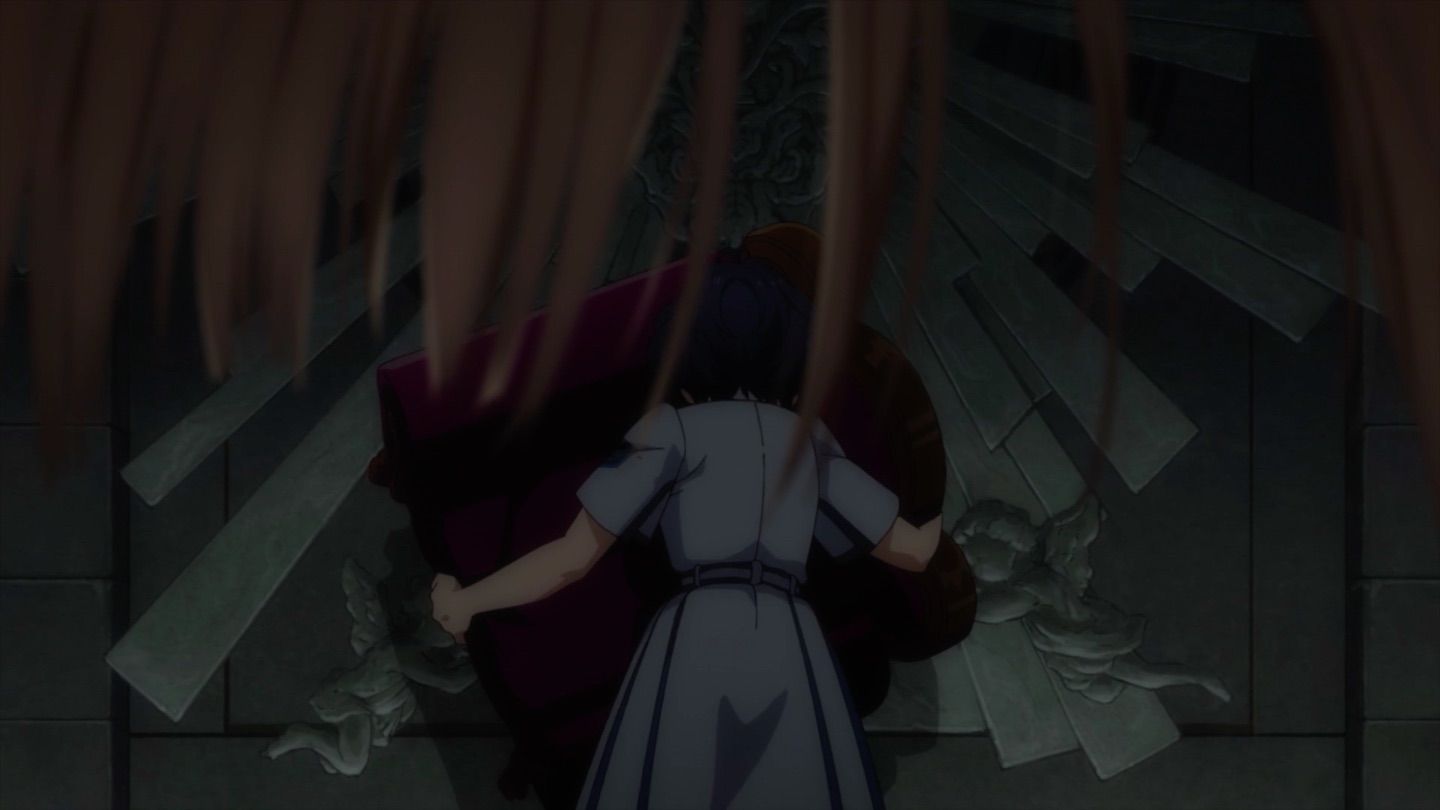
That was the past, and it doesn’t entirely gel with the image we have of her in the present. However, as the series nears its climax, the mysterious “wall” that was giving them instructions all along reveals that it is actually an AI that had been manipulating the girls for its own purposes and no longer needs them. As the 22/7 girls strongly plead to let them join back together instead of disbanding, the AI refuses to budge. When hope is all but lost, Miu steps up to make her intentions known…by hitting the wall with an armchair.

What really impresses upon me in this scene and the one Snow White performance in the flashback is that Miu’s actions aren’t portrayed as “wacky” or “cool.” They’re expressions of frustration and indignation over perceived malicious acts, and they come from someone who lashes out despite her lack of confidence because of what she believes in. It’s a far cry from a pillow fight or some slapstick antics, and it’s what establishes the 22/7 anime as a little more than just some forgettable idol fair. 

Recent Thoughts on Love Live's Nijigasaki High School Idol Club

In the past, the third Love Live! multimedia project, “Nijigasaki High School Idol Club” (previously known as “Perfect DREAM Project”), had somewhat eluded me in terms of its appeal. Certainly, when it comes to Love Live! In general, I’m usually something of a late adopter—it’s usually the anime adaptations that bring me in, as opposed to the games, magazines, or even the songs. I’m also not so big a fan that I’ll follow every crumb of information, or try to pick favorites before I’ve had a chance to learn about the characters.

Two things have changed since then: the Love Live! School Idol Festival All Stars mobile game (hereafter LLSIFAS) came out, and I attended a delayed viewing of the “Love Live! Fest” concert featuring the girls from all three generations. Together, they’ve given me a better insight into how this third Love Live! Is supposed to work, and its concept of “more individualized school idols” has me curious.

As soon as the nine Nijigasaki girls came out on stage at “Love Live! Fest,” it was clear that the thinking behind them diverged from what went into their predecessors. Rather than appearing as a nine-member unit with matching outfits, each of the singers/voice actors dressed like their characters, who themselves all have very different concert wardrobes. So instead of, say, having all of μ’s in white for “Snow Halation,” it was a hodgepodge ranging from a Swedish dress to a fancy nightgown to a kind of Vocaloid-esque ensemble. Their styles were incongruous, and intentionally so. As explained by one of the members, the theme of the Nijigasaki High School Idol Club is to emphasize each girl’s uniqueness above all else. It’s quite a departure from previous Love Live! projects, which were all about nine girls working as one. 

Each of the Nijigasaki girls also has their own solo number (in addition to a couple of group songs), which is something that the members of μ’s and Aqours didn’t get until later. I think it actually helps convey what each of their personalities is like, as opposed to trying to figure out which girl is which when they’re all singing at the same time. Asaka Karin is supposed to have a more mature sex appeal, and it comes across in spades when she’s the only vocalist. Speaking of Karin, learning about her character was an experience. First, she came out and called herself the “sexy” one. Then, she called her fans “slaves.” Last, it showed her signature symbol: a high heel (hmm). It dawned on me that Karin (as well as the other eight girls) are likely all going for very different audiences from one another.

LLSIFAS somewhat departs from its mobile game predecessor by having more of an ongoing narrative in the story mode. In Chapter 1, you learn that the Nijigasaki High School Idol Club is in a sorry state and on the verge of being shut down. Your goal is to bring back the old members and recruit some new ones, and you basically learn about each of the characters along the way. I think this has been effective in helping me get a better sense of what each of them is all about, with the heavy amount of interaction and the clearer direction doing a good job of showing how the characters are when there’s an obstacle to overcome. Still, I wonder why the forces that control Love Live! as a whole decided to move in this direction for their third endeavor.

I’m not ready to fully embrace Nijigasaki because I find that a bit of resistance is for the best when approaching idol franchises, even the continuation of one I’m already a fan of. The original Love Live! won me over even as I was very skeptical of it, and it took some time for me to enjoy Love Live! Sunshine!!, but it happened eventually. I don’t need to pick a favorite Nijigasaki girl, I don’t need to enjoy every song, and I don’t need to go all-in from the start. That said, I’m looking forward to how the more focused format of an anime will tell their story, and how this idea of individuality will play out. And with a fourth Love Live! project on the way, the Nijigasaki idols will become “senpai” themselves.

Splatoon Lore is Best Lore

Thanks to the recent Haikalive Kyoto Mix concert for Splatoon, I’ve had kids and squids on the mind lately. As I listen to music from Squid Sisters and Off the Hook while reading fan wiki entries about the Splatoon world, I find myself appreciating its lore more and more. It’s just robust enough to foster imagination but the games and their story are not beholden to it in any major way.

One of my favorite examples of Splatoon lore details is Marina, the DJ from Off the Hook, and what we learn about her music in the Octo Expansion. First, why is she a DJ? The likely answer is because she’s an Octarian. As a member of the ostensibly antagonistic species of Splatoon, her upbringing is both implied and outright stated to be different from the squids. Not only is the Octarian leader a DJ whose music plays throughout their territory, but Marina herself was an engineering prodigy from a young age.

In the backstory to Splatoon, it’s shown that octopuses are more technologically advanced than the squids. The reason why they lost the war is simply due to happenstance—someone accidentally unplugged their greatest weapons. Marina comes from the environment, where she helped develop weapons. Pearl even mentions that Marina is responsible for the Shifty Station stages during Splatfests, all of which utilize Octarian technology. So not only is the most prominent musician of Marina’s culture a DJ, but the technical know-how of turntables, synthesizers, and the like would come easily to her.

Furthermore, when you talk to Marie from the Squid Sisters in singleplayer mode, she mentions that she doesn’t understand how Marina makes music just by spinning some plastic plates—one of many indicators that squids are generally not tech-savvy. There’s even a moment during Haikalive Kyoto Mix where Marie looks at Marina scratching vinyl with confusion and amazement. The very idea of being a DJ seems foreign to squids by default, to the extent that the only other known DJ besides Octavio and Marina is a fellow octopus in Dedf1sh.

What ultimately made Marina defect from the Octarians is hearing the Squid Sisters’ “Calimari Inkantation.” Whether the song actually has magical properties or if it’s a Macross-style culture shock, Marina expresses the feeling that this new music changed her life and her direction.

In one of the chatroom logs in the Octo Expansion, Pearl and Marina share their song demos from before they made it big. Marina’s is an early rendition of “Ebb and Flow,” the song that plays during Shifty Station matches. It’s recognizable even in early form, but there are aspects of this version that hint at Marina’s Octarian origins—especially the jingle that plays when you beat a stage in singleplayer. In other words, “Ebb and Flow” likely began as an attempt by Marina to make something similar to the Squid Sisters while also working from her own cultural background, a fusion of squid and octopus styles.

Marina occupies a space where two cultures, squid and octopus, intermingle. Her role as this immigrant of sorts who expresses her history and her desired future comes across in little moments and details. It’s in the dialogue, it’s in the music, and it’s in the little gaps where imagination dwells. It’s that approach which makes Splatoon lore so fascinating, but just light enough a touch that it doesn’t obscure the other great aspects about the game.

Splatoon Live Concerts and the Expression of Character in Performance

Nintendo Live 2019 in Kyoto featured two nights of Splatoon concerts with holograms of the Squid Sisters and Off the Hook performing onstage. It’s not the first time both pairs have been together, but watching this event made me really appreciate the care put into expressing the individual differences between the characters in accordance with their musical styles.

Off the Hook and Squid Sisters (or Tentacles and Sea o’ Colors in Japanese) are very different groups. Pearl as MC and Marina as DJ have very distinct roles in Off the Hook such that their movements are heavily contrasted with each other. Pearl is fiery and aggressive while Marina is laid-back and soulful, and everything about them screams hip hop, which traditionally has liked to draw a sharp distinction between its musicians. There’s really no confusing the Pearl and Marina, and their performances put a bright spotlight on their individuality.

Squid Sisters, however, are more akin to a Japanese idol group, and so their performances are more synchronized and feel more choreographed. At the same time, every so often, you’d see a small difference in movement—an extra bit of flourish from Callie or a more composed and precise gesture from Marie. It’s especially noticeable at times when both are cheering the audience on, and Callie is bouncing up and down as Marie’s feet stay firmly planted, such as in the video above. The differences between the two are relatively subtle as a result, and idol fans eat this sort of thing up.

Adding these small quirks to Callie and Marie is all the more impressive because a lot of fictional idol media don’t really bother to do the same. When watching an episode of Love Live! or Aikatsu!, there’s often pretty much no difference in performance if two or more characters are doing the same routine in the same song. We’re sometimes told that there’s a difference, but it’s not really shown.

From idols to hip hop and beyond, the musical acts of Splatoon are given presence and personality. This is taken into consideration even in the live concerts. It makes me wonder where a Splatoon 3 will go genre-wise, and I anticipate what Nintendo has in store.

Day 2 Full Concert