Genshiken, Childhood Comics, and More: Kio Shimoku at Umeda Lateral Talk Notes

Kio recently had a talk at Umeda Lateral, an Osaka-based live music house and talk venue, to celebrate the release of his new artbook. Below are my notes from watching it. 

(Unfortunately, the VOD is no longer available. Also, screenshots are not allowed.)

There are three people: the host, Kio, and his editorial manager Moteki.

For the event, Kio drew special signboards featuring the Genshiken characters, one per character: Ogiue, Madarame, Sue, Ohno, and Saki.

As previously known, Kio has a very deep voice. 

Apparently, it’s normal for the hosts and speaker to drink on stage at this venue. Kio’s first order was draft beer.

He has been to Osaka before, for work and for sightseeing. Was on the train for 9 hours to get there.

The artbook was not his idea. It was Moteki’s, who brought it up because it’s Kio’s 30th anniversary. Kodansha wouldn’t do it themselves? Moteki actually reached out to him through Pixiv.

Kio wanted to reply, and he got motivated to actually make the book happen.

There were cases where Kio was looking through his old work and thought, “Did I draw this?”

Starting doing digital after Genshiken, starting with Jigopuri. At the time, he still scanned in his pencils, though.

Works prior to that transition were newly scanned for the artbook. He had a bit of experience doing it for the Shinsouban (the special edition that has new covers and changes the nine volumes of the original into five).

Kio admitted that he doesn’t actually remember much of his works before Genshiken. Moteki jokingly expresses concern that this pre-Genshiken period was eight years.

Moteki: Ogiue is a character who really takes the story places, but is there anyone from before Genshiken like that?

Kio: Nope, I don’t think so.

Kio actually doesn’t think Ogiue is that much of a driving force. Madarame was originally planned to be there from the start in some form.

Kio showed early concept notes about Genshiken. At the time, it was still written in kanji.

The original 3 characters were early versions of what would become Saki, Kohsaka, Madarame.

Saki (or her prototype) was the original protagonist. Prototype Kohsaka’s gender hadn’t been determined yet—the character was labeled “Hero (Heroine?)” One note mentions that he maybe looks like Squall from Final Fantasy VIII

The school setting was based on Chuo University, just like in the actual Genshiken.

Kio wanted to make the series focused on character gags.

Prototype Madarame looked very different. Labeled as the “Rival.” Second-Year, otaku. 

All the characters are listed with a specialized otaku genre. Proto-Kohsaka and Proto-Mada are both labeled as being into “everything.”

All the characters are labeled as virgins.

Prototype Kugayama was labeled as being a third-year, having a good personality, and also being a lolicon. Otaku genre: anime.

Another character with glasses specialized in games, and another shorter character has manga.

One unused design was a girl who was a second-year. She was a little unattractive, but with big boobs. (This might be the prototype for Ohno, but they look quite different.)

Kio does not actually particularly like kujibiki lotteries. But it is funny that Kujibiki becomes a plot device in Nidaime when all the girls are drawing straws for the order in which each girl has their date with Madarame.

Kio ordered octopus karaage next.

The first gunpla he built was probably the Guncannon. He built it right before the Gundam boom, when he was in elementary school. He has an older brother who was buying gunpla before him. Actually, it might not have been the Guncannon. Kio mentioned not having a good memory.

Did Kio have an inscrutable senpai like the original club chairman? He had senpai, but he wasn’t sure if they were quite like that. But Tanaka was based on someone Kio knew—a person who loved plastic model kits. 

Kio used to build a lot of gunpla and kits, and broke them at the joints all the time. But with more recent models, he remarked that they really don’t break easily. He also compared the old days of gunplay that used polycaps to the improvements of modern kits.

For the scene in Genshiken with the gunpla, Kio tried to break the hip joint of a real model for reference, but it wouldn’t snap. But he wanted to do the scene, so he had to force a break.

He checked with Bandai if showing a busted gunpla would be okay, and they said as long as the break was shown to be by accident and not on purpose, it was okay.

Kujibiki Unbalance was made to be an original parody series because getting permissions for actual things was difficult.

Host mentions that he wasn’t a pure otaku, and it’s because of Genshiken’s numerous reference lines that he got to be one. Chapter titles are references, and Kio had to constantly rack his brain for them. Kio does not consider himself a high-information-retention otaku.

He had a desire to draw and write about the old-style 90s-era otaku of his own generation. 

When Kio got Genshiken serialized, it made him feel like a real pro. When it got an anime he was ecstatic. “It felt like I had won at life.”

Kio was worried that if he tried to make a manga about the newest things, it would quickly feel dated, so that’s why the otaku stuff was more 1990s.

In that time, video tapes were still the standard, and official recordings of the anime were still done on tapes. He was okay with the work, but saw the struggles of the anime’s production in the anime, accepting that those are kind of inevitable.

The host asked about the OVA, believing that Kio wrote it himself, but Kio himself didn’t remember if that’s the case. He did work closely with Genshiken 2, as well as the original Kujibiki Unbalance anime.

Kio mentioned being involved with a scene involving Tanaka and Ohno, and the host instantly guessed correctly that it’s the spicy scene of them getting together. In response, Kio asked, “Why did you know what I was talking about?” It was later that he realized the scenes he drew for the fictional eroge Ohno made Tanaka play were just used straight-up in the anime. 

Kio showed his actual old notebooks.

“It’s not your dark history.”

Kio: But it is.

Kio loved Famicom Detective Club, and made his own story based on Famicom Detective Club II.

He wanted to make a manga of Ghibli’s Laputa in middle school, so he drew one. Here, he showed it to the audience, page by page. He even did the title logo. However, as he turned each page, he would have his eyes closed because he didn’t want to look at them.

(It actually looks really well drawn for a middle schooler.)

Kio actually wanted to change the story partway through in a way that would make it more interesting, but he couldn’t quite decide on where to take things after they get to the fortress, so he stopped drawing it.

Another notebook is filled with his attempts to draw like Miyazaki, clearly copying famous Nausicaa images. He also feels embarrassed about these.

He also showed that he made lots of drawings of Elpe Ple from Gundam ZZ.

He didn’t watch Gundam as it aired, but he did keep up with Dunbine and L-Gaim in elementary school (4th grade, 6th grade, thereabouts).

Also showed a piece of fanart for Metal Armor Dragonar in there, along with a drawing of the Queen Mansa from Gundam ZZ.

Because Kio was clearly into fantasy-like settings as a kid, the host asks if he ever wanted to make manga along those lines. Kio says that he actually worked on a real manuscript from high school to college. “Any plans to announce it?” “None.”

After the break, Kio got a lemon sour. Host a highball. Moteki got another draft beer.

Host talked about how some people considered Nidaime to be like a fan sequel. After the first series ended, everyone tried to imagine what would come next.

Kio got back to drawing Genshiken after doing the art for a budget edition box set of the anime (the ones with the white cases), which led to the one-shot, and then he was asked by Kodansha if he could come back for a short run, like a single volume. (Nidaime ended up running for 11.)

Kio hadn’t planned to resolve Madarame and Saki. Couldn’t it have just ended at the school culture festival?

The second half of the talk was Kio answering questions they had received from fans.

Will Spotted Flower get an anime?

Kio: That’s not up to me.

There are also challenges to getting a story like that made into anime. If he had to say whether he’d want one or not, he’d say yes.

What was a gathering spot for otaku in your days?

Kio was only in a circle for half a year. But there had to have been a place where people gathered to draw.

Kio was in the art club in high school, but it didn’t have an otaku feel. Same for middle school. But the otaku in middle school did meet up after school.

Kio actually bought his own Neo-Geo machine! They reminisced about the massive cartridges.

What works are you into recently?

Manga: A current work in Harta magazine by the author of Hinamatsuri, Ohtake Masao, called J⇔M.

Doesn’t watch dramas. Closest is taiga historical dramas like Kimi Hikaru e.

Couldn’t decide for anime or movies (mainly watches anime movies).

If you drew Genshiken now, what would the characters be into?

VTubers, not that he knows much about them.

Moteki mentioned that Kio must have done research about fujoshi circles and slang for Nidaime, but Kio said he was doing it since the first series. He got some things wrong, though. In college, Kio was surprised to discover fan-derivative works and 18+ doujinshi in college (much like Sasahara).

How did you decide who Madarame would end up with?

Kio didn’t even know who it would be as he was drawing it. He was thinking of having it conclude with Madarame alone, but he actually said to himself, “Are you really going to end it this way?” Even he as the author couldn’t accept that.

Moteki: When it comes to The Fifth-Year and Genshiken with Ogiue, these characters realized about the kind of people they are, and it helped them decide on their feelings. But Madarame even to the very end did not have that self-awareness.


Also, lots of people thought it’d be Sasahara’s sister, because she’s so similar to Saki.

Kio: Yeah, even now. When you mention it, that pairing could’ve worked. But I wasn’t thinking about Saki (or Keiko’s similarities to Saki).

Kio-sensei switched to tablet in Nidaime. How was it?

Actually, Kio switched during Jigopuri. Back then, he still drew the manuscripts on paper and scanned them in before doing digital drawing over them. Eventually, he switched to all digital.

Is there something you feel about the Otaku of the 2010s and 2020s?

Based on what he sees with his daughter and her classmates, it’s almost like there’s not really a distinction between otaku and non-otaku. 

Host: Even gyaru are into Frieren.

Kio: Maybe there’s no need for a series like Genshiken anymore.

Kio wanted to do Nidaime as a series where there were more members of the club who were like Ogiue and Ohno along with one new male character. However, he actually thought up a version with a more typically masculine guy, but thought it felt a little too normal. 

Host: It’s like the barrier between otaku and non-otaku is gone.

What’s important to remember while making works?

Kio: I can’t really think of anything. Maybe, if you think of it too much like work, you’ll lose what makes it unique. Don’t try too hard to make a “manga-like manga.” Don’t focus on how things are supposed to go at the expense of making it interesting.

Genshiken wasn’t intended to capture the zeitgeist, but it ended up doing so.

Did you see the online reaction to Genshiken or the doujinshi during serialization?

Kio did not look at comments. The people at Kodansha looked at it though. 

Kio bought all the doujinshi of Genshiken he saw. Didn’t have any problems with any content, knowing that it’s up to the doujin creators. He might occasionally check out the website of one of the artists. 

He got some of them for the Genshiken 8.5 doujin project.

What was it like working for Afternoon?

Thought of Shounen Sunday first for Kodansha, but Kio remembers Parasyte being a big title. Minor no Pride, Major no something (a cooking manga).

In response to Ogiue is drawing for Afternoon in the manga: “It’s meta.”

What do you think of making H-manga?

Kio always wants to do it. He’s working on Part 2 of his doujinshi project, and the manuscript has gotten to 134 pages. 

Moteki: What was the reaction to you announcing an 18+ doujinshi? Was it like, “Here we go!!!”

Not a particularly strong response, but when Kio posted it on Fanza (an adult site), some people who were fans asked him if it’s okay to do this at his age (he’s 50).

Can you do a live drawing?

He was unsure of his live drawing ability. Before the talk, Kio ended up putting a lot of time into the five signboard drawings at the talk, as well as the 30 that were included in specific copies of the artbook.

Host and Moteki tried to convince him, but no go.

Will there be more Genshiken merch?

It’s not up to him.

A lot of questions about how Kio decided who Madarame would be with, actually.

Are there any characters who acted in ways you didn’t intend?

All of them.

During the nose hair chapter (with Saki and Madarame), Kio planned to have a story about that, but went at it by thinking “What would the characters do in this situation?”

Before a manuscript, he’ll draw freely. For Genshiken, it’s like the ideas would just readily come. When drawing the characters, he would think about how they would behave. He compares figuring character’s lines to taking a dust cloth and wringing it tightly until the exact words drip out. 

Moteki: In terms of characters moving on their own, Ogiue is a well-known example, right?

Kio had considered sticking her with Kuchiki as a kind of “mutually cringe couple.”

Kio is unsure of what he needs to do in serializations. With one-shots, in contrast, it’s harder to play around. He’s still not sure what to do.

At first, Kio didn’t use any assistants. But that’s when he was young. Now he’s 50 and he can’t do the same anymore.

Weekly serialization is the “territory of monsters.” Knowing what weeklies are like, he understands the need for assistants there. But if someone came to him asking if he could do one, he’d consider it and try to figure out a way it could work.

Kio worked as Takano Fumiko-sensei’s assistant, but for only one day.

What otaku works or genres have you been into recently?

He watched some of Usada Pekora playing Elden Ring. He’d have her on as background noise while working on manga.

He also listens to music while thinking up ideas and working on manga. When he’s doing tasks with not a lot of information, he uses ambient noise. When doing the initial drawings, he listens to stuff like J-Pop. After that, more editorial/critical Youtube channels. 

What have you enjoyed recently?

Kio has a hard time thinking of anything, but he did travel to Gunma recently. He went to Ninja Gakkai, a ninja education camp.

Among your works, are there any scenes that stick out most in your memory?

The first thing that came to mind is the nose hair story, particularly when Madarame leaves the clubroom and is looking back at it from the outside across the courtyard, and you can see the light in the clubroom still on.

Moteki: Which character is your type?

Ohno, in terms of sexiness. The scene when she first appears in a mask is an example of her heroine appeal. Though Kio’s been told that the shifting heroine focus for Genshiken is unusual: from Saki to Ohno to Ogiue.

“How did you think of a plot like that?” 

“I didn’t.”

Moteki likes Saki best. So does the host.

The signboards got raffled off at the end!

See Kio Shimoku Talk About His Career!

To celebrate the release of his new artbook, Mata Ashita, Bushitsu de (See You Tomorrow in the Clubroom), Genshiken author Kio Shimoku had a special 2+ hour talk session on September 16, 2024. The venue was Umeda Lateral, a talk and live music club in Osaka, and was title “Gendai Shikaku Bunka Kenkyuukai Umeda Bunshitsu, or “The Society for the Study of Modern Visual Culture Umeda Annex.” 

Fortunately, the entire event was streamed live, and there’s an archived video available on their official site for a limited time! A streaming ticket costs 2,800 yen and lasts until September 30 JST.

While I plan to write about the talk (and the artbook) in more detail, I have not had the chance to watch it in full yet. I did take a brief look, though, and Kio actually appears in person. This is probably going to be the first time many people get to see him. Also, he showed early concept notes about Genshiken!

Sharing screenshots is not allowed, so unfortunately I can’t post his mug or those cool sketches.

I’m happy to see us go from having the man be a complete mystery, to doing an interview with VTuber Luis Cammy, to having him start a Twitter, and now this. 

Kio Shimoku and Genshiken Trivia, Courtesy of “Mou, Shimasen Kara”

Over the past year, the manga magazine Monthly Afternoon has featured interviews in comic form with its own serialized manga authors through the series Mou, Shimasen kara. Afternoon Gekiryuu-hen by Nishimoto Hideo. This past month’s issue puts the spotlight on Genshiken and now Hashikko Ensemble creator, Kio Shimoku, so I’ve taken the liberty of summarizing all of the Kio factoids in it.

-For the first time ever, Kio actually reveals his “face” (albeit in manga form). He’s known for being a private person, but he decided show himself through this manga. He reasons, “I’m over 40 now, so what does it matter if I show my face or not?”

-Kio used to work analog, but has been an all-digital artist ever since Jigopuri. He does everything, from thumbnails to color, all on his Wacom. He doesn’t customize his pen or brush settings much.

-He almost never uses assistants. Kio had one assistant on Genshiken Nidaime and none for Hashikko Ensemble, his new series. For those who don’t know, this is highly unusual.

-Kio got the inspiration for Hashikko Ensemble because his daughter joined a vocal ensemble, and he happened to listen to an all-male group.

-He was never a musician, but knew a local group, so he did do some singing for them about once a month, and even had a voice trainer. He’s a second tenor, which was the basis for Akira’s baritone in Hashikko Ensemble. Kio has a fairly deep voice himself, so he decided to exaggerate it for the manga.

-Once, in school, he saw two kids harmonizing on the way to class, providing further inspiration. “I want my manga to make readers want to sing.”

-Kio was in the softball club in elementary school, the judo club in junior high where he was the captain, and the art club in high school.

-He submitted his first manga in high school, for Shounen Sunday. It was about a high school student who works at a used bookstore and discovers an ancient text that he then tries to decipher.

He drew a lot when he was kid, and was an otaku in middle school, where he imitated Doraemon, Kinnikuman, and Captain Tsubasa.

-However, he stopped drawing between 4th grade of elementary and the start of middle school. This was because he was really into Miyazaki Hayao as a kid, and when he couldn’t copy Miyazaki successfully, he got depressed and stopped trying for those few years.

-In middle school, he helped a friend out by drawing backgrounds for his manga, only for Kio to realize he was also better at drawing the characters too. One day, when he tried to draw Miyazaki characters again, he noticed he had gotten way better.

-He wanted to be an animator, but Ghibli only wanted people 18 and up. Once, he created a manga based on the Laputa novel in a couple of notebooks.

-In college, he majored in Japanese art because he thought the pencil and brush skills would translate to manga.

-Kio’s dad worked at an insurance company, and while he wasn’t flat out against Kio’s aspirations, he would constantly ask him to consider the risk of being a manga creator. This made Kio want to quickly win a manga reward, to help his parents accept it.

-The school he went to had a club called the Society for the Study of Modern Visual Culture, becoming the inspiration for Genshiken. Surprisingly, however, Kio was actually only a member for half a year. He didn’t quit because if anything in particular, he’s just not good with group activities.

-Despite what it might seem, the Genshiken characters are not based on any real life counterparts.

-In response to the realism of his characters, Kio says he tries to convey a sense of “presence” with them.

-Kio feels Genshiken came at the perfect time, matching the zeitgeist of the era. However, it makes him feel like a one-hit wonder. If Hashikko Ensemble fails, he’s going to feel enormous pressure.

-He didn’t attend a technical high school so he needs more research. One of he authors of Mou, Shimasen kara. did, and the other has a sister who attended one, so they try to help out.

Thoughts

Kio’s done a lot!! He sort of seems like a renaissance man.

That bit of surprise aside, it is fascinating finding out just how many aspects of his own personal life and career have made their way into his manga. The attending a Genshiken-like club is one thing, but it’s notable that he was in the judo club and then the art club—just like Hato. He also converted to using a tablet monitor for manga at some point—just like Ogiue. While his characters aren’t based on any real people in particular, he takes bits of himself and places them in his creations. While not stated outright, I think it’s pretty clear that Jigopuri (which is about raising a baby) is the product of firsthand experience.

Like this post? Feel free to check out my Patreon, or leave a tip at my Ko-fi.

When Anime Babies Get Real

Babies in anime and manga serve many differing purposes. They can mark the passage of time, or a transition into a new stage in life. In series for young girls, they’re often a way for children to emulate their parents. Whether they’re a source of comedy, an adorable presence, and evil force in the world, the role of the baby is myriad and generally based on the audience being served. Among these varied works, the baby portrayal that tends to catch my attention the most are the ones that get a little “real.” These depictions aren’t necessarily trying to portray the entire baby-raising experience, but they will bring up the inherent difficulty in bringing up a small child. Even when they’re doing it for laughs, there is a sort of sobering effect that can potentially apply to all ages and demographics.

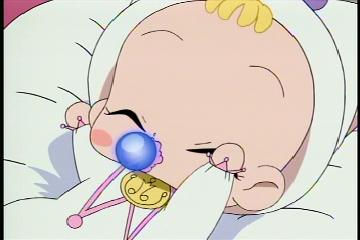
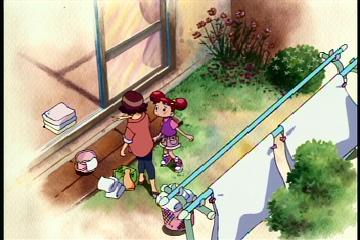
s2e4hana The first baby that comes to mind is Hana in Ojamajo Doremi. In the second season of the magical girl franchise, titled Ojamajo Doremi ♯ (“Sharp”), elementary school girl Doremi receives a magical witch baby from a tree. From one season to the next, she and the other girls take care of her. In many similar series, such as Doki Doki! Precure, the baby is often just there for cuteness factor, or maybe to sell a few baby-themed toys. Doremi plays it differently.
s2e4haruka

In one episode, Doremi, generally a clumsy girl, is having immense trouble taking care of Hana. She gets so frustrated by it, and the fact that the other girls are scolding her for doing a poor job, that she runs home to her mom looking for comfort and understanding. Instead, her mom slaps her (off-screen), and basically says, “If you get hurt, you just feel bad. If there’s no one to take care of Hana, it’s a matter of life and death.” In that moment, Doremi’s mom makes a crystal-clear point about how literally helpless an infant is, as well as the responsibility and strength absolutely required for their sake. Hana still acts the part of the precious anime baby, but even as a burgeoning witch with immense magical powers, reality sets in.

However, if we’re talking harsh depictions of the mental and physical toll babies can take on their parents, then one need look no further than Jigopuri: The Princess of the Hell. A short, two-volume manga by the author of Genshiken, Kio Shimoku, Jigopuri follows a young widowed mother named Ayumi and her newborn child, Yumeko. In contrast to the older characters, who all have a more typical moe look, Yumeko is drawn strangely hyper-realistically. The manga portrays raising Yumeko as a harrowing experience. Ayumi occasionally wishes ill on her own daughter due to the stress she causes, and feels immensely guilt over it. In one chapter, as Ayumi attends a meeting for new mothers, she finds out that others occasionally look at their children with disdain as well, which gives her immense joy and relief.

Unlike Doremi, which targeted an audience of young girls presumably into the idea of playing pretend-mama, Jigopuri ran in a magazine targeting adult otaku, Monthly Afternoon  which might be why it wasn’t terribly successful. It’s just not the kind of thing otaku are expected to know or care about. I find it kind of funny that a series targeting small children could deliver a serious message about raising children and then go on for two-three more years, while adult men rejected a similar message.

Nevertheless, I think that attempt to confront a reluctant or perhaps ignorant audience of certain truths or circumstances is what I find appealing about the “real” baby, even if seeing an infant girl with invisibility powers as per JoJo’s Bizarre Adventure Part 4 garners more laughs. In fact, I think of Spotted Flower, another Kio Shimoku manga about an otaku and his pregnant wife (who gives birth in the second volume) is kind of a do-over of Jigopuri. Even though it runs in more of a josei magazine, Rakuen: Le Paradis, it’s a compromise of sorts. Perhaps just as Hana is a magical baby with fun powers, having an otaku father can settle it into a more comfortable place.

This post was sponsored by Johnny Trovato. If you’re interested in submitting topics for the blog, or just like my writing and want to support Ogiue Maniax, check out my Patreon.

Save

Kio Shimoku in the Flesh

Kio Shimoku, the author of Genshiken, is an elusive individual. Portraying himself as a kind of ape, he so rarely makes public appearances that he is sometimes mistakenly believed to be a woman. In fact, when he appeared for an event to celebrate the Genshiken Nidaime (Second Season) anime, it was kind of a big deal. Thanks to Brazilian Genshiken enthusiast Diogo Prado, however, I’ve learned that photos of Kio do exist.

Apparently Kio had attended an event in Taiwan in 2010, where he promoted the release of his manga Jigopuri (also known as Digo Puri). His desire for privacy is respected here, as none of the photos actually show his face, yet it’s still pretty cool to see the man himself. Obviously I don’t know how he is as a person, but the fact that he looks like a nerd who knows how to clean himself up and dress nicely is a trait also demonstrated by the characters in Genshiken over time, namely Ogiue and Madarame. In fact, he looks pretty similar to Madarame from behind, while in the old Publisher’s Weekly interview with Kio he said that Ogiue is somewhat reflective of his own experiences.

By the way, I wonder how Jigopuri ended up doing in Taiwan.

How Kio Shimoku Got His Groove Back

Genshiken II‘s been running for a while now, and every so often I go back and look at the earlier chapters of the new series (would you expect me to do otherwise?). Upon a recent revisit, it hit me just how much the artwork had changed between the inaugural Chapter 56 and its immediate followup in Chapter 57.

For comparison, here is Ogiue in Chapter 56 on the left, and 57 on the right.

There’s a clear difference between the two versions of Ogiue (or any other character) that can’t be chalked up simply to the gradual evolution of art style that happened throughout the original Genshiken. This change, given just how drastic it is, was more abrupt, though one has to keep in mind that the real life gap between 56 and 57 was almost a year (Chapter 56 was originally a one-shot that got turned into the start of a new series).

Because of how much softer and more cutesy Chapter 56 Ogiue is portrayed, my suspicion is that Kio’s style was affected by his time working on Jigopuri. Indeed, Chapter 56 of Genshiken actually came out in the middle of his run on Jigopuri.

In fact, if you look at one of the characters in Jigopuri, the little sister Kaname (pictured left), she looks pretty close to the Ogiue of Chapter 56. What’s also kind of funny is the fact that Volume 1 of Jigopuri features an Ogiue cameo on the inside cover, and it’s clear that the Jigopuri style hadn’t fully taken over Kio’s artwork yet at the time he drew it.

I think it’s interesting how an artist can get so influenced by how they’ve been drawing that it makes it difficult to shift gears back to a different kind of story. It’s different depending on the artist of course, but I have to wonder how much effort Kio put into switching into a less moe-type art style. Something tells me it wasn’t easy.

Moe Anime Girl Gets Pregnant, Has Baby – Jigopuri Volume 1

Kio Shimoku is a manga author who is best known for his work on the 9-volume Genshiken series, about the members of a college anime/manga club. It’s personally my favorite manga series ever. It may come as a surprise then to know that Kio’s latest manga, Jigopuri: The Princess of the Hell, concerns itself with a topic normally far-removed from that of watching anime: Teen Pregnancy.

Well, not teen pregnancy per se, but it does center around a widowed 18 year old mother and her newborn child. The mother is Okiura Ayumi, her daughter is Okiura Yumeko, and living with them is Ayumi’s twin sister Hino Kaname. The raising and nurturing of young Yumeko, who is less than one week old when we first see her, is the central focus of Jigopuri, and the manga’s approach to a topic which is incredibly common in the real world but incredibly rare in comics is rather unique.

Despite its realistic tone and content, the art style of Jigopuri is closer to that of Kujibiki Unbalance than it is Genshiken, and it might be difficult to reconcile the fact that doe-eyed moe anime girls are discussing topics such as diaper-changing and the unbearable stress that comes part and parcel with raising a newborn. What can be even more jarring is the fact that Yumeko is drawn in a rather realistic style, more closely resembling a photograph than a kawaii anime infant.

No, Yumeko is not an ideal entertainment baby who is ten parts adorable and one part cuddles. She is a wrinkly, crying, pooping baby who needs attendance at all times because she’s a baby. Everything revolves around this fact, from the deliberately slow pacing of story (chapters generally span only a single day) to the way it handles all of its seemingly incongruous artistic elements, and understanding why Yumeko is portrayed in this manner is the key to understanding Jigopuri.

From the start, Jigopuri puts a young, inexperienced mother with no time or desire for romance in the spotlight, and in doing so makes Ayumi, and by extension the whole of Jigopuri, into something partially meant to stand against the tide of common trends seen in moe anime and manga. Although Ayumi at times feels helpless, it is never because she can’t do anything, but rather because she does so much. That doesn’t mean Jigopuri condemns moe, but it does remove much of the glamor and fetishism that accompanies many tropes of modern anime and manga. Nowhere is this more evident than in the comic’s portrayal of breasts.

As one might expect out of Jigopuri, breastfeeding occurs frequently, but the sight of an attractive woman exposing her large, shapely breasts (with nipples shown) begins to lose its erotic appeal once you are made aware of how inevitably their appearance is attached to the shrill cry of Yumeko as she wakes a sleep-deprived Ayumi up in the middle of the night. After a while, you begin to really feel for Ayumi, as you think to yourself, “She has to take out her breasts again?” And further cementing this un-fetishizing is the fact that Ayumi’s breasts are visibly veiny, an effect achieved through smart use of screen tones, and an indicator that these are not the idealized breasts you’d see in other works willing to show them with the same frequency as Jigopuri.

That’s Jigopuri as of Volume 1, and I really do recommend it, though I understand it’s not for everyone. Its cutesy art style combined with its realistic content can throw people off quite a bit, but if you can read Japanese or if it comes out in English, I think you should give it a chance.

A common sight in Jigopuri is a tired and weary Ayumi with deep bags underneath her eyes, a sign that each day wears on her even if she truly loves her daughter.

OGIUE’S TRIUMPHANT RETURN TO MANGA (sort of)

I recently purchased Volume 1 of Genshiken: The Society for the Study of Modern Visual Culture creator Kio Shimoku’s newest manga, Jigopuri: The Princess of the Hell, about an 18 year old mom trying to raise her newborn child. A review will be posted in due time, but there is something more important I must address.

Manga published in Japan generally has a dust jacket where the manga’s front cover is printed, as opposed to manga published in the US where the image appears directly on the book. As such, manga often have images underneath the dust jackets. Curious about Jigopuri, I looked underneath only to uncover this on the back cover.

YEEEEEEEESSSSSSS

Ogiue is saying, “Whatever the circumstances may be, there’s no way they could get this big.” (Thanks to prinny for correcting my mistake)

Even when the content isn’t even related to Genshiken, Kio Shimoku still finds a way to fit Ogiue in, and for that I give him eternal respect and devotion.

Incidentally, this is on the front cover.

Madarame: Why did he use these designs?
Sasahara: Who knows?

The Joys of Afternoon and Kuroda Iou

Recently I found out that Kuroda Iou, creator of Sexy Voice and Robo as well as one of my favorite manga artists, has a new series entitled Atarashii Asa (New Morning) in one of my favorite magazines, Monthly Afternoon. Afternoon was home to Genshiken, and is where Kio Shimoku’s current series about a teenage mom Jigopuri, as well as Mysterious Girlfriend X, are running. Suffice it to say, at this point I am almost, almost tempted to consistently buy Monthly Afternoon even though I understand how much the costs tend to add up after a while.

This got me thinking about why I like Kuroda’s artwork, as it’s a wild style unlike most other artists in the anime and manga industries. If you look at my previous Sexy Voice and Robo review, you can get a good idea of what his drawings entail. He’s detailed but not meticulously so, and his brush usage leans away from the “cleaner” style that is so popular with so many people. Often times his drawings and panels aren’t completely coherent, but I feel like these “mistakes” are part of what make his style so unique. I call them mistakes only in the sense that in the end he did not decide to redraw something so that the thickness of the lines made a little more sense or the proportions of a character’s fingers were more realistic, but ultimately it was a decision, and it’s these decisions of which I am fond.

I’ve mentioned before that his style is pretty much what I wish I had, and it really has to do with conveying a sense of energy that goes beyond “accuracy.” Accuracy has its place in that world, but it is not at the forefront, much to the dismay of people who scrutinize single frames from Naruto episodes. While I don’t think my own style will ever be JUST LIKE his, it’s good to know that he’s still in Japan producing works that hopefully will get brought over to America at some point.

Oh and I found out Jigopuri’s first volume should be out, but that’s it’s not listed on Kinokuniya’s website. Maybe it takes a while for new series to get over there.