Return to Genshiken: Volume 1 – The Old Guard

genshiken1-sasaharacomifes

Welcome to the very first “Return to Genshiken,” a new series of posts where I revisit the very first Genshiken manga series. For those unfamiliar with Genshiken, it’s a series about a college otaku club and their daily lives. Originally concluding in 2006 before restarting in 2010 and finishing once again in 2016. A lot has changed about the world of the otaku, so I figured it’d be worth seeing how the series looks with a decade’s worth of hindsight.

Note that, unlike my chapter reviews for the second series, Genshiken Nidaime, I’m going to be looking at this volume by volume. I’ll be using the English release of Genshiken as well, for my own convenience. Also, I will be spoiling the entirety of Genshiken, both the old and the recent manga, so be warned.

Volume 1 Summary

genshiken1-doujinshop

Sasahara Kanji is starting as a freshman at Shiiou University, a college in the Tokyo area. He wants to join an otaku club, and after some false starts winds up in a club called the Society for the Study of Modern Visual Culture, or “Genshiken.” While he believes himself to be nowhere near as hardcore as the other club members, he discovers that he fits in well with the laid back atmosphere.  As he learns the ropes about the otaku life, he’s also joined by other new members, including cosplayer Ohno Kanako, the usually handsome supernerd Kousaka Makoto, and Kousaka’s non-otaku girlfriend, Kasukabe Saki.

Back in Time

genshiken1-otakuclubs

I must say, reading the first volume of Genshiken really is like going through a time warp. Not only is the visual style of the manga starkly different compared to how it ends up by Volume 21, but the aesthetic of the characters the Genshiken members themselves are obsessed with is a trip down memory lane. During this period, Genshiken makes references to series like To Heart and The King of Fighters, and the world of the otaku just seems…smaller somehow.

In one chapter, Tanaka is examining a garage kit of a cute girl model, and he remarks that female characters’ faces are getting rounder and cuter as of late. Keep in mind that this was back in 2002, before the K-On!‘s and the Bakemonogatari‘s of the world came along, the time of series like Star Ocean EX. Character designs like Lina Inverse from Slayers and Deedlit from Record of Lodoss War were still holding strong.

It’s also notable that the character profiles included between chapters bother to list each person’s “favorite fighting game character.” Fighting games still exist today, but it should be noted that they began to die out around 2003 before being revived in 2009 with the launch of Street Fighter IV. I think we’re catching the tail end of the fighting game craze.

Perhaps the most major difference between Genshiken and Nidaime is that the latter mainly focused on fairly contemporary references in order to emphasize that its values were more current. In contrast, the original Genshiken, by starting at a point where years and years of otaku history preceded it, draws from the previous decades in order to establish its characters and their preferences.

Memories Refreshed

There are a lot of things that happen in Volume 1 that I pretty much forgot, and a lot of things that, having recently finished Nidaime, stand out as likely reference points for the second series.

I did not remember that Sasahara joins Genshiken because Kohsaka scares him from the Manga Society. Given how close they become later on, it’s almost surprising to go back and see just how intimidating Kohsaka appears to Sasahara. It makes sense: Sasahara is a meek fellow, and he’s suddenly confronted with this idea that guys like him might populate the Manga Society. And just in general, most of the main cast of awkward nerds—Sasahara, Tanaka, Madarame, Kugayama—get really uncomfortable when it comes to regular-looking guys.

Going forward to Nidaime, it frames how Yajima feels upon entering the club all those years later. While Sasahara felt threatened by Kohsaka alone as a kind of living contradiction, Yajima sees herself as being practically surrounded by Kohsakas. Ohno is attractive. Ogiue is very attractive. Yoshitake’s surprisingly fashionable. Hato is Hato.

While I thought Madarame’s lamentations over all the sex talk in Chapter 125 was more of a general callback to how the club used to be, I find that it’s actually specifically in reference to the guys overhearing conversations from others about how much sex they have that can be found in Volume 1. If you just read Volumes 1 and 21 back-to-back, it is a stark contrast that the characters would go from freezing up and sweating nervously when some fellow talks about doing three girls in one day, to Sasahara and Tanaka both mentioning how they wish they had more sex with their girlfriends. Similarly, the way Madarame freezes when he sees Kohsaka and Saki kiss for the first time is possibly the long setup to the fact that he’s too passive to even get something started with Sue even after they start going out.

Another moment i had forgotten the exact details for was the very first Kujibiki Unbalance discussion we ever see. First, I had no idea that Kujibiki Unbalance is supposed to be a shounen manga, given its makeup. Second, the characters talk about the fact that the school in Kujibiki Unbalance is supposed to be a mix of various real schools—a self-aware nod to how Shiiou University is itself an amalgam of real schools.

Saki the “Time Bomb”

genshiken1-sakiohno

In this volume, the manga refers to Saki as a “time bomb” whose effects influence Genshiken in unforeseen ways. Looking back, this statement is more profound than I think even the author Kio could’ve imagined. She fundamentally changes a great deal about the club over time. It’s because of her that the members of Genshiken grow and evolve themselves as people, beyond the otaku stereotypes to varying degrees.

Outside of the possible exception of Sasahara, whose sister Keiko is very much the “gyaru” type, Saki is Genshiken’s biggest exposure to the “normal” world before the members start graduating. Because of her, Ohno goes from shy wallflower to mother figure for younger otaku. Madarame changes himself as he discovers his feelings for her. Ogiue learns to open up as well. She is a force for change in the club, and one might even argue that she’s the real protagonist of Genshiken, at least initially.

I also noticed that the presence of the real world outside of Saki is much more prevalent in Volume 1. The aforementioned bro talk situations happen. Saki herself gets hit on by guys looking for a quick fling. As the series continues, that realm fades from view until Saki is the primary example of it. And even then, Saki herself changes as she gets acclimated to being friends with otaku.

Comic Festival

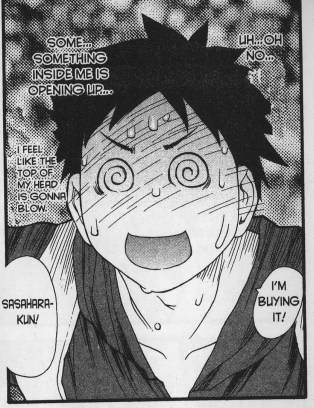
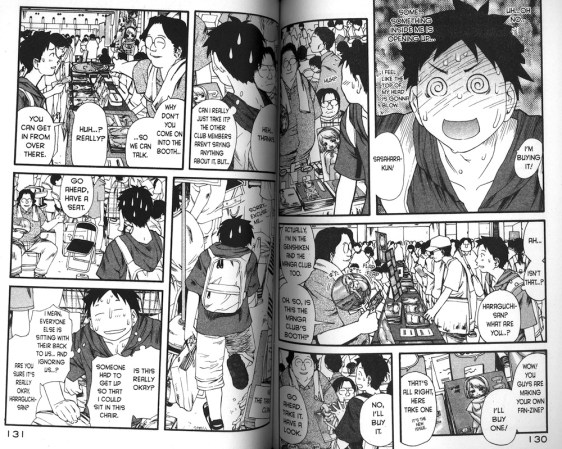
I recall that, prior to my discovering Genshiken, my main exposure to the idea of “Comic Market” came from two anime: Comic Party and Nurse-Witch Komugi-chan. Suffice it to say, that’s kind of a strange combination. While Comic Party had a couple of Kuchiki-esque creepers, it was mostly portrayed as a fairly tame event. With Genshiken, however, seeing the final barrier of Sasahara’s shame come undone gives the full doujinshi-purchasing experience. In a way, doujin events are where you confront your true self, and see what values lie within. What are your real priorities? What fundamentally tickles your fancy? It’s a time for reflection.
genshiken1-comifesharaguchi

Before Kuchiki, There Was Haraguchi

I think there’s a common feeling throughout Genshiken fandom that Kuchiki is an unnecessary element. Who wants to read about a guy with the absolute worst social skills, whose behavior is grating and downright pathetic? However, in Volume 1 Kuchiki has yet to appear. Instead, within early Genshiken exists the character of Haraguchi, and in many ways he provides an interesting contrast with Kuchiki.

Haraguchi is portrayed as an opportunist who likes to lord it over others. A member of all three otaku circles (Anime Society, Manga Society, Genshiken), it’s implied that each group barely tolerates him. Haraguchi works by making connections and ingratiating himself to those who “matter,” and he’s viewed as a leech who mooches off the success and passion of others. Haraguchi is that guy who gives orders without ever actually contributing, and the result is that no one in the universe likes him.

A similar dislike of Kuchiki is certainly prevalent, but for as much as can be said about Kuchiki’s flaws, being a manipulative person isn’t one of them. He’s obnoxious, lacks self control, has a tendency to give TMI, and perpetually irritating, but he’s also absolutely honest and upfront about who he is and what he enjoys. I think it’s ultimately why he’s allowed to stay with the club. Kuchiki is a man of innumerable faults, but he’s not a scumlord like Haraguchi.

Art in Progress

genshiken1-paneling

As I looked for the best image to include in this post, something hit me: the panel layout in Volume 1 is much less refined and elegant than what it would become. While there’s a nice sense of variation in terms of panel size, the composition isn’t as strong, the borders are rather rigid, and the pages don’t flow nearly as well. I’ve looked ahead a couple of volumes and it mostly seems the same, so I wonder if there’s a point at which it truly changes.

Actually, when looking just at the differences between chapters in Volume 1, the art style already begins moving towards the more familiar Genshiken style. As the series begins, the character designs are more similar to Kio’s previous works, and by the end of the volume they’re definitely getting softer. The difference between Chapter 1 and Chapter 2 is significant enough that I suspect they were drawn months apart. That’s what happened with Nidaime, where the pilot chapter still had the feel of Jigopuri.

Final Aside

I thought the portrayal of underage drinking was a Nidaime thing. Apparently not! It happens wit Kasukabe and Kohsaka right from the start.

Save

Save

Save

Save

Save

Moe + Saki = Maki: A Genshiken/Love Live! Character Comparison

sakimaki

On occasion I’ve had to explain to those unfamiliar with Love Live! the appeal of Nishikino Maki. While terms like “beautiful” or “cooldere” kind of get the point across to an extent to those who already know her, I’ve found that they still don’t quite do the trick for people outside the fandom. However, I’ve recently thought up a comparison that I think works well, provided that you have some experience with Genshiken. Maki, in esssence, is like Kasukabe Saki—or more specifically, the “moe” version of Saki that Madarame once envisioned.

In the extra at the very end of Volume 9 of Genshiken (the finale of the first series), the characters are discussing why Saki isn’t “moe.” They talk about how she essentially has no weaknesses, that she’s just an extremely capable person overall. Even her boyfriend agrees that Saki isn’t moe. Then, Madarame has an idea: the only way Saki would be moe is if she was a virgin.

While this might bring to mind the issue of “purity,” it’s more that being a virgin would be a chink in the armor of Saki’s all-powerful self. She would be this smart, no-nonsense woman who just knows how to get things done, but her relationship advice would come not from personal experience. By being a virgin, she’d have that essential vulnerability that would bring her into moe territory.

When it comes to Love Live!, being a virgin isn’t any more or less special from on character to the next, as it’s implied that all of the main girls don’t have sexual experience (no matter what fans think/hope). However, the idea of an overall intelligent, talented girl with a firm head on her shoulders who is also naive in certain respects and easily flustered by embarrassing things is right in the same territory as “Moe Saki.” Within Nishikino Maki exists both the girl who keeps Nico in check, and the girl who believes in Santa.

Side Note: While Maki is basically Moe Saki, I bet Madarame’s favorite Love Live! would be Nico. 2D is different from 3D, after all.

Save

Boyz II Men: Genshiken II, Chapter 125

In this month’s chapter of Genshiken Nidaime, the old boys are back.

Chapter Summary

Madarame, Tanaka, and Kugayama meet up for drinks. While they start talking about how things have changed now that Madarame’s finally not going back to the old university, the conversation eventually shifts to girls. As Madarame realizes how the boys of Genshiken have at some point started talking about girls instead of anime, he swears to bring himself back to his original mega otaku self. However, just as he successfully tempts the rest of the guys to pull out some 18+ doujinshi, Kohsaka shows up with Saki, who seems unfazed by Madarame’s attempts to creep her out. Not long after, they reveal to the guys that Saki is pregnant.

This causes Madarame to flip and exclaim that he should’ve just picked someone and ended his virginity, but then Saki reveals that it was all a lie orchestrated by her and Kohsaka to get Madarame to confront his true feelings. She then tells Madarame straight up that he should go out with Sue on account of his reasoning for rejecting her being total BS, and even gets Sasahara to call Ogiue and get Sue on the phone. Saki says to Madarame that, if Sue’s not interested anymore then it’s fine, but otherwise…

Straight Shooter Saki

Ah, Kasukabe Saki. While Keiko kind of fulfills her role as the no-nonsense outsider, she doesn’t quite capture Kasukabe’s ability to just cut straight to the point. Quite a few of the readers on this blog have commented that Madarame’s reasoning for rejecting Sue was incredibly weak, and I find it interesting that Kio Shimoku would purposely set that up as a sticking point. While I do still think that Madarame’s reasoning wasn’t solely to run away from the situation, it was pretty flimsy on the surface.

It’s also revealed that Saki set her ploy up because Kohsaka and her suspected that Madarame’s real reason for not choosing a girl was that he was still pining after he deep down inside. While I think this was pretty clear, especially given his reason for rejecting Keiko (she reminds Madarame too much of Kasukabe), this really shows just how much that’s actually the case. Somewhere in all of this is the idea that the other girls are maybe too otaku to get to the heart of the matter. Ogiue might be blunt and Yoshitake might be a schemer, but their anime and manga-oriented minds inadverently allowed the harem to flourish, and thus allowed Madarame to remain wishy-washy about the whole thing. Saki really is amazing.

As for the fake pregnancy, before Saki revealed the truth my immediate reaction was that this basically would have marked off Spotted Flower as a possibility. Now, it’s back to being in this nebulous space of pseudo-canon/alternate universe, and it’s a very intentional move by Kio to mess with his readership. Maybe, somehow, we’re all Madarame. What this also means, based on all of the talk of girls and sex (or in some cases lack thereof), is that the thematic gap between Genshiken and Spotted Flower is ever-shrinking.

By the way, the named of the chapter is “High-Slope Flower,” which is a parody of Spotted Flower, only with a reference to Kohsaka instead of Madarame; the saka in Kohsaka means “hill.”

Kio you troll.

Sex Talk

Though it’s one of the main jokes of the chapter, it really is crazy that the boys of Genshiken have been having varying degrees of success with the ladies, not least of which is Madarame’s recent harem adventures.

It’s unclear if Rino the Cabaret girl is actually interested in Kugayama or is basically doing her job and manipulating her client for more pay (remember, Cabaret Clubs are all about talking with girls as opposed to being a sex service), but it’s very likely that the latter is a factor. Kugayama himself acknowledges this, but just the fact that he is making some kind of vague move towards fulfilling his desire for real-life women, and that he’s gone from visiting Cabaret ladies to just one in particular, is itself a kind of change or progression.

One of the more notable aspects of this chapter is that Tanaka and Sasahara reveal quite a few details about their sex lives. Tanaka mentions that he “only” gets to have sex with Ohno about once a week, while Sasahara says that his rate is about once a month, much to Madarame’s consternation. Tanaka even mentions to Kugayama about how asking for a girl’s three sizes in order to get a cosplay outfit made for her (Kugayama’s current plan for a gift to Rino) can turn into dirty talk.

References to the characters having sex is nothing new to Genshiken. Way back, Saki talked about her and Kohsaka doing it doggy-style. Ogiue started drawing more realistic penises in her doujinshi after she began her relationship with Sasahara. I think this situation might feel different because it’s the guys, the ones who are supposed to be the “losers,” doing it, and so the dissonance in Madarame is understandable. I also believe that this dissonance was a huge factor when it came to Madarame’s decision to abstain from choosing a partner. This candidness contrasts with the younger characters that comprise the main cast now as well, because they are for the most part are still very shy about this sort of thing.

It’s easy to tell that the conversations are causing Madarame’s imagination to go wild, and that too is understandable.

They Just Keep Pulling Me Back In!

If Madarame does indeed end up with Sue after all, does it matter that it happens after the harem arc concluded rather than it being a direct result of Madarame’s decision? After all, choosing a partner would have, by definition, ended the arc anyway.

This is all speculation at this point, but I do think there is a difference between having Sue the winner of a competition versus her and Madarame potentially building something up together on their own. I think the harem itself put a lot of pressure on Madarame that a simpler one-to-one relationship wouldn’t carry, even if it doesn’t work out.

As for Sue essentially being Madarame’s 2D complex ideal given flesh and how this might mean that Madarame loses the last vestiges of his realistic otaku self, there are two points to take into consideration. First, guys can have many different ideals to the point that arguably any of the other partners could be considered an “ideal,” but the way the story has portrayed them shows a lot of interesting facets to their characters. Sue still seems a bit otherworldly, but this might be the start to opening her up more. Second, Sue really is the only one at Madarame’s otaku power level.

No Ogiue Image This Month

They do mention her, though.

Sasahara: Basically, Sue’s at Ogiue’s apartment, which means I can’t visit. Do something about it, please.
Madarame: Wha? What do ya mean? Wait… You just want to have sex with her!
Sasahara: ……That’s right! What’s wrong with that?!

If you liked this post, consider becoming a sponsor of Ogiue Maniax through Patreon. You can get rewards for higher pledges, including a chance to request topics for the blog.


A Message from Another Time: Genshiken Nidaime OAD

Volume 15 of the Genshiken II manga came out in Japan recently, and with it a limited edition featuring an OVA (or OAD as they call it) where they animate a couple of chapters from the original Genshiken. Covering Sue’s stay over at Ogiue’s apartment and the group’s new year’s shrine visit, it’s a part of the story that should be completely familiar territory to Genshiken fans, and watching it has made me want to both consider its role or purpose as the first Nidaime OAD and think a little about the story itself.

When you think about it, this OAD didn’t have to be the new year’s shrine visit, but it is in many ways the most appropriate given Nidaime. Ogiue’s trauma and the trip to Karuizawa would have been too long and arguably too heavy for this. The graduation in the last chapter of the original Genshiken would have been nice but is of course more of a finale than anything else. The no-dialogue chapter would have been an interesting part to adapt, but that would negate the entire new set of voice actors they’ve brought in. With the new year’s shrine visit, however, you get various threads which lead directly into Nidaime, particularly what’s been covered by the anime. Ogiue shows her softer side, which plays into her role in the second series. Sue expresses her desire to study in Japan, thus setting the stage for her increased prominence. The forlorn romance of Madarame is in full swing here, expressed almost painfully in its silence. Though Genshiken is in a sense full of turning points, this is a pretty major one in hindsight.

In terms of adaptation from manga to anime, I find it interesting that the characters were made to look like in the original series. It seems like a no-brainer but they had to do things like switch to older hairstyles and even styles of dress in order to capture the visual sense of how different the club was back then. In fact the entire mellowness of the OAD really stands out, and I imagine for anyone who watches it after having only experienced Nidaime, they would notice first and foremost the relative lack of bombastic energy. Even the references are from a different period of otakudom (“Sit, Nekoyasha!”).

One minor but noticeable change has to do with the fact that Ogiue has her default Series 1 hairstyle in the OAD, which is subtly different from the hair she wore to the shrine in the manga. There, instead of having the horizontal “antennae” on the sides of her head, Ogiue has more pronounced tufts of hair over her ears, and most likely creating another set of character design sheet just for this one-off Ogiue hair would have been too difficult or time-consuming. What’s important is that this specific hairstyle was not a fluke or a shift in judgment in the manga, as Kio Shimoku specifically drew Ogiue with that hair on the the limited edition cover of Genshiken Volume 15. Given her dress-up for Sasahara’s graduation a few chapters later, I feel like the purpose of this hairstyle was to show Ogiue trying to pretty herself up a bit (which in turn extends from a longer trend of her getting more fashionable after talking to Kasukabe).

If there’s one thing I really took away from  watching this, however, it would be a case of self-reflection, so I hope you’ll forgive me as I indulge in some introspection.

When Ogiue is drying Sue’s hair, she talks about how she’d like to be more like Sue, who isn’t afraid to be an otaku and to just be herself, which Ogiue has been trying to learn. This process Ogiue undergoes in the series is part of why she’s my favorite character, and it’s something I’ve tried to live by as well, to my benefite even, but as I get older I increasingly feel this pressure to not display my otaku-ness so openly. It’s not something I try to hide, but I realize that it’s important to know that sometimes other people won’t quite understand, and explaining who you are and why you love the things you do requires a certain sociability and deftness with words which often escape me. On some level, I worry that the essential advice of “be yourself” is something I’ve begun to creep away from even though it’s been so important to me.

Also, because I’ve managed to become more social and more comfortable over the years, I think what I basically am afraid of is becoming the very person I swore I never would, that person who passes judgment on others for being weird or socially awkward, not because I want to but because I might have lost touch with that feeling. That said, if I’m actively concerned about this, then that’s maybe for the best because it means I haven’t forgotten that idealism even if it doesn’t work out, well, ideally.

Zankoku na Genshiken Second Season Episode 11

Now comes the other big moment of the new anime. Of course I’d have a lot of thoughts on what transpires this episode, which you’ll find in the equivalent manga analyses: Chapters 78, 79, and 80.

I think there’s little doubt that Madarame’s confession is one of the most significant events in Genshiken. I’ve felt sort of conflicted that it happened because it is possible for someone to move on from a former love without the confession and rejection you see so often in anime and manga, but the series makes it clear that Madarame was incapable of doing so, no matter how hard he tried. Looking back, the idea of “freeing” Madarame to some extent implies making it so that he’ll be open to others.

There’s a fairly significant mistranslation in the Crunchyroll subs, at the very end of the episode. After Kasukabe starts to cry, the translation has Madarame say, “Now I know that Kasukabe-san cries easily.” This isn’t quite right: what Madarame actually says is more along the lines of, “I already knew that Kasukabe-san cries easily.” It’s a reference to the events of Volume 4 of the manga (Episode 11 of the first anime), when Kasukabe accidentally starts a fire which gets the club into trouble. Though she put on a tough face, her guilt over the accident caused her to start crying. Essentially, Madarame’s line is supposed to reference how much he’s paid attention to Saki over the years.

It’s probably significant then that Keiko and Saki both notice how Hato pays a lot of attention to Madarame. Or is it?!

Some of the timing of the confession itself turned out different, and there isn’t quite as much impact from Madarame’s response to the line about the relationship that might have been, but I think the episode overall does an all right job of it. The manga devoted an entire chapter to just the two of them in the club room, mirroring previous chapters which did the same.

As for the actual confession and reaction, I could see how Kasukabe’s response could be interpreted as cruel, though I don’t necessarily think so. One thing anime viewers may not be aware of is that Kasukabe’s line about how a relationship with Madarame might have been a possible future is actually also a reference to another series by Kio Shimoku called Spotted Flower. In it, characters very (but not entirely) similar to Madarame and Saki, an otaku and his non-otaku wife who knew him since college, are married and expecting their first child. In fact, the title itself is a reference to them: Madara means spotted (which also explains the Naruto character), and Saki refers to the blooming of flowers. It’s a sort of holy emblem for Saki x Mada fans, but at the same time perhaps incredibly cruel itself for very nearly giving those shippers what they want before collapsing the entire thing like a house of cards.

Cruelty abounds.

The Ambiguously Vague Gestures: Genshiken II, Chapter 81

After the intensity and emotion of the last chapter, this month’s winds down with a post-confession Madarame. In order to try and cheer him up, the old Genshiken girls (+ Hato and Kohsaka) cosplay for him, and for a brief moment the old impassioned expository Madarame makes a triumphant return. As Tanaka and Kugayama leave with Madarame for some male bonding, Saki encourages Madarame to not let go entirely of his past with Genshiken. There also seems to be some bad blood between Keiko and Hato, though the reasons are unclear.

As is the case with recent previous chapters, this one also referenced an old anime, in this case the title of Akuma-kun‘s final episode. Appropriate, because whether you want to call it the denouement of dramatic structure or the ketsu of kishoutenketsu, Chapter 81 feels like a wrap-up of the crazy developments that have happened over the past few months with Madarame, at least when it comes to his feelings for Kasukabe. As such, this chapter feels a lot less overt with its significance and its presentation of information compared to last time, but there are still plenty of moments which radiate with potential. As always, this isn’t an end (well obviously because the manga isn’t finished but you know what I mean), but a continuation.

There’s one scene in particular this chapter that I’ve read over and over because I’m not sure how to interpret it. As the girls (and guys) cosplay for Madarame from the gender-bender game that Kohsaka worked on, Kasukabe herself joins in as well. Before we see Saki in un-drag though, we see her having a conversation with Kohsaka about her character, who’s supposed to be “boyish,” to which Saki retorts that it’s actually a boy. Then, we see two characters off-panel speaking to each other (their words are visible but they aren’t), who I’m pretty sure are Kohsaka and Kasukabe. One of them asks if they accidentally “let it slip” and the other says that it’s not about that. I believe we’re supposed to read it as Kohsaka having hid the details of his game from Saki and her response being that the content of his game is besides the point. However, because of the way she says “it’s a boy,” and the follow-up conversation about a secret being out, and the fact that we see Saki go from what others have charitably referred to as “maternity clothes” to an outfit with a corset such that we can never get a clear idea of her figure, and the fact that even with the corset she looks bigger than she used to (notably in the chest area), I feel as if this chapter is lending credence to the theory that Saki is indeed pregnant.

I might just very well be overanalyzing, and things like Saki’s slightly larger figure and larger breasts might just be either a stylistic change by Kio or a sign that she’s growing older, but it just has me wondering. If my speculation turns out to be unfounded, I’m of course fine with that.

This chapter we get to see the “old” Madarame make a return as he muses on the very concept of “trap” characters and how there are different things to consider when translating them to 3D, a rant which Saki quickly reminds everyone is reminiscent of the Madarame she first met and despised. Is this scene a sign of Madarame getting his otaku groove back? Is it the case that the last few years have been a continuous trial and now that it’s over with he can go back to being himself, or is it that Madarame is trying to force it? Is it a regression to a past identity, or is it a progression, a nerd phoenix rising from the ashes of rejection and anxiety? I’d like to believe that the old Madarame is a new Madarame, and I’m definitely looking forward to where his character will go from here.

As a side note, if you’ve ever wondered what I meant by density of information looking unusual in manga, just look at the page above where Madarame is ranting. If you’re used to manga at all, just the whole page seems to stray from how Genshiken usually flows, though that’s what also gives this page its impact.

An interesting thing I’ve noticed about Madarame’s character is that Madarame seems to get paired with more characters than anyone else both inside Genshiken itself and among fans both English-speaking and Japanese. There’s of course the whole ordeal with Kasukabe, but there’s also Ogiue’s Sasa x Mada fantasies, Angela putting the moves on him hard, the ambiguity of Hato’s friendship, Kohsaka feigning (?) interest this very chapter, and then on top of that I’ve seen fanart and such going all the way back to 2005 that put him with Keiko and Sue, well before they interacted with him like they do now. It might just be that, as Hirano Kouta of Hellsing fame puts it, that “Madarame is the most moe character in Genshiken,” but I just find it interesting that so many, fictional or otherwise, seem to want Madarame to be happy (or at least less pathetic). It’s probably a testament to his enduring character and the fact that he is above all others the quintessential nerd/otaku.

In any case, it makes Saki’s comment that Madarame could very well make his own harem feel both tongue-in-cheek, yet somehow serious, though in the end I interpret it more as Saki telling Madarame that he is actually attractive in his own way. That said, I have to wonder how awkward it would be to have a girl who just rejected you also tell you that it’s okay for you to keep the sexy(ish coplay) photos you have of her. That’s the kind of scenario that so many nerds ae desperate to avoid (“What if she knows that I find her sexually attractive?”), but it’s a new world I guess. I wouldn’t be surprised if Madarame ends up throwing them out anyway, though I also wouldn’t be surprised if he keeps them.

I’ve used this comparison to describe multiple characters over the series, but Keiko is something of a Saki-type for Genshiken II. Yajima is a Saki in the sense that she’s a fish out of water and has the dry wit, but Keiko serves the role of being the character with the most “real world” experience, though as Sasahara remarks it’s more the result of making numerous mistakes. Still, it gives Keiko a type of perceptiveness that’s lacking in the current members of Genshiken, and it makes the moment where she just shows Madarame how his secret never really was one quite hilarious. Given how she didn’t even appear in the second TV series (though as far as I know that was just an unfortunate scheduling conflict, and she does make an appearance in one of the drama CDs), it almost feels like the series is making up for that by giving her more presence in the current manga.

As for the dirty look Keiko gives Hato, it’s yet another ambiguous moment in this chapter whose path will lead us who knows where. If we go by the harem view mentioned before, then this could be interpreted as Keiko exhibiting jealousy, but I think it’s something else. If I had to guess, I’d say that Keiko’s impatience towards Madarame dancing around and avoiding his own feelings for fear of confrontation is also showing itself with Hato and where he might stand with Madarame.

Even though she’s clearly not the focus, I do want to talk a bit about Ogiue’s part in this chapter. When Kohsaka grabs Madarame’s arms and tells him that they could’ve had a polygamous relationship with each other and Saki, I like how you can tell who is thinking what in that moment. For most of the guys, it’s just an awkward moment, but clearly Ogiue and Hato think more of it. Ohno seems much less affected, though it might make sense given her preference for significantly older, hairier, and balder guys. Keiko’s blushing on the following page is probably the most surprising, and another moment in this chapter open for interpretation. Could Keiko be a candidate for the Fujoshi Files after all?

The chapter ends with the reappearance of Katou, who we don’t know much about other than that she has Ohno-esque preferences, and that she’s been job-hunting as of late, but I wouldn’t mind seeing more of her at all. At this point Asada has more development than her, and she doesn’t even have a real face! I don’t have confidence we’ll see much of her, but one can always hope.

Dreams, Resolution: Genshiken II, Chapter 80

Chapter 80 of Genshiken II is a big deal, so much so that I have to ask if you want to read further.

Continue reading

The Night Before the Battle: Genshiken II, Chapter 79

Chapter 79 of Genshiken II is either the chapter everyone’s been waiting for, or the prelude to the chapter everyone’s been waiting for.

After denying to everyone the possibility of having anything to hide in his apartment, Madarame is made aware of the fact Hato already knows about his secret stash of Saki cosplay photos. Hato, in turn, accidentally tells Keiko about it, misinterpreting her awareness of Madarame’s crush on Kasukabe as knowledge of the photos as well. Keiko hatches a plan to finally get Madarame and Kasukabe together and to resolve that whole mess, stringing Hato along as well. Although they run into some trouble, they succeed in their goal of getting the two into the same room.

This chapter is full of something that I associate with many manga but especially Genshiken, which is this dire feeling of awkwardness and embarrassment. It’s practically what Genshiken is built on. Sasahara and doujinshi, Kasukabe and cat ears, Ogiue and the Scram Dunk event, the nose hair incident, here we have a string of moments right along those lines, and the interesting thing is always seeing what happens in the aftermath.

One of the major dangling plot threads of the original Genshiken was Madarame’s feelings for Saki, and at the time the first series finished, I had assumed that Madarame’s case would just be one of those where a guy never confesses his feelings because of fear that things can never be the same again after the fact. It’s certainly not an unheard-of scenario, particularly when it comes to awkward nerds, and I figured that it was just another instance of realism in Genshiken. In this respect, I was totally fine with this sort of non-conclusion for Madarame: it was the other side of the romance coin. Given that Genshiken did end up continuing though, I realize it would be much worse to have that hanging overhead and to have it simply never get resolved.

While Kio Shimoku could still pull a fast one and have Madarame say nothing and solve nothing, it looks like Madarame is finally going to have to say what’s been on his mind for years now. What’s clear, despite the hopes of Mada x Saki fans out there, is that Madarame has a less than 1% chance of success because Kohsaka and her are so comfortable together. You can see this even in the interaction between them towards the end of the chapter, when Kasukabe sees Kohsaka in his crossplay, and their conversation flows in such a way that obviously she finds that to be completely bizarre but accepts it and even congratulates him on his victory at the fighting game tournament. For those of you lamenting, just remember that Spotted Flower exists.

The funniest moment for me in this chapter has to be the panel where mostly oblivious Kohsaka slowly realizes what’s going on. Something about the way he says, “Ah- …Ahhh. Ahhh…..” before asking Sasahara to leave with him had me cracking up. We don’t see very much of Kohsaka anymore, and I feel like this one scene (and remember that he’s cosplaying as the trap character based on himself at the same time) encapsulates his character almost perfectly. It’s also obvious that Kohsaka has known about Madarame’s crush on his girlfriend for a long time, though it may have taken Saki herself to explain it to him.

The second funniest moment, then, is definitely Sue’s “GETS” pose, shown here. If you’re not aware of the reference, just watch this. Sue’s graduated from referencing just anime and internet memes to bad Japanese pop culture in general.

And if we’re talking references, I find it interesting that the next chapter preview for the past two chapters have referenced older series (Getter Robo Go and Wedding Peach), when the trend has been newer shows. I wonder if this has to do with the focus on Madarame, older anime for an older character.

Going back to people’s awareness of Madarame’s feelings, I realize from this chapter just how much Hato has drawn his own conclusions in regards to Madarame’s whole situation.  After all, the reason he even knew about Madarame’s interest in Saki is because he accidentally discovered those cosplay photos. When I think about it, it’s interesting that he’s never spoken with anyone else about this, not the new members of Genshiken nor the old ones, not because it doesn’t make sense (why would he share what he believes to be Madarame’s deepest, darkest secret), but because his understanding of the whole situation has been mainly his own (mostly accurate) inference. It’s just that his fear of betraying Madarame is what generates those moments of rambling outbursts, whether it’s at Comic Festival in front of Angela or this chapter in front of the crew.

I don’t know if I could call her a “counterpart,” but I like the Keiko-Hato dynamic quite a bit, I realize. Hato’s attempts to pave things over and the consequences of that interact interestingly with Keiko’s frustration at Madarame’s inaction. It’s also in a character like Keiko that I think Genshiken shows its strengths, because she’s not a main character by any stretch of the imagination, but has her development all the same. When you look at where she came from (shallow “gal” type) and where she is now, while she hasn’t changed significantly it’s still a different place from where she was. You might not call her “mature,” but at least she’s more mature.

Also, I’m under the impression that Ohno was aware of the photos (or something like them) all along. Back when Ohno finally got Saki to take some cosplay photos with her (it was the chapter with absolutely zero word bubbles in it), she brought some photos in secret to share with Madarame. Not only does this mean she knew about his feelings, but that he was on some level willing to have photos of Saki. All Ohno does this chapter is sweat nervously, but I have to interpret that as someone who has some idea of the very thing Madarame is trying to deny.

There was one Ogiue moment in this chapter, involving her in a discussion with Saki having to do with how the club has changed (answer: more fujoshi). Really, though, the main point of that conversation was to highlight the fact that Madarame comes around less often now, and to note how Kasukabe reacts to this fact. The way I see it, her surprise at the fact links to the general idea of Madarame “growing up” in general, though I am extremely curious as to whether or not they’ll end up talking about this in addition to the main topic in the next chapter.

Rinshan Kaihou: Genshiken II, Chapter 78

Kasukabe Saki visits Genshiken, bringing pangs of nostalgia to readers everywhere! As Hato puts it, “Is this what Genshiken used to be like?”

As Hato exchanges contact information with his old classmates, Kasukabe attends Shiiou University’s school festival, she catches up with her old friends, showing the degree of wit and perceptiveness she’s always been known for, the conversation turns towards the future, career paths, and even romance. Watching Saki work her magic, Hato can’t help but notice that the club somehow seems more lively when she’s around. Inevitably the topic of conversation turns towards Madarame, whom Saki caught receiving a kiss on the cheek from Sue in the previous chapter. Having heard about Madarame’s full-scale defense against the charms of Angela on top of that, Saki jokes that Madarame must be a lolicon, to which Hato comes to his defense in a rather awkward way.

As Sasahara’s sister discovers the truth of Hato, Saki silently considers that Madarame is finally hitting the point at which a guy like him becomes attractive to the opposite sex. Encouraging him to try out dating, the conversation ends on the kinds of porn that Madarame watches, which apparently is “everything.” We already knew that, though.

The new crew doesn’t get much exposure this chapter, but the hints towards Yajima possibly having feelings for Hato are definitely there. This is evident from the way her old friend Mimasaka, who thinks the world of her, reacts to Hato. Even if Mimasaka is being paranoid, it seems like she knows Yajima well enough to see when something is up. I actually expect them to be the focus in the next chapter or the one after that, especially because Hato’s story is “wrapping up” in certain respects, the mysteries of his existence now being a little less mysterious.

I have to wonder if showing Kasukabe again is a little cruel to the people who really miss the old Genshiken. While I know plenty of people who are fine with the new series, I also know people who much prefer the original style, presentation, and character dynamics of the first series. Giving them a glimpse of that environment once more might be equivalent to saying, “I could have continued Genshiken like how it used to be, but I didn’t!” In this respect it really does make the new club seem like a second generation.

That said, Kasukabe has always been that extra bit of spice which pushed Genshiken into interesting directions, the sole non-otaku in the club full of hapless dorks, as opposed to the current state where awkward isn’t quite what it used to be but no one is so firmly out of that sphere as Saki was. Just the way her statement about being okay with gay relationships getting misinterpreted by the fujoshi minds of Ogiue and Ohno (Saki’s response is that she’s referring to actual gay couples she knows in real life) shows that the rift still exists, albeit a rift that has had a solid bridge of friendship and understanding erected across it for years.

I realize that one of the limits of my analyses every month is that I don’t spend a significant amount of time on Hato, who seems to be getting more and more time in the story. At the same time, personally speaking I don’t think predicting whether or not he’ll end up with someone, be that Madarame or otherwise is particularly fruitful. I think Hato’s sexuality is not meant to be clear cut, whether that’s “he’s gay but denying it” or, as so many have mentioned both within the story and outside of it, that “2D and 3D are different,” and though I don’t have quite so much of a vested interest in the turn-out, I do find the degree to which the manga tackles the ambiguity of the topic to be particularly good. Hato destroys the lines which divide.

To what degree is otaku culture, especially male otaku culture, receptive to concepts like homosexuality or even sexuality in general? I’ve viewed it, both within Japan and outside of Japan, as being somewhat similar to geek culture in general in this regard, which is to say liberal in certain ways but can be quite conservative in others, which is why, as Kio Shimoku continues to bring the topic up through Hato and his potential feeling towards Madarame every chapter, I have to step back and think, “is this okay in a seinen magazine?” Granted, it is a seinen magazine which also runs Ookiku Furikabutte! (Big Windup), but I feel like there’s definitely a risk involved, especially when the potential target of homosexual affection is the most geeky of the otaku in Genshiken. Then again, if the guy was willing to make a detailed and in some ways harshly realistic manga about raising a newborn, then I guess nothing can stop him anymore (aside from lack of sales).

Saki views Madarame now as the late bloomer who’s apparently finally showing his petals. I’ve seen other manga talk about how there are simply times in a guy’s life when he’s more attractive to the opposite sex (and in the context of harem manga this means having it all concentrated into the present), but I don’t think Genshiken is quite going for that. Rather, I think it’s a complex interplay of elements that gives us the Madarame of today. When you actually look at him, although he’s similar to the Madarame we saw back in Chapter 1, he has in fact changed quite a bit. First, he’s not nearly as “aggressively otaku,” touting the lifestyle as a badge of sad pride, and second, he’s nowhere near as uncomfortable around girls as he used to be, probably from interacting with them so much in Genshiken.

Call it whatever you want, maturity, a betrayal of moe values, but I could easily see the how tempering of his passions to still be evident but not quite so extreme, as well as his overall understanding attitude (the result of being otaku in certain ways) could combine at this current point to make a fairly attractive guy. It doesn’t hurt that he dresses better now too. Madarame is seemingly no longer held back romantically by just being too much of an otaku, but by a combination of being unable to accept the possibility that he himself might be attractive, and that he has an unrequited love which he’s afraid to lose or to move away from. That said, I have to wonder if having to constantly interact with the girl he loves while hiding the fact (or at least trying to) also ironically helped him to develop more socially.

I noticed that there’s discussion as to whether or not Kasukabe is actually pregnant, given her choice of clothing, or if that’s just some fashion faux pas on the part of Kio. I can’t decide for myself, but I will say that because he’s tackled the topic of pregnancy and childbirth in his work, it wouldn’t be that surprising. It also might be me just making silly associations, but the way she looks reminds me of that moment in His and Her Circumstances where Yukino is pregnant and her mom, not knowing the truth initially, comments that she somehow looks more mature.

Again, though, I can’t say but it would lend meaning to Saki’s remark that Ohno’s wedding must be getting close. I have no idea whether she’s just joking or not, though Most of the relationship developments in the manga for Ohno and Tanaka have been off-panel (though the anime Genshiken 2 had its own steamy interpretation of things), so I can’t count out the possibility that this is actually for real.

Last thing I’ll say is, the reference for the next chapter is of Getter Robo Go, a decidedly older series compared to what’s been used lately. Curious.

Cosplay Parallelism in Genshiken and the world of 2.5D

I like Genshiken, and I like when other people talk about Genshiken, especially when they’re able to see just how strong and fleshed out the characters are. Best of all, it gets me to think more about the title, and reminds me that as much as I have looked at the series, there’s always more to consider. So when I read Pontifus’s look at the second half of Genshiken, it not only reminded me of a post from years back, but it also made me aware that the series presents many more comparisons between 2-D and 3-D than I originally thought.

In his post, Pontifus wonders about why Madarame never felt anything for Ogiue, first pointing out that:

“Ogiue is precisely the kind of manga character he likes (literally!). When she’s finally talked into cosplay, she even dresses as Madarame’s favorite Kujibiki Unbalance character, who, in terms of broad traits, isn’t all that unlike her.”

He then goes on to describe how based on his own personal experience, the things that get you going in a fictional character don’t exactly apply to actual women, and that this seems to be the case with Madarame as well. Madarame does show a moment of piqued interest towards Ogiue’s brief debut as Kamishakujii Renge, but it seems to be more about the character than the person behind it.

However, Madarame isn’t the only one in the story whose attraction to a real woman runs opposite to his manga character fetishes; Sasahara also falls into this category. While Sasahara’s taste in pornography isn’t dwelled on as much in the latter half of the series, we are told fairly early on that his favorite female character is Ritsuko Kubel Kettengrad, the chairman in Kujibiki Unbalance, whom Kasukabe famously cosplays to save the club from doom.

So we have Kasukabe, whom Madarame likes, as the character that turns Sasahara on, with Ogiue, whom Sasahara likes, in the guise of a character that turns Madarame on. Again, given the guys’ doujinshi-buying habits and overall anime character fetishism, you might think that their taste in women has been flopped, but the series makes it clear that they have good reason for liking the girls they do, and it all has to do with how they are as people.

In addition to reminding the reader of the distinction between 2-D and 3-D, the parallels between Sasahara and Madarame (or perhaps Ogiue and Kasukabe?) affirm the overall theme of growth and maturity in Genshiken. Otaku can enter the real world and still be otaku, it just might take some help to adjust. But putting aside notions of “2-D complexes” and such aside, people’s tastes in women (and men!) change over time. You can have in your mind your concept of your “ideal partner,” or a mental checklist of all the things you like in an anime character, but you never know if something is totally going to surprise you. It’s not necessarily that they’re fickle, but more that there could always be more qualities that you love, either in a person or a character, which even you don’t realize.