OGIUE MANIAX

Anime & Manga Blog | 50% Anime Analysis, 50% Ogi

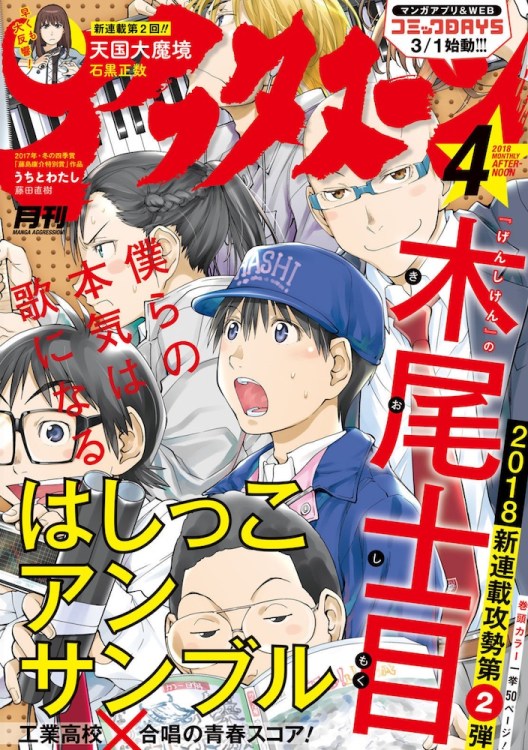
Ensemblers Assemble: Hashikko Ensemble Chapter 2

It’s the second chapter (and the first regular-sized chapter) of Shimoku’s new manga!

Summary

Kimura Jin wants members for his chorus club, and he’s asking the quiet yet unusually deep-voiced Fujiyoshi Akira to join. Akira’s reluctant, but Jin has a proposition: if he can help Akira speak more loudly, Akira will join the club. Akira tentatively agrees.

But while Jin calls it an ensemble “club,” it’s more of an “appreciation society” at the moment—the distinction being that a group only gets club status if it has five or more members and an advisor. Jin’s first choice for advisor, Takano-sensei, refuses because she’s more of a violin specialist than a vocal one.

Jin’s also not the only one trying to get a club off the ground, as a friendly (?) rival in Hachida Shinji, who has dreams of forming a “mountain castle club.” Shinji is skeptical of Akira’s chances of speaking at a normal level, to which Jin replies that Akira’s body will understand.

As the three continue to talk/argue, they run into the Class 5 teacher, Kitano-sensei, who’s lecturing a blond delinquent-looking student named Orihara. Unbeknown to Kitano, Orihara is actually wearing noise-canceling earphones. Jin pulls out of Orihara’s ears to have a listen, prompting Orihara to start swinging at Jin, which then causes Akira to instinctively yell out. His voice is so deep and resonates so much that it astounds everyone. Jin’s first thought: Akira has “singer’s formant,” i.e. the ability to sing both loudly and clearly, which usually only comes with musical training.

Story in Motion

So now we’ve established the initial goal, and it’s the classic “getting enough club members” story—a tried and true trope that I don’t mind one bit.

If things go as typically expected, Orihara is on track to becoming a member. I have to wonder what his for might be, both character-wise and voice-wiser. Hachida Shinji is a potential member as well. Maybe they’ll pull the “combined club” trick, a la Chuunibyou demo Koi ga Shitai with its “eastern magic and napping society.”

Shinji

As an aside, the idea of a club dedicated to studying mountain castles is tremendous, and I hope Shinji gets his wish.

I also think Kitano-sensei will be their advisor, but that might just be wishful thinking. Her brief appearance has already made me a fan. She’s adorable!

Another character I think is going to make a splash is a female classmate named Hakamada. In this chapter, Jin asks her what music she’s listening to, and something about the way she’s framed says to me that she’ll be significant somehow.

Jin is a Character

The way that Akira ends up yelling out plays perfectly into Jin’s notion that he’ll understand what to do “with his body”—as in almost by instinct. But is Jin actually the calculating type? He sure doesn’t seem that way. And yet, he’s also the one who offered Akira exactly what he wants.

Jin might look like a typical anime otaku, but he really is a music otaku through and through. He carries around a device to measure the number of Hertz in people’s voices and appears to have both a technical and intrinsic understanding of singing. What’s more, he hears an anime song and thinks “Ghibli? Disney? Eva?” as opposed to something more hardcore.

Jin’s vocal range really is absurd. It was established in the first chapter, but here he basically shows that he can cover most of the guy parts (as well as some girl parts) and only really needs Jin for the deepest registers.

By the way, Akira is actually a bass, not a baritone! I madea mistake in my description last review. Chalk that up to me having no real music knowledge.

Singer’s Formant

Speaking of being a total newbie when it comes to music, I’m still not entirely sure I understand Singer’s Formant. As far as I can tell, certain sounds don’t carry as well, so singers train to be able to project loudly and clearly over even orchestras in large spaces. Correct me if I’m wrong!

I also found this video, which might help explain things better.

Songs

If you’re wondering what that “anime” song is that Jin is asking about at the beginning, it’s. “Trancing Pulse” by Triad Primus from The iDOLM@STER Cinderella Girls.

Final Thoughts

Actually, a lot of teachers are introduced quickly in this episode and they all seem full of personality. I’m looking forward to seeing which ones become more prominent as the manga progresses.

Until next time!

Like this post? Feel free to check out my Patreon, or leave a tip at my Ko-fi.

Kio Shimoku and Genshiken Trivia, Courtesy of “Mou, Shimasen Kara”

Over the past year, the manga magazine Monthly Afternoon has featured interviews in comic form with its own serialized manga authors through the series Mou, Shimasen kara. Afternoon Gekiryuu-hen by Nishimoto Hideo. This past month’s issue puts the spotlight on Genshiken and now Hashikko Ensemble creator, Kio Shimoku, so I’ve taken the liberty of summarizing all of the Kio factoids in it.

-For the first time ever, Kio actually reveals his “face” (albeit in manga form). He’s known for being a private person, but he decided show himself through this manga. He reasons, “I’m over 40 now, so what does it matter if I show my face or not?”

-Kio used to work analog, but has been an all-digital artist ever since Jigopuri. He does everything, from thumbnails to color, all on his Wacom. He doesn’t customize his pen or brush settings much.

-He almost never uses assistants. Kio had one assistant on Genshiken Nidaime and none for Hashikko Ensemble, his new series. For those who don’t know, this is highly unusual.

-Kio got the inspiration for Hashikko Ensemble because his daughter joined a vocal ensemble, and he happened to listen to an all-male group.

-He was never a musician, but knew a local group, so he did do some singing for them about once a month, and even had a voice trainer. He’s a second tenor, which was the basis for Akira’s baritone in Hashikko Ensemble. Kio has a fairly deep voice himself, so he decided to exaggerate it for the manga.

-Once, in school, he saw two kids harmonizing on the way to class, providing further inspiration. “I want my manga to make readers want to sing.”

-Kio was in the softball club in elementary school, the judo club in junior high where he was the captain, and the art club in high school.

-He submitted his first manga in high school, for Shounen Sunday. It was about a high school student who works at a used bookstore and discovers an ancient text that he then tries to decipher.

He drew a lot when he was kid, and was an otaku in middle school, where he imitated Doraemon, Kinnikuman, and Captain Tsubasa.

-However, he stopped drawing between 4th grade of elementary and the start of middle school. This was because he was really into Miyazaki Hayao as a kid, and when he couldn’t copy Miyazaki successfully, he got depressed and stopped trying for those few years.

-In middle school, he helped a friend out by drawing backgrounds for his manga, only for Kio to realize he was also better at drawing the characters too. One day, when he tried to draw Miyazaki characters again, he noticed he had gotten way better.

-He wanted to be an animator, but Ghibli only wanted people 18 and up. Once, he created a manga based on the Laputa novel in a couple of notebooks.

-In college, he majored in Japanese art because he thought the pencil and brush skills would translate to manga.

-Kio’s dad worked at an insurance company, and while he wasn’t flat out against Kio’s aspirations, he would constantly ask him to consider the risk of being a manga creator. This made Kio want to quickly win a manga reward, to help his parents accept it.

-The school he went to had a club called the Society for the Study of Modern Visual Culture, becoming the inspiration for Genshiken. Surprisingly, however, Kio was actually only a member for half a year. He didn’t quit because if anything in particular, he’s just not good with group activities.

-Despite what it might seem, the Genshiken characters are not based on any real life counterparts.

-In response to the realism of his characters, Kio says he tries to convey a sense of “presence” with them.

-Kio feels Genshiken came at the perfect time, matching the zeitgeist of the era. However, it makes him feel like a one-hit wonder. If Hashikko Ensemble fails, he’s going to feel enormous pressure.

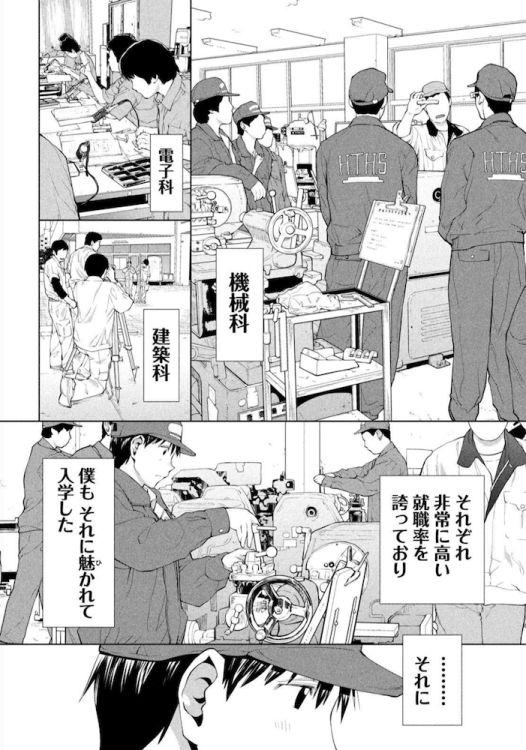
-He didn’t attend a technical high school so he needs more research. One of he authors of Mou, Shimasen kara. did, and the other has a sister who attended one, so they try to help out.

Thoughts

Kio’s done a lot!! He sort of seems like a renaissance man.

That bit of surprise aside, it is fascinating finding out just how many aspects of his own personal life and career have made their way into his manga. The attending a Genshiken-like club is one thing, but it’s notable that he was in the judo club and then the art club—just like Hato. He also converted to using a tablet monitor for manga at some point—just like Ogiue. While his characters aren’t based on any real people in particular, he takes bits of himself and places them in his creations. While not stated outright, I think it’s pretty clear that Jigopuri (which is about raising a baby) is the product of firsthand experience.

Like this post? Feel free to check out my Patreon, or leave a tip at my Ko-fi.

“I Go High, You Go Low”: Hashikko Ensemble Chapter 1

Genshiken author Kio Shimoku has debuted a brand-new manga series this month, and it’s a bit of a departure from the otaku-centric tribulations of daily life that he’s known for. Fan that i am, I’ve decided to start doing monthly reviews for it, much like my previous Genshiken Nidaime posts.

Summary

Fujiyoshi Akira and Kimura Jin are new students at Hashimoto Technical High School. Akira sports an unusually deep voice that cracks when he tries to raise it, so he generally avoids speaking if he can help it. Jin is anything but quiet. Notorious throughout the school for his undaunting enthusiasm and his loud, boisterous tunes between classes, Jin wants to recruit fellow students to form a vocal ensemble.

When Jin notices Akira’s exceptional baritone, he sees Akira’s voice as the perfect complement to his own alto-soprano range, and becomes dead-set on having Akira join, all while unaware that Akira was actually a singer himself in middle school before his voice changed. While Akira is reluctant, he ends up having second thoughts for one major reason—Jin thinks he knows how to fix Akira’s voice.

A Dynamic Duo

Although Hashikko Ensemble has only just begun, the concept of a pair that’s greater than the sum of its parts has me intrigued. It’s not exactly new territory, with titles like Haikyu!! and Kuroko’s Basketball among the more famous, but I am curious to see how this turns out in a non-sports, non-shounen narrative.

Making Akira’s voice extremely deep is a simple yet unorthodox character choice. While I’m no expert on singing manga, my experience is that main characters in such series tend to stand out because they can sing extra high (such as in the manga Shounen Note) or powerfully. It’s also uncommon, despite the commonness of teenage settings in manga, for the voice-cracking that comes part and parcel with puberty to actually come up in series.

One aspect of Akira that isn’t entirely clear is whether his reticence over his voice is because of the attention he receives from the other students (who inevitably remark how “manly” it sounds), because it’s a painful reminder of when he could sing, or some combination of the two. Whatever the reason, it helps to give Akira a strong sense of character and presence, despite his fairly generic appearance and demeanor.

In contrast, Jin stands out tremendously. Because of the way he looks, comparisons with Onoda Sakamichi from Yowamushi Pedal feel inevitable, but two differ in two important ways: Jin seems immune to embarrassment, and he’s a “music otaku” rather than an “anime otaku.” There’s something about a guy who so overwhelmingly looks like a dork while being utterly fearless in the face of his peers that instantly appeals to me. It’s what I aspired to be in my teenage years, so I find Jin quite admirable. As for what being a music otaku means, Jin has a scientific understanding of sound and voices, speaking of vocal cord vibrations and decibels, which is why he believes he can help Akira.

“Ensemble” Cast

While the main focus of this opening chapter is Akira and Jin, there are plenty of side characters with potential to enrich the story. As with Kio’s other series, realistic portrayals of human relationships look to be one of Hashikko Ensemble’s strengths, and I look forward to seeing how the cast at large develops. From the first chapter, the stand-out character has to be Hanzan, the wisecracking son of a Buddhist temple who actually wore a wig to school on day one just so he could reveal his bald head during class introductions.

One factoid about their high school is that boys outnumber girls by about 11 to 1. I have to wonder if this will play a major role in the story, or if it’s just for realistic flavor. I wouldn’t mind seeing some female characters join the cast (there’s already one who shows up briefly), but would also be fine if it remains guy-centric.

Songs

Originally, I was going to list every song that shows up in this chapter, only to realize that Jin sings so much that the number of tunes encroaches into the double digits, and I’ll leave it to someone who’s more of a music buff in general. Here’s a sample:

Hashimoto Technical High School Anthem

“My Grandfather’s Clock” (Japanese version). English lyrics by Henry Clay Work, originally performed by Johnny Cash.

“Te no Hira o Taiyou ni” (Sun in the Palm of My Hand). A children’s song originally featured on the weekly television program Minna no Uta in 1962.

“Kanade” by Sukima Switch.

“HEIWA no Kane” (Bell of Peace) by Okinawa Yukihiro.

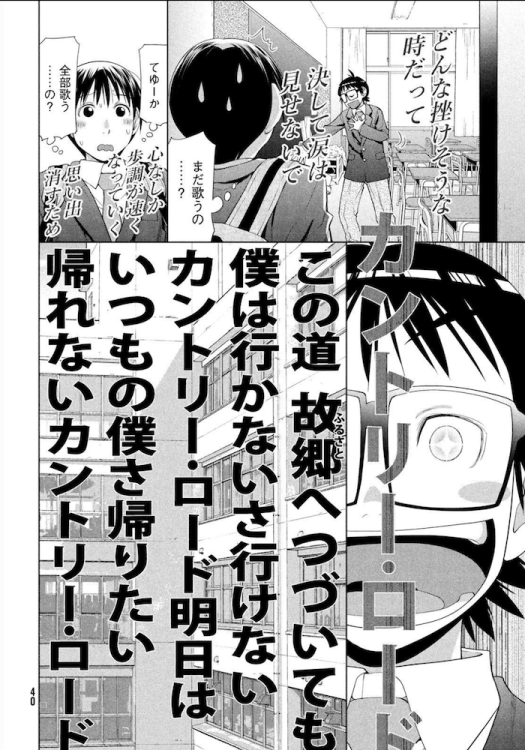
“Country Road” (Japanese version) by John Denver. This is the version from Whisper of the Heart.

“Country Road” is particularly significant to the story, as it’s the point where Akira is finally drawn in by Jin’s singing—particularly Jin’s ability to handle traditionally women’s roles.

Final Thoughts

This series definitely has potential, and I don’t mean that just because I’m a Kio Shinoku fan. It’s somehow both low-key and energetic at the same time, reflecting the different personalities of its two central characters.

There’s another manga that also runs in Monthly Afternoon titled Mou, Shimasen kara: Afternoon Gekiryuu-hen, which features interviews with other Afternoon manga creators. This month’s is Kio Shimoku, and in it he mentions being especially invested in Hashikko Ensemble because he doesn’t want to be a one-hit wonder after Genshiken. I hope Kio finds new success with this manga.

As for the rest of that interview, it’ll be the focus of my next blog post. SEE YOU NEXT POST.

Like this post? Feel free to check out my Patreon, or leave a tip at my Ko-fi.


Kio Shimoku Interview at Anime News Network… and He Answered My Question!

A couple of months back, Anime News Network announced that they were interviewing Kio Shimoku for the release of the new Genshiken Second Generation (aka Genshiken Second Season aka Genshiken Nidaime) bluray set. The interview is now up, which you can read here. Kio speaks about topics such as why he decided to introduce Hato to Nidaime, how he feels about otaku culture.

Kio actually answered my question, which I’m totally stoked about! I’ve reproduced it below, though I’m sure you could find it by just hitting “ctrl+f Ogiue.”

When it comes to Ogiue, one of the more notable visual changes is how her eyes are drawn. As this quality is unique to Ogiue in Genshiken, why did you decide to express her mental and emotional growth in this manner? Additionally, is it something you planned to do from the start, or was it something you developed as you worked on the manga?

It was accidental and naturally developed.

To put emphasis on her unfriendly look and distant nature, I designed her eyes without the highlight. After her mental transition, those characteristics changed and the initial design for her eyes simply didn’t work anymore.

It’s not surprising to me that the change in Ogiue’s would have come from a whim of sorts, as this is the case with a lot of creators and their characters. As much as I love the original Ogiue’s eyes, it also makes complete sense that they wouldn’t work nearly as well as she began to truly open up to Sasahara. It’s also quite noticeable how differently she looks and behaves compared to her former self (something I’ve tried to show off in my new banner).

The 0ther answer I find most interesting has to do with how Madarame’s “harem” has developed, because Kio states that it’s something of a natural progression. There were already characters interested in Madarame in some capacity, and when Saki finally rejected him, it opened up the playing field, so to speak. He wasn’t suddenly popular, they just began to be interested in him for just the way he is. If I were to interpret it further, it’s not like Madarame became the image of the attractive guy, but rather that he attracted exactly the type of people that would be into him.

As for the rest of the interview, it’s really worth a read and gives a lot to think about, especially when compared to his old interview with Publisher’s Weekly back in 2008. At the time, Kio expressed a lot of discomfort with the increasing attention otaku were getting in the media, and even in this ANN interview he talks about how he came from the generation where people were ashamed to be otaku. It’s really fascinating to see this mindset play out and evolve over time, as well as how the concept of “otaku” itself has become more nebulous. In fact, this sentiment has also been expressed by Tamagomago, who calls himself an old-type otaku standing in the face of these changes. In a way, it makes me wonder if Genshiken Nidaime is an attempt to navigate this newer environment in a way that embraces it, rather than shunning the unfamiliar.

If you liked this post, consider becoming a sponsor of Ogiue Maniax through Patreon. You can get rewards for higher pledges, including a chance to request topics for the blog.


Ask Genshiken Creator Kio Shimoku!

In preparation for the American bluray release of Genshiken: Second Generation (aka Genshiken Second Season, Genshiken Nidaime, Genshiken II), Anime News Network and NISA are accepting questions from fans for an interview with creator Kio Shimoku. Keep in mind that Kio has historically given very few interviews even in Japanese, so this is a very rare opportunity for anyone who’s a fan of Genshiken and the man himself.

I of course will be submitting my own question, and it will most likely be Ogiue-related. Also, I may have bought the Japanese blurays already, but I definitely plan on picking these up as well.

(Thanks to Patz for telling me about this.)

Kio Shimoku in the Flesh

Kio Shimoku, the author of Genshiken, is an elusive individual. Portraying himself as a kind of ape, he so rarely makes public appearances that he is sometimes mistakenly believed to be a woman. In fact, when he appeared for an event to celebrate the Genshiken Nidaime (Second Season) anime, it was kind of a big deal. Thanks to Brazilian Genshiken enthusiast Diogo Prado, however, I’ve learned that photos of Kio do exist.

Apparently Kio had attended an event in Taiwan in 2010, where he promoted the release of his manga Jigopuri (also known as Digo Puri). His desire for privacy is respected here, as none of the photos actually show his face, yet it’s still pretty cool to see the man himself. Obviously I don’t know how he is as a person, but the fact that he looks like a nerd who knows how to clean himself up and dress nicely is a trait also demonstrated by the characters in Genshiken over time, namely Ogiue and Madarame. In fact, he looks pretty similar to Madarame from behind, while in the old Publisher’s Weekly interview with Kio he said that Ogiue is somewhat reflective of his own experiences.

By the way, I wonder how Jigopuri ended up doing in Taiwan.

How Kio Shimoku Got His Groove Back

Genshiken II‘s been running for a while now, and every so often I go back and look at the earlier chapters of the new series (would you expect me to do otherwise?). Upon a recent revisit, it hit me just how much the artwork had changed between the inaugural Chapter 56 and its immediate followup in Chapter 57.

For comparison, here is Ogiue in Chapter 56 on the left, and 57 on the right.

There’s a clear difference between the two versions of Ogiue (or any other character) that can’t be chalked up simply to the gradual evolution of art style that happened throughout the original Genshiken. This change, given just how drastic it is, was more abrupt, though one has to keep in mind that the real life gap between 56 and 57 was almost a year (Chapter 56 was originally a one-shot that got turned into the start of a new series).

Because of how much softer and more cutesy Chapter 56 Ogiue is portrayed, my suspicion is that Kio’s style was affected by his time working on Jigopuri. Indeed, Chapter 56 of Genshiken actually came out in the middle of his run on Jigopuri.

In fact, if you look at one of the characters in Jigopuri, the little sister Kaname (pictured left), she looks pretty close to the Ogiue of Chapter 56. What’s also kind of funny is the fact that Volume 1 of Jigopuri features an Ogiue cameo on the inside cover, and it’s clear that the Jigopuri style hadn’t fully taken over Kio’s artwork yet at the time he drew it.

I think it’s interesting how an artist can get so influenced by how they’ve been drawing that it makes it difficult to shift gears back to a different kind of story. It’s different depending on the artist of course, but I have to wonder how much effort Kio put into switching into a less moe-type art style. Something tells me it wasn’t easy.

Anime! The Cause of, and Solution to, All of Life’s Problems: Genshiken II, Chapter 58

It’s a big day for the newest members of the Society for the Study of Modern Visual Culture, as the three rookies spend their very first chapter almost entirely independent of Ogiue and the others. Can Yajima, Yoshitake, and Hato carry the story without backup from the Genshiken veterans? Do they have what it takes to garner their own fans? And is Sue a fan of Hellsing? All these questions and more (or not) will be answered in Genshiken II, Chapter 58.

Ogiue, Genshiken chairman that she is, decides to foster camaraderie among the club members and revive an old tradition by having everyone write/draw their own profiles for Genshiken’s defunct club magazine, “Mebaetame.” If you’re not sure what that is, try to remember the little blurbs they had in between chapters of Genshiken where they talked about their favorite Kujibiki Unbalance characters and what-not; that’s “Mebaetame.” If you’ll recall, Ogiue never actually participated in the magazine, and perhaps we’ll finally learn just how to pronounce her pen name, Ogino/Okino Meisetsu/Nayuki/Nariyuki.


Yes.

Yoshitake thinks this is a good opportunity for some healthy bonding, and invites herself and Hato over to Yajima’s place to work on their profiles together while having some beers. Yajima (kind of) agrees, but is uneasy about alcohol. Hato doesn’t seem to mind either way. Here is where we see our first bit of additional insight on the new members: Yoshitake, cheerful and bubbly, has no qualms about knocking a few back (which creates anticipation for the inevitable drinking session/contest with Ohno) and breaking some rules, whereas surly and practical Yajima, citing age restriction as the primary reason to not purchase alcohol, turns out to be more naive than expected. In fact Yajima’s naivete and confidence (or lack thereof) seem to be a major topic for this chapter.

Lacking faith in her own artistic skills (“I said that I draw, not that I can draw!), Yajima, whose first name we find out is “Mirei,” is arguably the most “typical” of all of the girls in Genshiken at this point, especially in terms of looks. When she compares herself to members past and present, including a curvaceous cosplayer, a fashionable “normal” girl, and an impossibly attractive male cross-dresser, you can see how it impacts her self-image. Even Ogiue is likely included among the “beautiful,” as Yajima has only ever seen her as Ogiue Chika, Well-Dressed Professional Manga Artist with Boyfriend, and wasn’t around for the Ogiue who wore clothes two sizes too big, or her gradual and awkward transition to her current state. You can see Yajima thinking, “Wait, otaku aren’t supposed to be this way! If even my fellow nerds are this attractive, where does that leave me?” It’s all the more troubling for her when she remembers that Hato indeed has a Y-chromosome, and that a guy is passed out in her apartment from drinking too much. Being the innocent straight-arrow of an otaku that she is, when she accidentally/intentionally confirms Hato’s gender via skirt lift, it’s clear that it’s far outside of Yajima’s comfort zone.

Seeing as it’s a chapter taking place in Yajima’s apartment, it’s no surprise that she’s getting the most development of the three, though we still learn a few details about the other two. In addition to Yoshitake’s excited, yet nonchalant attitude towards life and its vices, we learn that she has an appetite on the level of Kobayashi Takeru and equates “profile” with “personal essay.”  And with Hato, we now know that he 1) is an Economics Major 2) has quite good taste in anime, and 3) is pretty damn hardcore with the BL. Among his favorite titles are Hetalila, Doarara!!!, Winter Wars, Fuyume’s Book of Friends, and Sweets Basket. He also likes a series called Femto, which I’d like to believe is some Berserk spinoff all about Griffith but might actually be a reference to Boku no Pico.

So overall, I think that Yajima, Yoshitake, and Hato held their own, though next chapter seems to be focusing on Madarame, which is also welcome. Until then, I’m going to try and popularize the phrase “Dai Ogiue.”

The Not-So-Gentle Path: Genshiken II, Chapter 57

From the moment I began this blog, I’ve established the fact that I am a huge fan of Genshiken. After reading the inaugural chapter of the all-new Genshiken II however, I realized that this is the first time that I’m actually reading fresh material alongside all my fellow Genshiken enthusiasts. Sure, there was the second TV series, but that was mostly existing material, so in a sense this new “limited series” acts as a kind of return to basics for Ogiue Maniax, a starting point for me to share my thoughts so to speak.

So to celebrate this small revival and to welcome back this blog’s namesake to the world of serialization, I am going to give my thoughts and impressions on this first chapter. As more chapters come out there’s a possibility that you’ll be seeing Ogiue Maniax’s first ever instance of episodic chapter blogging, but I’m not making any guarantees.

New Genshiken feels different. I won’t pretend that it doesn’t. The cast is mostly different and is now populated primarily by women, replacing the “awkward men’s club” vibe that kicked off the original series. At first this seemed a little jarring, but Ohno’s off-handed mention of the soul patch guy, aka the Genshiken member that never was, reminded me that prior to the arrival of Yajima, Yoshitake, and Hato the membership barely ever increased. Ogiue and Kuchiki arrived together, while the following year Sasahara’s sister Keiko entered, and in the case of Kuchiki and Keiko both of them were already introduced previously. Sue is Sue. If anything, with such a large cast change I’d be surprised if the series didn’t feel a little different.

The focal point of Chapter 57 is the cross-dressing Hato Kenjirou (who might be a reference to Hayate the Combat Butler author Hata Kenjirou), or rather, everyone’s opinions of Hato. I think Hato’s inclusion set off alarms in a lot of readers’ heads more than anything else, creating a bit of fear that the series would lose its heart and pander too much to otaku at the expense of what made Genshiken good in the first place. As the chapter went on, I could feel that fear growing in myself, but I think it was actually all just set-up for a really pointed reminder that Kio Shimoku did not forget what made Genshiken tick in the first place.

While I clearly favor Ogiue, I think the real star of the chapter was Yajima. Throughout most of the chapter the club feels almost uncontrollable when it comes to the topic of Hato and cross-dressing in general despite Ogiue’s best efforts, sort of like the impression you might get at an anime con seeing a bunch of young attendees with no supervision. Then Yajima comes out and says that she’s kind of uncomfortable with Hato’s cross-dressing. By presenting this point of contention, Yajima manages to bring the club (and the manga itself) back down to Earth and keeps the club environment from getting completely out of hand.

This sort of conflict is actually a pretty persistent theme in Genshiken, whether it’s in the earlier days with Kasukabe’s mean-spirited attacks on the club, or later on with Ogiue and her own inner demons. In a way, Yajima’s somewhat direct personality and her unfamiliarity with the beast that is the Society for the Study of Modern Visual Culture makes her the “Saki” of the new bunch, even if she can’t match Kasukabe in looks. Whereas Saki was a normal person experiencing the world of otaku for the first time, Yajima, who is already an otaku, has to deal with an anime club unlike any she’s ever experienced. That’s not to say that the other characters are unrealistic, though. Hato is developing well, and even the way in which Ohno, Sue, Yoshitake, and Kuchiki get carried away is not that unusual. It’s simply that Yajima, as well as Ogiue, act to rein them in a little, creating a new and different character dynamic.

On the topic of Ogiue, I found it quite interesting that, aside from a small bit of pictorial exposition by Sue, Ogiue goes through the entire chapter without her signature paintbrush style. Even the one-shot had Ogiue tie her hair up, something that was established in previous material as a habit of hers when drawing. Though I’m sure it’ll return in at least one future chapter, it still feels like a break of sorts with the previous series. In terms of her character, it’s interesting seeing Ogiue as Genshiken chairman. After all, back when the original series ended it was one of my greatest wishes to see the continued appearance of Ogiue as head, and in this situation I find myself to be quite fortunate.

Ogiue isn’t a natural leader. In fact, none of the previous chairmen were, with the possible exception of the mysterious First Chairman. However, all of them were able to develop their own natural strengths into leader-like qualities, whether it was Madarame’s strong self-image as an otaku, Sasahara’s subtle confidence and understanding, or Ohno’s gentle guidance, and Ogiue looks to be doing the same. Though not always consistent, Ogiue can have quite a forceful personality, especially when she puts her foot down about something, and I think that this aspect of her personality, combined with the fact that those new members are all freshmen, will result in her being more and more comfortable with her position of authority as time passes.

So that’s the start Genshiken II, and I look forward to more. Of course.

Genshiken 2 DVD Box Set AND A NEW CHAPTER OF GENSHIKEN MANGA?!

I mentioned it a while ago, but I just wanted to remind everyone that Genshiken 2‘s compilation box set is being released tomorrow, December 22nd, 2009 in Japan. This box set will differ from the previous DVD release in that it will have special exclusive box art by Genshiken author Kio Shimoku featuring Ogiue, Sue, and Angela.

More importantly however, MUCH MORE IMPORTANTLY in fact, is the news that Kio Shimoku has actually penned an ENTIRELY NEW CHAPTER OF GENSHIKEN. Much, much thanks to this anonymous commenter for making me aware of it. You can find a link to the chapter itself in there, and if you want an actual copy I believe it will be a part of the February 2010 issue of the magazine Monthly Afternoon, whose official release date is Christmas Eve (though apparently it’s been leaked!) Most likely it will be included as a special with volume 2 of Jigopuri, Kio Shimoku’s current series about a young mother.

The chapter focuses on Ogiue as chairman of Genshiken, and makes references to Kinnikuman. So in other words, pretty much everything I wanted.

BANZAI

OGIUE BANZAI

荻上よ、永遠に輝け!!