A couple of episodes of the magical girl anime You and Idol Precure has an enemy henchman named Cutty forcibly transformed into a giant robot called Cuttinda. As a fan of both giant robots and magical girls, I felt the need to write about Cuttinda, particularly its appearance and the way it draws from three different works from the mecha genre.
The first robot referenced is Mazinger Z, based on the red plate on its chest. Normally, those shades are part of the Monster of the Week’s face, but here, they’ve specifically been placed in a way similar to the Mazinger line.
The second is Gaiking. The limbs, particularly the design of the wrists and the red sections of the legs, are really reminiscent of the monster-chested robot.
The third is Giant Robo. Cuttinda’s head, like Giant Robo’s, resembles that of a pharaoh or the Sphinx.
I think Cuttinda being the way it is comes from the fact that Precure is a Toei franchise, as all three of these mecha are also by Toei. Mazinger Z and Dino Mech Gaiking are both anime, while Giant Robo is a tokusatsu series.
WIll we ever see Cuttinda merch? Probably not, but I wouldn’t mind getting a silly robot.
I’ve been looking at the Kakumei Shinka Mazinger line from Soul of Chogokin, and the first thing that stood out to me was the legs. They’re slimmer than what immediately comes to mind when I think of Mazinger, and so I decided to just look at other images: anime screenshots, manga images, other toys, etc.
There are two things I’ve noticed. First, the Kakumei Shinka line more closely follows the original manga designs in terms of silhouette. Second, the lower halves of Mazinger’s limbs really run the gamut, from relatively svelte to Popeye-esque.
I don’t know why exactly this variation occurs, but I’d hazard that it’s about the constant push and pull between adhering to the original, appealing to nostalgia, and attempting modernization. The first Soul of Chogokin was the realization of a concept: high-end toys for the child fan who has grown up. It reflects a goal of looking more mature. The GX-07 is based on the Mazinger Z from the 90s Mazinkaiser OVAs, where it has some 90s flourishes but isn’t supposed to be the absolute unit that Mazinkaiser is. Other versions, like those based on Shin Mazinger and Mazinger Z: Infinity take their own angles as well.
I think I prefer the ones with a bit more heft, but I definitely find a certain charm in the manga/70s anime look. It gives Mazinger Z (and Great Mazinger) a more human feel that’s more superhero than weapon.
So, to any readers, I have to ask: What are your favorite Mazinger legs?
Terada Takanobu is a veteran game producer, and has been involved with the Super Robot Wars franchise since the 1990s. This interview as conducted at Otakon 2023 in Washington, DC.
Hello, it’s great to meet you. I’ve been a long-time fan of the Super Robot Wars series, and I’m very glad that is finally easy for people to play around the world.
My first question: You recently announced that you were becoming a freelancer. How has that change been for you? Have there been any particular advantages or challenges that come with it?
There were lots of interests I wanted to pursue, so I decided to step down from the producer role to become a supervisor, and use that time to do the things I’d like to do.
I want to make toys and plastic models, and original robot animations—ones that are not Super Robot Wars OG.
Do you have any all-time favorite anime or even tokusatsu works?
My favorite super robot is Mazinger Z. As for tokusatsu, Ultraman and also Masked Rider. And more and more.
Original Kamen Rider, or…?
It would have to be the first Masked Rider, fundamentally.
One signature element of SRW is the continued use of very creative 2D attack animations. What are the reasons you have stuck with this style even though so much has changed about video games over time?
In Super Robot Wars DD, we’re doing 2D animations and something between 2D and 3D too, so we’re diversifying.
In SRW DD, the idea behind going for 3D animation is to better capture the original. But more than when I was a producer, I can now better create the content I make compared to before
What has it been like developing mobile games, as well as having multiple games out there? Is it part of a broader strategy?
With regard to the overall strategy of creating mobile games, that lies with the publisher, Bandai Namco, so I can’t really speak to it. However, as for challenges in mobile games specifically, I’d say one that having a deadline every month is a bit challenging. For example, before, if it was for a console, you had three years to get the battle animations and the scenarios and put everything into one package. But now, with the mobile games, you have everything packaged every month.
You started at Banpresto in the 90s. Are there any staff from that era still at [its successor] BBSoft?
There are some.
Do you have any specific series or character units that you thought turned out especially well in terms of their presence in SRW? Or do you think there were any storylines that were executed very well?
It’s a bit difficult, because all of them are a lot of work, and I’m mainly putting effort into making what’s there. It’s a cyclic process of making and releasing and making. More than myself, it’s ultimately the users who decide what’s good.
Are there any titles you are especially proud of being able to obtain for SRW or thought you’d never get for the series?
Space Battle Yamato, aka Star Blazers. As for recently, too many. Hmm…recently, Gridman, Mobile Suit Victory Gundam, and Gun x Sword. In SRW DD, Devilman and Koutetsu Jeeg. What’s it called in English?
Translator: [Steel] Jeeg.
Oh, just that directly.
Ogiue Maniax: There isn’t much of a Jeeg presence in America.
Ah, I see. Oh, and there are two Jeegs now: [Steel] Jeeg and [Steel God] Jeeg.
The impression I have about SRW is that there are the “main” games—Alpha, F, F Final, V, X, T, 30, etc.—and then there are smaller ones that tend to be a little more daring with game mechanics and what series they include. One title I think of is SRW Neo, with Jushin Liger. Is there any truth to the idea that you see the smaller games as more experimental?
Before, yes, there was a difference with the more experimental ones. But now, SRW DD is the only one out, and in there, we try all sorts of things like Jushin Liger and Granzort. SRW DD does embrace the style of SRW, such as the game stages and the scenarios and everything.
I know that you cannot reveal any unannounced information, but has there ever been any consideration to include giant robots from non-Japanese media?
I’m not allowed to say what it was, but there were past attempts. There’s lots I would like to license, but it didn’t work out.
Do you receive feedback from the directors and other staff involved with the titles included in SRW? For example, have you ever had to interact with directors Tomino or Anno?
Yes, there has been some feedback—and actually, there have been some ideas that came from Tomino-san and Anno-san. And actually, I came across some suggestions that Kawamori-san of Macross had earlier. But I had to tell him that’s not something I have control over.
One last question: Over the years, you’ve worked with many voice actors, and unfortunately, some have passed away. Sometimes, they are replaced by new actors, and other times, you re-use existing voice clips. Do you have any say in who gets recast in SRW, or is it outside your control?
If it’s stated by the original source material, I will do as the source material requests. Otherwise, I have the freedom to choose.
Sometimes, you’ll see a wild claim about mecha anime, like “Gurren-Lagann was the first giant robot series to be about characters instead of the robots,” and it inevitably results in a backlash—in this case, the counterargument that all giant robot shows are about characters. Whether the initial statement is made in jest or as a genuinely ignorant take by someone with only surface-level knowledge of mecha, it reflects certain assumptions about what the genre is like.
I got to thinking about the notion that giant robot anime are about characters because it’s both true and an oversimplification. Moreover, the extent to which the giant robots truly “matter,” as in they’re inexorable from the world being portrayed and can’t be substituted with some other form of weaponry, varies tremendously. But regardless of the true “necessity” of either characters or robots, I feel there is more to it than just one side mattering more than the other. Then a thought occurred to me, and I have a kind of nascent “universal theory of giant robot anime”:
Giant robot anime are about characters, but more specifically, the main character reflects some vital or fundamental aspect of the world and story around them. The giant robot, in turn, is reflective of the connection between the hero and that aspect.
If it seems nebulous, that’s because it is. I’m thinking less about trying to justify every mecha anime and more about how the giant robots end up being the avatar through which so many of these protagonists interact with their environment and their histories, and thus reveal more about the anime themselves. There’s also no denying the close ties between giant robots and merchandising, but this also ebbs and flows over the decades.
So let’s start with some of the big ones.
Tetsujin 28is about Shoutarou trying to make a difference in a post-WWII environment by being a boy detective who fights crime. Tetsujin 28 the robot was created to fight the Allies, but is now being used for an alternate purpose: as a guardian of peace instead of a weapon of war.
Mazinger Zdraws a direct lineage to this sort of thinking. While the power fantasy and toyetic appeal of the robot itself is undeniable, Kouji is presented with a question about human potential from the very beginning: If you had great power, would you be a god or a devil? The robot Mazinger Z is Kouji’s way of making a difference, and he chooses to use it as a protective guardian.
Mobile Suit Gundam, the first “real robot” anime that emphasized the robots as weapons of war over superhero-like entities, is about its hero Amuro’s repeated exposure to the trauma of war. It’s through the Gundam that he experiences physical and emotional scars alike, and the very fact that his piloting experience molds him into a capable soldier also contributes to the overall “horror of war” message that girders Gundam and its many sequels.
Superdimensional Fortress Macrosshas three main components: romance, music, and robot battles. Here, the titular robot is literally a flying city traveling through space, and it functions as both an urban cosmopolitan center and a massive superweapon. In other words, it is the very space in which all three pieces of Macross take place.
Neon Genesis Evangelioncenters around Shinji and his fear of human connection, be it with his family, his peers, his friends, or anyone else. It is the anime of extreme introspection. Not only is the EVA-01 the means by which he tries (and fails) to find self-worth, but the EVA itself is revealed to house the soul of his dead mother. He is contained in a womb-like structure inside of his giant mom.
Tengen Toppa Gurren-Lagann is about Simon and the limitless potential of humanity to overcome all obstacles slowly but surely—and ultimately whether there should be limits on that power. Gurren-Lagann manifests this through numerous transformations fueled by human spirit that bring on exponential power growth.
The above examples are all heavy hitters, but what I also want to emphasize is that this applies to “lesser” titles as well.
Brave Police J-Deckeris maybe the most on-the-nose example of the relationship between a boy and his giant robot, as the story is about how Yuuta’s friendship with the giant police robot Deckard is what teaches the latter to develop true emotions and a proper sense of justice and humanity.
Shinkon Gattai Godannaris about the relationship between Gou and Anna as husband and wife and how their love affects both their personal and professional lives as co-pilots. Godannar Twin Drive is literally a combination of both robots.
Robotics;Notesfocuses on Kaito and his relationship with Akiho’s giant robot club, and the blurring of augmented reality with actual reality. The creation of the Guntsuku-1 is basically an untenable goal that, through the events of the series, becomes effectively “real” through how Kaito and Akiho view and utilize it.
Trider G7is about Watta, who’s both a little kid and the CEO of his own company, utilizing both the image of Japanese corporate culture of the early 1980s and the classic child desire of wanting to do what the adults do. The Trider G7 robot literally flies out of a playground, and has tons of cool and wacky weapons, but the fact that it’s Watta’s robot and the main way he gets his job done means it’s the conduit through which that “grown-up” fantasy takes place.
Shinkansen Henkei Robo Shinkalion the Animationis literally a commercial for bullet train toys that are, in turn, advertising for the Shinkansen trains in Japan. Its main character, Hayato, is basically a Shinkansen fanatic who sees them as not only the coolest things ever but as reflecting a philosophy of unwavering service to the people of Japan. The Shinkalion robots, by extension, portray a more action-packed version of this concept.
Giant robot anime embody many values, from crass commercialism to dreams of being brave and strong, from anti-war sentiments to deep looks inward at the psychological scars of society. The mecha themselves are often not “characters” in and of themselves (with a number of notable exceptions), but they are symbolic of how the protagonists of these stories relate to what they experience. The hurdle for those who think that these anime are “more about robots” is that this particular way of communicating the characters’ stories requires an acceptance of giant robots as a storytelling device.
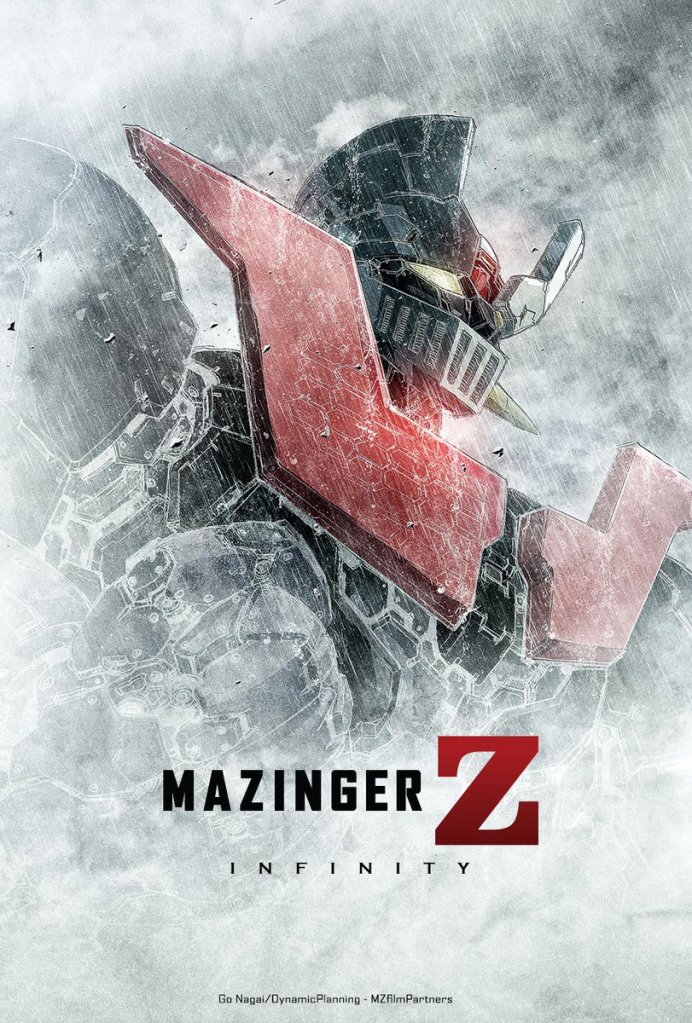
A mechanical titan emerges from a pool of water, piloted by an impetuous youth. With the power of Japanese science, this boy and his robot use lasers, mjssiles, and (of course) rocket punches to defend the Earth from the forces of evil. This simple concept became one of the foundations of anime and manga, helping to spawn the “super robot” genre as we know it, and made Mazinger Z a household title across Japan. The 2018 animated film, Mazinger Z: Infinity is the latest iteration, joining other recent Nagai Go revamps such as Devilman Crybaby and Cutie Honey Universe.
As one of the seminal works of an entire genre, Mazinger Z has been re-imagined and reworked time and time again. Whether it’s a mythological alternate world (God Mazinger), an ultra-macho 90s edition (Mazinkaiser), a mid-2000s meta epic (Shin Mazinger), or something else entirely, there’s always a desire to return to the father of super robots. Common to all of these works is a desire for action, tension, and spectacle, so it’s interesting to see how each film navigates the balance between new and nostalgic, as well as where on the Nagai spectrum of “goofy to gory” it falls.
Mazinger Z: Infinity takes place ten years after Kabuto Kouji, the hot-blooded hero of the original series, defeated his arch-nemesis, the mad scientist Dr. Hell. Now in his late 20s and a scientist, he researches photon energy (the power source of Mazinger Z) alongside his childhood love interest, Yumi Sayaka, spreading a clean energy source around the world. But when the forces of Dr. Hell reemerge with the goal of retrieving Mazinger Infinity—a mysterious robot/artifact that dwarfs even Mazinger Z in size—the people of Earth and Kabuto Kouji have to decide how to best protect their planet. Key to this conflict is a girl found inside Mazinger Infinity named Lisa.
The action scenes are amazing, as expected. The very first thing the audience sees is Great Mazinger in combat, piloted by Tsurugi Tetsuya, using nearly all his signature moves as if to make clear that this film revels in the thrill of combat. Later sequences are similarly impressive, especially in how they focus not on the classic one-on-one battles of the 70s but on large-scale clashes. The rest of the film, i.e. the non-action moments, tend to feel kind of safe and harmless at least in terms of presentation, like what one might typically expect from a Tezuka Production anime (Mazinger Z: Infinity is by Toei Animation). Visually speaking, Devilman Crybaby this isnot. If Mazinger Z: Infinity was just about fighting, it probably would have been good enough. The film, however, is surprisingly ambitious.
This desire to do more can be seen in both the world-building and the messages conveyed, as blunt and hamfisted as they are in execution. Throughout the movie, there are numerous cases that show, “what if the technology of the Mazinger world has progressed?” Not only is photon energy ubiquitous, but it was even instrumental to helping the world rebuild from disaster—which is probably Dr. Hell-related but also draws parallels to the 3.11 Fukushima triple disaster. Robots of a global peacekeeping force are based off of the Mazinger series, and Kouji’s little brother Shirou is a pilot.
Yet while Mazinger Z being powered by a miraculous energy might have once been interpreted as a kinder look at nuclear power, Mazinger Z: Infinity takes a contemporary stance in light of 3.11. At one point, Sayaka expresses that although photon energy is an incredibly clean source of energy, it can still be exploited by humans for less than altruistic purposes. Mazinger is classically described as having the potential to be a “god or demon”—a notion that not so subtly reflects humanity’s relationship with technology. Messages about life and family further reflect a desire to communicate social morals, which is quite different from most of the previous sequels and re-imaginings.
While the movie is meant to take place a decade later, that 10-year difference feels massive and more like the 50 years that have passed since Mazinger Z debuted. Yes, Kouji is still in his prime, so his inevitable return to the cockpit can be less of a Rocky Balboa or The Last Jedi Luke Skywalker situation. But for everything else, that decade of time embodies various cultural and historical changes since Mazinger Z debuted, and includes idols, home computers, the internet, and more. Lisa, with her robotic personality, can even be seen as a Nagai version of Ayanami Rei from Neon Genesis Evangelion. On a similar note, Kouji is faced at one point with a very Shinji-esque situation, but approaches it as only the very first super robot pilot would.
One aspect of Kouji’s aging I enjoy is the fact that he became a scientist; it’s the future I always wanted for him. His grandfather and father were both scientists who built Mazingers, so I always thought it would only make sense. I just wish he would build his own robot finally, but perhaps him being more of a “peacetime” scientist is important.
Before Mazinger Z: Infinity, there were special interviews with the staff, and what’s notable is the utter lack of pretention. When asked what they key point of the film is, the response was “entertainment.” When asked what fans should look out for, the answer was essentially “cool robot fights.” It’s a largely straightforward film that wears all of its messages on its sleeve, speaking to kids and adults alike.
A final note about nostalgia: One original character for Mazinger Z: Infinity is the leader of the joint forces that defend against Dr. Hell’s mechanical beasts. That character is voiced by Ishimaru Hiroya—the original voice of Kabuto Kouji.
While at this point we have an understanding of the concept of a “weak” protagonists in giant robot anime thanks to characters like Ikari Shinji from Evangelion, rarely are main robots allowed to exude an image of weakness and vulnerability as well. If we even look at Shinji himself, while he’s known for being passive and lacking in will, the actual EVA-01 looks monstrous and acts even more terrifyingly.
In most cases when there is a “weak mecha,” it ends up being a joke character’s ride, whether that’s Boss Borot from Mazinger Z or Kerot from Combattler V. In terms of actual main-focus giant robots, the closest this concept gets its maybe Dai-Guard the almost-literal “budget robot,” or perhaps the perpetually incomplete Guntsuku-1 from Robotics;Notes. Maybe the Scope Dog from VOTOMS counts because it’s so disposable, but like Dai-Guard it still at least looks strong.
Of course it only makes sense that mecha tend to be on the powerful side; they’re giant mechanical humanoids after all. It’s just something I’m starting to consider a potential limitation of the genre and an interesting space to explore.
One of the defining traits of director Imagawa Yasuhiro’s adaptive works is the way in which he takes a large mass of disparate information pertaining to a particular work and organizes it such that the themes and concepts are strengthened and made more vibrant through cohesion and consistency. With Giant Robo, it’s an amplification of the history of legendary manga creator and Tezuka contemporary Yokoyama Mitsuteru. With Tetsujin 28 (also originally by Yokoyama) it’s about highlighting Tetsujin 28 as a connection between post-war Japan and the militarism which had preceded this period. With G Gundam, in spite of the fighting tournament setting, it’s about the effects of continued conflict on the Earth. Shin Mazinger Shougeki! Z-Hen takes Mazinger Z’s iconic status as the super robot and shows just how much influence it’s had on the genre as a whole while also providing an argument for how Mazinger as a whole gives much food for thought if only one delves a little deeper.
What I find particular interesting about Shin Mazinger as an adaptation is the way in which Mazinger Z’s attacks themselves have been reorganized to strengthen the image of Mazinger. For example, take the Photon Energy Beam, Mazinger Z’s eye lasers. Generally they’re considered one of its weaker attacks, even often being the first and least-damaging move for Mazinger Z in the Super Robot Wars franchise. In Shin Mazinger, however, it is initially Mazinger’s strongest weapon When taking into consideration what Mazinger Z is supposed to be, a robot whose basic power comes from a combination of its Super Alloy Z (which the bombastic narration is very keen on making the viewer remember by deliberately repeating its name) and its miraculous Photon Energy power source. Tapping directly into the very thing that moves Mazinger Z only makes sense as a highly destructive attack.
When it comes to Mazinger Z’s arsenal and its cultural influence, however, there is nothing in all of the history of super robots with more imitators, successors, and homages than the Rocket Punch. What does Shin Mazinger do? For one, it makes the Rocket Punch the very first attack that Mazinger Z does in the show while giving it a fanfare worthy of the gods, but Imagawa doesn’t even leave it at that. He adds new elements to Mazinger Z so that the Rocket Punch, or a variation of it, is the greatest, most visually striking, and memorable thing that Mazinger Z can do. When Mazinger Z performs the Big Bang Punch, it literally transforms its entire body into a massive fist and becomes one with the Rocket Punch, such that Mazinger Z’s most lasting legacy (outside of the act of actually having someone control the robot from within) is also its most potent weapon.
Shin Mazinger takes Mazinger Z’s attacks and asks, “Why are these moves fun and exciting?” In doing so, it is able to play around with Mazinger Z as a cultural object and bring attention to not only what made it conceptually interesting to its fans in the first place, but also what potential still lies within it.
On the recent Anime World Order podcast there was an e-mail from a listener lamenting the lack of “real mecha anime.” The AWO guys (Clarissa was absent) concurred with his view, and said that, while they understand the argument that elements they don’t enjoy in current shows were present in past robot anime, the ratio of ingredients for baking this “cake” has changed for the worse. As one of the people who speaks about elements of current robot shows being able to trace their elements back to previous decades, and who has argued this point before, I agree that the shows of today are different. Different things are emphasized to differing degrees, and the robots are not always used in the same ways as they would in the past. My question in response is simply, what is wrong with this change?
From what I understand, when Anime World Order and their listener say they desire proper mecha shows, what they are actually looking for are shows heavily featuring action, power, and manliness as represented by giant robots. While I too am a fan of cool robots shooting lasers and all sorts of diplays of machismo, and I’m aware that Daryl and Gerald’s tastes are not exactly the same as their listener, the problem is that if you define “proper mecha” as such, then the genre becomes extremely limited. Who draws the line to say, “this is the correct amount of robot prominence in a mecha show?” You can point to Mobile Suit Gundam and say that it’s a show that has the “right ratio” of elements, but I can point to Mazinger Z and say how actually different it is compared to Gundam in terms of narrative focus and even the ways in which the robots are used, not to mention the differences between Gundam the movies vs. Gundam the TV series. How about Superdimensional Fortress Macross, which (indirectly) takes the Char-Amuro-Lalah love triangle and transforms it into a main draw of that series?
The reason I bring this up is firstly because I want to emphasize how much that ratio has changed even within the conventional history of robot anime (and I am deliberately avoiding bringing Evangelion into the equation due to its unusual position), but even more importantly because the shows which “get it right” in the current age are the product of adjusting the ratio in favor of a certain perspective on what giant robot anime should be like. Shin Getter Robo vs. Neo Getter Robo is brought up frequently in the podcast as an example of a relatively recent giant robot anime done right (or at least in the spirit of the old stuff), but it does not actually have the same ratio of elements as the robot anime of the past. If anything, it’s somewhere between the tamer Getter Robo anime of the 1970s and the harsher Getter Robo Go manga in terms of action and violence, and to highlight certain elements of each while ignoring others makes not for a show like the old stuff, but one which emphasizes certain desired elements from the previous works. This is hardly a problem as Shin Getter Robo vs. Neo Getter Robo does in fact offer the things that AWO says it does, but it’s also the result of distilling a robot anime into something more focused and specific to the preferences of particular viewers, which is not that different from the objections leveled at the current audience of robot anime.
I understand that this criticism is primarily aimed at Code Geass and other anime like it which put characters front and center in their stories and use robots for flavor. While I could argue that shows like Votoms do the same thing only in a way which emphasizes a masculine ideal, if we assume that current shows simply do not have enough robots, then I have to ask why the thrill of violence and power should be the primary motivation of robot anime? AWO speaks of the sacrifices that robot fans must endure in current mecha shows, but what about the same sacrifices people made in the past to enjoy those old robot shows when the ratio may not have been ideal for them? If people see elements such as romance, attractiveness of characters, drama of war, friendship, or any number of themes in robot anime, then I think it’s fair to say, “You know what, it’s cool that those elements are there, but wouldn’t it be great if there were anime which really brought those things to the forefront for people instead of having them buried beneath layers of action?” Using robots as a means to tell the story at hand, having problems solved by thoughts and intentions instead of by robots as a power metaphor, those sound like great ways to convey a narrative or express an idea. De-emphasizing power in a giant robot anime can and often does lead to interesting things.
Turn A Gundam, which isn’t a “modern” mecha series like Code Geass, but still places both a different level and type of emphasis on its mecha component, results in an overall stronger story because of it. The 2004 remake of Tetsujin 28 is hardly like the old 1960s one, because the theme shifted from “isn’t it cool that this kid has a robot?” to “exploring the post-war condition of Japan and the specters of the war through this robot as a science fictional element.” Yes, the latter theme was part of the original manga and anime to an extent, but by not having to value the proper “ratio,” it was able to do more. Robotics;Notes possesses many of the “flaws” of current robot anime such as an emphasis on high school, a lack of robot action, and a strong dose of drama, but it’s also an anime which emphasizes the thematic purpose attributed to giant robots. It uses the intimacy of a high school setting to show the bonds the characters have with the concept of giant robots, and does so by utilizing the “modern formula” that is supposedly anti-mecha. In all three cases, their amount of straight-up conventional robot fighting is less than expected, but it allows them to serve different purposes.
Gerald spoke of Die Hard and how keeping its constituent elements but not understanding it as a whole does not necessarily make for a proper Die Hard. That might be true, but why are we limiting the scope to just one movie? Action movies can be Commando, but they can also be Highlander or The Dark Knight. If that example is too broad, then let’s look at a franchise like The Fast and the Furious. After four movies about racing cars in deserts or highways and having some vague infiltration plot, Fast Five comes out and changes the formula into what is essentially a heist film. By focusing more on action with purpose and the teamwork element, and being less about the cars themselves, the result is a much more solid and well-rounded film which is still undoubtedly of the action genre.
Or to put it in terms of Daryl’s analogy, yes if you change the proportion of ingredients when baking a cake, you get something different. The thing is, cakes are but one possibility. What we have now are robot pies, robot souffles, robot quiches, robot donuts. You might prefer cake in the end, but all of those are equally valid and can be equally delicious.
I can still remember my first exposure to pre-Gundam giant robot anime. I had a VHS fansub which at the very end had a number of retro openings on it, a preview of what was to come from that fansub group. That’s where I was first introduced to Zambot 3, which I thought looked pretty cool, and where I first got a glimpse of the 80s’ Aura Battler Dunbine, whose catchy theme song sticks with me even today. At the same time, though, I remember distinctly thinking that Koutetsu Jeeg looked like the dumbest thing ever. I still think Jeeg is an ugly robot with its pickle legs, but it was more the overall style, fashion, choice of song, everything, that made it seem so foreign to me as an anime fan. I loved robots then as I do now, but obviously I needed some education, and I’m glad that I now know better.
I think what really sticks out in my mind in that video was the second Mazinger Z opening, mainly because of the way that Mazinger Z itself was shaded. It didn’t have the standard shine+shade of later giant robot anime, and instead had these large areas of pencil (or something like it) blocked in. When you watch the opening, you can literally see the grit of the drawing materials right there on the limbs and stomach. I hated it then, thought it made the show look old and tacky, but looking back, the way it stuck in my mind is part of why I started being able to look well past the aesthetics of 90s anime I had become so accustomed to, and to eventually realize how much the time that we’re in influences the look of everything around us, including the entertainment we watch.




 OGIUE MANIAX