The Fujoshi Files 116: Fujiyoshi Sakurako

Name: Fujiyoshi Sakurako (藤吉桜子)
Alias: The Virgin Mary (聖女マリア)
Relationship Status: Single
Origin: Hebi to Maria to Otsuki-sama

Information:
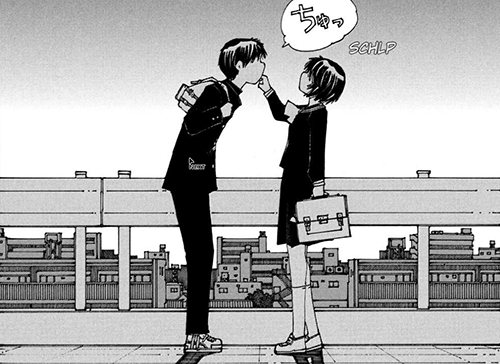
Fujiyoshi Sakurako is a high school student attending St. Otaku Women’s Academy. A closet fujoshi, she maintains an outward image of innocence and purity to the extent that she is referred to by fellow students as the Virgin Mary. The only people who initially know her secret are her mother, a famous romance novelist, and her best friend (and otome game otaku) Yori. Sakurako has experience drawing doujinshi as well as reading plenty of it.

Initially blackmailed by two high school boys who discover her hobby, Sakurako discovers that the two are actually the true identity behind “Maria Megu,” Sakurako’s favorite BL artist. She begins working as an assistant for them.

Fujoshi Level:
Sakurako kills two birds with one stone, maintaining her image as a refined lady while reveling in her own fujoshi ways by hiding her BL inside of fine literature books.

Everyone Digs Robots: Big Hero 6

When Disney announced that they had purchased Marvel, they opened themselves up to three things: jokes, cross-promotional opportunities, and new material from which to create new stories. The first two have been well in supply, while the third has just made its debut in the form of Big Hero 6, a 3DCG film loosely adapted from a Marvel comic series of the same name. The result is a movie that wears its lineage as the offspring of Disney and Marvel upfront, and which for the most part benefits from combining the raw, simple excitement of superheroes with the old Disney desire of creating family-friendly and uplifting animated films.

Story-wise, Big Hero 6 is an overall strong affair. The film centers around a 13-year-old boy named Hiro Hamada, a young robotics prodigy from the awkward portmanteau of “San Fransokyo” who mostly squanders his talents. Due to the influence of his older brother Tadashi, as well as Tadashi’s own creation in the form of a gentle healthcare robot named Beymax, Hiro is set on a path that leads him to not only pursue his ambitions but become a full-fledged superhero in the process. Big Hero 6 balances humor with action and a bit of tragedy, and it’s amazing how much can be done with a simple fistbump joke. On top of that, though, there are two qualities in the film, or I should say the protagonist, that stand out to me.

First, Hiro is an Asian protagonist in a field that is classically connected to the image of white heroes. At first, this might not seem that important because both Disney and Marvel have histories with Asian characters. Disney has Mulan and American Dragon Jake Long, and if we’re counting the Middle East as part of Asia as well, then there’s also Aladdin. Marvel has numerous superheroes that are ethnically Asian, such as Sunfire and Jubilee. However, I what’s special about Hiro is being able to see an Asian hero at the center of a big, important Disney + Marvel movie as someone whose abilities are not derived from his “Asian-ness,” especially because of how both companies have historically projected an image of “whiteness,” intentional or otherwise. Both companies have most recently shown a greater concern for diversity in characters (see Princess and the Frog and the new Ms. Marvel for a few examples), and while Big Hero 6 may not be the first, it is a clear and concerted effort to further show heroes of all kinds. To have powers derived from some mystical East Asian aspect is not inherently a bad thing, but it is quite overdone. While there is the risk of the association of Japan with technology and thus a kind of Techno-Orientalism, it never comes across that way even as San Fransokyo greatly resembles a Disney-fied Blade Runner Los Angeles.

The second important aspect of hero, which I’ve already mentioned, is that he’s a nerd. At this point nerd chic is old hat, and we’re at a point where so many people play video games that there’s little of the stigma that used to be there, but I think this is still important because of the portrayal of nerds in media, especially in Disney and Marvel properties. Again, both companies are not inherently against hyper-intelligent characters; Phineas and Ferb, a comedy about two genius kids, is one of Disney’s most successful properties in recent memory, while Marvel has characters like Professor X leading the X-Men. However, in both cases the go-to formula for hero vs. villain primary conflict has been some form of brawn vs. brains, where intelligent characters are scheming connivers: Scar to Mufasa, Jafar to Aladdin (who granted is more clever than anything else, but it’s a different type of smarts), Captain America vs. the Red Skull, Hulk vs. Leader. Big Hero 6 doesn’t just flip this into a good brains vs. evil brawn scenario, but actually makes it brains vs. brains. At the climax it’s a matter of pitting intellects against each other (albeit intellects redirected to look a whole lot like brawn) which are doing battle.

Of course, the brainy Asian who’s good at math is still a prominent stereotype, but this is mitigated by the fact that many different characters, Asian and non-Asian, are shown to be intelligent and into robotics. The rest of the core cast, which is mostly comprised of Tadashi’s college friends, are Asian, Black, White, etc., who are all so enthusiastic about developing technology that they went to college to accomplish that. Additionally, these characters have not just ethnic diversity but also a kind of physical diversity as well. While it doesn’t go as far as to include, say, handicapped or transgendered characters (which is still probably a risky step for a company like Disney and so unlikely to happen), the characters have a wide range of body shapes and sizes. Compare for example the difference between the tall and thin Honey Lemon and the shorter and rounder Gogo, both of whom are portrayed as beautiful in their own ways without their beauty being their most defining features or their primary functions in the narrative.

Speaking of diversity, the character Wasabi, who in the context of the film is the nickname for a black character, was originally a source of some controversy because his name was “Wasabi-no-Ginger” for an Asian character. I can see why this got a bad reaction, but I do wonder if it was supposed to be a reference to how manga characters are sometimes named. Most famously, Toriyama Akira, creator of Dragonball Z, names most of his characters after food (Vegeta), food-related products (Freeza), or underwear (Trunks). Here, the choice to change a Japanese character with a potentially offensive name into a black character might in a vacuum be considered on the same level as turning a non-white character into a Caucasian, but I think the contexts are different. My opinion on this is still undecided, but I think it’s the result of both an increasing awareness of cultural sensitivity and how important that can be, along with Disney responding to a market that increasingly cares about this issue.

This being primarily an anime and manga blog, I also want to mention all of the references and similarities to anime and manga that litter the film. From Hiro’s not-Mazinger Z wall clock to the fact that his superhero outfit looks awfully similar to Priss Asagiri’s hardsuit in Bubblegum Crisis, there’s much love paid to mecha in a way similar to Pacific Rim and even anime like Robotics;Notes which are also love letters to robot shows. Having seen it only once in theaters I couldn’t go over it with a fine-toothed comb, but attention is paid to Japan and its own history of animation. Given Frozen and its enormous success in Japan, I wonder if Big Hero 6 with its Japanese protagonist can perform similarly

Overall, Big Hero 6 is a strong first step in a lot of different areas. It’s good as the true debut of the Disney-Marvel alliance, and even better as a product of both companies’ increasing efforts to represent and inspire a multicultural environment. There’s clear intent at franchising this film, so I’ll be curious as to where it all goes.

Smash Bros. and Games as Physical vs. Mental Competitions

Note: As is evidenced by some of my recent posts, I’ve been quite into the new Super Smash Bros. as of late, and have been participating in online discussions more because of it. Rather than keeping those posts in forums or on other sites, however, I’ve decided to also include them here as “supplemental” blog posts.

Taken from Smashboards:

I’m not competitive on the level of anyone in this discussion thread, but I wanted to post in here just because the direction of this conversation is one that I’ve seen fought a million times over in multiple competitive gaming communities. I’m not a game designer so I can’t say firsthand what works and what doesn’t, but what I mainly want to say is that it’s very easy to take a firm position on how competitive games “should be” but it risks inadvertently accusing others of making or even playing games “incorrectly.”

Sirlin usually comes up in these arguments because of his emphasis on yomi and how polarizing it can be. To simplify Sirlin for a bit, he believes that execution barriers are the devil and if we could all play with purely our thoughts and intentions games would be much better. Essentially, Sirlin wants games to answer the question, who is the superior thinker? It makes sense, but mainly if you see games as “brains over brawn.”A number of years back Sirlin took a class on Starcraft Brood War that was being given at a university, and from his perspective one of the issues with Brood War is how tedious the game is in terms of things you have to click to even play the game at a remotely decent level. I can’t remember the exact words, but he basically suggested something like a maximum cap to APM so that who presses buttons faster wouldn’t be a measure of skill. Instead, it would be about using your actions wisely instead of simply some people getting more opportunities than others. Naturally, the Brood War community disagreed. It loved the idea of APM as an execution barrier, or more specifically the combination of speed and precision needed to use it effectively. It separated chumps from champs, and when a great player is able to build his army so perfectly because he never misses a beat in his production cycles, it’s viewed as a thing of beauty.

We’ve heard it over and over again that fun is subjective. It’s the rebuttal that competitive Smash players use against the argument that they’re playing the game wrong because they don’t embrace the free for all chaos that Smash advertises itself as. It applies here too: different people get satisfaction out of games differently, and this includes competitive gaming as well. In other words, while Sirlin views games as a domain of the mind, some people like the idea of being able to defeat brains with brawn even in games. They like the idea that they can train up their “muscles”, and that, by being bigger, faster, and stronger too, even the most brilliant tactical mind in the world wouldn’t be able to keep up.

For some, mastering a frame-perfect 50-hit combo in an anime fighter sounds like the most tedious thing ever. You sit around, committing things to muscle memory, hardly a showing of your mental skill. However, for others, improving your ability to read the player and to think more critically in a match is too abstract a reward. Others still might believe that the true test of skill comes from managing luck and taking advantage of uncertainty, as in games like mahjong or Texas Hold ’em. Depending on where you fall between those two extremes, different games appeal to different people because of what they believe “competition” means. Bobby Fischer famously promoted a version of chess where starting positions were randomized because he believed that chess was becoming too reliant on memorizing openings, but it didn’t stick because, most likely, people on some level liked being able to improve by having superior memorization compared to their opponents (inertia from years and years of tradition was probably a factor as well).

I think the implicit disagreement as to how games should be competitive is what creates such tension within Smash Bros. itself. You have this massive clash of philosophies within a single franchise, and even within a single game. Putting aside the fact that Melee is more mechanically difficult than Smash 4 (as far as we know), and that this has created some dissatisfaction for players who believe the Melee way is the best, even Smash 4 itself has different philosophies behind its characters which can cater to different people’s idea of “competitive fun.” We’ve seen the argument that Sonic’s gameplay is degenerative because it forces the opponent to have to guess where he’s going to be and throw out moves in the hopes of catching Sonic, but there are people who love the idea of games as gambles, of having to shoot into the darkness because there’s a thrill in being able to more effectively navigate uncertainty. This isn’t to deny the frustration fighting Sonic can create, nor is it an argument that Sonic or any other character is balanced or imbalanced. Rather, it’s about the fact that different characters in Smash end up embodying different concepts of competitive play, and when they clash there’s always the chance that arguments of a character being bad for gameplay for being too simple or complex or whatever. It’s important to think beyond our own conception of competitive fun and to be able to see from the perspective of others.

Tomino’s Daughter (NSFW)

Wl3MssK

One of the talking points of the new anime Gundam: Reconguista in G, related to the fact that it’s the return of Gundam creator Tomino Yoshiyuki in a directorial role, is that the dances performed by the characters in the eyecatches were choreographed by, of all people, Tomino’s youngest daughter Yukio. According to Japanese Wikipedia, Tomino Yukio is a modern dance choreographer living in the Netherlands, and as it turns out, some of her performances are available on YouTube.

Be warned, these videos contain some nudity.

I’m not really into dance, so I can’t comment in depth on the performances or the choreography, but I find it interesting that both of his children went into the performing arts (his oldest daughter Akari is a theater director in Japan). Obviously I have no idea about their family but I do feel that Tomino’s own work in anime reflects a kind of performative spirit in itself (his dialogue often sounds like it comes from a musical or play), and I wonder if this has influenced his children in any way.


Ogiue Maniax Reviewing Monthly Girls’ Nozaki-kun on the Anime Now! Podcast

Monthly Girls’ Nozaki-kun was one of my favorite anime of last season, only I never got around to talking about it. Fortunately, I’ve gotten a second chance thanks to one Mr. Bradley C. Meek, who has started up a new show, the Anime Now! Podcast. You can listen to us talk about one of the funniest shows in recent memory, where perpetual misunderstandings make would-be romances even more charming at the same time that the series riffs on shoujo manga tropes.

Anime Now! Podcast Episode 1

Smash Bros. and the Desire to Learn Bad Characters

I’ve been playing quite a bit of the new Super Smash Bros., first for Nintendo 3DS and soon for Wii U. In both cases I waited in line along with millions of other folks with the intention of playing the game until the cows come home. In celebration of the true beginning of the 4th generation of Smash Bros., I’d like to talk about the idea of using “inferior” characters.

Whenever I see a comment that X or Y character is garbage, something compels me to try that character out. I don’t consider myself an exceptionally talented player, nor am I going to win any tournaments any time soon. Even if i were, I also definitely don’t think I will be responsible for revolutionizing any character’s style or for defying tier lists in a major way, like Taj did for Mewtwo or aMSa has done for Yoshi in Melee. Instead, I think what prompts me to start delving into seemingly weaker characters is that when I see others so strongly deny a character’s ability to compete, it makes me genuinely curious.

Is this character really as bad as they say? Is there perhaps some aspect to the character that may have been overlooked? While in the end they might very well be right and a certain character could end up being the bottom of the barrel, often times I feel as if there is some incompatibility between a player’s preferred style and a character’s attributes that could lead to a bit of wasted potential (even if that potential might not be particularly high). For example, I often see “this character has no combos!” on a character not built for combos, or using a very aggressively oriented character defensively or vice versa.

It’s like there’s something peculiar at work in the minds of players, at times unspoken philosophies which dictate how an individual approaches their game. Case in point, when players/commentators Scar and Toph discuss why Melee player Hax is not a Captain Falcon at heart due to his preference for perfect, impenetrable technical skill over relying on reading the opponent. I want to try and adapt myself to different frames of mind for different characters.

My current project is Meta Knight. He’s had something of a fall from grace since Brawl where he was the undisputed best character, but there are all these little aspects of the character that make me feel as if those who regard Meta Knight as terrible are perhaps missing something vital to the character. Of course, now there’s a patch and Meta Knight has gained some extra tools, but even before that I felt that while I wasn’t going to wow the world with my Meta Knight, as I practiced and saw more of his ins and outs, I honestly felt that it was possible to put all the pieces together and create a formidable opponent, or at least one who would put up a decent fight against all opponents. Now that he’s been augmented in certain areas (notably killing power), things will probably be easier.

This is less a point of pride for me and more a learning process. If you read this blog and are familiar with my anime and manga content, I think you might see this approach applied there as well. Of course, unlike anime and manga in Smash Bros. there’s really only one criteria for how strong something is (how often it wins), but I think that difference is sort of inevitable.

I’ll see you online!

Iconic Sounds in Super Smash Bros.

Super Smash Bros. for Wii U is coming out this week. While a lot of the fun of the franchise is its sharp gameplay and visual nsotalgia, one thing I find fascinating about Smash Bros. as a celebratory game is the fact that many of the sound effects are taken from the original games. When Mega Man shoots his Arm Cannon, it makes that characteristic pew pew noise. When Mario does his Super Jump Punch, he has that classic “boing” effect. If you know the sounds, they’re pretty nostalgic, and if you don’t, they probably seem as if they come from a bygone era.

Smash Bros. is certainly not the only game to do this. In fact it might very well be the Dragon Quest series which does this the most, as the same sounds for spells since the original game are still being used in every sequel. However, what’s interesting is more than just the use of those classic sounds, as there are also clearly decisions to not use those sounds as well.

For example, when Charizard uses its Flamethrower, it’s just the sound of fire spewing forth, and not the original Game Boy games’ crackling noise. Its nostalgia, arguably, is not located in that aspect. In contrast, Duck Hunt’s special moves are loaded with audible NES references, whether it’s the sound of a falling duck or a wild gunman shouting, “FIRE!” while garbled by primitive voice digitization. Here, it’s as if Duck Hunt is there to represent the NES Zapper line as a whole, and because the existence of the Zapper is tied to a specific era in video games, most of its sounds have not been updated, unlike Charizard’s. It’s also notable that the Pokemon have their voices from the anime, as it implies that their cartoon is the primary way by which Pokemon characters are associated aurally.

Of course it doesn’t mean much for gameplay whether the sound effects are modern or retro, but they do give a lot of flavor to the characters and the game as a whole. It’s easy to get the sense that, ah yes, this is the character I remember from my childhood.

The Fujoshi Files 115: Kuroda Chouko

Name: Kuroda, Chouko (黒田蝶子)
Alias: N/A
Relationship Status: Single
Origin: Kyoumeiseyo!! Shiritsu Todoroki Koukou Tosho Iinkai

Information:
A member of the Todoroki High School Book Committe, Kuroda Chouko is the perfect student, skilled in both academics and sports, reliable, and blessed with good looks. Unknown to most, however, Kuroda is also an extremely rotten fujoshi who is particularly fond of super sentai. Fantasizing over pairings of imaginary characters and fellow club members, Kuroda has also created some BL doujinshi herself.

Fujoshi Level:
While most fujoshi are satisfied with thinking of pairings in terms of the traditional “Character A x Character B” or “B x A” scenario, Kuroda has come up with a whole system of pairings using additional mathematical symbols to represent different concepts. These include A ∞ B, A ≠ B (which creates something of a tsundere relationship), and A ≡ B.

Love Grows in Odd Directions: Mysterious Girlfriend X

mgx-bondofdrool2

Note: This post contains spoilers.

When you look at the manga Mysterious Girlfriend X, it’s hard to believe that it lasted for over eight years. Sure, it’s not much compared to  Ah! My Goddess, which also ran in Monthly Afternoon but for an astounding 25+ years. Yet the everyday romance of a boy and a girl connected by, of all things, a literal swapping of saliva, feels less like it should have been a consistent presence in manga and more an odd one-off (which it originally was). But last Mysterious Girlfriend X has, getting over the years not only an animated adaptation that is available both streaming and on home video in the US, but even seeing the actual manga itself available in English.

Given its long publication history, I’ve found that my life has naturally progressed since I began reading it all those years ago, and that when I come back to the title it’s from a different place. Yet, I still remember my feelings towards Mysterious Girlfriend X from back then, and it’s interesting for me to compare both the feeling of reading it one month at a time versus all at once, and from a person about 8 years younger to where I am today.

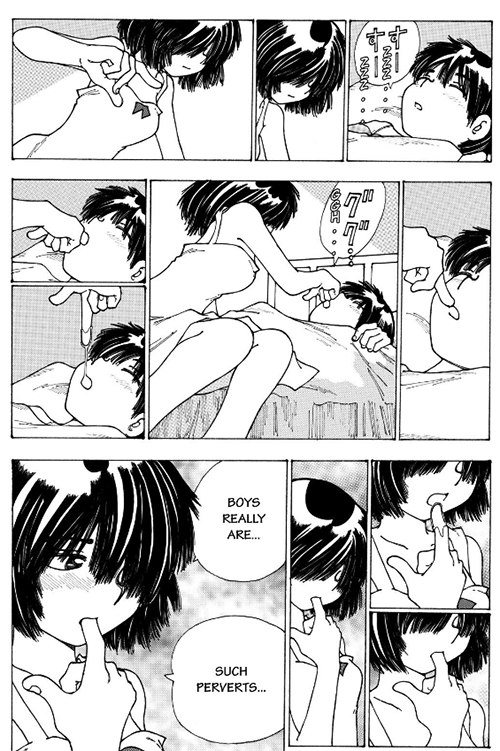
Mysterious Girlfriend X is the story of a young couple. Tsubaki Akira one day meets the eccentric Urabe Mikoto, and on some bizarre impulse decides to taste some of her drool that had been left on her school desk. Afterwards, he finds himself ill in a way inexplicable to doctors. Eventually, he learns the cause from Urabe herself: he’s having withdrawal after not being able to taste her saliva after a few days. The reason? Love, simple as that. According to Urabe, Tsubaki has fallen in love with her, and their only choice is to become a couple, especially given how Urabe herself reciprocates his feelings. However, their relationship is an unconventional one, and though they won’t even kiss or hug, they’ll taste each other’s drool. For some strange reason, this “bond of drool,” which allows them to communicate unspoken thoughts and feelings with each other, is a connection beyond typical human comprehension, brought about by love and desire.
mgx-boysareperverts2

Given this description, it would be very easy to assume that Mysterious Girlfriend X is some kind of saliva fetish manga, but in that regard the title is often misunderstood. What I described above is the initial premise to get things moving, and rather than having the manga consist of different ways to present drool lust as some sexual deviancy, it’s more a means to an end to explore various facets of their relationships, from Tsubaki learning about Urabe, to Urabe understanding her own feelings better, to the growth of their relationship in comparison to others’. In Bakemonogatari, the character Senjougahara comes up with a word to describe the main character Araragi’s feelings towards her: not moe or whatever, but captivation. Tsubaki’s view of Urabe is a similar phenomenon.

Having re-read the entire series recently, I noticed that marathoning it results in quite a different experience. This is obvious to a certain extent, but what I mean more specifically is that when I originally read the series month to month, it was easier to notice long trends (some might even call them ruts) that the manga was going through. However, reading it all at once made me aware that Mysterious Girlfriend X has rough arcs and turning points for Tsubaki and Urabe. I doubt the series had some kind of intricate forethought behind it (Legend of the Galactic Heroes this manga is not), but some seeds were sowed along the way, and by the end they bear fruit.

mgx-pantyscissors

At the start of Mysterious Girlfriend X, the narrative is mainly about Tsubaki trying to learn about firstly what it means to have a girlfriend and secondly the utter enigma that is Urabe. Here, both he and the reader get to see for the first time not only the bizarre “bond of drool,” but also Urabe’s superhuman skill with a pair of scissors that she tucks into her underwear, her willingness to swap spit but not kiss, her refusal to ever let Tsubaki have a photograph of her smiling, and other eccentricities that separate her from others. She comes across as alien both literally and figuratively, perhaps even occult, especially when compared to the relatively normal relationship between Tsubaki’s best friend Ueno Kouhei and his girlfriend Oka Ayuko. We also learn about Tsubaki’s family, particularly his very motherly sister.

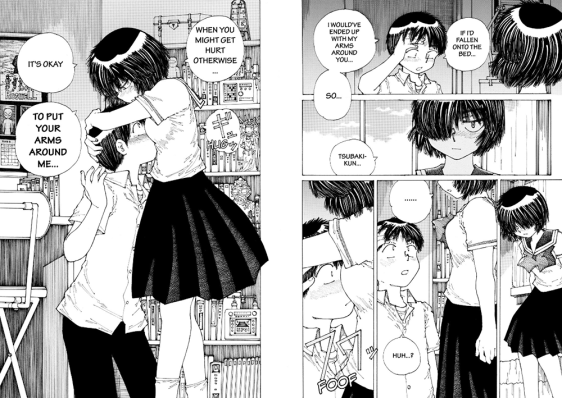
Gradually, the layers of mystery surrounding Urabe are peeled back. The first major turning point comes amidst this relationship between Tsubaki, Urabe, and the reader, as we learn about Tsubaki’s late mother through the fact that Urabe can read his latent memories from when she passed away (through his drool of course). Though Tsubaki is unmistakably a reader-insert character to some degree, here he becomes an individual of his own, and the connection between the two deepens.
mgx-hug2

From there, we get to see how Urabe herself changes, how she sees the relationship from her perspective. In particular, the manga begins to present Urabe’s own character flaws, such as her possessiveness (which turns out are also shared by Tsubaki), as well as her own growing desire to be with Tsubaki. Here, she becomes more human, and while still an unusual person is less mysterious by virtue of how much time the two spend together. The most notable events in this part of Mysterious Girlfriend X occur when Tsubaki’s bond with Urabe is put to the test. First, an old crush of Tsubaki’s comes back to try and seduce him. Second, an idol who bears a striking resemblance to Urabe (and thus a source of jealousy for Urabe when Tsubaki begins to secretly collect magazines of her) trades places with Urabe. When I first read these storylines, they felt like mini-arcs much like what came before, but now I realize that they are more or less milestones for Urabe and Tsubaki, the points at which their feelings resonate more strongly than mere appearances or past loves.

mgx-urabevsmomoka2

At the same time, the introduction of the Urabe look-alike, Imai Momoka, also signals another turning point for the series, towards what might be the most meandering and out-of-control part of the manga. Here, Mysterious Girlfriend X begins to enter a realm of fantastic occurrences and even stranger fetishes. While Mysterious Girlfriend X is not exactly a realistic series in certain key aspects, it starts off feeling somewhat grounded in an almost palpable sense of intimacy and desire between Tsubaki and Urabe. In early chapters, the dark attractiveness of Urabe is expressed in moments such as this, which are weird but understandably thrilling for Tsubaki:

mgx-scissortanlines2

In contrast, immediately after Imai Momoka we get, of all things, “eating bacon while wearing cat ears”:

mgx-catearsbacon2

Other questions from this part of the manga include “Wouldn’t it be great to count the moles on your girlfriend’s body?” and “What’s more attractive, droopy eyes (like Nozomi from Love Live!) or slanted eyes (not in the racist sense, but like Ogiue)?  Eventually the series is able to parlay this into some forward progression between the two, introducing another rival for Urabe in the competition for Tsubaki’s affections (the aforementioned “droopy eyes”), but when you’re reading from month to month it can feel like a kind of narrative limbo. I do want to point out once again though that all of this has more or less nothing to do with saliva, further reinforcing the fact that the drool in Mysterious Girlfriend X is more a kind of means to an end, and representative of many more things than simply a fetish. It’s a substitute for kissing but also much more, a way to access each others’ feelings and to capture the otherworldly feeling of being young and in love.

Even with the holding pattern that the series suffers, one thing that becomes especially clear during that most unusual section of Mysterious Girlfriend X is the evolution of the creator Ueshiba Riichi’s art style, which becomes less round and cute as was his way in his previous manga, and a bit sharper and more angular. Whereas his characters looked shorter and rounder, by the second half of the series they begin to look not only more mature but more expressive as well, especially with Urabe’s cat-like eyes. Even Ueshiba himself points this out when he discusses how his changing art style might make things difficult for the character designers.

mgx-artchange

Another clear indication of Ueshiba’s improved character drawing skills is Oka, who physically is supposed to be as small as an elementary school student but with the body of an adult. The way this is originally portrayed is rather jarring, as Oka looks more like a human being who was hit by a shrink ray, but as the series progresses she ends up looking more properly like a girl who’s simply really short.

mgx-earlyoka2

mgx-lateroka2

Eventually though the series begins to wrap up, and I think the most telling thing about Mysterious Girlfriend X and its motivations as a bizarre romance come from how it builds up towards its conclusion. The most significant developments at this point are not characters taking the next step physically so much as them sharing more information with each other. We learn how Oka and Ueno became a couple. More and more characters learn about Urabe and Tsubaki’s relationship, notably Tsubaki’s sister, who throughout the series has run into Urabe multiple times under the pretense that she is merely one of Tsubaki’s classmates. As Urabe reveals the truth about her connection with Tsubaki (conveniently leaving out the drool thing), there is a passing of the torch as Tsubaki’s sister, who has pretty much been a mother to Tsubaki all his life, acknowledges Urabe as the one who will become the most important woman in his life. Whether reading on a monthly basis or altogether, the way in which Mysterious Girlfriend X heads towards its ending is somehow surprisingly tame yet still quite appropriate for how the series has been throughout.

There’s a bit of controversy surrounding the ending to Mysterious Girlfriend X, as the manga throughout its 92-chapter run has teased a kiss between Tsubaki and Urabe while also showing many other couples kissing. Even in the final chapter a kiss never happens, as while Urabe finally asks for one, Tsubaki refuses upon learning that it would mean the end of the ritual that has defined their relationship up to this point (kissing is basically exchanging saliva, so there would be no need to do it the other way). Instead, Tsubaki asks if they can’t just keep doing their routine as they always have, at least until they graduate high school. For some readers, this ending is the ultimate denial of what the series had building towards, and indeed the series appeared to be working its way towards their first kiss. However, I find that it’s clear, given how much their relationship grows over the course of the manga, that their first kiss will happen, they will have sex for the first time at some point, but these events will happen off the page, in a future that the manga does not allow us to witness except in our imaginations. By keeping their kiss away from readers’ eyes (but at the same time showing plenty of other characters kissing throughout the series), it is the final emphasis the bond of drool as representative of their strange love as indicative of not just how love looks when you’re young, but also how it feels. Following that, one might say that the point of those almost-kisses is purely in the tease and enjoying that tease is fun in its own way.

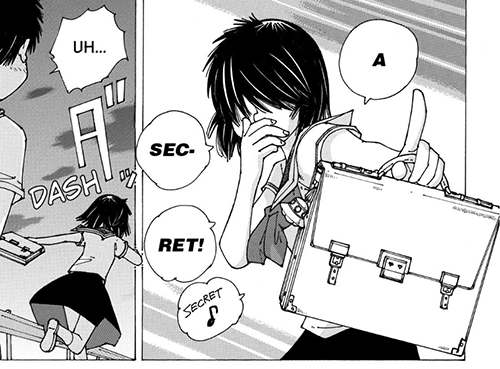
The final chapter also has a number of callbacks to significant events throughout the series, including Tsubaki’s late mother, and the excitement that sparked Tsubaki and Urabe’s relationship in the first place. The example below also of course shows off the difference in art mentioned above.

mgx-firstsecret

mgx-lastsecret

Ueshiba writes at one point that he never had a high school romance, let alone something as unusual as the one depicted in Mysterious Girlfriend X, but as I’ve gotten older I’ve begun to find that the quirks that were seemingly brought forth through sheer fantasy on Ueshiba’s parts are closer to reality than perhaps he even realized. Moments which seemed ridiculous five to eight years ago are not so far from actual reality as I’ve witnessed it. Sure, I haven’t seen anyone stick their finger into someone’s mouth and eat their drool, but the meaning and intent behind those actions also exist in reality, or at least the “realness” of one’s emotions.

Naruto: Victory is Mine!!!

Naruto final chapters SPOILERS.

As an anime fan, I don’t have a lot of character pairings to which I’m super devoted. However, the closest I come to having a true “ship” is Naruto x Hinata. Based on how their relationship began and has developed over the course of Naruto, I find that it makes the most sense, and had hoped that Hinata would have her happy ending. After all, Hinata saw before anyone else how hard-working Naruto is, and was the first to understand his pain, wile Naruto is the catalyst for Hinata’s own growth.

Now that the final chapter of Naruto all but confirms that Naruto and Hinata not only end up together but even have a couple of kids, all I can say is…

WE WON!

That said, I never actually participated in any “shipping wars” or whatever. However, I finally understand on some level the joy that more dedicated shippers feel when their desired pairing ends up being canon. There’s a strange satisfaction in knowing that all of the little moments that caught my attention as a reader ended up bearing fruit.

Now all that’s left is for me to someday feel the agony of defeat, but for the time being:

Oh, and for all of the confusion and convoluted plot developments, it looks like Naruto ends just fine.