OGIUE MANIAX

Anime & Manga Blog | 50% Anime Analysis, 50% Ogi

Maury Povich Nidaime: Genshiken II, Chapter 108

In Chapter 108 of Genshiken II, Yajima’s mom plays “Are you a Man or a Woman,” Yajima tries to get closer to Hato, and the club meets Yajima’s dad. As Kuchiki has a surprisingly heartfelt moment.

I think Genshiken in general has a knack for conversations that feel natural while reflecting the awkwardness of its characters, and nowhere is this more evident than in the scene between Hato and Yajima this chapter. As Hato and Yajima are going to pick up Madarame and Kuchiki from the nearby hotel (motel?), Yajima begins to talk to him about his comic. It’s the one subject where she believes that they’re on roughly even ground and that they can both relate to in a way that the others (sans Ogiue) cannot, so she’s going to use it for all that it’s worth. It’s a moment that really says, “Yes, this is what Yajima is about.” What makes this scene really work for showcasing Yajima’s feelings, though, is the artwork itself, where Yajima is trying her best to work through her own awkwardness and continue conversation.

Obviously that scene references the previous chapters where Yajima and Hato have been working on their manga, but there are actually quite a few callbacks to events much further back in Genshiken as well. The first one worth mentioning is Yajima’s mom trying to guess which of the girls is in fact a boy. You might recall that this happened in Chapter 56, the very first chapter of Nidaime, when Madarame predictably couldn’t figure it out and Saki was able to with one look. Looking back, it’s kind of amazing how that was Madarame and Hato’s first meeting, and now it’s gotten to this crazy stage. Also, the logic Yajima’s mom uses to single out Keiko is clear, even if she’s off the mark: all of that effort put into her makeup and appearance has to be for something, right?

Poor Keiko. Poor Yajima. Speaking of Yajima, she really does look like the halfway point between her parents.

Speaking of Yajima’s mom, I do find it interesting that the chapter goes out of its way to point out her similarities to Yoshitake in terms of personality. I think we’re supposed to interpret that comparison in two ways, the first being that she has a kind of subtly aggressive personality as she questions everyone’s gender (including her own daughter’s!), and the second being that she gives off a warm, inviting personality. One could even argue that Yajima, who takes after her father in terms of temperament, would get along with someone who’s just like her mother. That’s probably a stretch, though.

The second callback comes from the bath scenes. Recalling the Karuizawa trip, it’s quite telling that Keiko treated the disparity in chest size between her and Ohno back then not as an attack on her confidence, but in the case of Angela she sees the American character’s body as more of a threat. No doubt this is done to show that Keiko views Angela as the most dangerous rival of all for Madarame, reinforcing also her initial view of Angela upon finding out that Angela has a thing for Madarame. I’ve talked about this before, but the friendly antagonism that exists between Keiko and Angela is something you don’t see in a lot of manga, let alone manga about a group of otaku. Both clearly have a lot of sexual experience, both are aware of this fact, and thus both see each other in a different light compared to the rest.

To a lesser extent, Ogiue and Sue’s bath scene also references Karuizawa, but it’s not as significant. It’s mostly just an opportunity to make a joke at Ogiue’s expense, though in this case it’s her own self-deprecation. Actually, when I think about it, most of the time when the subject of Ogiue’s chest comes up, it’s usually her putting words into another person’s mouth. “Now you’re going to say… I’m a small-chested tsundere!” exclaims Ogiue “Joseph Joestar” Chika, as Sasahara or Sue or whoever denies her accusation.

The last reference to the past is the most obvious, as Kuchiki is told to recount how he became a member of Genshiken in the first place. Between his initial club visit, his running away upon seeing the lovey-dovey interactions between Kousaka and Saki, his re-joining the club and causing trouble from the get-go, the scene for the most part reinforces Kuchiki’s role in the story as that annoying guy in the club you just can’t get rid of. However, Kio takes the time to put a bit of a twist on all of that when he has Kuchiki reminds everyone of Genshiken’s origins as a home for misfit otaku (the rejects of the rejects).

In this regard, I  find that his apology to Ogiue actually says a lot. As he’s giving his speech before the toast, Ogiue jokingly reminds him that in their first meeting he laid her hands on him and that she’d never forget that, and Kuchiki gets down on his knees (“dogeza”), and immediately says sorry. Within this one moment, we can see that, as much as Kuchiki is generally a completely tactless and grating individual, that he cherishes Genshiken as more than just a place where he can fantasize about being a harem lead. Rather, it’s his home, a place that accepted him when nowhere else would, and to lose that connection is to lose a sense of belonging.

A few days ago I posted a translation of Japanese blogger Tamagomago’s latest article on Genshiken, where he asserts that the distinction between otaku and non-otaku, at least as it was in the mid-1990s to early-2000s, no longer really matters or indeed exists in the same capacity. Kuchiki clearly comes from before this time (as does Madarame of course), and I think given how Nidaime has gone it’s easy to forget just how awkward the club used to be. Kuchiki is a refreshing reminder of its origins, of a time that has arguably passed ages ago, and how places like Genshiken can be important for the awkward. On a personal level, as I’ve gotten older myself I’m no longer quite the nervous teenager I once was, and though vestiges of it still exist within me (and I’m still an awkward individual to be sure), it can be easy to forget just how intense it can be to worry that you don’t belong.

In a way, I wonder if Genshiken and its titular club at this point embody not simply the idea of a group of otaku, but the idea of a space to grow.

If you liked this post, consider becoming a sponsor of Ogiue Maniax through Patreon. You can get rewards for higher pledges, including a chance to request topics for the blog.

Translation: “Otaku are Hybridized, Genshiken Nidaime is Painful”

NOTE: This is a translation of a post by noted Japanese blogger Tamagomago, concerning the subject of “otaku” in current society and its portrayal in Genshiken. You can follow him on Twitter @tamagomago and check out his, Tamagomago Gohan.

All of the image links use Tamagomago’s original Amazon referrals.

As a final note, Tamagomago has a particular writing style that involves separating sentences by line, and separating general ideas by larger spaces. In the past I’ve consolidated these things into paragraphs both for readability and because WordPress used to have a hard time with multiple line breaks. This time around, I’ve tried to leave his general style intact.

61Swif41tPL

Genshiken is a manga that I love.

I love it, and that’s precisely why it’s…


Painful.


The current Madarame Harem arc is really quite interesting.

Personally speaking, I read Volume 17 and I’m on the side that thinks, “It has to be Sasahara’s sister, right?”

That’s the sort of fun I’m having with it.


However…

It isn’t about “otaku” anymore.

It’s interesting as a “romantic story about a pathetic guy.”


This isn’t a problem with the storytelling in Genshiken.

It’s because times have changed.

The existence we call “otaku” has ceased to be.

That’s all there is to it.

———————————————————————-

51V4C4lGPvL

Genshiken Volume 1 came out in 2002.

That’s the same year as King Gainer, Ojamajo Doremi Dokkaan!, Sister Princess RePure, Haibane Renmei, She, the Ultimate Weapon, Mahoromatic, Tokyo Mew Mew, Asagiri no Miko, Abenobashi Shopping Arcade, Azumanga Daioh, and RahXephon.

I think that it’s easy to understand the atmosphere at this time.


It was the dawning of a new Internet era. It was a time when 2chan had barely come into prominence.

There was no Nico Nico Douga.


We were just beginning to find freedom from the Eva Shock. We were already free from Miyazaki Tsutomu.

We felt guilty using the word otaku, and it was kind of embarrassing to like anime.

Anime such as Haruhi were yet to debut, and while we could make friends with people who also like anime and manga, we weren’t that open about it.

Those were the times.


Sasahara found in the Society for Modern Visual Culture a place where he could lay bare his otaku self. That was the first step.

Ogiue’s story was about fighting the trauma towards manga she harbored within her heart. That was the second step.


In both cases, the on-looker, the non-otaku, was symbolized by Saki.

———————————————————————-

Now, things have changed completely.

In fact, Genshiken Nidaime has been different from the very beginning.

In the first part of Nidaime, the series depicts the Society for the Study of Modern Visual Culture as a space for a group of BL-loving girls to work together.

Also, it’s the story of Hato, a crossdressing boy troubled by his worries.

Characters like Ogiue and Hato already have their pasts resolved by this part of the story.


In this first part of Nidaime, the state of “otaku” reaches a turning point just as the first chapter in Madarame’s story concludes.

51ATNfxJ64L

In this volume, we see the demise of the image of the ’00s “otaku.”


“Otaku” as a status, “otaku” as a community we depend on, the fun of trying to co-exist as both a member of society and as an “otaku.”

This is where it all ends.


When I say it’s over, I don’t mean, “there are no longer any otaku.”

Rather, the very word “otaku” has become hybridized.


That’s why Madarame, as an old-type otaku, has lost his place.

———————————————————————-

Madarame is actually a ’90s-type otaku.

Sasahara is a ’00s-type.

What’s different, you ask? It’s that the period between ’95 and ’96 is the dividing line before more and more people could be considered anime viewers and not otaku.

Sasahara gives the impression that “Otaku are out there, huh…”

Madarame is among the group of otaku who had to seek out others like themselves.

In an era without online networks, fans used analog means to get together and have fun.

It wasn’t a match over a network, but rather two people getting together to play.

———————————————————————-

For Madarame, he no longer needs to identify himself as “otaku.”

He certainly doesn’t look quite so sour anymore.


To put it boldly, everyone has become Kousaka.

Kousaka, unlike the other members of Genshiken, does not look like an otaku at first glance.

This is not something to be depressed or troubled over. Quite the opposite, it’s become totally okay to express your otaku hobbies.

———————————————————————-

I think this is a good thing.

There’s no longer that feeling of suffering and turmoil, like what Ogiue experienced.

There’s no longer that feeling that you can only ever belong to this specific group of people, like Kuga-pii.

Actually, Kugapii is in a nice place, working as a company employee.


There also isn’t anyone in Saki’s position.

In fact, I think that, even if Saki were perhaps in the club now, she wouldn’t have to pull everyone along like she used to.

After all, there’s no one left like Madarame, who would hem and haw. Everyone would just say, “Okay, okay,” in response to Saki and that would be the end of it.

You can think of that final kick Saki-chan gives Madarame as the demise of the “’90s otaku.”


Let’s talk about Sasahara’s little sister, who has dived straight into the thick of things.

The cabaret club story was interesting, wasn’t it?

That’s the feeling I’m talking about.

51JocGkSxsLTheory on the Adaptive Hybridization of Otaku subculture and Yankii Fast Food/Scenery

This book also came out recently. It’s really interesting so you should check it out.

I think the combination of otaku and subculture is easy to understand.

But they’ve also put yankii in there.

These yankii treat being a yankii nonchalantly, and even if they come into contact with otaku or subculture, it doesn’t bother them.

Here, I think you have the basis for the back and forth between the younger Sasahara and Madarame.

———————————————————————-

At this point, it’s unnecessary to identity oneself as “otaku,” nor is there a need to move and hide in secrecy. The fence between men and women has come loose.


Is it still necessary to depict “otaku?”


Works about otaku have been increasing.

However, everyone essentially looks cheerful, don’t they? They certainly don’t appear to be all that gloomy.

I think that Kirino in Oreimo has times when she looks gloomy, downright sour even (“Erotic games aren’t just popular shlock anymore, they’re deep!!)

Comparing her appearance and actions, however, she possesses the spirit of a retro otaku.

How is the “maid café” genre doing in manga? They don’t really touch Akihabara culture anymore, so there’s no way to tell.

Characters who go to Comic Market have become a part of normal manga.

61l2t4xc-FL

I totally love this manga.

There’s a lack of refinement in all directions. That said, there’s a cute underclassman (I won’t allow this! Take a good look!!).

There’s a lack of refinement, but take a look at their fashion. They’re plenty cheerful.


51KaNULe6VL

This comes across more as fantasy, but Denki-Gai no Honya-san also has pure, proper otaku.

However, rather than being about otaku, I think that this work is actually more a story of “positive self-affirmation.”

It’s okay to read erotic manga! It’s okay to enjoy BL!

Along those lines, it even says, “It’s okay for you to fall in love!”

———————————————————————-

Genshiken is also similar to these manga. It’s a 2010s otaku… wait, the word otaku no longer exists. It’s changed direction to become a communication manga about a group of people who share a hobby.

The girls who appear in the story are, to put it differently, “reality.”

In terms of their fantastic elements, they would probably be ranked as:


Hato > Sue > Angela > Sasahara’s sister


The more to the right you go, the closer you get to reality.

In a way, Hato is a boy who acts out the role of the “ideal girl” (it’s not a gender identity disorder), so naturally I’m comfortable including him in this.

Angela is a little more likely to exist in Japan, even though she can be described as the girl who wants to date “OTAKU.” [Translator’s note: “OTAKU” here was originally written in English]

———————————————————————-

This Genshiken is a romance manga that’s cheerful and filled with happiness.

It’s fun.


It’s fun, but reading it is painful.


My own sense is that of Madarame’s generation, the ‘90s otaku.


It’s come to the point that I’ve said my farewells to that era, and I’m giving my regards to the younger generations.


I no longer build myself up into a kind of character.

———————————————————————-

51+y63MvznL

I have more empathy for this work.

It’s because he’s an adult otaku. More than that, I have a lot of friends who are just like this.

I understand this type, someone who’s no longer doing the otaku thing at full force, but still trudges along that path.

———————————————————————-

Perhaps Genshiken has at least made me into an “old boy,” who goes about saying, “Ah, youth!”

But that’s not quite right, is it?

There’s no gloom. There’s no anguish.

If it had become a completely different, unrelated world, I could say, “Wow! Look how this manga shines! How wonderful!” but that would only be a halfhearted, depressed reaction.

To grow up along with Genshiken wouldn’t in itself make me feel so awful.

“All of you, please move on.”

“You don’t belong here anymore.”

If you look at it that way, it’s painful.

———————————————————————-

However… it’s interesting so I keep reading.

It doesn’t matter that this is Genshiken. Manga is manga.

Yajima, Sue, Hato, all of them are cute. In particular, Yajima has gotten increasingly cute.

Ah, youngins!


Actually, on a personal level I find this girl to be the most amazing one of all.

“This alone makes Genshiken Volume 17 worth it.”

-Gogo Tamagomago of the Dead


Yoshitake is the character I like best in all of Nidaime.

It’s just, here’s a character that really positive, acting as the axis that influences both the suffering Hato and Yajima, all while Yoshitake herself doesn’t move one bit.

This face is the first time we get to see what’s underneath.

Ah.

She’s always cheerful, but doesn’t it seem like there’s something underneath the surface?

No matter what, I can’t take my eyes off of Yoshitake.


Speaking of which, someone (a woman) once said, “Yoshitake’s fashion is really female otaku-esque.”

Somehow, I can understand that at least a little.

Though, it’s more like, Yoshitake is the very image of the female otaku during the time when Nidaime first began.

———————————————————————-

I took a long time to write this.


Right now, I’m not an “otaku” nor am I part of a “subculture.”

I realize I’m now an adult who doesn’t “belong” to anything like that.

I think it’s a joyful thing. I can like what I like and then write about it.


And yet, why is it so painful?

Why do I feel such sadness when I read Genshiken?


It’s probably because the first part of Genshiken is a story of youth coming from the idea of “deviation,” but between Hato’s change of heart and Madarame’s situation being reset, there’s no need to be deviant.

It’s a sentiment I don’t understand, and it’s just not something I have in common with them.

Please give me the courage to continue along in this deviant subculture – Tamagomago Gohan

Even as I become an adult, I don’t feel like one – Tamagomago Gohan

Even re-reading the above articles, I really don’t understand after all.

Even though I understand that I’ve become an adult and moved on.


The depression that comes from Genshiken continues to grow.

It’s simply that I’ve reached a bothersome age.


Is it just that I’m still trying to find myself?

———————————————————————-

51uvEtLeceL

Actually, I feel like this title can give me a hint.

It’s a manga I absolutely cannot ignore.

That’s because, when I read it I feel relieved.

I feel like there’s a hint here.

———————————————————————-

Ah, could it be? Is it because they don’t really talk about their favorite things in Genshiken Volume 17?

They do for a little bit, but their words feel somehow unnatural.

However, I understand that these are “otaku.” They’re otaku who don’t depend on being anything.

———————————————————————-

And yet, I love Genshiken.


The End.

———————————————————————-

Notes:

I had a realization that this is like what happened to rock music.

If you liked this post, consider becoming a sponsor of Ogiue Maniax through Patreon. You can get rewards for higher pledges, including a chance to request topics for the blog.

The Fujoshi Files 124: Ero-hon G-Man

Name: Ero-hon G-Man (エロ本Gメン)
Alias: G-Man (Gメン), Ero Books Government Man, Class President (委員長)
Relationship Status: Single
Origin: Denkigai no Honya-san

Information:
This Japanese government agent inspects erotic books in order to find inappropriate content. However, as a fujoshi, she herself is a fan of erotic materials and reads them in her off-hours. She treats her job not so much as a form of censorship but rather a form of protection for ero manga, preferring that they be labeled correctly in order to reach their desired audiences, while being appropriate enough that they don’t get removed outright: at one point she dressed up as Santa Claus to distribute orphaned erotic comics.

The Ero-hon G-Man has known the employee at Comic Umanohone famous for his excellent recommendations, nicknamed “Sommelier,” since they were little. Sommelier introduced her to the world of erotic books, forging a life-long friendship and a mutual attraction. As a child, she was a fan of the badminton-themed manga  The Prince of the Shuttlecock.

Fujoshi Level:
She occasionally attends Sommelier’s manga recommendation evenings, and is notorious for being very specific in her interests in yaoi manga. At the same time, her tastes are fairly broad including both pretty boys and muscley men.

Traveling the World One Story at a Time: Ashita no Nadja

Two of Toei Animation’s most enduring franchises are Ojamajo Doremi and Precure. Magical girl anime that are as different as they are similar—the former is four seasons following the continuing adventures of the same core characters, while the latter is currently running 10 years strong and changes its cast almost every season)—the two are chronologically separated by only one year. What filled that gap was a 50-episode anime known as Ashita no Nadja. Literally meaning “Nadja of Tomorrow,” the title points to the idea of a young girl who, in spite of all hardships, continues to look forward.Unlike the shows that bookend it, Ashita no Nadja is not a magical girl series, though it is similar in being a shoujo series geared towards a Sunday morning children’s audience. The anime’s story follows a young English orphan in the early 20th century named Nadja Applefield as she travels the world as part of a traveling troupe of entertainers in search of her mother. Initially unaware that her quest will get her entangled in the complications of European nobility, along the way she makes lifelong friends, a few bitter enemies, and manages to make almost every guy she meets fall in love with her energy and honesty. While Doremi and Precure thrive on varying degrees of entertaining “filler” episodes combined with the occasional dramatic climax, Nadja more or less continuously builds up its narrative, though not without throwing in an aggravating twist of fate every so often, to emphasize the small tragedies of Nadja’s life, and by extension her never-give-up attitude.In this way, Ashita no Nadja bears similarities to both melodramatic 70s shoujo series such as Candy Candy, as well as World Masterpiece Theater series such as Anne of Green Gables. Namely, while the main narrative isn’t about romance, it is a constant presence in the series, and in that respect it’s also similar to Candy Candy in that Ashita no Nadja is sort of a reverse-Bechdel Test. There is rarely a single conversation in the series between two men that doesn’t somehow involve Nadja. Men rich and poor, young and old, and on all sides of the law fall for Nadja Applefield.If this makes it sound like Nadja is something of a Mary Sue, that’s not necessarily all that far off, but it also doesn’t mean that Nadja is a bad character. The anime as a whole just wouldn’t quite work without Nadja being a strong protagonist both in terms of personality and what she contributes to the overall story. While she does have certain elements of wish fulfillment for a young audience, she always comes across as very human, maybe even ultrahuman (as opposed to superhuman). What I mean is that her humanity, her emotions, radiates seemingly without end.This is not to say that the series is endlessly optimistic. While I’ve already mentioned that the show has tragic elements at times, I want to emphasize this point again because Ashita no Nadja can get surprisingly dark at times. Although it’s not exactly butchering people left and right, it’s not afraid to take away a beloved character or sprinkle in a bit of betrayal. Notably, the series addresses the gap between the rich and the poor during the period in which it takes place. For example, two aristocrats frustrated at the system also vehemently disagree over how to solve this problem: one believes in working within the system, using his family’s money to help the needy, while the other believes in attacking the system Robin Hood-style. Rather than confine this theme to an episode or two, or using it merely as flavoring, this portrayal of a turning point in history, when nobility is on the verge of becoming a relic of bygone times, is actually a persistent plot point throughout Ashita no Nadja.The surprising level of consideration for Nadja’s world and the interplay between tragedy and hope are such prominent parts of the series that it even affects the merchandising engine that Ashita no Nadja was supposed to be. Like Doremi and Precure (as well as Sailor Moon, of course), Ashita no Nadja was a vehicle for selling toys. Indeed, the show is full of conspicuously toy-like products, from pink castanets to umbrellas, and even a flashy typewriter for some reason. However, at one point in the series, a male character gives Nadja a kaleidoscope, with the meta-intent being that kids will surely want this exciting new product, but the back-story they created for it is anything but joyful. It turns out to be the most prized possession of his dead mother, who lived a sad and lonely life inside the mental and emotional prison known as aristocracy, and the closest she could come to seeing the outside world was that kaleidoscope. That’s Ashita no Nadja, a show where even “BUY OUR TOYS” comes with an element of sadness.

The last thing worth mentioning about Ashita no Nadja is its visuals. Generally the show looks decent enough, full of vibrant colors and just an overall cute aesthetic. Some episodes better than others, as is expected of such a long series. In some cases, though, the animation will punch well above its weight class. While this also happens with Doremi and Precure (especially when it comes to Precure‘s fight scenes), here it is even more noticeable. In particular, episode 26 (seen above) has such eerily gorgeous character animation, set design, and atmosphere that it’s absolutely unforgettable, and even a little difficult to capture in screenshots or clips. It might come as no surprise that the episode director (and one of the key animators) was none other than Hosoda Mamoru, acclaimed director of The Girl Who Leapt Through Time, Summer Wars, and Wolf Children. He also directed the opening (seen at the beginning of the post) and ending for Ashita no Nadja, which by themselves probably endorse the show far better than my humble words.As each episode finished, I actually found it hard to skip that ending. It’s compelling and strangely addictive, which also describes Ashita no Nadja as a whole.—If you liked this post, consider becoming a sponsor of Ogiue Maniax through Patreon. You can get rewards for higher pledges, including a chance to request topics for the blog.

Ogiue Maniax on Patreon

Ogiue Maniax is a part of my life. Over the past 7+ years, I like to think that I’ve made a reputation for myself as consistently providing insightful commentary on anime and manga. I’ve never tried to monetize this blog, but am trying something out with a site called Patreon.

Patreon is sort of like Kickstarter, except rather than donating one time towards a singular goal, you would essentially be sponsoring me every month as a way to show your appreciation. You can give as much or as little as you want, and you can stop at any time or even set an upper limit in case you’re worried about spending money you don’t have. I also have some rewards for those who would like to contribute more, including the chance to tell me what to write about.

If you’re interested, head on over to my Patreon and take a look.

I want to stress that Ogiue Maniax will continue to be free. I genuinely love exploring and analyzing Japanese popular media, and that won’t ever stop.

Ogiue Maniax Talking Love Live! on The Anime Now! Podcast

hanayoriceballmunch

Love Live! is a cool show not to be underestimated. I recently made a guest appearance on The Anime Now! Podcast to talk about it along with ANN’s Bamboo and host Bradley. More importantly, I explain why Hanayo is the best Love Live.

Listen here

Hanayo_pure_sr242_t

The Fujoshi Files 123: Choco Donuts

Name: Choco Donuts (チョコドーナツ)
Alias: N/A
Relationship Status: Married
Origin: Inaka no Sengyou no Shufu-chan

Information:
Choco Donuts is a “shufu,” a fujoshi wife, who moved to the Japanese countryside after getting married. Living in “S Prefecture,” she must not only hide her yaoi-loving side from the innocent old ladies who reside there, but must also deal with the fact that it is more difficult to obtain BL works compared to more densely populated regions. Originally becoming an otaku in high school, Choco Donuts would become a complete BL fan in college. She is also a fan of the manga series Junjou Maron, which features a complex love web including a hero, a rival, the hero’s father, and even a horse.

Fujoshi Level:
Choco Donuts traveled to four different bookstores in S Prefecture just to find the latest volume of Junjou Maron.

We’re Having an Intervention: Selector Spread Wixoss

wixoss-spread-lrigs

Combining the fun of an anime about card games with the classic idea of “be careful what you wish for,” I genuinely enjoyed Selector Infected Wixoss. It explores the lives of various girls sucked into a zero sum occult game, with a protagonist who defies the rules in the sense that she plays for the love of the game, which has its own consequences. Selector Spread Wixoss is an immediate sequel that follows up on the cliffhanger from the first series, and it tries to take all of the disparate information strewn throughout the series and thread it together into a coherent story. The results are mixed.

At the end of the first series, protagonist Kominato Ruuko has a climactic battle with the fashion model/fellow “Selector” Urazoe Iona, but in spite of Ruuko winning, it is Iona’s wish that triggers. Iona, wishing to battle alongside the strongest, becomes Ruuko’s Lrig—her main card. Along the way, Ruuko and her friends have also learned the terrible truths of the Wixoss TCG: those who lose three times have their wishes reversed (someone who wishes for friends can never make friends again), and even those who win have their minds swapped with their own Lrigs. Selector Spread Wixoss explores the origins and reasons behind the Selector battles as well as the truth of a mysterious “white room” and the girl that resides there.

wixoss-spread-ruuko

As elaborate as the story can get, plot was never really the strength of Wixoss and it shows in this second series as there are a number of huge inconsistencies. While sometimes narrative consistency can be set aside for dramatic flair and strengthening characters, with Wixoss those plot holes are really impossible to ignore. I won’t go into detail about them, but there are certain explanations, connections, and reveals that just don’t quite make sense if you think about it for a few seconds, and more often than not it’s to instill a major change in a character. The story resolves well enough, and Ruuko’s stance is ultimately an interesting one, but it could have happened without all of the attempts at intricacy.

Even so, I still hold Selector Spread Wixoss in high regard. While the “conspiracy” behind the Selector battles kind of falls flat, this second series still maintains and even amplifies the strengths of the original, namely the exploration of various characters’ psychologies and the idea of wishes and desires born out of suffering, ambition, and various other emotions. For example, after Ruuko learned the truth about Wixoss in the previous series, she and her friends become dedicated to never battling again. They’ve lost too much, and are too conscious of the dangers. However, Ruuko loves Wixoss, and along with prodding from Lrig Iona she comes across as a recovering addict. “One more card battle, just one more, no biggie,” Ruuko says, as her friends try to pull her away from her deck, which she actually keeps in her pocket the whole time. At the same time, while she eventually finds a reason to battle and a noble wish to grant that is very fitting for her character, it is a bit disappointing to lose her Ryu-like status from the previous series.

I had previously compared Wixoss to Puella Magi Madoka Magica because their similarities make it almost impossible to ignore. In looking at these two works again, I realize that they essentially have opposite strengths. Whereas Madoka Magica thrives on its twists and manages to bring it all together in the end at the expense of characterization (which often feels stiff and unnatural), Wixoss as a whole manages its characters’ stories, feelings, and humanity much more deftly, with the overall plot holding together like a game of Jenga. In the end, I find Wixoss to be a fascinating series that doesn’t deliver on all of its promises, but the ones it manages to fulfill are satisfying and thought-provoking.

PSA: Tread Carefully When Episode Reviewing Yuri Kuma Arashi

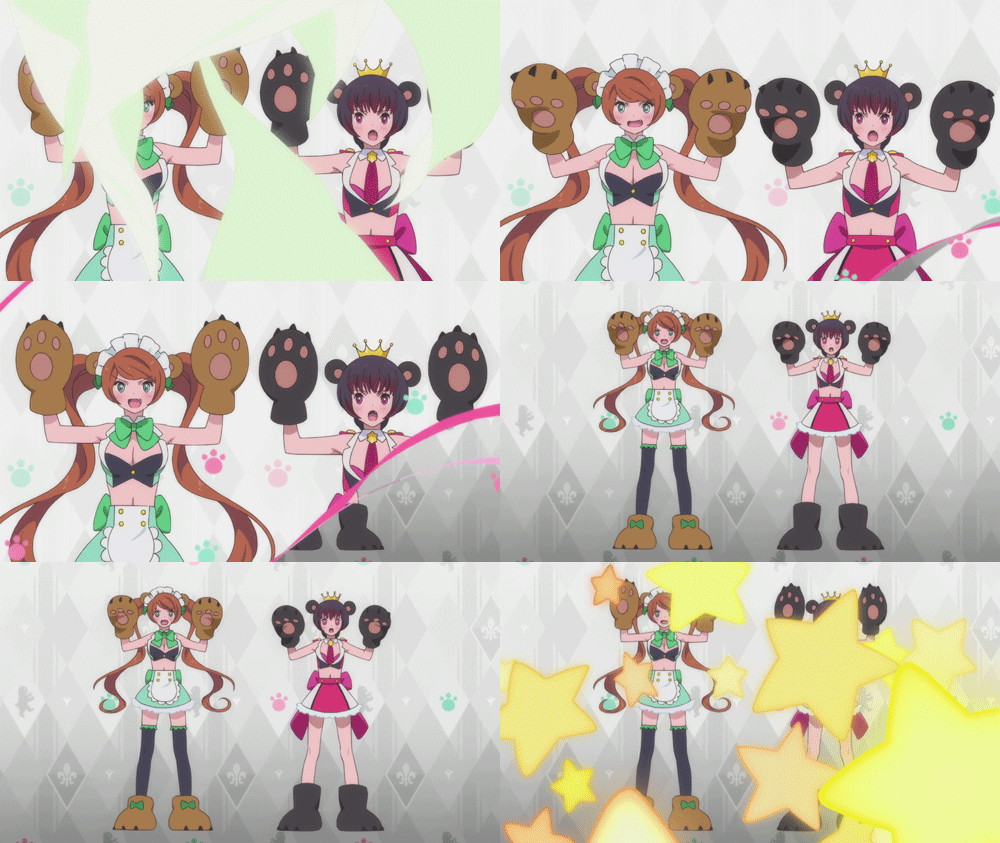
yurikumaarashi-bearhenshinGif taken from this tumblr

Ikuhara Kunihiko does not direct anime often, but when he does they almost inevitably end up being very abstract, theatrical, and full of hidden and disguised themes. Best known for Revolutionary Girl Utena and Mawaru Penguindrum, this season he comes at us with a new series, Yuri Kuma Arashi. It brings to us exactly what is in its title: lesbians, bears, and some kind of invisible storm.

Episode 1 is extremely disorienting with a lot of seemingly strange decisions. It’s easy to jump on the keyboard and begin typing out how wacky or bizarre the series is. However, while I don’t want to stop anyone from writing their feelings on the show from week to week, I want to warn my fellow anime fans, whether they’ve got blogs, vlogs, podcasts, or maybe even some kind of anime review diary (???) that it is best not to approach Ikuhara’s anime as if they were any other works. This might some a bit pompous or pretentious but I really mean it, especially in light of how episode reviews of Mawaru Penguindrum generally went.

When Mawaru Penguindrum originally aired, I would see reviewers pick apart the show each week, asking something like, “Was episode 8 better than episode 7? Well, the characters didn’t really develop more, so probably not!” People ended up focusing on small, almost pointless details and missing the bigger picture, because they were used to how a typical anime might try to improve itself from week to week. Ikuhara’s anime don’t really work that way.

One thing to watch out for is repetition. Often times, whether it’s use of stock footage or just having characters repeat some process episode after episode, this is generally not merely a time-saving measure nor solely visual flourish but something that gains meaning through that repetition. Ikuhara also likes to build in subtle hints towards the truth of what his series are about, while throwing in a few red herrings. Why would he do that? Because truths and lies and the the blurring of fantasy and reality are big themes of his, practically as big as girls loving other girls.

Given that we only have one episode I, like everyone else, don’t have much material to work with at the moment. I don’t intend to episode review Yuri Kuma Arashi, but I’ll say a few things I found notable that I think are worth keeping track of for this show. First, yuri is often something of an undertone in Ikuhara’s works, but this time it is front and center, to the extent that it appears in the title. It’s overt, maybe too overt if you get where I’m going: it is likely going to be tied to some greater concept than solely girls’ love. Second, the distinction between (yuri) girls and bears and the whole theme of “eating.” Yes, the imagery is clearly meant to imply some serious sexual activity, but why make that metaphor, and why contrast it against the chaste-looking beauty of a girls-only world? Third, consider the concepts of “Life Beauty,” “Life Sexy,” and “Life Cool,” as they pertain to how people view yuri as a genre and lesbian relationships. For more speculation from reviewers more familiar with Ikuhara’s works, check out the Reverse Thieves’ S.W.A.T. Review of Episode 1, who also helpfully ask the question why the only men in the series so far are there to judge the interactions between girls.

Again, it’s not an impossible task to review each episode of Yuri Kuma Arashi, but don’t take the show lightly, and don’t write it off as if it’s merely a vehicle for fanservice. Obviously I can’t say how the show will turn out, but don’t go seeing the inevitable twist and thinking, “But that came out of nowhere!” In all likelihood, it really didn’t.

The Fujoshi Files 122: Muryou

Name: Muryou (無量)
Alias:
N/A
Relationship Status:
N/A
Origin:
Fudanshifull!

Information:
A member of the middle school Kentei Academy manga club along, Muryou is friends with the club’s president. Muryou is a fan of the Tentel x Mikoto pairing from Omakase Tentel, though she can be very shy and embarrassed about it, especially around guys, whom she believes would only mock her.

Fujoshi Level:
While definitely a fujoshi, Muryou lacks experience at Comic Manga Market, which may indicate that she is fairly new to being a BL fan.