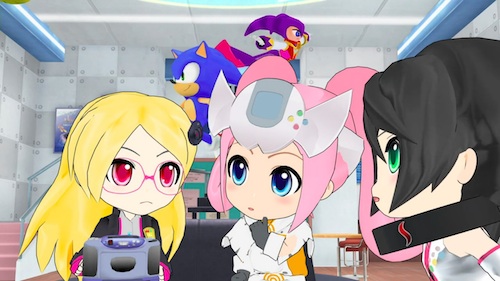
Anime Secret Santa: Plastic Nee-San

Once again I’ve participated in the Reverse Thieves’ Anime Secret Santa, where various bloggers, podcasters, etc. anonymously recommend anime to other people. This year, the show I will be reviewing is Plastic Nee-san (aka +Tic Elder Sister) a comedy series that somewhat defies description.

plasticneesan-armwrestling

Ostensibly an anime about three cute girls in a high school plastic model club, Plastic Nee-san thrives on being utterly bizarre yet just familiar enough to make it difficult to label it as simply “wacky.” Even as the girls eviscerate each other physically and mentally, it can be difficult to predict where the show will go next. Episodes are extremely short, amounting to about two minutes each, and the jokes are rapid-fire while never overstaying their welcome.

plasticneesan-mochi

Of all the anime and manga I’ve seen, the show that comes closest to Plastic Nee-san is probably Ai-Mai-Mi! Both series utilize their settings as the absolute loosest of pretenses to engage in strange, often non-sequitur humor, revel in watching their characters suffer while generally deserving it. The key differences between the two would be that Ai-Mai-Mi! goes places that Plastic Nee-san doesn’t even dream of (Plastic Nee-san at least tries to keep things in and around their school), and that Plastic Nee-san gets more over the top with its facial expressions.

plasticneesan-pointlaugh

plasticneesan-sweating

plasticneesan-laugh

plasticneesan-soldier

On the Kurumi Erika scale of amazing faces, Plastic Nee-san is clearly a 10 out of 10.

Another show that Plastic Nee-san is Nichijou, particularly in terms of the Kyoto Animation adaptation. At some point on your internet travels, you may have come across the following animated gif:

plasticneesan-slam

This lovingly animated moment is from Plastic Nee-san. In fact, this is how an episode starts. While the rest of that episode isn’t quite so violent, it still does a brilliant job of building from that initial shock to leave you dazed, confused, and asking for more. This is what makes the anime, strangely enough, very accessible to even those unfamiliar with anime, as the impact of the humor is unforgettable. Even if they don’t know the name of the series, it will inevitably go down as “that crazy anime you showed me.”

The last thing I want to point out is that while a number of shows have super cute girls doing obnoxious things, in the case of Plastic Nee-san this is greatly improved by the fact that just about every individual in this series gets what’s coming to them quickly and mercilessly. Unlike other series where characters never get their comeuppance and continue to expand their irritating and annoying personalities (which I know can be a deal breaker for some), Plastic Nee-san rains slapstick vengeance on them like there’s no tomorrow. In some cases, characters don’t even realize that they’ve paid their price, which makes things all the better. In this respect, it’s like Nichijou with all of the warm, heartfelt moments excised.

In short, if you were to watch Plastic Nee-san and Ai-Mai-Mi! in the same day, you’ll probably either solve world hunger or doom the planet to an eternity of plagues.

The Fujoshi Files 119: Saotome Haruna

Name: Saotome, Haruna (早乙女ハルナ)
Alias: Paru (パル), Great Paru-sama (グレート・パル様 Fictrix Comica (漫画製造者)
Relationship Status: Single
Origin: Negima! Master Negi Magi

Information:
Originally a middle school student at Mahora Academy, Saotome Haruna is at that point already been working as a doujin artist under the pen name “Paru.” Though she shares a close friendship with her classmates Ayase Yue and Miyazaki Nodoka, she is originally unaware of the fact that her 10-year-old teacher, Negi Springfield, is actually a powerful magician because her friends are afraid that Haruna’s gossipy nature would reveal Negi’s secret to the world. After eventually finding out, she enters a magical contract with Negi (as do many of the girls in their class) and gains the ability to bring her drawings to life as golems (a magical artifact known as “Imperium Graphices”), also earning the title “Fictrix Comica.”

Haruna is a talented artist whose skills bring her much success in unusual ways. In one case while trapped in the magic world she introduces manga to their world and earns enough money to buy a large goldfish-shaped airship and names it after herself. In her adult life, she becomes one of the most popular and best-selling BL manga creators ever, her work enjoyed by both magic and non-magic users alike.


Fujoshi Level:
In addition to becoming a best-selling BL manga artist, Haruna also regularly attends doujin events as both an artist and a customer.

Shoujo Face, Bishoujo Body

I’ve been reading one of Crunchyroll’s latest manga, Watashi ga Motete Dousunda (aka Kiss Him, Not Me) by Junko, which is premised around a fujoshi who loses a ton of weight after her favorite anime character dies and so inadvertently gives herself a makeover that attracts all the guys. Given the idea that the main character Serinuma Kae is supposed to be absolutely gorgeous, I find it interesting how this is expressed, because it’s somewhat unconventional for shoujo manga.

When looking at characters in manga, one can generally get a sense of who the artwork is trying to attract based on how characters’ sexual features are drawn. In manga for girls, even when a character is supposed to have large breasts, they tend not to really stand out compared to how they’re portrayed in boys’ manga. This is quite noticeable, for example, when looking at the difference between how the character Maya looks in the Survival Game Club anime vs. the manga. Another example is when a work depicts its female characters wearing unrealistic shirts that look practically painted on. You rarely if ever see this in a shoujo series.

Kae has what I would call a face that is fairly typical for beauty standards in shoujo manga, but her body is closer to what you would find in a bishoujo series, that is to say a manga for guys all about attractive ladies such as Love Hina, making her a hybrid of sorts between the two styles. Moreover, while the clothing isn’t so unrealistic so as to basically be super spandex, there are times when Kae’s figure is accentuated and her clothing clings to her chest. Again, this would not be so surprising to me if it were in a series that ran in, say, Dengeki Daioh, but Watashi ga Motete Dousunda is definitely a shoujo series, as evidenced by the fact that so much effort is made to portray the guys themselves as various degrees of angst, handsomeness, and dream-boatitude.

Watashi ga Motete Dousunda is not the only series to do this, though maybe there’s something to be said (about me or manga more generally) about the fact that the first example that immediately came to mind was another fujoshi-themed manga, Mousou Shoujo Otakukei (aka Fujoshi Rumi) by Konjoh Natsumi. Like Watashi ga Motete Dousunda, Konjoh’s series portrays its guys as tall, attractive fellows in that way you’d more typically see out of shoujo manga, but the girls, especially the character Matsui Youko, are given a kind of physical attractiveness that is more in line with guy-oriented stuff.

In his introduction to his book The Moe Manifesto (a collection of industry, scholar, and fan interviews about the subject), Patrick Galbraith makes mention of how Azuma Hideo, the “father of lolicon,” created his cute girl characters by combining the expressiveness of shoujo characters with the bodies more in the style of manga pioneer Tezuka Osamu. It could be said that Watashi ga Motete Dousunda is going for a similar effect, though of course calling it lolicon wouldn’t quite be accurate, even if one were to take into account how the definition of that term has changed over time, as it seems to be less about the intersection between youth and adulthood, and more about expressing a new type of ideal.

A Very Belated 7th Anniversary Blog Post

November 20 is the birthday of Ogiue Maniax, and while I’ve forgotten it before it was never quite to this extent. All I can say is, whoops! It’s not really that big a deal in the grand scheme of things, but an annual look back is one of the traditions of this blog, and it’s one I like to keep up. So, here we are.

Of course the biggest change this year for me and the blog has been moving back to the United States. In light of this, I’ve considered maybe doing something new for it. Perhaps a new banner? Maybe a new series of posts? Then again, the Gattai Girls and Fujoshi Files are still going on, and especially with the former I can only get a new post out once every few months. I also tend to drop a lot of ideas after bringing them up for no other reason than lack of inertia. Switching back to the old daily posting schedule is also a possibility, but at this point it might not be so feasible like it was four years ago.

At the same time, I’m still devoted to posting at least twice a week, though this has come with its own challenges. A few years back, in an effort to not fall behind when I was extremely busy, I started writing a number of posts in advance so I could keep up a consistent schedule. It’s worked, but one side effect is that often-times I’ll have ideas that I should be posting sooner when a show or whatever is fresh in people’s minds, but then I delay it because I have so many. What happens then, if I have a huge archive of drafts such that I don’t have to write anything for a while, is that I start to feel a bit disconnected from anime, manga, games, and even myself. It’s a weird feeling, like somehow I’m engaging less with this stuff (even though I’m still watching and reading plenty). However, if I start posting all of them at once, I get nervous about running out of a supply. I still have posts from like two years ago that I finished and just never published because the timing never seems right, and some I’ve gotten rid of because they just didn’t feel right.

I don’t know if I’ll ever get rid of this feeling, even if this blog magically became my job and I could live off of its profits (fat chance). In fact, that might make me feel even more pressured which might result in Ogiue Maniax losing some of its identity. That’s not always a bad thing, but still something I probably wouldn’t do. I know it sounds like I’m not enjoying the blog anymore, but that’s not the case at all. It’s still my favorite place for talking about the things I love.

To end off, I want to use this post to give a eulogy to my old Tenhou account. Though I managed to reach 4-dan a while back, my own neglect resulted in me failing to log in during the 3-month grace period, and so it’s been suspended with no way to bring it back. I now have to start again from the bottom, though of course that’s not actually the case, seeing as I’m re-starting with a lot more experience behind me.

The Fujoshi Files 118: Kanamori Hakata

Name: Kanamori, Hakata (金森 羽片)
Alias: N/A
Relationship Status: Single
Origin: Ebiten: Ebisugawa Public High School Astronomical Club

Information:
Kanamori Hakata is a high school student and a member of Ebisugawa Public High School’s “Tenmonbu,” or “Astronomical Club.” A cosplayer in addition to being a fujoshi, she is often teased and sexually harrassed by the club’s president, Todayama Kyouko. Kanamori is also extremely clumsy, and is a fan of a variety of series, including Saint Seiya.

Fujoshi Level:
Hakata is regularly seen carrying around yaoi doujinshi even in class.

Week to Week, Weak to Strong: Thoughts on My “Anime Power Rankings”

This past season I’ve begun participating in the revived “Anime Power Rankings,” which polls anime bloggers for their top 5 shows each week. It’s not super serious or anything, and people can choose whatever criteria they want for their favorite anime of the week, but doing it myself has made me aware of how much judging something on a per episode basis can differ from one’s assessment of the show as a whole.

I’ve noticed that within the weekly parameters I’ll often find that the shows I enjoy and look forward to the most don’t necessarily take the #1 or #2 slots every time. For example, I’m really into Tribe Cool Crew and Gundam Build Fighters Try, but when judging the merits of individual episodes, in terms of their story, excitement, ability to captivate, interesting ideas, animation, etc., often something like Rage of Bahamut Genesis will win out instead. And yet, I can’t say it’s my favorite show of the season.

Probably the show that suffers the most in my rankings in Selector Spread Wixoss, the sequel to Selector Infected Wixoss. I’m enjoying it a great deal, probably more than Bahamut even, but it almost never makes my weekly Top 5.

This isn’t to fault the Anime Power Rankings system itself; it works for what it’s supposed to reflect. However, it does reinforce in my mind the idea that some series are more than the sum of their parts.

Souther’s Holy Emperor Curry is a Real Thing

souther-curry

The magazine Comic Zenon has recently announced a special Fist of the North Star-themed curry based on Souther, the strongest of the various practitioners of Nanto Seiken, the Sacred Fist of the Southern Cross. Souther, who uses the “Nanto Houou Ken” or “Southern Cross Phoenix Fist” style, is known for fighting without stances, having his heart on the right side of his body instead of his left, using child slave labor, and riding a three-wheeled motorcycle with a throne on top (sometimes affectionately called a “thronercycle”).

More specifically, the curry is based on the recent parody manga of Fist of the North Star titled Fist of the North Star: Strawberry Flavor. Fist of the North Star is considered one of the most significant, influential, and popular shounen manga series of all time, making it a prime target for parodies both official and otherwise. In this case, Souther is specifically “Supervising Director Souther.”

Fans of Souther and Fist of the North Star will notice that the pyramid shape of the rice is a direct reference to the character. In the original manga, Souther uses his child slaves to build a pyramid in honor of his dead master, which then becomes the site of his and Kenshiro’s final battle.

The curry is available at Cafe Zenon in Tokyo and Kichijouji until January 15th. Other foods include Supervising Director Souther’s Strawberry Sweets and Hyui’s Blue Hawaii Lassi. Stickers, metal badges, and other products are also available.

souther-badge

The Fujoshi Files 117: Sakuraba Midori

Name: Sakuraba, Midori (桜庭緑)
Alias: N/A
Relationship Status: Single
Origin: Gakuen Polizi

Information:
Sakuraba Midori is a student at Hanagaki All-Girls’ High School and a long-time member of the undercover inter-school student police force “Gakuen Polizi.” Having transferred from another school, Sakuraba is paired up with a new agent named Sasami Aoba. Though often exasperated with Sasami’s enthusiasm and rookie mistakes, the two work to solve various issues pertaining to the student body. Cool and reticent, Sakuraba is also a member of the manga club and often draws BL manga in her spare time, though she tries to keep it a secret from others.

Fujoshi Level:
Sakuraba’s manga appears to be solely dedicated to yaoi. Though she argues that BL manga is just a hobby for her, she also devoted a considerable amount of attention to it.

Gundam: Reconguista in G and the Ghost of Lalah Sune

Raraiya_mondayGundam: Reconguista in G continues to be the kind of whirlwind experience that I love in a Tomino anime. Part of that feeling comes from the show’s tendency to throw around a lot of terms without explanation that everyone but the viewer understands, only to gradually peel back the layers over time. Among these many terms are clear references to the Universal Century timeline of the original Mobile Suit Gundam that Tomino directed back in 1979, and I’ve noticed that there are a couple that relate strongly to the character Lalah Sun from that first series.

The first and most prominent reference is the G-Reco character Raraiya Monday. Not only does she have dark skin like Lalah and appear to exhibit some connection to the G-Self, the “Gundam in everything but name” of the series, but characters will sometimes even refer to her as “Rara,” which sounds mostly similar to Lalah in Japanese (ララ vs.  ララァ). When looking at their last names as well, a connection forms: Lalah Sune -> Lalah Sunday -> Rara Monday -> Raraiya Monday.

The second reference comes from one of the terms being tossed around by characters that has yet to be seen: The blueprint of the “Rose of Hermes.” In Japanese, Hermes is pronounced “Erumesu” (エルメス), which is the exact same pronunciation as Lalah Sune’s Mobile Armor, the “Elmeth.”

(By the way, I learned about the pronunciation thing from watching Densha Otoko, which has as an important object in its story, Hermes-brand tea cups.)

What does this all mean? While I don’t know if these are thematic references or actual plot points, if I were to assume the latter it would mean a few things. First, Raraiya is probably a Newtype (maybe even a Cyber Newtype given her personality?), and the reason nobody is aware of this possibility is because the concept of Newtypes has been buried with time (we also see the protagonist Bellri have occasional Newtype-like flashes). Second, the blueprint of the “Rose of Hermes” might actually refer to design documents for the Elmeth’s bits. If that were the case, whoever joins Raraiya with the Rose of Hermes would gain a powerful weapon, which would also connect to the criticism of militarization that is a central plot point in Reconguista in G.

You Must Be Tripping: Genshiken II, Chapter 106

As Hato and Yajima struggle to make more manga, Kuchiki announces that he’s finally finished his senior thesis and wants to have a club trip in celebration. Though Kuchiki would prefer to travel abroad, the other members can’t afford to do so and they ultimately decide on going to Nikkou, and to stay at Yajima’s parents’ house, which is close to Nikkou. However, the club soon finds out that not only is Madarame coming along but so are some of the girls interested in him—Angela and Keiko. Moreover, Yajima somewhere deep inside sees this as an opportunity to get closer to Hato.

I feel a bit sorry for Kuchiki at this point. Think about it: Genshiken is the closest thing he has to friends, and all of them barely tolerate his existence. They have good reason for treating him that way, of course, but even what’s supposed to be a farewell vacation in celebration of Kuchiki finishing his senior thesis is secretly a “finally Kuchiki will be out of our hairs for good” adventure. On some level, I respect Kio for keeping Kuchiki around all this time, even if he’s rarely present. I feel that with a character this grating, most manga would have jettisoned him for the sake of popularity, but there Kuchiki was, being “that guy” after Haraguchi graduated long ago. It’s as if there’s a need to remind people that being a dork isn’t always endearing, but that the issue comes less from just being socially awkward and more from lacking consideration for others in your words and actions. The only question is, if this manga continues, will someone new and equally irritating eventually take his place?

As for the real meat of the story this month (sorry Kuchiki but you’re a side note even in this chapter), it looks like the feelings of jealousy (?) expressed by Hato towards Yajima and her superior manga-making skills are blossoming into something more. Though, to be accurate, it’s more like Yajima is trying to passively seize this opportunity to get closer to Hato in a way she never could, as an equal (or perhaps even a superior). It wasn’t so long ago that Yoshitake was barely able to get Yajima to admit that she has feelings for Hato, and to see her begin to sort of, kind of make a move is nothing if not impressive. I think the idea being expressed through their interaction is that, for Yajima, being able to see Hato as imperfect boosts her own confidence and thus her ability to see Hato as a “possibility” in her life. This comes across clearly when Yajima gives Hato advice on his manga, saying that it’s only half-done. Yajima has never acted like that around anyone, let alone Hato, the closest being when she acts as the “big sister” (or maybe something more?) to Mimasaka, or when she’s looking to strangle Yoshitake. There’s also something very real about the creator’s blocks that Hato and Yajima are experiencing, as Hato is struggling to get his story out in a cohesive sense while Yajima’s brilliance came from a lot of pent up emotion and a situation that is just difficult to replicate.

One of the main factors in the trip to Nikkou is Madarame and the Girls Who Love Him, which is not only a cruel joke against Kuchiki but also evidence that, despite some traumatic experiences with them, Keiko and Sue’s stories aren’t over yet (Sue isn’t mentioned but I’m sure she’ll be a part of the trip somehow). On top of that, it’s now Angela’s turn to have her chapter, and the fact that the setting is a trendy tourism spot makes me wonder if it’ll be Angela’s flirtation cranked up to 11 (especially if she catches wind of what Keiko attempted), or if she’ll go for a more subdued approach in her (mostly accurate) assessment of how to nab an otaku boyfriend.

As a final, Ogiue-related note, Ohno’s comment on the Karuizawa trip being the start of Sasahara and Ogiue’s romance made me realize that, probably much like Ogiue herself, I had always associated that whole thing with trauma and pain. You can even see Ogiue’s reaction to this when Kuchiki mentions Karuizawa and she’s the only one with a sweatdrop. However, Ohno has a point, and it really is the turning point for Ogiue, her sense of self, and her happiness. Karuizawa is when she managed to finally let it all out, whether in a long and sad drunken rant to the other girls, or to Sasahara as they were walking. It’s kind of amazing that the meaning of such a significant moment in Genshiken, for Ogiue, and by extension for this blog Ogiue Maniax, could still continue to change.