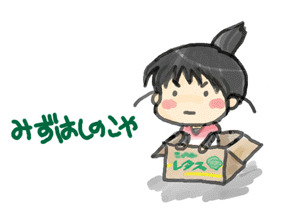
First Drawing of Sagimori Arata

Cause You’ve Got Personality: Smile Precure!

When I look at Smile Precure! in hindsight, I feel like its status as a hit was almost inevitable. The 9th entry in the mega-popular Precure franchise, it’s in many ways a return to the tried-and-true formulas of magical girl anime. However, it ends up pulling off those well-worn aspects with such confidence and excellence in execution that it never really comes across as stale.

The premise is typical magical girl and typical Precure: Hoshizora Miyuki is a girl who loves both fairy tales and spreading happiness, and when her family moves to a new town she not only makes a bunch of new friends but ends up encountering Candy, a young fairy from the land where all fairy tales come from, Märchenland. Miyuki turns out to be one of the legendary warriors capable of saving Märchenland from the dreaded “Bad End Kingdom,” and so becomes the pink beam-firing Cure Happy. Later, she’s joined by her friends, the quick-talking Hino Akane (Cure Sunny), the shy but imaginative Kise Yayoi (Cure Peace), the straight-forward Midorikawa Nao (Cure March), and the graceful Aoki Reika (Cure Beauty).

The simple mix-and-match character design philosophy sometimes (and somewhat erroneously) referred to as “database” character design is quite easy to write off as inherently lazy or artless, but Smile Precure! shows that there is a strength to being able to convey characters so succinctly. For quite a few people I know, Smile was the first Precure series they really got into, and though the reasons might have differed, in the end it all boils down to a cast of characters who each possess an immediate and unique appeal which stays consistently strong throughout the series. While it might not have the inspiring feeling and depth of character development of Heartcatch Precure! or as much rough-and-tumble action as the original Futari wa Pretty Cure, what Smile Precure! does, better than any other entry in the franchise for the most part, is give each of its characters an extremely vibrant and magnetic sense of presence.

Thus, even though Candy of all characters gets the most development in Smile Precure!, the robust representations of the entire cast allow the show to place them in all sorts of Silver Age superhero comics-level wacky situations, from turning invisible to getting lost in Osaka to transforming into a giant robot, and have it be as memorable as the rarer episodes of heartfelt personal exploration and growth. It also helps that the villains of the series are equally fun. Derived from recurring antagonists in fairy tales, the werewolf Wolfrun, the red oni… Red Oni…, and the witch Majorina humorously approach the task of being up to no good with such carelessness that I think they could possibly carry a show all by themselves. Rounding out the villains is the masked Joker, who is menacing enough to give the story an injection of seriousness when needed, and whose appearance usually signals an upping of the stakes.

In many ways, Smile Precure! feels like a more refined version of Yes! Pretty Cure 5, and not just because of the obvious similarities (five-man team with the same color scheme and roughly comparable personalities). Smile has the same type of fun and silly character dynamic as Yes! 5, but brings to it those stronger individual characterizations, and adds to the mix a better design sense, more consistent art (especially when it comes to the action), and stronger comedic timing. The places that Smile feels a little weaker are that sometimes the interactions aren’t quite as clever as Yes! 5, the humor of the characters is more reactive than active, and the conclusion (which is pretty similar) isn’t quite as satisfying. That said, I would dare wager that anyone who enjoyed Yes! 5 would get into Smile as well (unless you like Cure Lemonade so much that Peace is a poor substitute), though I’m not sure if the opposite is true.

Also somewhat similar to Yes! 5 is the fact that some of the more minor characters have a surprising amount of popularity. In the case of Yes! 5 it was the handsome princes who were really mascot characters, and for Smile it’s the Precures’ moms. Go figure.

Smile Precure! isn’t darkly experimental, nor is it a representative pinnacle of where the very concept of a magical girl anime can go. Its presentation is mostly conventional, and its similarities to previous shows, especially within its own franchise, are numerous. However, Smile Precure! also has a level of polish that allows it to extend its appeal beyond its expected audience. It’s no Heartcatch (admittedly an incredibly unfair benchmark), but overall its characters and just sheer fun factor makes for a memorable show that’s very accessible and rewarding in its own right. It wouldn’t be so bad to introduce people to Precure through Smile Precure!

The Nostalgia Critic AND the Angry Video Game Nerd in Zettai Karen Children: The Unlimited

UPDATE: The Angry Video Game Nerd made a cameo too! Thanks, VF5SS!

I tweeted about this as well, but I also want to leave a more permanent record of this rare occurrence.

theunlimited-criticandnerd
The Unlimited Episode 5

critic_7168The Nostalgia Critic

220px-James_D._RolfeThe Angry Video Game Nerd

Coincidence?

Edit: Actually with the way he’s wearing that tie, there’s no way that’s mere coincidence.

Sketch in Celebration of the New Genshiken Anime + More

The Current Genshiken Club Members

The Hokuto Brothers (I think Toki turned out the best)

Yoshimori and Tokine from Kekkaishi

Nonowa etc.

The Comedic Stylings of Five Legendary Warriors: Yes! Pretty Cure 5

I was originally going to make my next Precure review about the recently-concluded Smile Precure!, but because of its many similarities to Yes! Pretty Cure 5 I thought it would be better to talk about that one first so that when I do get around to Smile you’ll know where I’m coming from. Do keep in mind that I haven’t seen the sequel, Yes! Pretty Cure 5 Go Go, all the way through yet, so this review is “incomplete” in that sense.

Yes! Pretty Cure 5 comes from the time when the official English still demanded that you refer to it as “Pretty Cure” in spite of the Japanese pronunciation, and it’s the first series in the franchise to step away from a pair oriented cast of main characters and do a full-on Sentai/Sailor Moon-style five-man team. As the story goes, one day an energetic girl named Yumehara Nozomi encounters a small mascot creature named Coco, a prince who asks her to become a legendary warrior and help restore his kingdom, which had been destroyed by an evil organization called “Nightmare.” Nozomi agrees and becomes Cure Dream, and is later joined by the athletic Natsuki Rin (Cure Rouge), the idol Kasugano Urara (Cure Lemonade), the gentle Akimoto Komachi (Cure Mint), and the intelligent Minazuki Karen (Cure Aqua), as well as Coco’s best friend and fellow prince, Nuts.

Out of all the Precure shows, Yes! Pretty Cure 5 ranks as one of the least visually impressive. Its animation is frequently awkward and off-model, and the transformed costume designs are awkward and unmemorable, but Yes! 5 is able to make up for those issues through really, really genuinely fun character interactions and antics. The five Cures all have dynamic characterizations, and seeing their personalities bounce off of each other is simply a joy. This even extends to the side characters, especially the school newspaper’s reporter, Masuko Mika (above), and her infectious Lois Lane/April O’Neil-like desire to get the scoop on the Cures.

Because of how entertaining the lunch-time and after-school banter can be, I sometimes refer to Yes! Pretty Cure 5 as the “Real K-ons, ” a comparison all the more appropriate because they girls are shown eating all the time. Four out of the five Cures have huge appetites and/or are obsessed with sweets, and the only one left out, Komachi, is the daughter of traditional Japanese candy maker. It makes for a show where just seeing the five girls hanging out at school is in many cases far more engaging than the action scenes, something which is often the opposite case when it comes to Precure.

That said, when the two halves of talky comedy and action come together, the result can be some incredibly solid episodes. My favorite example is when you find out that Rin (“the red flame of passion”) and Karen (“the blue spring spring of wisdom”) don’t get along quite as well as the others, but when a villain tries to use their lack of cooperation against them, it actually backfires: their rivalry ends up egging each of them on to perform even better, ironically improving their overall teamwork. Smile Precure! has a similar episode but the conclusion isn’t nearly as hilarious. Also, Cure Aqua takes a lot of her attacks from pro wrestling.

Speaking of the villains, Nightmare may be my favorite antagonist group in all of Precure because it actually runs itself like a corporation, albeit one inhabited by otherworldly monsters. You have the CEO, who can only be contacted through an intermediary. You have board meetings where the bad guys discuss their latest plans, end-of-year staff performance reviews, and of course promotions and demotions. For the most part the individual antagonists aren’t much to speak of, but there are a couple of notable exceptions, the aforementioned intermediary, Kawarino (think of him as the equivalent of Smile‘s Joker), and Bloody, a wizened veteran who attacks the Pretty Cures less through brute force and more through psychological manipulation.

Also of note is the fact that the mascots in the show, Coco (right) and Nuts, are the first in the franchise to be able to take human form, and in this case the two turn into handsome fellows. There’s a not-so-subtle undertone of Coco and Nozomi having feelings for each other, as well as Komachi and Nuts, but it remains just ambiguous enough that it needs to be inferred. Somewhat predictably, Pretty Cure 5 is the Precure most popular with fujoshi; if you ever wondered where Sayonara Zetsubou Sensei character Fujiyoshi Harumi’s favored pairing of “Pine x Napple” comes from, it’s a parody of Coco x Nuts.

Yes! Pretty Cure 5 is most certainly a show with its fair share of flaws, but also really noticeable strengths which make the show great to watch one episode at a time or in semi-large batches. The show’s antagonists make for a decent enough threat to motivate the story along, but the real fun is in seeing the antics of the five Cures, as the series does an excellent job of showing the main cast as friends who trust and love each other. Even more fortunate is that the direct sequel, Yes! Pretty Cure 5 Go Go seems to make up for a lot of the problems of its predecessor.

PS: Cure Rouge is one of my favorite Cures. Yes, more than Sunny. No, not nearly as much as Marine.

Drifting Clubroom: Genshiken II, Chapter 84

Before we jump into the chapter, I have to make sure you’ve heard the news.

ATTENTION:

NEW GENSHIKEN ANIME!!

YOUR EYES DO NOT DECEIVE YOU

You’d think after the Madarame/Saki climax from a few chapters ago that Genshiken would let up for a while, but Chapter 84 is an intense one.  In the previous chapter, Madarame revealed that he was going to quit his job near the school (implying he would be unable to visit the college as often as he used to), despite Saki’s advice not to do so. As Madarame appears to feel increasingly alienated from the current club’s atmosphere (and Yoshitake tries to convert him to the church of BL), Hato is having trouble of his own as his emotions become a mystery to even himself. As Ogiue asks him to contribute to a “Tiger & Bonny” doujinshi, Hato begins to wonder about his relationship with Madarame, and the seeds of doubt Kaminaga placed in him about his heterosexuality begin to sprout.

Meanwhile, Sue of all people seems to have feelings for Madarame as well, though her character might mean it’s stranger (or simpler) than that.

I do not think that the change in demographic in Genshiken is the root cause per se for Madarame’s decision. Rather, my suspicion, based on my own experience, is that Madarame’s connection to the actual Genshiken as an on-campus club is starting to weaken. I had a similar group of nerd friends back in high school, and for the first three years after I graduated I would visit the school often to maintain that experience. Eventually, however, everyone who I even had a loose connection to graduated, and I lost any compelling reasons to continue. I’m still friends with a lot of the people I knew from that time, but our friendship has in a certain sense transcended the physical location, and I could see Madarame feeling like the clubroom itself is no longer that important.

That said, I’ve noticed, based on some of the response to the new Genshiken anime, that there are fair amount of readers both Japanese and non-Japanese who feel a bit alienated or even betrayed by Genshiken II, and I think Madarame is meant to embody that feeling to some extent, being the character who most embodies that classic otaku personality. Perhaps the deal with Madarame’s character is that he’s caught in a state of limbo, where he’s not yet fully integrated into adult living but at the same time his old haven away from reality, Genshiken, is starting to fade away.

The more that Genshiken focuses on Hato, the more I realize that he is probably the most psychologically complicated character in the entire manga (though I get the feeling that there’s something up with Nakajima that might be even more complex). Ogiue is one thing, as her story cuts to the bone, but Hato’s situation is such that you can’t even explain it as simply “he’s realizing he’s gay.” There’s a good chance that’s what’s happening, but based on the specifics of the chapter and of his history, doubting his own sexual orientation doesn’t seem to be the only thing going on.

In the chapter, Hato tries to shoo away the suggestions of his imaginary counterpart, only to have the female Hato replaced by Kaminaga, who echoes the real Kaminaga’s statement that the crossdressing likely facilitates the potential homosexuality of Hato. In that scene are a lot of things to take into consideration, starting with the fact that the Stand (i.e. Hato’s inner thoughts?) transforms specifically into Kaminaga. Based on previous chapters, it’s still not clear what his feelings towards her are. Does he want her? Does he want to be her? Does he perhaps desire both? Even the fact that the transition from Stand Hato to Kaminaga is a little hard to spot at first if you just skim through the chapter is indicative of the fact that Stand Hato continues to resemble Kaminaga, despite the fact that Hato has undergone an image change by semi-permanently switching to the shorter wig, as if to show that she specifically continues to influence him. It’s a weighty past and a convoluted present for Hato.

As for Sue, the easiest connection to make in regards to her blushing is the kiss she placed on Madarame’s cheek at the school festival as a sort of prank. Putting aside the notion of “Madarame: mack daddy of American fujoshi,” I’m starting to realize that Sue pretty much functions in Genshiken the same way the penguins do in Mawaru Penguindrum, bringing into the very foreground some of the “hidden” elements of the characters’ relationships at the time. I also think it’s quite appropriate for her to quote Dio Brando, and to have it be not one from the more popular Part 3 Stardust Crusaders story but from the original Phantom Blood.

There’s not much Ogiue this chapter, but there’s probably going to be another chapter at least partly focused around her soon, given the impending Comic Festival, though I imagine it won’t be until at least another three or four chapters.

The Fujoshi Files 64: JUNE-chan

Name: JUNE-chan (JUNEちゃん)
Alias: N/A
Relationship Status: N/A
Origin: Tonari no 801-chan

Information:
A doujin event friend and acquaintance of 801-chan, JUNE-chan’s name is a reference to the earliest BL manga magazine, which also reflects JUNE-chan’s tastes. As such, JUNE-chan creates doujinshi in that vein, which is a source of friendly disagreement between her and 801-chan.

Fujoshi Level:
In addition to the creature she transforms into upon having her yaoi interest piqued, JUNE-chan’s fondness for an old-school type of yaoi sets her apart from many of her peers.

The Day the Angel Fell…IN FLAAAAAMES

The 2012 Les Misérables movie was my first experience with the story in any format, and while watching it I had a thought that was probably the last one anyone would have: What if Gundam AGE were more like Les Misérables?

(Warning: Gundam AGE spoilers. Also for Les Miserables, but maybe that’s less of an issue because the book is quite old.)

flitoldyoung

I have a couple of reasons for comparing the two works. First, Gundam AGE, like Les Misérables, is a generational tale with a large cast of characters essentially centered around one strong-willed protagonist. Second, Flit Asuno, the hero of Gundam AGE, is extremely devoted to his quest to crush the enemy who has taken his family and his home, and over time it gets to the point that “eliminate the enemy” becomes a near-dogmatic mantra that he’s created for himself. His unerring path had me drawing parallels to Inspector Javert and his single-minded pursuit of Jean Valjean, while Javert’s personality that would have him rescue a man from robbers and then arrest the same man for not paying taxes further reinforces this comparison.

Gundam AGE suffers from not being able to properly bridge its generational shifts. The choice as to which characters remain and which ones leave (either by death or simply by never being on-screen again) feel rather arbitrary in that show, and so it loses the momentum that a work like Les Misérables manages to keep right until the end. So, if it were possible to revise Gundam AGE, I would make it more like Les Miserables but centered around Javert, with Flit of course being in that role of the straightforward devotee of justice, also reworking the enemy Vagans to be multiple characters playing the role of Jean Valjean-like antagonists, characters who challenge Flit’s black and white world view. However, I would also keep the element from the original Gundam AGE where Flit has a child and a grandchild who eventually rescue him from himself in his old age, so that his life doesn’t end as tragically as Javert’s. I’ve not read the book, but I know it is much more complex than the musical, and I could see a proper story existing somewhere between the two, depending on the audience desired, as well as other factors such as where exactly the broad strokes of the story should be focused.

Of course, there’s one last question to consider: would this version of Gundam AGE have singing? Maybe it wouldn’t be so bad.

THAT’S RIGHT, NEW GENSHIKEN NIDAIME(?) ANIME

The newest issue of Monthly Afternoon has revealed that a new Genshiken anime is in the works. This calls for a celebration:

I’ll be honest: even with the serialization of Genshiken II (aka Nidaime aka Second Season), I never expected it to get another anime adaptation. I wished for it, of course, given that the anime never even resolved Ogiue’s arc, but I thought its time had passed, and the reception to the manga sequel has been mixed, with a number of fans both inside and outside of Japan feeling alienated by the new setting.

Of course, this development begs quite a few questions. First and foremost, will the new anime actually cover the remaining parts of the original Genshiken, or is it actually just an adaptation of the second series? Would it be half and half? Would they speed through the remaining parts of the first series in order to get to the new characters? How many episode will it be? For that matter, will it even be a TV series?

Second, who is going to animate this new version? The first Genshiken anime was by the now-defunct studio Palm, while the OVAs and Genshiken 2 were done by Studio ARMS. Responsible for Queen’s Blade and currently Maoyu: Maou Yuusha, ARMS brought a bit of a perverted slant to Genshiken, and given the presence of not only Hato but also a very aggressive Angela I could imagine them going hog wild, for better or worse. I don’t exactly have a dream studio I’d like to see work on it, but the resulting product could definitely be a tad unexpected depending on who gets it.

Third, what about voice actors? We have all of these new characters, with Hato especially presenting a challenge. Do you go the route of having one of the “masculine” female voice actors vary her voice, or do you find one of rare male voice actors who can successfully do a female voice? I would actually suggest Ishida Akira as Hato, if he weren’t already playing Kuchiki. As for the other characters, maybe they’ll go for a curveball, like Kugimiya Rie as Yajima. In any case, it’ll be good to hear Mizuhashi Kaori’s Ogiue again. Over the course of the anime, Mizuhashi’s conveyance of Ogiue’s blunt and awkward personality improved tremendously, and I’m wondering how it might have changed in the 4-5 years since she last played this blog’s favorite fujoshi.

There’s plenty to think about and anticipate, and I’m sure I’ll do even more when the next bit of info is out, so I’ll just conclude with the following words.

BANZAI!

OGIUE BANZAI!

OGIUE-KAICHOU BANZAI!!!

Delicious Rate 300%