The Fujoshi Files 48: Chie

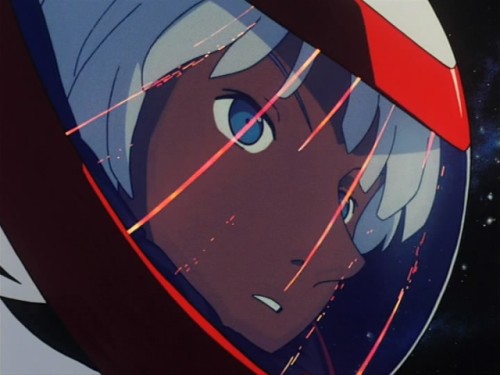
Name: Chie (千絵)
Alias:
Kai Muryuu (海夢)
Relationship Status: Dating
Origin: Hanjuku “fu” joshi

Information:
Chie is a 22-year old college senior who devotes most of her time to BL, being both an artist under the name “Kai Muryuu” and active consumer of comics and games under that theme. In contrast to her fictional interests, she has more of a preference for girls, and is even thrilled to go to her little sister’s high school festival because of the fact that it is an all-girls’ school. Chie is also quite fashionable for a fujoshi.

Though Chie originally prioritized “moe” over “love,” her encounter with a female high school otaku named Yuria begins to shift her feelings in the opposite direction. Her relationship with Yuria inspires Chie to begin drawing yuri doujinshi.

Fujoshi Level:
Chie’s 2-D interests and 3-D relationship combine in a somewhat incongruous fashion, especially after she starts dating Yuria. The manifestation of this contradiction and Chie’s desire to have both make for a versatile fujoshi.

GET NiGHTS iNTO DREAMS HD

If you ask me what my favorite video game ever is, my answer is unwavering and undeniable: NiGHTS into dreams… An absolute classic of the Sega Saturn, I poured countless hours into the game just enjoying everything, from the environments to the clever boss fights, from the excellent music to the crisp and ultra-smooth gameplay. No game that I’ve played, including its Wii sequel, NiGHTS: Journey of Dreams, has quite captured the movement of acrobatic flight that the original endowed upon players. I can wax nostalgic on this game until the end of the time, but I’ll cut it short by just saying that no game feels quite like it.

Now, NiGHTS is getting a downloadable HD remix. When I first saw the character models used for the kids, I immediately thought of the old blockier gameplay models. I have to wonder if they somehow took the models from the old cut scenes and used those instead, or if they’re built from scratch.

Are you part of the new generation that’s never seen a Saturn? Are you part of the old generation but just never got a chance to play it because you chose the Playstation over the Saturn (like most people ended up doing?) I think it is only in your favor to try it out. And if the HD version is somehow messed up, the game actually includes the original Saturn version as well, so no worries there.

Actually, one thing I am concerned with is the controllers themselves, as while playing the Wii NiGHTS I found the octagonal gate of the Nintendo analog sticks to compromise the smoothness of the flight needed to play a NiGHTS game properly, and it is probably because of the controller that it could not capture that feeling of acrobatic flight I mentioned at the beginning. The Saturn 3D controller’s analog control was so incredibly smooth and nice to use (though the controller itself was kind of clunky) that it makes every analog stick or equivalent since then pale in comparison.

I will have faith that the current consoles will be able to deal with it adequately for now, though I am concerned with the Windows edition. Does anyone know of a Saturn-to-USB converter for controllers?

The Incredible Kaminaga: Genshiken II, Chapter 77

In Chapter 77 of Genshiken II, we learn that while many fujoshi are strong, but Kaminaga may be Strongest of All.

The cat’s out of the bag as Kaminaga learns that Hato occasionally dresses up as her doppelganger, but as much as Ogiue downplays it as coincidence, and as much as Hato’s old classmate Konno mentions that it’s because of Hato’s crush, Kaminaga has other ideas entirely. Presented with an older brother and a younger brother who dresses up like the elder’s girlfriend (and now fiancee), Kaminaga creates the pairing of Yuu x Ken, or Hato’s older brother and himself. This is made all the more outrageous by the fact that she herself is the girlfriend.

Kaminaga throws out the tough questions pertaining to Hato’s sexuality. She brings up the possibility that he might be bisexual, and also the fact that his stance of “I’m not gay but I like yaoi” is similar to the BL trope of “I’m not gay, I just love you in particular.” As Kaminaga presses the question and asks if there’s a guy Hato knows who fits that situation, Madarame shows up, though Hato’s feelings about him are still left ambiguous. Instead, Hato mentions that everything’s fine, because he has plenty of friends, male and female, who know and accept him.

I’ve previously written about how the new Genshiken members in a way resemble Kohsaka in terms of the way they’re able to combine style with their very otaku mindsets, but I feel that, more than any other, including the attractive Angela and Ohno, that Kaminaga comes closest to the idea of a “female Kohsaka.” The ways in which she so unashamedly displays her delusions, especially to a guy she just met (Hato’s brother in the previous chapter’s flashback) and eventually turned him into a lover stands in stark contrast to the complexes that the other girls have about mixing fujoshi lifestyles with significant others. Ohno has Tanaka, but Kaminaga was able to get a decidedly non-otaku boyfriend for the long-term. When you think about Kaminaga that way, her sheer confidence and simultaneous ability to not compromise her compromised mindset is a kind of inspiration.

As we learn more and more about Hato’s past and set up his potential future, I feel that part of his purpose in the story is to “challenge.” Somewhat like how Ogiue flipped the story of Genshiken upside down, Hato really pushes the envelope in terms of assumptions about the club and how otaku behave and the like. The amount of Hato x Mada material in this chapter brings up certain questions about the nature of Genshiken II, and it reminds me of the fact that the new series is more than different enough from the original to seem somewhat alien to those who may have enjoyed the previous iteration.

I’m not referring just to Madarame’s rather confused feelings, but also the way the series has given him what in another work would have been some kind of “awesome harem” but in this case is an exercise in confusion and mixed emotions. While pining for Saki (still), he’s been growing a friendship with a very convincing crossdresser, gets kissed on the cheek by one American girl, and almost gets a full on boob grab on the other American girl.

Speaking of Sue’s “attack,” it’s a reference to Rei from Fist of the North Star.

Have I ever mentioned before how nicely Kio draws the blondes’ eyelashes in the new Genshiken? He out of his way to show only their outline instead of simply using black like he did previously, and it gives them a kind of mysterious quality. Aesthetically it’s quite pleasing, though perhaps it emphasizes their foreignness a little too much? I’m not exactly sure how I feel about it other than that I like the way it ends up looking.

Actually, when you think about Kuchiki and his accidental swipe at Risa’s chest in a previous chapter, which he did while totally unconscious from being choked out by Hato and thus unable to remember, or even the way the older Yoshitake was denied the privilege of seeing Hato come out of the shower, it seems like the series likes to mess with which characters get to have things happen on-panel. The rest of the actual sexual interaction, as we know, happens, it’s just that it’s never really shown. It’s that kind of manga.

As for Ogiue, this isn’t one of her chapters, but the mere fact that she refers to using one’s own boyfriend for yaoi source material as “normal” is rather amusing, and in its own way another sign of significant change within her. Could you have imagined the old Ogi half-admitting that she’s doing the very same thing on a regular basis, and on top of that is calling it normal?

Anyway, next time is Saki time. Watch out.

Stand Aside, Book Smarts: The “Knowledgeable Girl”

While reading the Drops of God recently. I took notice of the supporting character Miyabi, a sommeliere-hopeful who assists the hero Shizuku, bolstering his seemingly supernatural sense of taste (literally tasting things with his mouth) with a larger knowledge of the wine world. In this setting, Shizuku’s genius, though achieved through years of work and forced training, comes across as of a deeper quality than Miyabi’s superior book smarts.

Miyabi falls into a character type I might refer to as the “Knowledgeable Girl,” a trope I see most often in shounen manga. This character is different from someone who’s simply smart or studious or is a bookworm. Instead, it is the character who seems to play two roles: the first is to have a solid foundation of knowledge so as to be useful when exposition is necessary, and the second is to have that knowledge contrasted with the hero’s more impressive abilities, as if to say that, while the hero lacks conventional knowledge, he is such a radical that he can overcome it, or that it’s only a matter of time before he picks up that knowledge as well. In a way, she is meant to be surpassed.

Probably the most prominent example I can think of is Sakura from Naruto, who, like Miyabi, criticizes the male hero for not knowing the basics, and whose book smarts are ultimately shown to be less powerful and important than the unique flavors Naruto himself provides. I bet you can think of many others as well.

I don’t think this is a character type doomed to mediocrity, as the key, I feel, is to actually give a true advantage to book smarts, something that just isn’t waiting to be trivialized. Female coach Riko from Kuroko’s Basketball (AKA THE BASKETBALL WHICH KUROKO PLAYS), for example, while very much in that supporting role, at least shows a strategic knack owing to her intense study lacking in the players. Tokine in Kekkaishi, more knowledgeable than her counterpart Yoshimori, is better at refining her abilities than at simply making things bigger and more powerful.

I wonder if it’s possible to argue that no character type is truly terrible and that it’s all in the execution? I’m sure I’ll be corrected rather immediately.

Operation Bring Devil Curry to the World

So it turns out that one of my favorite places in the world to eat, Go Go Curry, is teaming up with legendary manga creator Nagai Go to create a new super spicy curry. Called “Devil Curry” in honor of the 40th anniversary of Devilman, it is going to be a permanent fixture on the Japanese Go Go Curry menu.

These days, however, Go Go Curry is international, with stores in New York and Singapore. I know I want Devil Curry where I live, and for those of you who feel that Go Go Curry, while good, isn’t quite spicy enough, I’m sure you’d like to try it out too. The only choice then is to campaign for the international release of Devil Curry.

Every time you go to a Go Go Curry, tell them you heard about Devil Curry and want to have it on the menu.

For the times you’re not near a Go Go Curry, they also have twitter accounts: GOGO_CURRY and GOGOCURRYUSA

The only concern I have is that it might end up losing its Devilman connotations upon going abroad. I’m not sure how I feel about that.

Explaining Compression in Comics

Last year I wrote a post titled “Explaining Decompression in Comics” in response to what I felt to be persistent misconceptions concerning decompression in comics storytelling. “Decompression” is characterized in these instances as using multiple panels to do what can be done in just one panel, and the gist of my argument was that decompression is less about total page count or delaying the rate at which a story is told and more about how information unfolds. It was quite a popular post, and it seems to have helped people get a better understanding of some of the particulars of decompression, especially in terms of manga paneling. However, even before I wrote that post, I was well aware that the opposite problem exists, where some readers of comics, particularly manga readers, can have trouble with the way “compression” works, especially in superhero comics of the Jack Kirby tradition. That is why I am writing this followup, to point out different ways as to how content can be conveyed.

Before I begin, I want to make something of a correction to my previous post that also applies to this one. In using titles like “Explaining Decompression” and “Explaining Compression,” I may give the impression that decompression and compression are simply things which comics “do.” This is not exactly true. Rather, decompression and compression are best thought of as descriptions of a variety of elements and how they interact within a comic, words which help to summarize an overall effect achieved by the relationships of many constituent parts such as panel layout, density of information, and the arrangement of elements within a panel. Also, I’m associating “decompression” with manga and “compression” with American comics due to their respective histories, but I’m well aware that the line has never been rigidly defined.


Suppli

In a recent article comparing the manga Suppli and 2011’s Batman #7, Forrest Helvie criticized Suppli for being overly compressed while praising  Batman for avoiding this problem, an odd opinion given manga’s notoriousness for being “too decompressed.” While this usage is somewhat erroneous, the nature of that mistake brings up some important points about the meaning of “compression.” Essentially, he associates visual conciseness with decompression and visual complexity with compression, when such distinctions are non-existent. A comic can be concise and compressed, just as one can be elaborate and decompressed, and in fact those two ideas better summarize the visuals of Batman #7 and Suppli respectively.

Even the seemingly easy-to-understand compression turns out to not be so simple, so it should come as no surprise that American comics and their tradition of compression can be a tough read for those unfamiliar with it, notably readers of manga. While the stereotype is that manga fans’ dissatisfaction has to do with the content itself, characterized by caped musclemen and good vs. evil dichotomies, I would say that it also has a lot to do with how those comics work visually.  More specifically, the problem is that a highly compressed comic can make a reader more accustomed to the decompressed nature of manga feel as if the story is dragging along, creating a sense of impatience.

This can seem rather peculiar, given that decompression is stereotyped as taking forever to get to anything significant, but the word impatience takes on a different meaning depending on whether we’re talking about decompression or compression. For decompression, a sense of impatience has to do with the feeling that a comic is taking forever to get to where it needs to be. Impatience towards compression, on the other hand, derives from a sense that the story being told is not moving as quickly as your eyes want to, and this can be a significant hurdle which the inexperienced must overcome if they are to derive greater enjoyment from such comics.

The above page, taken from a scene in Crisis on Infinite Earths, DC Comics’ first mega-crossover, called the “Battle Around the World,” is a classic example of complex compression, a big fight scene with simply a lot of figures acting and participating, with the text boxes very thoroughly explaining the context in which the battle is occurring. Though there is a cohesiveness to the page as a whole, this comic places incredible importance on each individual panel, where even the smaller elements within each panel encapsulate some distinct meaning. Each panel tells its own dense, rich story, a glimpse at events in every corner of the planet, and each character is posed to show them performing an action which defines their character to some degree. In the first panel for instance, the Green Arrow shoots from his bow and Starman is firing a blast from his signature weapon, the Star Rod. The image composition of each individual panel is vivid, each of them related to each other through similarities in both form and content.

For someone more used to manga, the way in which this information is organized together can be overwhelming. Whereas a character may be placed and posed to influence the reading direction of the page in manga, here the characters and panels are more self-contained. As a result, the manga reader may start to feel as if the story comes in fits and starts, almost as if someone were slamming the breaks every time there was something interesting to see. Manga and other comics which are more decompressed present panels as fragments of a whole, but here, panels are whole ideas unto themselves.


Batman #7

If we look at Batman #7, we can see that the word bubbles are fairly precise. There is no deluge of visual information requiring the reader’s attention. However, each panel is still being presented as a whole nugget of information, communicating a clear and specific point in every instance. That is not to deny the overall relationship the panels have with each other or the page on which they sit, but if you then look at Suppli, while it has some panels which present information as dense exposition, each panel (as well as each visual element within the panel), appears to cascade into the next, with the reader collecting bits of information along the way. Keep in mind, however, that compression and decompression, though essentially operating on opposite philosophies, can co-exist in a story, and the dividing line between them is not absolute, though one is often more present than the other.

Decompression is increasingly a part of American comics, but the long-standing history of compression in American comics can be seen even in the ways a lot of more current comics have incorporated decompression. Marvel writer Brian Michael Bendis, for instance, is known for his snappy, natural-sounding dialogues which occur over multiple panels and pages, and which lend his comics a sense of decompression, but different artists have use different ways to portray those extended conversations, some of which are more compressed than others. Similarly, Chris Ware’s work (something decidedly non-superhero) can be both sparse and minimalist or extremely detailed and elaborate, but the paneling used in his comics also shows signs of an American comics tradition, albeit transformed heavily. The panels are somewhere between existing for complete information while also trying to hold back and let themselves strongly present their relationships to the panels around them.

So in the end, what can be done to help the reader for whom compression is a problem? In my opinion, the key is mainly awareness of how the panels operate. If you find yourself being weighed down by the comic, then just try to approach it one panel at a time. Think of the panel in a compressed comic as a lake or a pond. You dive in to examine its breadth and explore its depths, and then surface before moving on to the next one. Over time, your experiences will accumulate, but it’s important to let them build up.

I Love Smile Precure’s Banal Villainy

If you’ve watched Smile Precure, you’ve probably noticed that while the villains have an overall dastardly goal (revive their evil leader), most of the time their motivations are incredibly shallow and petty, something along the lines of “Eh I’m bored, what evil can I do?” Contrary to it detracting from their characters, however, I feel like it actually makes them more enjoyable to watch, humanizing them beyond simply the idea that they’re “bad,” while also still keeping them cartoonishly villainous. It also adds to the overall feel of the show as fun and enjoyable with a lot of big, vibrant personalities. In this sense, the villains are kind of like K-On!

Another thing I enjoy about the villains, Wolfrun, Aka Oni, and Majorina, is that they have a consistent theme as fairy tale villains which makes them a bit more memorable. That might not seem like much, but at least in terms of the Precure franchise it’s a significant step up. Previous series would utilize such memorable combinations as “a bunch of evil muscley dudes,” or “a plant guy and a gold guy,” and even probably the show with the best villain concept in the series, Yes! Pretty Cure 5 (whose staff I believe is also responsible for Smile) with its evil corporation (complete with evil salaries, evil promotions, and evil quarterly evaluations) basically turned into a mishmash of designs once they transformed out of their (evil) business suits.

Wolf, Ogre, Witch. It works, and the fact that they’re so dumb makes it even better.

The Fujoshi Files 47: Tamura Tomomi

Name: Tamura, Tomomi (田村知美)
Alias:
N/A
Relationship Status: Single
Origin: Otaku no Musume-san

Information:
Tamura Tomomi is an elementary school student who was regularly picked on her dorkish behavior. This all changed when Yukimura Kanau transferred into her class, becoming her best friend in the process. A somewhat shy girl, Tomomi is a big fan of the manga Nikibi na Mahou (Pimple magic) by Clearasil Shinra, though she at first doesn’t realize that Kanau’s father is Clearasil Shinra’s assistant, or that Clearasil Shinra lives in the same apartment as them. Tomomi is especially a fan of the character Azark, whom she affectionately refers to as “Azark-sama.”

Fujoshi Level:
Tomomi is a staunch believer in the pairing of Azark x Rindou. When Kanau’s friend Serio expresses a preference for a non-yaoi coupling, Tomomi labels her an “enemy.”

Dutch-Japanese Foods Part 3: My Own Experiment

Nattou, that Japanese food which divides families and shatters nations but which I love immensely, is hard to come by in the Netherlands, so when a friend said he knew a way to get some, I knew what had to be done. Upon receiving it, I had a strange epiphany, to combine it with another food which embodies cultural adaptation and assimilation: The McKroket.

The McKroket is a sandwich from McDonald’s available only in the Netherlands, taking the Dutch fondness for fried meaty goop and shaping it into a disc suitable for bunnery. Just as a word of advice, be careful when eating all krokets and kroket-like products, as the ragout can and will burn your tongue if you bite in too suddenly.

Anyway, I opened up my pack of nattou, added the soy sauce and mustard, and gave it a mighty stir before placing some on top of the kroket part of the sandwich. With the top bun back on my culinary Frankenstein monster was complete.

And you know what? It was fantastic. I know 99% of people reading won’t believe me, even the people who do like nattou, but I am completely serious when I say I would do this again if given the opportunity. It is a complex mix of savory flavors between the ragout and the strong nuttiness of the nattou, and the combination of the crunchiness of the fried crust and the chewiness of the fermented soy beans made each bite strangely satisfying, hough keep in mind that I find nattou itself to be a purveyor of contentment, so your mileage may vary.

I guess if you’re in Japan, you could just buy some nattou and put it on a croquet pan but it wouldn’t be quite the same. Maybe you should fly to Europe just to do this.

Dutch-Japanese Foods Part 2: They Made a Hello Kitty Cereal

One day I went to the supermarket with a mission: buy a relatively inexpensive cereal because I’d been eating out too much. That quickly went out the window once I laid my eyes on this:

Now I’m not much of a Hello Kitty fan, and I have never been a collector of Hello Kitty merchandise, but the combination of the very existence of this cereal and the fact that its full name is actually “Hello Kitty Fruity Chocs” meant I had to try it at least once.

According to the box it is chocolate cereal outside with strawberry-flavored inside, which is kind of surprising given that the cereal actually isn’t that sweet. I probably won’t buy it again, but I’m definitely keeping the box.