The start of October means a new anime season, and there’s a lot of new shows I’m looking forward to. My main concern is having enough time for all of them. We’ve got manga adaptations I’m looking forward to like Shy, MF Ghost, Under Ninja, Migi and Dali, and Firefighter Daigo: Rescuer in Orange. Then there’s not one but two rap/hip hop battle shows in Hypnosis Mic season 2 and Paradox Live. And then Otona no Precure, the first sequel to feature past Precures as adults! For those who might be feeling tired of isekai, I think this season is gonna be one to remember—and even if you love isekai a ton, there’s still plenty to go around.
Thank you to my October Patreon subscribers below!
I don’t know if there’s a wrong side of ridiculousness, but I definitely know that Birdie Wing: Golf Girls’ Story is squarely on the right one. And with the series now finished, I wanted to do a review of Season 2 to wrap everything up.
(Warning: Season 1 Spoilers)
The plot of the first season is like something from a fever dream: An orphan girl named Eve participates in her country Nafrece’s illegal underground golf scene, where big money is on the line. One day, she encounters a Japanese girl destined to become her rival/romantic interest Amawashi Aoi. In order to fulfill their dream of truly playing against each other someday, Eve has to overcome all the crime lords involved through the power of her brute force approach to golf. During this time, the list of things that happen include: a rocket launcher assassination, an airship with a transforming golf course inside, and even a cyborg golfer. Eventually, Eve winds up in Japan and attends the same school as Aoi, an academy for people with dreams of going pro.
At the end of Season 1, we were left with a question of what kind of series Birdie Wing will be overall. It has so many components that it could lean just a little in any direction and become something wildly different. Now that Season 2 is done and the series is complete (for now), we have the answer: Birdie Wing is all about Maximum Drama, and it will use every tool in its arsenal to achieve this goal. These include: a disease that kills you if you play too much golf, convoluted family trees that boggle the mind, and special abilities passed down from mentors and long-lost figures from the past. What we have is not so much a sports anime or a drama, but a series that asks, “What if a soap opera had tournament arcs?”
I will give one small spoiler about Season 2: My prediction about them going into space to play golf never came true, despite the fact that “Amuro Ray” and “Char Aznable” essentially both exist in this anime. Nevertheless, it’s an enjoyable roller coaster all the way through, and how the series ends is actually brilliant in its own way. While I’m not going to say that Birdie Wing is perfect, or that it’s for everyone, I do believe that we need more anime of its kind in the world.
Introduction: “Gattai Girls” is a series of posts dedicated to looking at giant robot anime featuring prominent female characters due to their relative rarity within that genre.
Here, “prominent” is primarily defined by two traits. First, the female character has to be either a main character (as opposed to a sidekick or support character), or she has to be in a role which distinguishes her. Second, the female character has to actually pilot a giant robot, preferably the main giant robot of the series she’s in.
For example, Aim for the Top! would qualify because of Noriko (main character, pilots the most important mecha of her show), while Vision of Escaflowne would not, because Hitomi does not engage in any combat despite being a main character, nor would Full Metal Panic! because the most prominent robot pilot, Melissa Mao, is not prominent enough.
—
This is an unusual “Gattai Girls” entry. Sakura Wars is one of Sega’s most beloved video game franchises in Japan, and doing a review/analysis of it based on an animated TV adaptation will inevitably mean I can’t fully capture everything that makes the series what it is. Nevertheless, we have a solid example of an anime that fulfills the criteria of a mecha series with a centrally prominent female pilot, so here we are. As far as I know, the TV series follows much of the same plot, but there are some cases where major events (such as a certain heel turn) do not play out as they did in the game.
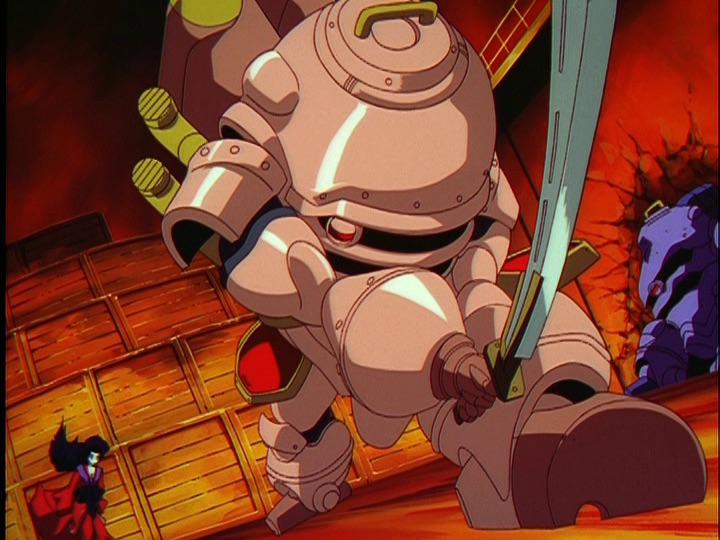
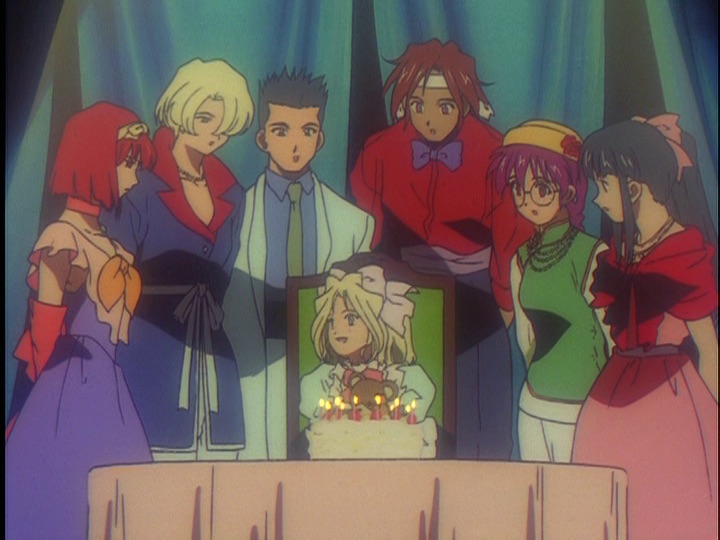
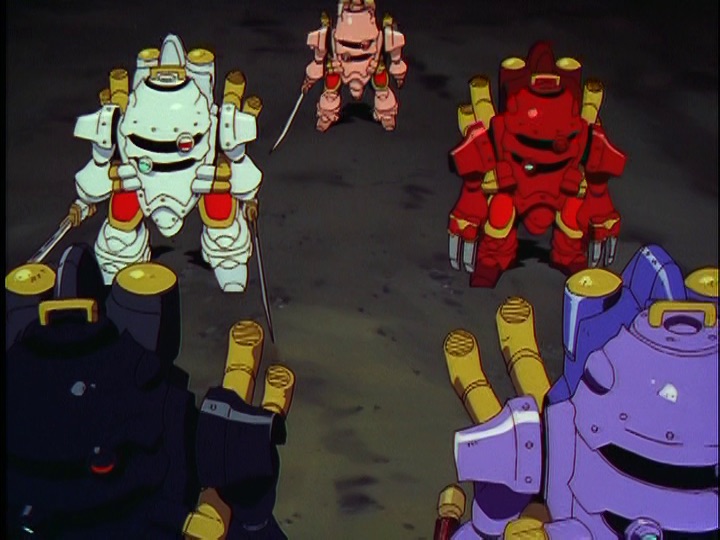
Sakura Wars takes place in an alternate Taisho-era mystical-steampunk Japan where people and technology thrive, but where horrible demonic forces also threaten the peace. The only people capable of fighting them on relatively even terms are the members of the Imperial Combat Revue: a group of girls who have the dual roles of being performers in musicals in the vein of the Takarazuka Revue and fighting as pilots of special spiritually powered mecha known as Kobu.
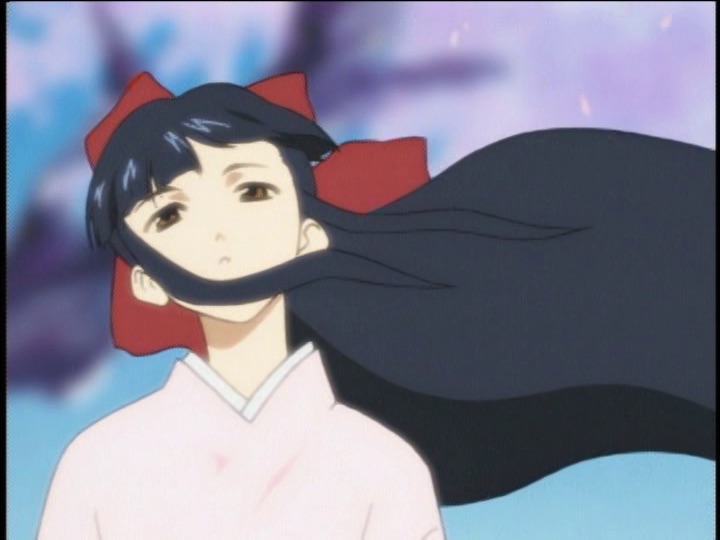
One of the points of appeal of Sakura Wars is that these girls are all interesting and memorable characters, but the face of the franchise is undoubtedly its namesake, Shinguji Sakura. To understand her general popularity, one need only look at Sega’s 60th anniversary popularity poll wherein Sakura got 3rd place behind only Sonic the Hedgehog and Opa-Opa from Fantasy Zone. What makes her so appealing is that she’s essentially the ultimate yamato-nadeshiko—the classical Japanese beauty—but without being a regressive character bound by conservatism.
(SIde note: While I acknowledge that the series is full of excellent female characters, the focus will be on Sakura as the main heroine).
When Sakura first arrives to join the Combat Revue in Tokyo, she’s like a fish out of water. Clad in a kimono, everything about her screams “traditional.” However, this is the Taisho era, a time of increasing embrace of certain Western values (such as marrying for romantic love). Much of Sakura’s growth over the series involves adapting to the cosmopolitan nature of her new environment and her teammates—allies who come from different parts of Japan and the world, and who hold different values—all the while still honing the swordsmanship and spiritual energy that has made her a recruit for the Combat Revue in the first place.
I don’t often devote space to discussing the voices behind the characters in these “Gattai Girls” entries, but I have to make a special exception here because Yokoyama Chisa is simply exceptional. Her voice carries such a range of emotions, from strength to vulnerability, from joy to sorrow, sometimes all at the same time. She’s the main singer in the Sakura Wars opening for this anime (as well as many of the games), and it really does feel like Shinguji Sakura is bringing the song to life.
I understand that romance is actually a significant part of the Sakura Wars games, as the player usually takes the role of a male captain who’s in charge of the squad. In the case of the earliest games and related media, that would be Ogami Ichiro, and I believe Ogami and Sakura are the most popular pairing. However, romance isn’t really a huge factor in the anime, and much of the story is focused on Sakura and the others developing bonds that help them to grow as people and warriors, as well as unraveling the secrets of the demons that are plaguing Japan. In this regard, Sakura is shown to possess immense inner strength, focus, and courage, all of which end up translating to becoming a great Kobu pilot over time.
The Kobu themselves look fantastic, their round shapes and steam valves capturing the setting’s aesthetic better than anything else. They’re distinctive, and their unisex designs means that no specific attention is drawn to the Kobu being piloted primarily by girls. Every character fights in their mecha with weapons similar to what they’d use on foot, and Sakura’s is a single katana. The power, will, and resolve to defend the innocent is actually part of Sakura’s appeal as a yamato-nadeshiko, but this is again presented less as a facet of an ossified woman and more an anchor she can use for stability when she needs it.
Shinguji Sakura is the kind of female protagonist who is often imitated but never duplicated. To be able to embody seemingly contradictory values of progress and tradition while truly betraying neither is a juggling act that can fall apart all too easily. She’s the surest sign that just because a character falls under a dominant archetype doesn’t mean they have to be boring or bland.
I’m five years late to the party. As others started playing The Legend of Zelda: Tears of the Kingdom, I decided to dust off my barely touched Breath of the Wild with the goal of freeing the Divine Beasts and taking down Calamity Ganon. I wouldn’t be going in totally ignorant (I’d seen others both play and beat it), but I still had to contend with my own poor sense of direction. And so here I am now, on the other side of glorious victory, here to detail my thoughts on a game everybody has already played.
I’m not the most hardcore Zelda fan. I have a history with the games—including playing the original NES game, Link to the Past, and Ocarina of Time—but I never really touched 21st-century Zelda. I know there have been various debates about whether the post-Wind Waker games have been too linear and uncreative, and that having Breath of the Wild arrive in this context was like a bolt of lightning. This open world game ends up being situated in an interesting place in the Zelda series, not only because it had never been done before, but because it both harkens back to and defies its predecessors. The free exploration feels a lot like classic Legend of Zelda, but the open-ended solutions for puzzles hits differently compared to earning a Hookshot and utilizing it throughout a dungeon designed around it.
I think my experience with BotW can best be encapsulated by the fact that my greatest challenges and frustrations were at the beginning of the game. As mentioned, I am directionally challenged, and throwing me into the middle of nowhere without many visual markers is a sure sign for me to never get a sense of my bearings. I was probably stuck up on the game’s first area, a low-stakes plateau, for far longer than I probably should have been. Still, once I managed to actually get stuff done, the game opened up to me, and I started to have a lot more fun.
There’s something very satisfying about just discovering stuff as you go on little detours, or looking at the map and seeing something really odd out on the edges of the land—“Is that a maze?!” The game rewards you for being curious, though you may get skill-checked by the nearby monsters. It’s one thing to be able to assess the strength of enemies, but when you have to factor in that your weapons and equipment can shatter and leave you defenseless, you really have to decide if trying to go somewhere is worth it. I often stubbornly decided it was, and would end up either killed or hanging on by the skin of my teeth. Did I have to fight that first Lynel? No—the game even explicitly says you don’t need to—but I wanted to try, and I was willing to lose 80% of my weapons to do so. It’s a funny feeling to look at your rewards against what you lost to get them.
Combat is a major part of BotW, as enemies are a frequent sight, and bosses require you to at least be able to function. I’m of two minds about the fact that the game gives you so many tools for one-on-one situations but then frequently pits you against many—I like that they don’t just wait kindly like in Ocarina of Time, but it is annoying nevertheless. I would also often wonder if maybe I was too powerful for an area with the equipment I had; I wanted to test my skills but it might have just been a matter of brute force. At the same time, I also didn’t necessarily want to be facing challenges masochistically underequipped. I understand that any powerful items I possessed were thanks to my own exploration, so it’s not like anything was unearned, but I still would have liked a better sense of where I stood in terms of mechanics mastery.
Overall, though, it was a very satisfying experience to play through Breath of the Wild. I’ve heard that Tears of the Kingdom is just a straight-up improvement in every way, which I’m looking forward to trying out sooner rather than later. I actually find it fascinating that TotK is such a direct upgrade, as that has never really happened in the history of Zelda. I’m curious to see how people assess BotW vs. TotK in terms of greatness: What do you value more, the pioneer or the refiner?
I don’t know if it’s the record heat waves or just the sheer amount of things going in life, but the summer has felt incredibly long. But now that it’s the final stretch, I’m sure I’ll be missing it soon enough.
During this time, I also managed to watch both Shin Ultraman and Shin Kamen Rider, so expect some reviews of those sooner than later. In the meantime, I’d also like to mourn the loss of gfycat, which provided many a useful moving record for both mirth and study. I didn’t use the site much for Ogiue Maniax, but I have been updating a few posts here and there.
September Patreon subscribers! Thank you to the following—
A post about the new Hololive dog twins and their preferred name pronunciations.
Kio Shimoku
Kio mostly talks about Elden Ring, but also, check out that high-resolution Ogiue art!
Closing
I watched the Hololive Summer 2023 concert, and it was a blast. There were some issues with the viewing platform that ended up with the entire Day 1 concert being streamed for free on Youtube for the next month, and I’m thankful for that because it meant being able to easily watch Holotori strut their stuff over and over. The fact that Day 2 has holoX’s performance of their new song, “Labyrinthine Labyrinth,” as part of the free preview makes me feel like I won a small lottery again. I also highly recommend checking out the last song in the Day 2 preview, especially those who love 80s anime.
And now Hololive Myth 3rd Anniversary is coming up! It’s amazing to reflect on how much time has passed, and how directly it’s tied to the COVID-19 pandemic. No, I will never forget about that.
At this point, Otakon is a given in my life. I have enough faith in the people who run the anime convention every summer that they will create a rewarding experience. But short of anything pertaining to Genshiken, Otakon 2023 ended up with a guest announcement straight out of my otaku wishlist: Iwao Junko, the voice of Daidouji Tomoyo in Cardcaptor Sakura.
And yet, somehow, Iwao was only the tip of the iceberg. Between Asamiya Kia (manga artist of Silent Mobius, Nadesico), Aramaki Shinji (mecha designer on Bubblegum Crisis, Magazine 23), Terada Takanobu (producer on Super Robot Wars), and even the sleeper hit that was Ikezawa Haruna (science fiction writer and the voice of Yoshino in Maria Watches Over Us), I feel like I three conventions’ worth of experiences.
Line Con No More
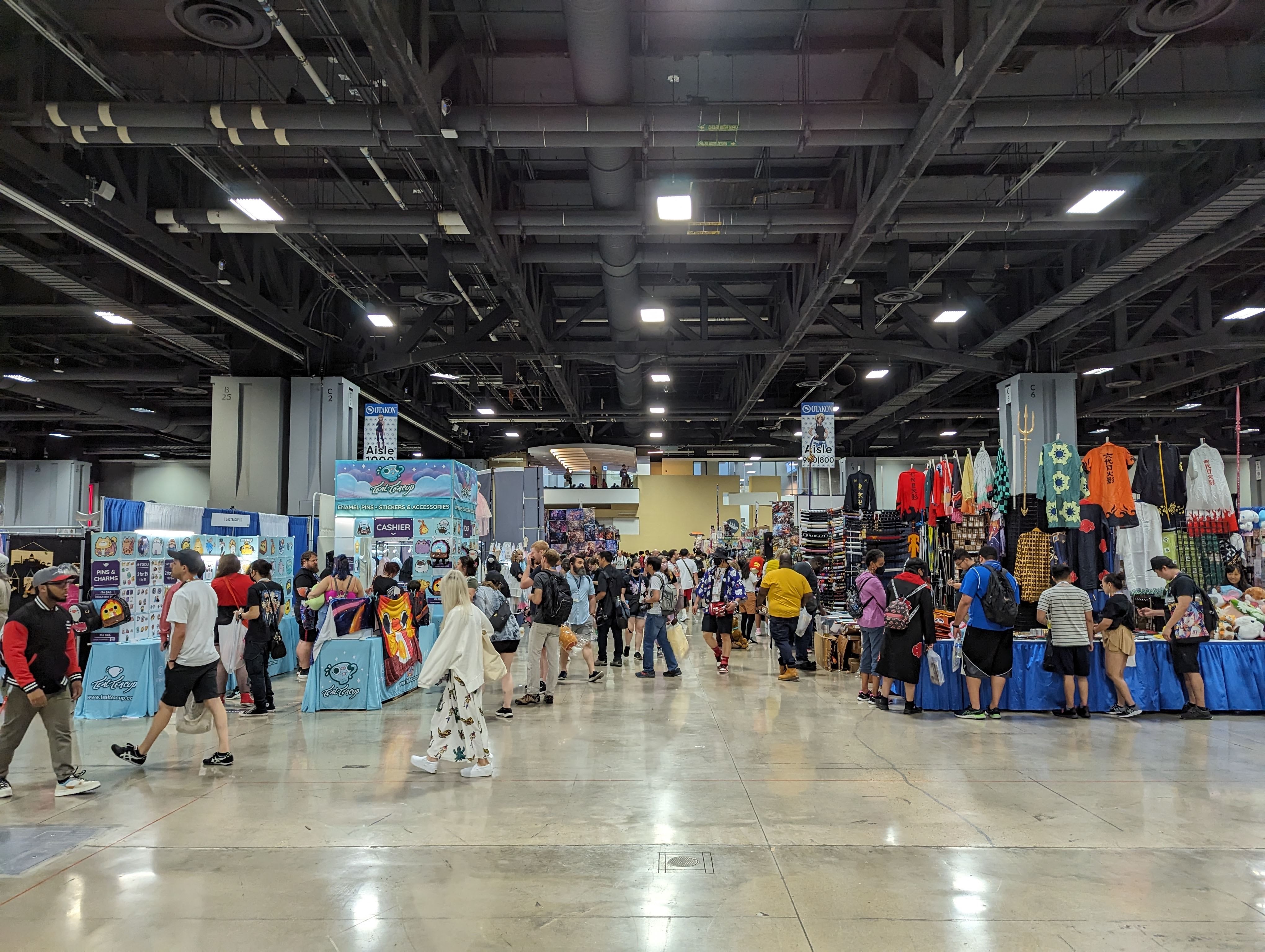
Otakon 2023 took place from July 28 to July 30, once again at the Walter E. Washington Convention Center in Washington, DC. It was coming off a previous year with record-breaking attendance, and two big questions were whether 2022 was a fluke caused in part by the US opening up again after the height of the COVID-19 pandemic, and how Otakon would handle the flow of foot traffic if it wasn’t. Long story short: Otakon actually surpassed its record this year, and the lines got noticeably better. While there were still a few hiccups here and there (like an unusually long wait to get my panelist badge due to a change in how they handled that process), it’s no coincidence that multiple people in the post-con feedback session praised the staff for fixing most of the congestion issues in a single year.
Fixing the lines was of even more paramount importance due to the weather over that weekend. DC was blisteringly hot; including humidity, there were times the temperature was reported as feeling like 112 degrees. Otakon needed to make sure people could get into that convention center quickly and easily, and they succeeded.
Lack of Masking Policy
I know it is incredibly difficult to put the genie back in the bottle, especially because “officially” COVID-19 is no longer a national emergency, but I really do wish Otakon would re-implement a mandatory masking policy. While I didn’t catch it at this convention, I was definitely in circles where the virus was present, and it would just allow more people to attend the con.
Industry
The guest list this year was truly packed, to the extent that I had to make some serious decisions as to what to spend time pursuing. Kawamori Shoji (creator of Macross) would have been near the top of the list any other year, but the fact that I had already gotten the chance to interview him in 2018 meant sacrifices had to be made. There were also a great number of manhwa artists at Otakon 2023, and as a general enjoyer of comics who is less familiar with Korean comics, this could have been a great opportunity to learn more. Alas, time was truly limited.
A good chunk of my time this year was thus spent on obtaining autographs because a lot of the guests are industry veterans, and some are getting up there in age. It may sound a bit morbid, but I’m worried that we’re going to lose more and more great figures in anime and manga, and I want the chance to see them and thank them before it’s too late. At the same time, I do worry that too much of my Otakon experience ends up being in autograph lines, and every year is a bit of a struggle in that for every wonderful thing you do, you know you’ll miss at least two other equally fantastic experiences.
Iwao Junko
One guest panel highlight for me was Iwao Junko’s, where she went over how she got into voice acting, her earliest days in the industry, and how she eventually made it into a full-time job. I have a detailed summary of the panel as its own post, and I also interviewed Iwao alongside her frequent music collaboration partner, Kawamura Ryu.
Mecha Guests
Another panel I was looking forward to featured multiple creators involved with mecha, including all the ones mentioned in the introduction. Just getting to hear them banter back and forth was entertaining, and you could tell that all of them would gladly talk your ear off if given the chance. One funny part of all this is the fact that Kawamori was clearly but somewhat surreptitiously drawing on his tablet in between answering questions—a fact that one panel attendee humorously called him out on (it turns out he was working on a project).
I got to sit down with two of the guests and talk more in depth: mecha designer Aramaki Shinji and Super Robot Wars producer Terada Takanobu.
Ikezawa Haruna
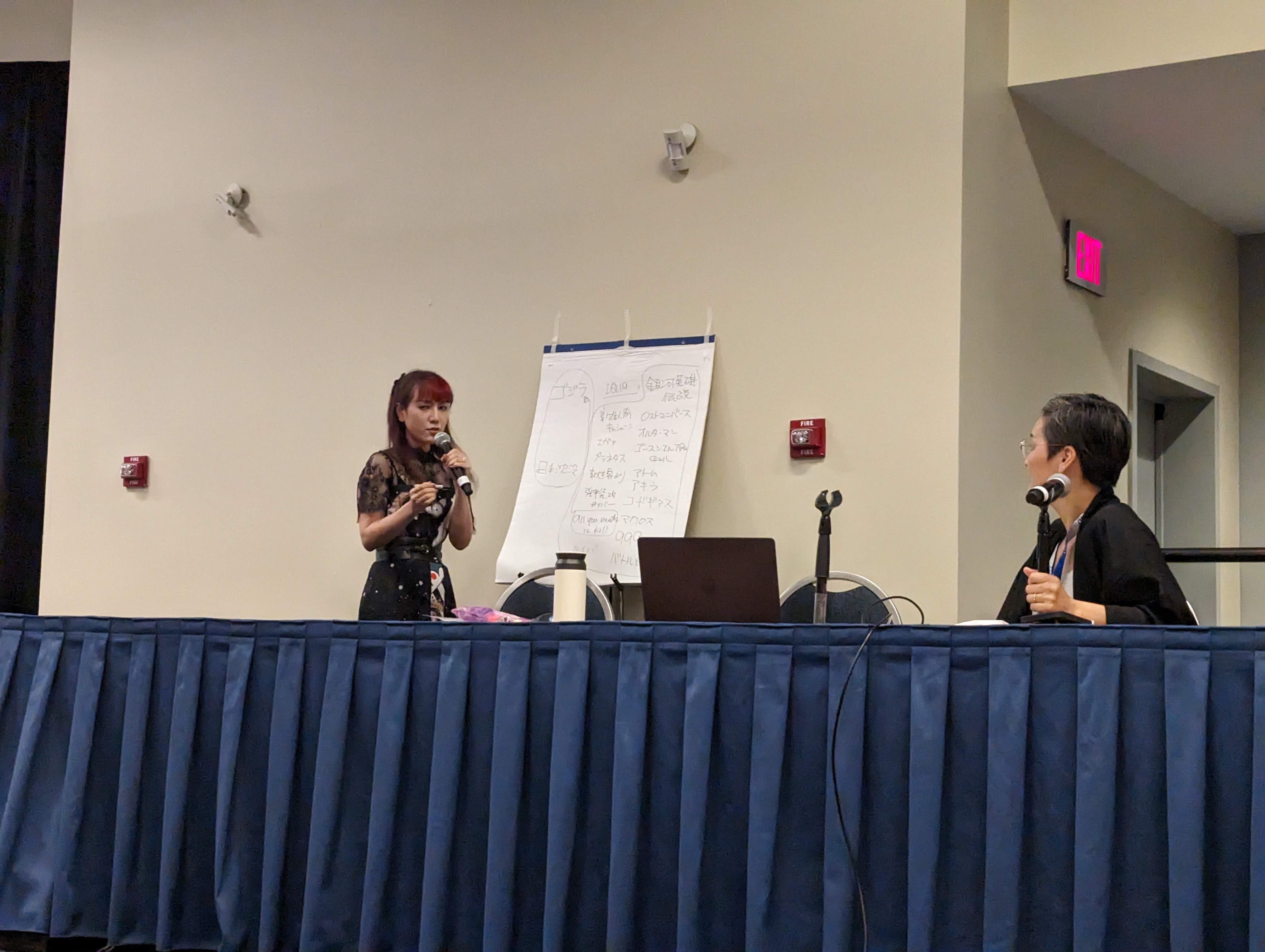
But there was one guest who was possibly the sleeper hit of the entire con: Ikezawa Haruna. While Ikezawa did her requisite panel about what it’s like to be a voice actor, she also did something incredibly rare for Japanese guests: run a panel entirely about one of her own personal interests.
In this case, it was a panel all about Japanese SF as compared to Western SF. Not long after she started, it was crystal clear that her knowledge was encyclopedic, and that her passion for the subject was through the roof. She probably knew more about science fiction in that room than the entire audience combined, and she made some interesting points about the essence of regional science fiction. For example, in the context of Japanese SF, she mentioned how xenophobia has become a big topic because it’s a major subject right now in Japanese society.
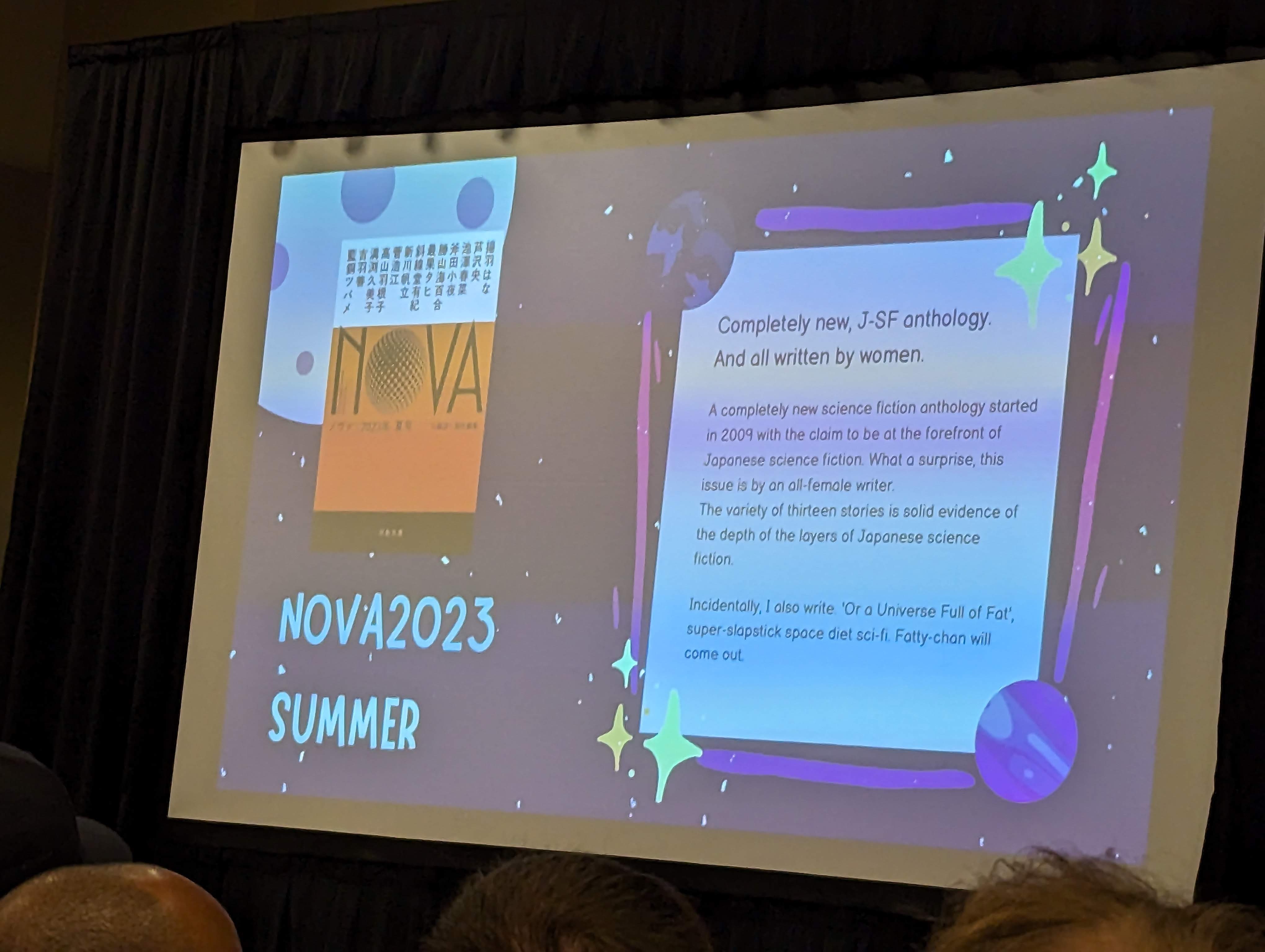
Ikezawa talked about how she actually prefers the term SF to “science fiction” because she thinks Japanese SF encompasses so much more—the abbreviation can stand for sukoshi fushigi (“a little mysterious”), speculative fiction, super fantasy, and so on. She also gave a variety of recommendations, including stories she’s written herself. These are Nova 2023 (an all-woman anthology), SF in 2084 (an anthology themed around stories that take place in 2084), the Naoki Prize–winning Maps and Fists by Ogawa Satoshi, Law Abiding Beast by Harukure Kouichi, and First, Let the Cow Be the Ball by Isukari Yuba. Unfortunately, all of them are in Japanese, but another story by Isukari, Yokohama Station SF is available in English.
Anime Screenings
While I was unable to attend the Discotek panel this year, I do think it’s worth mentioning the fact that they licensed all the Digimon Adventure movies, including both the original Japanese versions as well as the smashed-together film shown in US theaters. Not only is this the first time they’re all available in English, but Discotek did a special screening of them at Otakon. Sadly, I couldn’t attend that either, nor the showing of Macross Frontier: The False Songstress. That’s because I chose to watch the US premiere of The Tunnel to Summer, the Exit of Goodbyes, which I’ve reviewed here.
VTuber Presence
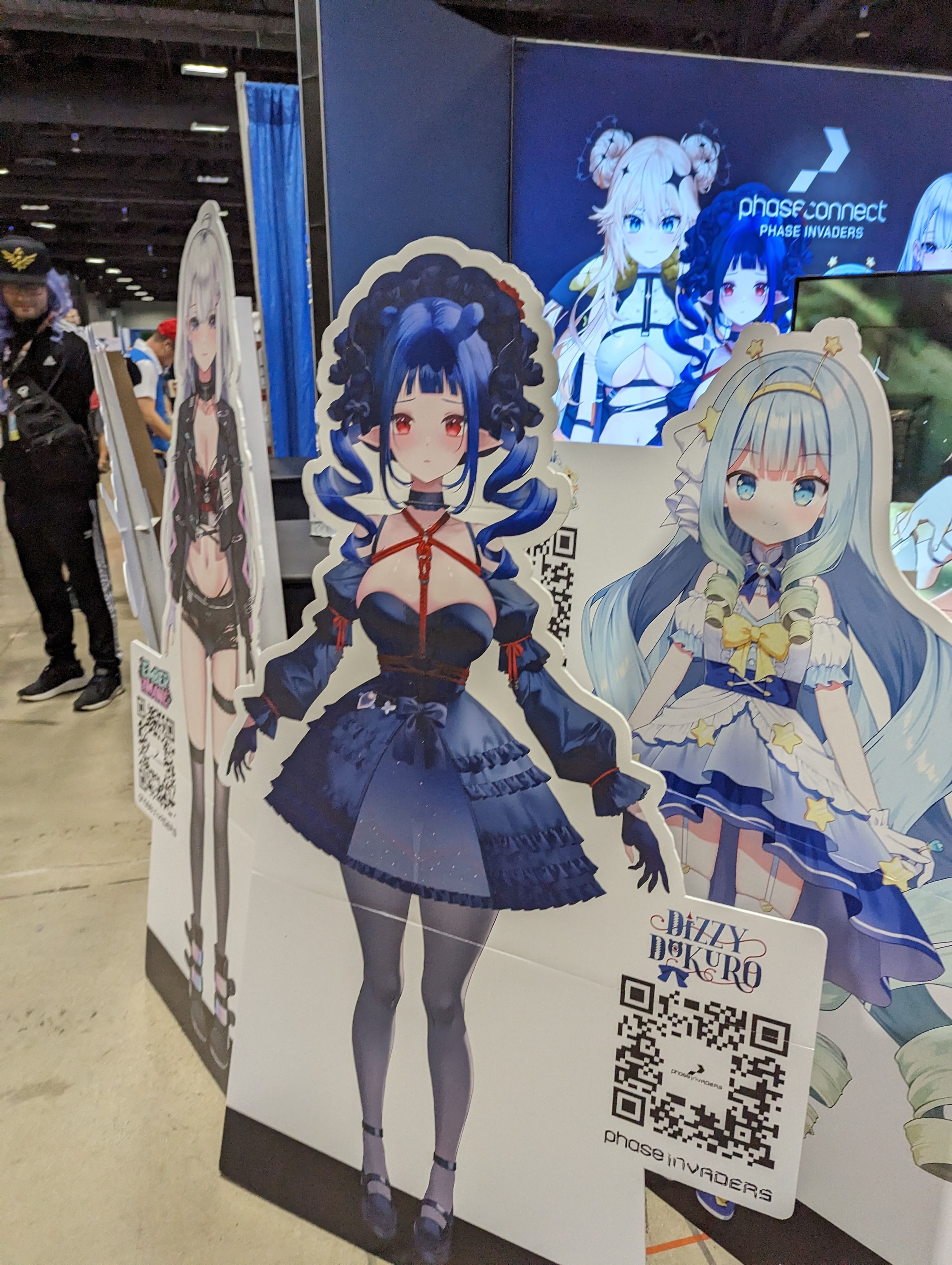
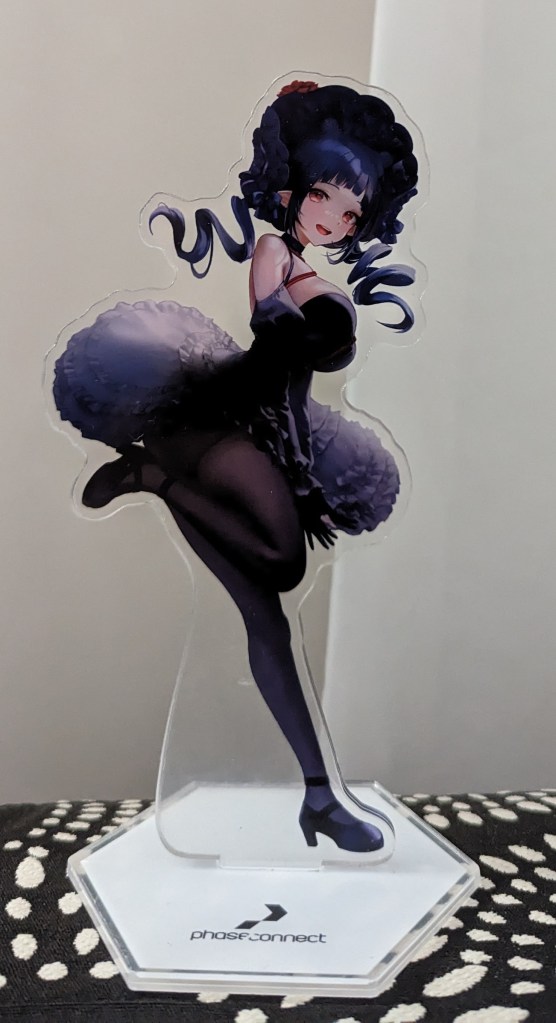
While there were cosplayers and artists who were repping the VTubers, there wasn’t much of an official presence (in contrast to Anime Expo, where it was a major force). That said, the group Phase Connect had a booth. I visited and bought an acrylic stand of Dizzy Dokuro.
Panels
Due to everything else going on, I shamefully ended up not attending very many fan panels this year despite that being one of Otakon’s best features. And for the ones I did, I could only see them in part.
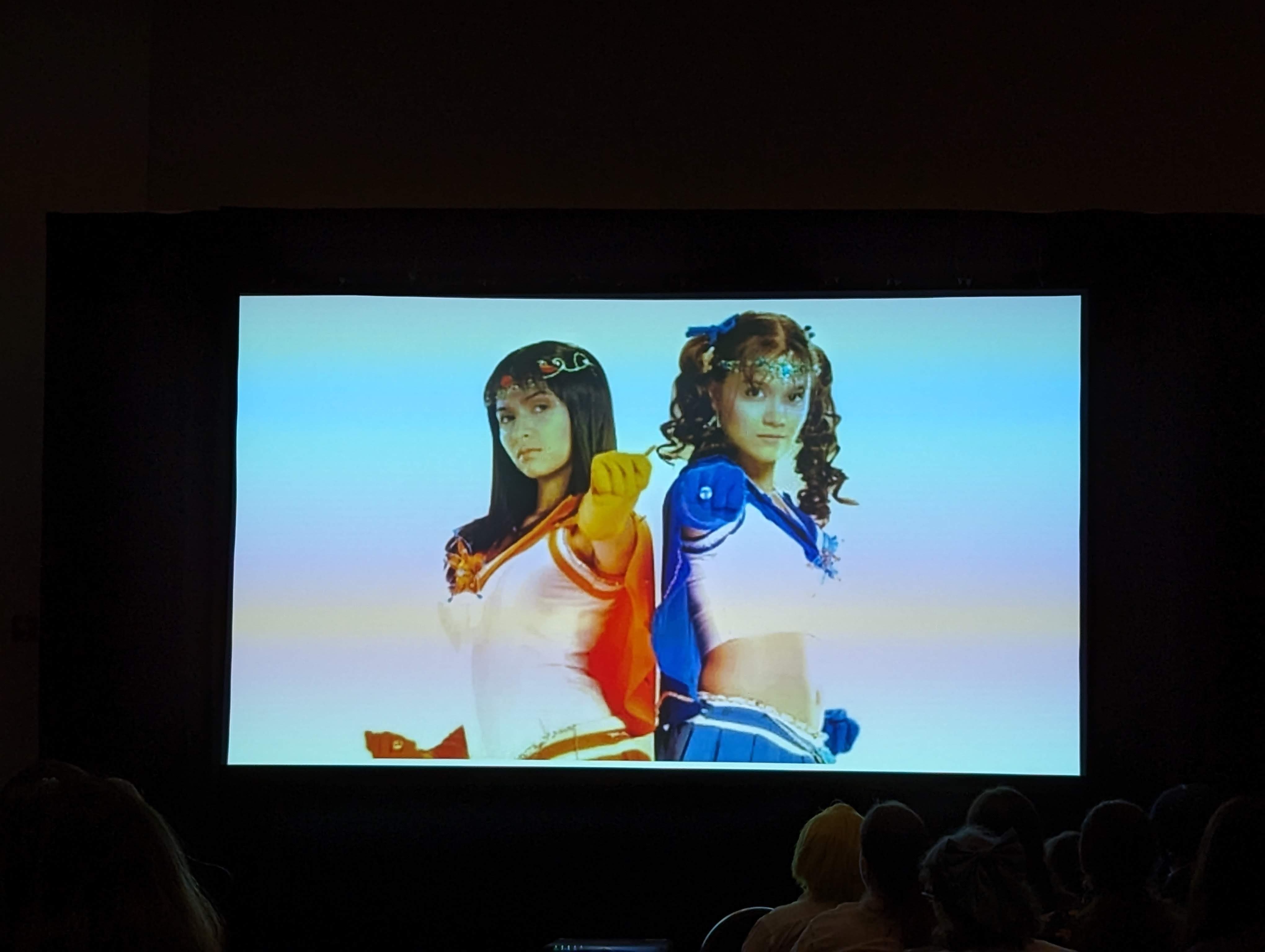
I do want to give a shout-out to Anime in the Philippines, as it definitely taught me new things, and gave a window into a culture and fandom that I was largely unfamiliar with. For example, now I know that Mechander Robo aired there, and I learned about this:
I did present on two panels this year myself, though: “Giant Train Robots of Anime and More” and “Densha Otoko: Train Man, Modern Myth, Internet Legend.” The theme of Otakon 2023 was trains, so I decided to play along.
Giant Train Robots was a joint project between myself and Patz from The Cockpit. We both love mecha, and I also relied on his greater knowledge of the tokusatsu side in bringing this together, and I think the result was a fun and breezy panel whose goal was to entertain, inform, and leave the audience appreciating trains that turn into robots. We got a good-sized attendance despite being at 1030am on Friday, and I hope everyone enjoyed it.
The Densha Otoko panel was all me, and I had actually started thinking about doing it since the end of Otakon 2022 when they had announced the train motif for the following year. Densha Otoko had been such a phenomenon in the mid-2000s, and I was curious to both look back on that era and to see what was its legacy today. I seemed to get mostly people who had already seen or knew about it, but that was just fine with me.
I think Giant Train Robots actually got more attendance than Densha Otoko, and I find that interesting because it used to be that the evening panels were better attended than the morning ones, and that mecha panels weren’t terribly popular, at least back in Baltimore. And this is on top of us actually being at the same time as a different giant robot panel! I wonder if there has been a generational shift or something that would explain this.
Food
After many years, the convention center cafeteria was finally open, giving another option for those who want to get something to eat but don’t want to travel too far. I dropped in there once, and saw that there were three options: Japanese, pizza, and hot dogs/sausages. I went for the last option (which was pretty similar to what’s offered at Ben’s Chili Bowl) mainly because it had the shortest kind, and it was pretty decent. The Japanese food naturally had the longest line at an anime con, though I still remember Otakon staff claiming a long while back that the sushi was actually pretty decent.
But the best food in the Walter E. Washington Convention Center was still the Caribbean food stand, which was located at the far end of the Exhibit Hall. While all con food is inevitably overpriced, this place always feels like the best deal, and the meals feel well balanced in terms of taste and nutrition. I’ve had something from them pretty much every year, and they never disappoint.
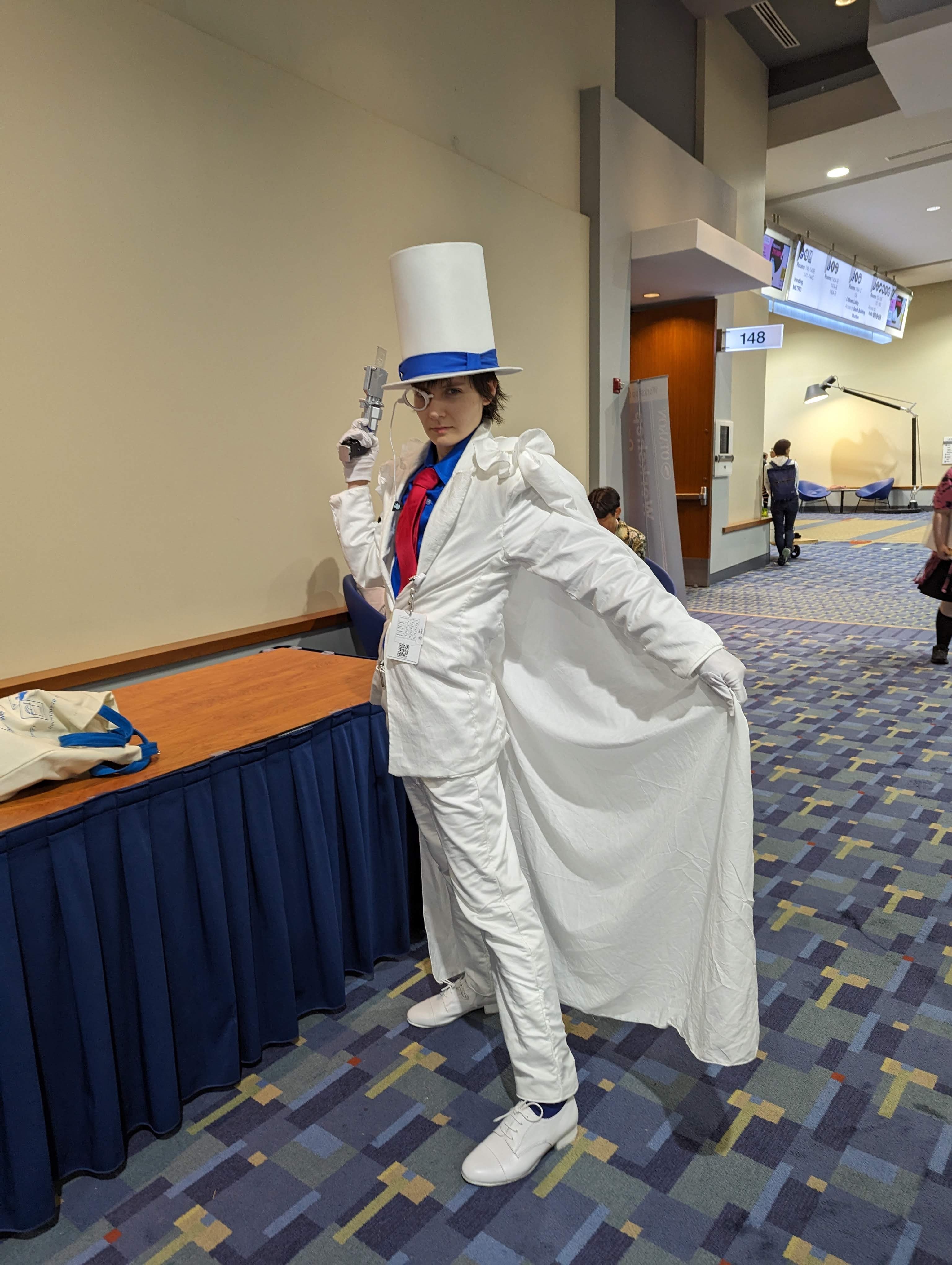
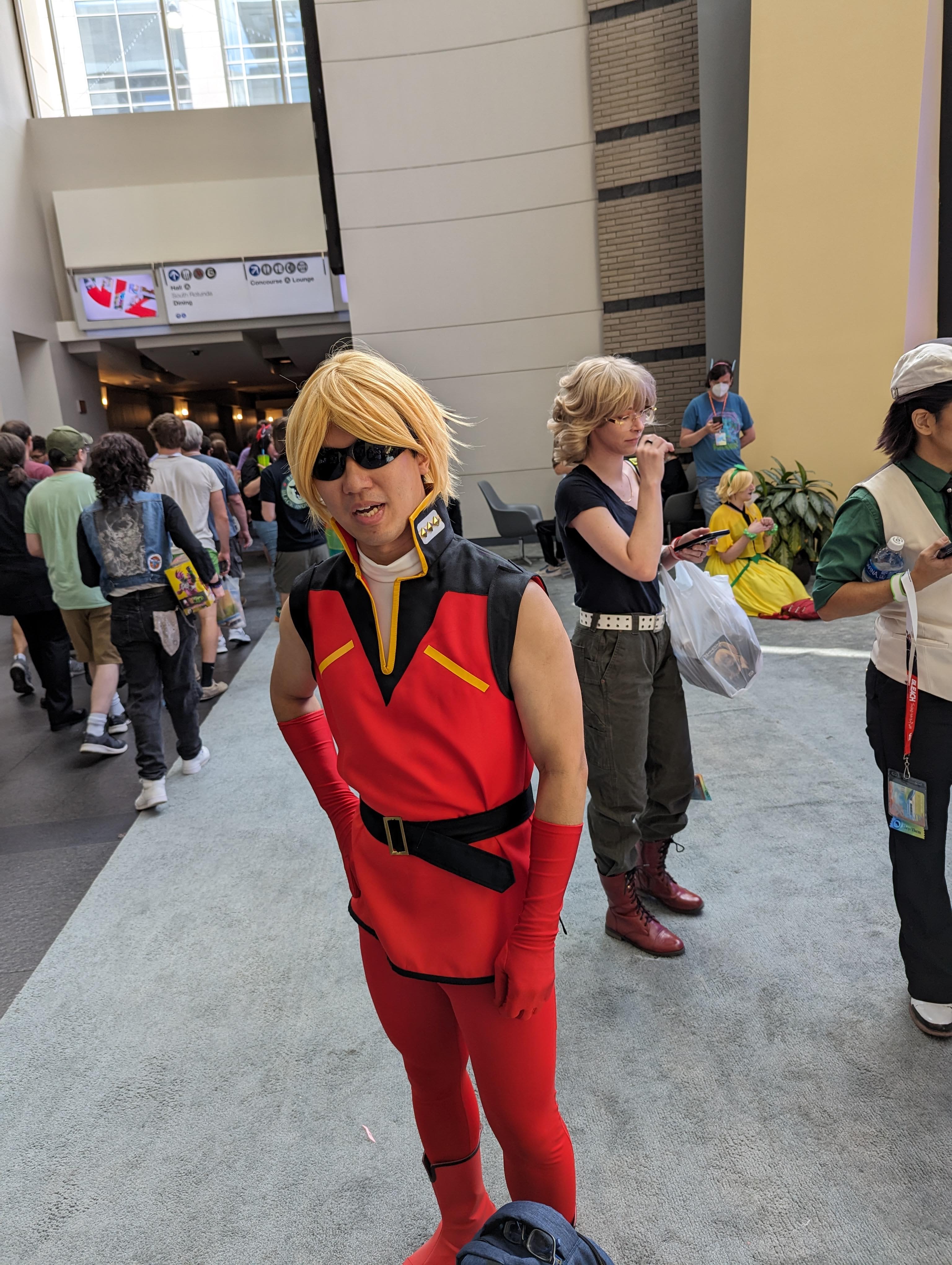
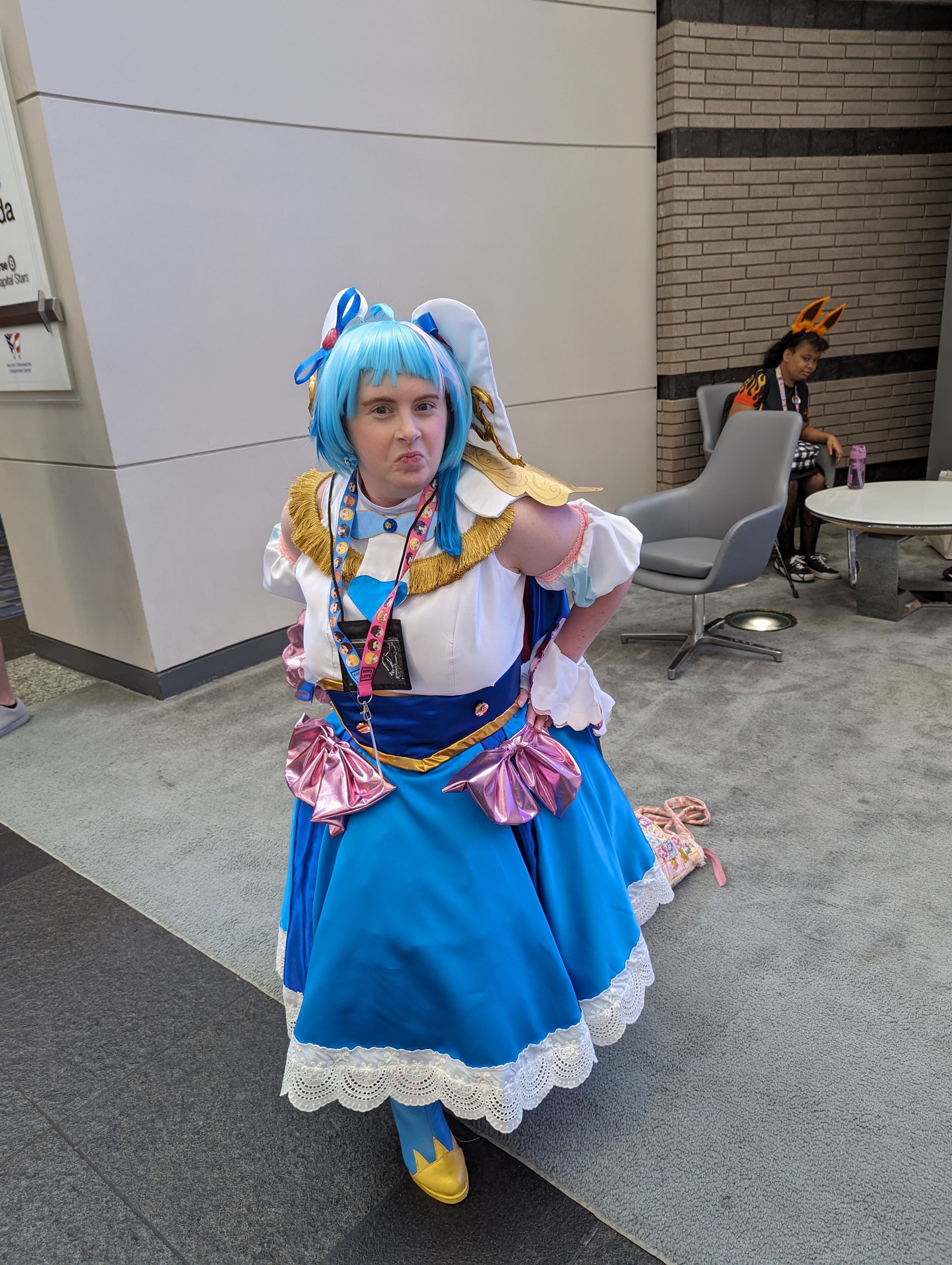
Cosplay
Closing Thoughts
2023 was definitely a strong Otakon in spite of circumstantial issues like the weather. Most importantly, I got to meet Tomoyo.
That said, the amazing thing is that next year promises to be even bigger and more powerful because it’ll be Otakon’s 30th anniversary. I’m already brainstorming ideas for panels, and wildly speculating on potential guests. I feel like it would be the perfect time to get people who were big back in 1994, and I trust the staff running the show to bring in some big guns.
Terada Takanobu is a veteran game producer, and has been involved with the Super Robot Wars franchise since the 1990s. This interview as conducted at Otakon 2023 in Washington, DC.
Hello, it’s great to meet you. I’ve been a long-time fan of the Super Robot Wars series, and I’m very glad that is finally easy for people to play around the world.
My first question: You recently announced that you were becoming a freelancer. How has that change been for you? Have there been any particular advantages or challenges that come with it?
There were lots of interests I wanted to pursue, so I decided to step down from the producer role to become a supervisor, and use that time to do the things I’d like to do.
I want to make toys and plastic models, and original robot animations—ones that are not Super Robot Wars OG.
Do you have any all-time favorite anime or even tokusatsu works?
My favorite super robot is Mazinger Z. As for tokusatsu, Ultraman and also Masked Rider. And more and more.
Original Kamen Rider, or…?
It would have to be the first Masked Rider, fundamentally.
One signature element of SRW is the continued use of very creative 2D attack animations. What are the reasons you have stuck with this style even though so much has changed about video games over time?
In Super Robot Wars DD, we’re doing 2D animations and something between 2D and 3D too, so we’re diversifying.
In SRW DD, the idea behind going for 3D animation is to better capture the original. But more than when I was a producer, I can now better create the content I make compared to before
What has it been like developing mobile games, as well as having multiple games out there? Is it part of a broader strategy?
With regard to the overall strategy of creating mobile games, that lies with the publisher, Bandai Namco, so I can’t really speak to it. However, as for challenges in mobile games specifically, I’d say one that having a deadline every month is a bit challenging. For example, before, if it was for a console, you had three years to get the battle animations and the scenarios and put everything into one package. But now, with the mobile games, you have everything packaged every month.
You started at Banpresto in the 90s. Are there any staff from that era still at [its successor] BBSoft?
There are some.
Do you have any specific series or character units that you thought turned out especially well in terms of their presence in SRW? Or do you think there were any storylines that were executed very well?
It’s a bit difficult, because all of them are a lot of work, and I’m mainly putting effort into making what’s there. It’s a cyclic process of making and releasing and making. More than myself, it’s ultimately the users who decide what’s good.
Are there any titles you are especially proud of being able to obtain for SRW or thought you’d never get for the series?
Space Battle Yamato, aka Star Blazers. As for recently, too many. Hmm…recently, Gridman, Mobile Suit Victory Gundam, and Gun x Sword. In SRW DD, Devilman and Koutetsu Jeeg. What’s it called in English?
Translator: [Steel] Jeeg.
Oh, just that directly.
Ogiue Maniax: There isn’t much of a Jeeg presence in America.
Ah, I see. Oh, and there are two Jeegs now: [Steel] Jeeg and [Steel God] Jeeg.
The impression I have about SRW is that there are the “main” games—Alpha, F, F Final, V, X, T, 30, etc.—and then there are smaller ones that tend to be a little more daring with game mechanics and what series they include. One title I think of is SRW Neo, with Jushin Liger. Is there any truth to the idea that you see the smaller games as more experimental?
Before, yes, there was a difference with the more experimental ones. But now, SRW DD is the only one out, and in there, we try all sorts of things like Jushin Liger and Granzort. SRW DD does embrace the style of SRW, such as the game stages and the scenarios and everything.
I know that you cannot reveal any unannounced information, but has there ever been any consideration to include giant robots from non-Japanese media?
I’m not allowed to say what it was, but there were past attempts. There’s lots I would like to license, but it didn’t work out.
Do you receive feedback from the directors and other staff involved with the titles included in SRW? For example, have you ever had to interact with directors Tomino or Anno?
Yes, there has been some feedback—and actually, there have been some ideas that came from Tomino-san and Anno-san. And actually, I came across some suggestions that Kawamori-san of Macross had earlier. But I had to tell him that’s not something I have control over.
One last question: Over the years, you’ve worked with many voice actors, and unfortunately, some have passed away. Sometimes, they are replaced by new actors, and other times, you re-use existing voice clips. Do you have any say in who gets recast in SRW, or is it outside your control?
If it’s stated by the original source material, I will do as the source material requests. Otherwise, I have the freedom to choose.
It’s not uncommon for people to dwell on what might have been. “If only I could get back what I lost, then everything would be better.” The Tunnel to Summer, the Exit of Goodbyes is an anime film that explores this feeling, told through the lens of a summer romance with a spark of the fantastical.
The Tunnel to Summer explores the lives and relationships of two teenagers, a boy named Touno Kaoru and a girl named Hanashiro Anzu, who end up finding an actual urban legend: the Ryuuguu Tunnel that is said to give you your greatest desire but at the price of losing everything. Touno has to deal with an abusive father who blames him for all their troubles and trauma. Hanashiro has something to prove and an attitude to match—one that says, “I have neither the time or patience to deal with stupid crap.” The pair discover that time passes much more quickly in the tunnel, and even a few seconds in there translates to hours in the real world. But the two have wishes they want to fulfill, and so they work together to figure out its secrets, all the while growing closer.
Time dilation isn’t a new premise in Japanese fiction. Both Aim for the Top! Gunbuster and Voices of a Distant Star explore how human relationships can be affected by the uneven passage of time within science fictional settings. Even beyond anime, the Ryuuguu Tunnel itself is a reference to the fairy tale Urashima Tarou, which is about a guy who visits the underwater Ryuuguu-jou (Dragon Palace) for what he perceives as three days but is actually 300 years. As a trope, I actually enjoy time dilation quite a bit because of how it messes with our minds so simply and easily—and The Tunnel to Summer adds another emotional dimension because it’s not just about how they are passively affected by it but also how their active decisions have consequences. The characters must consider how the past (or future) they long for might very well be distracting them from finding happiness in the present.
Something else that stands out to me is the central relationship between Touno and Hanashiro because of how much the two feel like equals. It sort of brings to mind BL shipping in shounen series, and how often it happens simply because all the boys are involved in the same competition—which often engenders visibly greater passion than whatever interaction the hero has with a female love interest. Here, Touno and Hanashiro feel very much like they’re in it together as they learn and experiment about the Ryuuguu Tunnel. In terms of how this plays out in the overall story, I like how each character is very invested in their mutual endeavor in their own way. The similarities and differences between the two ultimately enriches their relationship and gives the film a nice emotional anchoring.
Because of the subject matter and the seasonal setting, The Tunnel to Summer, the Exit of Goodbyes ends up having a very nostalgic feel while at the same time questioning the value of nostalgia itself. It’s more than just another summer-themed anime movie, carrying a memorable identity all its own.
Aramaki Shinji is a creator known for his mecha design work on Bubblegum Crisis, Genesis Climber Mospeada, Megazone 23, and more. He also designed many of the toys that became Transformers, including Soundwave. Aramaki is also an anime director who has focused on pushing 3DCG animation since the early 2000s.
You have a lot of experience as a mechanical designer, and I understand that different mechanical designers have different processes for designing. For example, Kawamori Shoji has talked about how he uses Legos. What are the key aspects of your approach?
Well, it depends a lot because I get different requests for each project I work on. For example, you mentioned that Kawamori Shoji-san uses Legos, but I think that’s mainly for designing transforming mecha. Should I answer just based on transforming ones? It’ll make it easier if we narrow it down to a certain genre.
Sure, let’s go with transforming.
So we initially choose two or three shapes/forms, and we ask, what are we going to transform and how. But we start out with the two coolest forms.
Would you say you sort of work backwards from the final designs/silhouettes perhaps?
Initially, we don’t really get into the details. We just think, oh this is what a cool bike looks like, and this is what a cool robot looks like. So we just start off with what looks cool and don’t get into the particulars of how it transforms yet.
It gets difficult from there. In the past, I used to study how things might transform using papercraft. Nowadays, though, we can use 3D programs. We start off with simple blocks, but using them, we can join them and see how these volumes move around.
If we use 3DCG, we can study how these forms look from varying perspectives, so it makes the process much easier.
The next work is one that you might not be as known for. I looked up your credits, and it said that you’re responsible for conceptual design on the anime Star Driver. The style of the mecha there are quite different from what I typically think of when it comes to your work. How far removed are the final designs compared to your originals?
Actually, for Star Driver, I didn’t do much mechanical design, and I didn’t really touch any robots. But I actually designed the landscapes and backgrounds—the stage design—for Star Driver. The series is set on an island, and I designed what the island is like, and what the school is like. I did it based on discussions I had with the director, Igarashi, to set the mood for the anime.
You directed works such as Appleseed, which was, at this point, decades ago. I remember seeing them first start to show up, and that was a time when directing in full 3DCG wasn’t nearly as convenient as it is today. What are some of the challenges you faced in the early 2000s?
Back then, we actually had a lot of problems. There was no standardized software for design, so the character design software was different from the landscape design software. That made it really difficult to organize everything and keep it together as one team.
For one scene, when we decided on the camera angle and looked at the scene, the table and the character were sort of shifted because they were designed using different softwares.
These seem to be simple problems, but back then, Japan wasn’t as advanced in the field of CG. So we faced challenges every single day.
My final question: I actually have fond memories of the cartoon M.A.S.K. and its toys, and I was excited to learn that you worked on it. What designs were you responsible for, and what did it feel like to work on a foreign production?
This series involved a lot of transforming vehicles such as trucks and boats, but the original designs came from the toy company, Kenner. Back then, I was working in LA, but I went to Chicago where their company was based, and took a lot of pictures of the prototypes. We did drawings to help with animations.
Most of the mechas were designs provided from the toys, but some were not from the toys, so I got to design them.
I don’t remember all that well where they appeared in the show, but they let me design two transforming vehicles back then, where I got to pick the car types and how they transform. They were called the Manta and the Shark.
Thank you for this interview. It was great to have you at Otakon!
At Otakon 2023, Iwao Junko (Tomoyo in Cardcaptor Sakura) had a panel focused exclusively on her history and career. This is a summary of the panel, as well as notes from the Q&A that occurred. To read the interview I conducted with her and collaborator Kawamura Ryu, go here.
The Beginning
Iwao started off the panel by talking about her childhood, and how she loved listening to records found in storybooks, watching anime, listening to music. At that time, voice acting wasn’t seen as it is today, so when she asked others about a career in that realm, they told her she would have to be an actor or a singer/musician. Even so, she thought about getting into voice acting since she was 6 or 7 years old.
Around 13, she secretly auditioned to become an idol, and while she was ready to get rejected 100 or 200 times, she ended up getting accepted after just on try. Her parents (especially her dad) were very against it, but she promised them that she would quit in ten years if she didn’t make it.
So she went to Tokyo and did lessons, and she eventually debuted as an idol in a four-person group at the age of 16. She was actually replacing another idol in the group who had “graduated” (i.e. quit and moved on), but the group was already planning to split up after one year. Once that was done, she had to do part-time jobs and attend night school.
Iwao’s First Anime Role
From then on, until the age of 23, Iwao just worked and auditioned, ending up with various jobs. She was in musicals, and also played an assistant in a science show for kids. She even worked at a train station. One day, one of the members of the science show saw Iwao and asked if she had given up on show business. At that time, the ten-year deadline she had promised her parents was almost up. This person mentioned that a certain show was looking for someone who could act and sing, and so Iwao went for it because it could be her last chance. After auditioning, she was nervous waiting for results every day.
It was her first anime role, and it was Melissa Thorn, one of the main characters in an Japanese-French co-produced anime called Montana Jones, about explorers on a voyage. Got the part of one of the main characters of Montana Jones. When she told her parents about it, worried that time was technically already up, her parents instead congratulated her, and said they want Iwao to keep trying for another 10 or even 20 years.
From there, Iwao joined a voice acting school and practiced for her debut in Montana Jones. One thing that surprised her about working on the show was that there was no rehearsal time in anime. The first day of recording is when you meet the rest of the cast.
Another surprise was that they recorded based on roughly drawn non-color animatics. She expected to be acting in reference to finished animation, and while there was sometimes color, that was often not the case. Sometimes, ttwo characters would even be represented by just a red line and a blue line.
The other main characters were played by Otsuka Akio (Solid Snake, Black Jack) and Nakao Ryusei (Freeza). Their performances were so good that she worried there were actually prior practice sessions that she didn’t know about and missed. Iwao couldn’t keep up with them at all.
The way the recording studio was set up, 10-plus people had to work with four microphones. And in fact, one of those mics was the “main character mic,” exclusively used by Ohtsuka as Montana Jones. The result: you ad to quietly get up to the mics each time and constantly choosing which of the three you’d use every time. Not only that, but recording was analog back then, and the tape didn’t stop for you. Every take was 15-minute long (about half an episode), and whenever there was a mistake, everyone had to start all over again. Iwao remembers the other voice actors getting frustrated with her and asking, “What is this amateur doing here?” It was Otsuka and Nakao who helped her through the process, until they eventually finished the first episode.
After the debut episode, haired, the show actually got complaints from viewers who wanted her to be replaced with someone more experienced, and she even received a stack of physical hate mail complaining about her. The other actors supported her and let her know that everyone has to deal with this. Gradually, the staff also supported her, and she gained fans little by little. She still got negative feedback, but would also receive letters from fans. Because of that, she wanted to become someone who could someday help a newbie overcome these same troubles. Something curious she noticed was that once she started having a more positive outlook, she started landing a lot more roles.
Going Full-Time
At first, she didn’t have enough voice acting gigs to quit her day job, but eventually had enough roles that she could go full-time. Her first time as protagonist was in Key the Metal Idol, and from there, it was Cardcaptor Sakura and Evangelion and so on. She remembers her manager saying, “You’re gonna get it,” in regards to Eva. It was with Eva that she could make voice acting her sole career. One thing she learned, though, was that despite the job being “voice acting,” a lot of her work seemed to be event-related. Couldn’t get much sleep, which was rough.
Iwao recalled that the Eva audition was 15 minutes long for everyone. There was a long bench where everyone sat as they waited to try out, and she could see so many voice actors there who were interested. Iwao actually auditioned for two roles, and hinted that the second role has become known recently, but did not specify which one.
Q&A
At the 20th anniversary CCS exhibition, she got to go to dinner with all the other actors outside of work.
Shows she wishes people would know more: Harimogu Harley, Betterman, Key the Metal Idol.
Perfect Blue was a case where she actually received a real script and storyboards prior to recording. Iwao’s time as an idol only lasted one year, but she knew from others while working at that time that some of the things Mima goes through in the film actually dho happen. What she didn’t find out until later that director Kon Satoshi didn’t know anything about her idol history or age, and decided it based on one line that everyone was supposed to recite for their audition: “Who…are you?” Kon had decided on voice alone, so when he looked at her résumé, he reacted to Iwao’s extremely strong-sounding family name, which translates roughly to “Boulder Man.” Kon was excited to see what kind of Rock-like Man would show up, and was surprised Iwao was rather small. Because of this, he was watching her with a stern and scary face, but she didn’t know this was the reason, and Iwao was so scared that she couldn’t greet him. When playing Mima and the “other” Mima, she had to have separate recording days for the different personalities, and thought Matsumoto Rica (who played Rumi) gave a powerful performance.
When asked if she ever had the chance to be the mentor she wanted to become during Montana Jones, she mentioned that she thought upon entering her 50s that this would be her mentorship phase (Iwao is 53 this year). The series where she was able to to do this was an anime called Shining Post, where she thought, “Now is my time to shine.” Iwao ended up telling the new voice actors about what she herself had experienced.
I got to ask a question as well, one that I couldn’t fit into the interview! “Are there any roles you played later in your career that would have been difficult for you earlier in your career?” Iwao replied that it would have to be Hisae in Onihei, as it was a role where she felt she could bring the experience she had built up over time. When playing her, Iwao thought, “Finally, I can play adult roles.”
Everyone who worked on the Madoka Magica found out about the twists and turns week by week, so it was a surprised to everyone.
Iwao is from Kyushu, and a major Tomoyo/Iwao fan asked the final question, which was regarding recommendations for anyone traveling to her home prefecture. Iwao’s Her recommendations are Beppu in Oita Prefecture, which is famous for hot springs. She also suggested checking out Nagasaki.







 OGIUE MANIAX