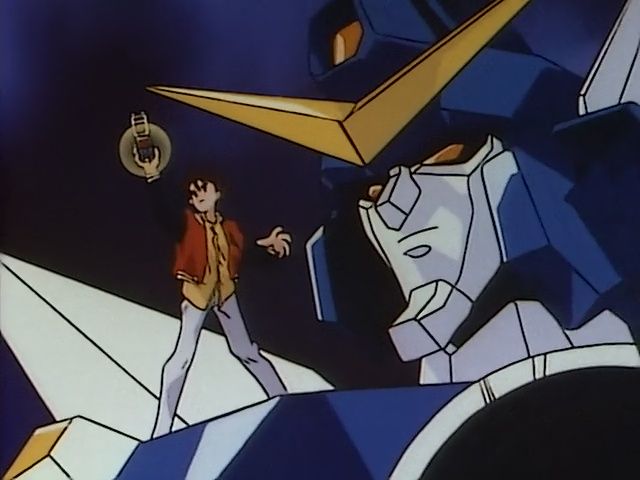
The World Wide Web of Human Pain: SSSS.Gridman

If you were to ask me what my favorite Power Rangers-type show was as a child, it would undoubtedly be Superhuman Samurai Syber-Squad. I distinctly recall running around the house yelling “SUPERHUMAN SAMURAI!!!!” mimicking both the theme song and the TV commercial jingle. So while I’ve never seen the original Gridman the Hyper Agent in Japanese that provided the source material, SSSS.Gridman was an instant must-watch—especially because it was being made by Studio Trigger (Little Witch AcademiaKill la Kill).

SSSS.Gridman is ostensibly about a boy named Yuuta who can merge with a computer entity called Gridman the Hyper Agent and use his abilities to fight off giant monsters attacking their city. However, it quickly feels more like a bizarre paranormal mystery that seems eager to deal out the truth piecemeal. Often times the show is seemingly less concerned with personal character development and more about pulling back the curtain. One of the biggest questions is how the monsters and even Gridman himself, who were previously confined to the computer realm, are manifesting in the real world.

The result of SSSS.Gridman‘s peculiar mixture of ingredients is that it can feel like a never-ending ocean of information to explore in both profound and frivolous ways. Somehow, it simultaneously presents itself as both a shallow case of “geek-info/reference overcharge” and an introspective look at the pain and suffering of human interaction.

The series is full of odd details that aren’t exactly vital but add to a certain meta-ness that can enhance enjoyment of SSSS.Gridman. Two side characters in the series actually come from a yuri short story by the series director. Most if not all of the characters in the anime are based on a Botcon convention-exclusive mirror-universe series called Transformers: Shattered Glass. it’s a strangely elaborate reference to make, almost purely for enjoyment’s sake (and to get the Transformers fans jumping out of their seats), or perhaps as a wink and nod to the fact that the company Takara had a hand in both Transformers and Dengeki Choujin Gridman. Even the title, SSSS.Gridman seems to be willing to play into its own American adaptation. After all, how else would a fan of Superhuman Samurai Syber-Squad interpret the series?

But then the anime also makes references so as to hint at the true natures of its characters, or to foreshadow what’s to come. It’s really deep-cut stuff that generally involves using monsters and motifs of past tokusatsu works (especially from Tsubaraya Productions, the studio behind Ultraman and Gridman), and far beyond my knowledge or experience to have picked up without outside reference (thanks to Mike Dent!) However, it’s not as if one needs to get every in-joke or obscure callback to understand SSSS.Gridman and where it’s going. The series is another showcase of one of Studio Trigger’s great strengths: the ability to put in all of that under-the-surface content for hardcore fans without alienating newcomers. The references aren’t a barrier to entry so much as a reward for the faithful, and it’s as much a sign of love as the very movements of the monsters themselves, who despite being animated in 3DCG are made to behave like people in rubber suits as a way of replicating the live-action feel of the original Gridman.

Right to the end, SSSS.Gridman seems to change and shift, and it can be difficult (though not impossible) to predict where it’s truly headed. Watching the series unfold is a quiet yet boisterous joy that captures simultaneously the anxieties and wonders of both childhood and adulthood.

Dreams Before Harems: Why I Like “We Never Learn”

We Never Learn is a popular harem manga currently running in Weekly Shonen Jump, and one I actually like a good deal. With the anime debuting next season, I’ve been thinking about why I’m fond of this particular series over other similar works, and I realized something. While We Never Learn is indeed a harem series, and thus shipping is ostensibly an important factor for enjoying the series, I find that I don’t actually care about pairings at all, and this makes the series better for me.

Because the anime is coming out this season, I’m going to make this post as spoiler-free as possible. Actually, I don’t even think I need spoilers to explain my point, so it works out.

The basic plot of We Never Learn has high school boy Yuiga Nariyuki tasked with tutoring two of the smartest girls in school. However, while Furuhashi Fumino is a genius of literature and the arts, and Ogata Rizu is a math and science wizard, their respective dreams are to go to college in their worst subjects instead. Along the way, other girls join the cast, and the close calls with Nariyuki never stop, in typical harem fashion.

One thing clear from the start is that each character has their own goals they want to reach. Sparks fly and fanservice abounds, but their attractiveness doesn’t define who they are as people. Moreover, they’re all supportive of one another, and this makes it a refreshing experience.

Nariyuki could end up with anyone, or no one. Any of the girls could end up with each other. Perhaps they might all marry random, unrelated characters. To me, none of it truly matters, because I want all of them to succeed in ways beyond relationship success. While the girls and their cuteness is a major part of We Never Learn, you want to see these girls achieve their dreams as they try to overcome genius with hard work in a Rock Lee-esque way. The fact that the geniuses they’re to beat are themselves makes it all the greater.

Help Me! Why is “S&M” Lingo So Common in Anime and Manga?

Out of the many tropes and trends to come out of anime and manga, there’s one I find especially curious: the casual use of “sadist” and “masochist” to describe characters. It’d be more understandable if it was limited to more sexually charged series, or to describe villains as “sadistic bastards,” but it occurs in just about everything—romances, kids’ shows, sports/competition series, and so-on. You see the letters “S” and “M” thrown around by characters as if it’s the most normal thing to say in a conversation.

In series like Prison School, “S&M” is used conventionally to refer to kinks and fetishes. In other cases, like Chihayafuru, the phrase is more removed from an explicitly sexual context, and could potentially be seen as simply referring to a non-sexual pleasure derived from inflicting or receiving pain. Or perhaps that layer of sexual tension and mild eroticism that permeates many anime and manga also trickle down into the ones that aren’t like that. The same could perhaps be extended to phrases like “siscon,” though many recent anime have gone out of their way to make that particular phrase anything but innocent.

I’m not against this trend of using “S&M” terminology, or at least find no need to take umbrage with it, but it really makes me wonder where the heck it all comes from. Is it a few famous titles? Could it be from some visual novels that got big among otaku? Or maybe it’s from something more mainstream, like classic Japanese literature. Yet, try as I might, any attempts at cursory research turn up fruitless. I get the feeling that there’s no straightforward answer, and that it might be bits and pieces of both Japanese domestic and foreign imported culture mixed together into a complex stew.

If anyone has any expertise on this matter, or knows any potential resources that could point me in the right direction, I’d love to know. This is one mystery that I really want to solve.


Mystic Eyes: Ogiue Maniax Status Update for January 2019

2019! It’s time to look back briefly at all the resolutions I failed to keep (like getting literate in Dutch), and then ignore them to keep myself looking ahead. When it comes to Ogiue Maniax, I don’t recall making any blog-specific resolutions, but maybe I should…

As we go into the new year, I’d like to express my gratitude towards my supporters on Patreon and ko-fi.

General:

Johnny Trovato

Ko Ransom

Diogo Prado

Sue Hopkins fans:

Serxeid

Hato Kenjirou fans:

Elizabeth

Yajima Mirei fans:

Machi-Kurada

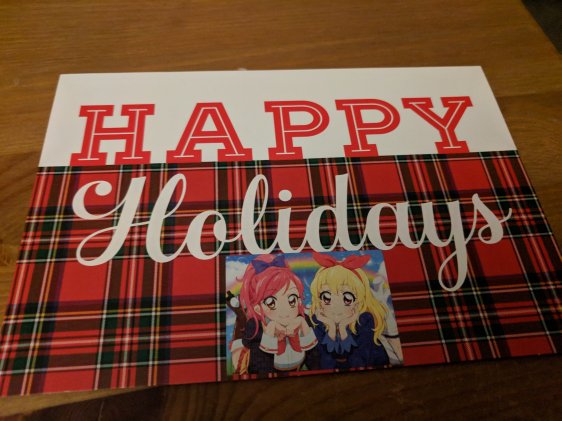
A special shout-out to Johnny Trovato, who actually went as far as to send me a holiday card. Thank you!

My favorite posts from December:

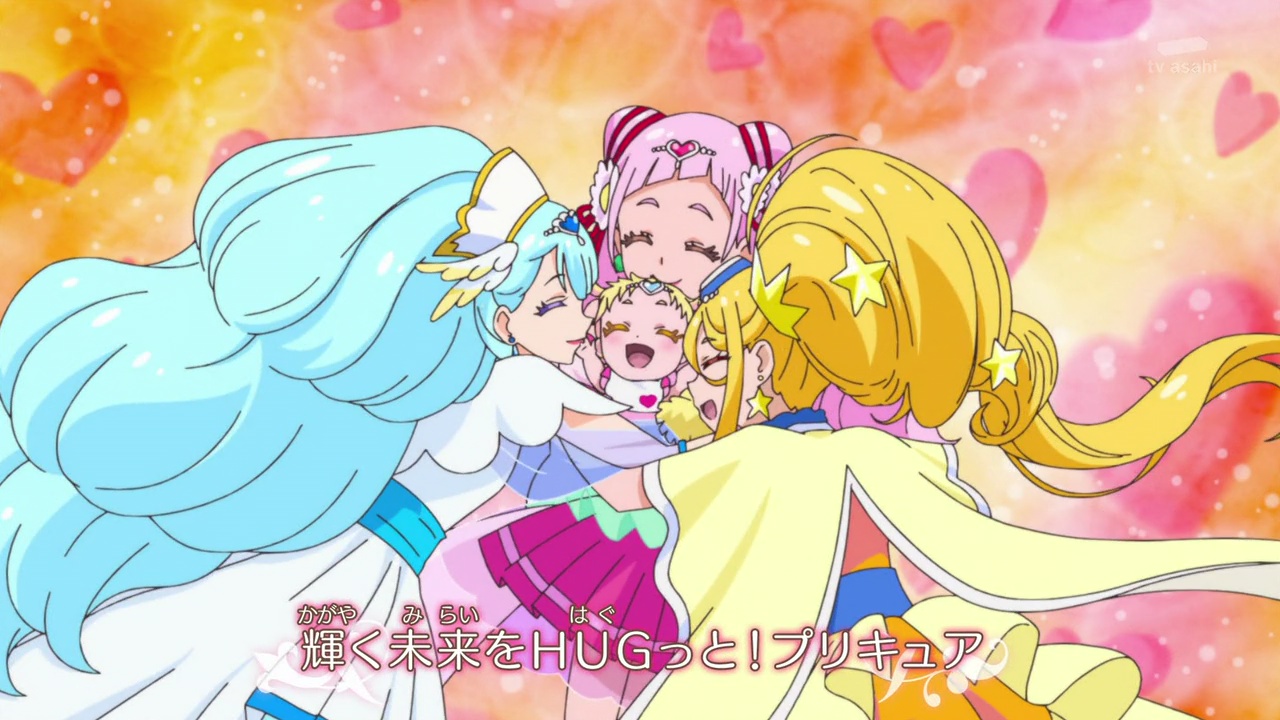
The Dynamics of Hugtto! Precure’s Gay Couple

Hugtto! Precure has a lot of strengths, and its semi-under-the-radar same-sex couple says a lot about the show.

Gattai Girls 9: “Mobile Police Patlabor” OVA 1 and Izumi Noa [Anime Secret Santa]

For the second year in a row, it’s a dual-purpose Gattai Girls + Secret Santa review! Incidentally, my very first Anime Secret Santa was actually the first Patlabor movie.

Best Anime Characters of 2018

My picks for the best characters of the year. Who were your faves?

Hashikko Ensemble

Chapter 11 focuses on the girls we’ve seen, and it’s one of my favorite chapters yet.

Patreon-Sponsored

Aikatsu Friends! Knows How to Celebrate Christmas

I hope Aikatsu! never loses what makes it so fun.

Closing

So for New Years’ Resolutions, I think I’ll challenge myself. Hopefully I’ll remember to check back on this in January 2020.

1) Have more overall visitors to the blog compared to 2018.

2) Be more topical, though without trying to chase the latest popular trend. Try to maintain that balance where I’m still writing for myself, but I give my take on the things anime fans care about.

3) Increase my overall Patreon sponsors by the end of the year, even by one!

To quote a great president, “We must move forward, not backward. Upward, not forward. And always twirling, twirling, twirling towards freedom.”

Best Anime Characters of 2018

BEST MALE CHARACTER

White Blood Cell 1146 (Cells at Work!)

I have been fascinated by the immune system ever since I could read. That’s why Cells at Work!, a manga and anime that anthropomorphizes the cells of the human body, feels like a dream come true. Among the many highly amusing characters, White Blood Cell 1146 is one of the centers of the series, and his actions and personality as the main representative of immune response is an endless source of education and comedy.

White Blood Cell is an absurd entity disguised as a straight-man. His sense of duty and his deep, serious voice present a no-nonsense character. However, when you see him literally biting into a virus as he stabs it repeatedly and then turns to cordially greet his good friend Red Blood Cell, it speaks to an individual who is me than meets the eye. In a way, White Blood Cell being the best is the result of his relationship with Red Blood Cell.

BEST FEMALE CHARACTER

Aisaki Emiru (Hugtto! Precure)

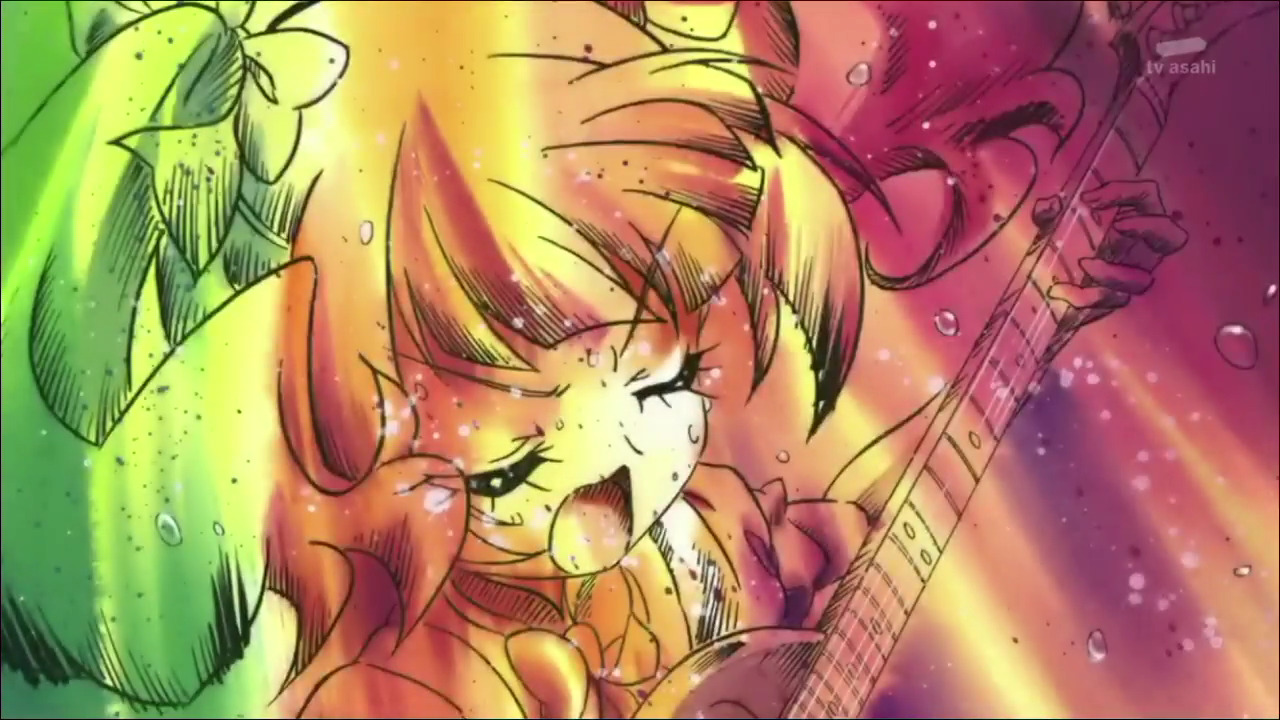
I love Precure in general, and many of its characters among my favorites, but I’ve never seen myself in a Precure character as much as I have Aisaki Emiru. Her initial appearance as an overly cautious girl who over-prepares for the worst spoke directly to who I am, and my similar anxieties on a daily basis. I can’t exactly relate to the enormous wealth and secret electric guitar, but you can’t expect everything.

But it’s not just my similarities to Emiru that make me fond of her. Like all of the girls (and guys!) in Hugtto! Precure, there’s a strong sense of growth and maturation, even for someone as young as Emiru. She learns that friendship can take all forms, that holding back one’s emotions can be harmful, and that a heart which believes in change can make the world a better place. I’ll never forget Emiru’s words as she played guitar that first time: “The ‘nyeowr’ is the shout of your soul.”

THE DAIDOUJI TOMOYO AWARD FOR BEING DAIDOUJI TOMOYO

Daidouji Tomoyo (Cardcaptor Sakura: Clear Card)

This year brought back to anime one of the best magical girl series ever—Cardcaptor Sakura—and with it the very greatest best friend in anime history. A now-teenaged Daidouji Tomoyo continues to support her beloved Kinomoto Sakura, but now with the power of a personal drone.

What makes Tomoyo great is that she wants the best for everyone she cares for. Wise beyond her years and always willing to dispense advice for her lovely oblivious friends, she’s the one you want in your corner every time.

Basically, I am extremely, extremely biased towards Tomoyo to the point that she unfairly destroys the field of best characters of the year, male or female or anything else. Thus, I’ve spun her off into her own category to make this year’s picks more fair in general.

Hail Tomoyo.

Final Thoughts

There’s one simple word that ties all of my 2018 winners together, including the titanic Tomoyo: friendship. Whether they’re discovering friendship for the first time or long-time believers in its power, all three truly embody the joys and strengths of being a true friend. It’s not just about selflessness, and it’s not just about companionship. There’s a real sense of trust and rapport that come from knowing that you have each other’s best interests at heart, and it lets them overcome just about anything.

Save

Save

Save

Save

Save

Save

Save

Save

Gattai Girls 10: “Mobile Police Patlabor” OVA 1 and Izumi Noa [Anime Secret Santa]

Introduction: For the second year in a row, I’m combining my Reverse Thieves’ Anime Secret Santa entry with my Gattai Girls review series—posts dedicated to looking at giant robot anime featuring prominent female characters due to their relative rarity within that genre.

Here, “prominent” is primarily defined by two traits. First, the female character has to be either a main character (as opposed to a sidekick or support character), or she has to be in a role which distinguishes her. Second, the female character has to actually pilot a giant robot, preferably the main giant robot of the series she’s in.

The year is 1988, and the long-standing image of giant robots in anime fluctuates between either fantastic heroes and gritty, expansive science fiction. In this environment, one multimedia franchise decides to ask a simple yet potential-laden question: how does a society police its citizens in a world where mecha are commonplace?

In the near future of Patlabor, humanoid robots are commonly used in various industries, the police have also decided to incorporate mecha known as Patrol Labors into their forces. Patlabor follows Special Vehicles Unit 2, a ragtag bunch of eccentrics who solve Labor-related crimes. While there are multiple iterations of Patlabor, including anime, TV series, OVAs, and films (all of which apparently have branching continuities), this review will be focused on the first OVA series, titled simply Mobile Police Patlabor, but also known as Patlabor: The Early Days.

At first, Patlabor presents itself as a fairly low-stakes works, with its eclectic cast of officers and mechanics trying to deal as much with each other as the crimes they’re supposed to prevent. However, it gradually reveals concerns that are deeper and broader than first expected—provided you peel back the curtain a little bit. Over the course of the seven episodes of the first OVA series, those “Labor crimes” (not sure if pun intended) often speak to underlying social issues in Japan such as the struggle between pacifism and militarism that has affected the nation since World War II.

Such themes are the wheelhouse of the OVA’s director, Oshii Mamoru, and he gets even more philosophical about the intersection between technology and society in his Patlabor films. Here in the first OVA, though, Oshii doesn’t go nearly as hard on his pet topics, and the result is a comparatively much more straightforward story. The OVA is much more willing to be a police drama with some underlying political messages, and thus more approachable for those who might feel the films to be too overbearing.

But it’s also impossible to shake the idea that Patlabor cares relatively little about what it presents on the surface, especially when it comes to the treatment of the ostensible protagonist, Izumi Noa. If one were to guess what Patlabor is about from just the opening alone, one would assume that Noa is the star of the show, as she relaxes with, takes care of, and fights in her beloved Patlabor, Alphonse. In fact, she’s the only character who appears in it at all! Yet, somehow, the clear poster child for Patlabor as a whole only ever has a semi-major part at best in any of the episodes.

It’s not as if Noa is portrayed as useless or incompetent or in need of big, strong man to rescue her, but her general character—tomboyish robot lover with a knack for piloting—seems to have the least connection to the series’s underlying focus on the intersection between politics and technology. In contrast, Shinohara Azuma is the son of the president of a Labor-manufacturing company, while Goto is the deceptively intelligent and wily chief whose past has him confront the militaristic elements of Japan. Even the other prominent female characters, Kanuka Clancy and Nagumo Shinobu, seem to get more screen time than Noa because they’re tied much more deeply with the police system. Ironically, the woman who was to be the heroine by virtue of her neutral and apolitical passion for mecha ends up feeling more like a side character.

Overall, Mobile Police Patlabor seems to embody much of the OVA spirit that permeated anime in the 80s and 90s by providing an opportunity for projects to go in unique and interesting directions. The result is a fascinating series, but also one that seems in conflict with itself at times.

Aikatsu Friends! Knows How to Celebrate Christmas

Christmas is a different holiday in Japan compared to the United States. Even putting aside the religious vs. secular aspects, December 25th is traditionally seen in Japan as more of a romantic occasion featuring cake and fried chicken, and various anime and manga throughout the years have reflected this. That’s why I was surprised to see that the Christmas episode of Aikatsu Friends!—aptly titled “Merry Friends Christmas”—feels so at-home with a more American conception of the holiday.

The episode begins with drawing lots for a big idol tournament. Once the matches have all been decided, each duo goes out to practice and to shore up their weaknesses. The portrayal of “idol activities” is always a highlight of the Aikatsu! franchise, and watching the two goth girls weight-lift using an oversized die and a black crystal ball to shore up their weak stamina reminds me of why I enjoy these shows. What’s more, I like that it doesn’t dedicate the entire episode to Christmas, as it minimizes the sense that this is a one-off break from the main story. The celebration is woven into the overall momentum of Aikatsu Friends!

Heroine Aine decides to invite her partner Mio and their rival teams to have a fun Christmas party, and there’s just something familiarly heartwarming about the gathering. The exchanging of presents, the overall sense that the competition doesn’t overshadow their friendships, and the festive mood would fit right in with US Christmas TV specials—but with all of the morals about kindness and giving merely implied instead of said outright. It’s the sort of execution that makes me wish Aikatsu! could get a real foothold outside of Japan, even though I realize that its success is tied in heavily with the arcade games.

As with every Aikatsu! Christmas, they end with a rendition with of “We Wish You a Merry Christmas” with a characteristic rap section that talks about turning a holy night into a party night. At this point, and I have to wonder what the reason is behind keeping the song from year to year. It’s not a bad thing, but I would have expected them to switch it up from series to series—maybe some “Jingle Bells” or “Deck the Halls.” Maybe it’s just what the fans expect, and hearing the latest generation of Aikatsu! stars give their own take on the song is itself a tradition.

Overall, it’s an excellent Christmas episode from Aikatsu Friends, and an excellent way to set the mood for the holidays. It also makes me wonder if the image of Christmas has changed in Japan! That investigation will have to be for another time.

This post was sponsored by Johnny Trovato. If you’re interested in submitting topics for the blog, or just like my writing and want to support Ogiue Maniax, check out my Patreon.


Ahh Real Babies: Hosoda Mamoru’s Mirai

Director Hosoda Mamoru is nearly synonymous with family themes in anime films, but his newest work, Mirai (in Japanese: Mirai no Mirai) takes it to a whole new level. Whereas his past films such as Summer Wars, Wolf Children, and The Boy and the Beast explore the value and meaning of family, Mirai is more focused on the authentic feel of raising (and being) real flesh and blood children, and the challenges that come with having a family.

The story of Mirai centers around Kun, a bullet train-loving toddler who’s meeting his newborn little sister, Mirai, for the first time. As is typical of only children who suddenly have a sibling in their lives, he quickly grows jealous over all the attention given to the new baby. However, his tantrums lead him to discover that his backyard is the gateway to something magical, and that it lets Kun discover places and times he never could have otherwise. Through these voyages, which bring him to see his family members past and present in a new light, Kun is witness to the many small steps that lead him to being who he is.

At least, that’s the way the film presents Kun’s adventures. Mirai has almost a Calvin and Hobbes feel in that they never explain outright whether it’s all his imagination or if there really is time travel, and I think that ambiguity is a strength. While Mirai leans more toward the notion that Kun is actually accessing his family’s history given the amount of details he picks up, it doesn’t discount the possibility that Kun, like so many young children, is paying more attention than anyone realizes.

What makes the film truly memorable is the way it so realistically portrays the behavior and learning process of small children in Kun and Mirai. Speaking from my own experiences, I have plenty of friends and family at this point who have raised kids of their own, and many of the obstacles the parents face in dealing with Kun and Mirai actually perfectly mirror the experiences I’ve seen in those close to me. In particular, there’s a scene where Kun refuses to change out of his favorite pants—a stubbornness I’ve seen firsthand. It can feel almost too real, as if Mirai is trying to tell parents that it understands what they’re going through. Moreover, Kun’s mother and father also have to deal with delegating responsibility in their “working mother + work-from-home father” situation that’s quite unusual in Japanese society, which leads to even more examination of the “roles” of family in the modern age. To little surprise, in an interview shown at the screening, Director Hosoda discusses how having children of his own influenced the making of this film.

But it’s not just the parents that the film successfully empathizes with; the portrayal of the experience of being a young child is just as vivid and authentic. There’s one scene in particular toward the end of the film that successfully captures a child’s fear of being in a strange and unfamiliar place. While I’ve not been a baby in a long, long time, Kun’s reaction to his surroundings reminds me of the nightmares I had as a kid, as well as the times where I got lost in a mall or similarly large and eerie spaces.

Mirai feels more like a series of small episodes tied together into a single movie, but perhaps that’s the way childhood is. There’s no grand scheme or single obstacle to be overcome. It’s a learning process for the entire family.

SSSS.Gridman and the Question of Genre

At a Studio Trigger panel at Anime NYC 2018, an interesting exchange occurred. During the Q&A session, the topic of Trigger’s preferred genres came up, and producer Wakabayashi Hiromi asked the audience what genre they thought the studio’s latest anime, SSSS.Gridman was about. They received various answers, but a common one was “action,” to which they responded, “Action? Really?” What this says is that, on some level, many viewers see SSSS.Gridman very differently compared to its creators.

The point here isn’t to figure out what genre SSSS.Gridman (Twin Peaks-esque paranormal mystery?). Rather, it’s to dwell on that incongruity between so many of those con attendees and Trigger itself. There are certain caveats to account for—like how this was only a handful of fans in the grand scheme of things or the way the series holds its cards close to its chest—but something has to be creating that difference in judgement.

Perhaps those viewers simply have a broader, more lenient idea of what denotes an “action series,” especially compared to creators who inevitably go in with their own values beforehand. If you asked Tomino Yoshiyuki what genre Mobile Suit Gundam is, he might not necessarily say “mecha” or “science fiction” or, indeed, “action.” Moreover, while fans might take the tokusatsu feel of the show (which it captures down to the rubber suit-like movements of the monsters) as more evidence of its “action” qualities, Studio Trigger could be seeing it as an aesthetic quality in service to a greater structure.

Adding thrilling violence to a story could just inevitably change how fans perceive it. The spectacle, on some level, can be overpowering. While I can’t say with full confidence that SSSS.Gridman is a Twin Peaks, there is an anime that takes a lot of inspiration from David Lynch and Mark Frost’s influential TV series: JoJo’s Bizarre Adventure Part 4: Diamond is Unbreakable. While that series revolves around its small-town mysteries as well, the legacy of JoJo as a shounen fight series is still present in its DNA. For some fans, that battle tendency might dominate their view of Part 4.

Whatever the case may be, it’s clear that in the eyes of the creators, there’s more to SSSS.Gridman than just action. At this point, as the show moves towards its conclusion, that might very well be “obvious,” but I do wonder how many fans it pulled in under the vague pretense of strong fight scenes.

Smashing-Good Holidays: Ogiue Maniax Status Update for December 2018

Ogiue Maniax just celebrated its 11th anniversary, and it feels like quite the milestone. However, as much as that has been on my mind, my head space is currently occupied 80% by Smash Bros. Ultimate. 4 days to go!!!

I’m always grateful for my supporters on Patreon and ko-fi. Many thanks to the following!

General:

Johnny Trovato

Ko Ransom

Diogo Prado

Sue Hopkins fans:

Serxeid

Hato Kenjirou fans:

Elizabeth

Yajima Mirei fans:

Machi-Kurada

Here are also my favorite posts from November:

Geek Reference Culture vs. Rap Reference Culture: A Personal and Meandering Comparison

An exploration of how heavy reference usage differs between geek entertainment and rap.

How Hugtto! Precure Tackles Childbirth and C-Section Controversy in Japan

The current Precure series likes to go places.

“Hi-New York”: Anime NYC 2018

My overview of Anime NYC 2018.

Hashikko Ensemble

Chapter 10 feels like the end of one story and the beginning of another.

Patreon-Sponsored

An Amateur Look at the Atelier Games

How mellow can an RPG series get?

Closing

I promise that not every post I make for the next 6 months will just be about Smash Bros. That said, I get the feeling there will be plenty to go around.