Halloween Means Precure!

I’ve come to realize that my favorite Halloween-themed episodes in anime come from the Precure franchise. This might be because it runs all year long (thus making holiday celebrations a common part of the shows), but I also think the mix of magic (in the form of magical girls) on a night associated with the occult works in its favor. Out of the many Halloween-themed instances of Precure, three stand out in particular: an episode of Suite Precure, another from Maho Girls Precure, and the movie Go! Princesss Precure: Go! Go!! Gorgeous Triple Feature

Before I proceed, here’s the requisite SPOILER WARNING.

Suite Pretty Cure

One of my main criticisms of Suite Precure is that, once a major character development moment passes, the show acts as if the new status quo is the way it’s always been. The key example of this is when the character Siren goes from antagonistic cat character to fellow human Precure. All of her history as a villain is seemingly forgotten after a couple episodes. The one major exception comes in the Halloween episode, where the now-Kurokawa Ellen dresses up as a cat girl. When a classmate asks about her costume, Ellen (without missing a beat) casually begins to mention that she used to be a cat, which prompts the other Precures to jump in and brush it off as a joke. It’s a clever bit of continuity in a show which often put it on the back burner.

The character Atarashi Ako is herself dressed as a princess, which is also a joke based on her true identity. Amusement all around!

Maho Girls Precure

The Harry Potter-esque world of Maho Girls Precure lends itself perfectly to a Halloween episode. One of the running jokes of the series is the way that visitors from the Magical World will sometimes forget that they’re supposed to be hiding their identity and will just casually mention things that the Muggles (so to speak) shouldn’t know. Halloween is presented as a major exception, because in the festive, costumed environment, magicians can come as they are because people will think they’re dressed for the occasion. Even then, the Maho Girls find a way to push the limits. The star of the show in this instance is probably Haa-chan, the third Precure and by far the most powerful of the trio in terms of magic. She appears throughout the episode in bizarre costumes, like a mummy complete with sarcophagus, and an alien being taken away by Men in Black.

It’s just a fine episode of nudges and winks and fulfilling the expectations one might have for a Halloween episode in a show about wizarding magical girls.

Go! Princess Precure

Go! Princess Precure: Go! Go!! Gorgeous Triple Feature is actually an entire Halloween-themed movie, consisting of two shorts and one longer standard Precure movie. It was (appropriately) released on October 31, 2015. Go! Princess is already one of the strongest entries in the franchise, and many of its strengths—animation, charismatic characters, strong and positive themes—can be seen in the movie. Interestingly, the main thing the film seems to take from Halloween is the prominence of pumpkins. Whether they’re jack o’ lanterns or pumpkin desserts, the iconic Halloween vegetable seems to overshadow the costume and trick or treat aspects of the holiday. In a way, it’s probably the best of the three story-wise, but the weakest in terms of Halloween hijinks.

I do need to make a special mention in regards to the movie-exclusive transformation, though. The Cures here have a special Halloween-themed power-up that is appropriately flashy.

So those are some of my favorite Halloween anime. In the 90s, the holiday wasn’t a big deal in Japan, but has grown in prominence over the past couple of decades. If we were to move away from Halloween the holiday and more towards “monster”-themed anime, then Kore wa Zombie Desuka? would rank much higher. If you have your own special Halloween shows, feel free to leave a comment.

This post was sponsored by Johnny Trovato. If you’re interested in submitting topics for the blog, or just like my writing and want to support Ogiue Maniax, check out my Patreon.

Save

Love Live! Sunshine!! and the Complexities of Anime Tourism

Love Live! Sunshine!! Real Escape Game in Numazu

Love Live! Sunshine!! is a media-mix property whose purpose, apart from pushing its stars and profiting from a match of anime fandom and idol fandom, is to promote tourism to the region around the city of Numazu in Japan. What I find fascinating about its approach, however, is that it not only encourages people to visit Numazu, but also reflects and tries to address many of the problems facing Japan in terms of the link between sustaining population, community, and business.

There are three main issues brought up in terms of population in Japan in recent years. First, and the one that gets the most attention, is declining birth rates. Whether it’s “herbivore males” or the difficult choice many women have to make between starting a family and having a career, theories abound as to why fewer Japanese people are having children. Second is the post-3.11 decline in tourism; a nuclear meltdown scares off not just international visitors, but those from within Japan as well. Third, and perhaps the most familiar to people around the world, is people moving out of rural areas into urban ones, leaving the old towns a shadow of their former selves with little new blood coming in.

Flying Witch

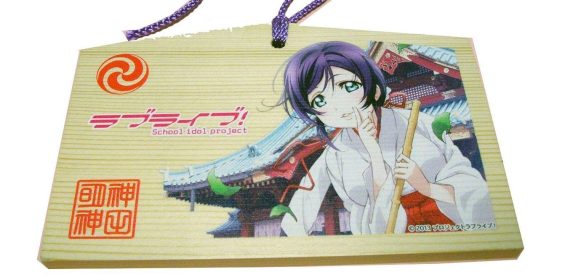
The ways in which anime have been used in response to these problems are myriad. Famously, the popularity of the anime Lucky Star led to people visiting the very shrine featured in the show, Washinomiya Shrine. The first Love Live! School Idol Project anime had a similar effect on Kanda Myoujin Shrine in Akihabara, where the character Nozomi works. But there are also anime which try to show the splendor of Japan whether directly or not. I don’t think it’s a coincidence that Flying Witch was made into an anime a few years after 3.11 when Japan was trying to revive tourism to the affected Tohoku region. Taking place in Aomori (a prefecture in Tokyo), Flying Witch features lovingly crafted shots of picturesque landscapes as if to say, “This area is lush with life.” The studio P.A. Works used the series Hanasaku Iroha to create the fictional “Bonbori Festival” and then bring it into the real world. Their more recent work, Sakura Quest, is an anime explicitly about trying to deal with a declining population in a small town through tourism and promotion.

Official Love Live! Wish Board from Kanda Myoujin Shrine

Love Live! Sunshine!! takes place in the small town of Uchiura, near Numazu. Much like the first franchise, the main characters’ school is threatened with closure due to declining attendance rates. The girls, inspired by the group known as μ’s (from the original Love Live!) attempt to replicate the latter group’s success in saving their own school, and form their own idol group called “Aqours.” Already, it’s clear how Love Live! Sunshine!! touches upon issues of population movement and tourism, but it’s especially notable when comparing the series to its predecessor.

Consider where the two properties take place. The μ’s girls of the original Love Live! are centered around Akihabara, which is both the spiritual center of otaku in Japan and, as a result, already a popular tourist destination. The Aqours girls of Love Live! Sunshine!!, on the other hand, are situated near Numazu, which has a population of under 200,000 as well as a recent history of absorbing nearby towns—a major plot point in Sakura Quest and a potential future for Uchiura. Unlike Akihabara, Numazu is hardly world-famous. And yet, if Love Live! had started differently—if it had decided to go with Numazu from the start—then I don’t think it would’ve reached its original success. Much like AKB48, it relied on the notoriety of Akihabara to build itself up, and is now paying it forward, in a certain sense. Love Live! used tourism, and now tourism is using Love Live!

Love Live! Sunshine!! can be seen as another arm of the “Cool Japan” concept, which uses Japan’s fame as a symbol of cultures both traditional and popular to promote itself at home and abroad. It appears to be succeeding, at least in the short term. In fact, over at Apartment 507 where I also write, one of the most popular posts is a guide to visiting Numazu. But as Gundam director and Anime Tourism Association chairperson Tomino Yoshiyuki has warned, short term success is not enough; permanent change is necessary, even if it’s to come from anime. The fact that Love Live! went from being supported by pop culture to being a pop cultural influence that can potentially make a change is a big deal, and I’m curious to see if this experiment has any long-term impact that goes beyond the cute idols of Aqours.

Save

Save

[New York Comic Con 2017] Mashima Hiro Panel Thoughts

New York Comic Con 2017’s biggest manga and anime guest was, without a doubt, Mashima Hiro. Mashima came to NYCC after concluding his most famous series, the hit shounen manga Fairy Tail, and he sat down for a couple of panels. While I only have a passing knowledge of Fairy Tail, I attended his Saturday retrospective panel at the Hammerstein Ballroom. An hour later, I came away with the sense that Mashima Hiro might be closest to the mindset of anime and manga fandom than other creators.

Because NYCC had another major shounen manga guest last year in Naruto creator Kishimoto Masashi, and because Mashima himself mentioned during the panel that he considered Kishimoto his “rival,” I can’t help but compare the two. Listening to both of them explain their motivations painted two very different pictures. Kishimoto talked about how, at some point, Naruto became a story of redemption, while his becoming a father during the course of his manga’s serialization also influenced the messages he wanted to leave behind. Mashima, on the other hand, seemed to thrive on the simple yet effective premise of “what would be cool?” Fairy Tail was apparently powered by questions such as “Who would win in a fight?” and “What kind of magic would be awesome to see?”

Combined with the greater amounts of fanservice in Fairy Tail—it seems as if, after a certain point, every panel in the series of a girl is pinup quality—it just seems like a series that didn’t have especially lofty goals, not that there’s anything wrong with that. It’s a certain kind of purity, and has in its basis much of what makes shounen manga so popular in the first place. It’s part power fantasy, part adventure. The kinds of ideas floating around in Mashima’s head seem to be cut from the same cloth as much of the fandom, especially when taking into account Western fans. Fairy Tail in Japan is no match for One Piece, but I always get the impression that they’re much closer in popularity at least in the US. I feel like this fan space, where crossover dream battles are practically the potatoes of online discussion (the meat is “who do you ship?”), is one where Mashima’s mindset can thrive.

The Fujoshi Files 174: Mejiro Juon

Name: Mejiro, Juon (目白樹音)
Alias: N/A
Relationship Status: Single
Origin: Princess Jellyfish

Information:
A popular yaoi manga author, Mejiro Juon lives in Amamimizukan, a girls-only shared home occupied by nerds and geeks. Due to her social anxiety, she never reveals her face to others, and instead communicates purely through written notes. She was not always in BL; in her younger days, she even drew shoujo manga.

Compared to her housemates, Mejiro adheres most strongly to Amamizukan’s “No Men” policy.

Fujoshi Level:
Other than the fact that she is a published author of BL works, nothing specific is known about Mejiro Juon’s fujocity.

Save

Chouchou and Body Confidence in Boruto

I’ve been enjoying Boruto: Naruto Next Generations quite a bit, even to my own surprise. The series is quite different from Naruto, akin to how the transition from Avatar: The Last Airbender to Avatar: Legend of Korra involves fundamental changes to the world. It’s a new era in the Hidden Leaf Village, and this is reflected in not just the setting, but how the newer generation of characters behave. One of my favorites in this regard is Chouchou, especially because of her body positivity.

As a daughter of the Akimichi clan, Chouchou is a heavyset character just like her father. However, unlike Chouji in his younger days, who was extremely sensitive about comments to his weight, Chouchou barely bats an eyelash to those who would call her fat. She’s confident in her lifestyle, and to anyone who points out how much she eats, she responds that it’s necessary for an energetic girl like herself. She may be larger than her peers, but it’s anything but a negative for Chouchou.

One of the biggest indicators that Chouchou is not meant to be your stereotypical fat character is that she lacks a “fat voice.” It’s very common in anime for overweight characters to have a rounder, deeper voice that is meant to accentuate their size. Instead, Chouchou sounds perky and fun to be around.

That being said, the “fat voice” does appear in an episode with a different character, a film actor who was fired because he put on too many pounds, so it’s not as if Boruto is entirely without fault in regards to its portrayal of fatness. Even so, Chouchou is still a step in the right direction.


Save

[APT507] Doremi’s Unexpected Successor: Why You Should Watch Little Witch Academia

It’s likely you already know and love Little Witch Academia, but I went and wrote a post over at Apartment 507 about the positive similarities between it and Ojamajo Doremi. Check it out!

Save

The Precarious Balance of Tradition and Progress: Sakura Quest

For years, the raison d’etre of the anime studio P.A. Works appeared to be creating intetesting settings as a pretense to showcase cute female characters. Whether it was True Tears, Hanasaku Iroha, Tari Tari,  or something else, they appeared to focus on personal relationships above all else. A more careful look, however, will reveal another major theme permeating many of their works: the declining population of rural Japan, and the complicated effects of tourism on this situation. Now, P.A. Works has doubled down on this idea in their new anime, Sakura Quest.

Koharu Yoshino is a young woman struggling to find work, when she’s been asked specifically by name to come work in the small, virtually forgotten town of Manoyama. Desperate for employment, she takes the offer, only to discover that it was a mistake. But the contract’s been signed, so now Yoshino—along with a group of other young women—are tasked with helping to revive Manoyama.

Much like one of their previous hits, Shirobako, the main cast of Sakura Quest is notably all adult-aged women as opposed to high school girls. When I interviewed P.A. Works at Otakon 2016, they expressed that they’d been wanting to do that as early as Hanasaku Iroha, but trends and the need to make a profit pushed them to stick with the reliable teenage formula. Now, with two series bucking that trend, it looks like they’re eager to challenge that status quo—at least in part.

The use of attractive girls to anchor Sakura Quest means that the series does not fully escape the market forces of young, attractive heroines, but in many ways it also does not pull its punches. Yoshino and the rest of the core cast, consisting of both those new to Manoyama and life-long residents, are confronted with difficult decisions that often leave their best plans only half-formed and arguably doomed to failure by the many considerations they must account for.

Central to this conflict is the contrast between valuing the traditions of Manoyama and its people, and when those traditions stifle the potential for the town to adapt and evolve. Trying to make tourism and local promotion work in a long-declining town is portrayed as a struggle where the gains are few and the solutions are rarely cut-and-dry, if available at all. The series is not necessarily a cynical one, but any progress comes in small steps.  This can be frustrating at times, but it grounds the show in more realistic expectations. After all, if the solution to the rural decline of Japan were easy, we’d probably have seen it by now. It also highlights the idea that, while gimmicks can boost tourism, this is a serious double-edged sword.

Sakura Quest is not one of those gripping anime that keeps you in suspense, or has you falling in love with the girls so hard that you feel compelled to buy their merchandise. It’s a pretty slow burn, and the characters will repeat their mistakes on more than one occasion. However, it’s a very satisfying work in its own way, as it challenges viewers to think about one of Japan’s major problems today, and the myriad factors that complicate it.

Save

Save

Changin’ My Life: Ogiue Maniax Status Update for October 2017

October is going to be a special month for me from this point forward.

That’s because something big has happened, something I once thought impossible: I got married.

Seriously.

I won’t go into too many details, but I’ll just say that my wife is a very special person to me, who’s stuck with me through thick and thin. This even includes my time abroad in the Netherlands. I actually met her thanks to Ogiue Maniax, though I wouldn’t recommend writing anime blogs as a way to find relationships.

So I want to give a very, very special thanks to my Patreon members this month, because your continued support lets me pursue this blog as a passion project.

General:

Johnny Trovato

Ko Ransom

Alex

Diogo Prado

Viga

Sue Hopkins fans:

Serxeid

Yoshitake Rika fans:

Elliot Page

Hato Kenjirou fans:

Elizabeth

Yajima Mirei fans:

Machi-Kurada


In other, non-matrimonial news, I recently did a series of manga recommendations on Twitter. Check out the thread!

Also, here are my favorite posts from last month:

Tomino Yoshiyuki’s “Big Picture”: WHy the Gundam Creator Can Be So Hit or Miss

Recently, I got to thinking about Tomino and all his eccentricities. Here’s my hypothesis on the “Tomino style.”

Fighting Evil By Moonlight – Heartcatch Precure!: The Novel

I reviewed the Heartcatch Precure! novel, which ostensibly focuses more on Cure Moonlight than the anime.

Beyond the Brokeback Pose: Don’t Meddle with My Daughter

A look at the idea of superheroine sexualization and fetishism as a kind of cultural export, through the lense of the manga Don’t Meddle with My Daughter. It actually got retweeted by the author!

Return to Genshiken

Return to Genshiken: Volume 5 – Pride and Fujo Justice

Part 5 of my Genshiken re-read. Ogiue starts her journey here, but it’s Sasahara who really grows.


Patreon-Sponsored

My Favorite Light Novel Anime

Self-explanatory, but a fun topic all the same.

Closing

Here’s to an exciting new life!

Save

Save

Save

Gattai Girls 7: Shinkon Gattai Godannar and Aoi Anna

Introduction: “Gattai Girls” is a series of posts dedicated to looking at giant robot anime featuring prominent female characters due to their relative rarity within that genre.

Here, “prominent” is primarily defined by two traits. First, the female character has to be either a main character (as opposed to a sidekick or support character), or she has to be in a role which distinguishes her. Second, the female character has to actually pilot a giant robot, preferrably the main giant robot of the series she’s in.

For example, Aim for the Top! would qualify because of Noriko (main character, pilots the most important mecha of her show), while Vision of Escaflowne would not, because Hitomi does not engage in any combat despite being a main character, nor would Full Metal Panic! because the most prominent robot pilot, Melissa Mao, is not prominent enough.


This Gattai Girls entry is a bit unusual because I’ve already posted a review of the series before. Moreover, with a series like Godannar, I’ve already written extensively about the the portrayal of female characters because it’s all but unavoidable. If the prevalent fanservice wasn’t enough, there’s the fact that over half of the cast is women. While I’ll inevitably retread some old territory, this time around I’m going to focus more heavily on the main heroine of the story, Aoi Anna.

Godannar follows 17-year-old Aoi Anna, who’s engaged to burly, veteran robot pilot Saruwatari Gou in a May-December romance. Years ago, he rescued her from a monster attack, and eventually their feelings blossomed into love. But while she’s no slouch herself when it comes to mecha—she’s a prodigy who’s dreamed of fighting in a robot since childhood—Gou forbids her from becoming a full-fledged defender of the Earth. The reason? That’s how he lost his previous lover and trusty co-pilot. Still, Anna and Gou are humanity’s greatest weapons, as their robots combine into the mighty robot, Godannar Twin Drive, the “marriage of god and soul.”

From a characterization and narrative perspective, Anna’s story stands out in a way capable of overshadowing even the infamous double decker cheesecake of Godannar. Romance traditionally takes a backseat in many giant robot series, and when it does show up, such as in Macross, the two sides are often from different worlds, either metaphorically or literally. In Godannar, however, not only are Anna and Gou equal partners, but they have to work together as a team both personally and professionally. The cockpit becomes a second home of sorts, as they iron out their differences and fight the enemy. The series literally has relationship plot and mecha action resolve simultaneously, as if the two sides are permanently fused together, and it’s glorious. In a way, this is the story about the power of love, but it’s less “love defeats everything automatically” and more “love opens them up to resolve problems they couldn’t otherwise.”

In a certain sense, this heavy emphasis on relationships plays into the stereotype of girls only caring about guys, and one might even feel that Anna’s character is directly tied to her connection with Gou. While I think there’s some truth to that, I also find that Godannar‘s direct focus on its main couple (as well as many other couples throughout the series) is a big part of its, and by extension Anna’s, appeal. It’s basically a story about newlyweds who are also co-workers, and having to navigate that tricky interpersonal landscape. Through it all, Anna’s inner strength stands out. When Gou first tells her to stop piloting for her own sake, her response is that they have a duty to take care of each other as husband and wife. At one point, she feels herself unable to fight as Gou’s equal, but is able to find the motivation within herself to not back down in the end. By the end, due to unfortunate circumstances, she’s actually the one having to do the lion’s share of the work, to make up for what Gou can no longer do. Her strength, perseverance, and caring make her one of my favorite characters ever.

I’ve already made mention of it a couple of times, but when it comes to how women are depicted in Godannar, the series heavily sexualizes on a level where few others can compare. To say otherwise would be disingenuous. When the girls, including Anna, are piloting their robots, they’re in ultra-form-fitting suits that leave less than nothing to the imagination. During combat, their breasts jiggle to and fro as if made from some alien substance. Even when they’re in regular clothing, the fabric hugs every curve as if holding on for dear life. The camera angles can also be extremely voyeuristic. Even if I wanted to say, “You should really just ignore all this,” that’s pretty much impossible whether you’re into heavy fanservice or not. There’s an incredibly good series with some strong, well-written characters both male and female there, but it requires either an acceptance or tolerance of just a non-stop barrage of sexual imagery.

One last aspect of the series I want to talk about is the interesting way it addresses the topic of gender roles. In the second season of Godannar, the enemy monsters begin to utilize a different tactic. Instead of just trying to out-muscle Earth’s giant robot forces, they also evolve to spread a virus that specifically targets hot-blooded, macho men—the very people who are supposed to excel at being mecha pilots. As the men become increasingly unable to fight, the women, led by Anna, have to take a stand. On the one hand, this plays into the idea that men are supposed to be strong and tough (though it should be noted that a more masculine girl gets hit by the disease while a more effeminate playboy guy does not). On the other, it brings up the notion that hyper-masculinity can become a weakness to be exploited.

Godannar is a contradictory anime. Its unrestrained sexualization of the female body makes it seem like a series all about pure objectification of women, but at the same time its female characters, notably its main heroine Anna, are fully realized characters who have goals and dreams and a desire to stand on their own feet. They’re fleshed out as human beings, but also practically the embodiment of “temptation of the flesh.” But if marriage is a union of separate yet compatible beings, then Godannar is an unlikely marriage of disparate elements that somehow, some way, work to make something beautiful.

Otakon 2017 Interview: Tomoki Kyoda (EUREKA SEVEN)

At Otakon 2017, I had the opportunity to interview Tomoki Kyoda—director of one of my favorite anime series ever, Eureka Seven. He was at the convention to promote the world premiere of the film EUREKA SEVEN HI-EVOLUTION, and I spoke to him the day before the showing.

Eureka Seven was originally created as a media mix project with video games and manga telling side stories or different, alternative narratives from the anime. How much of a say did you have in the spin offs?

With the spin offs, we would say, “We want so-and-so” for a concept. The various directors and mangaka we were working with would present their spin offs to us, and we would check over them.

My next question concerns Eureka herself. Her appearance changes throughout the series, especially when she gets covered in scars. It’s a very bold decision, I think—especially for anime. What was the thinking behind changing her appearance?

When we were doing the original story, Mr. Kenichi Yoshida and I were talking about what we could do to provide lots of inspiration and different paths the story could take. One of the inspirations that someone came up with was, “What about drastically changing her appearance?” So we actually took that and went with it.

What is it like working with creators Dai Sato, Shoji Kawamori, and Kenichi Yoshida? Do you have any interesting production stories to tell?

With regards to Mr. Sato and Mr. Yoshida, we were actually all born in the same year, so we all have an understanding of our pros and cons; what each of us do well and what each of us do not so well. But with regards to Mr. Kawamori, he is a person we look up to. He is a very interesting person, and his works are also very interesting. But then if you meet him in person… whoa. You’re going to notice that he’s more interesting than anything he’s actually done. So, if we start talking about Mr. Kawamori, we’re going to go past two hours like it was nothing, so let’s just leave it at that.

In revisiting Eureka Seven with the new movies, what feelings are you hoping to evoke in old fans and those who have never seen the series?

First of all, I’d like to say that, for old fans coming back to us, thank you very much. I hope they will actually be very accepting of this, since, even if we use some old footage, it doesn’t mean that we could do something just like the old version. In that sense, it’s in many ways a new movie. I hope they will be very accepting of it. With that being said, for new fans I hope they take it for what it is, and accept it for what it is, and that they will see what Renton and Eureka and Anemone have to do in order to live through that world. So the greater idea I have for everyone is acceptance, really. I hope everyone will accept EUREKA SEVEN HI-EVOLUTION for what it is.

Thank you very much!