
I love giant robots, and I love seeing them turned into Soul of Chogokin figures. Here’s the first five of 10 that I think should get that Chogokin Tamashii treatment!

I love giant robots, and I love seeing them turned into Soul of Chogokin figures. Here’s the first five of 10 that I think should get that Chogokin Tamashii treatment!
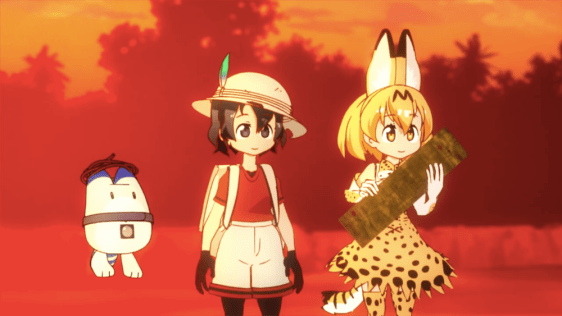 Kemono Friends has taken the anime fandom in Japan by storm. With chart-topping sales in blu-rays, CDs, and more, Kemono Friends is an unlikely success story. How can such a simple-looking 3DCG cartoon about animal people win over the hearts of so many? The answer is by being just off-kilter enough to surprise, and then endearing enough to make a lasting impression.
Kemono Friends takes place in a nature park called Japari Park. The main characters, Serval (the serval cat) and Kaban (the human; kaban means “bag” in Japanese) journey to find out what kind of animal Kaban is. Along the way, they meet other half-beasts, collectively called “Friends,” learning about other species as well.
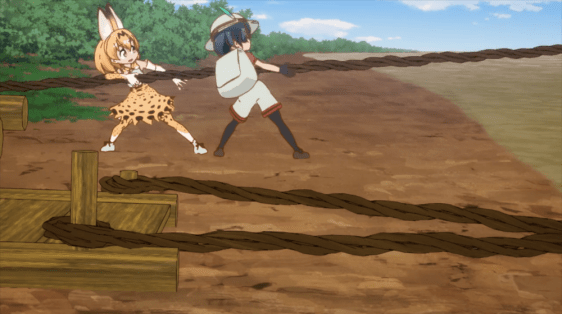
The initial hook of the series is how Kaban (and in fact everyone they meet) is unable to identify what Kaban herself is. Given the dilapidated state of Japari Park, it hints early on that the world of Kemono Friends is more than it seems. Is it a post-apocalypse? Is it something less sinister? The fact that the show maintains its laid-back feeling despite all of that gives the show an unusual charm that’s difficult to find elsewhere. Moreover, in every episode Kaban-chan inadvertently does something that comes easily to humans but is difficult or incomprehensible to the Friends, e.g. handling tools, analyzing situations, etc., which makes for a kind of intriguingly self-reflective position.
I find that a part of Kemono Friends‘ success is that it carries the DNA lineage of gdgd Fairies, a show that mixes cheap animation, unpredictable humor, and an improv section that lets its voice actresses go wild. The series Tesagure! Bukatsumono is of this vein, and its animation director, TATSUKI, is the director behind Kemono Friends. Although Kemono Friends has significantly less improvisational elements than gdgd Fairies or Tesagure! Bukatsumono, the use of simple CG to create a mellow yet mildly uncomfortable world remains. In fact, if there’s any other show that I think even comes close to Kemono Friends in terms of setting and feel, it’s Straight Title Robot Anime, another gdgd Fairies descendant that’s about robots trying to re-discover the concept of humor in a world where humans are extinct. In a sense, Kemono Friends is an “evolution” of this strand of anime, adapted to fit wider consumption than the niche approaches of its predecessors.

Above: Straight Title Robot Anime
It would be a mistake to wholly attribute the popularity of Kemono Friends to those bits and pieces of DNA, however. Another reason the series works is because it’s actually an incredibly effective environmental awareness cartoon, especially for otaku viewers.
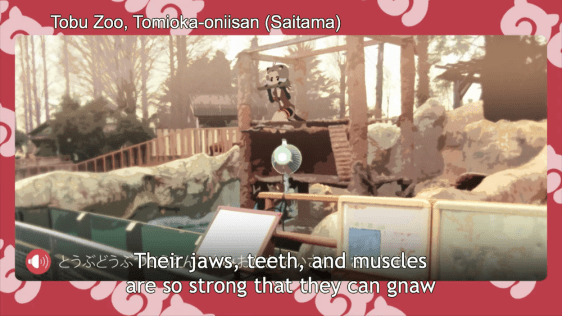
I think the default image of environmental cartoons are fairly overt (and arguably preachy) works: Captain Planet, Nausicaä of the Valley of the Wind, Fern Gully. etc. Kemono Friends, in contrast, takes a less direct approach. By merely introducing “Friend” versions of a variety of animals both popular and obscure, giving them personality traits tied to their actual animal behaviors, and contrasting them with Serval and Kaban, they all become memorable characters at the same time they help commit to memory the qualities of those animals. Perhaps nothing emphasizes this more than the eyecatches, which feature actual zookeepers and other animal experts describing the actual animals in great detail. The experts’ words are accompanied by an onscreen depiction of the Friends version of that animal, and the result is something along the lines of how Hetalia or Kantai Collection fandom involves learning more about actual history. In other words, Serval isn’t just a “catgirl,” she’s truly the embodiment of the serval cat, and just might make you want to help out all serval cats.
Kemono Friends isn’t impressive in terms of animation, but it has an odd charisma that works. While the show won’t win over everyone, I believe it takes only two episodes to really determine whether or not someone will enjoy this series. Those who watch it will be rewarded by a show that deftly balances a lot of different plates.
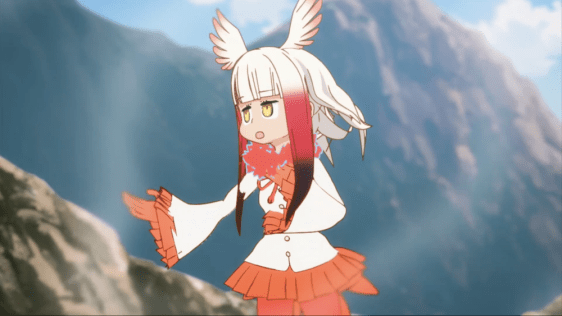
Crested Ibis: The Voice of an Angel Mixed with a Banshee
As for my favorite Friends, they’d have to be the shrill yet friendly Crested Ibis and the detail-oriented and the neurotic Beaver. Fight me.
—
This post was sponsored by Johnny Trovato. If you’re interested in submitting topics for the blog, or just like my writing and want to support Ogiue Maniax, check out my Patreon.
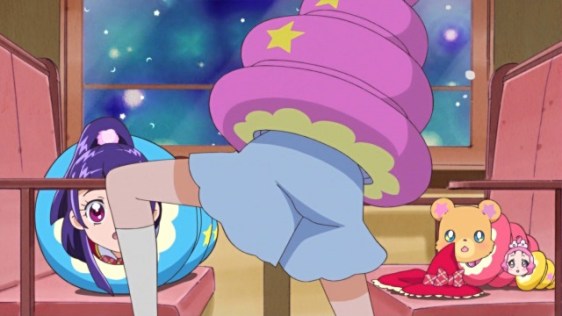
Perhaps I should do a review of March Comes in Like a Lion this month. It’d be the kind of super dumb joke I adore?
You know what else I adore? The support of my Patreon users!
General:
Johnny Trovato
Ko Ransom
Alex
Diogo Prado
Viga
Yoshitake Rika fans:
Elliot Page
Hato Kenjirou fans:
Elizabeth
Yajima Mirei fans:
Machi-Kurada
As I think about all I’ve written on the blog, a thought occurs to me: I might subconsciously assume more knowledge in my readers than I should. This is not an assertion that people who read the blog don’t know enough, but rather that I’ve written about so much over the years that it colors how I write on Ogiue Maniax. Because I avoid trying to repeat myself too much, I feel that I leave too many things unspoken, things that are worth explaining or elaborating upon for readers who are learning of certain elements of anime, manga, and Japanese pop culture for the first time. For this reason, I plan to be more conscious of newer audiences as I write. I’m aware that anime fans nowadays prefer to get their info from YouTube, but I should still make a greater effort to account for people who haven’t been reading my blog for 5+ years, i.e. most people.
Moving on, here are this past month’s blog highlights:
Two series I enjoy concluded recently: Maho Girls Precure and 3D Kanojo. The latter I’m especially fond of, and it’s one of my favorite shoujo manga in recent memory.
I also wrote about the incredible voice acting by Ishida Akira in Showa Genroku Rakugo Shinjuu, as well as the ambiguous morality of Saga of Tanya the Evil.
And i you want to learn about one of the stranger Japanese manga one-shots out there, look no further than Chiyo’s Lips, a title about a relationship based on popping pimples (you might not want to read this over lunch).
March is shaping up to be quite a month, as it’s time for the New York International Children’s Film Festival. I’ll be seeing a whole bunch of movies in the next few weeks, so expect some reviews! I’ll also be writing up my re-read review of Genshiken volume 2.
See you on the lamb side!
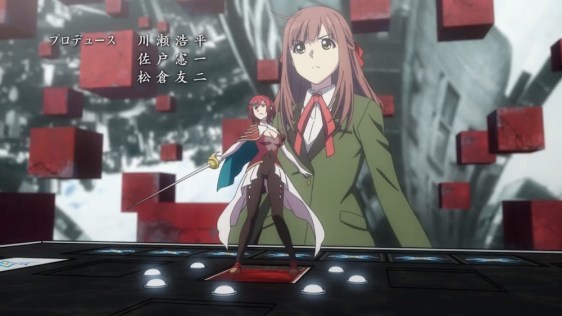
Combining the trappings of Yu-Gi-Oh! with the zero-sum world of Madoka Magica, the Wixoss franchise is an oddity among card game anime. Although based on an actual existing TCG, its narratives tend to be less “buy our things” and more melodramatic human relationships with an occult twist. The latest series—the bizarrely named Lostorage Incited Wixoss—continues this trend, but trades in the “be careful what you wish for” theme of its predecessors for a new challenge.
Overview
Clumsy Homura Suzuko and capable Morikawa Chinatsu are the best of friends, but when Chinatsu moves away the two lose contact with each other. Fast forward to when the two are teenagers, and both girls get involved with Wixoss, a collectible card game that appears innocent on the surface but has mystical origins. A handful of players are chosen as “Selectors,” pitting them against each other in a battle for their own memories. Players are given special cards with sentient girls called “Lrigs,” and whoever wins enough earn the chance to restore or change one of their memories. However, every loss destroys one of their memories. As a result of both becoming Selectors, Suzuko and Chinatsu end up on a course for a difficult and painful reunion.
Oh!! That’s a Card Game
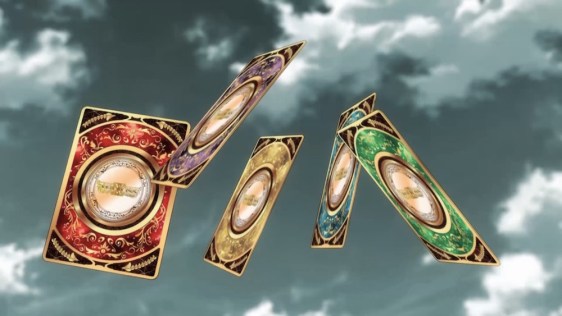
One of the key differences between Lostorage Incited Wixoss and the older Wixoss anime is that the latter were made before the shows’ creators had any idea as to how the actual game’s mechanics work. Much of it was therefore just used purely for dramatic effect. With this newer series, there appears to be much more of a coherent portrayal as to how the game is supposed to work. Where Selector Infected Wixoss and Selector Spread Wixoss used the TCG aesthetics as a vehicle for characterization and character development, Lostorage strikes more of a balance between the thrill of seeing two people face each other in a competitive environment, and highlighting the players’ stories. The key example of this is the “coin bet” system, where characters can wager special coins—essentially their “star chips” in the parlance of Yu-Gi-Oh!—to activate unique special abilities, with the caveat that this is literally putting their memories on the line.
Even as the show presents the game in a better light, however, one of the curious aspects of Lostorage Incited Wixoss that it shares with the other Wixoss anime is that they don’t exactly inspire a strong desire to play the TCG. It’s one thing when Yu-Gi-Oh! has its heroes fight against the forces of darkness, but when the game of Wixoss is portrayed as a source of endless anguish I’m not sure what feelings it’s supposed to conjure up in its potential player base.
Intimacy and Hatred

The highlight of Lostorage is the complex relationship between Suzuko and Chinatsu, a corrupted twist on the concept of childhood friendship (with mild yuri elements) that offers vague glimmers of hope throughout. As kids, Suzuko looked up to Chinatsu as everything Suzuko wished she could be. When she gets her Lrig, she bases the card’s appearance and personality on her image of Chinatsu as someone to aspire. To Chinatsu, however, Suzuko is a reminder of the false facade of strength that she’s had to keep up since childhood Thus, much of the series is about Chinatsu trying to erase her own memories of Suzuko in order to destroy their friendship, while Suzuko attempts to save it.
This conflict is very different from anything in the previous Wixoss anime, and the fate of their friendship does drive the story along effectively. And yet a part of me also misses how unique Ruuko from Selector Infected Wixoss was as a protagonist. The strange joy she feels from matching wits against other opponents despite knowing about the horrors of the game was an interesting source of conflict, but I also understand that doing this again would’ve just been treading old ground.
Given this strange love-hate relationship between Suzuko and Chinatsu, Lostorage Incited Wixoss resembles elements of Madoka Magica even more than Selector Infected/Selector Spread Wixoss, with the two of them possessing a kind of Madoka-Homura dynamic. When I think about it further, though, it’s actually closer to an Utena-Anthy relationship from Revolutionary Girl Utena: a girl who wants to be the light of hope for another girl who falls further and further into corruption.
Overall
Much like the previous two Wixoss series, Lostorage Incited Wixoss provides a mostly dark, cynical twist on the typical “TCG anime” formula. What sets Lostorage apart is that the stories of the characters comes across as much more personal and interconnected due to the use of “memory gain/loss” as an overarching premise. It lacks some of the surprising punches of the old Wixoss, but is a much more stable and coherent narrative overall.

It’s very tempting to categorize Saga of Tanya the Evil according to its appearances. What else would you do about a series where a Japanese man is reincarnated as a blonde magical little girl in an alternate universe version of Nazi Germany? Is it fetishizing the Third Reich? Is it making an argument for authoritarianism and militarism through the lens of contemporary anime tropes? Questions abound, and yet I find that this anime is very difficult to gauge its moral direction, if there is any at all.
Tanya is a little girl who in another life was a ruthless salaryman dedicated to staying the reliable course that is assumed of his profession. So devoted a company man is he that he fires one of his employees for a minor infraction. Believing in the superiority of a detached, logical mindset, he fails to anticipate that his ex-employee would be so despondent as to push the salaryman in front of a moving train. At that moment, the man receives a message from God but refuses to believe in the existence of a higher power, which prompts God to reincarnate him as Tanya.
As Tanya, she has kept her memories of her previous incarnation, and at only 10 years old joins the imperial military due to her extremely high magical aptitude. Similar to her previous life, she sees the military as the steady course to a comfortable life, but a variety of contrivances both divine and coincidental cause her to consistently put her life (and her beliefs) in peril.
Given this back story, it’s possible to argue conflicting points. For example, the refusal by Tanya to let God control her could be seen as a defiance of fate and religion, but the fact that Tanya is constantly denying the existence of a supreme being despite everything that happens might render it a point in favor of religion. For me, I find that the main point of conflict and confusion when trying to analyze this series is actually the question of whether it’s supporting Tanya’s mindset or criticizing it (or maybe both!).
Tanya’s desire for the most stable track in life, and the calculated way she goes about it, has the appeal of an older science fiction protagonist. Often, she’ll say one thing and think the other, and it’s usually in service of appearing like an upstanding member of society in order to further her own desires. However, the subsequent derails that keep Tanya from that comfortable life might be a criticism of the Bubble Economy mindset that has been the cause of much anguish ever since the Japanese recession began. Where once the path to success was all but assured for many Japanese salarymen, that foundation crumbled underneath them, leading to (among other things) a crisis of masculinity.
Perhaps this is the reason why Tanya is a girl in the first place. While it’s normally assumed that older male anime fans gravitate towards young female characters due to a desire to be with them, there’s also to some extent a desire to be them. The assumed idyllic life of cute girls, and the innocent mindset that is supposed to come with that, holds what I believe to be a particularly strong appeal to those whose lives are slowly ground down by the engine of corporate society. That being said, the fact that Tanya maintains her previous life’s Japanese salaryman/mildly sociopathic mindset seems more confrontational than those kinds of series usually are.
In this respect, the series that I think holds the greatest connection to Saga of Tanya the Evil, it’s actually Strike Witches. In terms of setting, the two are quite similar: alternate versions of World War II Earth where magic and technology come together to give young girls flight and military might. Strike Witches is much more in the vein of the types of series I described in the previous paragraph, because while the story is about war, it’s as if the world is an extension of the characters’ identities as cute girls. With Saga of Tanya the Evil, this concept is taken to its extreme. Tanya is akin to a Strike Witch if that world actually had the image of military machinery beyond lighter aesthetic elements.
—
This post was sponsored by Johnny Trovato. If you’re interested in submitting topics for the blog, or just like my writing and want to support Ogiue Maniax, check out my Patreon.
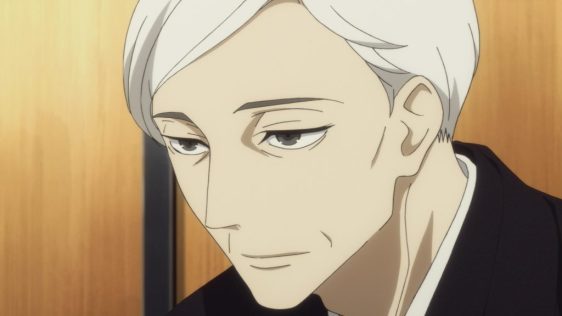
One of the best anime of 2016, Showa Genroku Rakugo Shinjuu, has returned for the Winter 2017, and with it some of the finest voice acting in recent anime history. Given that rakugo performers are themselves supposed to be able to take on many roles while telling a story, it requires the seiyuu playing these characters to have a great deal of convincing range. Nowhere is this more evident than in the voice of Ishida Akira, who plays Yuurakutei Yakumo the Eighth.
Ishida Akira has been a major player in anime since the 1990s, with roles such as Xelloss from Slayers and Athrun Zala from Gundam SEED to his name. However, what made me realize the sheer skill Ishida possesses is an audio clip of him performing seven different people, male and female, of all ages. From a young girl to an elderly grandpa, he can do it all. So, when he first appeared in Rakugo Shinjuu as Yakumo, I expected great things—an expectation that was fulfilled in spades. There’s a clear distinction in season 1 between Yakumo’s younger self in the past, and his elderly demeanor in the present.
To my surprise, season 2 turns out to show off Ishida’s chops even better. In this sequel, Yakumo is even older, and Ishida actually goes as far as to modify his performance to further show the passing of time. Often, I find that voice actors will have an “elderly voice,” but will not necessarily make the distinction between someone in his 60s versus someone in his 70s, for example. Ishida, however, does just that. His voice in season 1 had the weight of many years in it, but by season 2 it’s slower, deeper, and just a bit less coherent, as if that weight has finally started dragging his body down.
What’s even more impressive is when he performs privately for Yotarou (a.k.a. the new Sukeroku). Here, despite the strain it puts on him, Yakumo gives an extremely lively rakugo show. Pay attention to Ishida’s acting here, as he’s not just changing his voice to play younger characters as you would expect from any other professional voice actor. Instead, Ishida purposely plays a man in the twilight of his life imitating younger people as he performs. His enunciation is much clearer when he’s “on-stage,” but nevertheless has that characteristic elderly drawl. When he finishes and appears completely exhausted, and his voice reverts to “normal.”
Ishida’s performance is just one aspect of why Showa Genroku Rakugo Shinjuu is amazing, but it gives the series as a whole such a powerful presence. It’s great to see the guy in a role where he can really show the full extent of his talent.

Name: Ayame (アヤメ)
Alias: N/A
Relationship Status: Single
Origin: Hacka Doll The Animation
Information:
Ayame is a fujoshi who’s considering applying for Comic Market when she’s visited by the Hacka Dolls, semi-incompetent AIs who attempt to help people with mixed results. Though Ayame’s experience with them is mostly stressful, they help to inspire her to stick with her fandom on more than one occasion.
Fujoshi Level:
Ayame enjoys more typical bishounen-style BL, as well as beefier guys closer to the “bara” style of homosexual manga.
In honor of Valentine’s Day, that romantic holiday transformed in Japan into a way for girls to express their feelings for guys, I present an image mosaic of one of my favorite character traits: dead or empty eyes.
Dead eyes, that is to say empty eyes without luster, are usually associated with characters who have been mind-controlled. However, I’m more fascinated by them when the characters who have them are in full control of themselves. Rather than being a sign of a loss of will, they’re often symbolic of something else. They can be intensity, trauma, otherworldly perspective/experience, or even a swirling madness. Just think about how all many of the characters in the image above have notably different personalities!
Do you have a favorite character in the image above? Is there a dead eyes character you’re a fan of? Let me know!

Surprising even to me, it turns out Dragon Ball Super is actually really good. I’ve written a small post detailing how Dragon Ball Super has improved upon its predecessors. Take a look!
Though I was never a big fan of the show, I’ve been impressed by the Japanese Medarot (aka Medabots) opening theme. It’s surprisingly intense, and it hits with just the right hint of melancholy as anime songs tend to do. Imagine my surprise, then, when I found out that others who grew up with the show on TV in the US did not quite agree. If you take a look at the YouTube comments for the opening, there’s a pretty even divide between those who think the English opening is better vs. the Japanese one.
While nostalgia likely plays a big factor in many of these opinions, I believe that there’s something more, some essential differences between the two songs and the messages they try to convey. Essentially, while the English opening emphasizes “coolness,” the Japanese opening is all about “fiery passion.”
In the case of the English version, there’s a sense that “Robattling” is the hip thing to do. Get your gear, get your robot, and engage in this cool activity. In contrast, the Japanese song is focused towards the energy of youth, and that’s even putting aside the lyrics, which occasionally mention things being “white hot” and such. The song itself ends with the idea that the world of Medarot is one of intelligence and bravery.
The more I thought about this difference, however, the more it became clear to me that Japanese cartoons for children have historically seemed to be more willing to emphasize the value of being young. Be it Digimon or Cardcaptor Sakura or something else entirely, I get the sense that these openings want kids to feel like being a kid is fantastic. American openings for cartoons and other shows, on the other hand, tend to skew towards the desire for kids to grow up. While they’re not telling kids that it’s great to be a 20-year-old or anything, there exists a general marketing idea that kids do not connect with characters who are younger than them. Neither side exists at an absolute extreme, and you can find plenty of exceptions (Precure features characters in middle school while targeting elementary school children), but I can’t help but feel that this is what actually underlies the Medabots vs. Medarot theme song divide.

 OGIUE MANIAX