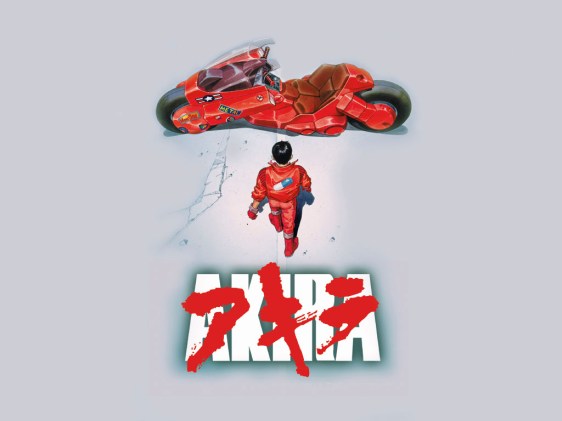
Just Enough Magic: Flying Witch

flyingwitch-poster

When it comes to stories about witches, it’s quite common (and perhaps even expected) to have magic be prominent. Whether it’s American sitcom classic Bewitched, Archie’s Sabrina the Teenage Witch comic, or an anime and manga like Witch Craft Works, the influence of spells and sorcery is, if not grandiose, at the very least quite large. The anime Flying Witch is a much mellower series in comparison. As a show where just the lightest of touch of the supernatural appears, it makes for a most delightful series.

Adapted by J.C. Staff from the manga by Ishizuka Chihiro, Flying Witch follows the daily life of Kowata Makoto, a teenage witch who moves in with her cousin Kuramoto Kei’s family as part of her coming of age. Residing in Aomori Prefecture in the Tohoku region of Japan, the people there still have a fairly strong connection to nature, and just going back and forth from school is enough to take in the greenery. For the most part, magic doesn’t make much of an impact, but when it shows up it’s just enough to make their world feel a little bit more unusual, and a little bit more wonderful.

Though the show consistently succeeds at its sparse but effective interaction between the human and witch cultures, the most memorable example has to be in the very first episode. Makoto is walking home from school with her new friend, Nao, when she sees an unusual plant. For anyone who’s familiar with stories about witches and wizards this is a red flag. Sure enough when she gives it a hard tug a mandrake pops out and gives its shrill cry.
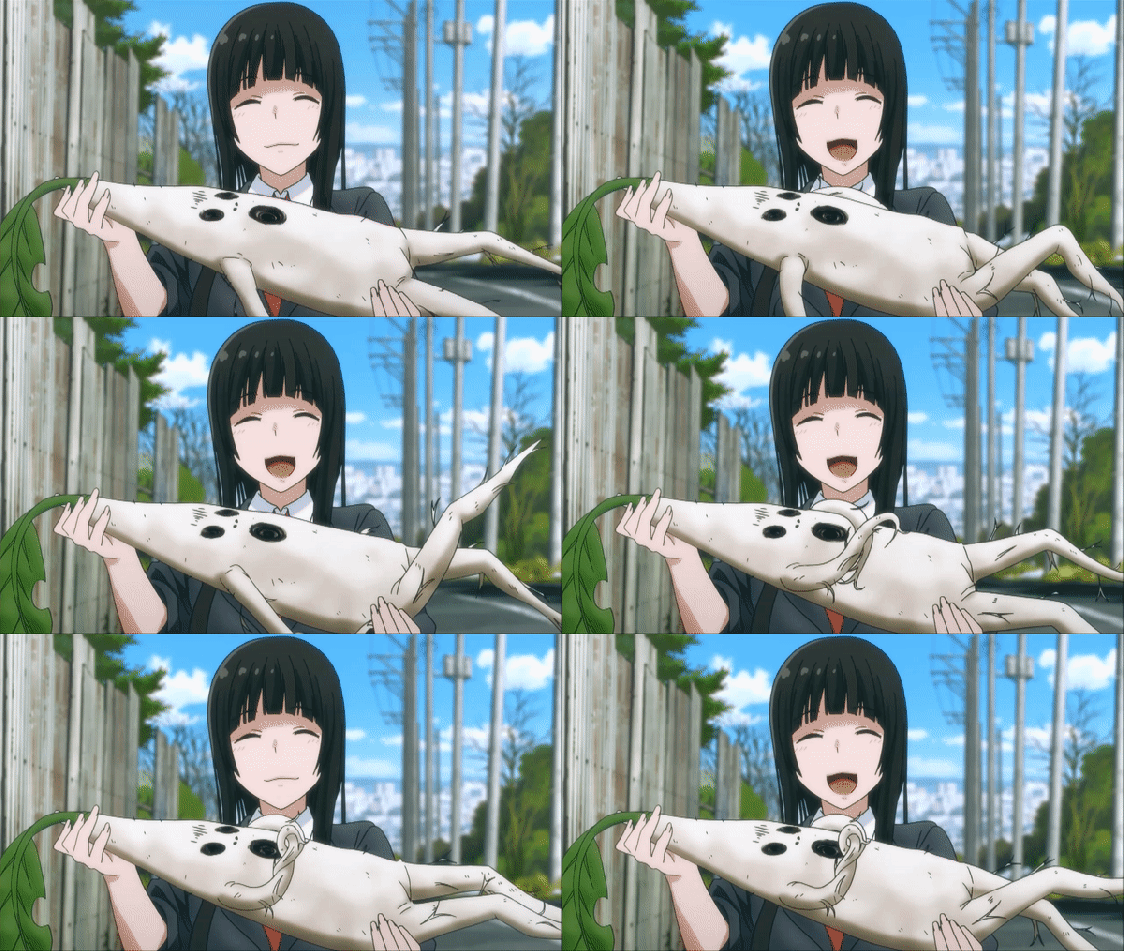
flyingwitch-mandrake

As Makoto cradles the demon plant, she cheerfully explains to an aghast Nao that it’s a good thing that they found a young Mandrake because an adult one can literally send people to the hospital or worse. The anime doesn’t stop being this fairly laid-back series, but the result is that the tiniest bit of magic feels that much more amazing.

What also helps Flying Witch is that all of its characters, guys and girls, are extremely charming. Makoto’s older sister Akane is a more experienced witch whose penchant for mischief contrasts delightfully with her younger sibling. The Kuramoto family is entertaining all around, whether it’s the dad’s thick Tohoku accent being indecipherable for Makoto or Kei trying to get his little sister Chinatsu to try more vegetables.

The fanservice in this show also has a deft touch akin to its use of magic, to the point that it might not even be right to call it fanservice. Just to be clear, generally speaking the female characters in this series are all extremely attractive, but Flying Witch never goes out of its way to show them off. When it focuses on Makoto or anyone else, the anime just lets the audience see how nice they look without lingering or leering.
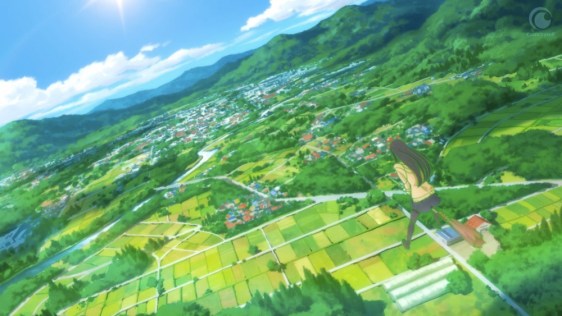
flyingwitch-scenery

Another notable aspect of Flying Witch is its focus on Aomori, because it at times feels like a promotion for the prefecture. In fact, it makes me wonder if this is one of the reasons it was adapted from manga to anime. The Tohoku region has in recent years been known more for the Fukushima disaster, and a lot of effort has been put into reviving the region in terms of agriculture, tourism, and more. A series like Flying Witch might be just the thing to really get people to visit Aomori and Tohoku again.

Overall, because of how delightfully mellow yet powerful the show’s humor and characters are, Flying Witch has become one of my favorite anime of the year. When I get the opportunity, I’m definitely going to pick it up, possibly in multiple formats. If you want to check it out, you can find the entire anime on Crunchyroll, and Vertical Comics is releasing the manga in 2017.

If you liked this post, consider becoming a sponsor of Ogiue Maniax through Patreon. You can get rewards for higher pledges, including a chance to request topics for the blog.
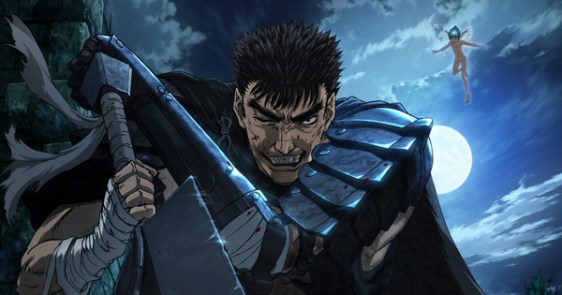
[Apartment 507] Berserk is 27 Years Old

berserk-new-visual

Just some thoughts on how much has changed since Berserk first debuted.

Charge Ahead!: Ogiue Maniax Status Update for July 2016

Don’t forget, the Ogiue Maniax Love Live! Contest ends this Saturday!

With that out of the way, let’s get back to our regularly scheduled monthly blog update.

As always, much thanks to my Patreon sponsors:

General:

Johnny Trovato

Ko Ransom

Alex

Diogo Prado

Sasahara Keiko fans:

Kristopher Hostead

Yoshitake Rika fans:

Elliot Page

Hato Kenjirou fans:

Elizabeth

Yajima Mirei fans:

Machi-Kurada

A special thanks to Diogo in particular for giving me an amazing present: Volume 1 of the Brazilian edition of Genshiken!

genshiken-brazilian

A new season of anime is on the horizon, and I’m looking forward to checking out as much as I can. I’m most looking forward to Love Live! Sunshine!!, which started airing just this past weekend. Unfortunately, I tend to watch many more shows than I have time to write about, so often some of my favorite series don’t end up getting blog posts dedicated to them. I’m considering doing something about that, but it’s always a small struggle between writing about the anime and manga that no one’s looking at to get them more exposure and talking about the things I like that people already have some familiarity with so that there’s an easier connection to be made.

I think that, due to a lack of time, my posts have started getting a bit shorter again. I believe that there are strengths and weaknesses to larger and shorter entries, but it also means that Ogiue Maniax might feel more like the scratchpad for my thoughts that it originally was in the first place. What do you readers think of this, and is there any kind of preferred ratio for you?

June’s post of the month has to be the review of Genshiken Chapter 125. I know, I know, Genshiken is a highlight every month, but I think this is a real case of the manga zagging when you thought it would zig, and it more than anything else reminds me of how wonderful a series Genshiken is.

I also have more reports from my trip to Japan, including my visit to two different Love Live! events, and a look at Comic Store Wonderland in Osaka, which is home to a ton of amazing autographs from famous manga artists. The Hanayo bag I bought at the doujin event is quite possibly my favorite piece of merchandise from Japan. Taketayo~

Another highlight is my review of the new Cardcaptor Sakura manga. CLAMP is back! I mean, they’ve never left, but I just lost interest after years and years of Tsubasa and XXXHolic. This new CCS really feels like a return to form, and I’ve already got plans to get each issue of Nakayoshi as it comes out in Japan.

Lastly, I wrote a post about Mystic Archives of Dantalian, as requested by Patreon sponsor Johnny Trovato, where I explore the show’s intersection with the idea of chuunibyou.

As always, if you’re interested in having me write about something, you can make a pledge through Patreon.  And if you’ve ever wondered why that tier is so high, it’s actually because I really want Ogiue Maniax to still be a space where I share and explore my thoughts, and so having the blog just be about fulfilling requests isn’t what I really want. However, because I’m also always eager to broaden my horizons, I invite the opportunity to make me watch or read or talk about something I might not have thought of otherwise.

I hope you all have a great July. I’ll be spending the month getting panels ready for Otakon in August. If any of you are going, I look forward to possibly seeing you.

Over Half the Movie is Tank Battles: Girls und Panzer der Film

girlsundpanzerderfilm-anglerfish

Girls und Panzer is quite upfront about what’s in it: you have the cute girls, and you have the tanks. In spite of its seemingly vapid approach, however, the TV anime is actually quite robust, and I rate it very highly. But a television anime is different from a film, and a major question about the film sequel, Girls und Panzer der Film, is whether it can succeed similarly in spite of the new format. In this respect, I find Girls und Panzer der Film to be a very strong work, but one which is not as adept at drawing in skeptical or uninitiated viewers as its TV prequel.

Synopsis

Taking place right after the original TV series, Girls und Panzer der Film follows tactician Nishizumi Miho after she has led the ragtag rookies of Ooarai Academy to become the champions of competitive tank sports. Having defeating her former school in the grand finals, their efforts were supposed to save the school from being shut down, but because of a legal loophole their work isn’t done yet. With the help of old friends and foes alike, Miho and Ooarai Academy continue to fight for their school.

Television vs. Film

When it comes to the TV anime, I don’t believe it is absolutely necessary to be a fan of both cute girls and tanks. The show sports strong narrative and characterization as well as celebration of military hardware (as well as war simulation as competitive sport), such that a lukewarm reception of one aspect could be saved by the other. Because the series was more structured and more adept at its dramatic progression, it ends up being more enjoyable than other shows of its ilk.  It’s only when either one or both elements together create wariness in a viewer (dislike of moe designs, fear of the show’s potential role as military propaganda) that the anime doesn’t really work.

Girls und Panzer der Film makes no concessions. The film immediately starts with a tank battle and ends with a tank battle. In contrast to many anime, films, etc. where we see either multiple small battles without any real sense of connection between them, or the focus is on a single duel, the last fight is a continuous 50-minute campaign. It showcases elaborate strategies on both sides, lovingly introduces new tanks to the story, and brings together characters in battle that had previously never joined forces. This film is made for people who love Girls und Panzer, and while it happens to have a solid and enjoyable story overall, newcomers are clearly not its target audience.

Slim but Effective Character Narratives

girlsundpanzerderfilm-nishizumis

The battles themselves are fantastic. It’s rare in even the most action-packed shows and movies that a single battle will go for nearly an hour, especially one where you have a strong sense of where all the pieces are positioned and how they influence each other. Girls und Panzer der Film accomplishes just that. However, I have to re-emphasize that the concluding battle is so long that you have to enjoy tank combat at least a little bit. Either that, or you have to be so invested in the characters that seeing them develop and grow gives you great joy, even if it’s amidst the explosion of tank shells.

That’s not to say the film meanders needlessly, or that it doesn’t know how to tell a story. Girls und Panzer der Film, despite its enormous cast of fan favorites, keeps its narrative nice and focused. Perhaps nothing is more surprising than the fact that fan favorite Akiyama Yukari does not take over the film, but that’s because it isn’t really about her. While considered a possible weakness of the original TV series, the light characterization of Girls und Panzer (where characters are defined either in groups or from a few simple and easy-to-grasp qualities) works in the movie’s favor because one can easily grasp many of the girls’ motivations in only a few minutes. Seeing Miho reunite on good terms with her sister Maho (the commander of the team she defeated in the championships) was a joy. Even my favorite character, Anzio’s squad captain Anchovy, makes an appearance, and shines in her own special way.

Girls und Militarism

The elephant in the room (though not really because I already mentioned it), is to what extent Girls und Panzer der Film promotes militarism. While it’s easy to write Girls und Panzer off, either as a series that is clearly designed to get Japanese men to enlist in the Japanese Self-Defense Forces or as simple fluff that shouldn’t be overthought, I don’t think it’s so simple.

When it comes to the question of whether Girls und Panzer glorifies war and militarism, the answer is yes and no. I know that sounds like a cop-out, but let me explain. On a surface level, the appeal in this respect is obvious. Get people to fall in love with the girls, associate them with tanks, and you might see some otaku driving them once they hit enlistment age, and while the anime isn’t quite that simple, that initial impression carries a lot of power. That being said, if you watch the series, tank combat is presented as a sport akin to archery or soccer, and it presents a world where tanks are no longer weapons that take millions of lives but rather tools for friendly competition. Is this whitewashing history, or is it presenting a kind of utopian alternative? I think cases can be made for both, which is why it’s more complicated than what is evident at first glance.

So where does Girls und Panzer der Film fit into all of this? I argue that, even as it celebrates tanks and tank combat, the film makes a rather prominent criticism of patriotism. In the movie, a new school is introduced call Chi-Ha-Tan, where the girls try to make up for their lack of skill with sheer fiery gusto. However, they’re also constantly sabotaging themselves because of the members’ desire to preserve their “honor.” When comrades are taken out, they believe that the best solution is to charge the enemy and fall in glorious combat. They despise turning their backs to the enemy, because they need to make up for everything. Unlike Saunders Academy (the American school), who believe in overwhelming force as a strategy, they have no actual strategy, and are instead merely victims of their own zealousness.

In other words, the science of senshadou (way of the tank) reigns, and foolhardy aggression (the kind of thing encouraged in Japanese citizens during World War II) is a mistake.

Conclusion

Girls und Panzer der Film deftly balances its two extreme components through efficient storytelling, compelling action, and overall cleverness. It’s not as newbie-friendly as the TV series, both in the sense that it’s a direct sequel and because the tank combat is much more important, but it also doesn’t let the desire for fanservice (both technological and girly) get too much in the way of a solid narrative. It even adds an interesting new angle on the image of itself as a work that promotes militarism. Girls und Panzer der Film does a lot in two hours, and leaves a lot to contemplate, even if the movie might seem pretty light on thoughtful content otherwise.

If you liked this post, consider becoming a sponsor of Ogiue Maniax through Patreon. You can get rewards for higher pledges, including a chance to request topics for the blog.

Save

Save

Save

[Apartment 507] Passionate Whispers: Hanayo Koizumi is the Best Love Live! Character

kinghanayo

To end off my Love Live! Character Spotlight series, I’ve written an article about my favorite school idol, Koizumi Hanayo.

May the rice be with you.

[Apartment 507] Love Live! Character Spotlight: Nozomi Tojo’s Spirit of Friendship

washiwashi

Nozomi makes number 8 in my Love Live! Character Spotlight series at Apartment 507. I hope you enjoy her kansai-ben and attitude as much as I do.

Now only one remains…

whiterice

Soremachi Creator Ishiguro and His Two Biggest Influences

soremachi-8-9-14

In the June 2016 issue of Monthly Afternoon released in April (it’s confusing, I know), there’s an interview with two previous winners of the Afternoon Four Seasons Award, which is a manga competition run by the magazine. One of the winners is Ishiguro Masakazu, creator of And Yet the Town Moves (Soredemo Machi wa Mawatteiru). When talking about his influences, Ishiguro mentions a number of manga artists, but two in particular are especially important to him and his style. Those would be Otomo Katsuhiro of Akira fame, and Fujiko F. Fujio, creator of Doraemon.

akira2_0 doraemon-sticker

Although it isn’t terribly surprising that these two titans of manga would influence other manga artists, in the case of Ishiguro this is a really big deal. That’s because, if you think about what Soremachi is, how it’s drawn in terms of environment and character expressions, and how the stories range from the dramatic to the silly, from the everyday to the alien, Soremachi is pretty much an even fusion between Akira and Doraemon. There was even a story about time travel that revolves around some super delicious snack cake!

Quite a few years ago my friend, translator Ko Ransom, mentioned to me that he felt Ishiguro’s art style reminded him a lot of Akira. As it turns out, he was right on the nose with that one. When you think about it, it’s not like it’s immediately obvious given how different those two stories are, which makes me all the more impressed by his keen eye.

If you liked this post, consider becoming a sponsor of Ogiue Maniax through Patreon. You can get rewards for higher pledges, including a chance to request topics for the blog.
Mystic Archives of Dantalian and that Chuunibyou Feel

dantalian

The existence of the term chuunibyou is fascinating to me. Most famously used in the series Chuunibyou Demo Koi ga Shitai, it basically means someone who has the aesthetic sensibilities of a middle school student. What this translates to is a desire to feel special, to believe that there is more to one’s life than its simple and mundane surface, and this is most frequently portrayed in Japanese media as characters who claim (or like to pretend) that they have magic powers, cursed body parts, and have access to the “Akashic Records.” What is maybe less talked about, at least on the English-speaking side of the things, are the works that spawn this kind of sensibility in the first place. What an American anime fan might label as “anime as hell” can often also be called “chuunibyou,” and it’s from this perspective that I’d like to talk about Mystic Archives of Dantalaon.

Originally a light novel series, Mystic Archives of Dantalian takes place post-World War I. Hugh Anthony Disward receives a key and instructions from his dead grandfather to become the new Keykeeper of the “Bibliotheca Mystica De Dantalian.” There, he meets a young girl in gothic lolita clothing named Dalian, and discovers that the Mystic Archives are a collection of “Phantom Books,” each of which possess fantastic, supernatural abilities. As Keykeeper, Hugh (along with Dalian) must pursue cases of Phantom Books run amok, using the power of the Archives.

Just from the basic premise alone, there’s just a lot of “this world is not as it seems” sensibility, but it doesn’t stop there. The anime’s visual presentation, akin to Gosick or Croisée in the Foreign Labyrinth, emphasizes a dark and moody atmosphere. The fact that Hugh accesses his powers by plunging his hand through a large, transforming keyhole in Dalian’s chest, as well as the fact that use of those powers comes from reading mystical books with flowery prose aloud, pushes the series into clear “chuunibyou” territory.

However, one thing that stands out to me about the series is actually how Hugh is presented as a character. Although Hugh has these supernatural abilities, he himself seems like a normal fellow. This isn’t to say that he’s bland or generic, but rather that he presents himself as calm and fairly level-headed without going into “perfect stoic badass” territory or “generic everyman.” The result is that Hugh, while having access to chuunibyou qualities, doesn’t encourage chuunibyou behavior through his demeanor. Even when reading from the Bibliotheca Mystica de Dantalian, he comes across as a regular guy. If one were to pattern themselves after him, it would come not with an overwrought sense of self, but more like “just a dude who happens to have powers.”

That’s not quite true for Dalian. Not only is it hinted strongly that she’s older than she looks, but she combines many of the qualities that can inspire others (specifically chuunibyou) the desire to be her. Her words typically imply that she’s much older than she looks. She is the gateway to these magical archives that house the most forbidden knowledge of the universe. Even her gothic lolita aesthetic works in this direction. Dalian exudes mysteriousness, and I think you can easily find the kinds of characters that are indirectly parodies of her type: Kuroneko in My Little Sister Can’t Be This Cute, Kobato in Haganai, and so on.

As an aside, I wonder why so many Gothic Lolita characters end up being similar in Japanese media. In terms of actual real-life wearers of Gothic Lolita fashion, I’ve come to learn that a lot of it has to do with wanting to defy or push back against the expectations placed upon people in terms of appearance, sexuality, age, and other related areas. In anime and manga, the Gothic Lolita often combines a recurring mix of qualities that contrast innocence and maturity. Dalian speaks with an air of authority, but perks up like a kid at a candy shop when the prospect of eating delicious sweets shows up. Victorique from Gosick behaves the same way, as does Shinku from Rozen Maiden. The idea of the Gothic Lolita character carries with it not just a visual personality but also behavioral elements as well, and I wonder to what extent the two sides inform each other to perpetuate this character type further.

My discussion of Mystic Archives of Dantalian isn’t a criticism against the series for being chuunibyou, or that only those who are interested in works like that could possibly enjoy it. The anime has a lot going for it, from its atmosphere to its mysteries, and it overall makes for an involving and entertaining work. What the chuunibyou elements grant Mystic Archives of Dantalian is a kind of self-seriousness that can be overwhelming at times, but can also be welcome when one wants to enjoy a story that revels in the idea of the unknown.

This post was sponsored by Johnny Trovato. If you’re interested in submitting topics for the blog, or just like my writing and want to support Ogiue Maniax, check out my Patreon.


First Train Home: Pat Metheny’s Been with Me All Along

For most of my life, I’ve had a theme stuck in my head. It’s a haunting, yet relaxing tune that I only knew as the “Community Calendar theme for Channel 9 in New York City.”

Eventually, YouTube became a thing. I decided to search for it, but at the time nothing came up. Being a song without words, I couldn’t exactly search for it by lyrics. Years later, around 2012 I looked again, and finally found it:

Have a listen, it’s really good. Much better than any “Community Calendar” music has any right to be.

I looked up the song’s name and artists, listened to the original a few times, and then promptly forgot it (and the name+band) again for a few years.

Recently, the song popped back into my head one morning, and I went back to YouTube. Again, I looked to the comments to find the names of both the song and the band, but this time around I knew I could never forget them.

The tune is called “It’s for You.” The musicians responsible are Pat Metheny and Lyle Mays.

Does that first name sound familiar? That’s the same Pat Metheny responsible for “Last Train Home,” which I know as the second ending theme for JoJo’s Bizarre Adventure: Stardust Crusaders. If it wasn’t for JoJo, I would have never committed this tune to memory, and it would have just been “that song on TV from when I was a kid.”

Thanks, JoJo’s Bizarre Adventure. Thanks, Pat Metheny. Also, I found out that there’s this vocal version by Japanese musician Yano Akiko:

By the way, did you know that Pat Metheny has his own official Q&A board? I keep hoping to see it filled with JoJo fans.


[Apartment 507] 5 Tips for Growing Your Love of Anime and Manga

5tips-genshiken

I’m trying to do lists my way! My latest post on Apartment 507 features five pieces of seemingly generic but I think useful advice for those who want to get more into anime/manga (or want to revive their lost interest) but feel lost doing so. Tell me what you think, and even throw in some tips yourself because this certainly isn’t a closed list.