Of All Things, an Introspective Card Game Anime – Battle Spirits: Shounen Toppa Bashin

A few years ago, I went to an event at the Japan Society in NYC, where Satou Dai of Cowboy Bebop and Eureka Seven fame was a guest. In the lobby, they had design materials from shows he’s written for, and among the works on display was something unfamiliar which caught my eye. This anime was Battle Spirits: Shounen Toppa Bashin, a show whose character designs by Shimogasa Miho (probably best known for Demashitaa! Powerpuff Girls Z) stayed with me for years. Having finally decided to take a look, it turns out that Shounen Toppa Bashin is surprisingly strong in the categories you wouldn’t expect a trading card game-themed anime to even take into consideration, such as personal psychology and portrayals of parent-child bonds. It’s one thing to be an anime like Selector Infected Wixoss, which tries to mess with the conventions of this genre, but this very first Battle Spirits doesn’t subvert so much as challenge and uplift.

The basic premise of Battle Spirits: Shounen Toppa Bashin is about as standard as it gets: kids (and adults) love a trading card game, and they somehow are able to access another dimension and battle with 3DCG monsters. They challenge each other, enter tournaments, form friendships. It basically sounds like a Yu-Gi-Oh! clone. What is notable, however, is that the character relationships in Shounen Toppa Bashin really stand out in a way that I would expect more from a Satou Jun’ichi magical girl show (Ojamajo Doremi, Fushigiboshi no Futagohime) than a TCG merchandising engine. I guess I shouldn’t be that surprised that the man responsible for the series composition of Eureka Seven would also give an impressive showing here.

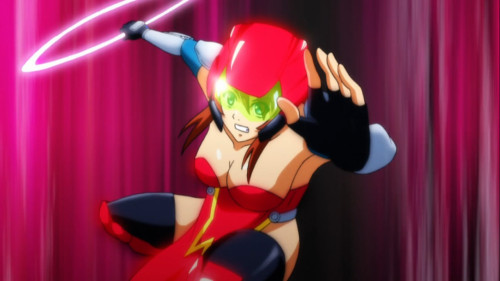
For example, when you see the extremely straightforward, shounen fighting spirit main character Bashin Toppa talk to his mom Hayami (both pictured above), you get a real sense that his energy and attitude come directly from how she’s raised him. Rather than ignore or deny that familial connection as is often the case with anime, the show uses it to give a real sense of personality to Toppa, to show that his simple-mindedness is also surprisingly deep. After all, what does it really mean to always look ahead, to always want to “Break through the front,” as Toppa often says? It sort of reminds me of Sei and his mother in Gundam Build Fighters, though it also doesn’t hurt that Hayami is not only a classy lady just like Rinko but a taxi driver famous for her Initial D-level driving.

There are a lot of other examples too, but I’ll only mention one more. Another source of delightful interaction comes from the fact that the devious ace player Suiren is actually the popular idol My Sunshine, and Toppa’s inability to see through her disguise in spite of how much time they spend together is pretty hilarious. At the same time, however, it’s also the impetus for Suiren to open up to others and to form friendships with the rest of the main cast. The character designs by Shimogasa really shine here, which reminds me somewhat of Chousoku Henkei Gyrozetter and its own strong character designs and personalities. Speaking of character designs, they’re probably at their best when looking at the show’s ending videos.

Seeing all of these characters with really simple yet vibrant personalities interact with each other in clever and entertaining ways while sporting those strong character designs just makes the show a joy to watch to the extent that it pretty much overshadows the card battling aspect of the series, which almost feels intentional given how much the show rushes through the matches. Usually, when it comes to TCG anime like Yu-Gi-Oh!, the drama is mostly focused on the card game, seeing step by step how the hero overcomes his opponents, but Shounen Toppa Bashin is different. In fact, in most episodes it generally skips a lot of turns to get straight to the climax of a match. The result is that, like Yes! Precure 5, the “fights” seem supplemental to the characters. Maybe not the best for selling the “Battle Spirits” card game, but purely as an anime I would rate it higher than most other shows in its genre.

There is one TCG-relevant aspect, however, that I do find unique to Shounen Toppa Bashin, which is that the anime makes an effort to show how the characters gradually gain experience with the card game they’re playing in a way that is easy to follow. Toppa is head-strong and prefers a straightforward approach of busting through his opponent, for example, but then loses a match early on because he doesn’t take into account strategies that more directly counter his deck type. By the next battle, you see this weakness made up for to an extent, and then strengthened further in a following match. It’s a nice touch to show that the characters are learning, instead of just seeing them bust out a new deck with “all-new secret strategies!!!” (though that happens sometimes too). What also helps is that a lot that both male and female characters are considered strong players, and everyone will take games off of each other fairly regularly so there are no real “weak links” in the core group, and even those who start off that way improve over time.

I’ve only watched 26 episodes so far, but I definitely look forward to seeing how the show continues to unfold. It’s the kind of show I wish more morning boys’ anime would be.

I Didn’t Go to AnimeNEXT 2014 But I Have Some Thoughts on the Studio Trigger Panels

I was unable to go to AnimeNEXT this year, but thanks to the Reverse Thieves and their con report, I’ve learned that the Studio Trigger panels were fantastic and I’m totally jealous of them for being there. Obviously I can’t write about the experience, but there are two points in their post on Trigger that I find interesting to look further into.

The first aspect I want to talk about is in regards to them having an initial version of Kill la Kill with five episodes already planned out in full, but decided to scrap it and start over again with something they felt was stronger. Back when I wrote my review of Kill la Kill I got some comments from a particular poster that criticized Kill la Kill‘s writer for making numerous revisions to the script, as if it had hacked together haphazardly, but with this clarification it’s now obvious that the drastic changes came from the planning stage and were less about cobbling together a frankenstory and more about trying to find the right direction no matter what.

The second little factoid that caught my attention is the fact that the staff at Studio Trigger is really into American superhero comics, which is sort of obvious if you’ve watched all of Inferno Cop. What I find funny about this is the fact that for American comics, superheroes are increasingly seen as this bland, boring, mainstream yet niche thing that we need to move past, while Studio Trigger has this reputation for being a new and cutting-edge anime studio, and they take inspiration from superhero comics.

Love Live! is Like a Golden Age Sitcom

It’s kind of a curious experience watching Love Live! School Idol Project because the more I see, the less the “idol” aspect matters to me. Sure, the songs are catchy and the dance sequences can be quite fun, but I find that it’s actually the show’s sense of humor that really stands out for me.

There are many different ways in which anime does comedy. There’s the slice-of-lifey approach of K-On! or Hidamari Sketch, where the idle moments provide grounds for chuckles. There’s the wild and wacky form of something like gdgd Fairies or Sakigake!! Cromartie High School, featuring one absurdity after the other. In many cases, the characters themselves are not only important to the jokes, but the jokes are subordinate to showing off the characters and how crazy/cute/sexy/rad they are. Love Live!, especially its second season, often feels closer to a classic sitcom than a typical gag anime.

Episode 7 of Season 2 is probably the best example of this so far. When Hanayo is happily chowing down on her over-sized onigiri as Honoka complains about her diet, there’s both the humor of Hanayo inadvertently rubbing it in and the humor of Hanayo’s increasing hubris leading to her inevitable downfall (carbs, man). Later in the episode (10 minutes, 30 seconds), Honoka and Hanayo are jogging when they come across a restaurant. The sight gags and the way they communicate with only excited grunts reminds me of an I Love Lucy skit like the chocolate factory, or maybe something from The Honeymooners. There’s even sort of a similarity between Yazawa Nico and Ralph Cramden.

That’s not to say that the characters are not a focus of the anime, as it is in the end a show about idols designed to have you become a fan and buy all of their merchandise. Despite their looks, however, I often find that the humor isn’t simply about “moe” even when it comes to highlighting their personalities, or if starts out that way then it becomes something else over time. Hanayo, who I describe as “a G Gundam character with the volume turned down to 10%,” essentially has a soft scream that sets up or supports a lot of the jokes in the show. Perhaps the most prominent example of the show doing more with its characters is Sonoda Umi, who in Season 1 is sort of an Akiyama Mio from K-On! type—a cool-looking and responsible girl who is easily embarrassed and writes cute lyrics. However, while she retains those elements to a degree in Season 2, she also begins to show a kind of hilarious intensity that is best summed up by the gif below.

umi-angryface

Another aspect that works in the show’s favor is that it will sometimes take episodes to set up a joke and reward those who’ve been paying attention. In Season 1, it’s when they get a club room (or something, my memory’s still a little shaky), and you can see Hanayo just casually using a rice cooker in there. It’s not the focus of the scene, and no one really makes mention of it, but then when they have their training camp, you see the fact that Hanayo has this gigantic bowl of rice piled so high that it looks like a snowy mountain. When someone finally asks about it, Hanayo’s rsponse (“Don’t let it bother you”) comes and goes so quickly in part due to her soft, high-pitched voice that somehow it just gets funnier.

In Season 2, episode 1 shows Honoka yelling at the sky to stop raining. When rays of sunshine start peaking through the clouds, we’re supposed to think of it as Honoka showing that people can do anything if they set their hearts on it, an inspirational moment for the characters. However, a few episodes later Honoka, Umi, and Kotori get trapped in Okinawa because of a typhoon, and as the weather gets increasingly bleak, we can see Honoka trying to stop the weather again, only this time to no avail. I actually think that little moment in the first episode was partly done to pave the way for this punchline a little down the road.

I find that humorous anime tend to attract a particular audience because it isn’t quite the same as what you’d find on television, and the fact that Love Live! often veers towards the latter may either be a welcome aspect or the very thing that they ran away from when they discovered anime in the first place. The “idol” aspect may also be a turn-off for some, as the concept implies a certain desired level of maniacal devotion, even more than other anime that rely on the charm of its female cast. With Love Live!, however, there’s some real meat to the comedy, utilizing the characters’ personalities but not being solely in service to them.

By the way, my Love Live! top 3 are Hanayo > Nico > Nozomi. 4th is actually A-Rise lead Kira Tsubasa.

The Price of Art: Miyazaki Hayao’s “The Wind Rises”

It’s been a few weeks since I took the opportunity to see Miyazaki’s The Wind Rises. For personal reasons I’ve been unable to write about it until now, which makes me a little sad since my memories of the movie are no longer as fresh. Nevertheless, the film made such an impression on me that I can still remember its effects on me, the mild trembling and near-existential crisis I experienced after leaving the theater that I feel compelled to write about it. This is because while other Miyazaki films have been beautiful, profound, poignant, heart-warming, and intelligent, The Wind Rises is challenging.

I’m going to spoil quite a bit. If you haven’t seen it, I highly recommend this movie.

The Wind Rises is a highly fictionalized account of the life of Horikoshi Jirou, inventor of the “Zero,” the most famous Japanese plane of World War II. We first see him as a child in love with the idea of flight, though sadly unable to ever truly take to the skies due to his terrible eyesight. Instead, in a dream where he meets Caproni, a famous Italian aeronautical engineer, he realizes that if he can’t fly the planes, then at least he can build them. The movie is thus the story of a man with a passion that stays with him throughout his life. The main issue is that he lives in the 1930s, and Japan already has an alliance with Nazi Germany. We know what Jirou’s passion will lead to, and this aspect of his story is how The Wind Rises confronts its audience with difficult questions.

There is a sort of romantic image surrounding the artist who lives for his craft, and over and over again the movie shows how Jirou would rather not think of anything but the plane itself. However, The Wind Rises juxtaposes this quality in Jirou with the era in which he lives. Given the imperialist and militaristic nature of Japan at the time as depicted in the film, it is clear where Jirou’s inventions will eventually take him, and yet given the context of his society, it’s also the only opportunity he really has to fulfill his dream. He makes the best of his situation, pursuing his life-long goal using the means available to him, and though on a personal level this can be seen as the emblematic of the adaptability of the creative human mind, it also comes at a very real cost of millions of lives, claimed essentially by Jirou’s imagination. At the end of the movie when Jirou returns to his dreams of the sky and we see the clouds in the sky transform into his greatest invention, there’s a clear sense of tension on the screen between the beauty of the Zero and the ugliness inextricably tied to it. This is why when I see people accuse this film of being militaristic, I feel as if they did not bother to actually see what was happening in the film.

Can art truly be made for art’s sake? This is one of the central questions of the film, and The Wind Rises answers that this passion, as much as we might want to bottle it and isolate it from the world, is nevertheless still a part of it. Even the refusal to compromise ends up being a type of compromise in itself, and the film makes this point clear not only through Jirou’s profession but also his personal life. Falling in love with a woman suffering from tuberculosis in a time when there was no cure, throughout the movie they make sacrifices between their immediate and future happiness. When ultimately they decide to live together despite knowing that this will shorten her lifespan, the parallel is clearly established that, whether it is at home or in another country, Jirou’s passion in a sense destroyed lives. And yet, it is impossible to see Jirou as a “villain,” or as morally reprehensible. There is no guarantee that we would not have done the same thing, living in the here and now while hoping for a brighter future. Jirou’s choices cannot simply be divided into “right and wrong.”

The very fact that Miyazaki himself is an artist making some of the most successful animated films ever makes the ideas of The Wind Rises feel both self-critical and targeted toward society at large. One of the more interesting decisions for the movie was that Anno Hideaki, creator of Neon Genesis Evangelion, animator on Miyazaki’s Nausicaa of the Valley of the Wind, and otaku extraordinaire was cast as the voice of Jirou. Anno is no voice actor, and it shows in his amateurish performance, but I think this was a deliberate choice because Anno is also a “passionate person” as an otaku. Evangelion was Anno’s attempt to tell otaku to get out there and confront the world, and in certain ways the opposite happened, so I believe that Anno in the role of the protagonist speaks to the idea that otaku are generally considered obsessive people in some sense “cut off” from society. There is an earthquake at the beginning of the film, and when the ground begins to crumble and shake, it looks like the old Gainax style more than that of Ghibli, and I have to wonder if it was animated in this way to call attention to the otaku. As with Jirou, the question would be if we can call otaku a pocket of society, a subculture, or if that passion should be contextualized. It’s a confrontation with both otaku and non-otaku.

I saw this movie at a period in my life where many things are in flux. The future often looks uncertain, the present looks frightening, and more than a few people I’ve known have become ill or worse in recent years, and this movie hits me hard in those areas. Moreover, as someone who has spent his life in creative endeavors, whether it’s art or writing, I feel as if this movie peered straight into my soul, asked me about my life, and forced me to ask myself what a human being really is. In spite of this—or perhaps because of this—however, The Wind Rises may very well have become my favorite Miyazaki film ever (which has been Laputa: Castle in the Sky for the longest time). In fact, when I think about it, the last time I felt this profoundly affected by any anime was the masterful Turn A Gundam. If I had to summarize my thoughts on the film in three words it would be: beautiful, deep, painful. 

The Fujoshi Files 99: Shiina Mafuyu

Name: Shiina, Mafuyu (椎名 真冬)
Alias: N/A
Relationship Status: Single
Origin: Seitokai no Ichizon

Information:
Shiina Mafuyu is a shy and demure girl who often has her face buried in a video game. So addicted to video games is Mafuyu that she will bring multiple home consoles and portable systems with her on long trips. Though open to diverse genres, Mafuyu mainly plays visual novels, for which she creates internet guides.

Along with her older sister Minatsu, Mafuyu is a member of the Hekiyou Academy student council, voted in by her fellow students. There, Mafuyu participates in the idle discussions which characterize the student council, and has a tendency to pair the only male council member, Sugisaki Ken, with another male student named Nakameguro. She is also somewhat antagonistic towards Ken’s younger sister as the two have “overlapping characters.”

Fujoshi Level:
Mafuyu describes herself as “half-games, half-Boys Love.” She believes being able to fantasize about a pen and a pencil together is a fundamental skill.

Diving Straight Into Your Heart

nicoknee-cropped-small

A Susanna Hopkins Hug Pillow…?!

I can’t say I’m entirely surprised that a Genshken hug pillow would exist some day. Kio Shimoku once drew a fake Ogiue hug pillow, and it’s not even that farfetched for the pillow to be Sue of all characters. When I think about it, though, isn’t Sue pretty much the polar opposite of the typical “hug pillow” character? She’s not just an awkward otaku, she’s an awkward otaku who actively makes others feel awkward, as opposed to some ideally flawed character. Or has the popularity of Tomoko from Watamote changed the dynamic and now this sort of girl is “in?”

I’m honestly curious as to who’s going to end up buying this. I get the feeling it’ll require a very specific and special type of fan.

news_large_genshiken2-suomote news_large_genshiken2-suura

Shiftylook’s “Wonder Momo” Anime is Straight Out of the 90s

wondermomo-wonderhoop-small

As part of a move to briefly revive some of their old and beloved properties, Bandai Namco commissioned a comic based on the old Wonder Momo franchise, which was subsequently adapted into a short anime. At five episodes total and seven minutes per episode, it’s not much of a time commitment so even though it didn’t impress me at first I decided to just watch through the whole thing.

Here’s my verdict: The show looks fine, the actors (aside from Akihabara idol legend Momoi Halko) are clearly inexperienced. Overall, Wonder Momo is like a 90s OVA adaptation of a 90s anime fanfic. Let me explain that last point.

In the 80s and 90s, anime had a curious reputation in the United States. Aside from the idea that it was mostly porn and gore, the fact that a lot of the anime that came out were more long commercials for existing manga or video games resulted in the notion that anime was big on visuals but short on narrative. Stories didn’t make sense (and I don’t meant that they were boring, I mean they felt like nonsense), series ended at odd moments, and details like “who are these people” were glossed over readily because they expected you the fan to fill in the blanks. The Wonder Momo anime feels very similar in this regard, in that everything is a bit rushed and there’s no real sense of conflict.

The other thing is that a lot of the humor feels like it came straight out of 90s US anime fandom, like someone had taken inspiration from all of those Ranma 1/2 fanfics of the era and said, “Yes! This is what comedy is, you bakas!!!” While  the Wonder Momo anime is done in Japanese and so there’s no Janglish to speak of, it’s kind of surprising that it doesn’t devolve into a flurry of sweatdrops and chibis. I suspect it has to do with its webcomic source material, but I haven’t read enough of it to judge.

In a sense, Wonder Momo answers a long-standing question: what would it look like if the 90s US fandom’s idea of anime got made into an actual anime? In that regard, I find it to be more a proof-of-concept than anything else.

Robotech Fans Wish They Had Yamato 2199

I recently finished Space Battleship Yamato 2199, the outstanding remake of the original Space Battleship Yamato. It’s a series deserving of an elaborate, detailed review to explain all of the thing they did to update the series and why the work, but this isn’t that review. Maybe it’ll come in the future, but what I’d rather talk about is a small revelation I had after I finished the series: Yamato 2199 is basically what Robotech fans wish they got.

The long-standing Robotech fandom is notorious for an obsession with minutiae. Every little detail in the series is scrutinized. Things are renamed to sound more “high-tech.” Every mistake in script and animation in the source anime (Macross, Southern Cross, Mospeada) is either ignored, retconned, or mentally transformed into something which makes technical “sense.” A whole slew of supplementary material exists to explain in a satisfying way to an audience who enjoys harder science fiction some of the sillier moments that come from the original anime.

While Yamato 2199 doesn’t go quite that far, it does accomplish a lot to smooth over some of the narrative and hazy science fictional bumps which littered the original version. Case in point, the ridiculous-sounding device that the crew of the Yamato must travel to Iscandar to pick up to save the Earth, “Cosmo Cleaner-D,” is rechristened the “Cosmo Reverse System,” and is given a technical explanation as to how it’s supposed to work. Moments in the original Yamato which were more for dramatic flair than anything else keep the drama but also add sounder technical elements. Aspects of the show barely touched upon originally receive elaboration in Yamato 2199, and where the old series at times looked like it was still trying to find what it really wanted to do, the new series has the benefit of hindsight to cleanly and efficiently aim for its narrative and thematic goals.

As far as I can tell, what Robotech fans really want is just Robotech as it was back in the 1980s with minor adjustments, and this is what really makes Yamato 2199 the ideal template for Robotech fans. Yamato 2199 is about 90-95% the same as the original in tone and feel, even though it is updated for the modern era to take into account social developments in the past 40 years and the character designs are a little more modernized. It’s this formula which something like The Shadow Chronicles does not appear to achieve, though it also helps to have a substantially higher budget and cleaner animation like Yamato 2199 does, to accomplish its goals.

Pokemon and Color

The depiction of race and culture in Pokemon over its nearly 20-year history has been a work in progress. Much of this has to do with the very Japanese origins of the game and their exportation to the rest of the world. A mostly assumed Japanese cast of characters suddenly wasn’t, like when the character Sakaki was renamed Giovanni to evoke the image of an Italian mob boss. At the same time, Pokemon with seemingly innocuous elements within Japan such as Jynx became a legitimate concern against the increased awareness in the United States of the history of discriminatory visual depictions of black people. Since then, thanks in all likelihood to its international success, Pokemon has taken considerable steps to try and be more culturally sensitive and inclusive, mainly through the depiction of characters with different skin tones and features. In some cases, the characters have more definite racial features, and in others they’re left vague, and the question of whether or not an “ambiguous brown” is for the better becomes an especially difficult question that is nevertheless worth exploring.

124Jynx_OS_animeJynx

The change to include characters who are neither vaguely white or Asian in appearance began with Pokemon Black and White, a series which I would argue not-so-coincidentally takes place in Pokemon universe equivalent of New York City, one of the most ethnically diverse cities in the entire world. Unlike the regions of Kanto, Johto, Hoenn, and Sinnoh (all based on areas of Japan), the Unova region (Isshu in Japan) would not reflect the NYC influence properly if everyone was of the same skin color (what sometimes gets referred to as Friends syndrome).

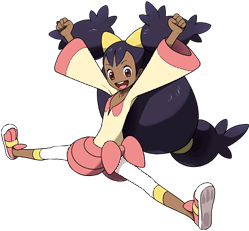
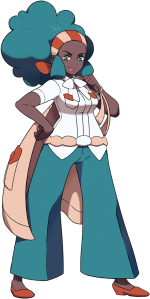
Black_White_IrisBlack_White_MarshalBlack_White_Lenora_2

Iris, Marshal, Lenora

Major characters of color were introduced during these games, such as the Gym Leaders Lenora (Aloe) and Iris, as well as the Elite Four’s Marshal (Renbu), all of whom are bosses one must face before eventually challenging the final opponent, the Pokemon League Champion. All three of these characters are shown to be strong trainers, and Iris even featured prominently in the Pokemon anime. At the same time, all three possess varying degrees of ethnic identifiers. Iris is difficult to pinpoint, Marshal has features which indicate black, and Lenora is undeniably black to a possibly stereotypical fault. Originally wearing an apron in her official design, the proximity of this depiction to the Aunt Jemima-esque mammy stereotypes of the United States (in a game based on a US city!) prompted a revision which portrays Lenora simply slinging the apron over her shoulder (though she still wears it in the in-game sprite). This is far from a Jynx scenario, as Lenora is both a clever gym leader and the curator of her own museum, and her design is still fairly restrained, but it is rather telling that the approach taken with the next generation of games, Pokemon XY, lean closer to Iris’s style.

XY_Grant                XY_Olympia

Grant, Olympia

Pokemon XY, which takes place in the France-inspired Kalos region, features not only Gym Leaders Grant (Zakuro) and Olympia (Gojika) but also individual trainers throughout the game such as the male Pokemon Ranger and Rising Star. As is evident from their designs, a greater amount of care is put into them as well. The location of not-France is also perhaps an influence here, as taking into account the centuries-old Arabic influence in Europe, colonialism, and even just recent immigration from other continents creates a complex milieu of cultures that differs in significant ways from that of the United States. The vagueness of these character designs may be a reflection of that aspect.

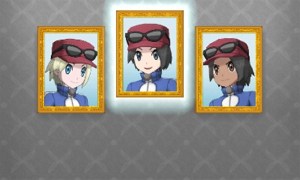
However, the biggest change is undoubtedly the fact that Pokemon XY actually allows you to choose the skin color (and eventually hair color) for your player character. Now, in addition to choosing gender (a feature available since the second-generation Pokemon Crystal), it is possible to get closer to having your avatar appear the way you do (or don’t, as the case may be). The ethnic vagueness idea comes to the forefront here, as only three skin tones are available, which leads to the question of whether or not this is the right direction to take, if it’s perhaps a washing out of cultural identity.

malecharactercustomizationchoices

femalecharactercustomizationchoices

I’m of two minds about this. With some characters such as the Gym Leader Marlon (Shizui), it’s actually difficult to tell if he’s supposed to be a darker skin color or just someone with a nice tan. The lack of concrete information, as well as the fact that many of the characters have very Japanese-sounding names in Japanese regardless of appearance, makes it easy to accuse them of just taking “white/Asian” designs and swapping the hues. On the other hand, it’s erroneous to assume that certain features are meant to evoke one race rather than another. After all, it’s a classic mistake to assume that anime characters “look white” because of their large eyes. When the racial features are relatively nondescript, perhaps it gives them a versatility that prevents those features from being abused as stereotyped caricature. That’s not to say that future games couldn’t benefit from adding more skin tones, for example, but there’s something to be said about allowing players to make their own interpretations.

Whether or not the racial ambiguity of character designs in Pokemon helps or hinders (or both), one positive that is hard to deny is the benefit of just having so many depictions of characters of color being happy and successful. They talk to dragons, climb mountains, run museums, practice martial arts, and go on adventures. They’re intelligent, dedicated, compassionate, funny, people you can look up to and want to know better. They’re role models with limitless potential. It’s especially notable that, in the follow-up games of Pokemon Black 2 and White 2, Iris would go from being a Gym Leader to being the Pokemon League Champion herself. The Pokemon games have always done a good job of portraying female characters, with three of the most recent games featuring female Champions, and to have a woman of color be the strongest and most celebrated individual in the land is nothing to scoff at.

Black_2_White_2_Iris

In the end, what I see as the greatest contributing  factor in the depiction of diversity in Pokemon is that the series has not gotten complacent. With every passing generation of games they continue to make improvements, and it’s a likely sign that this will continue as long as Pokemon stays alive.