Two of My Favorite Moments in Kill la Kill Episode 22

This post is about a week late to the “Kill la Kill episode 22 was awesome” meeting, but Kill la Kill episode 22 was awesome. As far as I’ve seen, this has been the general consensus among fans of the show, and it’s no surprise given the fact that many of the show’s narrative threads reached their turning points in this episode. While 22 was packed with a ton of impressive moments (like the Evangelion reference with Ryuuko hunched over and covered in blood like EVA-01), I’d like to talk about ones that I enjoyed in particular.

1) The Glory of Mako and More

The return of Fight Club Mako will forever be one of the glorious highlights of Kill la Kill, but in that triumphant return there is also a serious Ira x Mako moment. I’ve been a fan of that particular pairing and of course as the show has progressed it’s turned very real and I’ve enjoyed every minute of it. While people will talk about the fact that Gamagoori eats Mako-shaped croquettes in the episode as the Ira x Mako moment of the episode, I actually turn to Fight Club Mako’s appearance instead.

At the end of the episode, the heroes are attacked by a giant COVERS monster when out of a sky drops a dresser. As we know now, Mako in her banchou outfit is in there, but how does she introduce herself? Mako’s over-sized fist comes flying out of the dresser door and socks the giant monster, a feat of comedic spatial distortion the show normally associates with Gamagoori.

You can keep your croquettes.

2) Satsuki’s Radiance

In episode 22, Satsuki finally comes clean with her entire plan, and how she intended to use Ryuko as an x-factor in her rebellion against her mother’s global domination scheme, but realizes that manipulating others to serve her needs was the wrong way to go about it. Satsuki then apologies and takes a deep bow (the lower you go, the more humble and respectful you’re being, see Barack Obama), and then begins to emit a blinding light.
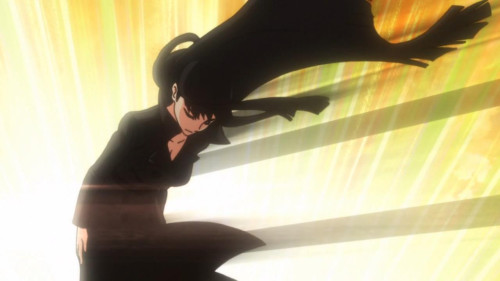
One of the visual icons of Satsuki throughout the series has been her literal radiance. When Satsuki appears, a blinding light shines forth from her, as if to say that she is simply that much more amazing than everyone else around her. It is as much a part of her character as her indomitable will and her giant eyebrows, but when you think about it, it hasn’t been around for quite a few episodes. To have the moment where Satsuki sets aside her pride also be the point at which she is at her most brilliant encapsulates the character so wonderfully that in an episode of great things it’s an absolute high-point.

In other words, to see the visual style of Kill la Kill match up so well with its narrative is just a rewarding experience.

Some Cool Things About Sengoku Majin Goshogun

I finished watching Sengoku Majin Goshogun recently. It’s notable for being an earlier work from the director of the early Pokemon anime, though overall it’s an okay show at best with a kickin’ rad opening. There are, however, a few things about the show that really stand out, and make the show fairly memorable.

Warning: Spoilers

Goshogun is abouta mecha-loving boy named Kenta  who, along with the crew of the mighty robot Goshogun and their teleporting airship the Good Thunder, fight against an evil organization bent on world domination. While the episodes are often kind of bland and episodic, the ones which explore the pasts of the main characters tend to be quite interesting. It’s one thing when the lead pilot Shingo is a generic do-gooder type, but it’s another when you learn that his past was full of danger and tragedy and that he actively chooses to be the Good Guy in spite of all that.

Actually, the show in general has amusing characters. Remy Shimada is the fiery female character of the series, and while she often talks about not being able to get married and settled down due to her giant robot work, it’s clear that she doesn’t really mean it when she actively chose her path. The villain Prince Bundol is a handsome blond who plays classical music when he goes into battle and cherishes beauty so much that when someone tries to betray the heroes he dismisses the guy and doesn’t follow through on his tip because “betrayal is ugly.” One of the other villains, Kerunaguru (pictured above), a guy whose name basically means “Kick and Punch” and who owns a robot designed specifically to be beat in fits of anger. In one episode, he opens up his own fried chicken joint without any ulterior motives. The guy just wants to sell some good fried chicken on the side while assisting in global domination.

By far the most fascinating reveal of the show however is the secret behind Goshogun’s ultimate attack, the Go-Flasher Special. First, it answers what the “blue button” mentioned in the opening does. Second, as it turns out later in the series, the Go-Flasher works by allowing the normally non-sentient enemy mecha to gain self-will, which causes them to override their controls and then voluntarily explode because they don’t like being used for violence and evil. Basically Goshogun’s greatest weapon is to give the enemy robots an existential crisis which makes them commit suicide. Now that’s an attack.

Oddly enough, the best way to enjoy the character interactions of Goshogun is to watch the movie Goshogun: The Time Étranger, which curiously does not feature the robot at all.

Kio Shimoku in the Flesh

Kio Shimoku, the author of Genshiken, is an elusive individual. Portraying himself as a kind of ape, he so rarely makes public appearances that he is sometimes mistakenly believed to be a woman. In fact, when he appeared for an event to celebrate the Genshiken Nidaime (Second Season) anime, it was kind of a big deal. Thanks to Brazilian Genshiken enthusiast Diogo Prado, however, I’ve learned that photos of Kio do exist.

Apparently Kio had attended an event in Taiwan in 2010, where he promoted the release of his manga Jigopuri (also known as Digo Puri). His desire for privacy is respected here, as none of the photos actually show his face, yet it’s still pretty cool to see the man himself. Obviously I don’t know how he is as a person, but the fact that he looks like a nerd who knows how to clean himself up and dress nicely is a trait also demonstrated by the characters in Genshiken over time, namely Ogiue and Madarame. In fact, he looks pretty similar to Madarame from behind, while in the old Publisher’s Weekly interview with Kio he said that Ogiue is somewhat reflective of his own experiences.

By the way, I wonder how Jigopuri ended up doing in Taiwan.

The “Character Development” Crutch

In response to recent shows such as Kill la Kill and even Dokidoki! Precure I’ve been seeing a particular criticism thrown around lately:

“These characters are bad because they have no character development.”

In a way, it’s pretty much the go-to question for a lot of things, because when we traditionally think of a character-driven narrative, a character starts off in one place and ends up in another. Sometimes it’s a physical displacement, sometimes it’s an emotional one, and often times the two go hand in hand. When it comes to basic storytelling, it’s about as reliable a structure as it gets.

Reliable, yes. The formula by which all characters should be judged, no.

I understand that character development can be a powerful thing, and seeing a character grow can be a tremendously satisfying experience, but when “character development” is bandied about as doctrine it comes across as a Beginner’s Guide to Criticism. People end up being so eager to establish the “right way” to construct a story that they effectively throw out the baby with the bath water. “Static” characters, or even static elements of characters, have their own place, and are capable of being part of great stories. However, the narrative arc need not be about them in particular.

There are many ways to portray characters, and not all of them need to have the hero go through the typical kind of character progression. Does anyone watch Akagi asking, “Where’s Akagi’s character development?” Is Kenshiro an issue because he doesn’t have “character progression” beyond getting angrier and sadder as the series goes along? Raoh’s “development” is more a retcon which turned him from just an Evil Guy to someone who wanted to bring order to chaos. Yet all their characters work for what they are and what they need to be. That’s not to say that character development shouldn’t ever matter at all (and both Kill la Kill and Dokidoki! Precure have more character development than either Akagi or Fist of the North Star), but it shouldn’t be held up as holy doctrine that a story can only succeed if its character progression is sufficient.

I think this is why people are so often eager to point out that some character is a “Mary Sue.” This character who is on some level larger than life or a product of wish fulfillment is assaulted by the big book of how narrative tropes are “supposed” to work, and the attackers don’t care about anything but the idea that stories should adhere to it.

Galilei Donna Should Have Been a Movie

Galilei Donna is an anime which knew very well how it wanted to begin and end, but it’s clear there was not much forethought put into the middle. There are elements in the first episode which pay off satisfyingly in the end, such as the condition of the Ferrari sisters’ mother, but the length of time in which they went largely unmentioned compromises the impact. The amount of meandering that happens in the show (and I’m not against meandering per se, it’s just that it often seemed to contradict itself), certainly did not help, and it made the whole thing feel like it should have been 5 episodes shorter.

Given this, I really feel like Galilei Donna would have benefited from being either a film, or an OVA, or something along those lines. I think one of the key issues is that the beginning and end feel too far off from each other (even though it’s only 11 episodes), and the fact that the way they go about finding the Galileo sketches seems abrupt and without much conflict around the actual objects. This is the kind of thing that would be more forgiving in a movie or maybe 1-3 episode anime where the act of searching for the sketches could be done in montage and would not lead the series to feeling like the sketches had no true narrative weight to them. Also, when the conclusion is only 90 minutes away, it would not feel like the middle was largely wasted.

They’re Better Than You: Dokidoki! Precure

If there’s one thing about Dokidoki! Precure that really stands out, it’s the characters.

You might be thinking, “But isn’t that true for just about every other Precure you’ve reviewed?” It’s certainly true that the characters tend to be a substantial part of Precure, and with its “enemy transforms people’s selfish desires into monsters whom the heroines must fight with the power of magic sparkles and martial arts action” premise Dokidoki! Precure is pretty typical for the franchise. However, with respect to its heroines, Dokidoki! Precure differentiates itself from its predecessors in that it really pushes the concept of its main cast as role models and targets of wish fulfillment. The girls of Dokidoki! Precure are larger than life even before they transform into magical girls.

Take Hishikawa Rikka, Cure Diamond. She’s a level-headed student council vice president, the best friend of main character Aida Mana, and the top student at their school. Her dream is to become a doctor, and the fact that she’s already studying medicine in middle school is pretty amazing. In terms of ambition and power, she’s already at a level higher than most previous Precure characters, who are usually just the ace of their athletic teams or club heads or whatever. She’s also in a way the least impressive of the Dokidoki girls.

Left to right: Kenzaki Makoto, Yotsuba Alice, Aida Mana, Hishikawa Rikka

Mana, Cure Heart, is student council president. She also gets high grades (though not as high as Rikka), and is sought after by all of the sports clubs because of her all-around amazing athletic skills. On top of that, Mana is relentlessly energetic yet cool under pressure, able to handle the work of ten people without breaking a sweat. Mana is perhaps the most effective leader in Precure history, and yet even she’s no match for Yotsuba Alice (aka Cure Rosetta), who is the kind-hearted heiress of a powerful business conglomerate, well-versed in a variety of martial arts, and is basically what you’d get if Daidouji Tomoyo mega-evolved into Batman (complete with badass butler). And even that arguably pales in comparison to Cure Sword, the last surviving warrior of a kingdom destroyed by evil and greed, who has escaped to the human world in the guise of Kenzaki Makoto, pop idol sensation, while bearing the burden of having to restore her fallen homeland.

All of the central characters in Dokidoki! Precure are outstanding beings, and the degree to which the anime is able to live up to that standard is essentially what dictates the strengths and weaknesses of the series. Dokidoki! Precure follows a pretty typical children’s anime pacing, where there’s a lot of episodic content and then a swell of story during the end of each approximately 13-episode chunk, and although there are plenty of episodes which explore the characters’ impressive qualities, there’s a sense that they could have done more. Alice is  the biggest example of this, as every episode about her ends up being amazing but are also few and far between. Similarly, I thought Makoto’s reverse-identity (her real name is Cure Sword) wasn’t portrayed with as much consistency as the concept could have handled.

Also I really wished they kept using the awesome bows from the middle of the series, perhaps the most impressive Precure toys ever in terms of giving young viewers the chance to wield things that look like actual weapons. …Maybe that’s why they went away.

I’ve seen some people be critical of Mana, saying that she overshadows the other characters, but I never found this to be the case. The issue isn’t that Dokidoki! Precure devotes too much to Mana, or that Mana is somehow too perfect to be a protagonist, but that many episodes are designed to be formulaic and self-contained to a fault. If you look at the episodes which are devoted to the greater narrative, they do an excellent job of pushing things forward, and by the end the story wraps up nicely with a conclusion unprecedented in Precure.

While I enjoyed watching every week, Dokidoki! Precure ends up being one of those shows which benefits from having a list of “important episodes,” especially because the show concludes very well in spite of some large plodding spaces in the middle of its run. At the same time, if you’re comfortable with kids’ show pacing, it’s not much of an issue. Dokidoki! Precure is reliable as an introduction to the franchise as a whole, while its different take on characterization can be refreshing for those already familiar with Precure.

PS: The first ending of Dokidoki! Precure is actually now my favorite Precure ED ever. Maybe it’ll be yours too.

Step 1) Kung Fu, Step 2) Transform into Submarine: Hurricane Polymar

There are about three weeks left in the Hurricane Polymar DVD crowdfund project and out of all the anime on Anime Sols, I think it’s a show especially deserving of attention. It’s fun, it’s wild, and somehow despite the clearly older animation doesn’t feel all that dated.

Some people might be more familiar with the Hurricane Polymar OVA from the 90s, and though I’ve never seen it myself I’ve been told that it is kind of a drab affair. This original 70s Hurricane Polymar TV series however is anything but mundane. In fact, although it’s called Hurricane Polymar, the Japanese used to write “Hurricane” actually means “Shattering Backfist,” while the opening is so vibrant and energetic that I think its style alone is reason enough to at least check out the first episode.

The actual premise is fairly silly but in a delightful way which still leaves plenty of room for action. The main character is Yoroi Takeshi, an assistant for a bumbling yet cocky detective named Kuruma Joe who proclaims himself to be the “Next Sherlock Holmes.” Every episode they fight a different animal-themed criminal organization, and Takeshi, under the guise of a simple yet loyal apprentice, secretly helps the detective’s investigations more than the detective himself realizes.

When things call for some martial arts violence, however, Takeshi can transform into the mighty Hurricane Polymar, who chops and kicks and creates illusions while somehow fitting the word “hurricane” into Bruce Lee-style WATAAAAAAs.

Rounding out the cast are the narrator (a dog), and Nanba Teru, who is perhaps the most stylish female character ever. Actually, like many old Tatsunoko Pro shows, the character designs are by Amano Yoshitaka, best known for his work on Final Fantasy.

Hurricane Polymar essentially acts as a mix of the comedy of Inspector Gadget, the secret identity shenanigans of Superman, and a Hong Kong kung fu flick. It’s not the kind of anime that has a really dramatic impact or a fantastic ongoing story, but it doesn’t really need it either. What Hurricane Polymar excels at is being supercharged entertainment, the kind of thing where you watch an episode just to get invigorated and ready to tackle the world. In fact, it might not be good to watch too many episodes in a row, as you might get too hype.

If you decide that you are so capable of handling Hurricane Polymar that you actually want a physical copy of it (and live in the United States or Canada), you can contribute to the Anime Sols crowdfund.

A Tale of One Bishounen’s Love of Large Ladies: Pochamani

Thanks to one Mr. Ed Chavez I was recently informed of an unusual shoujo manga called Pochamani. It’s short for “Pocchari Mania,” which translates into something like “Chubby Chaser.” It’s a pretty rare concept in manga but especially shoujo manga where characters are generally known for being thin wisps, be they male or female. The series also earned a mention in the annual These Manga Are Great! (Kono Manga ga Sugoi!) 2014 edition, while the author Hirama Kaname mentions that her own preference for chubbier folks was the impetus for this series.

The main character of Pochamani is a chubby girl named Tsumugi who begins to date a handsome classmate who has a thing for larger ladies. While on some level wish fulfillment, the manga does a number of notable things. First, is that Tsumugi is not “fat” in the way Yomi from Azumanga Daioh or Hiro from Hidamari Sketch are “fat” (meaning visually indistinguishable from other characters in terms of weight and relying solely on text and speech to make this point), but is drawn differently from other characters. Though the art is inconsistent with how big she’s supposed to be (perhaps due to the artist being unfamiliar with how to draw such a body type?), it generally gets the point across that she’s small and round.

Second, while the manga, at least from the first volume I read, is not super progressive or tactful in every way (one of the most common scenes is the boyfriend rubbing her underarm flab with excitement), it does point out that the boyfriend is into her not simply because she’s chubby. Instead, it has a lot to do with her personality and demeanor, namely that whereas the girls he’s dated in the past have been depressed about their weight, Tsumugi is comfortable with how she looks.

Third, it covers those moments where they’re walking down the street and getting stares because people simply can’t believe that a guy like him is with a girl like her. Tsumugi is confident but not unshakable, and seeing her strength even through this is admirable.

Probably the strangest thing to come out of Pochamani is its official website, which is designed to be a fan club for people who like their partners on the large side. It has a list denoting the “charms of chubby people” and even an interview with a handsome male voice actor (seen above) about how he likes chubby girls (and also the manga of course). They also have a female Osakan comedian named Babazono Azusa as their somewhat corpulent spokesmodel. I’m not 100% behind the site because it seems to veer more towards a more simplistic fat fetishism compared to the actual manga, but I know Japan of all places is not known for its acceptance of fat as a type of beauty, so I see it as a kind of marketing decision within this context.

The Perfect Nickname for Saki’s Anetai Toyone

The new season of the Saki anime is here, and with it comes a whole slew of new characters. I’m quite fond of a number of them, but perhaps none more than Anetai Toyone. At 197 cm tall (over 6’5″) she’s not just “anime girl” tall, but actually a dark and imposing figure (at least physically).

I mentally refer to her as “the Undertaker” because on her resemblance to the WWE wrestler, particularly his early-to-mid 90s look, and I’m encouraging everyone else to do the same. It’ll make the actual experience of watching the show that much richer, and I want you to think of that signature gong every time you see Toyone.

Perhaps Kakura Kurumi (the small one) could be her Paul Bearer.

Shounen Sports and Girl Appeal

I’ve been watching two shounen anime adaptations as of late, Yowamushi Pedal and Kuroko’s Basketball. The former runs in Weekly Shounen Champion, the latter in Weekly Shounen Jump. When you look the contents of each series, it’s almost obvious, as if they embody the general direction each magazine has taken, but not in a way which denies either their contemporary nature or their shounen-ness.

In this age where the definition of shounen manga has been in flux, Shounen Champion is the most primary source of classic, old-fashioned shounen manga where a boy does his best to fight and improve. It fits the basic goal of that magazine quite well, which is to be a boys’ magazine for boys, though Yowamushi Pedal isn’t without its modern flairs, including having a more handsome rival for the main character.

Shounen Jump on the other hand is arguably the mainstream boys’ magazine which has embraced its female audience the most, outside of Jump variations which specifically target that audience. Kuroko’s Basketball, like Prince of Tennis before it, is filled with good-looking guys handsomely showing their best. Even if they’re not fujoshi, there’s a clear appeal to girls in it, though overall the series still has in common with Yowamushi Pedal the thrill of sports and competition.

One thing that both series share is the female manager archetype, who more broadly fits into the “knowledgeable supporter” role as well. The idea is that, while they’re not participants in the main activity of each series, they bring an enthusiasm and a set of knowledge that helps the reader understand the sport better while also acting as a cheerleader for the main character and maybe providing a bit of eye candy, though I don’t think either Miki from Yowamushi Pedal or Riko from Kuroko’s Basketball are quite the characters you’d go to for cheesecake. At the same time, I think there’s a certain substantial difference between Miki and Riko, which is that Miki is clearly a love interest for the main character, whereas Riko if she has any romantic involvement at all is with a side character in the series.

I think the fact that Riko is not a love interest, and arguably that Kuroko’s Basketball has no main female love interest for its main character at all (Momo is ostensibly one but her connection to Aomine seems stronger) speaks a lot to the difference in their magazines.  I don’t think this just has to do with Kuroko’s Basketball having a fujoshi fanbase which prefers pairing the guys together, either. If anything, I get an almost shoujo manga-esque impression of Riko’s relationship with Hyuuga and Teppei due to their interactions, not in the sense of hearts and sparkles in the background, but from its use of Riko as a character in her own right.