The Fujoshi Files 27: Naganohara Mio

Name: Naganohara Mio (長野原みお)
Alias: N/A
Relationship Status: Single
Origin: Nichijou

Information:
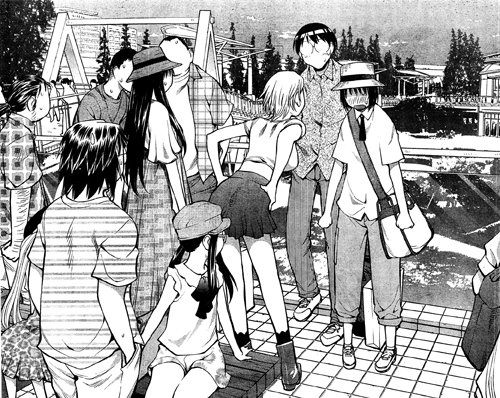
Naganohara Mio is a high school student and an easily excitable girl who frequently has to deal with the absurdity of others, whether it’s from her best friends Aioi Yuuko and Minakami Mai, or from her older sister Yoshino. Fairly athletic, the main thing that keeps Mio from excelling in sports is a seeming inability to channel her physical abilities in an organized fashion. Regardless, she is a fast runner, has some training in kendo (thanks to her sister being a prodigy in the sport), and is adept at pro wrestling techniques, notably the Dragon Screw. Mio is also notable for her usage of two wooden cubes as hair ties.

Mio is a skilled amateur artist who frequently ends up drawing BL content or something related to it. Though she often tries to refrain from showing that side to others, it ends up coming out whether she wants it to or not. The most frequent reference for her racier drawings is an older student named Sasahara Koujirou, a sophisticated son of a farmer on whom Mio has a crush.

Fujoshi Level:
Mio is able to use her physical skills in defense of her fujoshi lifestyle. When pushed to the limit, she is capable of defeating multiple adversaries, man or beast, in order to protect her artwork.

The Fujoshi Files 26: Momose Tsugumi

Name: Momose, Tsugumi (百瀬つぐみ)
Alias: Momotsun (モモツン)
Relationship Status: Dating
Origin: Mousou Shoujo Otakukei

Information:
Momose Tsugumi is a student at North Haneda High often seen hanging around with other similarly fashionable students. Having a crush on fellow swim team member Abe Takehiro back in Junior High, she was shocked to find him getting increasingly close to his classmate Asai Rumi, and has taken great efforts to make her feelings known, including coming onto him strong.

Believing the term to carry particularly negative connotations, Momose refuses to call herself a fujoshi, citing her large amounts of “normal” friends, her manner of dress, as well as her ability to not come across as an otaku in public. However, she is often exasperated by how boring her non-otaku friends are, and will occasionally engage in some otaku-related activity, albeit at a subdued level. Like many, she is a fan of Fullmetal Prince.

Fujoshi Level:
Despite her denial, Momose exhibits all the signs of being a fujoshi, including a fondness for popular titles among BL enthusiasts and a familiarity with popular doujin artists.

The Fujoshi Files 25: Matsui Youko

Name: Matsui, Youko (松井曜子)
Aliases: Mattsun (まっつん), Asa Matsu (アサマツ), Miss Gomaki (ミスゴマキ)
Relationship Status: Dating
Origin: Mousou Shoujo Otakukei

Information:
An overweight and unattractive fujoshi in middle school, Matsui Youko spent the months after graduation undergoing a strict regimen of diet, exercise, and studying fashion. By the time Matsui entered North Haneda High, she quickly gained a reputation for having one of the most dynamite bodies in school, which she flaunts. Intending to bury her past as a fujoshi, Matsui saw Asai Rumi’s unabashed fandom and seeming popularity with men to be a slight on all of her efforts. Though initially Asai’s tormentor, the two quickly came to an understanding, becoming best friends and even fellow collaborators on doujinshi.

Matsui originally discovered BL in junior high thanks to a Shinji x Kaworu doujinshi, and is currently a fan of titles such as Gundam SEED and Fullmetal Prince. Her tastes are similar to Asai’s, though she occasionally prefers pairings in the opposite order. Matsui is also in a relationship with Chiba Shunsuke, a suave blonde whom she had a crush on since junior high, and whom she originally thought was gunning for Asai.

Fujoshi Level:
The first time that Matsui and Chiba engage in intercourse, Matsui bases her assumptions of how sex should proceed on her experience with BL material, believing her boyfriend’s capacity for and willingness to receive anal foreplay to be greater than in reality.

Show Me the Way to You: Genshiken II, Chapter 67

Chapter 67 of Genshiken II hits short and sweet, but that’s also what makes it fun.

Things are mighty awkward in Genshiken ever since Hato loudly proclaimed his BL fantasies at Comic Festival. Madarame and even Kuchiki are avoiding him. Discussing what to do, Sue points out that the loss of Madarame is the loss of Hato’s only male friend, and that there is only one solution: have Ogiue show Hato (and the other freshmen) her old Sasahara x Madarame doujinshi, so that Hato can know that his opinion, at least in the club itself, is not so unusual.

As the three freshmen are shocked by the combination of outright eroticism in Ogiue’s doujinshi and how she has depicted her own boyfriend manhandling Madarame, Hato takes “acceptance” one step further, now inspired by Ogiue’s drawings to make his own Madarame doujinshi. Just as Hato makes clear his intentions though, Madarame walks into the clubroom.

To break the awkwardness once and for all, Yajima steps up and tells Madarame that every first-year member of Genshiken saw him as an uke from their very first meeting, and that he should just treat it as the unreasonable delusions of a bunch of “rotten-minded” individuals. Kuchiki, always one to restore awkwardness to new heights however, barges in and tries to pull an anime convention move. Trying to force a kiss onto Madarame in order to please Hato, Kuchiki is neutralized by a swift palm strike from Sue and a legitimate sleeper hold from Hato’s judo skills (where according to Wikipedia it’s called a “Naked Strangle”). For the near future, Madarame is not visiting the club.

This chapter of Genshiken II initially feels a little light on content, but the more I think about it, the more I find that there is plenty of “meat” to go around, particularly in the character interactions and the bridging of gaps that occurs within them. Yajima, who has had the hardest time with Hato out of everyone, goes out of her way to make Hato feel more comfortable within the club. Though Yajima still can’t get too close to him because of the fact that Hato is indeed a man, it does feel like they have something you can call a friendship now. Then there’s Ogiue showing her doujinshi to the freshmen, which is not only the first instance of Ogiue willingly displaying it to others since Sasahara (though Sue found it on her own), but something that makes you realize the history gap between the old Genshiken and the new. To Yajima, Yoshitake, and Hato, all of this information is entirely new and exciting, in every sense of the word.

Ogiue displaying her Sasa x Mada work in front of everyone says a lot about how Genshiken, and perhaps anime fan culture has changed, at least in terms of how otaku “should” behave. We’re reminded early in the chapter that Ogiue suffered immensely for being a fujoshi, that her shame and guilt brought her to the point of an attempted suicide which Ogiue herself refers to as a “Perfect Bad End.” Even with Sasahara, she went through a lot to bring herself to show it to him. With the new members though, their reaction is only one of mild surprise, more astounded by the quality of the work itself than the fact that it actually exists. Yoshitake even wonders if Ogiue would be willing to make copies. After all, one of the first things the three first-years did as a group was think up pairings for all of Genshiken guys at a club party. Times have changed, and what was once the ultimate dark secret has become just another “thing.” As if to emphasize this contrast, Ogiue wears a flannel shirt straight out of 1980s otaku subculture during the whole presentation that makes even Yajima look more fashionable.

What’s also similarly interesting is how “Madarame as uke” became the prevailing opinion among everyone. After all, one of the first things Ohno said back when she was introduced to Ogiue’s private doujinshi was that the pairing should probably have Madarame as the aggressor and Sasahara on the receiving end. Given how they presented themselves to the world up to that point–Madarame exuded a forceful persona of “proud otaku” and Sasahara was a quiet guy who went along with the flow–it seemed to be the more “sensible” pairing, but apparently Ogiue was able to see it on a deeper level, though it might just be that Ogiue came in around the time that Madarame and Sasahara began to change, Madarame from unrequited love and Sasahara from growing a spine. Just as Ogiue’s initial impression of everyone in the club was different from that of Sasahara’s, so too have Yajima, Yoshitake, and Hato formed opinions through their own limited experience. Granted, the freshmen are also kind of a different breed of otaku, so there’s no telling what would have happened had they met Madarame a few years ago instead.

Meanwhile through all of this, Yoshitake shows what it’s like to be an anime nerd seemingly free of worry in regards to the opinions of others, all while actually being socially aware, unlike Kuchiki. If ever there was a character to show how the right kind of confidence and passion can counter any inherent awkwardness from a given topic, that would be Ed Chavez, but in his absence Yoshitake Rika is the next best thing. Reading this chapter, I found myself asking, so when does Yoshitake get her time in the spotlight, and as if to answer me directly, the preview blurb mentions that she is getting center stage next chapter.

I’m excited, how about you?

The Fujoshi Files 24: Kanbaru Suruga

Name: Kanbaru, Suruga (神原駿河)
Alias: Valhalla Combo (バルハラコンビ)
Relationship Status: Single
Origin: Bakemonogatari

Information:
Kanbaru Suruga is the basketball ace of Naoetsu Private High School who in junior high was part of the “Valhalla Combo,” a designation given to her and track star Senjougahara Hitagi (by herself) for their athletic abilities. A quick runner and capable of even delivering dunks, Her friendship with Senjougahara wanes after junior high due to a sudden change in Hitagi’s personality, as well as Kanbaru’s own confession towards her being rejected. The negative effects of this rejection are compounded when Kanbaru discovers in high school that Hitagi had begun dating one Araragi Koyomi.

Kanbaru’s most distinguishing visual feature is her bandaged left arm, which hides the furry demonic limb of a “Rainy Devil.” Originally mistaking it for a monkey’s paw, the arm still grants her wishes, only it fulfills her darkest desires instead of what she says aloud, and often does so violently. Its power is only subdued when the demon in her arm’s contract cannot be fulfilled.

Despite the seriousness of her situation, Kanbaru is quite forward and cheerful. She also identifies herself as being something of a pervert, being a self-admitted lesbian, fujoshi, exhibitionist, lolicon, and masochist.

Fujoshi Level:
Kanbaru’s room is filled with so many books that they take up the vast majority of space. Though it is unclear just how many books are BL and how many cater to her other tastes, it is a good indicator that her ability to collect and consume yaoi is nothing short of astonishing.

Fujoshi Characters by the Score

When I first began the Fujoshi Files, my intent was to put the spotlight on what I saw as a rising trend at the time: the appearance of the yaoi-loving female fan as a character archetype, particularly in the manga and anime targeted towards that otaku market, as well as the presence of “fujoshi-like” traits in characters who might not qualify otherwise. From what I knew, there were enough to get a decent-sized list, and as it was a burgeoning character trait, I figured if I did one every couple of months or so that I’d be able to keep up fairly easily.

That was not the case, and now I currently find myself with a backlog bigger than the amount of Fujoshi Files currently available on the site. Aware that I had been neglecting it somewhat over the past year or so, I’ve decided to start posting them more frequently. Most likely, you’ll be seeing them every other Sunday, but this is subject to change, particularly if I feel like I don’t have anything ready by then.

One problem that has faced the Fujoshi Files since very early on has been access to the works themselves, because I try to write a profile after reading as much as is available at the time. This can result in entries that are outdated, but it also makes it so that I don’t always feel I can write an accurate description of the characters themselves. Sometimes, a character’s name will be mentioned in passing in a single panel and then never again, and then when I look online and see that there are no records of a character by that name, I have to ask myself if I just imagined it. Still, the way I’m planning on posting these, I believe I will do a pretty good job of reading the source material while still posting entries regularly.

Another issue has been the sheer amount of characters that could potentially qualify. While it seems like the small “boom” of fujoshi main character may have died down recently, there are still plenty of minor fujoshi characters appearing in series, and it’s even gotten to the point where someone will make mention of a fujoshi, or there will be nameless fujoshi in the background and I can’t decided whether or not I should count such things. For example, in Baka and Test: Summon the Beasts, Himeji mentions in one episode that she has a friend who is a fujoshi. What would I even do about an image? If I counted such a “character,” would I be taking it too far? I get the feeling the answer is “yes,” but I’d like for the Files to be comprehensive.

And that’s not even mentioning Genshiken II, which has a whole new batch of characters who need profiling, or the spinoffs and alternate universes that have spawned out of Tonari no 801-chan. Those will come in due time.

What do you think? If you’ve been enjoying my little side project over these past few years, then how comprehensive should I make it? Should I include even background characters? Would you prefer I post somewhat incomplete entries and then fill them back in later?

The Fujoshi Files 23: “Onee-chan”

Name: N/A
Alias:
“Onee-chan” (お姉ちゃん), “Nee-chan” (ねーちゃん)
Relationship Status: Complicated
Origin: Fujoshi Nikushoku Hikikomori

Information:
An unnamed hikikomori, this girl is occasionally visited by a younger guy. Possessing a strong sexual appetite, she aggressively pursues a primarily physical relationship with her male friend.

Fujoshi Level:
Other than her designation as a “fujoshi,” there is little evidence of her status as such. The most relevant information available is that she treats her friend like a typical BL “uke/bottom” character.

Angela Attack: Genshiken II, Chapter 66

I’ve been waiting for a month to use that title.

The final day of Comic Festival is nearing its end, and Madarame is in deep trouble, at least from Hato’s perspective. First, Madarame and Hato encounter Kohsaka, whose picture-perfect crossplay (to promote his company’s new 18+ game) blows away both of them. Hato remarking with amazement that Kohsaka, unlike himself, doesn’t even need makeup to complete the gender illusion, wonders why things aren’t more uncomfortable between Madarame, who likes Saki, and Kohsaka, her boyfriend. Hato comes to the conclusion that Madarame’s just isn’t able to compete for Saki’s affections. Madarame and Hato comfort each other over their respective areas of inferiority relative to Kohsaka, though Hato points out that he’s much better at undergoing the cross-gender transformation by using his feminine voice.

Angela strikes, laying on the flirt as thick as humanly possible, with Madarame naturally not being sure what to do. Hato jumps in for the rescue, pointing out that Angela is flying back the next day, so obviously there’s no way anything could happen between them, but Angela doesn’t quite agree.

Knowing that the actual reason Madarame can’t even begin to think of Angela is because Saki is still in his heart but not wanting Madarame to know that he is aware of Madarame’s unrequited love, Hato changes his thought midstream to try and find a safer reason. In doing so, he blurts out that Madarame is such an uke that there’s no way he should be with a girl, though unbeknownst to Hato, Angela is a big fan of Madarame as “sou-uke,” and instantly bonds with him. Wanting to point out however that real life and fiction are different, physically different, Angela tries to give Madarame his Very First Boob Grab, but is deflected by Sue, who then admonishes Angela’s rash action with a roundhouse kick.

At the end of the day, Angela still has her eyes set out on the 72-year-old Pit Viper, Madarame and Hato grow in their friendship, and Madarame comes to the shocking realization that he is in fact perceived as the catcher in yaoi imaginings.

Angela’s forwardness and acknowledgement of previous experience with one night stands sets her far apart from the nerds of Genshiken and at first it might come across as too far out there from how Genshiken has been in the past, but given what has happened in the manga before, it doesn’t seem so inappropriate. If you think about it, the awkward expression of sexuality has been a big part of Genshiken from day 1, whether it’s Saki having to come to terms with Kohsaka’s 2-D complex, the Sasahara x Madarame doujinshi that underscores Sasahara and Ogiue’s relationship, or even the fact that every ComiFest ever has been about buying comics not to “read” but to “use,” and the understanding that everyone else you know is doing the same. In this regard, the most awkward moment of all might just be seeing Angela’s “sex on the first date is okay” viewpoint collide with Madarame’s otaku chivalry, the same noble attitude that at first kept Madarame from taking a seat on the train in place of Saki back in Chapter 32.

That said, it is still a bit of a shock to just see Angela just blast down that implied wall of silence that surrounds the topic of sex, a wall that normally is talked around  or through tiny holes, but is rarely trampled over so easily. It’s a kind of bluntness similar to Sue, and I have to wonder if this is a shared American trait for the purpose of the story. On the other hand, Angela and Sue’s aggressive attitudes aren’t quite the same, and while we see Sue expressing her fondness for yaoi or making references all the time, I can’t really ever see her coming on to a guy as nonchalantly as Angela does. It makes me want to see their friendship in action outside of the context of a visit to Japan.

While that might be considered an inter-otaku cultural gap between Japan and America (and even only somewhat so), the inter-otaku generation gap is also clearly  present in this chapter with Madarame and Hato. At first when Hato sees Madarame talking to Kohsaka. “Why isn’t Madarame seeing him as a rival?” Hato wonders, but just the fact that Hato is asking that question shows a different mindset from the older members of Genshiken. Going after a girl who’s already in a relationship when, on top of that, you’re friends with the both of them? That stuff is for fiction, man. How differently might this manga have turned out had Madarame gone for it from the start, or if Ogiue and Ohno already had boyfriends prior to meeting Sasahara and Tanaka? Would those two have even bothered? But that’s just not how Genshiken is, because that’s not how the characters are. After all, I’m sure that people besides Tanaka entertained the thought of having a relationship with Ohno after she joined, but once it was established that she had a thing with Tanaka, that ship sailed. It’s not a matter of monogamy or anything like that, but simply that someone like Hato (or Yoshitake) carry an extroverted attitude and awareness of interpersonal relationships romantic, sexual, or otherwise, that only the non-otaku Saki and Keiko could see as clearly.

It’s also nice to see the friendship that has formed between Madarame and Hato. Could it be something more? I doubt it, given that both have said outright that they are not into same-sex relationships, at least outside of the world of BL, but I could see the idea continuing to make things a little awkward for them, especially given the number of (too much) high-power fujoshi populating the club.

There was only one small Ogiue cameo this chapter, so let’s close out with it.

The Fujoshi Files 22: Arisaka Haruka

Name: Arisaka, Haruka (有坂 遥)
Alias:
Harurun (はるるん), Haruharutei (ハルハル亭), Ice Cream (あいすくり~む)
Relationship Status: Single
Origin: Otaku no Musume-san

Information:
Arisaka Haruka is a high school-age manga assistant who lives at Higan-sou, a small apartment filled with otaku and other eccentric individuals. The younger sister of a popular doujin artist, Haruka also attends Comic Market frequently as an artist. Unable to find self-confidence on her own, she began mimicking her sister both in drawing style and personality, and even quit high school as a result.

Though she originally copied her sister, Haruka was able to rediscover her own style and conviction to draw manga thanks to the help of Higan-sou resident and fellow manga assistant Morisaki Kouta, his daughter Yukimura Kanau, and Kanau’s friend, Serio, who was a fan of Haruka before she started copying her sister. Haruka has since begun attending high school again and developed a crush on Kouta. Since returning to school, she has gained a friend and fellow fujoshi in her classmate Rika.

Fujoshi Level:
Haruka’s fujoshi mind has been able to fantasize about Kouta and another resident of Higan-sou in loving embrace using that energy and her own artistic talents to bring those ideas to life. Fueled partially by her crush on Kouta, it is unknown to what extent the fictional BL Kouta’s personality differs from the real thing.

Time and Genshiken

When I originally read Tamagomago’s post on the Genshiken generation gap, I realized something: time has moved differently for the characters of Genshiken compared to the real world.

The gap between Genshiken and Genshiken II has changed how I relate to Genshiken. Genshiken II starts off only a few months after the end of the first series, but in the real world, nearly five years had passed. One result of this is that the references used in the new series are a little anachronistic (a Zan Sayonara Zetsubou-sensei reference when the show shouldn’t have been out at that point, for example), but the one I find to be more personally important is that I went from being around Sasahara’s age to actually being closer to Madarame’s. I am no longer the college senior who could read about Sasahara’s graduation around the same time as my own. Had the manga progressed steadily from Volume 9, had there not been the long wait to herald in Genshiken II, I wonder if I would’ve also been reading the manga a little differently?

One criticism of the new Genshiken that I see from not just English-speaking fans but also Japanese ones is that it’s been difficult to relate to the new, primarily female cast. The feeling I often get from that response is that the readers who are of the opinion that Genshiken has changed for the worse feel that this world of college-aged otaku is not the one they had originally left. I even talked about it when the new series was beginning, remarking that Genshiken has always been about change, and that it should be possible to relate to these new characters, even if they do come from a different generation otaku. I realize now though that it’s not so much a matter of these readers not being able to relate to characters unlike themselves, but more that they feel the philosophy of Genshiken has changed, that the core essence is something different and perhaps frightening.

Obviously, the experience of shifting age groups as the result of the gap between Genshiken series is not something everyone can experience, especially if they’re not reading the comic as it comes out. Even if that weren’t the case, given time I would’ve reached Madarame’s age anyway. And even if others are around the same age as me, it’s not like people experience the passage of time in the exact same or even similar ways. More importantly, it’s not like my own personal experiences over the past five years are particularly better than others’. Even so, when I think about it a little more, it seems like one of the themes that comes out of Genshiken for the readers as well as the characters is the influence of personal history and how self-perception of time changes accordingly.

Ogiue originally defined herself by the trauma of her time in junior high. It dominated her life before she was eventually able to move on with the help of her friends. Madarame clings to the recent past by leaving his situation with Kasukabe comfortably ambiguous. Kugayama put his half-hearted ambitions aside and decided to just be normal. The first chairman, well, I’m not sure if he existed within time.

For the fans who feel alienated by Genshiken II, their personal definition of what it means to be otaku, and by extension, what it means to be part of a group otaku, has not changed in the five year Genshiken gap. I emphasize once again that there’s nothing wrong with this, and in fact it’s also pretty much where Yajima is at in terms of her own otaku-existential conflict. As for me, I know fully well how much I’ve related to Genshiken and continue to do so, but I also know that a lot has happened in my life since I finished the original series. I’ve defined myself many times on this blog according to how Genshiken has changed my life, but in the face of this new iteration, I find that it doesn’t change me so much as change alongside me.