Kio read Volume 10 of Koukaku no Sukima (Scheme in the Crimson Shell), a series about the world of Pandora in the Crimson Shell by the original author, Koshi Rikudo (of Excel Saga fame). Kio likes the “Shiromasa World” (which I assume has to do with Shirow Masamune?), and the fact that one particular story gets a continuation.
Kio is overjoyed that he could relate to the main character of From Bureaucrat to Villainess: Dad’s Been Reincarnated!, an anime adaptation of a manga about a 52-year-old salaryman who is reincarnated as a villainess.
An online preview is available for the sequel to Kio’s 18+ doujinshi, Zenbu, Sensei no Sei. (It’s All Your Fault, Sensei.) on the adult site FANZA. Note that the site is region-locked. The full 82-page version is out now.
Otani Ikue (voice of Pikachu) was trending on Twitter. Kio jokingly claims that she’s known primarily for her role as Kamishakujii Renge in Kujibiki Unbalance.
A fan mentions being surprised when Kujibiki Unbalance became its own standalone title. Kio concurs, though mentions that all the voice actors had to change from the OVAs that were packaged with the first Genshiken anime.
Kio also watched the movie Twilight of the Warriors: Walled In. He enjoyed the portrayal of the people living in Kowloon Walled City and the free-flowing action.
WIth the doujinshi out on FANZA, Kio talks abouts how he originally intended it to be a single 134-page work, but found that doing so meant cutting out too much of what he wanted. Now, it’s been split into two roughly 80-page parts.
For a color illustration with a lot of skin tones, Kio tried a high-contrast style with lots of layers and some airbrushed red. He thinks he could figure out how to replicate what he did, but is holding off on that for now.
Kio was interviewed by Yomiuri Shinbun a little while back along with fellow manga artists Toyoda Minoru and Shito Reisa. (Unfortunately, I can’t seem to access the site.)
Kio is shocked to discover that yuzu pepper sauce has no black pepper in it. Apparently, in Kyushu, they call chili peppers (karashi) “black pepper” (koshou). It might have something to do with English.
Kio never made an account on mixi (an older Japanese social networking site), so while he might be an old man himself, he can’t jump in on discussions related to it.
In the new year, Kio plans to release part of It’s All Your Fault, Sensei2, the sequel to his 18+ doujinshi. In the meantime, the first book is on sale at various sites.
I want to preface this month’s Kio Shimoku Twitter Highlights acknowledging the recent exodus of Twitter users. There’s always a chance that the site might go under, which would make a lot of these posts hard/impossible to read. While it would make sense to take screenshots, a lot of Japanese artists are not comfortable with that, so I’ve been using quotes all this time to avoid any potential issues (and also to save time).
My compromise has been that I try to make my tweet summaries useful to read even if the tweets themselves disappear. Hopefully it’s enough.
Kio really likes the new Ranma ½ anime. It’s not a total copy of the original manga, but it captures what makes the series interesting.
He recalls how Ranma came out after Takahashi Rumiko had achieved her “perfect form” from working on Urusei Yatsura and Maison Ikkoku, and that Ranma was good from the start.
Kio decided to start re-reading the manga Pandora in the Crimson Shell: Ghost Urn because the series ended. He remarks that the satisfaction he gets from reading manga is amazing.
The author of Pandora in the Crimson Shell, Rikdo Koshi (of Excel Saga fame) thanks Kio, and talks about how he was inspired by the cosplay in Kio’s work. Kio says he’s the grateful one because he got to read Rikdo’s work.
Kio’s art is included in a illustration collection to celebrate the 15th anniversary of the manga magazine Rakuen: Le Paradis. It will be on sale at Comitia 150.
Kio went to VOTOMS Model Exhibition 2024. To him, nothing beats seeing this stuff in full three dimensions, and he particularly admired the work of modeler Aihara Yoshiyuki.
Kio had to do a factory reset on his PC last month, but when he tried to re-download his saved assets for Clip Studio Paint, it didn’t work for some reason.
For the Rakuen artbook, Kio went back to using analog tools after 17 years away from them. This is why he was looking for his old supplies back in September.
The Part 2 DVD for the Vietnam special of How Do You Like Wednesday? Kio did not originally watch this as it aired, but because this was seen as the final HDYLW special at the time, watching it now brought tears to his eyes.
When he was little, Kio used to draw overhead diagrams of his own model hobby shop that included all the Gunpla he wanted but couldn’t buy. He would then pretend that his Kinnikuman and kaiju erasers were customers for his shop.
Kio elaborates on his childhood dream of owning a model hobby shop in his art book interview. He then calls the tweet an advertisement that happened naturally.
Kio recently had a talk at Umeda Lateral, an Osaka-based live music house and talk venue, to celebrate the release of his new artbook. Below are my notes from watching it.
(Unfortunately, the VOD is no longer available. Also, screenshots are not allowed.)
There are three people: the host, Kio, and his editorial manager Moteki.
For the event, Kio drew special signboards featuring the Genshiken characters, one per character: Ogiue, Madarame, Sue, Ohno, and Saki.
Apparently, it’s normal for the hosts and speaker to drink on stage at this venue. Kio’s first order was draft beer.
He has been to Osaka before, for work and for sightseeing. Was on the train for 9 hours to get there.
The artbook was not his idea. It was Moteki’s, who brought it up because it’s Kio’s 30th anniversary. Kodansha wouldn’t do it themselves? Moteki actually reached out to him through Pixiv.
Kio wanted to reply, and he got motivated to actually make the book happen.
There were cases where Kio was looking through his old work and thought, “Did I draw this?”
Starting doing digital after Genshiken, starting with Jigopuri. At the time, he still scanned in his pencils, though.
Works prior to that transition were newly scanned for the artbook. He had a bit of experience doing it for the Shinsouban (the special edition that has new covers and changes the nine volumes of the original into five).
Kio admitted that he doesn’t actually remember much of his works before Genshiken. Moteki jokingly expresses concern that this pre-Genshiken period was eight years.
Moteki: Ogiue is a character who really takes the story places, but is there anyone from before Genshiken like that?
Kio: Nope, I don’t think so.
Kio actually doesn’t think Ogiue is that much of a driving force. Madarame was originally planned to be there from the start in some form.
Kio showed early concept notes about Genshiken. At the time, it was still written in kanji.
The original 3 characters were early versions of what would become Saki, Kohsaka, Madarame.
Saki (or her prototype) was the original protagonist. Prototype Kohsaka’s gender hadn’t been determined yet—the character was labeled “Hero (Heroine?)” One note mentions that he maybe looks like Squall from Final Fantasy VIII.
The school setting was based on Chuo University, just like in the actual Genshiken.
Kio wanted to make the series focused on character gags.
Prototype Madarame looked very different. Labeled as the “Rival.” Second-Year, otaku.
All the characters are listed with a specialized otaku genre. Proto-Kohsaka and Proto-Mada are both labeled as being into “everything.”
All the characters are labeled as virgins.
Prototype Kugayama was labeled as being a third-year, having a good personality, and also being a lolicon. Otaku genre: anime.
Another character with glasses specialized in games, and another shorter character has manga.
One unused design was a girl who was a second-year. She was a little unattractive, but with big boobs. (This might be the prototype for Ohno, but they look quite different.)
Kio does not actually particularly like kujibiki lotteries. But it is funny that Kujibiki becomes a plot device in Nidaime when all the girls are drawing straws for the order in which each girl has their date with Madarame.
Kio ordered octopus karaage next.
The first gunpla he built was probably the Guncannon. He built it right before the Gundam boom, when he was in elementary school. He has an older brother who was buying gunpla before him. Actually, it might not have been the Guncannon. Kio mentioned not having a good memory.
Did Kio have an inscrutable senpai like the original club chairman? He had senpai, but he wasn’t sure if they were quite like that. But Tanaka was based on someone Kio knew—a person who loved plastic model kits.
Kio used to build a lot of gunpla and kits, and broke them at the joints all the time. But with more recent models, he remarked that they really don’t break easily. He also compared the old days of gunplay that used polycaps to the improvements of modern kits.
For the scene in Genshiken with the gunpla, Kio tried to break the hip joint of a real model for reference, but it wouldn’t snap. But he wanted to do the scene, so he had to force a break.
He checked with Bandai if showing a busted gunpla would be okay, and they said as long as the break was shown to be by accident and not on purpose, it was okay.
Kujibiki Unbalance was made to be an original parody series because getting permissions for actual things was difficult.
Host mentions that he wasn’t a pure otaku, and it’s because of Genshiken’s numerous reference lines that he got to be one. Chapter titles are references, and Kio had to constantly rack his brain for them. Kio does not consider himself a high-information-retention otaku.
He had a desire to draw and write about the old-style 90s-era otaku of his own generation.
When Kio got Genshiken serialized, it made him feel like a real pro. When it got an anime he was ecstatic. “It felt like I had won at life.”
Kio was worried that if he tried to make a manga about the newest things, it would quickly feel dated, so that’s why the otaku stuff was more 1990s.
In that time, video tapes were still the standard, and official recordings of the anime were still done on tapes. He was okay with the work, but saw the struggles of the anime’s production in the anime, accepting that those are kind of inevitable.
The host asked about the OVA, believing that Kio wrote it himself, but Kio himself didn’t remember if that’s the case. He did work closely with Genshiken 2, as well as the original Kujibiki Unbalance anime.
Kio mentioned being involved with a scene involving Tanaka and Ohno, and the host instantly guessed correctly that it’s the spicy scene of them getting together. In response, Kio asked, “Why did you know what I was talking about?” It was later that he realized the scenes he drew for the fictional eroge Ohno made Tanaka play were just used straight-up in the anime.
Kio showed his actual old notebooks.
“It’s not your dark history.”
Kio: But it is.
Kio loved Famicom Detective Club, and made his own story based on Famicom Detective Club II.
He wanted to make a manga of Ghibli’s Laputa in middle school, so he drew one. Here, he showed it to the audience, page by page. He even did the title logo. However, as he turned each page, he would have his eyes closed because he didn’t want to look at them.
(It actually looks really well drawn for a middle schooler.)
Kio actually wanted to change the story partway through in a way that would make it more interesting, but he couldn’t quite decide on where to take things after they get to the fortress, so he stopped drawing it.
Another notebook is filled with his attempts to draw like Miyazaki, clearly copying famous Nausicaa images. He also feels embarrassed about these.
He also showed that he made lots of drawings of Elpe Ple from Gundam ZZ.
He didn’t watch Gundam as it aired, but he did keep up with Dunbine and L-Gaim in elementary school (4th grade, 6th grade, thereabouts).
Also showed a piece of fanart for Metal Armor Dragonar in there, along with a drawing of the Queen Mansa from Gundam ZZ.
Because Kio was clearly into fantasy-like settings as a kid, the host asks if he ever wanted to make manga along those lines. Kio says that he actually worked on a real manuscript from high school to college. “Any plans to announce it?” “None.”
After the break, Kio got a lemon sour. Host a highball. Moteki got another draft beer.
Host talked about how some people considered Nidaime to be like a fan sequel. After the first series ended, everyone tried to imagine what would come next.
Kio got back to drawing Genshiken after doing the art for a budget edition box set of the anime (the ones with the white cases), which led to the one-shot, and then he was asked by Kodansha if he could come back for a short run, like a single volume. (Nidaime ended up running for 11.)
Kio hadn’t planned to resolve Madarame and Saki. Couldn’t it have just ended at the school culture festival?
The second half of the talk was Kio answering questions they had received from fans.
Will Spotted Flower get an anime?
Kio: That’s not up to me.
There are also challenges to getting a story like that made into anime. If he had to say whether he’d want one or not, he’d say yes.
What was a gathering spot for otaku in your days?
Kio was only in a circle for half a year. But there had to have been a place where people gathered to draw.
Kio was in the art club in high school, but it didn’t have an otaku feel. Same for middle school. But the otaku in middle school did meet up after school.
Kio actually bought his own Neo-Geo machine! They reminisced about the massive cartridges.
What works are you into recently?
Manga: A current work in Harta magazine by the author of Hinamatsuri, Ohtake Masao, called J⇔M.
Doesn’t watch dramas. Closest is taiga historical dramas like Kimi Hikaru e.
Couldn’t decide for anime or movies (mainly watches anime movies).
If you drew Genshiken now, what would the characters be into?
VTubers, not that he knows much about them.
Moteki mentioned that Kio must have done research about fujoshi circles and slang for Nidaime, but Kio said he was doing it since the first series. He got some things wrong, though. In college, Kio was surprised to discover fan-derivative works and 18+ doujinshi in college (much like Sasahara).
How did you decide who Madarame would end up with?
Kio didn’t even know who it would be as he was drawing it. He was thinking of having it conclude with Madarame alone, but he actually said to himself, “Are you really going to end it this way?” Even he as the author couldn’t accept that.
Moteki: When it comes to The Fifth-Year and Genshiken with Ogiue, these characters realized about the kind of people they are, and it helped them decide on their feelings. But Madarame even to the very end did not have that self-awareness.
Also, lots of people thought it’d be Sasahara’s sister, because she’s so similar to Saki.
Kio: Yeah, even now. When you mention it, that pairing could’ve worked. But I wasn’t thinking about Saki (or Keiko’s similarities to Saki).
Kio-sensei switched to tablet in Nidaime. How was it?
Actually, Kio switched during Jigopuri. Back then, he still drew the manuscripts on paper and scanned them in before doing digital drawing over them. Eventually, he switched to all digital.
Is there something you feel about the Otaku of the 2010s and 2020s?
Based on what he sees with his daughter and her classmates, it’s almost like there’s not really a distinction between otaku and non-otaku.
Host: Even gyaru are into Frieren.
Kio: Maybe there’s no need for a series like Genshiken anymore.
Kio wanted to do Nidaime as a series where there were more members of the club who were like Ogiue and Ohno along with one new male character. However, he actually thought up a version with a more typically masculine guy, but thought it felt a little too normal.
Host: It’s like the barrier between otaku and non-otaku is gone.
What’s important to remember while making works?
Kio: I can’t really think of anything. Maybe, if you think of it too much like work, you’ll lose what makes it unique. Don’t try too hard to make a “manga-like manga.” Don’t focus on how things are supposed to go at the expense of making it interesting.
Genshiken wasn’t intended to capture the zeitgeist, but it ended up doing so.
Did you see the online reaction to Genshiken or the doujinshi during serialization?
Kio did not look at comments. The people at Kodansha looked at it though.
Kio bought all the doujinshi of Genshiken he saw. Didn’t have any problems with any content, knowing that it’s up to the doujin creators. He might occasionally check out the website of one of the artists.
He got some of them for the Genshiken 8.5 doujin project.
What was it like working for Afternoon?
Thought of Shounen Sunday first for Kodansha, but Kio remembers Parasyte being a big title. Minor no Pride, Major no something (a cooking manga).
In response to Ogiue is drawing for Afternoon in the manga: “It’s meta.”
What do you think of making H-manga?
Kio always wants to do it. He’s working on Part 2 of his doujinshi project, and the manuscript has gotten to 134 pages.
Moteki: What was the reaction to you announcing an 18+ doujinshi? Was it like, “Here we go!!!”
Not a particularly strong response, but when Kio posted it on Fanza (an adult site), some people who were fans asked him if it’s okay to do this at his age (he’s 50).
Can you do a live drawing?
He was unsure of his live drawing ability. Before the talk, Kio ended up putting a lot of time into the five signboard drawings at the talk, as well as the 30 that were included in specific copies of the artbook.
Host and Moteki tried to convince him, but no go.
Will there be more Genshiken merch?
It’s not up to him.
A lot of questions about how Kio decided who Madarame would be with, actually.
Are there any characters who acted in ways you didn’t intend?
All of them.
During the nose hair chapter (with Saki and Madarame), Kio planned to have a story about that, but went at it by thinking “What would the characters do in this situation?”
Before a manuscript, he’ll draw freely. For Genshiken, it’s like the ideas would just readily come. When drawing the characters, he would think about how they would behave. He compares figuring character’s lines to taking a dust cloth and wringing it tightly until the exact words drip out.
Moteki: In terms of characters moving on their own, Ogiue is a well-known example, right?
Kio had considered sticking her with Kuchiki as a kind of “mutually cringe couple.”
Kio is unsure of what he needs to do in serializations. With one-shots, in contrast, it’s harder to play around. He’s still not sure what to do.
At first, Kio didn’t use any assistants. But that’s when he was young. Now he’s 50 and he can’t do the same anymore.
Weekly serialization is the “territory of monsters.” Knowing what weeklies are like, he understands the need for assistants there. But if someone came to him asking if he could do one, he’d consider it and try to figure out a way it could work.
Kio worked as Takano Fumiko-sensei’s assistant, but for only one day.
What otaku works or genres have you been into recently?
He watched some of Usada Pekora playing Elden Ring. He’d have her on as background noise while working on manga.
He also listens to music while thinking up ideas and working on manga. When he’s doing tasks with not a lot of information, he uses ambient noise. When doing the initial drawings, he listens to stuff like J-Pop. After that, more editorial/critical Youtube channels.
What have you enjoyed recently?
Kio has a hard time thinking of anything, but he did travel to Gunma recently. He went to Ninja Gakkai, a ninja education camp.
Among your works, are there any scenes that stick out most in your memory?
The first thing that came to mind is the nose hair story, particularly when Madarame leaves the clubroom and is looking back at it from the outside across the courtyard, and you can see the light in the clubroom still on.
Moteki: Which character is your type?
Ohno, in terms of sexiness. The scene when she first appears in a mask is an example of her heroine appeal. Though Kio’s been told that the shifting heroine focus for Genshiken is unusual: from Saki to Ohno to Ogiue.
Having seen the anime movie The Colors Within, Kio points out how the images look euphoric and characteristic of director Yamada Naoko. There are also very few long shots, making the movie feel very personal and character-focused.
Kio describes being happy to discover that manga artist Nakano Deichi is able to make a work like h na h to A-ko no Noroi, which has a different feel from his previous works.
Fantasista mascot Sis-tan really likes Hashikko Ensemble, and shetells Kio why she likes the character Hachida Shinji so much (she also likes Orihara). Essentially, Hachida can’t seem to leave others alone, like when they’re going through hard times (e.g. Orihara, Masshy).
Kio replies that he pictures Hachida having an older sister who’s actually a yankii, and that he actually has a lot of experience with tough guys. Also, Masshy has light footwork, and knows how to interact with those who take singing very seriously.
Kio loves the Turn A Gundam novels so much, he’s read them countless times. He was originally shocked at where Tomino concluded the anime, so he was glad the novels show what happened after that. The fact that the series is all about the consequences of the foolishness of humanity is very “Tomino.” He has felt that this is the kind of thing he could not pull off as a manga artist. He also praises Turn A mecha designer (and legend) Syd Mead.
Kio did not tweet his own reaction to the death of voice actor Shinohara EMi, but he did retweet these drawings from Togashi Yoshihiro, author of Hunter x Hunter and husband of Sailor Moon creator Takeuchi Naoko.
He also had to gather a lot of old material for the talk, including work he finds embarrassing. He wonders if this is going to turn into a cringe session for him.
With summer ending and some work concluded, Kio is feeling that he should start something new. In the meantime, he declares that he will finish his doujinshi.
Kio read Volume 2 of The Kinks, a manga by Enomoto Shunji. While reading the serialized version Kio, always finds himself going “Well, that’s a first!”
The talk at Umeda Lateral also had a raffle for special signboards with art by Kio. The person who won Saki’s also happens to be an artist. Here’s Kio thanking him for some Saki fanart.
To celebrate the release of his new artbook, Mata Ashita, Bushitsu de (See You Tomorrow in the Clubroom), Genshiken author Kio Shimoku had a special 2+ hour talk session on September 16, 2024. The venue was Umeda Lateral, a talk and live music club in Osaka, and was title “Gendai Shikaku Bunka Kenkyuukai Umeda Bunshitsu, or “The Society for the Study of Modern Visual Culture Umeda Annex.”
Fortunately, the entire event was streamed live, and there’s an archived video available on their official site for a limited time! A streaming ticket costs 2,800 yen and lasts until September 30 JST.
While I plan to write about the talk (and the artbook) in more detail, I have not had the chance to watch it in full yet. I did take a brief look, though, and Kio actually appears in person. This is probably going to be the first time many people get to see him. Also, he showed early concept notes about Genshiken!
Sharing screenshots is not allowed, so unfortunately I can’t post his mug or those cool sketches.
I’m happy to see us go from having the man be a complete mystery, to doing an interview with VTuber Luis Cammy, to having him start a Twitter, and now this.
Kio visiting his section of the Rakuen: Le Paradis gallery in Shinjuku. He also bought all the postcards and pins.
He also informs a person replying that all the images are not actually analog, but merely recreations made to look as such. Kio currently works digitally.
After many days, Kio finally beat the final boss of the Elden Ring DLC. He had to consult online videos, and there’s still some stuff in the game he can’t seem to access.
One lucky fan got the autograph and was surprised to find out that it also came with an illustration! Kio apparently drew a wide range of characters for them.
Kio retweeted a t-shirt of the Fantasista mascot Sistan, which has art by Koume Keito (who worked on the Kujibiki Unbalance manga. Sistan thanks Kio, who responds that this makes him happy.
The electricity and water were out in Kio’s apartment, so he went to a super sentou (large bathhouse) and had a good time. Kusada and him talk about how losing power and plumbing should be a bad thing, but the bathhouse makes for a great way to relax.
Kio contributed art to a special Rakuen: Le Paradis 15th anniversary exhibition (and you can buy a replica if you’re in Japan!). He also realizes that he’s been a manga artist for 30 years, and half of that was with Rakuen doing Spotted Flower.
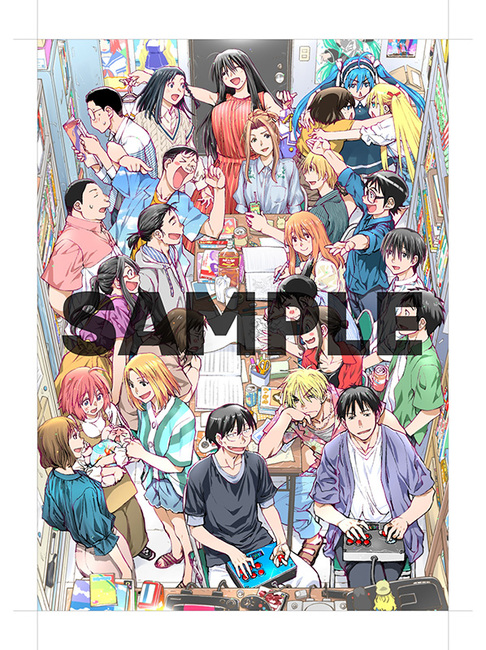
Kio is going to have an artbook! (I wonder if this is why he’s been posting high-quality images of his old art over the past year or so.) More details here.
He wondered when would be the right time to release the book, and reflects on the fact that it’s been 30 years since he started his manga career.
Kio has a color illustration job deadline coming up, so he’s been plugging away at it little by little. He thinks he can finish in time. That said, he has a lot of other work due the week after. It also means he can’t work on his ero manga.
Terry and Mai from Fatal Fury will be in Street Fighter 6. Kio is surprised at the news. One commenter says they’re looking forward to seeing Sue in SF in 15 years, to which Kio says maybe in 30.
It turns out this drawing from last month is for the cover to the artbook! It’s one of his characters from an older work (I think the Yonensei/Gonensei series?).
Kio bought all of the original Oblivion Battery manga out, only to find out that it doesn’t progress as quickly as the anime. Now, he wishes he stuck with just the anime.
There’s a Yasuhiko Yoshikazu and Koizumi Yuu exhibit titled “Modern Japan and Russia/Soviet.” Kio couldn’t go the previous day but has decided to check it out.
While waiting for a Pre-DLC Elden Ring update to download, Kio works on his ero manga and gets a page done. He’s also wondering how the hell he’s listening to an audio book of Buddha’s Teachings while working on said 18+ comic,
Otomo Katushiro is releasing an album called Akira Remix. The Otomo recent cel exhibition was playing music from it, and Kio remembers going to the exhibition and hearing the music the whole time.
Kio Shimoku, author of Genshiken, recently announced that he’s going to be releasing an artbook collecting his work from across his 30-year career! It will also include an interview with him.
The book is titled Kio Shimoku Gashuu: Mata Ashita, Bushitsu de—Kio Shimoku Art Collection: See You Tomorrow in the Clubroom. It’s being released by Fukkan, a Japanese publisher that specializes in niche specialty books and reviving out-of-print titles.
While the book is available for pre-order on other Japanese sites, pre-ordering on Fukkan’s site will get you a set of A4-sized replica illustrations of Kio’s work. And if you do it by July 16 (JST), then you can enter to win an autograph from the man himself!
Unfortunately, Fukkan will only ship domestically, so if you live outside of Japan, you’ll need to use a third party. Just keep in mind that with the pre-order bonus, shipping might be pretty killer!