Gattai Girls 14: “Sakura Wars” and Shinguji Sakura

Introduction: “Gattai Girls” is a series of posts dedicated to looking at giant robot anime featuring prominent female characters due to their relative rarity within that genre.

Here, “prominent” is primarily defined by two traits. First, the female character has to be either a main character (as opposed to a sidekick or support character), or she has to be in a role which distinguishes her. Second, the female character has to actually pilot a giant robot, preferably the main giant robot of the series she’s in.

For example, Aim for the Top! would qualify because of Noriko (main character, pilots the most important mecha of her show), while Vision of Escaflowne would not, because Hitomi does not engage in any combat despite being a main character, nor would Full Metal Panic! because the most prominent robot pilot, Melissa Mao, is not prominent enough.

— 
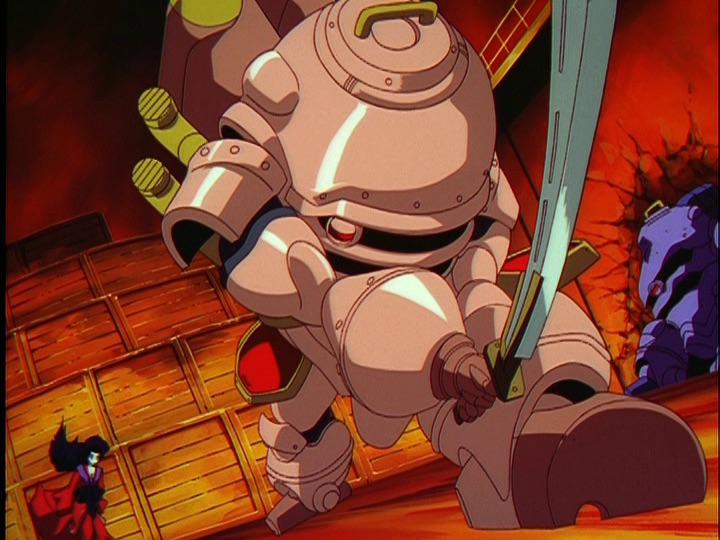
This is an unusual “Gattai Girls” entry. Sakura Wars is one of Sega’s most beloved video game franchises in Japan, and doing a review/analysis of it based on an animated TV adaptation will inevitably mean I can’t fully capture everything that makes the series what it is. Nevertheless, we have a solid example of an anime that fulfills the criteria of a mecha series with a centrally prominent female pilot, so here we are. As far as I know, the TV series follows much of the same plot, but there are some cases where major events (such as a certain heel turn) do not play out as they did in the game.

Sakura Wars takes place in an alternate Taisho-era mystical-steampunk Japan where people and technology thrive, but where horrible demonic forces also threaten the peace. The only people capable of fighting them on relatively even terms are the members of the Imperial Combat Revue: a group of girls who have the dual roles of being performers in musicals in the vein of the Takarazuka Revue and fighting as pilots of special spiritually powered mecha known as Kobu. 
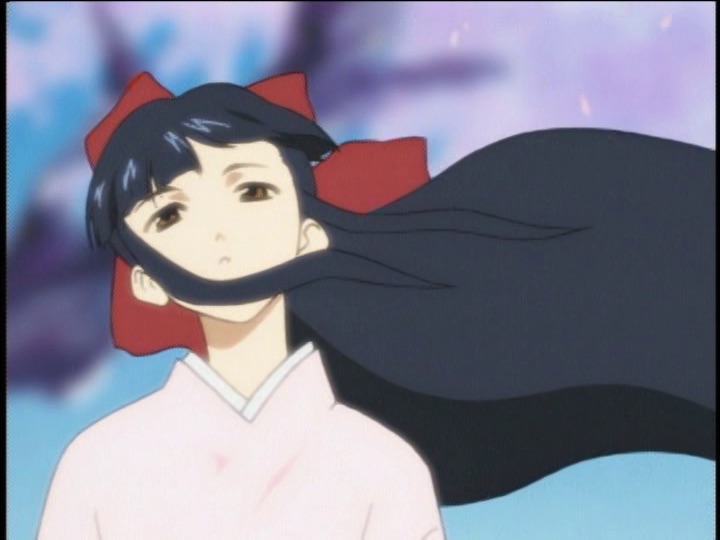
One of the points of appeal of Sakura Wars is that these girls are all interesting and memorable characters, but the face of the franchise is undoubtedly its namesake, Shinguji Sakura. To understand her general popularity, one need only look at Sega’s 60th anniversary popularity poll wherein Sakura got 3rd place behind only Sonic the Hedgehog and Opa-Opa from Fantasy Zone. What makes her so appealing is that she’s essentially the ultimate yamato-nadeshiko—the classical Japanese beauty—but without being a regressive character bound by conservatism.

(SIde note: While I acknowledge that the series is full of excellent female characters, the focus will be on Sakura as the main heroine).

When Sakura first arrives to join the Combat Revue in Tokyo, she’s like a fish out of water. Clad in a kimono, everything about her screams “traditional.” However, this is the Taisho era, a time of increasing embrace of certain Western values (such as marrying for romantic love). Much of Sakura’s growth over the series involves adapting to the cosmopolitan nature of her new environment and her teammates—allies who come from different parts of Japan and the world, and who hold different values—all the while still honing the swordsmanship and spiritual energy that has made her a recruit for the Combat Revue in the first place. 

I don’t often devote space to discussing the voices behind the characters in these “Gattai Girls” entries, but I have to make a special exception here because Yokoyama Chisa is simply exceptional. Her voice carries such a range of emotions, from strength to vulnerability, from joy to sorrow, sometimes all at the same time. She’s the main singer in the Sakura Wars opening for this anime (as well as many of the games), and it really does feel like Shinguji Sakura is bringing the song to life. 
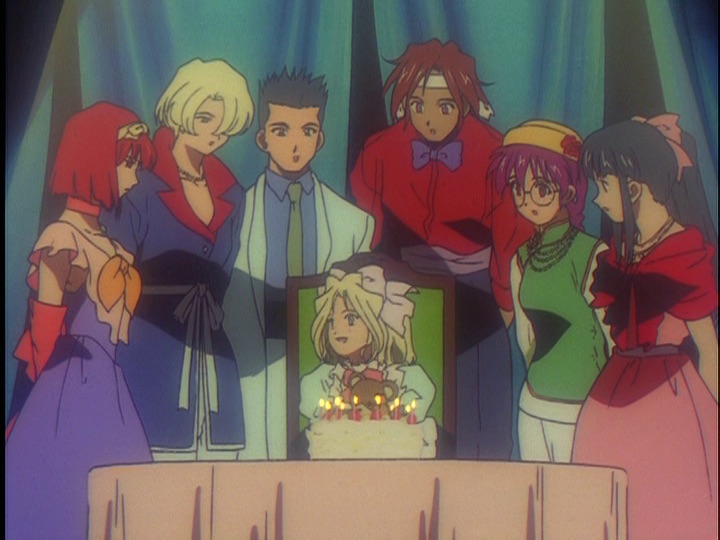
I understand that romance is actually a significant part of the Sakura Wars games, as the player usually takes the role of a male captain who’s in charge of the squad. In the case of the earliest games and related media, that would be Ogami Ichiro, and I believe Ogami and Sakura are the most popular pairing. However, romance isn’t really a huge factor in the anime, and much of the story is focused on Sakura and the others developing bonds that help them to grow as people and warriors, as well as unraveling the secrets of the demons that are plaguing Japan. In this regard, Sakura is shown to possess immense inner strength, focus, and courage, all of which end up translating to becoming a great Kobu pilot over time. 

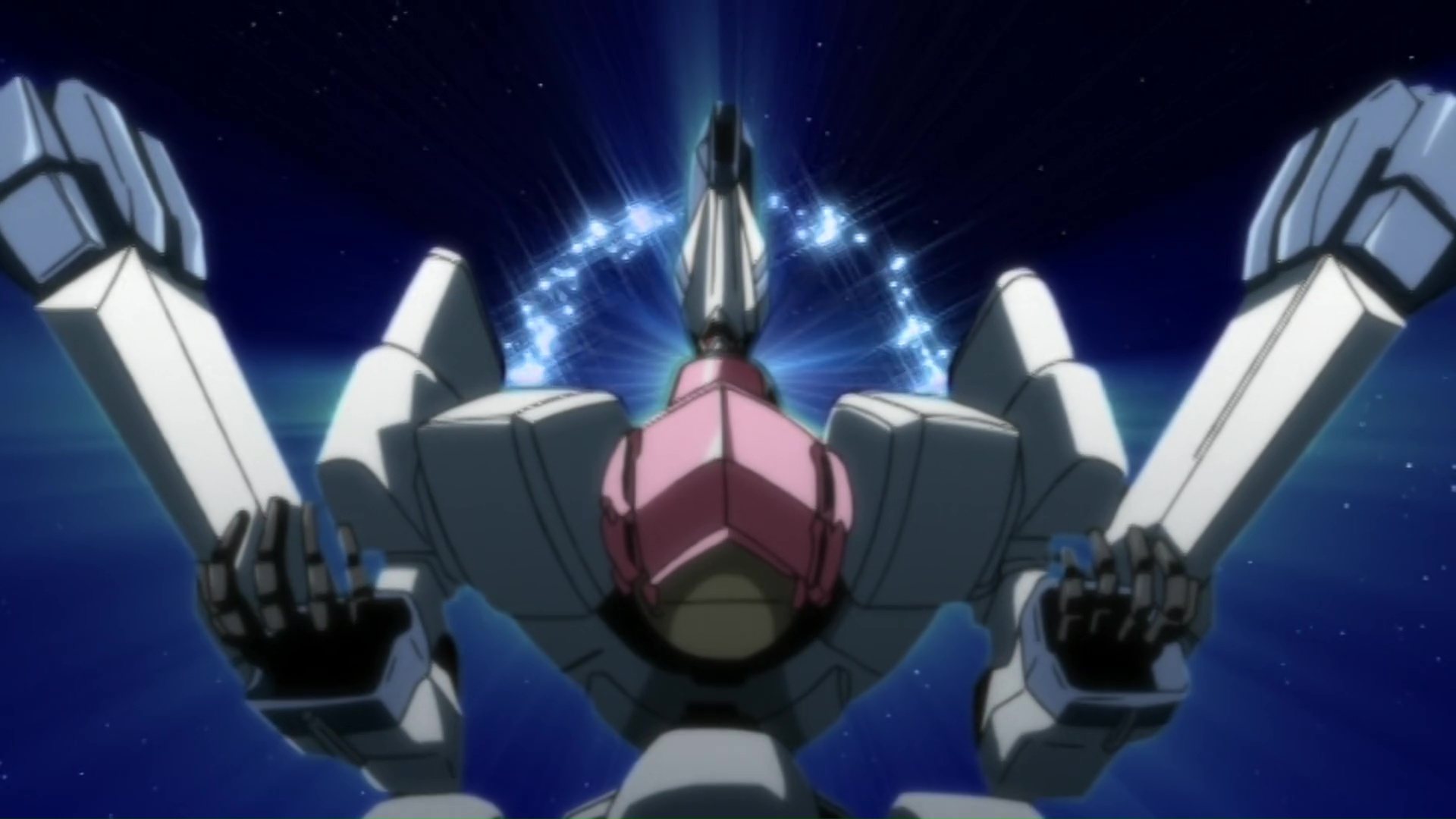
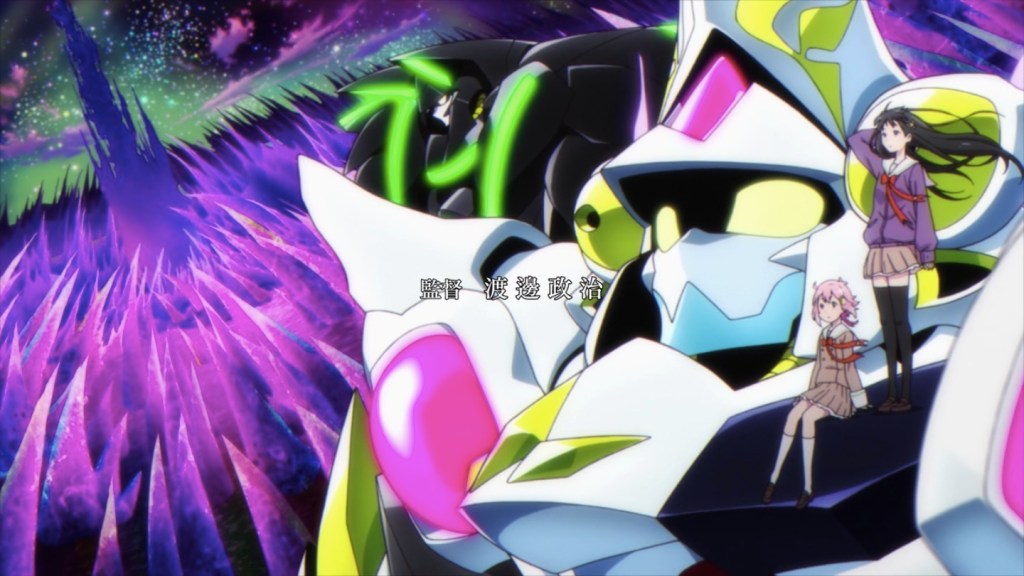
The Kobu themselves look fantastic, their round shapes and steam valves capturing the setting’s aesthetic better than anything else. They’re distinctive, and their unisex designs means that no specific attention is drawn to the Kobu being piloted primarily by girls. Every character fights in their mecha with weapons similar to what they’d use on foot, and Sakura’s is a single katana. The power, will, and resolve to defend the innocent is actually part of Sakura’s appeal as a yamato-nadeshiko, but this is again presented less as a facet of an ossified woman and more an anchor she can use for stability when she needs it.
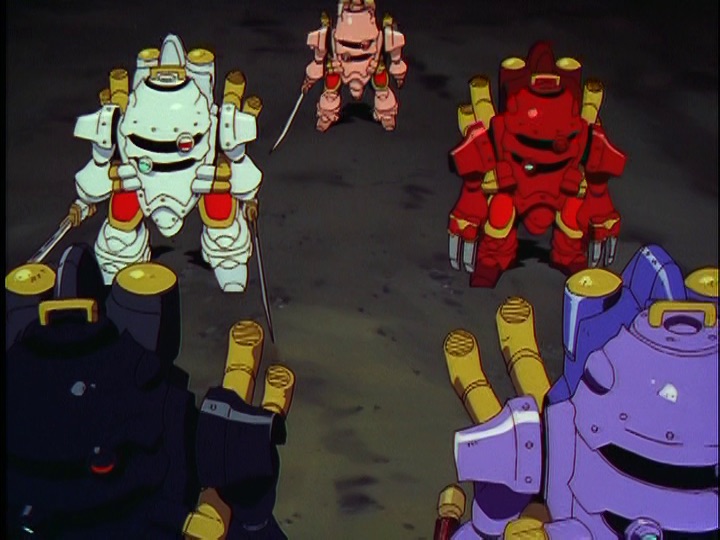
Shinguji Sakura is the kind of female protagonist who is often imitated but never duplicated. To be able to embody seemingly contradictory values of progress and tradition while truly betraying neither is a juggling act that can fall apart all too easily. She’s the surest sign that just because a character falls under a dominant archetype doesn’t mean they have to be boring or bland.
Gattai Girls 13: “Mobile Suit Gundam: The Witch from Mercury” and Suletta Mercury

Introduction: “Gattai Girls” is a series of posts dedicated to looking at giant robot anime featuring prominent female characters due to their relative rarity within that genre.

Here, “prominent” is primarily defined by two traits. First, the female character has to be either a main character (as opposed to a sidekick or support character), or she has to be in a role which distinguishes her. Second, the female character has to actually pilot a giant robot, preferrably the main giant robot of the series she’s in.

For example, Aim for the Top! would qualify because of Noriko (main character, pilots the most important mecha of her show), while Vision of Escaflowne would not, because Hitomi does not engage in any combat despite being a main character, nor would Full Metal Panic! because the most prominent robot pilot, Melissa Mao, is not prominent enough.

— 

I truly believe that Mobile Suit Gundam: The Witch from Mercury will go down as a pivotal work in anime history. There are the surface reasons, of course: It has the honor of being the first mainline Gundam anime to feature a female protagonist with a same-sex primary romantic interest. It’s also the first main Gundam to be only 24 episodes when even the next shortest series still got 39. But the core of why I think Witch from Mercury is a game changer is that it ncludes many elements unfamiliar or in defiance of Gundam that manage to tell a compelling and thought-provoking story that carries both idealism and realism in its narrative.

Witch from Mercury takes place in a world where Gundams are forbidden, even though they were originally based on research to help people with disabilities. Years after the banning of Gundams and the seeming purge of all involved, a shy and awkward girl named Suletta Mercury arrives at Asticassia Academy, a mobile suit school for the elite where student matters are officially resolved through giant-robot duels. Suletta wins a match in her Definitely-Not-a-Gundam, Aerial, ends up engaged to the daughter of the school’s owner, Miorine Rembran, and in doing so inadvertently steps into the complex corporate, social, and political forces at play.

The anime starts off reminiscent of both Revolutionary Girl Utena and G Gundam, but ends its first half throwing the relatively isolated nature of Asticassia into stark relief with the world at large, whether it’s the crushing disparity between Earthians and Spacians, the specter of war and how the parents of all the kids have a hand in perpetuating military conflict, or the realization that Suletta’s naivete isn’t merely an innocent quirk but points to an unusual and possibly even disturbing past.

The second half seems to calm down, only to ramp up even harder and throw the established order into further disarray. Things that other series might have left linger for 10 episodes are brought to bear in a fraction of the time. The anime can actually feel pretty rushed as a result, but in certain ways, I think this actually works out in its favor. Gundam series often meander and plod as they get into the latter 25-ish episodes as they try to incorporate extraneous characters and merch-friendly elements, whereas this one cuts out a lot of the fat, albeit with some of the flesh as well. The outcome of all this is a Gundam where I would get genuinely surprised and shocked, especially in terms of character deaths)—feelings that were often missing from my viewings of Gundam anime that have come out in the past 15 years.

The characters, especially the women, are memorable and one the best parts of Witch from Mercury. Suletta is a unique protagonist, both in comparison to her Gundam predecessors and in general due to the way she has to grapple with her own upbringing and the way she ends up establishing her own identity. She takes the viewers on a rollercoaster of a personal journey that makes her position as first heroine much more than a cynical decision for the sake of diversity. Similarly, Miorine’s aggressiveness makes for a great companion and foil, and the way she navigates her privilege and her desire to do more for humanity is wonderful. And Suletta’s mom Prospera is not only the best Char Aznable in ages, but shows the quiet fury of a woman who will do anything for her child.

As for minor characters, there are plenty of examples regardless of genders. Chuatury “Chuchu” Panlunch is refreshingly no-nonsense in a way rarely seen in anime. Guel Jeturk, a rival/potential love interest of Suletta, goes from annoying dude to endearing guy—something that actually happens more often than not with the cast. A number of characters are on the larger side but are not treated as jokes. And while Secelia Dote only has seven minutes of screen time across the entire series, her snarkiness manages to steal the show every time. I could keep going.

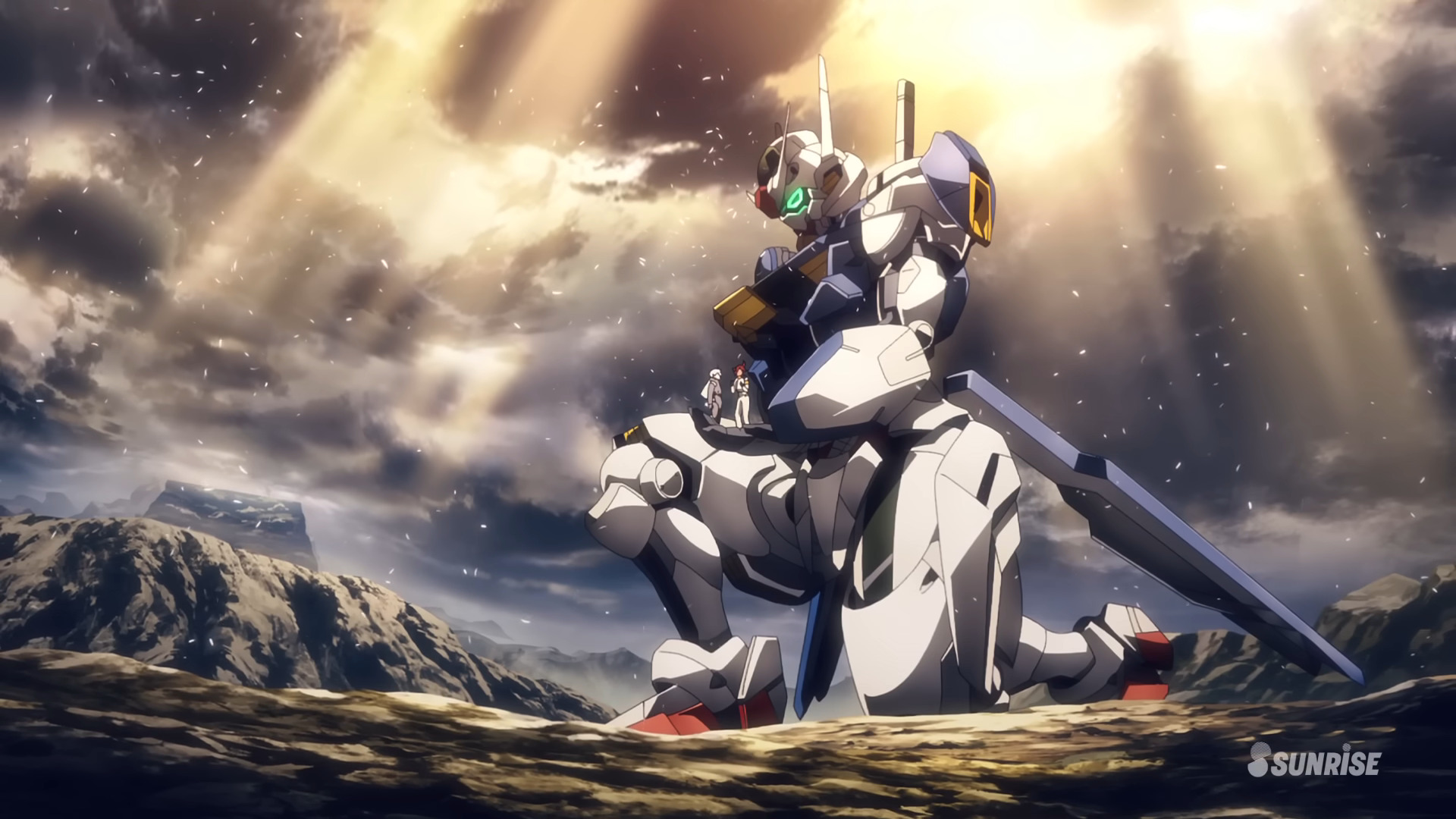
One of the more amazing things about Witch from Mercury is how well it strikes a balance between having ubiquitous mobile suits and incorporating them into the story and setting. They’re also very aesthetically pleasing, particularly the Aerial. It’s identifiably a Gundam, but its proportions and flourishes give a slight feminine feel without going straight into Nobel Gundam territory. I also enjoy the way it contrasts with other mecha, as it makes the Aerial come across more something that will disrupt the status quo. Moreover, Aerial is also a rare instance of a mobile suit basically being a character unto itself—something that has serious consequences as the series progresses.

A common criticism of Gundam as a whole is that while it generally contains anti-war messaging, the cool factor of the mobile suits can end up drowning it out. Although the designs in this particular series are indeed among the best ever, Witch from Mercury is also the first to establish that the technology did not begin as a military endeavor, and this helps throw the use of mobile suits as weapons into stark relief. It’s also part of a greater look at the inequalities and inequities suffered by those who lack the financial and familial might to make the world care—a world where even the children of those in power feel the burden of having to deal with their parents’ bullshit.

On that note, corporations play a major role in the series, and I’ve seen people get extremely confused with all the different alliances and factions. While I won’t say it’s simple to keep track of everything, one way to navigate that web is to understand that many adult decisions are the result of corporate greed, and trying to find positions to have the best profits with the least accountability. This is what makes Miorine’s ultimate decision all the more satisfying, as she throws that structure off kilter using the means available to her. Gundam series often feature politics because of how they take place on grander scales.

These two elements together help Witch from Mercury’s politics feel very contemporary and relevant to our times, instead of coming across as dated or tepid.

Witch from Mercury brings a new sense of what Gundam can be. It possesses many of the franchise’s well-worn tropes without being beholden to them. It breaks boundaries of all kinds, whether through its unique cast of characters, its central same-sex romance, or its perspectives on conflict and humanity. I truly feel that what we have is a turning point in Gundam and anime as a whole, and I’m hopeful it’ll be for the better. Suletta is the first main Gundam heroine, but she won’t be the last.

Yes My Dork: Ogiue Maniax Status Update for December 2022

I’m riding high off of three things: recent elections defied expectations, the VTubers of holoX have just been celebrating their one-year anniversaries, and it’s been 15 years of Ogiue Maniax! It’s hard to believe each one for somewhat different reasons, but I’m hoping I can carry this joyous monentum through this month and into the eventual new year.

Here are my Patreon subscribers for December 2022! Thank you to everyone.

General:

Ko Ransom

Diogo Prado

Alex

Dsy

Naledi Ramphele

Sue Hopkins fans:

Serxeid

Hato Kenjirou fans:

Elizabeth

Yajima Mirei fans:

Machi-Kurada

Blog highlights from November:

Hope and Chaos Take the Subway: Anime NYC 2022

My con report for this year’s Anime NYC. Note that it has a lot of coverage of Hololive.

I Started Reading the Saint Seiya Manga

And what a ride it is.

Non-Subpar Robot: Astroganger

I reviewed a lesser-known 1970s giant robot anime, now available via Discotek.

Kio Shimoku

If there’s anything to take away from this month’s tweets, it’s that Kio Shimoku loves Royal Space Force: The Wings of Honneamise.

Apartment 507

Looking at Akiba Maid War through the lens of 1999 Akihabara.

Closing

As with every year, I’m going to be rating the anime characters I think are the best of 2022. It is unbelievable how tough this year’s field is. I feel like the top candidates would have won in virtual every other year had they been eligible.

The Results Matter: Ogiue Maniax Status Update for November 2022

The new anime season is in full swing, but while I’m enjoying the hell out of so many things (like Gundam: The Witch from Mercury!), my mind is on the upcoming US midterm election. I plan on (sort of) following up with my thoughts on this subject in a few days but for now, I’m using this time to encourage citizens to vote however they can: in person on Election Day, by mail, by early voting, anything.

I’d also like to thank my Patreon subscribers for this month of November 2022.

General:

Ko Ransom

Diogo Prado

Alex

Dsy

Naledi Ramphele

Sue Hopkins fans:

Serxeid

Hato Kenjirou fans:

Elizabeth

Yajima Mirei fans:

Machi-Kurada

Blog highlights from October:

Gattai Girls 12: “Idolmaster Xenoglossia” and Amami Haruka

After like two years, Gattai Girls is back with a new entry!

Evangelion + Beavis & Butt-Head = Chainsaw Man

Call it an epiphany?

Rock-Troll Remake: “Mobile Suit Gundam: Cucuruz Doan’s Island”

My review of the nostalgic Gundam movie.

Kio Shimoku

A sparse month of comments, but his tortoise is feeling better!

Apartment 507

Thinking about VTuber Gawr Gura’s recent animated short relative to other bonus animations.

Closing

Congratulations to Brazil for making the right choice and not re-electing an authoritarian nationalist who cares more about his self-image than the wellbeing of the people (sounds familiar).

How about I make some Saint Seiya posts to celebrate?

Gattai Girls 12: “Idolmaster Xenoglossia” and Amami Haruka

Introduction: “Gattai Girls” is a series of posts dedicated to looking at giant robot anime featuring prominent female characters due to their relative rarity within that genre.

Here, “prominent” is primarily defined by two traits. First, the female character has to be either a main character (as opposed to a sidekick or support character), or she has to be in a role which distinguishes her. Second, the female character has to actually pilot a giant robot, preferrably the main giant robot of the series she’s in.

For example, Aim for the Top! would qualify because of Noriko (main character, pilots the most important mecha of her show), while Vision of Escaflowne would not, because Hitomi does not engage in any combat despite being a main character, nor would Full Metal Panic! because the most prominent robot pilot, Melissa Mao, is not prominent enough.

— 

At face value, Idolmaster: Xenoglossia is a perplexing title. Why in the world would the very first anime for The iDOLM@STER, a video game about managing Japanese idols, be a mecha series where the girls strive to save the Earth rather than give successful stage performances? When you get under the surface, though, it results in an even greater cognitive dissonance between the franchise’s origins as an idol sim franchise and this science fiction story ostensibly built on its foundation.

The confusion begins from the very basis of Xenoglossia. The premise is that high schooler Amami Haruka is unexpectedly recruited to potentially become one of the “Idolmasters,” pilots of world-defending robots called iDOLS. Outside of Xenoglossia, the name of the franchise refers to the player as an idol producer. That’s a simple enough change to accept given the story’s setting, but where the show throws the hardest curveballs is the portrayal of its characters.

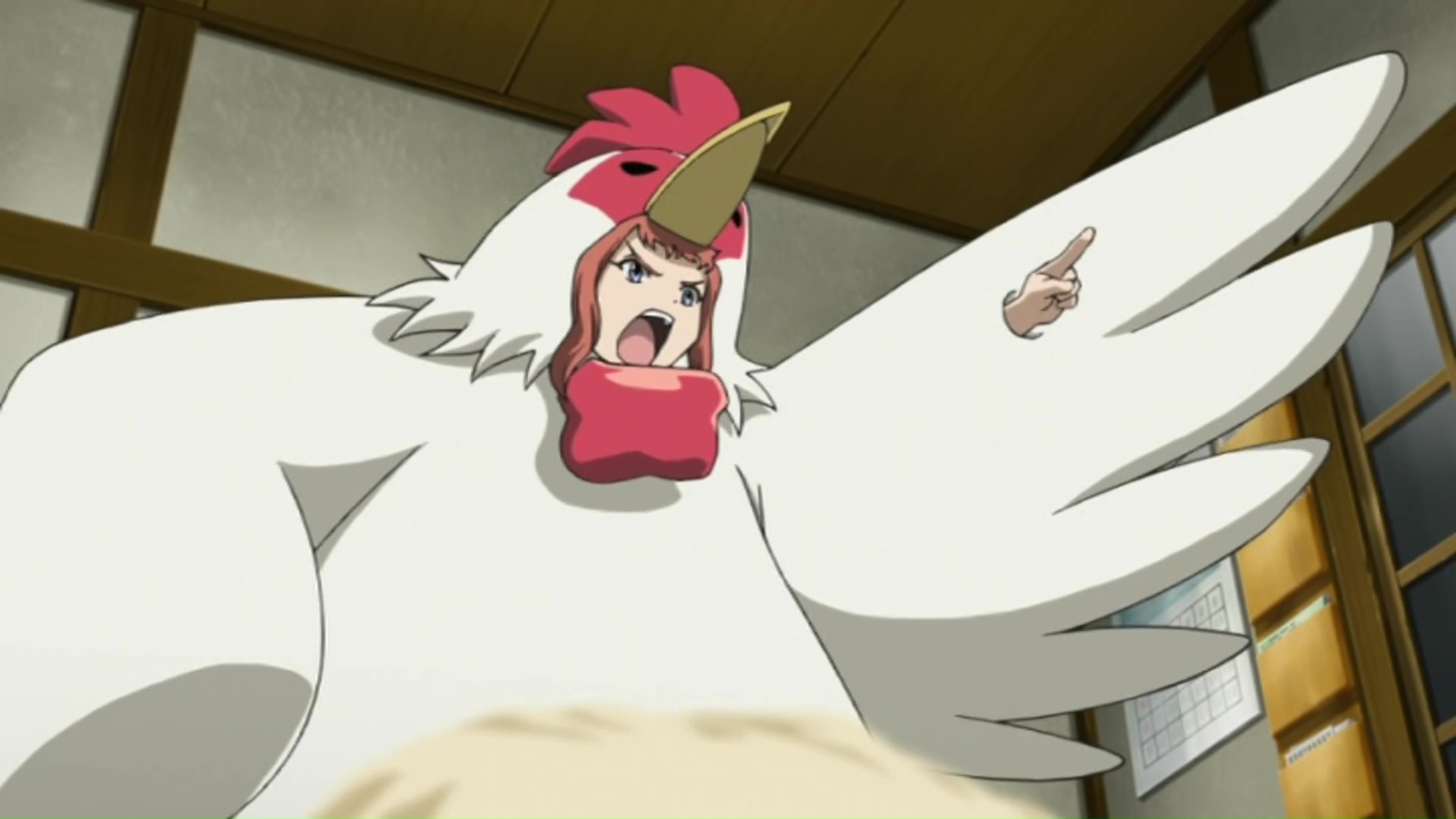
Despite this being a franchise where fans support the actors who play their favorite idols, the entire voice cast was changed for Xenoglossia. It’s an extremely odd decision in hindsight, but what makes it all the more strange is that the changes don’t stop there: age, size, personality, and more are drastically altered to the point that many characters become almost unrecognizable. The best example is the character of Takatsuki Yayoi. In The iDOLM@STER proper, she’s a small and energetic girl in her early teens known for her high-pitched voice and signature squeal of excitement. In Xenoglossia, she’s noticeably taller and bustier, is the only actual conventional idol in the show, loves to wear mascot outfits), and is much more antagonistic towards Minase Iori. 

I’m not a huge The iDOLM@STER fan, but I’ve watched the anime and have a decent idea of the core cast and their personalities. On some level, it’s impossible for me to fully divorce my preconceived notions, but this level of change is beyond rare. The closest example I can think of is the first Comic Party anime, where a high schooler got aged up and a middle schooler got aged down for seemingly no reason. It’s as if the creators of Xenoglossia just looked at some preliminary character sketches and just went their own way without regard for the source material. 

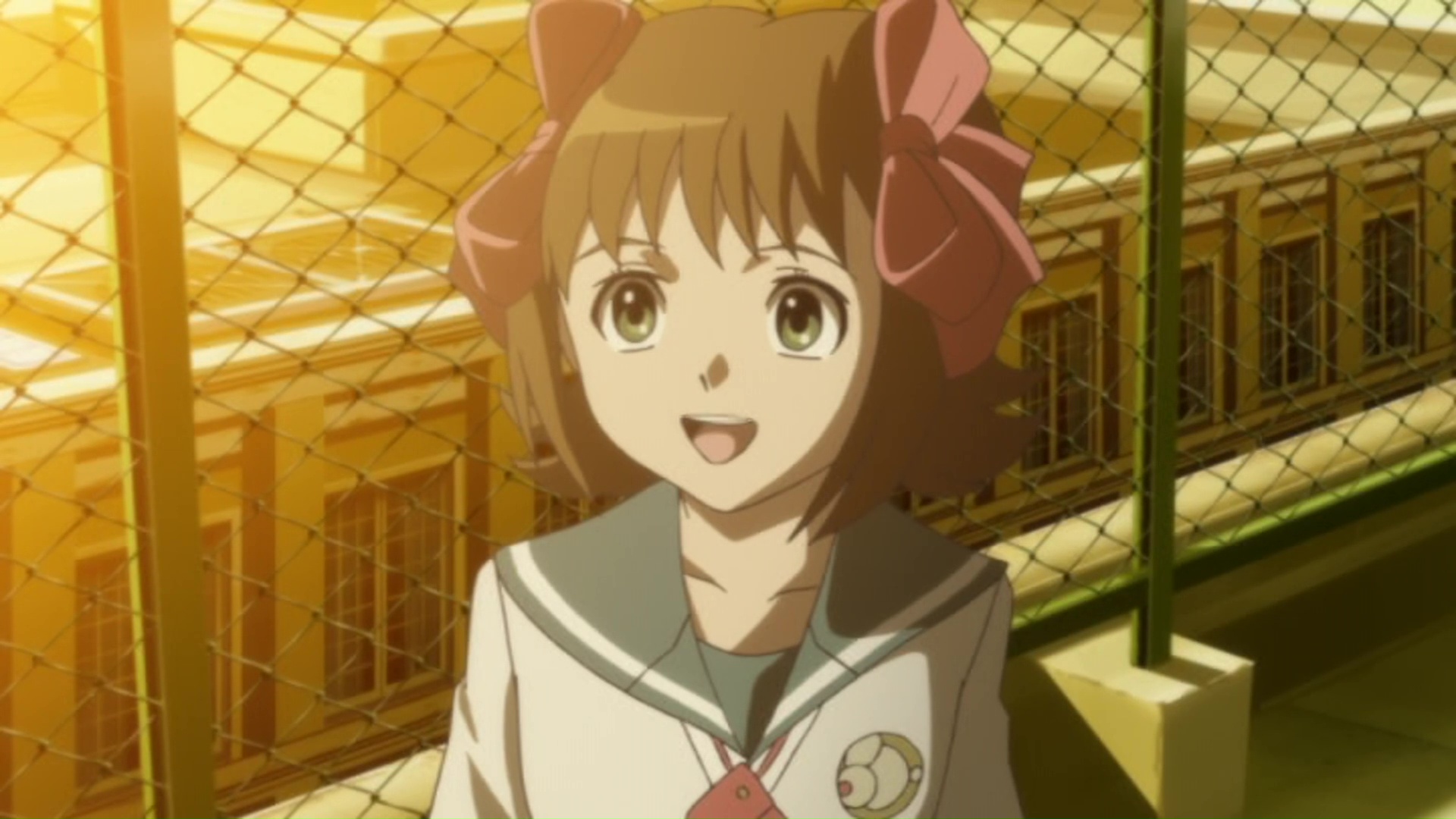
Funnily enough, the only character who’s mostly like her original self is the franchise’s flagship heroine and Xenoglossia protagonist, Amami Haruka. Her personality remains optimistic and hard-working, though tinged here with a bit of self-doubt as to what she’s capable of. But when she’s surrounded by an endless parade of bizarre doppelgangers, something always feels a little off. If one can ignore that to a degree, the show gets more enjoyable.

In terms of Haruka or any other character’s portrayal as giant robot pilots, they’re never upstaged by any male characters swooping in to save the day; in fact, there aren’t any male pilots at all. Different characters struggle with different aspects of being Idolmasters, and much of the plot is built around striving to overcome those challenges. There’s also a great deal more nudity and sexual behavior (including possibly incest?!) than would be expected of something based on The iDOLM@STER—which might be a dealbreaker for those who strongly believe in the whole “idol purity” concept, but still feels kind of odd for even those of us who don’t.

The relationship between the Idolmasters and their iDOLS also arguably runs counter to “idol purity” because the way they talk about the robots makes them seem on some level like giant mechanical boyfriends—especially the main iDOL, Imber. The robots are shown to be sentient on some level, and the way some characters work to become worthy of and accepted by the mecha while others treat them like companions comes across more like romantic fiction at times. The entire setup of Xenoglossia is conducive to this, showing itself to be the kind of anime where the requisite to becoming Idolmasters has angst-filled drama baked in.

Idolmaster Xenoglossia we got could never be made today. It came out at a time when The iDOLM@STER was a much smaller deal, as evidenced by the fact that the girls are all based on their designs from the first game rather than the revised versions from The iDOLM@STER 2 that have since been codified. This early on, Xenoglossia followed in the fine (?) tradition of titles like Lunar Legend Tsukihime, where it was assumed that a fledgling idol manager franchise needed a boost in star power and storytelling from the anime industry. Now, the shoe’s on the other foot, and if they were to attempt this again, it’d be all but inevitable that the characters would adhere much more closely to their original selves. It’s a historical curiosity, indeed.

Gattai Girls 11: “Granbelm” and Kohinata Mangetsu

Introduction: “Gattai Girls” is a series of posts dedicated to looking at giant robot anime featuring prominent female characters due to their relative rarity within that genre.

Here, “prominent” is primarily defined by two traits. First, the female character has to be either a main character (as opposed to a sidekick or support character), or she has to be in a role which distinguishes her. Second, the female character has to actually pilot a giant robot, preferrably the main giant robot of the series she’s in.

For example, Aim for the Top! would qualify because of Noriko (main character, pilots the most important mecha of her show), while Vision of Escaflowne would not, because Hitomi does not engage in any combat despite being a main character, nor would Full Metal Panic! because the most prominent robot pilot, Melissa Mao, is not prominent enough.

— 

Granbelm is a series that feels both modern and retro at the same time. The cute all-female cast is standard for current anime. Its premise, which pits these girls against each other in a Highlander-esque scenario to inherit the Earth’s magic, screams “early 2010s anime.” The story is straight-up early 2000s sekai-kei, a genre where the relationship between two characters determines the fate of the world. The mecha designs come straight out of a tradition of cutely proportioned robots from the late 1980s to early 1990s. Yet, while Granbelm isn’t shy about making its influences known, it’s also not ruled by them.

Female mecha protagonists are uncommon, which is why the lack of men in the series stands out all the more. That being said, this is not all that unusual, as there was an industry realization at some point in the industry that the total or near-total absence of male figures in anime could be a selling point to male and female audiences alike. In this sense, Granbelm follows in the footsteps of franchises like Love Live! and Puella Magi Madoka Magica, with the general mood of the show being more towards the darkness of the latter.

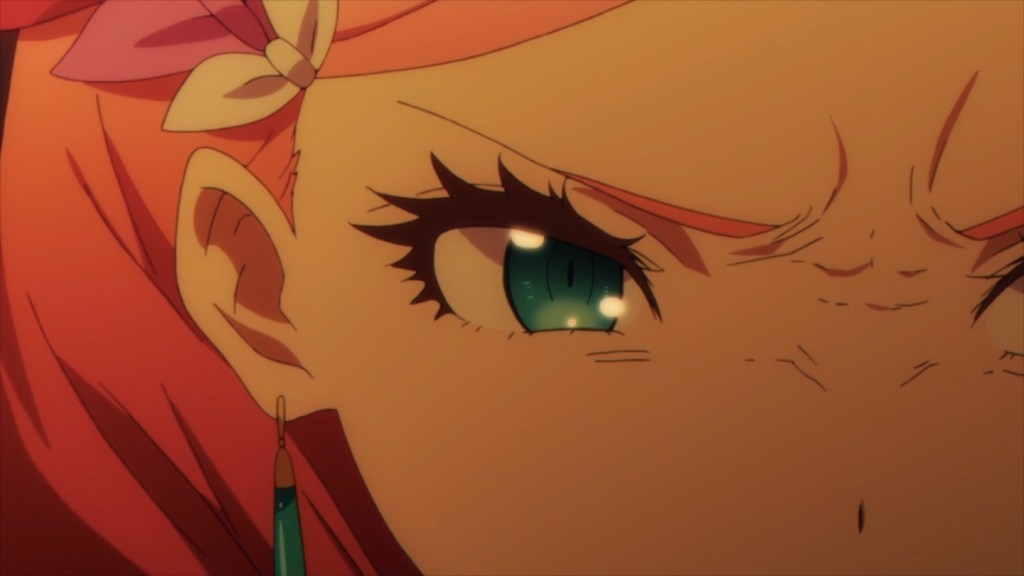
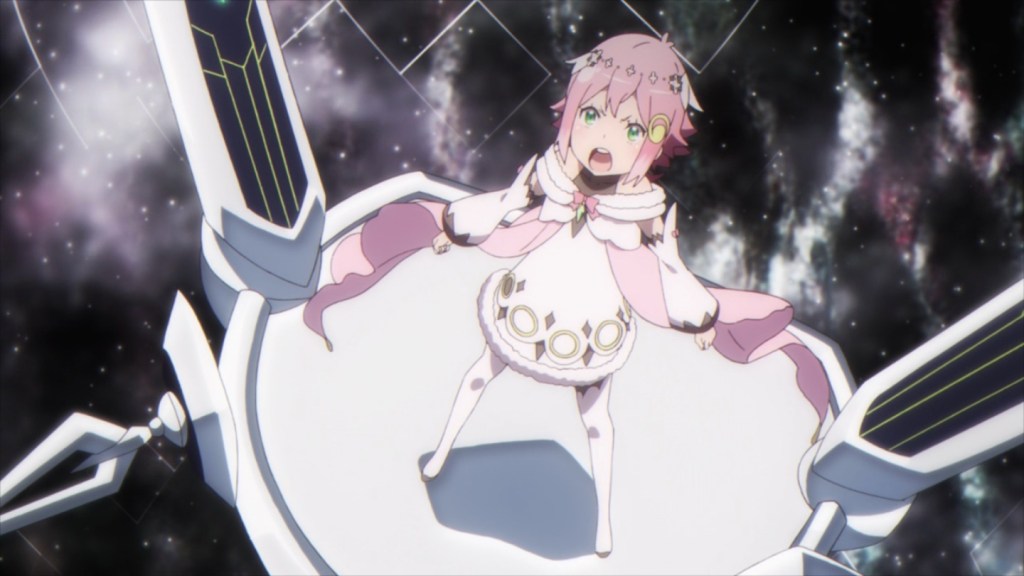
While having a predominantly female cast and thus passing the Bechdel test practically by default is by no means a mark of inherent feminism, these characters are varied in their personalities, motivations, strengths, and flaws in ways that emphasize their sheer presence on the screen. Whether it’s Anna (above) and her obsession with living up to her family reputation or Shingetsu and her guilt over her own power, the characters are convincing in their convictions. All the more impressive is the portrayal of the heroine, Kohinata Mangetsu (below). Although she comes across initially as a very generic protagonist, the series takes her naivete and exuberance and juxtaposes them against the others so as to highlight essential truths about her character in a manner most reminiscent of Selector Infected Wixoss

Moreover, it’s Mangetsu’s relationship with Shingetsu—their names meaning “full moon” and “new moon,” respectively—that is central to Granbelm. The way it plays out, similar yet profoundly different to Madoka and Homura’s in Madoka Magica, could only work with such strongly defined characters.

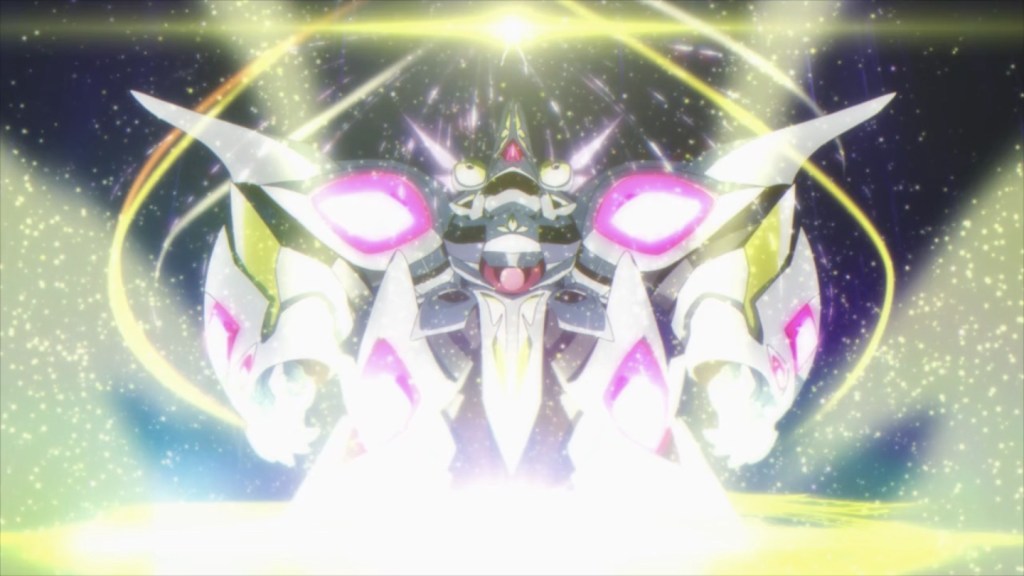
Given the general angle of Granbelm, the mecha might initially seem like an afterthought, but the series’s staff have worked hard to make them a vital part of the show in ways I appreciate a lot. Not only does the series wear its influences on its sleeve, with visual references to Gundam and even Space Runaway Ideon, but the way that characters argue with each other over heated personal and philosophical issues is right out of the playbook of Tomino Yoshiyuki, director of the original Mobile Suit Gundam and Ideon. Each robot—or “ARMANOX” in the anime’s parlance—reflects in form and function the personalities and fighting styles of each contestant. Whether it’s stealth, agility, or even emotional manipulation, you can sense through how they fight just what kinds of individuals they are. Mangetsu’s unit, White Lily, is fueled by her enthusiasm at the notion that she can be special in ways that elude her self-perception of mediocrity, and it comes across in the limit-shattering power and energy White Lily can generate.

Aesthetically, the ARMANOX draw from a very specific genre of giant robots: the chibi-fied robot tradition that began with SD Gundam and came into prominence in the 1980s to early 1990s anime thanks to titles like Mashin Hero Wataru, Mado King Granzort, and NG Knight & Lamune 40. Currently, the only modern anime that shares this look is the current 20th anniversary sequel to Wataru, which actively draws upon that visual nostalgia and carries a more straightforward good vs. evil story common to its original’s peers. The use of these mecha, with their squat and rounded appearances not only makes the visuals of Granbelm memorable against the backdrop of current anime, but also helps contribute to the cute yet foreboding feel of the anime as a whole. 

Granbelm takes cues from many anime trends over many decades, but it ends up synthesizing them all in an emotionally satisfying and thought-provoking manner. Vital to this success is the series’s portrayal of both its female characters and the giant robots they use to fight as reflections of each other and of the world they occupy. 

Gattai Girls 10: “Mobile Police Patlabor” OVA 1 and Izumi Noa [Anime Secret Santa]

Introduction: For the second year in a row, I’m combining my Reverse Thieves’ Anime Secret Santa entry with my Gattai Girls review series—posts dedicated to looking at giant robot anime featuring prominent female characters due to their relative rarity within that genre.

Here, “prominent” is primarily defined by two traits. First, the female character has to be either a main character (as opposed to a sidekick or support character), or she has to be in a role which distinguishes her. Second, the female character has to actually pilot a giant robot, preferably the main giant robot of the series she’s in.

The year is 1988, and the long-standing image of giant robots in anime fluctuates between either fantastic heroes and gritty, expansive science fiction. In this environment, one multimedia franchise decides to ask a simple yet potential-laden question: how does a society police its citizens in a world where mecha are commonplace?

In the near future of Patlabor, humanoid robots are commonly used in various industries, the police have also decided to incorporate mecha known as Patrol Labors into their forces. Patlabor follows Special Vehicles Unit 2, a ragtag bunch of eccentrics who solve Labor-related crimes. While there are multiple iterations of Patlabor, including anime, TV series, OVAs, and films (all of which apparently have branching continuities), this review will be focused on the first OVA series, titled simply Mobile Police Patlabor, but also known as Patlabor: The Early Days.

At first, Patlabor presents itself as a fairly low-stakes works, with its eclectic cast of officers and mechanics trying to deal as much with each other as the crimes they’re supposed to prevent. However, it gradually reveals concerns that are deeper and broader than first expected—provided you peel back the curtain a little bit. Over the course of the seven episodes of the first OVA series, those “Labor crimes” (not sure if pun intended) often speak to underlying social issues in Japan such as the struggle between pacifism and militarism that has affected the nation since World War II.

Such themes are the wheelhouse of the OVA’s director, Oshii Mamoru, and he gets even more philosophical about the intersection between technology and society in his Patlabor films. Here in the first OVA, though, Oshii doesn’t go nearly as hard on his pet topics, and the result is a comparatively much more straightforward story. The OVA is much more willing to be a police drama with some underlying political messages, and thus more approachable for those who might feel the films to be too overbearing.

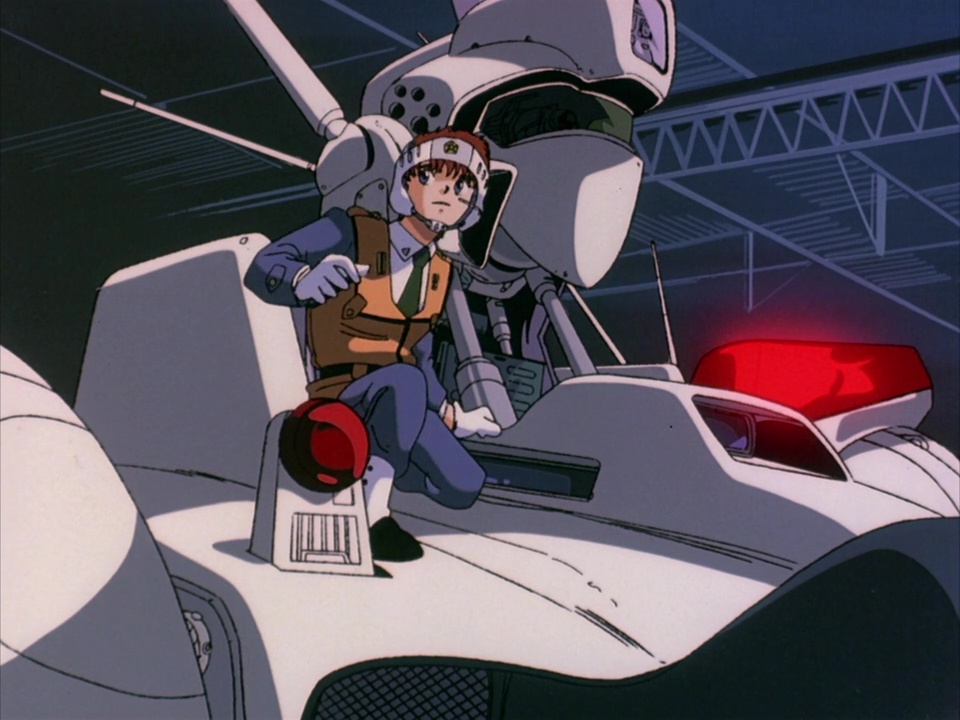
But it’s also impossible to shake the idea that Patlabor cares relatively little about what it presents on the surface, especially when it comes to the treatment of the ostensible protagonist, Izumi Noa. If one were to guess what Patlabor is about from just the opening alone, one would assume that Noa is the star of the show, as she relaxes with, takes care of, and fights in her beloved Patlabor, Alphonse. In fact, she’s the only character who appears in it at all! Yet, somehow, the clear poster child for Patlabor as a whole only ever has a semi-major part at best in any of the episodes.

It’s not as if Noa is portrayed as useless or incompetent or in need of big, strong man to rescue her, but her general character—tomboyish robot lover with a knack for piloting—seems to have the least connection to the series’s underlying focus on the intersection between politics and technology. In contrast, Shinohara Azuma is the son of the president of a Labor-manufacturing company, while Goto is the deceptively intelligent and wily chief whose past has him confront the militaristic elements of Japan. Even the other prominent female characters, Kanuka Clancy and Nagumo Shinobu, seem to get more screen time than Noa because they’re tied much more deeply with the police system. Ironically, the woman who was to be the heroine by virtue of her neutral and apolitical passion for mecha ends up feeling more like a side character.

Overall, Mobile Police Patlabor seems to embody much of the OVA spirit that permeated anime in the 80s and 90s by providing an opportunity for projects to go in unique and interesting directions. The result is a fascinating series, but also one that seems in conflict with itself at times.

Gattai Girls 9: Darling in the Franxx and Zero Two

Introduction: “Gattai Girls” is a series of posts dedicated to looking at giant robot anime featuring prominent female characters due to their relative rarity within that genre.

Here, “prominent” is primarily defined by two traits. First, the female character has to be either a main character (as opposed to a sidekick or support character), or she has to be in a role which distinguishes her. Second, the female character has to actually pilot a giant robot, preferrably the main giant robot of the series she’s in.

For example, Aim for the Top! would qualify because of Noriko (main character, pilots the most important mecha of her show), while Vision of Escaflowne would not, because Hitomi does not engage in any combat despite being a main character, nor would Full Metal Panic! because the most prominent robot pilot, Melissa Mao, is not prominent enough.

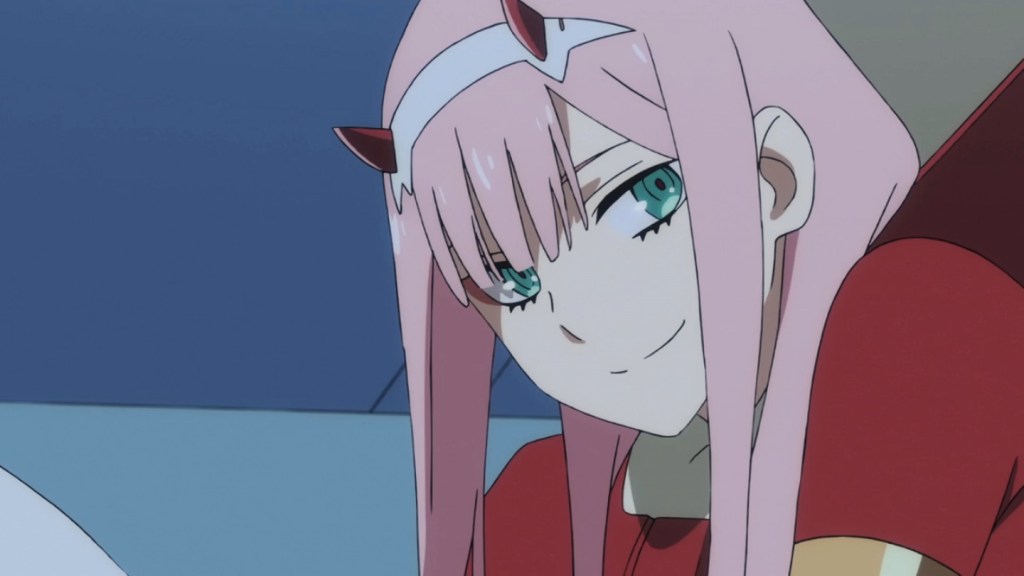
Darling in the Franxx is a mysteriously divisive anime, ripe for viewers of all stripes to interpret according to their personal values. Given a series whose messages appear to change depending on who you ask, it’s perhaps not so surprising that the main heroine of Darling in the Franxx, Zero Two, is just as much a whirlwind of contradictions.

Darling in the Franxx is a high-key sexually charged anime. If the doggy-style male-female combination cockpits weren’t enough, the series actively draws attention to the fact that the anime’s teen heroes live in a bizarre dystopia where their sexual energies are channeled into piloting giant mecha called Franxx. Covering subjects like love, sex, and marriage through both overt and relatively subtle metaphors, the anime is loved and hated in seemingly equal amounts in ways that contradict each other.

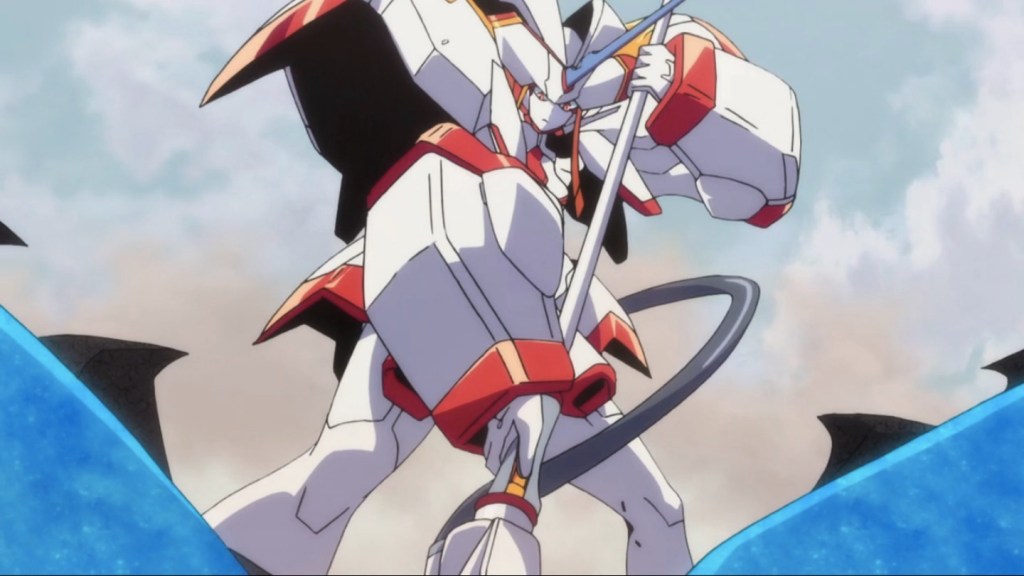
In Darling in the Franxx, Zero Two is the pilot of the robot Strelitzia. Far and away the most powerful weapon in humanity’s fight against the monstrous Klaxosaurs, Strelitzia would be their most reliable advantage if it didn’t come at a price: Any man who pilots with Zero Two inevitably ends up critically injured or dead. The protagonist, Hiro, ends up being the only guy who can survive Zero Two, and their combination becomes the key to turning the tide of battle. However, their connection ends up going back much further than either realize.

Is Zero Two an inspiring firebrand who lives by her own rules, or is she a fetishized sex object whose mere presence fulfills men’s fantasies? Is she an ideal girlfriend or a femme fatale? The answer is “yes.” She’s all these things and more, despite Zero Two being a difficult character to project one’s assumptions onto. She doesn’t have the appearance of an emotionless doll like an Ayanami Rei (Evangelion) or the “dishonest,” tsundere-esque feelings of a Souryuu/Shikinami Asuka Langley (Evangelion). She’s not an Asuna (Sword Art Online) either, whose kindness and strength make her practically “good wife, wise mother” personified.

Zero Two is rebellious towards rules and authority, loyal to those she loves, and willing to do whatever it takes to achieve her goals. She can’t be pegged down or held back, and the only times she’s willing to show weakness are around people whom she truly trusts. She’s more than willing to take matters into her own hands, and even rescues Hiro from being taken over by the enemy. Zero Two herself has never been damseled herself, and the only time Hiro had to reach out to bring her back was more in the metaphorical sense—diving deep into her mind and their shared past to keep Zero Two from going berserk.

Strelitzia itself is a fascinating piece of the puzzle that is Zero Two. The main mecha of Darling in the Franxx are feminine-looking, which goes against the tradition of primarily masculine designs. Those with a more feminine appearance tend to have attacks that draw attention to their “womanly” aesthetic as well, like how Aphrodite A in Mazinger Z shoots “Breast Missiles.” The Franxx are, aside from cute faces and a general feminine silhouette, not as overtly sexual on the outside. That being said, the workings of the cockpit mentioned above make it impossible to ignore sexual connotations, especially because the female pilots “become” their Franxx. Like the others, Zero Two’s facial expressions become Strelitzia’s, and when she talks to Hiro in fights, her display shows that robotic appearance instead of her own. Eventually, this integration of girl and machine gets taken further, driving home the theme of love in a way that both reinforces and defies the conventional cockpit setup.

Zero Two is strong and weak, cruel and compassionate, loving and spiteful. She’s a complete character in a certain sense, and a caricature in another. She is as much of what you want of her as you want, which means that on some level, she reflects the desires and/or anxieties of the viewer and their relationship with the world.

Gattai Girls 8: “Shingu: Secret of the Stellar Wars” and Moriyama Nayuta [Anime Secret Santa]

Introduction: The above title might seem like a confusing mess. The reason is that this post originally began as my annual review for the Reverse Thieves’ Anime Secret Santa, only for me to realize it also qualified for my ongoing Gattai Girls review series—posts dedicated to looking at giant robot anime featuring prominent female characters due to their relative rarity within that genre. So it’s a double special!

Here, “prominent” is primarily defined by two traits. First, the female character has to be either a main character (as opposed to a sidekick or support character), or she has to be in a role which distinguishes her. Second, the female character has to actually pilot a giant robot, preferably the main giant robot of the series she’s in.

 Overview

In the year 2070, middle school student and small-town resident Murata Hajime witnesses an extraterrestrial attack. To his surprise, Hajime’s neighbors in his town of Tenmo barely flinch, not even when a mysterious floating titan appears to stop the invader. It’s the beginning of a new life for Hajime, especially when he gets to know two of his classmates tied closely to the secrets of Tenmo: new transfer student Subaru Muryou and student vice-president Moriyama Nayuta.

2001’s Shingu: Secret of the Stellar Wars is an eclectic series. Also known as Gakuen Senki Muryou (“Record of School Wars Muryou”), Shingu combines science fiction mystery, small-town suspense, and everyday school life in a way that makes its continued enigmas consistently satisfying, even when it withholds answers. While the teasing of revelations and the subsequent disappointment of their reveals can often tank even the mightiest of works, Shingu always says just enough and encourages the use of imagination to fill in the blanks without feeling like a cop-out.

The deftness by which Shingu lays out it mysteries can be seen in one of the first scenes, when Muryou shows up for his first day of class in a school uniform. While this seems perfectly normal, it turns out that school uniforms haven’t been a thing for decades. Immediately, Muryou is shown to be unusual by placing him in an environment where what we perceive to be typical, i.e. school uniforms, simply isn’t. It’s an effect also used in the manga Coppelion to convey the uncanny quality of its main characters. The only explanation given is that Muryou got the uniform from his grandfather as a way to blend in, which puts Muryou potentially out of time, or at least sheltered from the world.

Moriyama Nayuta

It’s actually difficult to pin down a true “main character” for the series. Based on the English title, it sounds like Nayuta is the central protagonist, due to the fact that she can transform into the titular Shingu. However, the Japanese title centers on Muryou, who is a major catalyst in the narrative. And while Hajime can come across as a generic audience stand-in, his seeming blandness actually plays an important role in the series, as his ability to go with the flow and keep and open mind are key to humanity’s development. Because this is a Gattai Girls entry, I’m going to focus more on Nayuta and how her role as the Shingu works in the anime.

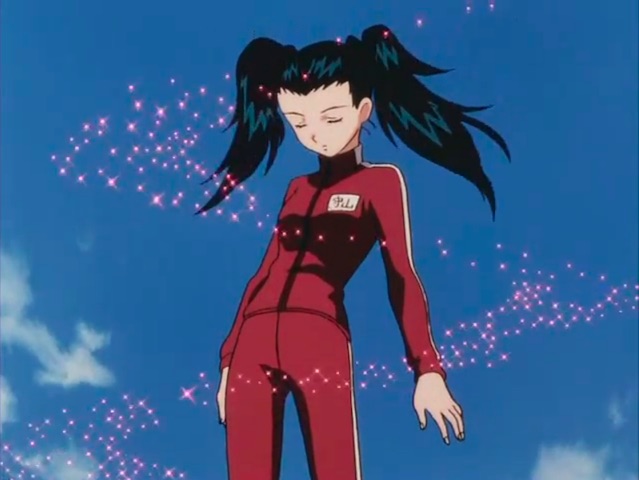
Nayuta feels cut from the same tsundere cloth as Evangelion‘s Asuka, especially when contrasting her with another female character, the taciturn Mineo. Nayuta has a not-so-secret crush on Hajime and sports the signature hairstyle of the tsundere, the twintails, but she’s not solely defined by those traits. Bullheaded, hardworking, and always eager to do the right thing, Nayuta’s closer in kindred spirit to Sonoda Umi from Love Live!, at least if Umi had the ability to transform into an alien behemoth.

Incidentally, Nayuta is not voiced by the tsundere master, Kugimiya Rie. Instead, Kugimiya plays a different character, Hajime’s adorable little sister Futaba, with Nayuta being played by Park Romi. Shingu is one of many series where Park and Kugimiya work together, perhaps most famously Full Metal Alchemist.

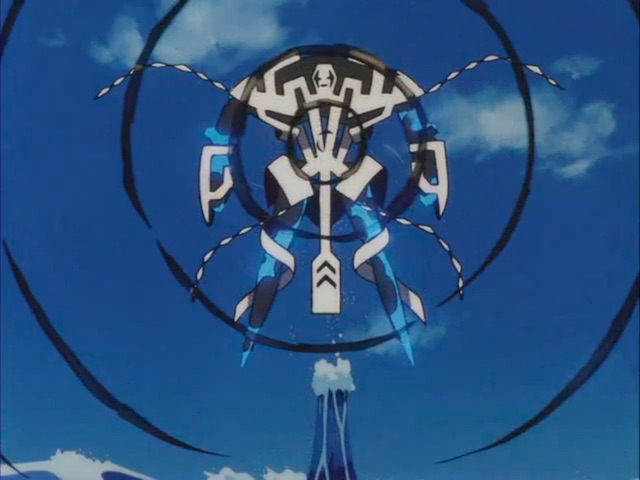
The fact that each of the trio fulfills a very different role, with Hajime and Muryou generally providing support for Nayuta, also means that she is rarely ever overshadowed in battle. As for the Shingu itself, it’s is an unusual design—a hollow vessel resembling paper that is then “filled out” by taking control of a nearby energy source or element such as water. It feels more reminiscent of the monsters found in series like Evangelion and RahXephon, with a dash of Ultraman thrown in. Aesthetically, the Shingu comes across as a combination of the alien other and beings from Japanese folklore, like a science fictional shikigami or tsukumogami.

Overall

Director Satou Tatsuo is more well-known for the series Martian Successor Nadesico, and much of the humor and interaction there can be found in Shingu. However, its mix of SF and the everyday also results in something that feels like the anti-Evangelion. Both Shingu and Eva focus on a trio of middle school students who have varying access to special abilities and must fend off unknown alien-like attackers. Both can arguably fall into the sekai-kei genre—stories where the personal struggles of the individual manifest into global consequences and where often the fate of the world is tied to the relationship between a boy and a girl. But Shingu is also more than just “boys and girls”; it’s about community and history, and the ability for humanity to learn and grow. Shingu: Secret of the Stellar Wars nonchalantly moves from one unexpected place to another, varying in scale from local to cosmic, and believing in people along the way.

Gattai Girls 7: Shinkon Gattai Godannar and Aoi Anna

Introduction: “Gattai Girls” is a series of posts dedicated to looking at giant robot anime featuring prominent female characters due to their relative rarity within that genre.

Here, “prominent” is primarily defined by two traits. First, the female character has to be either a main character (as opposed to a sidekick or support character), or she has to be in a role which distinguishes her. Second, the female character has to actually pilot a giant robot, preferrably the main giant robot of the series she’s in.

For example, Aim for the Top! would qualify because of Noriko (main character, pilots the most important mecha of her show), while Vision of Escaflowne would not, because Hitomi does not engage in any combat despite being a main character, nor would Full Metal Panic! because the most prominent robot pilot, Melissa Mao, is not prominent enough.


This Gattai Girls entry is a bit unusual because I’ve already posted a review of the series before. Moreover, with a series like Godannar, I’ve already written extensively about the the portrayal of female characters because it’s all but unavoidable. If the prevalent fanservice wasn’t enough, there’s the fact that over half of the cast is women. While I’ll inevitably retread some old territory, this time around I’m going to focus more heavily on the main heroine of the story, Aoi Anna.

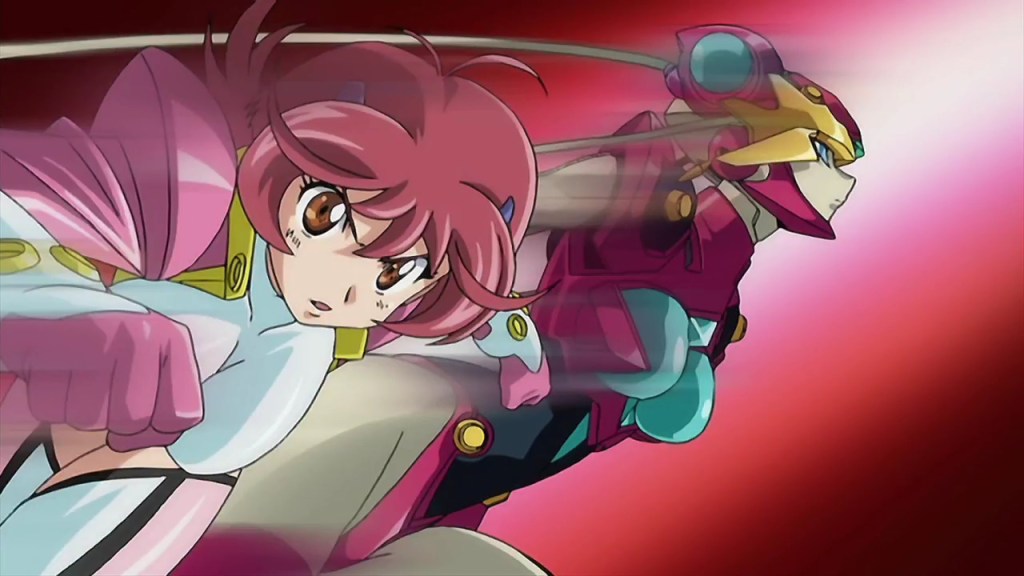
Godannar follows 17-year-old Aoi Anna, who’s engaged to burly, veteran robot pilot Saruwatari Gou in a May-December romance. Years ago, he rescued her from a monster attack, and eventually their feelings blossomed into love. But while she’s no slouch herself when it comes to mecha—she’s a prodigy who’s dreamed of fighting in a robot since childhood—Gou forbids her from becoming a full-fledged defender of the Earth. The reason? That’s how he lost his previous lover and trusty co-pilot. Still, Anna and Gou are humanity’s greatest weapons, as their robots combine into the mighty robot, Godannar Twin Drive, the “marriage of god and soul.”

From a characterization and narrative perspective, Anna’s story stands out in a way capable of overshadowing even the infamous double decker cheesecake of Godannar. Romance traditionally takes a backseat in many giant robot series, and when it does show up, such as in Macross, the two sides are often from different worlds, either metaphorically or literally. In Godannar, however, not only are Anna and Gou equal partners, but they have to work together as a team both personally and professionally. The cockpit becomes a second home of sorts, as they iron out their differences and fight the enemy. The series literally has relationship plot and mecha action resolve simultaneously, as if the two sides are permanently fused together, and it’s glorious. In a way, this is the story about the power of love, but it’s less “love defeats everything automatically” and more “love opens them up to resolve problems they couldn’t otherwise.”

In a certain sense, this heavy emphasis on relationships plays into the stereotype of girls only caring about guys, and one might even feel that Anna’s character is directly tied to her connection with Gou. While I think there’s some truth to that, I also find that Godannar‘s direct focus on its main couple (as well as many other couples throughout the series) is a big part of its, and by extension Anna’s, appeal. It’s basically a story about newlyweds who are also co-workers, and having to navigate that tricky interpersonal landscape. Through it all, Anna’s inner strength stands out. When Gou first tells her to stop piloting for her own sake, her response is that they have a duty to take care of each other as husband and wife. At one point, she feels herself unable to fight as Gou’s equal, but is able to find the motivation within herself to not back down in the end. By the end, due to unfortunate circumstances, she’s actually the one having to do the lion’s share of the work, to make up for what Gou can no longer do. Her strength, perseverance, and caring make her one of my favorite characters ever.

I’ve already made mention of it a couple of times, but when it comes to how women are depicted in Godannar, the series heavily sexualizes on a level where few others can compare. To say otherwise would be disingenuous. When the girls, including Anna, are piloting their robots, they’re in ultra-form-fitting suits that leave less than nothing to the imagination. During combat, their breasts jiggle to and fro as if made from some alien substance. Even when they’re in regular clothing, the fabric hugs every curve as if holding on for dear life. The camera angles can also be extremely voyeuristic. Even if I wanted to say, “You should really just ignore all this,” that’s pretty much impossible whether you’re into heavy fanservice or not. There’s an incredibly good series with some strong, well-written characters both male and female there, but it requires either an acceptance or tolerance of just a non-stop barrage of sexual imagery.

One last aspect of the series I want to talk about is the interesting way it addresses the topic of gender roles. In the second season of Godannar, the enemy monsters begin to utilize a different tactic. Instead of just trying to out-muscle Earth’s giant robot forces, they also evolve to spread a virus that specifically targets hot-blooded, macho men—the very people who are supposed to excel at being mecha pilots. As the men become increasingly unable to fight, the women, led by Anna, have to take a stand. On the one hand, this plays into the idea that men are supposed to be strong and tough (though it should be noted that a more masculine girl gets hit by the disease while a more effeminate playboy guy does not). On the other, it brings up the notion that hyper-masculinity can become a weakness to be exploited.

Godannar is a contradictory anime. Its unrestrained sexualization of the female body makes it seem like a series all about pure objectification of women, but at the same time its female characters, notably its main heroine Anna, are fully realized characters who have goals and dreams and a desire to stand on their own feet. They’re fleshed out as human beings, but also practically the embodiment of “temptation of the flesh.” But if marriage is a union of separate yet compatible beings, then Godannar is an unlikely marriage of disparate elements that somehow, some way, work to make something beautiful.