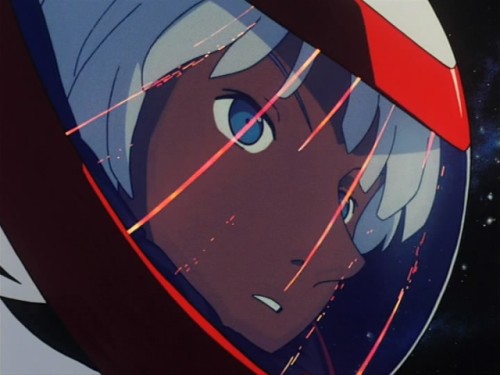
My First Exposure to 70s Robots

I can still remember my first exposure to pre-Gundam giant robot anime. I had a VHS fansub which at the very end had a number of retro openings on it, a preview of what was to come from that fansub group. That’s where I was first introduced to Zambot 3, which I thought looked pretty cool, and where I first got a glimpse of the 80s’ Aura Battler Dunbine, whose catchy theme song sticks with me even today. At the same time, though, I remember distinctly thinking that Koutetsu Jeeg looked like the dumbest thing ever.  I still think Jeeg is an ugly robot with its pickle legs, but it was more the overall style, fashion, choice of song, everything, that made it seem so foreign to me as an anime fan. I loved robots then as I do now, but obviously I needed some education, and I’m glad that I now know better.

I think what really sticks out in my mind in that video was the second Mazinger Z opening, mainly because of the way that Mazinger Z itself was shaded. It didn’t have the standard shine+shade of later giant robot anime, and instead had these large areas of pencil (or something like it) blocked in. When you watch the opening, you can literally see the grit of the drawing materials right there on the limbs and stomach. I hated it then, thought it made the show look old and tacky, but looking back, the way it stuck in my mind is part of why I started being able to look well past the aesthetics of 90s anime I had become so accustomed to, and to eventually realize how much the time that we’re in influences the look of everything around us, including the entertainment we watch.

The Eggshell of Gundam Fandom

Ever since Mobile Fighter G Gundam, various anime in the franchise have been accused of not really being Gundam, or for betraying the idea of Gundam in some capacity. Whether that’s robots powered by martial arts, a preponderance of pretty boys, or the presence of a mustache and biplanes, it’s clear that, at least to some, there is a vague idea of what Gundam shouldn’t be, but what I find interesting is that over time these prejudices seem to fade or in some cases even become something of a minority. Where once in the English-speaking fandom G Gundam was seen as a freak accident at best, nowadays you’ll find plenty of people who actually will say that G Gundam is their favorite Gundam, or even that G Gundam is the only good Gundam.

I am not here to judge anyone’s tastes or preferences, but rather I would like to wonder aloud about how and why this happens. In the case ofGundam W and G Gundam, the answer partly lies in the way they were situated in the Toonami block of the early to mid 2000s and were able to build up a fanbase as a result, but I feel like that is just one instance of a more basic process at work.

Whenever opinions form about a current or upcoming Gundam, it seems to come primarily from those most invested and devoted to Gundam. This group consistently has Gundam-ness as a priority, and so the initial discussion is shaped by that established fandom and their values. What I’m thinking is that over time, a series has a greater chance of reaching more people, and eventually they’re found by people who won’t necessarily label themselves as Gundam fans, whose value sets are different. At that point, a series may reach an audience more receptive to its ideas or less prejudiced against it (though they may carry their own prejudices different from the ones of more hardcore Gundam fans).

Essentially, what I’m wondering about is whether or not Gundam series (and perhaps other franchises like Macross) undergo a process where they first start off surrounded by their immediate fandom created by the franchise, and then break through that established core, such that the discussion about these series starts to change, that it’s not simply “a matter of time” but also a matter of reaching people who might be more receptive to it. That might not mean that a series will be loved, but that there is a greater chance of it happening.

Gattai Girls 2: Shishunki Bishoujo Gattai Robo Z-Mind and Ayame

Introduction: “Gattai Girls” is a series of posts dedicated to looking at giant robot anime featuring prominent female characters due to their relative rarity within that genre.

Here, “prominent” is primarily defined by two traits. First, the female character has to be either a main character (as opposed to a sidekick or support character), or she has to be in a role which distinguishes her. Second, the female character has to actually pilot a giant robot, preferrably the main giant robot of the series she’s in.

For example, Aim for the Top! would qualify because of Noriko (main character, pilots the most important mecha of her show), while Vision of Escaflowne would not, because Hitomi does not engage in any combat despite being a main character, nor would Full Metal Panic! because the most prominent robot pilot, Melissa Mao, is not prominent enough.

When you look at the full title of the 1990s OVA Shishunki Bishoujo Gattai Robo Z-Mind: The Battling Days of the “Shitamachi” Virgins, which is a mouthful to say the least, you get a pretty good indication of what’s in store for the 6-episode OVA. Shishunki Bishoujo Gattai Robo” literally means “Beautiful Girls in Puberty Combining Robot,” so in other words, expect pretty teenage girls piloting a big beefy robot, that peanut butter-and-chocolate combination which is at this point something of a staple in anime. And if it isn’t clear that this OVA is targeting robot fans, then note that 1) the vast majority of the robot attacks reference other anime (“Z-Boomerang” and “Z-Tomahawk” for instance), and 2) they even managed to insert a small Reideen cameo of sorts, as shown below.

Z-Mind centers around three Japanese sisters, Ayame, Renge, and Sumire, who pilot a giant robot named Z-Mind created through collaboration between the Japanese and American militaries. Together, they fight the Orgapiens, aliens with advanced technology who all look like creepy oversized babies. As the main heroine and leader, Ayame differentiates herself from her younger sisters by having a yamato nadeshiko-esque quality to her in contrast to her sisters’ more Western looks and fashion sense, making Ayame a character somewhere in the vein of Shinguuji Sakura from Sakura Wars.

The girls all exhibit strength and courage, and are also responsible for beating back the monsters at the end of the day, but the overall flat characterization in the series means that there isn’t much to discuss about them, other than that the desire to make Ayame more of a traditional beauty than her feistier sisters may say something about the kind of face the series wanted. Ayame is pretty inoffensive in any direction, but she suffers from the same lack of depth as the anime she’s in. Even Ayame’s love interest, a mysterious man from the future in a stylish red jacket named Kouji, is just kind of there until their relationship decides to grow abruptly, so it’s hard to say how much it affects her character.

When I finished each episode of Z-Mind, I would find myself regarding it as decent, but when I asked myself if I wanted to keep watching immediately after, the answer was definitely “no.” While this may have something to do with the fact that each episode exists somewhat independent of the others, in the end there was nothing so thrilling or compelling that I had to see the girls of Z-Mind again as soon as possible.

If I were being a little harsher, I would call the series mediocre, and if I were being a little kinder, I would say that it had potential, but I think the best way to describe Z-Mind is that if it had been properly released back in the 1990s in the US, I think it would have been a big hit. It’s short, it’s pretty, and while it’s sparse on characterization and development, it has enough in those categories to spark the imaginations of fans hungry to explore a fantastic world, one which sparks their imaginations and makes them thirsty for possible areas to elaborate. In this sense, I feel it would have garnered a reputation similar to Bubblegum Crisis, though one advantage it has over Bubblegum Crisis is that it actually has a conclusion instead of ending abruptly on a self-contained episode.

For Z-Mind, the character types, art style, and and overall feel of the series all come across as very much a product of their time, and Ayame too is a naturally both a part and a result of that combination. As such, Ayame winds up being a girl full of admirable qualities, but hard to categorize as anything more than a basic outline of a strong, ideal girl. Her character, and her anime, exist as one stop along the path of female heroines in robot shows.

Otakon 2012 Interview with Tenjin Hidetaka

Introduction: I attended Otakon this year and got the chance to interview mechanical illustrator and designer Tenjin Hidetaka. Responsible for box art from various series including Gundam and Macross, his latest work can be found in Aquarion Evol. His official website can be found at http://www.studio-tenjin.com and his Twitter is @TENJIN_hidetaka.

For the sake of consistency with the rest of this blog, Japanese names are last name first.

OM: How did you get started working in the anime and toy industries?

Tenjin: My very first anime work was Macross Zero from Satelight. I can’t remember what year it was, either 2002 or 2003, but my first anime was Macross Zero.

OM: How is it like working with Kawamori Shouji? How did you meet?

Tenjin: I met Mr. Kawamori Shouji because I had been illustrating for a Macross fansite. I was drinking with a few friends of mine I had met through the fansite and Mr. Kawamori Shouji also attended the event.

But even before I met Mr. Kawamori Shouji I had been working as a professional illustrator, so when I had a chance to meet him I showed him my portfolio, and he gave me the chance to start working with him.

OM: Does the fansite still exist?

Tenjin: The fansite no longer exists. I deleted it right away. But I think some archive of it still exists. Some very hardcore fans from the past still hold onto their precious archives of the past.

OM: I can understand that. So you work both in fantastic designs such as robots as well as more realistic designs such as planes and other vehicles. As an illustrator, do you use the same philosophies and concepts in drawing the realistic vehicles and the more fantastic ones, or are there more significant differences you have to keep in mind while drawing them?

Tenjin: I think about the practical purpose of the vehicle, how it’s used. For instance, with a Gundam it’s a weapon, an instrument of war. So I picture what a tank would be like, and I take the heavy texture of paint and use it for the Gundam. But on the other hand, for something like a Valkyrie, it’s basically a plane so I try to use lighter textures and try to focus on thinner silhouettes.

OM: I actually have a question related to that as well. When it comes to robots, we mainly hear about mechanical designers such as Katoki, Okawara, and Kawamori, who are all about designing the robot from various angles, but we rarely get to hear from someone who’s a mechanical illustrator. What are some of the unique advantages and some of the things you have to consider while drawing mecha without necessarily having “design” in mind?

Tenjin: The difference is, when there’s already a design, I need to think about what the designer had in mind. Even with something as simple as a single line, I have to think about what its purpose is. I need to focus not just on the design in front of me, but other designs that the designer has created because what I am trying to portray through my illustrations is not just the mechanical design or that one item, but the worldview of the designer, the fantastic world that the designer is trying to communicate.

For example, for classic model art for the package or box art, something I focus on is the background. By putting a lot of details in the background, I try to express the storyline of the world behind the design.

OM: You worked on Aquarion as well as its sequel Aquarion Evol. It’s been a few years between those projects. What do you feel you’ve learned between Aquarion and Evol in returning to the franchise?

Tenjin: Something I improved in is weathering texture, introducing weathering to express just how old a vehicle is within the world of Aquarion and Aquarion Evol. But with Aquarion, there are two time periods, the present and 12,000 years ago. I don’t think I was successful in depicting how things would change in 12,000 years.

OM: Related to Aquarion, it seems like 3D modeling is increasingly used to animate mechanical designs, and figures such as Mamoru Oshii have talked about how there are fewer and fewer people who know how to work with 2D designs without going to 3D models. As an illustrator, what do you see as the potential for 3D modeling for mechanical designs in anime?

Tenjin: When I first entered this industry, 3D animation was just at its start. You were seeing the very first examples of 3D animation and, to be honest, the quality was very low. But these days 3D is used very frequently in Japanese animation and very naturally and so the techniques have improved enough that you don’t really notice the differences between 2D and 3D animation. So, I don’t think there’s anything to worry about in that respect.

OM: I just have one more question. I noticed that there quite a few works in that slide show [Tenjin had in front of him an iPad displaying various examples of his box art] from VOTOMS. Do you have a particular fondness for VOTOMS?

Tenjin: [in English, without the need for a translator to explain my words] Of course!

Can You Watch Gundam AGE Without the First Half?

As the final part of the generation-themed Gundam AGE begins, I’m reminded of the “Machete Order,” a way of watching the Star Wars movies which supposedly introduces all of its elements in the best ways while cutting away some of the excess. Specifically, “excess” means “Episode 1,” as the entire adventures of a very young Anakin were deemed unnecessary and even perhaps detrimental to enjoyment. While I don’t think any of the parts of Gundam AGE are awful, it does make me wonder if it’s actually possible to watch the third and fourth Gundam AGE arcs without having watched the prior two.

While it would be sad to lose characters like Woolf and young Emily, I feel like the third part introduces you enough to the returning characters that someone who got into the show right at that point wouldn’t take long to fully grasp the story, and perhaps because the ratings were so low they actually made it with this in mind. While you don’t get to see Flit go from idealistic young boy to supportive but crotchety old man, you also get to immediately see the differences between him, pirate Asemu, and noble Kio. Obviously as someone who’s already watched the previous parts I can’t simply use my own experience to judge the effectiveness of omitting the earlier parts, at least not without much scrutiny and testing on willing subjects, but I would be interested in hearing thoughts on this matter.

Gattai Girls 1: Gowapper 5 Godam and Misaki Youko

Introduction: “Gattai Girls” is a series of posts dedicated to looking at giant robot anime featuring prominent female characters due to their relative rarity within that genre.

Here, “prominent” is primarily defined by two traits. First, the female character has to be either a main character (as opposed to a sidekick or support character), or she has to be in a role which distinguishes her. Second, the female character has to actually pilot a giant robot, preferrably the main giant robot of the series she’s in.

For example, Aim for the Top! would qualify because of Noriko (main character, pilots the most important mecha of her show), while Vision of Escaflowne would not, because Hitomi does not engage in any combat despite being a main character, nor would Full Metal Panic! because the most prominent robot pilot, Melissa Mao, is not prominent enough.

Between its generic Monster of the Week stories, basic “defend the world from evil” plot, and its overtly toy-oriented design, the 1976 anime Gowapper 5 Godam by Tatsunoko Pro is a largely bland and mediocre giant robot series. Following the “Gowapper 5,” a team of five kids whose purpose is to “go on adventures” (really) and who discover a giant robot, even the normal saving grace of such a show, the giant robot itself, is lacking.

Though one can ignore the Rudolph nose, the titular robot is so blocky and aesthetically awkward that even the animators for the show who are otherwise skilled at producing action scenes cannot make Godam look impressive. Despite a handful of fairly impressive episodes which manage some good bits of characterization or interesting moral dilemmas, overall Gowapper 5 Godam would be even more forgotten than it already is if not for two reasons.

First, the character designs were by Amano Yoshitaka of Final Fantasy fame, who worked on many other Tatsunoko anime as well.

Second, it is the first ever giant robot anime to feature a prominent female character in a leadership position.

Misaki Youko transcends the “token female character” position in a number of ways. In addition to being the unmistakable leader of the Gowapper 5 (she wears the red uniform and her teammates consistently refer to her as such), she is clever, courageous, cool under pressure, a highly-skilled fighter (possibly the most skilled of the five), always dresses sensibly, and, perhaps most amazingly of all, never actually gets kidnapped or put in damsel-in-distress situations. She shows strong leadership even in moments of weakness, at one point willing to relinquish her position for what she feels is her own error in judgment, and is able to pilot Godam effectively and deal the finishing blow on multiple occasions to the enemy. Even today, such a character is a rare exception in the mecha genre (especially when you exclude those shows where all of the pilots are female), let alone in 1976.

However, while Youko as a character remains extremely capable, she is hurt by the fact that the show itself can never actually decide if Youko is its main character or not. Even the opening flip flops between emphasizing her as the most important character and focusing on the blue second-in-command, Gou.

Looking at who is most prominent when piloting Godam itself, a method which would work with just about any other giant robot show, doesn’t really apply here. While Godam is the centerpiece of the series, usually the Gowapper 5 go out and fight hand to hand or in their personal vehicles, leaving whoever is left behind to pilot the robot, whether that’s Youko or Gou or one of their three comically misshapen teammates. Much later in the series when they start to regularly pilot it all at once, Gou sits in the center chair, but then other times Youko acts like the main character, even being the one to directly defeat a major villain.

Because of the way that Youko receives fewer and fewer episodes devoted to her as the show goes on, I get the feeling that the makers of Gowapper 5 Godam originally wanted her to be the undisputed protagonist (with Gou as deuteragonist), but something had to make them backpedal, possibly as early as when they were making the opening. The fact that Gou, the character who has more of the look you’d expect from a giant robot hero, overall gets the most episodes dedicated to him (followed by the youngest character, Norisuke) makes me think that they determined that a female as the central character of the show was hurting their sales and that they had to do something about it. Moreover, the odd 36-episode length of Gowapper 5 Godam and the number of sudden introductions of new merchandise into the series in the last 1/3 of the show hints at a possibly troubled production or low toy sales which they would have to try and overturn. At the same time, the fact that Youko continues to be prominent even at the very end might imply that this was an on-going conflict throughout the show’s production.

As the first true female leader in a giant robot anime, Misaki Youko is in many ways a pioneering character. She is well ahead of her time to the extent that she may have been too much for the very anime she comes from. In that respect, she perhaps not only the patron saint of female protagonists in mecha, but also the patron saint of characters who transcend the quality of their own anime.

My Dream Spinoff: Boss Borot the Animation

On the most recent Speakeasy Podcast, the Reverse Thieves discussed spinoffs/re-imaginings/sequels of series we love, with the caveat that they had to have definite endings, and asked listeners to come up with their own examples. It was actually a difficult question for me at first because what would have been my top two choices, Genshiken and Eureka Seven, are now currently enjoying sequels themselves. Obviously fortunate for me, but still a monkey wrench into the question at hand.

Then I remembered another idea I had some years ago: an anime starring Boss, the bumbling side character from Mazinger Z and his eponymous mecha, the Boss Borot. Sure, we got Shin Mazinger with its more charitable portrayal of Boss wherein he showed some competence and a fair amount of courage, but he was still ultimately on the sidelines. What I would like instead is a show where Boss and his Borot are in the spotlight, and a villain appears that he has to deal with more or less all by himself.

The way I picture it, the villain would be this diabolical mastermind who would always envision the mysterious pilot of that “round menace” to be some genius tactician who can read five moves ahead, when in fact Boss probably defeated him accidentally. It would be a relationship similar to Inspector Gadget and Dr. Claw, or if we want to just stick to anime examples, Boss would be like Yurika from Nadesico or Captain Tylor (though I’ve never actually seen The Irresponsible Captain Tylor so I’m hesitant to make that comparison only on what I know from listening to others).

I’m not really sure if there should be a Penny to provide competent support, though. Maybe his henchmen Nuke and Mucha would be help enough.

In any case, I even thought of the main hook for the opening theme.

“BORO BORO BORO BORO BOROTTOOOO

-Kageyama Hironobu (in my imagination)

Gundam AGE as Healthy Failure?

I’ve been enjoying Gundam AGE quite a bit since it began airing, and I think it’s a solid show (thought not without its flaws) which successfully utilizes its main premise of a battle being fought over multiple generations. The second generation hero Asemu is a far cry from his dad Flit when they were similar ages, and through hindsight it ends up highlighting what made Flit unique in the first place. As it turns out, though, Gundam AGE isn’t doing so well in the ratings, and it apparently has failed to reach the kids demographic it was trying for in the first place. At this point, it’s pretty easy to just say that the mistake was marketing to kids, that they shouldn’t have repulsed the older fanbase through the kiddier designs and the like, and that the solution is more UC (or things similar to the Universal Century stories), but I think this would be a huge mistake.

Putting aside the fact that this is not the first time that a good Gundam series has disappointed in the ratings (see Gundam X and even the original Mobile Suit Gundam) and just assuming that nothing the show does now will turn it around, the kind of risk that Sunrise took in gearing Gundam AGE towards a younger demographic is, in my opinion, the healthiest kind of failure there is. Well, if you consider it in terms of profits lost I’m sure there would be some disagreements, but what I mean by healthy failure is that they didn’t have to do this, but saw that there is a potential market from a new generation far removed from the original 1979 anime, and made a concerted effort to appeal to it. It reminds me of Sunrise’s recent hit, Tiger & Bunny, because that show was a surprise hit to even Sunrise themselves, and I have to wonder if it encouraged them to take more risks. Obviously I don’t know if AGE was in planning before or after T&B, but there seems to be this general spirit of experimentation which I’d rather not see stifled because of this setback.

When Sunrise did research into why kids weren’t getting into AGE, they arrived at the conclusion that kids these days don’t understand or know about wars and space colonies. It seems like an odd result, but assuming that this is the problem (or perhaps more accurately that modern kids don’t care about space war by default), the thing I want to point out is that there are ways to work from this information without just abandoning it entirely. If the children of Japan today are ignorant of wars and space colonies, then perhaps one of the goals of a Gundam which targets them should be to introduce those concepts  as if they were entirely new. In other words, if it’s unfamiliar, make it familiar.

Perhaps an easier solution would be to just find out what the kids like and transform the premise to fit the current trends, but I don’t think the solution has to be an all-or-nothing endeavor, even if Gundam AGE may have toed the line too much. Heck, I think looking back at the previous alternate universe of G Gundam could provide some nice possibilities, not so much because of the martial arts aspect, but the premise of having Gundams from various nations each with their own special abilities, which isn’t that far off from the cast of a collectible card game/monster battle show.

Utena via Gurren-Lagann

This isn’t really anything mind-blowing, but I find that one of the themes of Tengen Toppa Gurren-Lagann can be used to explain a certain aspect of the ending to Revolutionary Girl Utena in a rather straightforward fashion. As I’ll be discussing the ending to Utena, I think a spoiler warning is more than implied, but I’ll put one here anyway because I think both Utena and Gurren-Lagann have final conclusion that shouldn’t be experienced in the form of a paragraph. I advise you not to read this post unless you’ve seen both.

In the “epilogue” of Revolutionary Girl Utena, we see Ohtori Academy only nearly everyone has forgotten about Utena. At first, it seems like Utena ultimately had no impact on the students there despite everything that happened in the series, but little by little the show reveals subtle differences in the characters’ behavior, such as the fact that Wakaba now has a friend who looks up to her as much as Wakaba herself looked up to Utena. Then we see Anthy with Akio, where Akio is trying to revive the rose duels once more. Anthy, however, ends up walking away and (we presume) permanently out of Akio’s life.

If we look at Gurren-Lagann, the drill is one of the very overt themes of the series. The titular robot pulls them out of thin-air, the concept of the infinite power source that is “spiral energy” is derived from the same shape, and it appears in the show’s most famous quotes (“Your drill is the drill that will pierce the heavens!”). From that whole drill motif (though I can’t remember if it’s from a production interview or if it’s said in the actual show) comes the following idea: humanity is like a drill in that it moves forward with every revolution.

Now I believe that the Japanese word Gurren-Lagann uses for “revolution” is different from the one that Utena uses (回転 kaiten, revolving vs. 革命 kakumei, life-changing), but I think it explains the ending to Utena quite well. In the end, Utena did not defeat Akio, she did not permanently undo the rose duels, Ohtori Academy still stands, and Utena is gone from the world. However, it’s clear that she did indeed bring forth a revolution, and in that one revolution all of the characters were able to grow a little. All of the characters, that is, except for Akio. While Anthy is able to finally will herself to break free of the cycle that Akio has built up, Akio himself is shown to be a man who can no longer learn, who is doomed to repeat the mistakes of the past. Like the drill of the  Gurren-Lagann, for the revolution that Tenjou Utena induces, (nearly) everyone moves one step forward.

“Broad Appeal?”

Whenever I see an article or post about how anime is declining because of a focus on an increasingly niche, otaku audience, I’m a little taken aback. This is not only because the most commonly given solution, i.e. “make things with broader appeal” is easier said than done, but that the very idea itself doesn’t actually seem to be what its most adamant proponents truly mean or want.

Take Redline for instance, which is touted by a number of people as a sort of magic bullet that has the potential to blast away years of anime-related stigma. Certainly it’s a fantastic film on a number of different levels, but I have a hard time believing that it qualifies as “broadly appealing,” unless your definition of “broadly appealing” is limited to geeks with a penchant for thrills and visual spectacle, or alternately, anime fans from previous decades, especially from when “anime” was closely tied to “science fiction” in their eyes. Don’t get me wrong, I’ll be the first to argue that the storytelling in Redline is excellent, and that it’s far more than just pretty explosions, but something like Redline will be not judged by a more general audience unfamiliar with anime based on the subtle nuance that exists in its otherwise extreme characters. It’s full of violence and has a sprinkling of nudity, and while that sells for some, it’s also an instant turn-off for others.

“Anime with broader appeal.”

“Anime that the average person will enjoy.”

I believe these to be obtainable goals, but I find that when people talk like this, they don’t necessarily want something for a wider audience, they want anime that is closer to what they enjoy most, that possess the qualities they think are most essential to great anime, or at least acceptable anime. Certainly, wanting more of what you enjoy only makes sense, but it results in conflating “broad appeal” with the tastes of the individual. Rather than something like Redline or Cowboy Bebop, maybe the answer will be the anime equivalent of The Big Bang Theory or Hannah Montana or something else far-removed from the aforementioned anime titles. Which is to say, if anime in whole or in part transformed itself to really aim for that bigger audience around the world, the result may not be what we might be expecting.

This somewhat reminds me of all of the manga creators that have been revisiting their older work. Even putting my beloved Genshiken aside, you have GTO: Shonan 14 Days and Rurouni Kenshin, among others. All of them have certain expectations associated with them because you have the original creators working on them, but when you think about it there’s no guarantee that the work will actually be all that similar. After all, artists can change given time and experience. Macross: The First is a retelling of the first series by the original character designer Mikimoto Haruhiko, who is praised especially by a certain generation of anime fans as being one of the best character designers ever. They might point to his work and say, “There, why can’t anime characters look more like that, instead of what we’re getting today?”

The only problem is, Mikimoto’s own artwork today doesn’t look like his work from the 1980s. For that matter, if you look at his stuff from between the original Macross and now, it also looks quite different.

Expectations shattered?