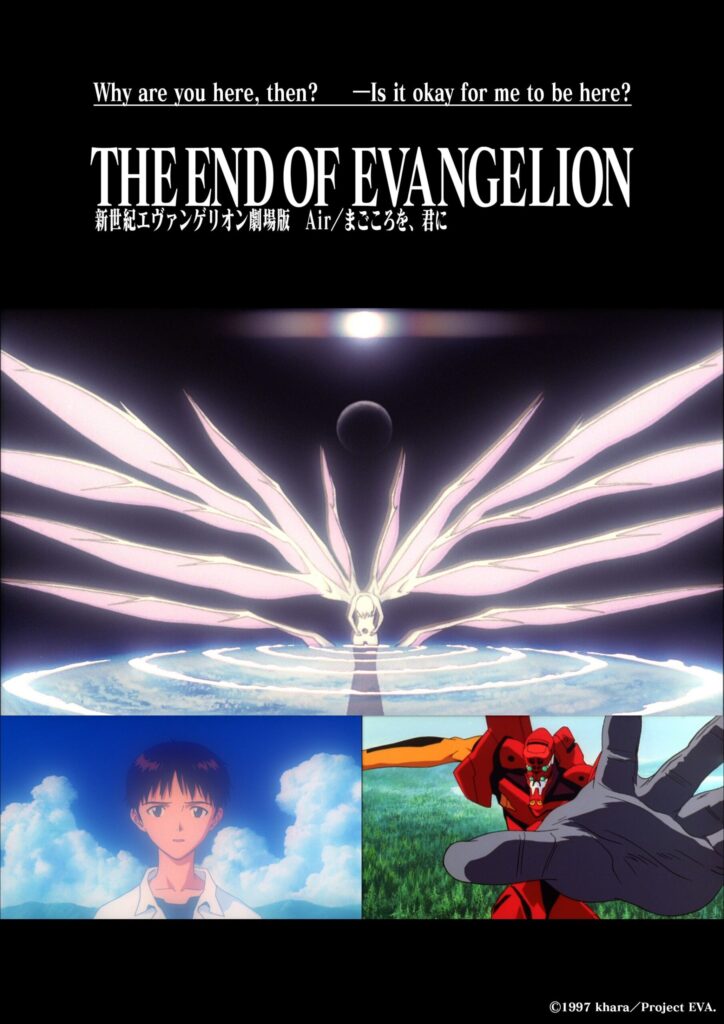
In March, I went to a screening of End of Evangelion. While it wasn’t my first time seeing the movie, it had also been many years, and this was actually the first time EoE had been released in theaters in North America, courtesy of GKids.
Evangelion as a whole is a major part of my history as an anime fan, culminating with the Shin Evangelionmovie. But two decades ago, End of Evangelion was one of those works that blew apart my preconceived notions about what animation could do. The emotional turmoil, the horrifying spectacle, and the beautiful animation all worked together to leave a lasting impact on my psyche.
It’s interesting to have again seen this film in full, now with the context of my own lived experience and where Evangelion has gone since then.
End of Evangelion is a sort of alternate version of the last two episodes of the TV series. Rather than taking place purely in an abstract world consisting of the collective minds and souls of its characters, things are based more in the physical world. After NERV defeats the last of the Angels, its secretive parent organization SEELE betrays NERV, and the ensuing carnage sends its already traumatized heroes spiraling down even further.
Ikari Shinji has long been the poster child for angsty teen protagonists, and it’s easy to see here why he could be both a very relatable character and an endless source of aggravation for viewers. As the people on his side and close to him are literally gunned down in cold blood, Shinji is unable to act. It makes me want to shout, “Get out of your own head, damn it!” And that admonishment more or less happens in the movie itself. But Shinji’s perspective is also one that hits close to home: He’s screwed up so many times that he thinks doing nothing is literally better than trying at all and inevitably making things worse. When you only see yourself as a source of failure and disappointment, it can be hard to take even a single step forward.
But when Rei initiates Third Impact, the apocalyptic event that’s meant to bring everyone’s souls together and reform humanity as the single entity it began as, Shinji does something surprising: He rejects this future that would ostensibly solve all his problems with human connection. It turns out that Shinji isn’t satisfied with a happiness that is handed to him, even if it would be a realm of sheer bliss. He wants to achieve self worth by going out there and finding it himself. The process itself, and the authenticity of the success, is paramount. It’s not so much that reality is about suffering, but more like telling someone who’s trying to plant a flower (and is incredibly bad at gardening) that you can just buy them an entire field of flowers that’ll be tended by the world’s best botanists.
The ending scene is one of many scenes that have long generated discourse, and thinking about it from the perspective of dreams vs. reality has me reconsidering its outcome. In the aftermath of the Third Impact (or at least its attempt), Shinji finds himself alone with Asuka. Seeing her lying prone, Shinji starts to strangle her, repeating an earlier “action” he took while being confronted in his mind about the way he desperately tries to avoid loneliness. But to his surprise, Asuka’s hands gently brush against his face, and this causes Shinji to let go. Asuka then says, “Disgusting.”
I see Shinji’s actions as indicative of him doubting that he’s out of the dream-like Third Impact, only to be thrown off by Asuka being very different from what he saw in his own mind. The compassion and disdain are both there, beauty and ugliness all mixed together. Reality is where dreams end, but it’s also fueled by those same dreams. It’s a messy world where Shinji can once again try to make a genuine connection, even if they’re the last two people on Earth.
To me, the essential difference between End of Evangelion and Shin Evangelion has to do with their relationship with depression. EoE is what you get when you’re caught up in it and are trying to provide hope that there’s a way out. Shin Evangelion is the result of someone who managed to overcome that depression and can tell you the other side is real.
Elden Ring completed! Kio is a little sad that there was no last dungeon after the boss rush, though (Note: Let me know if there is one, and I’m totally off in understanding this.)
Bang Brave Bang Bravern is like an anime that has traveled through time to reach us in 2024, but it’s not clear whether it came from the past or the future.
The show’s creator, Obari Masami, is near-synonymous with mecha. He’s been involved since the 1980s with works like Dancouga and Gravion, he’s the reason the Brave Pose exists, and they even bring him in to animate giant robot parodies in other genres. So when he announced a new series in the form of Bravern, I wondered what form it would take, especially with him as director and mecha designer.
The answer is: one filled with shocking twists that are as baffling as they are exciting. This is very much intentional, as the initial promo material and even most of the first episode has you believing that Bang Bravern is on the grittier side, with mecha as weapons of war. The first meeting between its central characters, Japanese soldier Ao Isami and American soldier Lewis Smith, seemingly portends a story about true camaraderie on the battlefield.
Then everything goes into Obari Overdrive. A shiny red robot shows up, literally shouting all his special attacks with a sincere level of camp. This namesake, Bravern, is a heroic sort who draws a lot from the Brave franchise, especially the bonding of kid and robot that is a hallmark of those anime. Only, Isami is a grown man instead of a wide-eyed grade schooler and reacts with a mix of awe and horror. The arrival of Bravern then kicks off a culture clash between the serious original setting and its brightly colored new reality that leaves everyone perplexed and hesitantly hopeful in the face of imminent doom.
During all this, we’re treated to the opening and then ending themes. The former is a blood-pumping super robot song that draws from the genre’s collective past, with shades of Godannar, Gaogaigar, Daiohja, and even Space Battleship Yamato. The latter features Isami and Smith in the rain, slowly undressing themselves as they sing dramatically like they’re starring in a musical. Together, these two songs encapsulate much of what Bravern is about.
And that’s only the first two episodes!
At least one shocking revelation or pivotal moment hits every episode, in a manner reminiscent of both Gurren-Lagann and Samurai Flamenco. The stakes keep escalating in wonderfully outlandish ways so frequently that Brang Bravern feels like 52 episodes got condensed into 12. The result is a show that leaves little breathing room for major moments, but also appears to act as an acknowledgement that giant robot anime comes from a time when year-long shows were the norm—and that such an era has long since passed.
With its muscular and passionate men in a setting that’s normally about masculine bravado, Bang Bravern might give the impression that it’s queerbaiting. In reality, it’s not really a bait: The show is very gay. At the same time, it feels very different from a lot of other works in that territory. For one thing, the attractive guys are also surrounded by attractive girls and attractive mecha, making it a smorgasbord of hotness all around. And amidst all this cheesecake and beefcake, the story told by Bang Bravern cuts to the heart of living up to childhood ideals.
This isn’t really plot spoilers, but the final episode plays the opening but with added sound effects like explosions and clanking sounds. This is a reference to the fact that many giant robot anime of yesteryear would at some point change their openings to include similar SFX. I think that says a lot about the spirit of Bang Brave Bang Bravern.
Spotted Flower Chapter 45 is out in the physical edition of Rakuen (digital is end of March). Kio also shows off all the issues of Rakuen he’s collected.
Kio retweeted a previous tweet of his showing an old model kit of the L-Gaim MK-II that he tried to rework and improve. It’s not quite to his liking yet.
The adult video version of Kio’s 18+ doujinshi was on sale (ended 3/11). The tweet includes one old drawing, and I believe one that’s entirely new (on the right).
Kio reacts to the death of Toriyama Akira. “Ever since I discovered Dr. Slump in my boyhood days, I was happy to have the art of Toriyama Akira with me through life. May your soul find happiness.”
Kio finally finished reading through the 7th The Five Star Stories Designs book. He especially likes the character 剣聖ヴェイデリ・コーダンテ (Sword Saint Veidery Codante? I can’t find an official English spelling).
Responding to the death of Tarako, the voice of the main character of Chibi Maruko-chan (also the second voice of Monokuma in Danganronpa). “Whoa, whoa, whoa. Hold on…”
Kio tries out a Five Star Stories Shindanmaker, and the site decides that he would be part of the Magic Kingdom Buchtgma, his Motorhead would be Batsch the Black Knight, and he would be compatible with the Fatima Harper.
Kio has apparently been shadowbanned on Twitter for the past year. When someone replies that he should consider bluesky, he’s hesitant because of how long it took him to get on Twitter.
Kio reacts to the death of Inomata Mutsumi, character designer on the Tales RPG series. “Inomata Mutsumu-sensei…I feel so sad…May your soul find peace in the afterlife.”
Reacting to the manga artist Kusada drawing the Jamru-Fin from Gundam ZZ, Kio joins in on talking about how awesome the design is. Kio remembers seeing it in a plastic modeling magazine back then.
Kio is surprised to discover there are Gundam model kits that are Real Grade Ver.2. He remembers having trouble with the fine details of the Version 1 Real Grades due to his aging eyes, but now he has Hazuki Loupe magnifying glasses, so it should be okay
I love me some mecha, and that’s why I want to give my thoughts on the recent giant robot anime that’s been the talk of the internet. I’m referring, of course, to Bullbuster.
Was there something else?
Joking aside (Go watch Bang Brave Bang Bravern!), I think 2023’s Bullbuster unfortunately went under the radar in a season and year full of great anime. It’s a mature show, but not in the mocking or edgy sense. Rather, it’s more akin to a salaryman anime with mecha included that, along the way, makes an argument for ethical companies in contrast to greedy corporations and their craven, plundering capitalism.
The plot: Okino Tetsurou is a mecha designer who is assigned to work with a small company called Namidome Industries. He’s a big fan of giant robot anime, and his latest work, the Bullbuster, was created to embody that aesthetic while also being useful for pest control. However, he soon finds out that “pest control” is a euphemism for large monsters roaming, and he learns that Namidome Industries was actually set up to eliminate these creatures so that the displaced residents can return home. However, there are many more hurdles than simply blasting the monsters away—like actually keeping a business running.
Bullbuster is cut from a cloth similar to that of Patlabor and Dai-Guard. While itdoesn’t get into the heady philosophy of the Patlabor movies, Bullbuster has that environment of regular people working regular jobs that just happen to involve giant robots. In fact, the mecha are less glamorous than either of those aforementioned series, and they typically come across as more vehicles with robot aesthetics grafted on. That has a charm of its own.
There’s actually an even older work also springs to mind: The Unchallengeable Trider G7, a series about a boy who owns his own company and his own super robot. In its opening, the singer (Taira Isao) asks: “Do we fight to protect our company funds?” He then immediately answers his own question: “NO! We fight to protect the Earth!” Bullbuster is presented with a similar situation, only the heroes are not an ultra-rich kid with nigh-unlimited money like in Trider G7, but rather adults who have to deal with issues like budgets, gaining local support, and other unsexy things. In the process, it becomes a David vs. Goliath story that pits Namidome Industries against the major corporation, whose threat comes not merely from their size but also their prioritization of profit at the expense of all else. One thing I find notable is that while there are moments where the big corporation comes across as possibly just suffering from a few bad apples, it becomes increasingly clear that the rot is actually deep in the roots.
The main fault of Bullbuster is that it doesn’t look particularly good. Nothing about the visuals whether in stills or in motion is anything to write home about, and the CG used for the monsters looks outdated by a decade or more. Even for someone like me who doesn’t put too much stock into “animation quality,” I think it holds the show back.
Ultimately, what tells me that Bullbuster has an adult perspective is not just the business setting or the lack of teen tropes. Rather, it’s because whatever hopeful message the anime conveys is inevitably tinged with a bit of cynicism that can only come from being worn down by entering “the real world.” Even when problems are solved and people are held accountable, often the ones truly responsible for the harm caused remain protected by power and privilege. Nevertheless, I respect Bullbuster for telling us to not give up.
PS: The singer of the opening is NORISTRY, and he’s actually an utaite, or amateur/semi-pro online singer. If you like the song, he streams and releases covers pretty regularly.
What does it mean for a work of fiction to feel “realistic?” It’s a question I return to over and over because of how subjective the answer can be. The more I’ve thought about different possible takes, however, the more I’ve found that I resonate strongly with something I call “emotional continuity,” and it informs which series I view most positively.
Broadly speaking, there are many types of continuity in storytelling. There’s the simple that the events of the past should inform the events of the future. A character who loses an arm in episode 1 of a show shouldn’t get it back with no explanation in episode 10. Then there’s capital “C” continuity, like what American superhero comics often deal in, where all the individual parts ideally look together to form a consistent universe and timeline across multiple different series. “Emotional continuity” isn’t nearly so complex. Instead, I define it as simply when events that should affect a given character emotionally result in an appropriate response, and that this character remembers this feeling on some level. Those reactions and memories don’t have to be “sensible,” and they don’t have to result in a “character arc,” though both are possibilities. They simply have to feel consistent with the character and their way of being, and then leave a mark on that character.
One work I’ve debated with others about realism (and by extension show quality, though the two are not necessarily related) is the anime Mobile Suit Gundam: Iron-Blooded Orphans. Whereas others saw the character actions as making little sense and thus stunting the overall story, I felt the opposite. I came to strongly understand each character’s motivations, especially in the core cast, and to see how early events both happy and tragic would inform the general trajectory of their approaches to life.
Another anime that I’ve argued about is Kill la Kill, specifically in regards to the idea that the heroine, Ryuko, is a strong main character even though she didn’t receive much “character development.” The big sticking point for detractors is that she doesn’t really change significantly throughout the series or learn any personal lessons. However, I find that even if she doesn’t transform dramatically, she conveys a strong sense of “emotional continuity” based in her anger, her stubbornness, and her desire to right wrongs. Even if she’s still the same rage-filled Ryuko by the end, it’s impossible to say that the events of the series don’t affect her emotionally or inform her friendships, battles, and decisions.
I realized that “emotional continuity” also greatly informs my utter fondness for the series Heartcatch Precure! and might even explain why the series is often seen as the best of the Precure franchise or somewhat overrated. Years ago, a blogger named Scamp tried to watch through as much Precure as he could, but ended up dropping every show, including Heartcatch. His reason was that nothing ever seemed to happen for the most part, and that dramatic, story-changing moments came too abruptly. This surprised me, because I felt the total opposite—that the show built up to every significant plot point like a skilled architect oversaw the construction. I even wrote a response. In hindsight, while I used the phrase “emotional logic,” i.e. reasoning through feelings, to describe what I saw, what I was actually highlighting was emotional continuity.
Moonlight…in suffering loss…felt wracked with guilt, giving up her role as protector. The task to defend the world had been passed onto a new generation…and as they collected the Heart Seeds, they laid the groundwork for Moonlight to redeem herself, to learn from her mistakes while also forgiving herself…. Although Cure Moonlight’s return is telegraphed to a degree, for me it built anticipation … I felt satisfied that the show had reached a strong emotional point with a solid expression of how the feelings of each character, especially Moonlight, defined their actions.
Rarely in fiction is anything utterly devoid of emotional continuity, but the best series make you feel as if they care about what’s happened to their characters. Something that has had issues with maintaining this continuity in recent years was World Wrestling Entertainment, and that seems to be finally turned around in the past couple years. While there are general structural issues with how WWE presents itself that go beyond emotional continuity, it’s telling that fans had very little faith in their favorites wrestlers being recognizable beyond a basic template. Continuity is played fast and loose in general, and the highly physical nature of their format means injuries and other unpredictable elements can gum up the best laid plans, but there’s a persistent sense that what a given wrestler does or says one week should actually matter the next.
Do you find emotional continuity to be important? If so, how much is it a priority for you? I’m curious to see how others feel.
Kio kind of wings it with the color, but thinks that the work wouldn’t be that different even in B&W. Kio likes the color palette in Star Wars in general.
Kio mentions that this Jedi is not to be confused with this girl from Kio’s 18+ doujinshi. However, he realizes that he might have certain preferences when the characters he came up with in 2010 and 2022 are so similar.
Ogiue and Ohno might technically fall under this category too. Kio includes an old drawing of Ohno cosplaying Leina from Queen’s Blade and asking Ogiue to cosplay as Leina’s little sister Elina. This is a voice actor joke because the original Ohno (Kawasumi Ayako) voiced Leina and the original Ogiue (Mizuhashi Kaori) voiced Elina.
After seeing a weather report that the temperature is going to be 35 degrees C (95 degrees F) after a typhoon, Kio is reminded of a line about becoming accustomed to torture.
Kio got through 70 pages of his eromanga manuscript, but then wasn’t sure of a certain part and ultimately decided to put in twice as much effort and drew the whole thing.
In response to the passing of Terasawa Buichi (author of Space Adventure Cobra), Kio describes Cobra as an accumulated mass of sense. (That sense seems to mean like an artistic/aesthetic/creative sense.)
Kio took a lot at the author Shima Tokio’s 18+ doujinshi, and was not only surprised at a development that happens in the middle, but that Shima would have the time to draw this on top of working on a serialized manga.
Kio read a comic drawn by Nagata Reiji, a person who left being a surgeon to become a manga artist, about that very experience. Nagata was apparently also serialized in Afternoon, and Kio decided to buy one of his manga.
9月22日(金)からTSUTAYAにて『げんしけん』POP UP SHOPの開催が決定いたしました! 新作グッズの販売や記念ノベルティなど盛り沢山!!
Kio has been meaning to tweet about the Genshiken pop-up shop at all TSUTAYA stores (that began on September 22nd) but kept forgetting to do so. (Check out the replies as well for lots of Kio thanking very excited fans.)
A tweet about the start of the Genshiken pop-up shop event, with Kio retweeting and responding to various photos taken by fans of the displays, including those lamenting items being sold out.
Introduction: “Gattai Girls” is a series of posts dedicated to looking at giant robot anime featuring prominent female characters due to their relative rarity within that genre.
Here, “prominent” is primarily defined by two traits. First, the female character has to be either a main character (as opposed to a sidekick or support character), or she has to be in a role which distinguishes her. Second, the female character has to actually pilot a giant robot, preferably the main giant robot of the series she’s in.
For example, Aim for the Top! would qualify because of Noriko (main character, pilots the most important mecha of her show), while Vision of Escaflowne would not, because Hitomi does not engage in any combat despite being a main character, nor would Full Metal Panic! because the most prominent robot pilot, Melissa Mao, is not prominent enough.
—
This is an unusual “Gattai Girls” entry. Sakura Wars is one of Sega’s most beloved video game franchises in Japan, and doing a review/analysis of it based on an animated TV adaptation will inevitably mean I can’t fully capture everything that makes the series what it is. Nevertheless, we have a solid example of an anime that fulfills the criteria of a mecha series with a centrally prominent female pilot, so here we are. As far as I know, the TV series follows much of the same plot, but there are some cases where major events (such as a certain heel turn) do not play out as they did in the game.
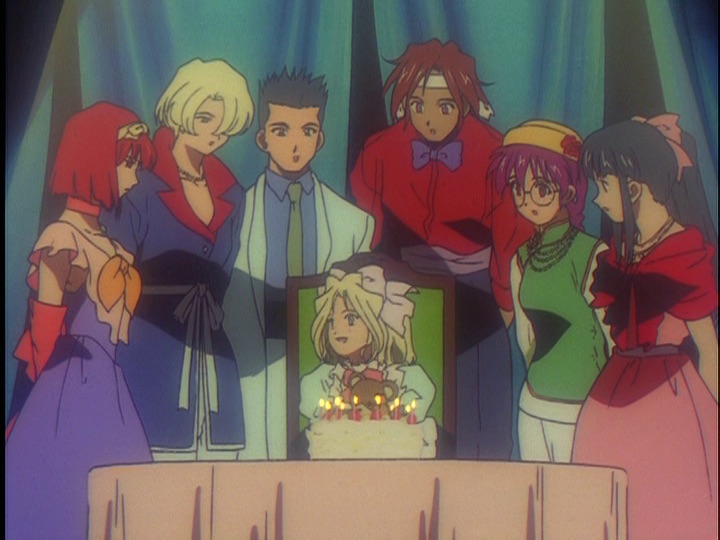
Sakura Wars takes place in an alternate Taisho-era mystical-steampunk Japan where people and technology thrive, but where horrible demonic forces also threaten the peace. The only people capable of fighting them on relatively even terms are the members of the Imperial Combat Revue: a group of girls who have the dual roles of being performers in musicals in the vein of the Takarazuka Revue and fighting as pilots of special spiritually powered mecha known as Kobu.
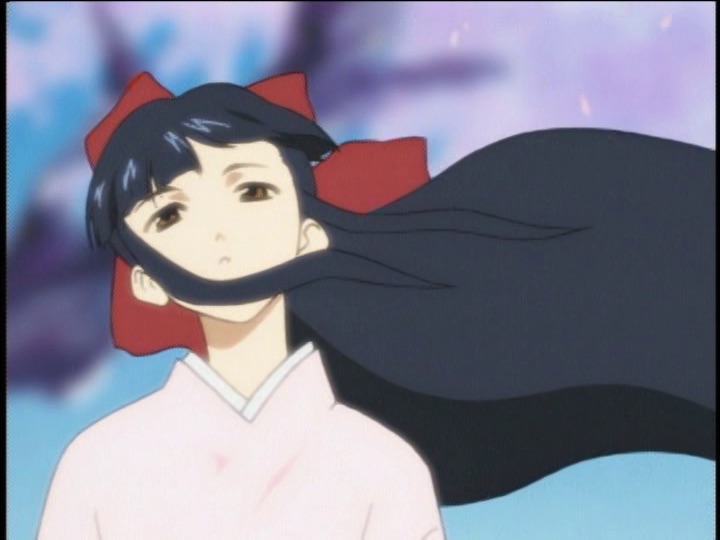
One of the points of appeal of Sakura Wars is that these girls are all interesting and memorable characters, but the face of the franchise is undoubtedly its namesake, Shinguji Sakura. To understand her general popularity, one need only look at Sega’s 60th anniversary popularity poll wherein Sakura got 3rd place behind only Sonic the Hedgehog and Opa-Opa from Fantasy Zone. What makes her so appealing is that she’s essentially the ultimate yamato-nadeshiko—the classical Japanese beauty—but without being a regressive character bound by conservatism.
(SIde note: While I acknowledge that the series is full of excellent female characters, the focus will be on Sakura as the main heroine).
When Sakura first arrives to join the Combat Revue in Tokyo, she’s like a fish out of water. Clad in a kimono, everything about her screams “traditional.” However, this is the Taisho era, a time of increasing embrace of certain Western values (such as marrying for romantic love). Much of Sakura’s growth over the series involves adapting to the cosmopolitan nature of her new environment and her teammates—allies who come from different parts of Japan and the world, and who hold different values—all the while still honing the swordsmanship and spiritual energy that has made her a recruit for the Combat Revue in the first place.
I don’t often devote space to discussing the voices behind the characters in these “Gattai Girls” entries, but I have to make a special exception here because Yokoyama Chisa is simply exceptional. Her voice carries such a range of emotions, from strength to vulnerability, from joy to sorrow, sometimes all at the same time. She’s the main singer in the Sakura Wars opening for this anime (as well as many of the games), and it really does feel like Shinguji Sakura is bringing the song to life.
I understand that romance is actually a significant part of the Sakura Wars games, as the player usually takes the role of a male captain who’s in charge of the squad. In the case of the earliest games and related media, that would be Ogami Ichiro, and I believe Ogami and Sakura are the most popular pairing. However, romance isn’t really a huge factor in the anime, and much of the story is focused on Sakura and the others developing bonds that help them to grow as people and warriors, as well as unraveling the secrets of the demons that are plaguing Japan. In this regard, Sakura is shown to possess immense inner strength, focus, and courage, all of which end up translating to becoming a great Kobu pilot over time.
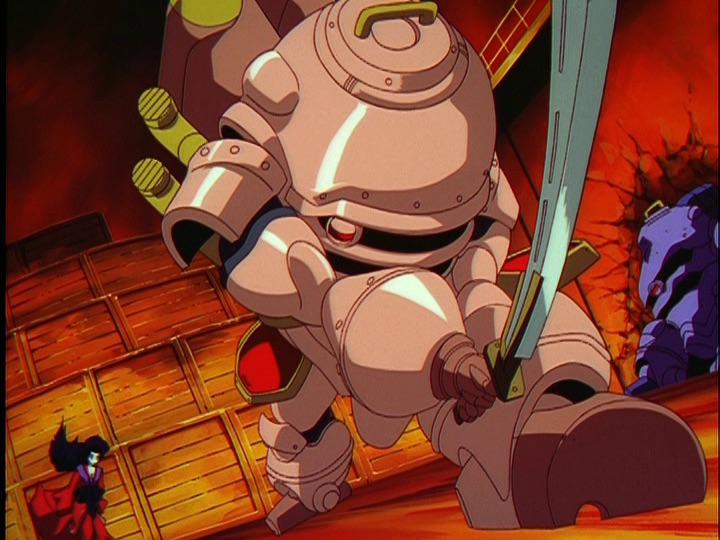
The Kobu themselves look fantastic, their round shapes and steam valves capturing the setting’s aesthetic better than anything else. They’re distinctive, and their unisex designs means that no specific attention is drawn to the Kobu being piloted primarily by girls. Every character fights in their mecha with weapons similar to what they’d use on foot, and Sakura’s is a single katana. The power, will, and resolve to defend the innocent is actually part of Sakura’s appeal as a yamato-nadeshiko, but this is again presented less as a facet of an ossified woman and more an anchor she can use for stability when she needs it.
Shinguji Sakura is the kind of female protagonist who is often imitated but never duplicated. To be able to embody seemingly contradictory values of progress and tradition while truly betraying neither is a juggling act that can fall apart all too easily. She’s the surest sign that just because a character falls under a dominant archetype doesn’t mean they have to be boring or bland.
This month, Kio mostly talks about Elden Ring. But we also get to see a high-quality version of one of the best covers he ever drew (no bias from me, clearly).
Even after 100 hours, Kio is having trouble in Elden Ring. In many places, he feels that he would never have been able to figure things out without strategy guides. (Forgive me for not translating this in greater detail.)
Kio keeps seeing figures and illustrations from Elden Ring but for the most part has no idea who anyone is, seeing as he’s only played 16% of the game.
Reflecting on his time with a much older FromSoftware game, King’s Field II, Kio recalls his experience. Despite the fact that it wasn’t really “open world,” finding out how one area of the game connects to another was very exciting.
There was a remix of AKIRA music playing at the gallery, and Kio wondered where it came from. Turns out that it was new arrangements done for the gallery. Kio wants a CD of it.
High-quality version of the cover to Genshiken Volume 6, as well as just the art of Ogiue. Needless to say, I love this cover and volume to death. Also check the thread to see lots of people posting their copies (and variations).
At this point, Otakon is a given in my life. I have enough faith in the people who run the anime convention every summer that they will create a rewarding experience. But short of anything pertaining to Genshiken, Otakon 2023 ended up with a guest announcement straight out of my otaku wishlist: Iwao Junko, the voice of Daidouji Tomoyo in Cardcaptor Sakura.
And yet, somehow, Iwao was only the tip of the iceberg. Between Asamiya Kia (manga artist of Silent Mobius, Nadesico), Aramaki Shinji (mecha designer on Bubblegum Crisis, Magazine 23), Terada Takanobu (producer on Super Robot Wars), and even the sleeper hit that was Ikezawa Haruna (science fiction writer and the voice of Yoshino in Maria Watches Over Us), I feel like I three conventions’ worth of experiences.
Line Con No More
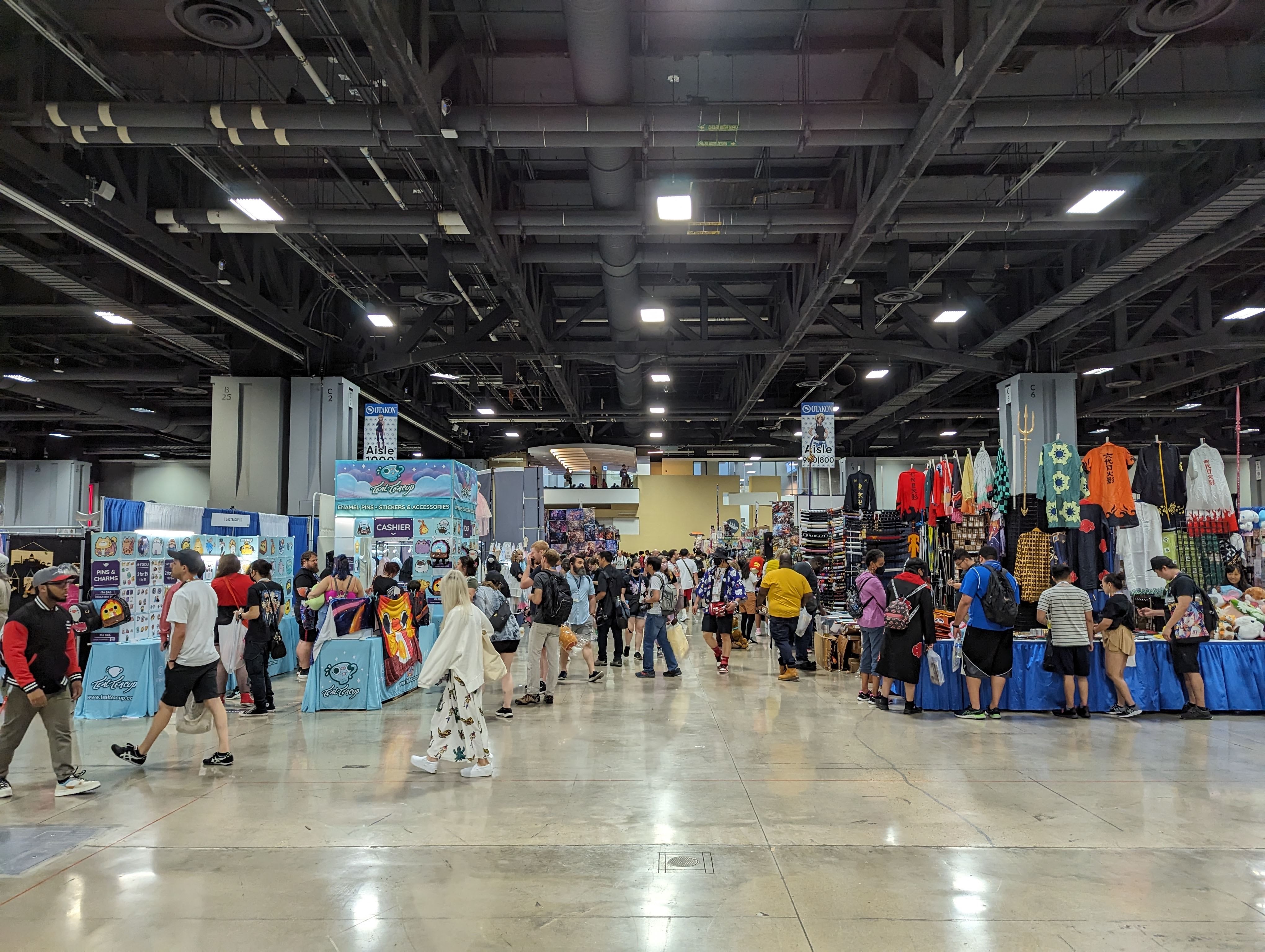
Otakon 2023 took place from July 28 to July 30, once again at the Walter E. Washington Convention Center in Washington, DC. It was coming off a previous year with record-breaking attendance, and two big questions were whether 2022 was a fluke caused in part by the US opening up again after the height of the COVID-19 pandemic, and how Otakon would handle the flow of foot traffic if it wasn’t. Long story short: Otakon actually surpassed its record this year, and the lines got noticeably better. While there were still a few hiccups here and there (like an unusually long wait to get my panelist badge due to a change in how they handled that process), it’s no coincidence that multiple people in the post-con feedback session praised the staff for fixing most of the congestion issues in a single year.
Fixing the lines was of even more paramount importance due to the weather over that weekend. DC was blisteringly hot; including humidity, there were times the temperature was reported as feeling like 112 degrees. Otakon needed to make sure people could get into that convention center quickly and easily, and they succeeded.
Lack of Masking Policy
I know it is incredibly difficult to put the genie back in the bottle, especially because “officially” COVID-19 is no longer a national emergency, but I really do wish Otakon would re-implement a mandatory masking policy. While I didn’t catch it at this convention, I was definitely in circles where the virus was present, and it would just allow more people to attend the con.
Industry
The guest list this year was truly packed, to the extent that I had to make some serious decisions as to what to spend time pursuing. Kawamori Shoji (creator of Macross) would have been near the top of the list any other year, but the fact that I had already gotten the chance to interview him in 2018 meant sacrifices had to be made. There were also a great number of manhwa artists at Otakon 2023, and as a general enjoyer of comics who is less familiar with Korean comics, this could have been a great opportunity to learn more. Alas, time was truly limited.
A good chunk of my time this year was thus spent on obtaining autographs because a lot of the guests are industry veterans, and some are getting up there in age. It may sound a bit morbid, but I’m worried that we’re going to lose more and more great figures in anime and manga, and I want the chance to see them and thank them before it’s too late. At the same time, I do worry that too much of my Otakon experience ends up being in autograph lines, and every year is a bit of a struggle in that for every wonderful thing you do, you know you’ll miss at least two other equally fantastic experiences.
Iwao Junko
One guest panel highlight for me was Iwao Junko’s, where she went over how she got into voice acting, her earliest days in the industry, and how she eventually made it into a full-time job. I have a detailed summary of the panel as its own post, and I also interviewed Iwao alongside her frequent music collaboration partner, Kawamura Ryu.
Mecha Guests
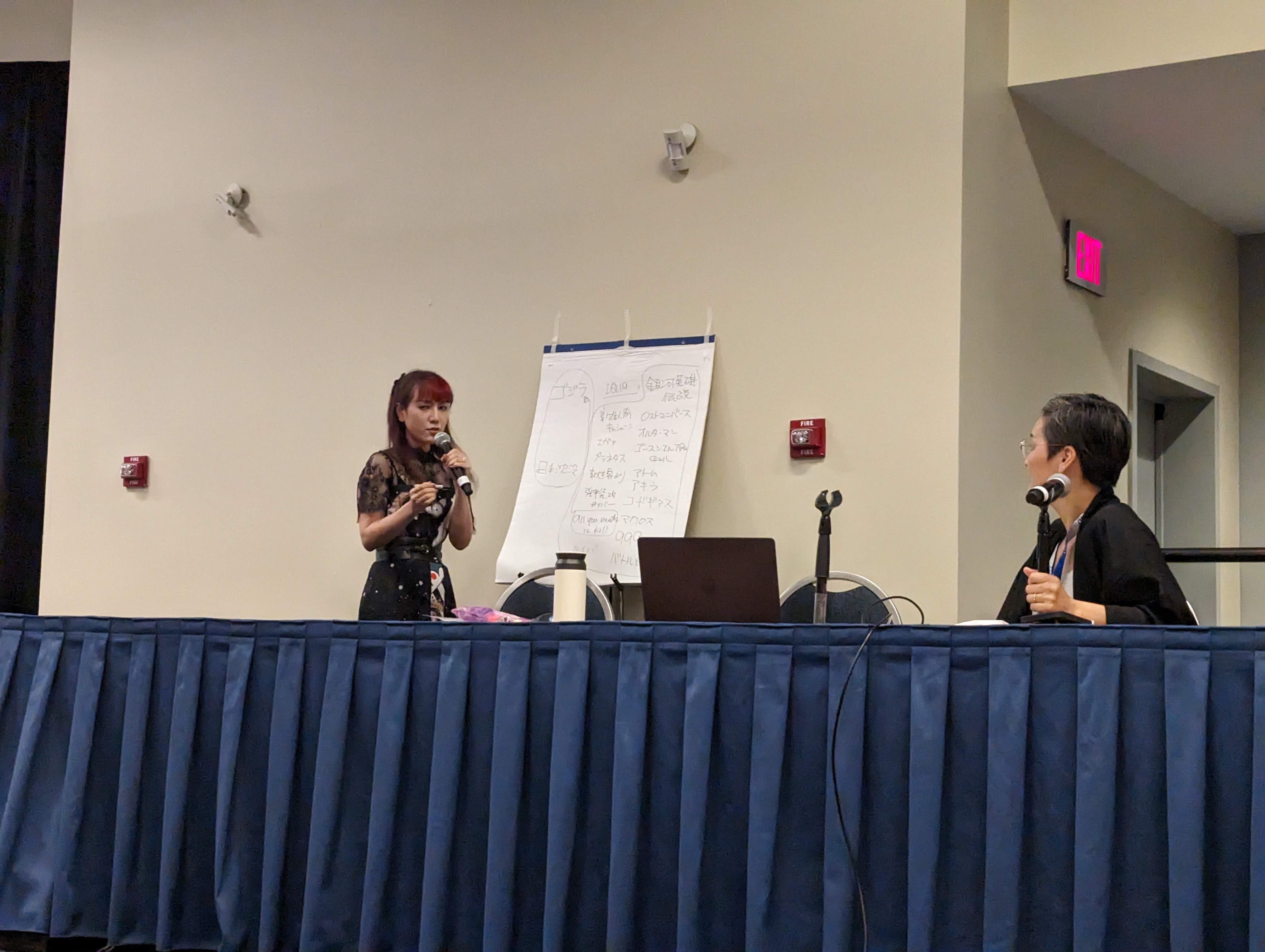
Another panel I was looking forward to featured multiple creators involved with mecha, including all the ones mentioned in the introduction. Just getting to hear them banter back and forth was entertaining, and you could tell that all of them would gladly talk your ear off if given the chance. One funny part of all this is the fact that Kawamori was clearly but somewhat surreptitiously drawing on his tablet in between answering questions—a fact that one panel attendee humorously called him out on (it turns out he was working on a project).
I got to sit down with two of the guests and talk more in depth: mecha designer Aramaki Shinji and Super Robot Wars producer Terada Takanobu.
Ikezawa Haruna
But there was one guest who was possibly the sleeper hit of the entire con: Ikezawa Haruna. While Ikezawa did her requisite panel about what it’s like to be a voice actor, she also did something incredibly rare for Japanese guests: run a panel entirely about one of her own personal interests.
In this case, it was a panel all about Japanese SF as compared to Western SF. Not long after she started, it was crystal clear that her knowledge was encyclopedic, and that her passion for the subject was through the roof. She probably knew more about science fiction in that room than the entire audience combined, and she made some interesting points about the essence of regional science fiction. For example, in the context of Japanese SF, she mentioned how xenophobia has become a big topic because it’s a major subject right now in Japanese society.
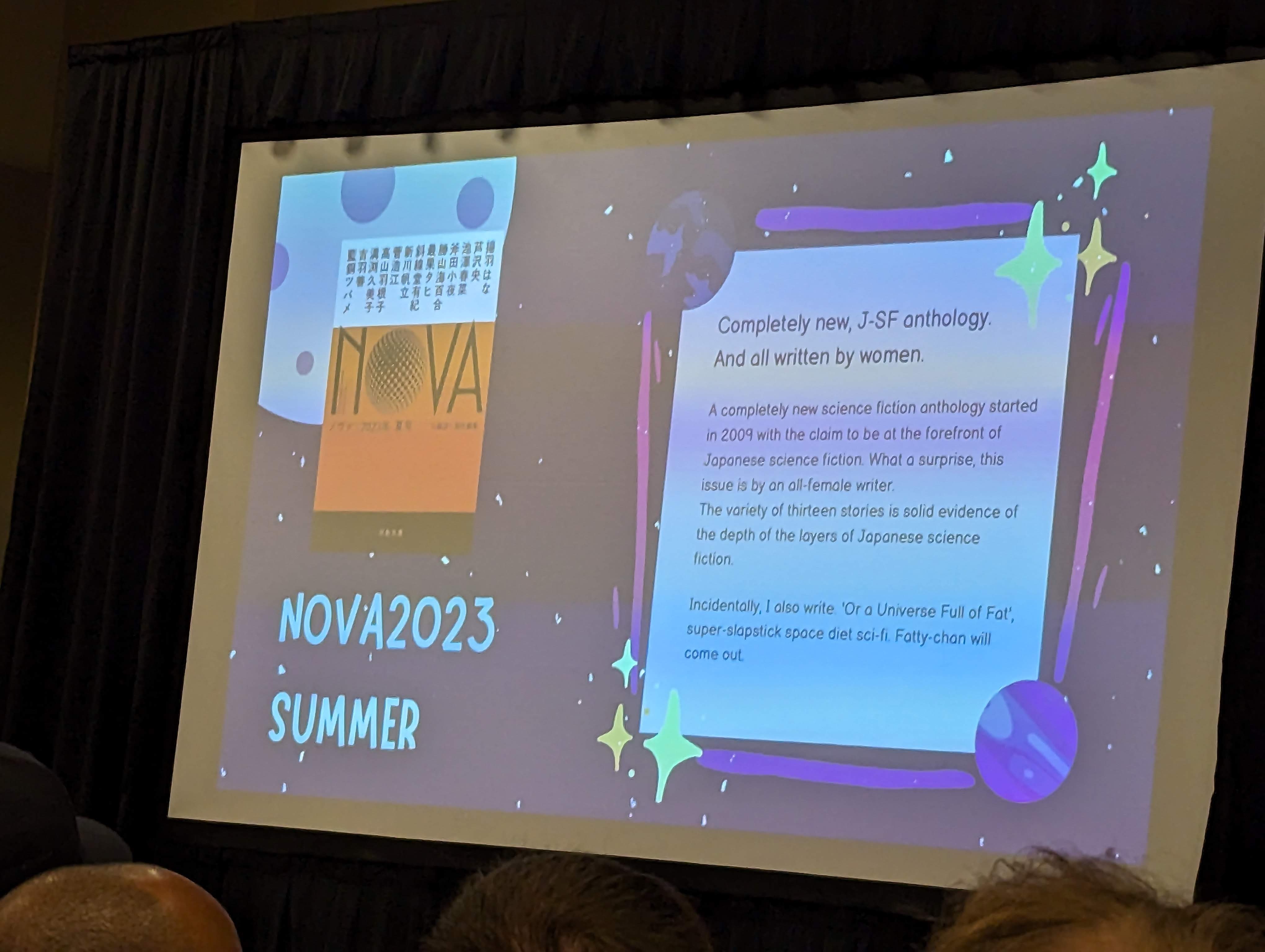
Ikezawa talked about how she actually prefers the term SF to “science fiction” because she thinks Japanese SF encompasses so much more—the abbreviation can stand for sukoshi fushigi (“a little mysterious”), speculative fiction, super fantasy, and so on. She also gave a variety of recommendations, including stories she’s written herself. These are Nova 2023 (an all-woman anthology), SF in 2084 (an anthology themed around stories that take place in 2084), the Naoki Prize–winning Maps and Fists by Ogawa Satoshi, Law Abiding Beast by Harukure Kouichi, and First, Let the Cow Be the Ball by Isukari Yuba. Unfortunately, all of them are in Japanese, but another story by Isukari, Yokohama Station SF is available in English.
Anime Screenings
While I was unable to attend the Discotek panel this year, I do think it’s worth mentioning the fact that they licensed all the Digimon Adventure movies, including both the original Japanese versions as well as the smashed-together film shown in US theaters. Not only is this the first time they’re all available in English, but Discotek did a special screening of them at Otakon. Sadly, I couldn’t attend that either, nor the showing of Macross Frontier: The False Songstress. That’s because I chose to watch the US premiere of The Tunnel to Summer, the Exit of Goodbyes, which I’ve reviewed here.
VTuber Presence
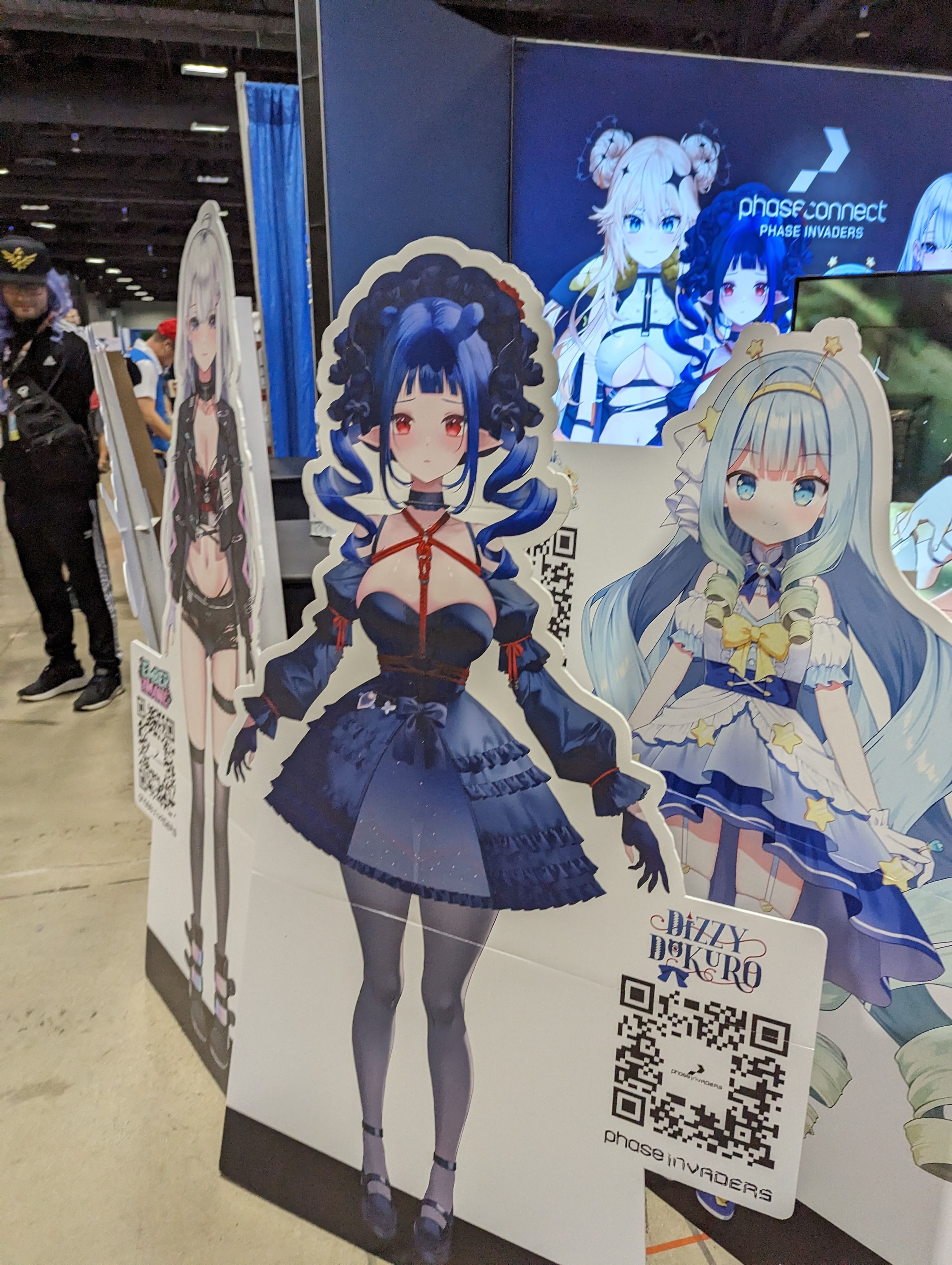
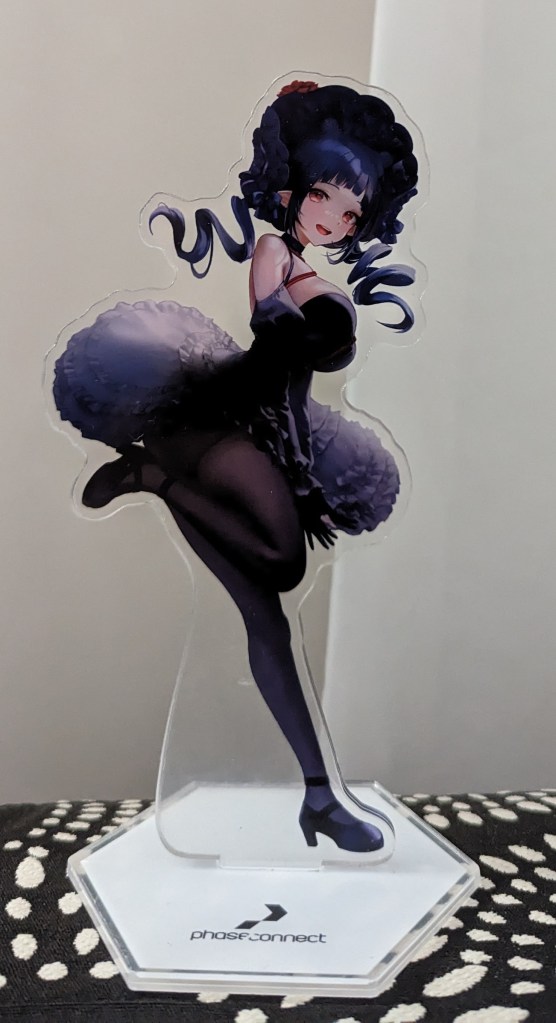
While there were cosplayers and artists who were repping the VTubers, there wasn’t much of an official presence (in contrast to Anime Expo, where it was a major force). That said, the group Phase Connect had a booth. I visited and bought an acrylic stand of Dizzy Dokuro.
Panels
Due to everything else going on, I shamefully ended up not attending very many fan panels this year despite that being one of Otakon’s best features. And for the ones I did, I could only see them in part.
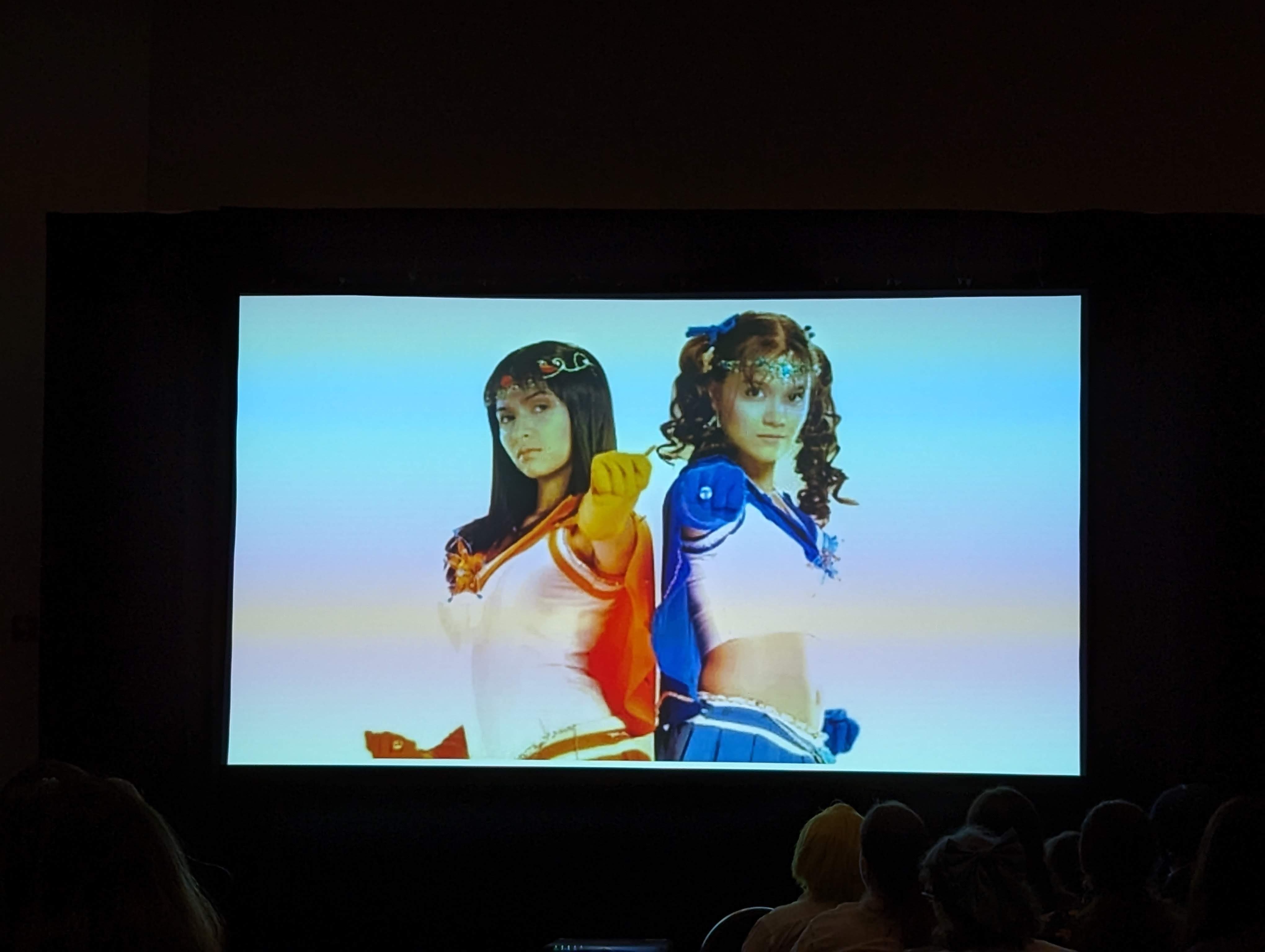
I do want to give a shout-out to Anime in the Philippines, as it definitely taught me new things, and gave a window into a culture and fandom that I was largely unfamiliar with. For example, now I know that Mechander Robo aired there, and I learned about this:
I did present on two panels this year myself, though: “Giant Train Robots of Anime and More” and “Densha Otoko: Train Man, Modern Myth, Internet Legend.” The theme of Otakon 2023 was trains, so I decided to play along.
Giant Train Robots was a joint project between myself and Patz from The Cockpit. We both love mecha, and I also relied on his greater knowledge of the tokusatsu side in bringing this together, and I think the result was a fun and breezy panel whose goal was to entertain, inform, and leave the audience appreciating trains that turn into robots. We got a good-sized attendance despite being at 1030am on Friday, and I hope everyone enjoyed it.
The Densha Otoko panel was all me, and I had actually started thinking about doing it since the end of Otakon 2022 when they had announced the train motif for the following year. Densha Otoko had been such a phenomenon in the mid-2000s, and I was curious to both look back on that era and to see what was its legacy today. I seemed to get mostly people who had already seen or knew about it, but that was just fine with me.
I think Giant Train Robots actually got more attendance than Densha Otoko, and I find that interesting because it used to be that the evening panels were better attended than the morning ones, and that mecha panels weren’t terribly popular, at least back in Baltimore. And this is on top of us actually being at the same time as a different giant robot panel! I wonder if there has been a generational shift or something that would explain this.
Food
After many years, the convention center cafeteria was finally open, giving another option for those who want to get something to eat but don’t want to travel too far. I dropped in there once, and saw that there were three options: Japanese, pizza, and hot dogs/sausages. I went for the last option (which was pretty similar to what’s offered at Ben’s Chili Bowl) mainly because it had the shortest kind, and it was pretty decent. The Japanese food naturally had the longest line at an anime con, though I still remember Otakon staff claiming a long while back that the sushi was actually pretty decent.
But the best food in the Walter E. Washington Convention Center was still the Caribbean food stand, which was located at the far end of the Exhibit Hall. While all con food is inevitably overpriced, this place always feels like the best deal, and the meals feel well balanced in terms of taste and nutrition. I’ve had something from them pretty much every year, and they never disappoint.
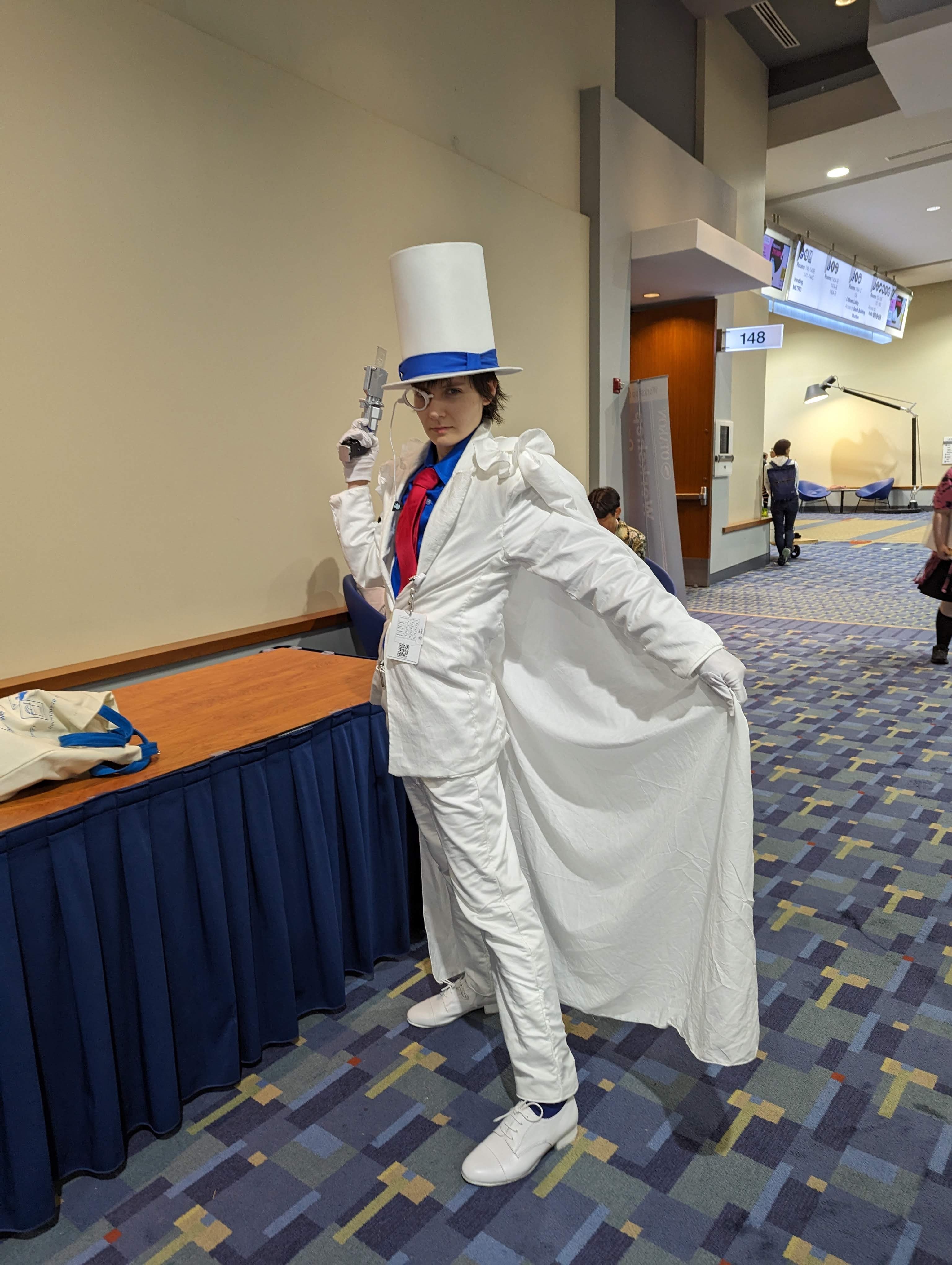
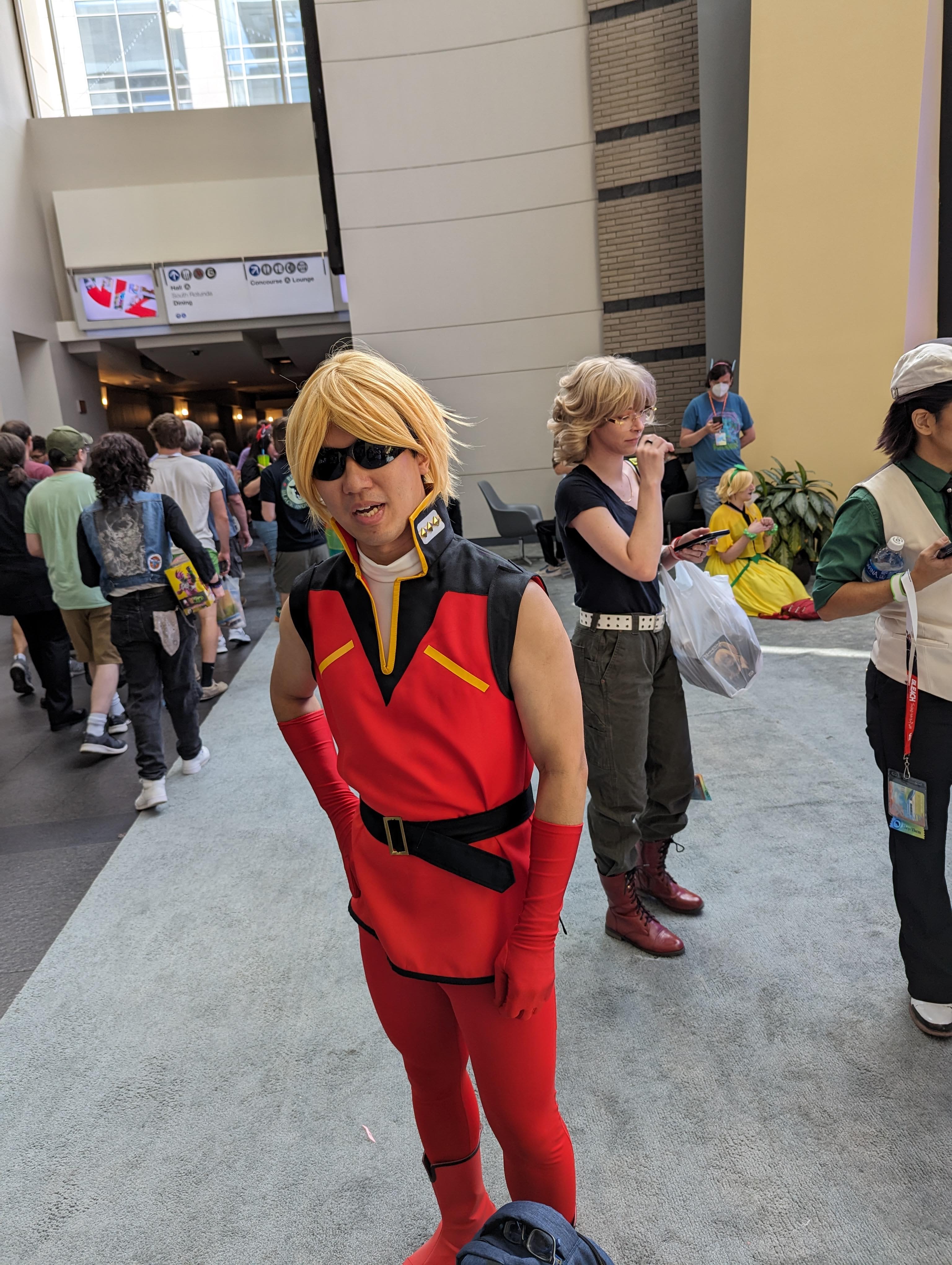
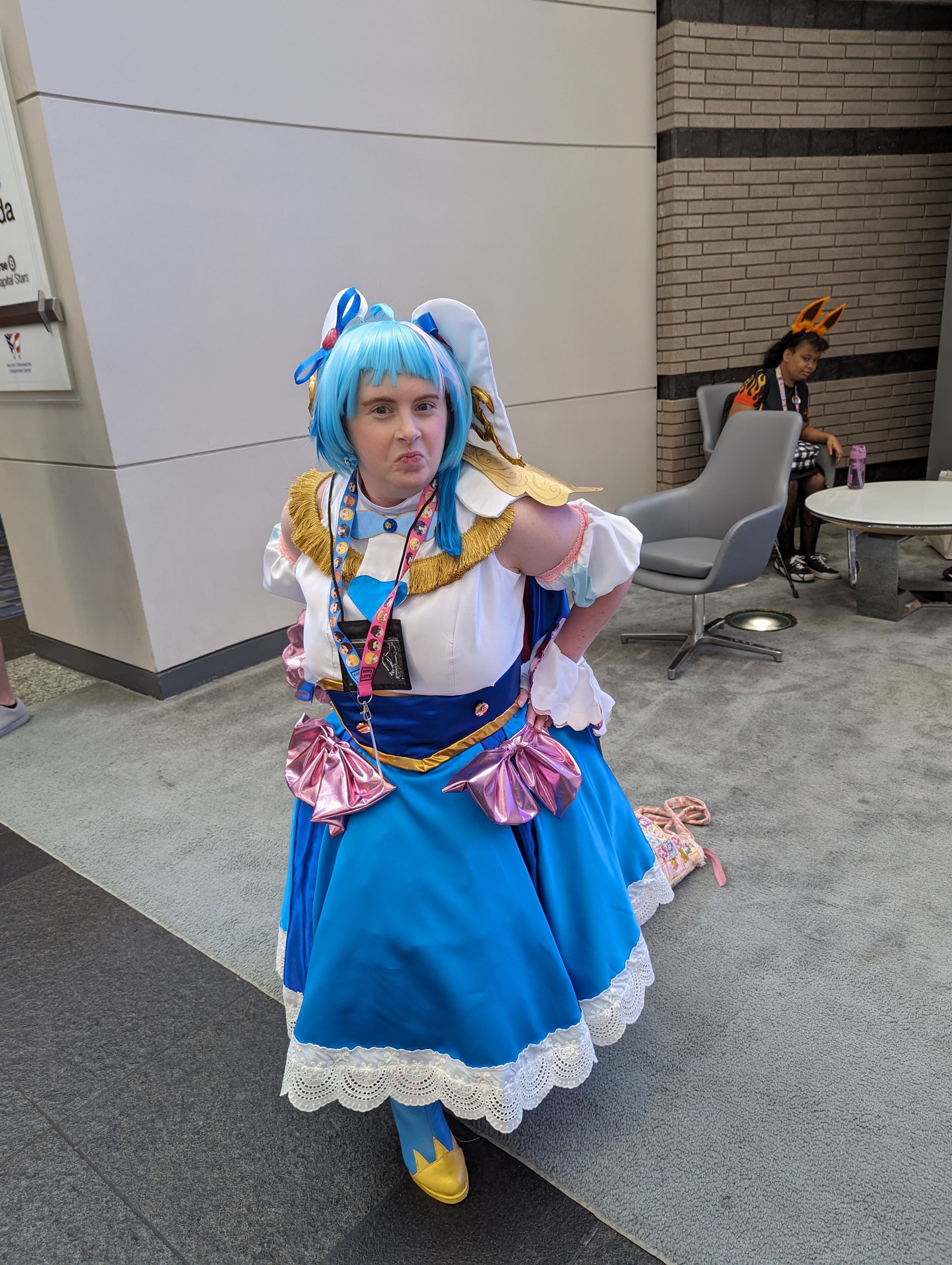
Cosplay
Closing Thoughts
2023 was definitely a strong Otakon in spite of circumstantial issues like the weather. Most importantly, I got to meet Tomoyo.
That said, the amazing thing is that next year promises to be even bigger and more powerful because it’ll be Otakon’s 30th anniversary. I’m already brainstorming ideas for panels, and wildly speculating on potential guests. I feel like it would be the perfect time to get people who were big back in 1994, and I trust the staff running the show to bring in some big guns.