Failure Is Technically in My Vocabulary, but I Choose Not to Acknowledge It to Make a Point: The Great Passage

“An anime about making a dictionary” sounds more like a sleep aid than entertainment, but The Great Passage defies such expectations. It heavily humanizes its story through its characters’ emotional journeys, but it also provides an interesting perspective on the fundamental role of dictionaries and how much we can take that role for granted.

The Great Passage tells the story of Majime Mitsuya, a young and awkward sales rep for Genbu Publishing who gets recruited by the company’s Dictionary Editorial Department. While his shyness and lack of people skills made him terrible for Sales, Majime shows an immense love of the nuanced and myriad ways words can be used. The department’s goal is to release a new dictionary, titled Daitoukai (“The Great Passage”), that would be ideal for modern users to have a robust understanding of how words are used in the here and now. Along the way, Majime makes friends, falls in love, and devotes his life to making Daitoukai a reality.

Majime has a certain magnetism deriving from the fact that while he’s extremely knowledgeable about words, he’s also bad at expressing himself, as if the sheer range of possibilities overwhelms his brain. This irony provides the backdrop for many of the relationships that develop throughout the series, and I appreciate that the story focuses on such an introverted character. The series isn’t subtle about this character trait at all—even stating it outright—but it’s still a very effective portrayal. The central friendship of the series, between Majime and his gregarious and sharp-witted co-worker Nishioka Masashi, sees two very different people with different strengths and weaknesses find ways to lift each other up.

In terms of the depiction of dictionaries, The Great Passage expends as much energy as it can to wax poetic about them. Dictionaries are likened to ships that help guide humans through the darkness, and it’s emphasized repeatedly that no two physical dictionaries are the same. They have to determine which words to keep and how to define them, and this results in different “personalities.” It implies that dictionaries are influenced by the priorities and biases of those who make them, even as they attempt to remain as objective as possible. In a sense, it brings the idea of reading multiple sources for news to a realm commonly considered rather staid and neutral. 

Towards the end of the series, there’s also an examination of the ups and downs of privately versus publicly funded dictionaries. While the series doesn’t delve too deeply into it, it does factor in ideas about the risk of government control over words versus the perils of being beholden to capitalism and the market. Brief though this comparison may be, it’s probably the closest The Great Passage gets to explicitly taking a difficult stance.

A more subtle yet nevertheless present point I find in the series is that it implicitly argues that “having kids” isn’t the be-all, end-all of adult life. There are a handful of couples throughout the series, and a decade-plus time skip halfway through shows where they end up. While one character is shown with children, another character’s situation quietly highlights how two people in love with each other but also possessing their own passions can find fulfillment in dedicating their lives to their respective endeavors.

The Great Passage is ultimately a charming series that takes an elegant approach to an unusual topic. Whether intentional or not, it makes for some impressive marketing for dictionaries, but much like Shinkalion does for bullet trains, it’s hard to fault something so inherently beneficial. The anime often plays it safe in many ways, but there are shadows of more daring positions and beliefs that result in a quietly complex work.

The Anime THEY Don’t Want You to Know About: Makyou Densetsu Acrobunch

For many years, the only impressions I had of the anime Makyou Densetsu Acrobunch were 1) that it has a fantastically beautiful and catchy opening and 2) the vague sense that it’s about a group of adventurers traveling the world in their giant robot. After finally getting the chance to watch the series in full, I find that it simultaneously falls short of and exceeds my expectations.

The premise: Acrobunch follows Rando Tatsuya and his five children on their quest to pursue clues about the legend of “Quaschika,” which is said to be the key to a mysterious treasure. Traveling in their combining giant robot, Acrobunch, they must also contend with the Goblin Society, an ancient underground race that is tens of thousands of years old and seeks the power of Quaschika to take over the surface world and supplant the human race. The characters travel to prominent ancient landmarks/sites (Atlantis, Stonehenge, the Nazca Lines. etc.), get into battles, fall in love, and discover that the secrets they’re after are far beyond what they could have predicted.

Acrobunch is, in a word, inconsistent. From story to animation, the quality swings wildly from meh to marvelous. When you look at the visual presentation, the secondary hero is supposed to be Tatsuya’s youngest son Jun, but he rarely gets plotlines of his own and is often overshadowed by his handsome older brother Hiro. On top of that, he looks anywhere between 10 and 20 years old, depending on who’s drawing him (see also Da Garn). The four Goblin Demon Generals are who the Randos fight the most, and every so often the series reveals a glimpse into their characters, only to hardly build on them further. Examples such as Hiro’s romance/rivalry with the beautiful White General Cera, Black General Groizy’s desire to make Cera his own, or how Blue General Bluzom seems to have a bit of a noble streak all get brought up and then left underexplored. All the storylines involve the search for Quaschika one way or another, but there are definitely some that are more compelling.

Even the robot itself suffers from this, sporting a nice-looking but rather complicated design that results in either Acrobunch looking fantastic (as in the aforementioned opening animated by the endlessly influential Kanada Yoshinori) or terrible (like a Ginguiser reject). That same opening also contributes to the false impression of Hiro’s importance and age. Overall, it’s not even that Acrobunch is too episodic, but just that sometimes there are episodes that hit and sometimes there are ones that miss, regardless of how much each one advances the main story.

Aside from the amazing opening, the main thing about Acrobunch that lingers in the memories of Japanese fans is actually the final episode, and so I think it’s important for me to discuss the big reveal of the series. Stop reading now if you wish to avoid spoilers. 

In episode 24, the characters discover that Quaschika is actually the spirits of a civilization that came from beyond our universe, and who are responsible for starting life as we know it. Whenever a planet’s sentient life-forms get too evil overall, the world and/or universe are destroyed, and the “good souls” are taken by Quaschika to start over again. It sounds like the perfect recipe for a true antagonist that could potentially unite the humans and goblins against a common foe—except that Tatsuya actually enables the world’s destruction and reset to happen! Without blinking an eye, he triggers the transformation, and in the end we see our six heroes and even one of the Goblin Demon Generals spirited off to a new universe as the rest of Earth’s inhabitants are wiped out!

Although it’s a hell of a twist, it doesn’t seem like Tatsuya’s actions are meant to be a kind of villainous reveal. Rather, because Acrobunch’s story takes so much from conspiracy theories, the anime’s curveball finale ends up feeling more like a cousin to the History Channel’s Ancient Aliens mixed with the kind of apocalyptic prophecies you get from cults like Heaven’s Gate or Jonestown. In a sense, Acrobunch is like a cousin to the grimmer works of Tomino Yoshiyuki like Ideon and Zambot 3, but with a further touch of paranoia. The abruptness of it might also be the result of the series getting cut short, and it wasn’t that unusual back then to cap off a canceled anime in the most traumatic way possible, as with Baldios.


Makyou Densetsu Acrobunch doesn’t exactly come out of the gate swinging, but it can be an interesting experience that does enough to build on itself. That doesn’t necessarily prepare viewers for the end of the series that basically explodes everything we knew thus far, but at least it means Acrobunch is hard to forget once you know about it. And as always, there’s that irresistible opening to re-watch over and over.

Orihara Kousei Has a Posse: Hashikko Ensemble, Chapter 44

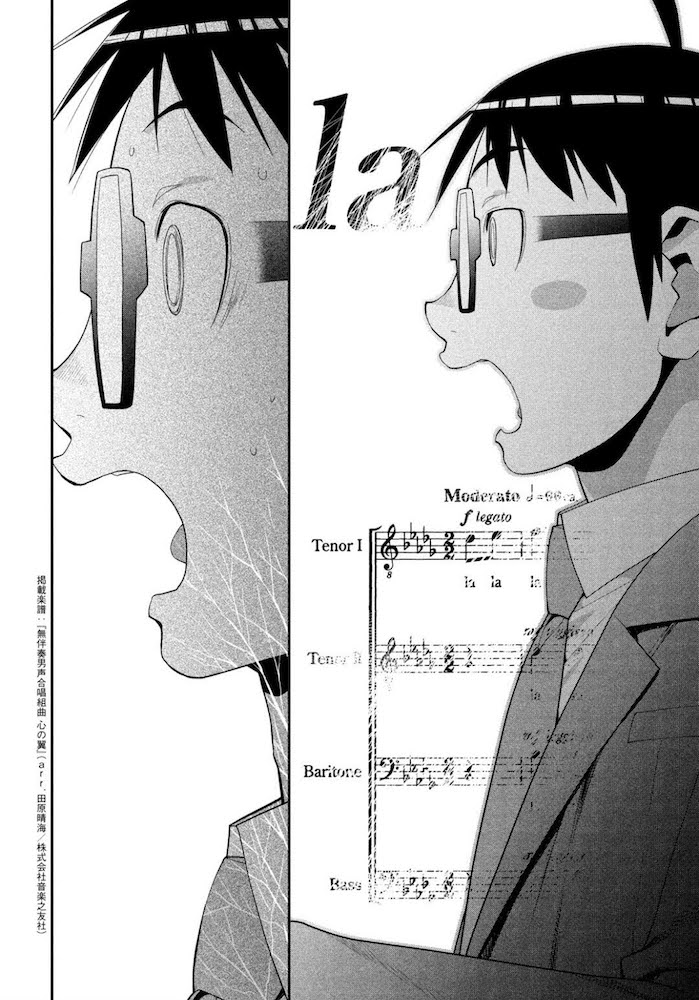
All the members of the Chorus Appreciation Society singing together intensely.

Summary

The Christmas-themed concert at Kousei’s orphanage continues, with the two sides (Christmas crew vs. Namahage Tsuyamers) joining together to sing a couple of songs as one. Kozue (still dressed as God) announces them as the Hashimoto High Chorus Appreciation Society, or “Hashi-kou Ensemble” for short.

The kids in the audience enjoy their performance, while Rikurou (the delinquent kid) is especially surprised by Kousei’s impressive singing. The orphanage’s assistant director thinks back to when a young Kousei first listened to a chorus concert himself. Later, Kousei has a heart-to-heart with Rikurou, where he talks about his dream: to buy a relatively inexpensive plot of land in a rural area, and use the architecture skills he’s learning in high school to build a house of his own where he can invite people over to listen to music.

During the concert, Jin notices Akira’s continued improvement in his singing—even in relatively higher notes, as opposed to the low notes that are Akira’s especially. Afterward, Akira casually mentions wanting to study music, which takes Jin by surprise. The caption at the end wonders how Jin will handle Akira potentially doing what Jin felt he never could.

They Said the Thing

Kozue, dressed as God, announces the group as the "Hashi-kou Ensemble"(Hashi High Ensemble).

This is the first time that the title of the series is (more or less) mentioned by the characters themselves, and it feels like a real milestone. What I think about is the sheer size of the group at this point, going from just Akira and Jin to around a dozen members. They’re on the verge of transitioning from appreciation society to full-fledged club, and I get a real sense of growth looking back at what’s transpired. 

At this point, there’s only one girl among the actual singers, and I see that changing as the story progresses. 

A Dream of a Home

Rikurou and Minori, kids at orihara's orpanage, being impressed by the singing.

Kousei is a character with a lot of layers, and I really love the reveal as to what he’s been working towards all this time. It’s strong and sweet, and encapsulates both the pain and healing that Kousei has been through. 

There’s potentially a conversation about toxic masculinity to be had here, though I don’t know if it’s necessarily limited to perceptions of manhood. What I do see is Rikurou’s previous anger towards Kousei for doing something decidedly uncool and unmanly in his eyes, and then how Kousei manages to change Rikurou’s mind about everything. Kousei’s masculinity is complex, and even though he’s quick to get into a fight, he’s also kind and caring in his own way, and even a bit vulnerable—like his bashfulness over Shion. During his talk with Rikurou, asks if Shion is his girlfriend, which Kousei strongly denies. We know, though, that he’s held back by the belief that he’s from a world too different from hers.

Songs

“My Neighbor Totoro” from the Studio Ghibli film

“Let It Go” (Japanese) from Frozen

Niji” (“Rainbow”) from “Itsu kara No ni Tatsute” (“Standing in the Field, Lost in Time”)

Kamome” composed by Kinoshita Makiko

As always, I have an ever-growing Youtube playlist of most of the songs featured in Hashikko Ensemble.

Final Thoughts

This was a good spotlight on Kousei, though I think the manga’s going to focus on other characters after this.

The series keeps building to some kind of confrontation between Akira and Jin, and I have to wonder when things will come to a head. 

“Gotcha!” and Pokémon Nostalgia, One Year Later

It’s been almost one year since Nintendo released their gorgeously produced Pokémon music video “Gotcha!” Even now, I find myself thinking about how amazing and emotional the short video is.

The song in the video, “Acacia” by Bump of Chicken, communicates a sense of both nostalgia and discovery; even on its own, its gentle and soulful sound makes it linger in my mind. When combined with the accompanying animation, however, it becomes something magical to those of us who have grown alongside Pokémon

“Gotcha!” features virtually every major and minor character from across eight generations of games, but I think it’s not merely the sheer amount of familiar faces that make the music video so impactful Rather, what it pulls off (with a sense of both elegance and down-to-Earth grit) is a celebration of what it’s like to make your way through one or more of the games—to capture those memories of triumph, accomplishment, and exploration.

With a big franchise like Pokémon, content is often traditionally made to celebrate what’s to come, as opposed to what has passed. There will always be new players, and while Pikachu and Charizard would remain popular even if you gave all existing fans amnesia, there’s a general aim towards a presentation that doesn’t delve too deeply into the lore and history of its world. “Gotcha!” defies that throughout its short timespan.

At one point, silhouettes of virtually every legendary Pokémon can be seen moving around the background, i.e. elements of the Pokémon single-player late game that are meant to communicate how far you’ve come in an adventure. These images then recede, and in their place are shadows of all the major antagonists from throughout the series—again, characters who are indicative of not the beginning but the end of these stories. The video then transitions to a gorgeously animated showcase of most of the league champions, whereas normally such characters would not be displayed in such close succession in advertising or merchandising. 

Later in the video, the remaining champions appear. Blue, the rival from the first generation, summons his six Pokémon while standing in front of a door and a couple of statues—portraying the moment after you defeat the Elite Four’s Lance and have to defeat Blue to take the title away from him. The attention to detail is notable, as all of Blue’s Pokémon are exactly the ones he would have if you picked Charizard as your starter: Pigeot, Alakazam, Rhydon, Gyarados, Arcanine, and Venusaur. The video then transitions to showing the battle on Mt. Silver between the player character from the second generation and the final boss of those games: Red, the player character from generation 1. In other words, this shift from fighting Blue to fighting Red conveys the passage of time through Red’s growth from player insert to final boss.

For those who don’t know anything about Pokémon, “Gotcha!” is plenty impressive, but what astounds me about the whole thing is that it just does an unbelievably good job of communicating and celebrating the nostalgia of Pokémon. It’s as if the music video captures not so much what happens in the games, but rather the memories that have been created through our experiences as players. It’s the sort of thing that can only happen with a series that has such a robust history and connection to its audience. 

Let’s Talk Evangelion in Shinkalion Z

Shinkalion Z 500 Type EVA, a robot that's a combination of Shinkalion and EVA-01 from Evangelion

It’s incredibly strange to go from the finality of the fourth Rebuild of Evangelion movie to seeing Shinji and Gendo characters show up in Shinkansen Henkei Robo Shinkalion Z, the fun-filled sequel anime about kids piloting bullet-train robots. What’s even more bizarre is that there’s a kind of thematic resonance between the two. The portrayals of the Eva characters in 3.0+1.01: Thrice Upon a Time and their Shinkalion Z appearances actually feel like they fit together.

Possibly due to its transportation and tourism connections, Shinkalion is famous for its unexpected pop culture cameos. A version of Hatsune Miku is a recurring character in the original Shinkalion. The franchise also makes multiple explicit references to city pop legend Yamashita Tatsuro, has Godzilla in a feature film, and showcases a Hello Kitty Shinkalion. It even just had a tiny Maetel from Galaxy Express 999 show up. Evangelion is just one of many pop culture icons to appear, but the sheer tonal difference between it and Shinkalion makes its presence all the more jarring on paper.

Ikari Shinji turning to face the viewer/the Shinkalion pilot Arata Shin.

Shinkalion already had a crossover with Evangelion in the first series, but whereas the main character back then (Hayasugi Hayato) visited Tokyo-3, here we have Shinji showing up in the world of Shinkalion. What really stands out about Shinji here is how gentle and reassuring he is in this world. The Shinji we see greeting the new protagonist, Arata Shin, has a calming presence that feels closest to the version of him we see towards the end of 3.0+1.01, as if parallel Shinjis arrived at the same place, only one had to go through some of the most dire trauma possible. The next closest would be the Shinji often found in Super Robot Wars after the positive influence of hotblooded pilots has rubbed off on him.

Not only does Shinji come across as a mature ment figure to Shin with the aura of a mentor, but he specifically mentions that he’s met a Shinkalion E5 pilot before. In other words, not only does the series acknowledge the previous Evangelion cameos within the world of the story, but we’re also likely seeing a Shinji who’s a little older. In a previous episode, it’s revealed that Shinkalion Z takes place in the world of the original Shinkalion after its climactic final battle, and reuniting with a Shinji with memories of what has come before actually creates a kind of anticipation for Hayato to return at some point.

Gendo sitting on a train platform bench next to some Shinkalion Z characters. The background is red and eerie, and Gendo's signature glasses are reflecting light.

As for Gendo (featured in the image at the beginning), he’s mostly played for laughs in terms of how incongruous he is with the relatively lighthearted world of Shinkalion. He says all the things you expect (“Shin, get in the Shinkalion”), but delivers it all with such a straight deadpan that it veers straight into parody territory. At the same time, his presence and demeanor feel reminiscent of a key scene in 3.0+1.01 involving trains, which makes the aforementioned resonance between that film and Shinkalion Z all the more noticeable. 

Ultimately, both Shinji and Gendo seem to be in better places in Shinkalion Z. While there’s nothing concretely saying so, I like to believe that the Shinji and Gendo of Shinkalion are better people because they have robots that are also trains—the kind of thing both father and son would probably enjoy, given their personalities and histories. 

Rei from Evangelion points at something, encouraging Asuka to take a look. Both are in their school uniforms.

Episodes are up on the official Youtube only until the following Monday EST, so anyone who wants to check out Shinji and the Shinkalion Z 500 Type EVA should do so as soon as they can. Unlike the last series, this episode actually has “Cruel Angel’s Thesis” for the streaming version.

The Gamble Is Afoot: Greatest M ~Mahjong Tournament of Eminent Figures~ Volume 2

Greatest M ~Mahjong Tournament of Eminent Figures~ starts with a premise that sounds like something out of a Type-Moon Fate series parody: What if famous figures from history competed in mahjong to inherit God’s position? And while there actually is a Fate mahjong series as well, this one works from the headline-worthy premise of having a cute anime-girl depiction of Helen Keller as the protagonist.

Volume 2 continues the story along largely expected lines: big hands being played by bigger personalities. Helen Keller’s “Miraculous Girl” title and ability are explained as her being able to stand up to even the greatest obstacles through her bond with Anne Sullivan—the moniker actually refers to both of them at once.

The results of the second match are decided off-panel, with a genderswap Toyotomi Hideyoshi emerging from a one-sided victory. While I’m not well versed in Japanese history, I’ve never seen the idea that Hideyoshi was really a woman, so I wonder where this might be going. In any case, the manga goes straight into the third match, which features three big names from France…and the world’s most famous detective.

Le Chevalier D’eon, Marie Antoinette, and Jeanne D’arc are all famous figures (and all three have been characters in anime and manga already), so it’s no surprise that these three would end up in Greatest M. However, for all three to be at the same table is a curious move. Moreover, the fourth seat—Sherlock Holmes—opens up the realm of possible contestants to not just historical figures (embellished though they might be), but also fictional characters. The Fate comparisons stay strong. I’m fond of all the character designs here, especially Jeanne’s battle-weary look, but the depiction of Sherlock is downright theatrical.

This manga could easily wear itself thin, but the third round also introduces the idea of alternate rulesets that can potentially spice things up. In this case, you can give a “Jong Command” and order your opponent to either discard a specific tile, force them to call a discard and open up their hand, or make them reveal their wait. It’s sort of like Go Fish, only the penalty for guessing incorrectly is losing 10,000 points. Especially with Sherlock in the picture, I expect a lot of predicting opponents’ motivations and deceptive strategies. That said, I actually expect there to be a twist, and for Sherlock to not make it through—possibly due to the chaos of mahjong itself. 

At this point, part of the fun of Greatest M is seeing just who will compete. What are the odds of Jesus showing up…?

It’s a Secret to Everybody: Giant Gorg

Tagami Yuu, a young boy in an explorer outfit and a beret, looks back at Giant Gorg, a large blue robot, in the background

In many ways, 1984’s Giant Gorg feels like an “anti–giant robot” anime. Sure, it has Yasuhiko “Yaz” Yoshikazu (one of the chief visionaries of Mobile Suit Gundam) as both director and character. And it’s indeed about a boy and his mecha guardian in the middle of a conflict that stands to change the entire world. But where most giant robot series before and after would aim for some combination of bombast, gritty science fictional realism, and/or gripping human melodrama, Giant Gorg often comes across as more concerned with atmosphere and conveying a sense of place in the world.

Giant Gorg follows 13-year-old Tagami Yuu, a Japanese boy who travels to New York City following clues about the death of his father. This takes him on a whirlwind adventure, all the way to the mysterious New Austral Island, where he learns about a mysterious organization named GAIL that seeks to discover the island’s secrets. There, he encounters a massive robot—Gorg—that seems to obey his every command. With a group of allies by his side, as well as the might of Gorg, Yuu works with the natives to push back GAIL, but he may have an even closer connection to the truths of New Austral Island than he realizes.

I enjoyed Giant Gorg for its moody feel, its excellent artwork and animation, and the fact that it feels more like you’re jumping into a specific time and place in world events. On the other hand, I would not call it “riveting.” While I had the ability to watch many episodes in one sitting, I rarely would watch more than two or three because the anime doesn’t really set itself up to compel viewers to keep going. Events that finish a given episode in Giant Gorg feel like the half-way point for an episode of Mobile Suit Gundam. Whereas the latter might leave you off with tears and shouting, the former more often hits the ending credits with the reveal of a hidden cave or something. 

Because of this, Giant Gorg feels unabashedly Yaz. Whether it’s a manga set in the dawn before the Russo-Japanese War or his retelling of the Gundam story in Gundam: The Origin, Yaz tends to focus on giving his stories the same feel as a fascinating but dense historical text. This makes it all the easier to see what he and Gundam director Tomino Yoshiyuki each brought to that franchise—Yaz’s attention to detail and physical realism contrasts with Tomino’s chaotic energy and far-reaching visions. It’s like Yaz is a master baker who can produce incredibly well-made cakes, but never quite got the hang of how to do amazing icing. Giant Gorg, in turn, can feel both like a distillation of one man’s style and half an anime.

As a final note, I want to end off by recounting a sort of “personal history of Giant Gorg”:

I was studying abroad in Japan in 2005 when I saw a commercial for the upcoming DVD release of Giant Gorg. I had heard of the series before, but was mostly struck by how fantastic the robot itself looked. It’s an aesthetic that stayed with me for a long time.

Ten years later, I found myself sitting near the front of the Sunrise anime studio panel at New York Comic Con 2015, alongside my friend Patz. The presenter was going through a list of Sunrise series available in the US, when Giant Gorg came on-screen. The series had been licensed for US release just months before, and as mecha nerds, both Patz and I began shouting with excitement. We were sitting close enough to the presenter that she noticed and, with a surprised look on her face, asked, “Really?” The two of us responded by shouting, “GOOORG!” in unison. We were just excited for the opportunity to own such an obscure and gorgeous piece of anime and mecha history. While Giant Gorg won’t go down as one of my all-time favorites, its flavor is unmistakable and appreciated.

PS: There’s an antagonistic group in the show called the Cougar Connection led by Lady Lynx. The jokes are silly and obvious, but I can’t help chuckling every time it comes up.

Standing in a Whirl of Confusion—Gundam Reconguista in G Part II: Bellri’s Fierce Charge

The G-Self in combat

Gundam Reconguista in G compilation films Part I and Part II are currently available on the official Gundam Youtube channel. Having previously seen the first film at Anime NYC 2019, I wondered if the smart changes that made Part I significantly better than the TV series would also carry into the sequel. I’m happy to say this is indeed the case.

Gundam Reconguista in G Part II: Bellri’s Fierce Charge continues where Part I: Go! Core Fighter left off. In this era of the classic Gundam‘s Universal Century timeline, the massive space wars of the past are ancient history and the nations of the Earth are managed by a central mediating body known as the Capital Tower, home to a space elevator that receives energy batteries from space and distributes them across the world. Bellri Zenam is the son of Capital Tower’s leader, but after the Tower’s defense force, the Capital Guard, starts to be supplanted by the more militaristic Capital Army, Bellri gets caught up in the middle of a new conflict. As the pilot of the mysterious G-Self, he ends up traveling with what is ostensibly a pirate crew as he tries to figure out his place in the world.

Bellri in tears while in combat

This film continues the trend of being far more understandable compared with its source material, though that’s not to say it’s easy to follow—merely easier. Director Tomino Yoshiyuki’s style can be famously obtuse and bombastic, and that’s the case here as well. However, Bellri’s Fierce Charge establishes the characters more solidly and allows them to act as a focal point for the story. So while the complex and sparsely explained politics of the G-Reco setting can still be a recipe for confusion, viewers can anchor themselves to the emotions of those characters who are often equally confused. If there’s anything viewers might get mixed up on that the characters take for granted, it’s the distinction between the Capital Guard and the Capital Army, which reflects an ongoing debate over the role of the Japan Self Defense Force and Japan’s constitutional anti-war stance.

This is especially the case with Bellri himself, who in the TV series could sometimes unintentionally come across as carefree at best and a sociopath at worst. Here, what should have been a major turning point in his life in the original version gets a proper amount of attention, and you can see the degree to which there is a clash between Bellri’s ideals, his frustration at adults for making the world a worse place, and the decisions he feels forced to make.

Barara Peor next to a wall

Other characters shine as well. Whether it’s Captain Mask, Aida Surugan, or even Bellri’s mom, the strong portrayals of their personalities—facilitated by great animation—give Part II an extra oomph that keeps it memorable and shows the complexity of their world. Yoshida Ken’ichi’s character designs are always excellent, with side character Barara Peor (above) being an especially strong design.

I think the Gundam Reconguista in G movies are well on their way to becoming the definitive version. The new edits and footage take what were excellent but obtuse ideas and criticisms about humanity’s current relationship with war, and convey these ideas much more solidly and emotionally. I would have watched the entirety of the tetralogy already, but now I’m really looking forward to seeing the end again.

One final note: The main theme of Bellri’s Fierce Charge is by the famous Japanese group Dreams Come True, arguably better known internationally as the composers of the first two Sonic the Hedgehog games. The theme, shown above, can be found on their official channel.

Speedwagon from JoJo's Bizarre Adventure shouting "Gaaaaah! Even Shakespeare is afraid!" in reference to lyrics from the Dreams Come True song, G.

It’s the ’Hara Knock Life: Hashikko Ensemble, Chapter 43

Akira, Jin, and Mai singing “Rudolph the Red-Nosed Reindeer” to little kids

We get a glimpse of Kousei’s home life (and a Christmas concert!) in Hashikko Ensemble, Chapter 43.

Summary

The Chorus Appreciation Society is visiting the orphanage where Kousei’s been raised, and they plan to hold a Christmas concert for the kids there. ItThere, Akira and the others meet three people in particular: Zenba Yoshimi, the assistant director of the orphanage; Hayase Minori, a 6th grader; and Sawamura Rikurou, a middle school delinquent. Rikurou clearly looks up to Kousei, and he doesn’t understand why Kousei would hang out with the Chorus Appreciation Society or take up singing.

The day of the concert, members of the Appreciation Society are dressed for the occasion, with Kousei taking on the role of Santa Claus himself. The Tsuyamers then come in as namahage (New Year’s demons) to “scare” the children, only for a fight between Santa Kousei and Hage Tsuyama to be interrupted by Kozue dressed as God. Though part of the show, the tension between Kousei and Tsuyama is all too real. 

God Kozue proposes a singing competition instead. Tsuyamers go with “My Neighbor Totoro,” while Akira’s group sings “Let It Go.”

Happy Holidays

Kozue, dressed as God, declares a sing-off between Santa Kousei and Namahage Tsuyama

I appreciate the particular blend of cultures we see around Christmas and New Year’s in Japan, between the Santa stuff, the namahage, and Kozue as the Judeo-Christian God with stereotypical white beard and all. The fact that they didn’t go with Jesus probably says a lot.

Imagination Station

I find it noteworthy how this chapter is how it starts, which is right at the orphanage. There was no scene in the previous chapter showing Kousei explaining his past to the other characters, nor was there any discussion regarding singing at his orphanage. And yet, because the characters have such strong and rich portrayals, it’s easy to imagine how this ended up happening. In particular, because Kousei has opened up over time, one gets the sense that he barely okayed this because he’s easily embarrassed but would like to give back to the place where he grew up. 

It’s also through the new characters we meet that we can get a glimpse of what Kousei’s life has been like since he was rescued from his abusive mother. 

The People in Kousei’s Life

Yoshimi, the assistant director of the orphanage, mentions that Kousei used to cry into her chest at night

Yoshimi, Minori, and Rikurou each make quite strong first impressions, and it’s easy to see how they’ve affected and been affected by having Kousei in their lives. 

At the start of the chapter, Kozue asks Yoshimi what Kousei was like as a kid, and despite Kousei angrily telling Yoshimi to keep shut, she nonchalantly mentions him often crying at night. She seems like a tough lady who takes no shit from anyone, and someone who’s accustomed to handling children like Kousei and Rikurou. I can also easily see her attitude rubbing off on Kousei. The orphanage itself also seems well run.

Minori tries to act mature, explaining that she’s not like the other little kids there. Yoshimi explains to the group that she’s smart, but she’s also in a hurry to grow up. From the little we see of her, she does come across as actively trying to have a good head on her shoulders, even dispensing advice to the older Rikurou. Minori is the one who points out that Kousei established the rule about not hitting anyone younger than you at the orphanage, and calls out Rikurou’s anger as jealousy over possibly losing Kousei.

Rikurou is the closest in demeanor to Kousei, to the point that much of it is probably him trying to emulate his role model. The kid clearly thinks the world of Kousei, and he’s threatened by the Chorus Appreciation Society the way an only child might feel about a new sibling. There’s fear and pain there, and Rikurou likely tries to compensate for it with his tough-guy persona. 

Speaking of Jealousy…

There are a few moments concerning the ever-so-slightly icier relationship between Jin and Akira. Jin mentally notes how much Akira has improved, while Akira realizes he kind of likes the change in attitude from Jin towards him. While not explained why Akira sees an upside to this, it’s probably because Jin has always been this larger-than-life figure when it comes to singing. For Jin to look at Akira with any kind of envy is, in a certain sense, a sign of Akira’s own progress.

Songs

Because they’re singing for an orphanage, all the tunes this month are for kids.

(Note that Youtube doesn’t let you add children-oriented videos to playlists, so many of these won’t be included on the big Hashikko Ensemble playlist).

“Rudolph the Red-Nosed Reindeer” (Japanese)

“Awatenbou no Santa Claus” (Hasty Santa Claus) is a Christmas song of Japanese origins.

“Jingle Bells (Japanese)”

“My Neighbor Totoro” from the Studio Ghibli film

“Let It Go” (or “Ari no Mama de” in Japanese) from Frozen

Final Thoughts

It’s interesting that the three characters we meet at the orphanage are all different age groups compared to Kousei. Their interactions show less of a peer dynamic and more of a somewhat intergenerational one. Because these three aren’t high school age, I don’t think we’ll be seeing a whole lot of them, but I’m sure they’re going to pop up from time to time even after this specific story ends.

Mashle Is the Answer to Harry Potter (No, Really)

Harry Potter is synonymous with magical school fantasy, defining the genre for an entire generation. However, one criticism I increasingly see is that it’s more about maintaining/restoring the status quo rather than trying to effect a real and lasting positive societal change that goes beyond defeating evil. While it’s a bit unfair to pigeonhole the books in this way, it’s also hard to deny that Harry Potter eschews structural issues about the world it presents, and that this is not especially uncommon in similar fiction.

That’s why the last place I expected to see a more boldly progressive take on the inequities of a wizarding society would come in the form of a comedic shounen manga called Mashle: Magic & Muscles.

I want to be clear that Mashle is not some leftist manifesto that proudly announces its overthrowing of capitalist oppressors. Jack London’s The Iron Heel this most certainly is not. But when you compare how Mashle and Harry Potter tackle the same premise, the differences stand out.

Both protagonists, Harry Potter and Mash Burnedead, enroll in a magic school where they must deal with being outsiders while also being under the benevolent watch of the school’s wise, old leader. However, whereas Harry Potter at the start is simply inexperienced with wizardry but has potential for greatness, Mash is completely incapable of magic. In order to get through his classes and achieve his goal of becoming Divine Visionary (a motivation from the beginning unlike Harry’s initial uncertainty), Mash has to overcome his disadvantage through sheer physical power. 

The contest between Mash’s muscles and the occult abilities he faces is generally played for laughs, but there’s another layer to that contrast. Sure, it’s funny to see his “magic” be activating different muscle groups and his “spells” amount to suplexes and punches to the face. Yet, because he is doing this purely through his human physiology, his victories over other students both read differently from Harry’s accomplishments and are received differently by the very mages he bests. By beating them without magic, Mash makes his opponents realize on some level that they are themselves victims because of how they’ve been drawn into society’s incessant and blinding obsession with hierarchy and power. The problem is not exclusive to any specific group of rogue ne’er-do-wells, it’s systemic.

Mash himself is not a sharp mind capable of bold leadership. He’s from that Goku/Luffy/Saitama lineage where thinking is not their strong suit. He merely wants to live a comfortable life with his grandfather, but he’s forced to attempt the impossible and become the top of a magical school because his world despises the weak. Mash defies his society in multiple ways: upending what strength means, as well as rejecting the notion that those with less deserve less.

Around Chapter 65, the “Voldemort” of the series is revealed, as are Mash’s true origins. While not quite the same as the concept of horcruxes relative to Harry and Voldemort, Mash and the main villain share a similar connection. Mash turns out not to be the everyman he assumed himself to be, but that doesn’t change the fact that he uses his particular skills to upend people’s preconceived notions. The difference between Harry discovering the magic within and Mash working to overcome the magic he lacks remains stark.

That all said, it’s hard to think of Mashle as being in the same league as Harry Potter when it comes to the ability to capture people’s imaginations. It simply doesn’t have that sense of wonder that makes Harry Potter so enduring; instead, it goes for lots of comedy, absurdity, and the occasional cool fight. Spiritually, it’s cut from the same cloth as Kinnikuman and early Dragon Ball, during the kid Goku era. I have trouble seeing children running around pretending to be Mash because Mashle doesn’t really provide for that.

Mashle and Harry Potter both operate under the idea that the power of love is in a category of its own. But where Harry Potter’s is either abstract in its sentimentality or all too literal, Mashle’s manifests in a grandfather taught the value of human life, and a grandson who strives to live up to that ideal through both word and deed.