“You Just Kind of Talk-Singed”: Hashikko Ensemble, Chapter 6

Chapter 6 is much more subdued than the previous one, but the things we get to learn are just as potent. This time, it’s an Akira-focused story!

Also I’m rethinking whether I should call their club the ensemble club or the chorus club. The latter is easier to understand, so I might just go with that.

Summary

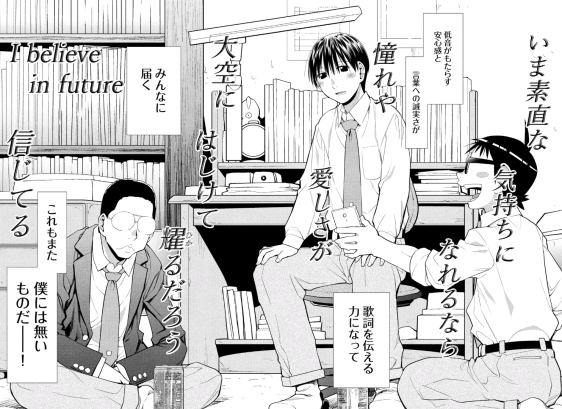
Akira, Jin, and Shinji go over to Akira’s place to celebrate him finally joining the club on a technicality. As the three shoot the breeze, Akira talks about his vast collection of children’s books (and general love of books), his lack of TV and other forms of media, as well as the fact that his widowed mom being the reason he enrolled in Hashimoto Technical High School. For his part, Jin explains his motivations, namely his love of chorus groups and his desire to do everything in his power to make singing buddies (of which Akira is the first).

When Jin decides to try another song with Akira, he makes a discovery: Akira can sing much more clearly if he’s reading the lyrics, as if the comfort he feels from books transfers over. Soon after, however, a new face shows up at Akira’s door: a disheveled lady of unknown identity.

Technicality

The requirement for Akira to join the chorus club was that he had to sing. Jin decides that Akira qualifies after reciting part of a song, but Shinji objects: Akira didn’t really “sing”—he just talked! Jin, however, replies that plenty of pop songs have spoken portions. If it’s part of a song, it’s singing!

There’s something very appealing about this technicality, in that it reminds me of discussions I’ve heard and read over the years as to whether something like rap counts as “music.” There’s a always a certain type who will dismiss things that don’t fit their definition of “song,” and to see Jin gave a wider criteria gives me hope that Hashikko Ensemble won’t be unnecessarily critical of certain genres or styles.

Akira’s Spotlight

This chapter reveals a lot about this soft-spoken fellow, fleshing out his background in simple but profound ways. That flashback of him singing in previous chapters finally has context, as we learn that he was part of a class vs. class competition in middle school, and regrets not being able to sing better. We learn about his family circumstances—including his mom being a nurse—and even his hobby too. I’m actually surprised that I didn’t even notice that the manga hadn’t revealed anything about his interests until know, and chalk it up to the characters being inherently interesting and charismatic. It feels a lot like Akira’s potential lies in taking the internal peace he can create while reading, and bringing it out into the world.

Non-Nuclear Families

When Akira mentions his family circumstances, the other two also mention that they also have “non-standard” families. Shinji’s parents are divorced, and he lives with his mom. Jin lives with his dad. While his parents aren’t divorced, they do have separate homes, and he seems to have some issues with his mom.

The fact that the main trio of Hashikko Ensemble all have families different from the typical “mom, dad, two kids” setup feels special. It’s one thing if only one of the characters is in one of these situations, but the fact that all three are “different” makes it seem like anything but. Their families have some influence on them, like how Akira wants to start working to support his mom, but no one comes across as the odd one out.

Songs

“Kanade” by Sukima Switch makes another appearance! It’s the song Akira’s class sang in middle school.

“Believe,” written and composed by Sugimoto Ryuuichi. It was used as the theme song for the NHK nature show Ikimono Chikyuu Kikou.

Final Thoughts

During a flashback, Akira is shown lending his earphones to Orihara. However, because they’re not noise-canceling, Akira accidentally hears some of the music. He doesn’t know what it is, but he definitely recognizes it. What could this song be, when Akira barely listens to music as is?

And who’s the girl at Akira’s door? I assume it’s either his mother or his sister, but it’s hard to tell from her appearance. She looks a bit on the young side, but she might just be youthful for her age.

Darling in the Franxx: Thoughts on a Divisive Anime

WARNING: Spoilers for Darling in the Franxx, Gurren-Lagann, Evangelion, and Daitarn 3 (yes, you read that right)

When I first wrote about Darling in the Franxx and its sexual dystopia, the series had just presented some major revelations, among them how Hiro and Zero Two first met, and the true identity of the Klaxosaurs. Seven concluding episodes later, it turns out those “bombshells” were only the tip of the iceberg.

But this show has been full of surprises, and fan reactions to all of these twists and turns has been just as fascinating to follow as the show itself. Darling in the Franxx is, in a word, divisive—perhaps more than any other anime I’ve seen in a long time. I believe the reason for this boils down to one thing: the show attracted a wider range of fan types than most anything else, and the conflicting takes are a product of these differences. My own take is tha the series only got better as it went along, but I’m well aware that many do not share my view to the extent that it seems as if we were all watching different anime. When I give my opinion and analysis of Darling in the Franxx, it’s with this caveat in mind.

Eye of the Beholder

Let’s get into some of the major reveals in the last quarter of the series.

  • Magma energy is revealed to be the energy source that has allowed humanity to achieve immortality.
  • The Klaxosaurs don’t consider humans their true enemy, because the actual problem is a non-corporeal alien race of conquerors called the VIRM, who all but destroyed Klaxosaur civilization both directly and indirectly thousands of years ago.
  • “Papa” is actually one of the VIRM. They infiltrated the human race and purposely pointed them towards magma energy as a way to weaken the Klaxosaurs. This is because the planet’s magma is actually made up of Klaxosaurs who purposely sacrificed themselves to become an energy source for the monster-form Klaxosaurs to fight off the VIRM.
  • The VIRM basically takes the minds of all of the adults because their goal is to integrate all species in the universe within themselves. This leaves only the non-adults (namely the Franxx pilots!) left to fight. The remaining humans join forces with the Klaxosaurs and go into space to fight the VIRM.
  • Ultimately, through the power of love and friendship, Hiro and Zero Two manage to truly become one (more on that later) and defeat the VIRM. Humanity has to rebuild without the use of magma energy, fully aware of the price they paid for draining the planet of such an important resource, and out of respect for the Klaxosaurs.

That’s quite a lot for a series where the initial main debate was “which girl is better, Zero Two or Ichigo?”, and for every fan who fell in love with the show from episode 1 only to be disappointed by where it went by episode 24, there seems to be another fan who thinks the opposite. Moreover, unlike series such as Dragon Ball Z, where the things that fans love about it are the very same things the haters scoff at, no one can actually seem to agree what Darling in the Franxx is about or what it’s saying, let alone which parts are good or bad.

The anime appears to have drawn in a larger variety of anime fans to it than is typical, combining a multitude of genre signals (mecha, science fiction, romance, love triangle) with provocative, often sexual imagery. As a result, the disparate values (both in terms of personal values and ideas as to what makes a show good) of the viewers meant that people came to the show with wildly different expectations from one another. In this environment, I’m not certain I can change anyone’s minds, but I can at least put my thoughts out there.

Defying and Affirming Conventional Humanity Through Romance

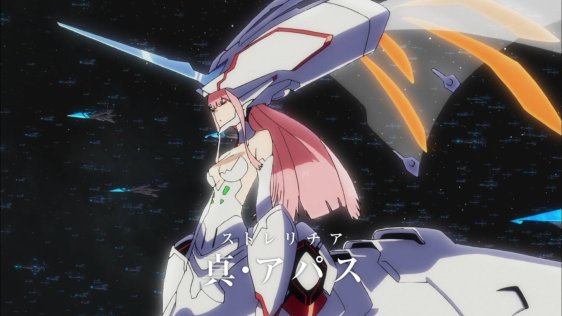
Take the subject of my previous post: whether or not the anime reinforced heteronormative values, extending to the rule of man and woman as father and mother. While Darling in the Franxx indeed ends with multiple characters having children in heterosexual relationships, it’s still notable that the main couple of the story cannot have children together. The ultimate expression of their union and happiness instead involves Zero Two becoming a literal giant robot version of herself, in a cross between a wedding dress and Mechagodzilla, while Hiro pilots her from within, carrying connotations of both penis and womb but also referencing the series’s own world. Hiro, in a way, acts like the magma energy that powers the Klaxosaurs, moving away from “conventional humanity” in order to be with the one he loves.

On a less dramatic scale, Ikuno (the only lesbian in the series) ultimately does not have children, but instead devotes her life to science and medicine. Without having any offspring of her own, she makes for herself a position that can help ensure humanity’s future. Hiro, Zero Two, and Ikuno all found ways to help humanity without having to be directly involved in pregnancy. And while not entirely clear, it might just be the case that Ikuno found someone who reciprocated her feelings as well. So I can’t see Darling in the Franxx as being all gung-ho about baby-making at the expense of other people’s life choices, though those more sensitive to the topic might see the degree to which the core cast decides to have children to be the stronger message.

Through the Lens of a Long-Time Mecha Fan

Another criticism of this series is that it’s shallow, schlock entertainment more interested in M. Night Shyamalan-esque swerves than any actual substance. What exactly this has meant in the context of Darling in the Franxx has changed over the course of the series, but one of the big sticking points is the VIRM reveal. Online discussion revolved around whether this was an unnecessary twist that betrayed the feel and purpose of the series, or if the show had cleverly set it up all along, and that it made perfect sense for Darling in the Franxx. I personally lean towards the latter, but I think this comes partly from being a long-time fan of the mecha.

Long before Gurren-Lagann took “go big or go home” to the most lovingly ridiculous degrees, sudden shifts to space or to larger-scale stakes were part and parcel of an anime genre founded in kids’ entertainment. The series Daitarn 3 (1978) literally goes immediately from Earth to space for the first time (barring flashbacks) in the final episode. In time, more creative and ambitious shows tried to incorporate that dramatic build-up more effectively, and I see the heavy emphasis on personal relationships and sexual tension of early Darling in the Franxx as an effective low-key cornerstone that sets up the eventual ramp-up in the long-term. Even the rapid pace of the last few episodes bothered me little for similar reasons, but fans who did not come into anime on shows that preferred such abrupt shifts could very well see it as clunky, headless-chicken writing. I understand, yet I still feel the progression to be appropriate and maybe even nostalgic.

Final Thoughts on the VIRM, and the Ending

It’s not uncommon to see Darling in the Franxx compared to either Evangelion or Gurren-Lagann for aesthetic and thematic reasons, but there’s another factor all three shows share: the idea that they in some way or form betrayed their audiences. Evangelion is probably the most famous example of an unexpected ending, with its compete stylistic departure and its abstract, introspection-heavy final episodes. Famously, the staff of Evangelion actually received death threats for it. Gurren-Lagann pulled the brakes on its do-anything, push-the-envelope mentality for its conclusion, which stung fans who watched it precisely to revel in that feeling of “doing the impossible.” Darling in the Franxx is capable of “betraying” large swathes of its diverse viewership, but I do not think the series actually crumbles when looked at with greater scrutiny.

While the opinion that the VIRM twist comes “out of nowhere” isn’t shared by all—some even accurately predicted the show’s move into space—I think an essential difference between detractors and supporters of the final episodes is that the finale comes with a tonal shift from being an anime that was focused heavily, at least on the surface, on the personal, intimate, and erotic. If that’s what you came to the show for, then it might feel like the two pieces don’t connect.

As mentioned previously, however, I don’t mind this change one bit. The reason? Because Darling in the Franxx has emphasized that something is terribly wrong with its world all along, and not just in terms of the Klaxosaur attacks. Whether it’s meeting other Franxx pilots and realizing how emotionally stunted they are, to the adult/child divide, to the sheer sterility of their cities, something has felt amiss from the start. Perhaps the VIRM being “the real enemy” can feel contrived, but taking a wide view of the series means seeing the depiction of a false Utopia that humankind bought into and that the children had to eventually make up for. Not enough people questioned the gradual consolidation of power around Papa and his organization, APE, or the exact nature of magma energy. Theirs was a society of ignorance, and it led to children like Hiro being punished for trying to fight that ignorance.

Even though Hiro and Zero Two manage to deal a crippling blow to the VIRM, the real challenge is trying to survive as a species without any magic bullets like magma energy. The libidinous energy that was once literally redirected into warfare goes to expressing love, whether that’s through making children, helping children, or just creating happiness. While personal perspective plays a significant role in how one interprets the series’s message, is it strange to see the main cast, poised to change the world since the first episode, end up doing so?

R.I.P. Nerd? More like RIPPED Nerd: Hashikko Ensemble, Chapter 5

I’ve liked Hashikko Ensemble well enough so far, but this is the first time I’ve found myself laughing over and over again while reading.

Summary

The rugby club has their eyes set on recruiting Orihara, but he doesn’t want anything to do with them. Jin wants Orihara for the chorus club, but when the rugby boys claim that their sport is perfect for strapping young fellows, Jin reveals a secret: he’s actually incredibly ripped!

Jin and the rugby captain decide to settle it with a competition: who can do the most push-ups while reciting the school anthem? But while they seem even, Jin has a trick: harmonizing with the captain to throw him off! Jin’s ploy is successful, and he wins the right to Orihara, but the guy doesn’t care. An altercation with the rugby captain, who demands Orihara honor the bet, causes Orihara to take a swing, accidentally breaking his earphones in the process. An incensed Orihara leaves the classroom, only to run into Akira.

Singing is a Man’s Sport

Who would’ve thought that Kimura Jim was that built? He’s practically Muten Roshi from Dragon Ball or the Incredible Hulk! I simply did not expect this twist, and while I assume it’ll not alter the general story in any crazy way, it does highlight just how into music Jin really is. He got that body just so he could sing better!

Funny thing: as I started this chapter, I thought to myself how Hashikko Ensemble showcases Kio’s knack for depicting realistic characters, where the humor doesn’t feel overtly “manga-esque.”

Then the shirts started coming off. Between the reaction from Hasegawa (whose clear preference for macho bodies comedically contrasts with her friend’s interest in more handsome types) and the “singing push-up” competition, the chapter hit a certain level of absurd that both deviates from Kio’s norm and reinforces that strength in characterization. It’s ridiculous but still somehow down to earth, and not in that healing slice-of-life way.

Orihara’s Part-Time Job?

Orihara has a part-time job of some kind, and it appears to have major implications. Orihara himself states that it’s the reason he can’t join any clubs. Jin guesses—correctly, it seems—that the job has something to do with his voice. I have no idea what that could be, but perhaps he works the loudspeaker at a supermarket or something.

Also, according to Jin, it’s work that probably requires Orihara to be heard, and he theorizes that Orihara has developed a rich baritone where his facial movements allow him to transmit sound more clearly without having to be as loud. This is also some solid storytelling, as it connects one of the first scenes in the chapter, the face exercises Akira and Jin are doing on the title page, with this new information.

The Girls

It might seem unusual that I bring up the female characters in every review, but that’s mainly because their purposes in the story are nowhere near as obvious compared to Akira, Jin, and even Orihara fall into the general flow of the narrative. Gradually, chapter by chapter, they come more into view. In Chapter 5, we learn about Kurata’s antagonistic perspective on club activities, which in her eyes serve no purpose in a high school devoted to tech and engineering—especially not music. Is her path continued opposition of the chorus club? If so, would it be more active or passive? Questions, questions.

I actually didn’t recognize Kurata at first, because she’s only shown up so far with her hair tied up and an intense look in her eye as she tries to master subtlety and control with her tools. The fact that she looks so serious and together in this chapter contrasts somewhat with her previous depictions. The only thing that makes it crystal clear it’s the same girl is the closeup on her eye. If there’s any way to describe her, it might be “serious business to the point of comedy.”

Hasegawa seems pretty nonchalant in general, so seeing her freak out over some hard bodies adds an extra wrinkle to her character. I find it noteworthy that she can talk to Orihara so naturally when he’s implied to be just as buff. Does she really only react to bare muscles, or is there something else? I also wonder if Hasegawa’s going to be into Jin, or if the fact that there’s plenty of muscles to go around means no direct romance.

The Science of Hearing

When Jin is talking to Orihara about the latter’s cryptic “I can’t hear it but I can” statement, he brings up two terms: “phoneme restoration” and “aural harmonic.”

Phoneme restoration, or the phoneme restoration effect, refers to when a listener somehow hears a sound during speech that wasn’t actually present. Under the right conditions, a word could be pronounced with noise replacing or overlapping certain consonants, and our brains fill them in as if they were there.

Aural harmonic is “an overtone that is heard by the normal ear when a pure tone of suitable frequency and intensity is sounded and that is presumably due to the nonlinear response of the ear mechanism.”

In other words, both refer to effects that alter listening and make you hear things that aren’t necessarily there. It’s unclear as to whether or not this applies to Orihara, though.

Songs

No special songs this month! Just the school song again, albeit done by buff guys doing push-ups.

Final Thoughts

I wonder if Orihara’s presumed ability to make his voice heard despite not speaking very loudly means he’s going to be a teacher of sorts for Akira. And as for Jin, I wonder if everyone in school will see him differently now.

Return to Genshiken – Volume 9: Don’t Call It an Ending?

Here we are: the end of Genshiken. At least, that’s what we could’ve said if the sequel never came out. It’s fascinating to look at this last volume while both remembering the finality with which it hit back around 2006, and being cognizant of the developments that have occurred since then.

What is Return to Genshiken?

Genshiken is an influential manga about otaku, as well as my favorite manga ever and the inspiration for this blog, but it’s been many years since I’ve read the series. I intend to re-read Genshiken with the benefit of hindsight and see how much, if at all, my thoughts on the manga have changed.

Note that, unlike my chapter reviews for the second series, Genshiken Nidaime, I’m going to be looking at this volume by volume, using both English and Japanese versions! I’ll also be spoiling the entirety of Genshiken, both the first series and the sequel, so be warned.

Volume 9 Summary

A visit from Ohno’s American friends, a New Year’s shrine visit, a fight between Sasahara and Ogiue, and a failed confession from Madarame all lead to the finale of Genshiken: graduation for Sasahara, Kasukabe, and Kohsaka. Good times, good memories, and an open future are in store (at least, until the sequel shows up).

A New Ogiue

It surprises me that even to the very end, we’re still learning a lot about Ogiue. It might be because she’s had such a dramatic shift in her own life in the previous volume (i.e. resolving her inner turmoil and starting a relationship with Sasahara) that we’re seeing sides of her that were previously obscured.

One of the most notable qualities in Ogiue after her change is that she loves being in love. She wants Sasahara to hold her. She enjoys walking and talking. She’s easily embarrassed, so public displays of affection are out of the question, but the thrill of being with Sasahara permeates her being and helps to make every day of Ogiue’s a less angry one compared to her past. However, what becomes evident is that Ogiue did not undergo a total transformation. That anger and confrontational stubbornness is no longer omnipresent, but it’s still there, and it still fuels Ogiue when she needs it.

This quality of hers is seen in Volume 9, when Ogiue asks Sasahara (who’s now working as a manga editor) to look over her submission for a published manga magazine (Monthly Afternoon, the home of Genshiken, as we later learn). Here, we find out Ogiue tends to take criticism very personally. In her eyes, comments about the lack of a clear protagonist and a too-long introduction are attacks on her character and her ability, and she lashes out at Sasahara. But as Yabusaki points out, Ogiue’s not the type to give up easily. Motivated by rage, she revises her manga (and draws a second submission!) in a way that incorporates Sasahara’s advice. So it turns out that she’s bad at receiving criticism but great at utilizing it—a volatile combination that Sasahara somewhat laments.

The unique editor-artist/boyfriend-girlfriend relationship between Sasahara and her is another facet of Ogiue hat is revealed in this final volume. In the sequel, this dynamic is constantly referenced, even as early as the first chapter of Nidaime, making it a vital part of how they interact with each other. While I’m loathe to simplify everything into S&M relationships, there is a sort of subtle sadomasochistic quality to their relationship because they keep going through this pattern of criticism, anger, and renewal, only to come back for more. But given that Ogiue’s both willingly letting herself get mad and taking it out on Sasahara, it’s not like there’s a clear-cut “S” or “M,” if you can even use those labels at all.

As an aside, Yajima in Nidaime goes through a similar thing, creating a highly entertaining manga after getting fed up by her lack of apparent talent compared to Hato, but I wonder if that’s less anger and more frustration.

Silence

In Chapter 53, “Confession,” Madarame runs into Kasukabe alone in the club room, conjuring up the memory of when he first started to develop a crush on her. Sure that she’d be forever out of his reach, Madarame elects to stay quiet about his love, preferably for the rest of his life. Back when I first read it, I thought Madarame did, if not the right thing, then the Daidouji Tomoyo route of “I want the person I love to be happy.” I think it was and is easy to relate to the plight of a noble (or perhaps spineless) nerd and his unrequited feelings, and to see Madarame as a mildly tragic (perhaps moe) character.

Of course, things have changed since then with Madarame in Nidaime confessing, being turned down, and ending up with Sue after a drawn-out competition from a bevy of female suitors, but I distinctly remember back then thinking that leaving things unspoken and unsettled might indeed be Madarame’s fate. And now, looking at this whole plot thread in full, I’d say Madarame confessing in Nidaime was the right choice because it’s clear he just couldn’t move on. In order to find another potential partner, he needed to be rejected because he’d be stuck in perpetual emotional limbo otherwise.

But Madarame’s confession isn’t the only time silence plays a major role. One of the highlights of Volume 9 is a special chapter dedicated to showing Kasukabe finally doing a joint-cosplay photo shoot with Ohno. The story has Kasukabe an unwilling victim of her own promise, Ohno trying to sneakily give photos of Kasukabe to Madarame, Ohno getting clocked for her efforts, and everyone getting ready for the graduation. This is done entirely without dialogue or sound effects (the sole word balloon being a “!?”), and it creates a powerful mood as the penultimate chapter. The fact that it comes directly after “Confession”—silence following silence, so to speak—might be coincidental, but it only adds to the feeling that “this is it, the end of Genshiken.”

That chapter is also an exercise in creativity for Kio, which is something I see in Volume 9 more generally. Earlier in the volume, when the characters are visiting a shrine in Narita for New Year’s, there’s an image of the group walking around, overlaying a bunch of other panels showing off the scenery. I have to wonder if these are the seeds that lead to the more dynamic (perhaps one could say shoujo-esque) paneling of Nidaime, and if that shrine visit is the start of Kio’s fondness for dumping tourist information into his series.

Before moving to the next topic, there’s an interesting panel in the silent chapter: an unfinished drawing of nighttime that leads into a Sasahara and Ogiue scene. It’s clearly not meant to be unfinished in that “roughness makes it look more interesting!” way, and it’s never been fixed or corrected. This isn’t a big deal, but it stands out all the more because of how detailed the scenery and environmental backgrounds typically are in Genshiken.

Sue, and the Story “Yet to Come”

Sue’s always been a fascinating character in the sense of her being a non-American’s (surprisingly accurate) interpretation of an American fangirl, but also in that she makes a strong impact from her mere presence. To this day, one of my favorite moments in Genshiken is Sue reenacting the “hiccup scene” from Azumanga Daioh—there’s something perfect about those “clones” of hers showing her gradually moving toward Sasahara, delivering every line in the process, before planting her fist in his solar plexus. In one of the between-chapter comics, Yabusaki runs from her (feeling awkward/shy around foreigners), only for Sue to unexpectedly start chasing her. If there’s any character in Genshiken who’s consistently hilarious, it’s Susanna Hopkins.

Given how little she appears, it’s amazing how much we see of Sue in Volume 9. We learn that she wants to study in Japan, we see her form a weird and affectionate bond with Ogiue, and we see her interact with Madarame more. If Genshiken had ended here as it originally did, we’d be left with just a general sense of Sue’s comfort around the two of them. With the context of Nidaime, these two relationships become much more significant. Even though Sue’s known Ohno for years, Ogiue might actually be her best friend. As for Madarame, that scene of him with Sue on his shoulders as he feels the warmth of her thighs takes on a whole new dimension.

Graduation as the Turning Point

Graduation is a special time in most school-themed works that run long enough, and it’s typically presented as all the things one might expect: a changing of the guard and the dawn of a new age. Genshiken ends up having two (three if you count Nidaime), and I think of its many strengths is how it handles these generational changes. They’re not necessarily abrupt, and it’s not like the old characters go away, but the refocus of the core cast is tricky to handle. While I know everyone has their own favorite “era” of Genshiken, I’m impressed by how well this manga handles that transition each time.

Anachronisms and Retcons

It amuses me that we still see flip phones in Volume 9. By the time Nidaime rolls around, Ogiue already has a smartphone. The sequel is supposed to take place not long after Volume 9, but the actual real-life time gap meant a lot of small things ended up changing. In the end, I think it’s for the best, instead of having to try and faithfully replicate 2005-2006 for the newer series. Besides, one of the points of Nidaime is to reflect how much otaku culture had changed over the past decade, and that wouldn’t quite fit if Kio just went straight back to the subculture of the mid-2000s.

In fact, one of the big changes in Nidaime is the much-higher female population, something that’s already sort of in motion in the first Genshiken. This brings up a big question: is the original Genshiken ending retconned? In it, we see a group of anonymous guys come up to the club room and greet an off-screen club president. In Nidaime, those guys are nowhere to be found. Is it supposed to be some undefined “future?” Should we pretend that scene never happened? It can’t be the past, because there’s a poster of Sänger Zonvolt and the little-girl version of Irui Ganeden from Super Robot Wars Alpha 3 (2005).

Kasukabe Saki, Moe, and a Translation Correction

I’m about to say something that might surprise Genshiken fans: The English translation of the final page has issues that alter the meaning significantly.

The final side story for Genshiken series 1 involves everyone having post-graduation drinks, when Madarame brings up a topic of discussion: “What would make Kasukabe be moe?” They go through different possibilities (sexy character, tsundere), only to realize that other girls closer fit those archetypes (Ohno and Ogiue, respectively). Madarame thinks the only way it’d work is if Kasukabe were a virgin, such that her insecurities became her vulnerability and thus her moe quality. Kasukabe asks Kohsaka what’s moe about her, and his answer is nothing. The other girls then wonder if Kasukabe really hasn’t noticed Madarame’s feelings, and the entire manga ends with her looking at them (and the viewer), oblivious.

This might not be how you remember it, and it wasn’t quite how I remembered it either. Back when I first read this, that I thought the final chapter was more about taking the piss out of Kasukabe and just ending with a good ol’ classic otaku discussion. Only now, having done this re-read, I realized both my error and the official English translation’s mistake. Japanese is very much a language of unspoken context and Genshiken is quite slangy when it comes to how the characters talk. By being even a little off in terms of understanding the meaning conveyed, it can completely derail the point of a scene.

Here’s the English translation:

Keiko: I wanna watch this whole thing explode.
Ohno: No, that wouldn’t be fair. Because you wouldn’t be the one exploding.
Ogiue: I’ve always felt this way, but I don’t think Kasukabe-senpai realizes how sensitive she is to conversations like this.
Girls: ……
Kasukabe: Huh?

And here’s what it’s saying in Japanese (I’ve made the translation a little stiff on purpose to give as much of the full context as possible).

Keiko: I sooo wanna step on that landmine.
Ohno: You can’t. Because you’re not the one who’d explode.
Ogiue: Um……I’ve been thinking about this for a while, but do you really think Kasukabe-senpai hasn’t noticed? I mean, she’s perceptive when it comes to this kind of talk, right……?
Girls: ……
Kasukabe: Huh?

The issue is that the English translation first has Keiko talking about wanting to watch it all explode, when the Japanese is using the term “step on a landmine” to basically mean “I want to bring up something I shouldn’t,” i.e. the fact that Madarame is in love with Kasukabe. That’s why Ohno responds with “You wouldn’t be the one exploding,” because it’d be Madarame catching the brunt of that. Then, when Ogiue chimes in, what she’s really talking about is how odd it is Kasukabe hasn’t noticed Madarame’s feelings when she’s normally so good at catching on to these kind of subtle social cues. The trouble is the term binkan, which can mean sensitive or susceptible, but also aware and alert.

So the real point of this whole thing is that Kasukabe’s potentially “moe” qualities are there, just not in the way that’s readily apparent. They mainly exist only relative to her interactions with other individuals, namely Kohsaka and Madarame. With her boyfriend, it’s her inability to handle Kohsaka’s cutting remarks. With Madarame, it’s the possibility that, somehow, the most socially perceptive person in the group hasn’t notice how hard this guy is crushing on her. As we later learn in Nidaime, Kasukabe’s suspected Madarame of liking her all along, but didn’t pick up on the actual hints, in a “stopped clock is right twice a day” sort of way.

Final (Random?) Thoughts: What is Genshiken‘s Greatest Strength?

As I finish this revisit of my absolute favorite manga series, I’m left to wonder why Genshiken grabs me so thoroughly. Luckily, a recent interview with Kio Shimoku revealed an important factoid: Kio never actually spent all that much time in the anime/manga/gaming club that became the inspiration for Genshiken. Instead, his characters are shaped by a seeming desire to make them feel as real as possible. And that’s who these characters are. They’re otaku, but they’re not limited by that label. They’re human beings, full of wants and desires, contradictions, the potential for growth, and so much more. That’s what drew me to the series, and that’s what inspired me enough to name this blog after Ogiue. The endless voids of her eyes and the anger inside of her filled me with inspiration and joy all those years ago, but it’s the way she evolved that made me a fan of her (and this great manga) forever.

Thoughts on Shinkalion, the Robot Anime Designed to Promote Bullet Trains

Shinkansen Henkei Robo Shinkalion is the most blatant advertisement in cartoon form that I’ve seen in a long time. It’s so upfront with its true purpose—promoting Japan Railways’ shinkansen (aka bullet train) system—that it’s right in the title. But I actually don’t mind the extreme shilling of Shinkalion all that much, and it’s for one simple reason: the Japanese train system, including its shinkansen, is astoundingly good.

The hero of Shinkalion is a young boy named Hayasugi Hayato, a total train otaku. Hayato discovers that his dad, ostensible a Japan Railways (JR) employee, works for a secret division dedicated to fending off monsters attacking Earth. In an emergency, Hayato becomes the pilot of a Shinkalion, a super-advanced train that can transform into a giant robo, and helps his dad in their fight against the forces of evil. Naturally, all Shinkalions are based on actual, real-world shinkansen trains. Incidentally, one recurring gag among Japanese Shinkalion viewers is referring to the series as a reverse-Evangelion because it’s about a young pilot who can’t wait to support his dad on his mission to fight off monstrous invaders.

It’s not just the Shinkalions themselves that are selling Japanese trains to the audience, as nearly everything about the anime talks up the country’s rail service. Hayato’s family name, Hayasugi, is a homophone for “way too fast” in Japanese—a reference to the high speeds of the shinkansen. His catchphrase, “I’m Hayasugi Hayato, the guy who always makes it on time!”, is based on the fact that the Japan rail system is famously on-schedule. Whereas other train systems around the world might see a 10-minute delay as “reasonable,” a five-minute difference is considered “extreme” in Japan. This is part of why train otaku exist, as it’s not just the mechanical aspects of the trains themselves that hold appeal. The precision and complexity allows enthusiasts to imagine riding from one part of Japan to another while planning the most perfectly efficient route possible.

While Shinkalion is indeed mainly about high-speed trains, it also advertises for a few other things. There’s tourism, the natural extension for a show about trains, with the ending theme showing various famous landmarks across Japan. While I haven’t researched it, I’m confident that all locales presented are reachable by shinkansen. Then there’s the Google product placement. Not only is one of the characters a popular Youtuber, they even use the term Youtube and show it off. The strangest promotion is the fact that the Vocaloid, Hatsune Miku (or a convenient alternate version of her), is a pilot in the show—and she’s actually voiced by the Hatsune Miku software! In this instance, it might be JR that’s benefiting from the association instead of the other way around. The result is that Shinkalion is a kind of marketing black matter. The characters would have to be plastered with logos like NASCAR racers for it to go any further.

I’ve taken bullet trains, and they’re an amazingly comfortable experience. I’ve taken regular trains, and they’re so reliable it makes coming back to New York City’s subway system almost feel like culture shock. If this fairly generic giant robot cartoon wants to sell me on shinkansen, it can do that all day long. That said, I would be wary of Shinkalion becoming propaganda for JR as this perfect entity, because there’s evidence that it isn’t. Glancing at reviews on Glassdoor, there are multiple negative comments about the companies being extremely conservative businesses and thus stifling its own growth. Perhaps the efficiency of the system comes at a (human) price.

Still, I can enjoy Shinkalion for what it is. This 500-yen Shinkalion model kit I bought is a testament to that.

Report: Retro Doujin Event Game Legend 28

On a recent trip to Japan, I attended a doujin event dedicated to retro games. It was an opportunity on my part to not only attend my first ever Japanese event dedicated solely to video games, but to see just what “retro” meant for a Japanese audience.

Held in the city of Kawaguchi, “Game Legend 28” saw a fairly packed attendance. I’m awful at estimating crowd sizes, but I’d say there was close to 200 people in attendance. The vendors there offered a diverse range of goods, even more than events I’d attended in the past, and it was primarily due to the subject matter. While the standard comics and essays were there in droves, one could also find CDs of video game music covered by amateur bands, entire archives of instruction manuals, people’s personally developed games, and even super-miniaturized (and playable!) versions of arcade and console titles. The last item seemed to be a trend, as more than one table offered them.

When it comes to trends one might not see at a US convention, I noticed that there was a great amount of love given to the PC-Engine (released in the US as the Turbo Grafx 16), and that certain popular Japanese meme characters such as Spelunker still held strong. I also met a woman who wore a Segata Sanshiro t-shirt and sold a photo journal of her time attending a Sonic fan event in Korea. Another dedicated herself to F-Zero, showing not only doujinshi but tiny F-Zero machine replicas as well.

It’s common to presume that doujinshi means “porn,” but I actually saw very few tables dedicated to 18+ material. Even then, one was selling a comic featuring a popular heroine from Tokimeki Memorial. In other words, even the smut was frequently retro.

Ultimately, I enjoyed Game Legend 28, and even bought a few things, including a Sega Smash Bros. parody doujinshi starring Alex Kidd. But the event also inadvertently curried favor with me when a small live brass band played a song from one of my favorite video game soundtracks ever. Following performances of the boss theme from R-Type and the ending theme to Chrono Trigger, they went straight into “Back to the Fire,” the Hydra stage music from Thunder Force III.

At that point, Game Legend 28 could do no wrong in my mind.

“Mogusa-san Fights Against Appetite” Concludes on a Body-Positive Note

Whether she’s a high school student discovering love or a college student striking it out on her own, the gluttonous Mogusa Minori is among my all-time favorite manga characters. Earlier this year, the story of a girl whose fondness for food transcends human limits had concluded in the fifth and final volume of Mogusa-san Fights Against Appetite. I’m not going to retread a lot of ground because my previous review still holds up, but I do want to elaborate upon the final message of the series and its overall positivity.

The main premise of Mogusa-san Fights Against Appetite is that Mogusa, whose appetite is virtually endless, is trying to transition into a more normal eating schedule. Where once she could be found snacking throughout the entire day, now she wants to limit herself to “only” three meals—albeit, every individual meal is itself more like three meals to the average person. Part of the comedy of this series is that, inevitably, Mogusa succumbs to her hunger pangs and has a rapturous encounter with whatever food’s in front of her. In the final volume of Mogusa-san Fights Against Appetite, however, this begins to increasingly weigh on her mind.

Seeing everyone, including her boyfriend Koguchi Torao, working hard to achieve their dreams and win their personal battles makes Mogusa very self-conscious about the fact that her own challenge—eating somewhat like a “normal” person—seems so frivolous compared to others’. But a trip back home and some advice from her mom helps Mogusa to see differently. She has matured, and in fact her gluttony has been of great benefit to her. She’s made great friends, met a wonderful boy who’s grown into a splendid man, and given her a wealth of experiences. Mogusa ultimately decides to embrace her food lust and aim to become a gourmet writer, sharing her passion for cuisines great and small with the world.

This conclusion resonates with me greatly, and not merely because I love to eat everything as well. When it comes to food shaming and body shaming, we live in a culture where outward physical appearance and behavior are often prioritized over one’s psychological well-being. The guilt Mogusa feels over eating is not uncommon, even if it’s exaggerated in her instance. Every so often, I see someone mention that a guy or a girl are disgustingly fat and that they need to get in shape, not taking into account the inner emotions of the person they’re speaking about. Some people are better off exercising and experiencing dramatic weight gain/loss because it can lead them to greater personal satisfaction and overall happiness. For others, however, the constant pressure to match a certain beauty standard means that being more physically fit can lead to mental turmoil. There’s no universal solution, even if at least some exercise is undoubtedly beneficial in e end.

This lesson isn’t limited to food. For as long as I’ve been a part of online communities, I’ve seen people twist themselves trying to hide what they deemed to be shameful hobbies or activities. They get so desperate in their desire to not be judged by their peers that it eats them up inside (Mogusa-san pun not intended), and I’ve tried to live my own life in defiance of that. Even if there might be problems that arise from one’s own interests, it shouldn’t be repressed to the point that it crushes people from within.

While Mogusa has an impossibly petite body given how much she eats, and she’s perpetually “anime-girl cute,” even she has to fight an image in her mind that she fails to live up to. In her case, it’s the yamato nadeshiko-style ideal Japanese woman archetype. She constantly imagines Koguchi, who’s living in the old Japanese capital of Kyoto, breaking up with Mogusa because she’s not traditionally beautiful enough. This also ties into how one of Mogusa’s greatest shames is the thunderous roar of her belly when she’s hungry. In Japan, many women find a growling stomach to be embarrassing, and Mogusa’s is capable of waking up sleeping animals. To see her overcome all that and be in a happier place fills me with joy.

That Distant Roar: Hashikko Ensemble, Chapter 4

As I continue to read this manga, I continue to find it hard to predict. That’s all part of the fun, though. There’s also much to be admired about the characters, especially Jin—even if he’s a bit lacking in social tact.

By the way, I was lucky enough to be in Japan when this new issue of Monthly Afternoon came out! That’s why the images are photos this month, instead of digital screenshots.

Summary

Jin’s found the perfect place for Akira to practice projecting his voice, and it’s an open stairwell at school with plenty of foot traffic. Acoustically, the location is ideal, and Jin does his best to break down how singing works. But Akira’s easily embarrassed, so they only get so far.

Jin’s still got his eye on the prize, though, and needs at least three more members to make the Chorus Club a reality. To that end, he has his sights on two classmates: Hanyama (that jokester son of a Buddhist priest), and the burly, delinquent-looking Orihara. Meanwhile, Orihara himself is getting into fights after getting accosted by a classmate. During this incident, Orihara’s heard uttering something cryptic: “I can’t hear it, but I can.”

Jin might be intrigued by Orihara’s statement, but it seems the rugby club also has their eyes set on him. Can the nascent Chorus Club get to Orihara before they can?

What’s in a Name?

Up to this point, I didn’t quite realize why the series is called Hashikko Ensemble. Turns out it was pretty much staring at me in the face the whole time! Much like how Genshiken is short for Gendai Shikaku Bunka Kenkyuukai (“The Society for the Study of Modern Visual Culture”), the full title of this manga is Hashikko Ensemble: Hashimoto Kougyou Koukou Gasshuubu, or “Hashimoto Technical High School Chorus/Ensemble Club.” So that clears up one mystery!

Another interesting tidbit I noticed is that the kanji for “Hashimoto” (端本) can also be pronounced as hahen, which means “incomplete.” Given how the characters are currently without a full club, I wonder if this is intentional.

Arts and Sciences

While I mentioned the technical high school setting of Hashikko Ensemble as an interesting backdrop for this manga’s narrative, it’s with this chapter that the juxtaposition of arts (music) and science (technical engineering) comes into the forefront. I think this is what makes Jin such a fascinating character. He takes a scientific approach to art, but his passion is anything but robotic.

Jin gives two different explanations for how voices work: a human one, and a technical one. The first one is “breath, vibration, and resonance.” The second one is “compression, oscillation, reverberation.” Akira seems to find something of an answer, but it’s not clear what did the trick.

A few years ago, I took some classes to help with speaking in public, and one of the lessons I learned was making “SHHH” sounds like I’m trying to shoot something down with my breath. In this chapter, Jin advises something similar to Akira as a way to train projecting his voice. I knew already that Kio does research for this series—it’s evident in the content—but it’s nice on a personal level seeing it line up with my own life experiences.

Orihara’s Secret

Orihara’s line has me curious too, but I’m just as curious as to why Jin responded to it so positively. Just what is it that Jin sees in him?

With only a layman’s understanding of sound and music, I can only guess at what the answer is. Perhaps Orihara has excellent hearing, and can detect sounds that most cannot. The beginning of the chapter features a lesson on how lower sounds remain longer, so maybe Orihara can hear those really low tones—the kind that Akira can produce.

What About the Girls?

Two female characters are featured in this chapter. Interestingly, both are in the same woodworking class as Orihara, and have scenes that involve him either directly or indirectly.

Kurata was introduced in the previous chapter, using more strength than necessary to saw through some wood, and we see in Chapter 4 that this is a persistent characteristic. She’s like a bull in a china shop, lacking in grace and trying to make up for it with energy and power. She’s shown right before Orihara, who’s much more in control even with his enormous strength, making a comparison between what Orihara does right and Kurata does wrong all the more noticeable.

The other girl is Hasegawa, who nonchalantly asks Orihara how she can complete the woodworking assignment in class more smoothly. As the other characters note, her lack of fear is impressive. I have to wonder if either of them will join the Chorus Club, especially given their proximity to the main cast at this point.

Songs

No songs again this month, only a lot of shouting, “AH!”

[Insert Akira Tozawa chants here]

Final Thoughts

Kurata’s only appeared twice, but I’m already enjoying her character. There’s something about a spaz who gets way too pumped that speaks to me. Both her and Orihara bring a lot of facial expressions that weren’t common in Genshiken, so it’s nice to see Kio’s expressive range in his artwork.

Gamblers’ Paradise: “Uma Musume: Pretty Derby”

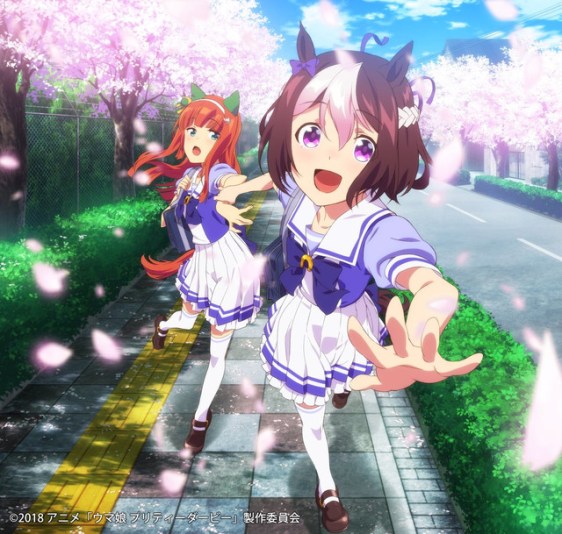
My Little Pony: Friendship is Magic may be the most prominent cartoon about horse girls, but Uma Musume: Pretty Derby is bringing a different angle. Instead of wide-eyed ponies, it’s human-horse hybrids in the vein of anime catgirls. Instead of a children’s show reminiscent of magical girl shows, it’s a strange hybrid sports/idol anime focused on racing and dancing. As a result, Uma Musume: Pretty Derby veers closer to Girls und Panzer than Twilight Sparkle and friends.

Having watched the first two episodes, Uma Musume: Pretty Derby succeeds in being a sports show. It’s got an underdog main heroine with untapped potential, plenty of characters (perhaps too many) with a variety of personalities and competitive styles, and a sense of forward progress while keeping intrigue strong. For example, just what is up with protagonist Special Week’s adopted mother? She gives me a “mom from Aikatsu!” vibe; maybe that’s not a coincidence given the idol aspect of Uma Musume.

Taken on its own, the anime seems like a reliably strong show. However, much like Girls und Panzer, the point of potential concern is what happens when one looks beyond the cartoon itself and into what it’s supposed to advertise and accomplish. For Girls und Panzer, it’s possible glorification of the military. For Uma Musume, it’s gambling.

Uma Musume is a moefied version of horseracing, a popular betting sport. But it’s also part of a multimedia franchise from mobile games juggernaut Cygames, makers of Granblue Fantasy. When it comes to lootbox/gacha systems that drive players to empty their pockets, Granblue Fantasy is one of the grandmasters, and the chase for those slim 1% chances for ultra-rares is especially enticing for those vulnerable to gambling addiction. And yes, there’s an Uma Musume: Pretty Derby mobile game on the way.

So essentially, there’s a dangerous final form of Uma Musume that could become a reality someday. This monstrous version would involve going to the racetrack to watch and bet on the ponies while also playing Uma Musume and trying to get the right gacha gifts for your favorite horse girls. To use an ancient internet joke, they put a slot machine into your betting, so you can gamble while you gamble. It’s not gotten to this stage as of yet, but I have my eye out to see where Uma Musume will go.

This post was sponsored by Johnny Trovato. If you’re interested in submitting topics for the blog, or just like my writing and want to support Ogiue Maniax, check out my Patreon.

Darling in the Franxx and Choice in a Sexual Dystopia

Amidst shipping wars and attention given to its fanservice, hearing about the anime Darling in the Franxx secondhand gives the impression that it’s light on substance at best and alarmingly conservative in its sexual values at worst. Yet the more I watch it, the more I’m convinced that these descriptions do not accurately convey what the show has to offer. Instead, what I see is an anime that explores political discourse on what it means to be in a relationship, focusing on questions of equality, agency, and defiance.

WARNING: Spoilers for Darling in the Franx

Darling in the Franxx takes place in a science fictional world where kids are artificially created and trained to use giant robots called “Franxx” in order to fight massive monsters known as Klaxosaurs. They live in a world that separates adults from children, has those same adults revered like virtual gods, and directs sexual energy towards combat. Those teens are put into not-so-subtle male-female pairings called “stamens and pistils,” who then enter a cockpit that has them basically pantomiming doggy-style sex without even knowing what it means to kiss. While these arrangements can seem like an excuse for some highly suggestive imagery, it’s implied throughout the series (if not stated outright) that this is an intentionally exploitative design within the context of their world.

The fact that their society is partly based on adults exploiting children, stunting and controlling their hormones, and making it seem like a favor is already a kind of political message. However, plenty of anime both deep and shallow have done the same. “Kids vs. adults” is a classic trope, and even the biggest names in mecha (e.g. Evangelion and Gundam) feature them to some extent.

This might appear to be an admonishment of “frivolous” romance. However, it’s quite the opposite. I find that the romances are of central importance to the complexity of Darling in the Franxx. The relationships, how they’re presented and what they represent, are a direct window into the shows’ political themes and messages. Those themes and messages, in turn, are actually supportive of more liberal views on gender and sexuality than assumed at first glance.

Futoshi and Kokoro: Relationship Betrayal or Relationship Freedom?

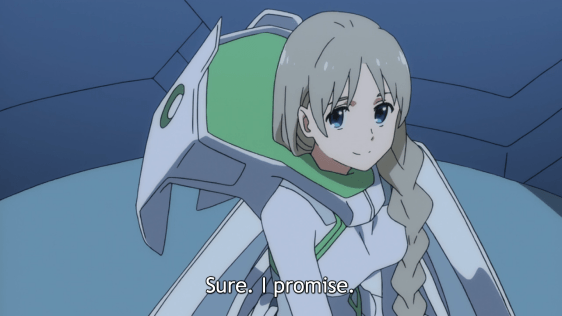
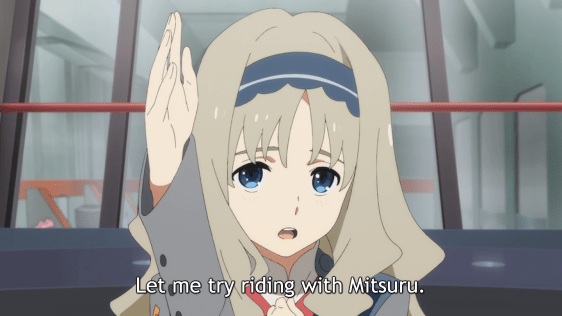
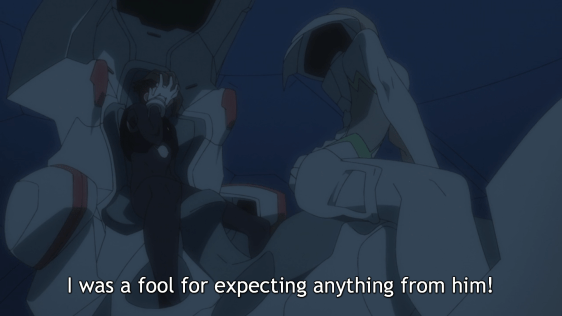
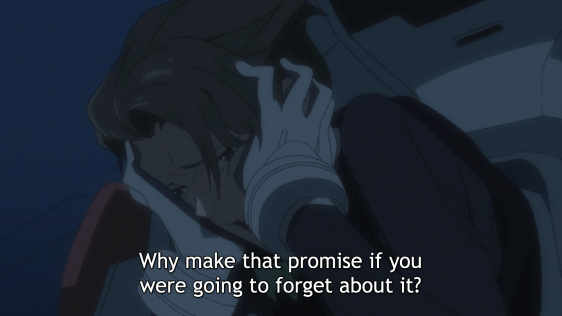
One of the more controversial episodes sees the character Futoshi pledge his devotion to Kokoro. After weakly promising to go along with Futoshi’s pledge to be his “partner [i.e. co-pilot] forever,” Kokoro later decides to try and switch partners to Mitsuru when the option becomes available—an implicit rejection of Futoshi. This was the cause of a great deal of consternation, with speculation that the show was trying to cheaply indulge in the NTR [cuckolding] fetish found in Japanese otaku culture.

However, what I think frames the importance of Kokoro’s actions is the fact that the stamen-pistil pairings are assigned. Yes, Futoshi was absolutely infatuated and Kokoro agreed to his pledge, but it was also established that Kokoro’s natural tendency is to oblige others and not speak her mind. This is what attracts her to the surly Mitsuru in the first place. He’s got a huge chip on his shoulder and isn’t afraid to let it be known—something Kokoro finds incredibly difficult. Rather than this being some “betrayal” of Futoshi, I find it better viewed as Kokoro finally taking initiative in her life and finding someone in Mitsuru who complements her flaws and benefits from her strengths. Kokoro breaks down the walls Mitsuru has established to hide his vulnerability, while Mitsuru’s attitude inspires Kokoro to prioritize her own feelings.

Certain elements of the series, such as the male-dominant sexual imagery of the cockpits, and the fact that other Franxx pilots outside of the core group tend to be emotionless, imply a world that thrives on power imbalances and sex without joy. While this could be considered the message of the show, romantic developments based on the need to find a true equal says otherwise.

Hiro and Zero Two: Equal Partners Against the World

Nowhere is the emphasis on equality more evident than in the main love triangle between protagonist Hiro, his childhood friend Ichigo, and the part-Klaxosaur pilot Zero Two. At first, it comes across as harem-esque wish fulfillment starring a guy who seems like he stepped out of every generic light novel ever. There’s a vague sense that the girls are in love with him because he’s ambiguously “nice,” in the most boring way possible. So why is Hiro so much more attracted to Zero Two?

It can seem like mere exoticism, or the series deciding that one girl has to win, but there are moments throughout the series that suggest a vital difference between how the two girls relate to Hiro. Ichigo worships Hiro, and places him on a pedestal. Zero Two, however, inspires Hiro to push forward and to try and overcome his limits. When we find out their lost history in Episode 14—that the two actually met when they were children and had their memories altered by the adults as a result—it’s not just about Zero Two being “another childhood friend.” Instead, Hiro’s attempt to rescue her and escape together is the ultimate act of a child who constantly questions the status quo of a rigid society. Similarly, Hiro is the catalyst that allows Zero Two to experience the outside world, and to see herself as more than a monster. There is a sense of equality and a constant desire to push one another forward that is present when Hiro and Zero Two are together—one that doesn’t exist with Hiro and Ichigo.

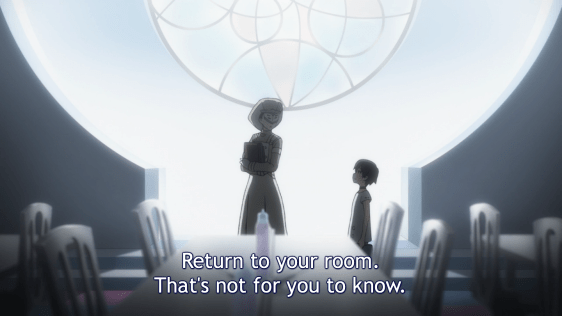
Surprisingly, Hiro himself becomes an increasingly fascinating character as the series continues, being revealed as not really the goody two-shoes his initial impression conveys. That childhood flashback to meeting Zero Two highlights the fact that he was actually a problem child for a society that encourages kids to stay ignorant and obedient. A young Hiro refuses to take “you’re not supposed to know” as an answer, and is punished for it by having his memories erased and being forced into a more complacent personality. When he meets Zero Two again for the first time years later (in Episode 1), that puts him on the path towards his naturally inquisitive self that dares to challenge society’s assumptions.

Gender Conformity or Gender Rebellion?

Accepting that the romances are more than skin-deep, the question then becomes: what exactly is the message conveyed through these relationships? A recent episode has garnered some backlash because it’s being seen as reinforcing gender conformity and a heteronormative worldview. However, based on other information about the world in Darling in the Franxx, I feel that it’s not so simple.

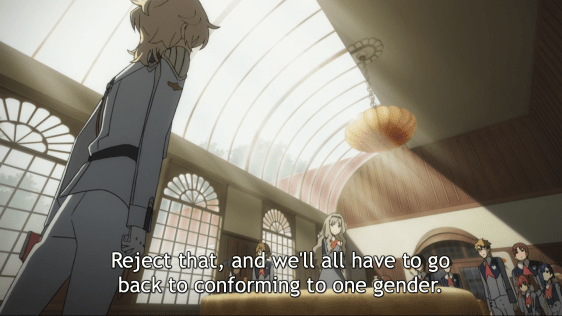
In Episode 17, Papa’s personal elite squadron, the Nines, move in with the main characters. Once there, they discover that Kokoro has discovered information on pregnancy and childbirth, which is forbidden in their world. The leader of the Nines, named Nine Alpha, talks about how traditional pregnancy and childbirth are unnecessary because humans have evolved past it, and that to go back to the old ways would be to restore rigid gender roles and identities.

An antagonistic character is making that point, which potentially makes it look like it’s being presented as the “wrong choice.” But if anything, Darling in the Franxx features a world where all sexuality regardless of gender, sex, or sexual orientation is taboo, so it’s not simply a matter of “proper gender roles” being enforced in the narrative.

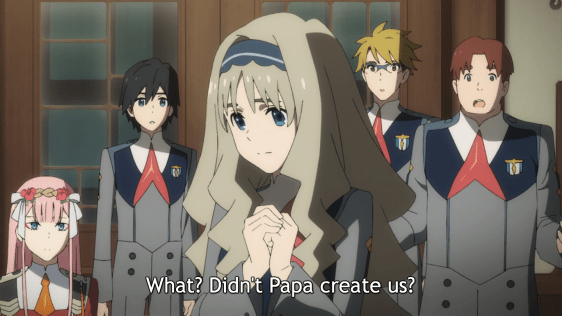
Consider the fact that only one of the characters, Kokoro, is expressing any desire for a traditional pregnancy. Consider also that the characters literally have no idea how they came into the world, believing that the “Big Brother”-esque Papa “made them” in some mysterious fashion. It’s one thing if they knew how they were birthed, but they’re not even allowed to know in the first place. Moreover, a previous episode features one of the other pilots, Zorome, meeting an adult who is heavily implied to be his biological mother—which means the talk about having evolved past the need for traditional childbirth might very well be a lie. To me, it looks like the issue isn’t that Papa is cruel for preventing humans from being able to have sex and reproduce and fulfill established gender roles, but that he’s suppressed all education about the topic.

Adults have their organs removed and their puberty somehow controlled or skipped over. Franxx pilots are allowed to keep their reproductive organs solely because they’re the key to piloting their robots, and they die early as a result. Sex and sexual desire are made a tool of the government regardless of the people and who they’re attracted to.

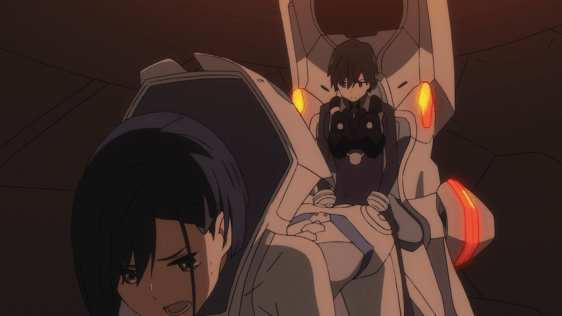
Franxx piloting becomes the closest thing people have to being able to engage in physical relationships, and even that is not so cut and dry. One of the other pilots, Ikuno, is clearly a lesbian or at the very least bisexual, but the world doesn’t even acknowledge her state as a possibility. When she suggests an attempt at a pistil-pistil combination for piloting, it doesn’t work—as if the state-ordained sex substitute known as the Franxx cannot allow it. Even then, she comes to Kokoro’s aid, slapping Nine Alpha for verbally attacking Kokoro’s newfound values. Prior to this, Ikuno can be seen bristling at the idea that gender distinctions could become more dominant if society reverted back to ancient times, but she still comes to Kokoro’s defense. I believe this is derived from the commonality between Kokoro’s wish for heterosexual procreation and Ikuno’s own emotional defiance of heteronormativity, which is that both wish to be free of a world that denies their feelings.

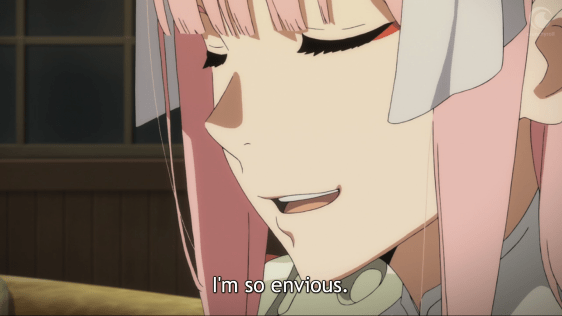
Even the main couple itself, Hiro and Zero Two, is a subtle rebellion against rigid gender roles. If the ability to have children is what defines women according to the story, then that would invalidate Zero Two, who mentions in Episode 17 that it is physically impossible for her. Yet her romance is the paramount love story of Darling in the Franxx. While she expresses envy at the fact that the humans can potentially have children, it’s more to do with them having a choice in the first place.

More Questions

One curiosity the series has yet to address is why the Nines seem to be capable of piloting in formations counter to the stamen-pistil pairing. Nine Alpha, for example, reads as male, but takes the bent-over position in the cockpit normally reserved for girls. Are the Nines, in part or in whole, actually outside of the male-female dichotomy in terms of sex and/or gender? Are their Franxx units somehow different from the rest? These unanswered questions further deepen the story and its potential avenues.

Conclusion: Emotional Depth and Political Rebellion

Darling in the Franxx starts off with many signs that it’s a shallow endeavor centered around boring wish fulfillment, shock value, and an excuse for sex and violence. But the show carries a lot of themes I would dare say are important to where we currently are in society. Its characters are extremely emotional teenagers, the classic archetype of anime, but their actions within the context of their world and the restrictions that world places on their bodies and minds gives renewed importance to everything they do. The romance of Darling in the Franxx is both a window into the politics of society and the importance of equality in emotional and loving relationships that transcend the strict hierarchies and roles given to them by a world of adults that seeks to mercilessly exploit its children. Rather than fighting for sexual conformity, the characters in Darling in the Franxx fight for sexual freedom and the freedom to choose their bodies’ futures, whether they know it or not.

Given that the series is yet to conclude, there’s a definite chance my interpretation is off the mark. If that time comes, I will be happy to reassess my analysis, and to see what I got right and what I got wrong.