Secret Santa: Overman King Gainer is Such a Thing

This post is my latest participation in the Reverse Thieves Secret Santa Project, wherein fellow bloggers anonymously recommend each other some anime and everyone writes a review of one of their “presents.” Given the Christmas theme of the endeavor, it is perhaps all the more appropriate that I review an anime which takes place in a land of endless winter, but really the reason why I ended up picking Overman King Gainer out of the choices I was given is that I had always wanted to watch it but had never gotten around to doing so.

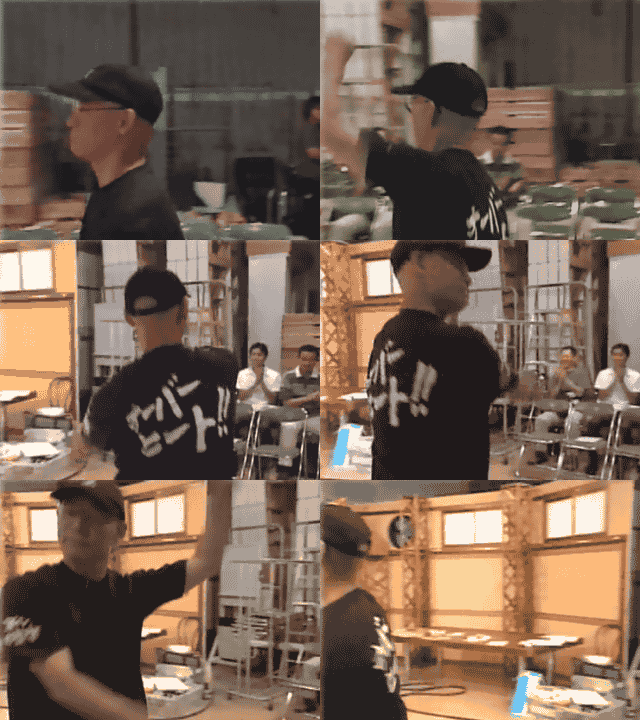
Overman King Gainer is a 2002 anime from the mind of Tomino Yoshiyuki, the famous creator of Gundam. He’s a man with a long history and resume in the industry, and when people talk about Tomino anime, they usually divide them into two categories: Depressed Tomino Anime and Happy Tomino Anime, with the amount of bloodshed and trauma varying accordingly. Featured above is a gif of Tomino during the production of Overman King Gainer; I’ll let you decide which kind of show this is.

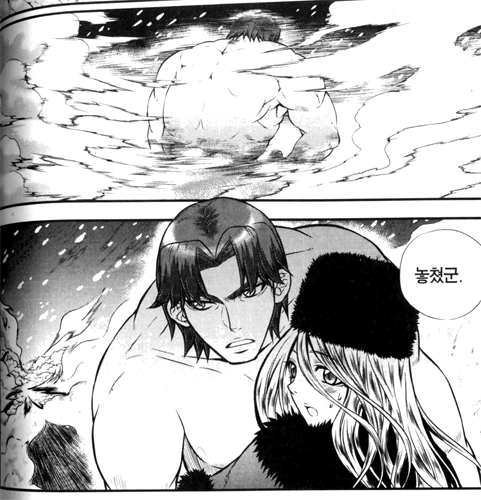
At first glance, Overman King Gainer is a strange show, not only because of its extremely catchy opening courtesy of Fire Bomber and JAM Project’s Fukuyama Yoshiki, Gaogaigar composer Tanaka Kouhei, and both characters and giant robots alike doing the Monkey (possibly the show’s most enduring legacy in anime), but because it presents new information about its world constantly and without any prior warning, making the whole thing quite difficult to summarize.

In the future of Overman King Gainer, humanity attempts to survive a harsh and close to uninhabitable planet by living in massive shelters known as “domepoli,” but among the people there are movements to participate in “Exoduses,” mass pilgrimages to lands with potentially more opportunity and resources, accomplished through the use of massive moving cities. The main character is a boy named Gainer Sanga, a video game champion who becomes the pilot of a mysterious organic robot he dubs the “King Gainer,” and who ends up becoming a part of the Exodus despite his objections to it. There is a complex world underpinning the main narrative, but we the viewers only ever get to see a few slivers of the whole, and even into the final episode the show still keeps a lot of its secrets. In that respect it reminds me of Xam’d: Lost Memories, which shares that similar pacing of world-building = plot progression, but much like Xam’d that’s also where a good deal of its charm lies.

Watching this show, I couldn’t help but feel that, more than Ikari Shinji from Evangelion or Kira Yamato from Gundam SEED, Gainer Sanga is the true updated version of classic Gundam hero Amuro Ray. Gainer has this strange introversion to him, as well as an aversion to the situation he finds himself in, but he adds this additional modern otaku element from the way he engages in his gaming. As an aside, the fact that he engages in games instead of tinkering with machinery reminds me that the original Gundam came out in a very different era of video games.

The character designs in this show are excellent, with both male and female characters clearly showing that a lot of care was put into their creation. The designs are full of vibrancy and personality, and though not the sole character designer on the show, the influence of Yoshida Ken’ichi (who would go on to do character designs for Eureka Seven and Xam’d) is both quite obvious and welcome.  I have to wonder what material would have been made for Overman King Gainer had it appeared in a post-Megami Magazine, maybe even post-Pixiv fandom environment. The show has a large number of female characters who seem to have a fair deal of enduring popularity, and I suspect that characters such as the strong-willed Sara Kodama, the spunky child princess Ana Medaiyu, the spy-turned-humanities teacher Adette Kistler, and the eccentric Cynthia Lane would’ve won the hearts of many current fans had the show been made in the last few years.

Tomino is often known for having rather stiff dialogue, and it’s easy to put Overman King Gainer in the same category, but I feel like that doesn’t quite tell the whole story, because it doesn’t take into account for its usage as a comedic element. The awkwardness of the phrasing and the responses they engender from other characters feels like this constant revolving tsukkomi, and when you take that sort of interaction and apply it to a diverse range of characters, including crazy Koyasu Takehito (see current anime JoJo’s Bizarre Adventure for reference), it makes for a fun if confusing anime which exudes a strange sort of energy that’s hard to find in other anime.

Another element of the anime that really stands out from other shows is its mechanical design, which both Yoshida and Yasuda “Akiman” Akira of Capcom fame worked on. The robots in Overman King Gainer come in two categories, the more basic and grunt-like “Sillhouette Machines,” and the “Overmen,” strangely powerful robots with a variety of abilities from invisibility to lightning bordering on the super (natural). Between their organic appearances and elements (artificial muscle tissue in the limbs for instance), as well as their striking appearances, probably the part of the show which most clearly describes the aesthetics of the anime, and that’s putting aside the whole Monkey-dancing thing.

I know I’m talking more about the components of Overman King Gainer than I am the overall feel of the series, and it’s something I normally prefer to avoid when I write reviews, but again I have to point out that the show kind of messes with expectations. Overman King Gainer is an unusual hodgepodge of elements which perhaps shouldn’t work together but do, and it defies categorization in the sense that it’s hard to say whether the anime is extremely straightforward or extremely obtuse, but which ends up being fun and clever.

In-Flight Mahjong, the Riichi-style Airplane Mahjong

Over the past few years I’ve had the opportunity to fly to other countries, and with flying comes checking out the in-flight entertainment. More often than not these days, in-flight entertainment includes a number of games from Chess to Tetris to even Doom, and sometimes the list even includes mahjong. While much of the time this refers to the tile-matching game, what I’ve found is that on Asian airlines it can actually refer to the real game we know and love. That’s how I found In-Flight Mahjong on Korean Air.

Actually, based on the full description provided, which used the phrase “match the tiles,” I ignored it for a while thinking it was going to be Shanghai, but curiosity got the better of me, for which I’m grateful. Programmed by the guys who make all of the other in-flight games (DHC or something?), the game purposely tries to aim for the anime fan audience by not only following the rules of Japanese-style riichi mahjong, but also boasting what it refers to as “anime-style” characters, which you can see in the videos below (trust me they’re worth it, if only for a healthy laugh).

I’m actually a little sad that I wasn’t able to record the audio (headphones-only after all). Whenever you see a character pop up in those videos with a “PON!” or a “KAN!” as in the first image above, just pretend they’re being exclaimed by people with heavily American-accented Japanese. The voice “acting” is anything but, though I don’t exactly hold my free game programmed to distract me for a few hours in between meals (which included bibimbap by the way) to the standards of Mahjong Fight Club or even Tenhou.

The game offers two modes: “quick game,” and “career,” which is meant to be like a single-player adventure mode (and in fact there is no multiplayer) with a few paragraphs to tell you whether you’re playing in a local parlor or at the end against some significant bigwigs. All of your favorite hands are there, though it refers to some in interesting ways (Chanta and Junchan are “Hon Chanta” and “Chanta” for some reason) The game offers three levels of difficulty, from easy to difficult, and of course I chose difficult out of some bizarre and fragile sense of pride. The computer opponents aren’t tough, but what I did notice is that on the difficult setting they tend to be extremely safe and conservative, and more often than not the rounds would end in a draw.

While this is not too surprising or annoying normally, it unfortunately comes with a peculiar rule in In-Flight Mahjong that rounds, at least in the South half of the game, will repeat if no one wins, even if East wasn’t in Tenpai. What this means is that the same round might last for 10 games in a row, and the only way to break out is to go for a win or hope a non-dealer computer pulls something off. Games that should have taken maybe half an hour total ended up taking about twice that.

Still, it is mahjong and definitely plays like mahjong, so if you happen to be flying to Korea (or wherever, as I assume this specific version appears elsewhere), and you have a desperate mahjong itch, you’ll know how to handle it.

Sexualization Without Objectification in Spotted Flower

When it comes to debates regarding how women are portrayed in media and entertainment, one recurring trend is the way that sexualization gets conflated with objectification. Whether it’s comics or not, Japanese or not, often times the two are presented as one, so it’s no surprise that there are readers who see them as one and the same and argue from a stance that reducing or removing certain depictions of women means a puritan-like removal of sexuality itself from media. While I don’t have the same problems with objectification that others might, it’s still an issue because this misunderstanding begets many other misunderstandings. It’s for this reason that I’m impressed by how the manga Spotted Flower handles the female body, and I think it gives a very clear case of how it is possible to draw sexual characters who aren’t necessarily sex objects.

A manga by Genshiken author Kio Shimoku, Spotted Flower is about an otaku husband and his pregnant non-otaku wife, and the small challenges they face as their lives enter a new stage. With a title referencing Madarame and Saki from Genshiken (Madara refers to spots—take note Naruto fans—and Saki means “bloom”) but clearly pointing out that the characters are not them, much of the manga revolves around how being an otaku can influence the relationship in certain ways. The other prominent theme, and the one I’m more concerned with for this post, is that of the pregnant wife’s sexual frustration. The problem the wife faces is that even through pregnancy she still wants sex and wants it badly, but it’s difficult for the husband to overcome the misconception that pregnant women are entirely different from sexual women (despite the act that it takes to get them that way). This makes sense, as depictions of pregnancy tend to focus on their motherly qualities and ignore the woman’s sexuality.

Spotted Flower does not draw that line in the sand. Much like his work on Jigopuri (about raising an infant), Kio doesn’t play it safe. He draws nudity. He draws bare breasts. He doesn’t shy away from showing sex and the desire for sex as very physical, mental, and emotional, but at the same time also doesn’t reduce pregnancy into a simplistic fetish or kink that you would find in some adult manga. He expresses the wife’s frustration in such a way that, even if she does not have the ideal body or the easy appeal of the “virgin” or the “nympho,” there is a kind of sexual attractiveness to her, an undeniable sensuality radiating from her which has little to do with the woman as object of desire and more as a person who desires.

As is obvious at this point, Spotted Flower is rather unusual in a number of ways, but it is also a series of possibilities and potentials. It pushes boundaries which probably shouldn’t be boundaries in the first place, and does so with a strong sense of characterization fans of Kio Shimoku have come to appreciate.

Blink-801: Genshiken II, Chapter 82

“Just once in my life I’d like to grow a penis!”

-Yoshitake Rika

Yes, it’s that kind of Genshiken chapter.

Yajima’s birthday has just passed, and noticing that Yajima has never engaged in a truly candid discussion with fellow girls, Yoshitake tries to get the straight-laced Yajima to open up moe. When the two discover a strange object in the club room, Yoshitake immediately assumes it to be an enema plug, and as the two let their imaginations run wild, the two narrow down the most likely owner of the plug to be Hato. As Hato and Yoshitake give their belated presents to Yajima, it becomes increasingly difficult to ask him about the enema. However, it turns out that Hato knows nothing about it, that it’s actually Ohno’s, and that it’s simply a small accessory from one of her cosplay outfits.

That Yoshitake and Yajima believed the owner of the “enema” had to be a guy is very telling of the ways in which yaoi has influenced their imaginations. Rather than simply limiting it to fujoshi psychology, though, I feel like the characters this chapter are showing more delusions run rampant, as if BL was more a key to a forbidden kingdom of the mind. It’s interesting how this contrasts with the predominantly male Genshiken of old in that awkward expression of sexuality has been a part of Genshiken since the very first chapter, and was something of a constant throughout the series, but it usually took the form of professing doujinshi or character preferences. It was certainly never to the level that the guys would wonder aloud about genitalia, and in hindsight it lent a good deal of realism to the series, both in the fact that they all had their own quirks and kinks, and that they were embarrassed about it and kept things understated.

When I think about it, the female characters have always been the ones to discuss sex and relationships more directly. Whether that’s Kasukabe describing her “friend’s” doggy-style with her boyfriend, Kasukabe asking Ohno if she and Tanaka had done it in cosplay, or even Ohno and Ogiue’s tough heart-to-heart discussions, the girls have done a lot less tiptoeing around the subject of sex. It’s even clear from this chapter that Yajima is pretty open with Mimasaka as well, relatively speaking, even telling her all about seeing Hato naked.

Yoshitake, however, takes that prospect to an all-new extreme, and I don’t know if that’s because she’s a social fujoshi of a younger generation, or if it’s just because she’s weird. Either way, the manga portrays Yoshitake as a character who at least wants to be unafraid of taboos, and the fact that she almost manages to ask Hato directly about the “enema plug” shows her as a person who can overwhelm whatever fear of awkwardness might still linger within her. Also, as this chapter and previous ones have shown, get a little alcohol in her and all bets are off. The quote at the beginning of this review is followed by Yoshitake declaring that anyone interested in BL has to wonder about having a penis, a line which certainly blows Ohno’s famous “There’s no such thing as a girl who hates homos!” straight out of the water.

One thing I like about Genshiken is the way in which details are not forgotten and can come up again in later parts of the story. One example is Yoshitake’s hair, which had more of a wavy look in the earlier chapters and then became much straighter down the line, which was explained previously as Yoshitake perming her hair to look good at the start of the school year but being unable to keep up with it. In this chapter, the detail which caught my eye was Hato’s present to Yajima, a basket of skincare products. Back when the first years originally all hung out in Yajima’s apartment, the manga showed how Yajima had a complex about her poor skin condition when compared to Hato’s meticulously kept complexion. It’s unclear whether Hato’s realization of this came from some implied off-panel moment or if she picked up on it way back, but the gesture is clear that she wants to help Yajima look better and feel better. Speaking of, in the image above of Mimasaka you can really see how she is perhaps held back by her own lack of fashion sense, similar to Ogiue in the old days.

The previous chapters with their heavy focus on Madarame and Kasukabe casted a fairly large shadow on the newer characters, but I think this chapter shows how well the new characters can hold up on their own side of things. They’re different from the old crew in many ways but there’s still a sense of relatability to them, and they’re interesting characters in their own right. Next chapter though looks to be focused on Ohno, who actually has never gotten a whole ton of coverage in the manga. I wonder if it’ll have anything to do with her tendency to put off getting a job and entering the “real world.”

The Ambiguously Vague Gestures: Genshiken II, Chapter 81

After the intensity and emotion of the last chapter, this month’s winds down with a post-confession Madarame. In order to try and cheer him up, the old Genshiken girls (+ Hato and Kohsaka) cosplay for him, and for a brief moment the old impassioned expository Madarame makes a triumphant return. As Tanaka and Kugayama leave with Madarame for some male bonding, Saki encourages Madarame to not let go entirely of his past with Genshiken. There also seems to be some bad blood between Keiko and Hato, though the reasons are unclear.

As is the case with recent previous chapters, this one also referenced an old anime, in this case the title of Akuma-kun‘s final episode. Appropriate, because whether you want to call it the denouement of dramatic structure or the ketsu of kishoutenketsu, Chapter 81 feels like a wrap-up of the crazy developments that have happened over the past few months with Madarame, at least when it comes to his feelings for Kasukabe. As such, this chapter feels a lot less overt with its significance and its presentation of information compared to last time, but there are still plenty of moments which radiate with potential. As always, this isn’t an end (well obviously because the manga isn’t finished but you know what I mean), but a continuation.

There’s one scene in particular this chapter that I’ve read over and over because I’m not sure how to interpret it. As the girls (and guys) cosplay for Madarame from the gender-bender game that Kohsaka worked on, Kasukabe herself joins in as well. Before we see Saki in un-drag though, we see her having a conversation with Kohsaka about her character, who’s supposed to be “boyish,” to which Saki retorts that it’s actually a boy. Then, we see two characters off-panel speaking to each other (their words are visible but they aren’t), who I’m pretty sure are Kohsaka and Kasukabe. One of them asks if they accidentally “let it slip” and the other says that it’s not about that. I believe we’re supposed to read it as Kohsaka having hid the details of his game from Saki and her response being that the content of his game is besides the point. However, because of the way she says “it’s a boy,” and the follow-up conversation about a secret being out, and the fact that we see Saki go from what others have charitably referred to as “maternity clothes” to an outfit with a corset such that we can never get a clear idea of her figure, and the fact that even with the corset she looks bigger than she used to (notably in the chest area), I feel as if this chapter is lending credence to the theory that Saki is indeed pregnant.

I might just very well be overanalyzing, and things like Saki’s slightly larger figure and larger breasts might just be either a stylistic change by Kio or a sign that she’s growing older, but it just has me wondering. If my speculation turns out to be unfounded, I’m of course fine with that.

This chapter we get to see the “old” Madarame make a return as he muses on the very concept of “trap” characters and how there are different things to consider when translating them to 3D, a rant which Saki quickly reminds everyone is reminiscent of the Madarame she first met and despised. Is this scene a sign of Madarame getting his otaku groove back? Is it the case that the last few years have been a continuous trial and now that it’s over with he can go back to being himself, or is it that Madarame is trying to force it? Is it a regression to a past identity, or is it a progression, a nerd phoenix rising from the ashes of rejection and anxiety? I’d like to believe that the old Madarame is a new Madarame, and I’m definitely looking forward to where his character will go from here.

As a side note, if you’ve ever wondered what I meant by density of information looking unusual in manga, just look at the page above where Madarame is ranting. If you’re used to manga at all, just the whole page seems to stray from how Genshiken usually flows, though that’s what also gives this page its impact.

An interesting thing I’ve noticed about Madarame’s character is that Madarame seems to get paired with more characters than anyone else both inside Genshiken itself and among fans both English-speaking and Japanese. There’s of course the whole ordeal with Kasukabe, but there’s also Ogiue’s Sasa x Mada fantasies, Angela putting the moves on him hard, the ambiguity of Hato’s friendship, Kohsaka feigning (?) interest this very chapter, and then on top of that I’ve seen fanart and such going all the way back to 2005 that put him with Keiko and Sue, well before they interacted with him like they do now. It might just be that, as Hirano Kouta of Hellsing fame puts it, that “Madarame is the most moe character in Genshiken,” but I just find it interesting that so many, fictional or otherwise, seem to want Madarame to be happy (or at least less pathetic). It’s probably a testament to his enduring character and the fact that he is above all others the quintessential nerd/otaku.

In any case, it makes Saki’s comment that Madarame could very well make his own harem feel both tongue-in-cheek, yet somehow serious, though in the end I interpret it more as Saki telling Madarame that he is actually attractive in his own way. That said, I have to wonder how awkward it would be to have a girl who just rejected you also tell you that it’s okay for you to keep the sexy(ish coplay) photos you have of her. That’s the kind of scenario that so many nerds ae desperate to avoid (“What if she knows that I find her sexually attractive?”), but it’s a new world I guess. I wouldn’t be surprised if Madarame ends up throwing them out anyway, though I also wouldn’t be surprised if he keeps them.

I’ve used this comparison to describe multiple characters over the series, but Keiko is something of a Saki-type for Genshiken II. Yajima is a Saki in the sense that she’s a fish out of water and has the dry wit, but Keiko serves the role of being the character with the most “real world” experience, though as Sasahara remarks it’s more the result of making numerous mistakes. Still, it gives Keiko a type of perceptiveness that’s lacking in the current members of Genshiken, and it makes the moment where she just shows Madarame how his secret never really was one quite hilarious. Given how she didn’t even appear in the second TV series (though as far as I know that was just an unfortunate scheduling conflict, and she does make an appearance in one of the drama CDs), it almost feels like the series is making up for that by giving her more presence in the current manga.

As for the dirty look Keiko gives Hato, it’s yet another ambiguous moment in this chapter whose path will lead us who knows where. If we go by the harem view mentioned before, then this could be interpreted as Keiko exhibiting jealousy, but I think it’s something else. If I had to guess, I’d say that Keiko’s impatience towards Madarame dancing around and avoiding his own feelings for fear of confrontation is also showing itself with Hato and where he might stand with Madarame.

Even though she’s clearly not the focus, I do want to talk a bit about Ogiue’s part in this chapter. When Kohsaka grabs Madarame’s arms and tells him that they could’ve had a polygamous relationship with each other and Saki, I like how you can tell who is thinking what in that moment. For most of the guys, it’s just an awkward moment, but clearly Ogiue and Hato think more of it. Ohno seems much less affected, though it might make sense given her preference for significantly older, hairier, and balder guys. Keiko’s blushing on the following page is probably the most surprising, and another moment in this chapter open for interpretation. Could Keiko be a candidate for the Fujoshi Files after all?

The chapter ends with the reappearance of Katou, who we don’t know much about other than that she has Ohno-esque preferences, and that she’s been job-hunting as of late, but I wouldn’t mind seeing more of her at all. At this point Asada has more development than her, and she doesn’t even have a real face! I don’t have confidence we’ll see much of her, but one can always hope.

Paths, Finding and Pursuing: Hanasaku Iroha vs. Tari Tari

As an anime by the studio P.A. Works about a group of teenage girls growing up and strengthening their friendship, Tari Tari inevitably draws comparisons to last year’s Hanasaku Iroha, which has both a similar premise as well as visual style. In addition, both feature similar trios: a petite main character with a lot of pep, a more serious one, and a gentler one with a sizable bust. Yet, as close as they are, I find the two shows to feel quite different, and it has to do with aspirations, or lack thereof.

In Tari Tari, each of the girls (and the guys as well) each have a concrete goal they’re trying to pursue. Some of them are more long-term, like Sawa becoming a professional equestrian, while others are more immediate, like Konatsu forming a successful choir club or Wakana composing a song to fulfill a promise, but all of them have a conceivable end point to pursue which drives each character forward. This in turn influences the pacing of the show, as the sense of looking ahead gives the show a kind of momentum.

In Hanasaku Iroha, however, only Minko truly has an objective to push her forward: becoming a great chef. For everyone else, especially the main heroine Ohana, there are no particular goals or dreams associated with them. At the very best they have things they don’t want, like Yuina’s hesitation about inheriting her family’s inn or Ohana’s pensiveness towards responding to her friend Kouichi’s romantic confession, and this lends to Hanasaku Iroha on top of the rural setting a kind of slower and more subdued “day-by-day” feel.

Essentially, Tari Tari and Hanasaku Iroha are both about teenagers becoming adults, but they differ in focus. Tari Tari‘s sense of maturation comes from the characters moving along paths they’ve set out for themselves, learning along the way as a result. On the other hand, Hanasaku Iroha‘s characters are wandering through their growth to adulthood, trying to find their paths among many. Though both are about the everyday, Hanasaku Iroha sits a little more in the present, while Tari Tari shifts a little more towards the future.

My First Mahjong Tournament!

This past weekend I was able to attend my very first ever “Riichi Mahjong Tournament” (quotes and capitalization used to convey my sense of awe), and to put it simply, I had a blast. I managed to do well at the tournament, and accomplished a number of things I can feel some sense of pride in. On the other hand, I made a number of mistakes that are a sign of my own greenness in competition. I’ll be trying to make this post fairly accessible, but keep in mind that I’ll be throwing a bunch of terms around, so it may wind up being obtuse for those unfamiliar with mahjong.

One thing that I realized while playing with the USPML over the last couple of years or so is that my mahjong stamina is not so great, and knowing that each day of competition would last many hours I tried to make up for it as best I could. I ate balanced breakfasts (making sure to include one egg for protein content) but also tried to avoid overeating (an easy problem for me to fall into), I took effort to stay hydrated, and I avoided overly sugary snacks in order to prevent a sugar crash at crucial points. I think it worked out okay in the end, though I still felt a sense of fatigue after a while which I think compromised my play.

In general, I’m not much of a tournament person for games at all (in my life, I’ve attended one Guilty Gear XX tournament, a handful of Smash Bros. tournaments, and some online Pokemon stuff back in the day), but I have to say that it was genuinely fun and exciting. This offline tournament was an intense experience with a really fun social component, both outside the game talking to fellow players, as well as inside the game. I think on some level riichi mahjong feels especially social because the rules, however daunting they may be for players to learn, encourage a high level of interactivity where you have to battle your opponents machinations as well as your own greed and cowardice. I might even go as far as to call mahjong a kind of window into people’s souls because of how the luck component combined with the potential decisions one makes in response to them shows how people may end up responding to situations beyond their or anyone else’s control. Go watch Akagi, and Akagi’s comment about someone being “weak against coincidence” makes that much more sense.

Interestingly, unlike the USPML which consists of mostly young folks who were exposed to mahjong through anime, the Dutch mahjong scene consists of older people (most at least 40 and up I would reckon), who came to it after playing other forms of mahjong. Talking to some, they had started to tire of the other formats and found riichi more exciting and interesting. I’ve never played other forms so I can’t agree or disagree, but I feel like I can see where they’re coming from given the interactivity of riichi mahjong. There was also a smaller contingent of international European players who just do this sort of thing semi-regularly, a world for which I hold a tiny bit of envy.

As for my accomplishments (which I hope you’ll let me bask in until I get smashed the next time), I played through nine full east-south (hanchan) matches and managed to avoid getting 4th in every single game. I even had a game where I was in dead last at the end of the east round (I was down 20,000 points!) and was able to surge back with some well-timed risky play to take first by the end. On the other hand, I actually misread one tile for another which cost me a round, drew from the wrong part of the wall at one point, and even dealt into a super obvious hand because I had too much tunnel vision while playing that round.

The tournament used the European Mahjong Association’s “Riichi Competiton Rules” (or RCR), and it made for a somewhat different dynamic compared to playing on the Tenhou ladder. The most obvious peculiarity of the European rules is the restriction of closed tanyao only (which means people cannot steal tiles to make this normally very basic hand) in combination with the presence of red 5s, tiles which can easily bolster your score and can turn weak hands into monstrous ones, but the one that caught my attention the most was the points system. Normally, you begin with a set of points (on Tenhou it’s 25,000) and whoever has more points by the end wins a match, and there is the added risk where if you go under zero points the game ends with you in dead last. However, with RCR there are no default starting points and everything is counted in terms of the points gained or lost. What this ends up meaning is that it is impossible to go bankrupt, and you can lose 1 billion points and still be able to play in subsequent rounds, though your morale might be shot.

The reason this was done, I think, was so that no one felt left out early in the tournament and everyone could play as much mahjong as possible. Supporting this was the fact that the format of the tournament was almost but not quite a round robin tournament, in the sense that it was not an elimination tournament like you’d see in Saki or Starcraft where 64 players/teams enter and then 32 advance and so on. Instead, everyone got the chance to play nine games (with time limits), so everyone wound up playing roughly the same amount of mahjong overall, whether they got 1st place or dead last. It’s quite a different format, but because it fosters enjoyment I like it all the same.

There was a second factor to the scoring system as well, what is known as “Uma” or the amount of points you gain or lose at the end of a match. In the most recent incarnation of the European rules, you get added to your existing score +30,000 points for a 1st place finish, +10,000 for 2nd, -10,000 for 3rd, and -30,000 for 4th. Thus, if in a game the 4 players wound up getting 10,000 points, 1000 points, -1000 points, and -10,000 points respectively, the final score of that session would be 40,000/11,000/-11,000/-40,000, and then you carried your score to subsequent matches. Thus, if the same results happened again to each player, they would end up with 80,000/22,000/-22,000/-80,000 going into their 3rd game. The gap isn’t entirely insurmountable, but the more 4th place finishes you have, the tougher it gets, which is why I was glad to not have any.

As a result of this format, your placement in a  match alone doesn’t matter as much as your place in a match alongside your points earned, which is different from other forms of riichi mahjong. In my case, I was in a game where I was practically guaranteed 2nd place at the end of a match, and was in potential range to get 1st so I took a risk and went for a hand and ended up dealing in and losing 8,000 points. While I still got the 10,000 point bonus for being 2nd, I would’ve had an additional 8,000 added to my total score if only I had played it safer. Similarly, if you’re in 4th and there’s no chance for you to take 3rd place, do you try to get as close to 3rd as possible to mitigate the damage, or do you just play safe in case you end up falling even more, and what would’ve been a big loss is now a gigantic one?

Mahjong, especially in this particular tournament style, is a funny thing in terms of competitiveness because you really have to decide what’s more important, your chance at claiming a top spot (or even the top spot), or being satisfied with where you are and not wanting to fall further. If you’re in 2nd in the overall tournament ranking with 1st place is 50,000 points ahead of you but 3rd through 10th place all nipping at your heels, do you avoid risks and try to hold onto your 2nd place position as much as possible, or do you take a chance and aim for 1st with the likely possibility that you’ll crash and burn and fall 10, maybe even 15 places? Which do you value more? It’s an interesting psychological test, I think, and I realize in hindsight that every time I imagined myself getting a top spot I ended up doing worse. Maybe it’s a lesson I need to learn better.

So overall, I’m more than glad I decided to participate. If I get the chance to attend another one, I most likely will.

Dreams, Resolution: Genshiken II, Chapter 80

Chapter 80 of Genshiken II is a big deal, so much so that I have to ask if you want to read further.

Continue reading

Reality TV: Humanity Has Declined

Anime is often praised for their sheer diversity of topics and approaches to those topics, but biting comedic satire is a rather uncommon occurrence. This is what the Summer 2012 series Humanity Has Declined brings to the table, and I consider it to be the #1 show of the season.

Based on a light novel, the show takes place in a world where humanity’s population is a smallfraction of what it once was. and many of its technological advances no longer feasible given a scarcity of resources. Life in some ways resembles the 17th century more than it does the 21st. The story is told from the perspective of an unnamed woman—referred to in some material as “the Mediator” but in actuality is only ever mentioned in the show as “I” (Watashi)—whose job it is to communicate with the “fairies,” small, human-like creatures with large smiles permanently plastered onto their faces, who are a source of great frustration for the main heroine.

In the story, the fairies are referred to as the “new humanity,” a title which makes sense in two ways. First, with humanity in decline, they are now in a way the dominant species on Earth. Second, and this is in my opinion the more significant allusion, is that the fairies are like a hyper humanity. More technologically advanced than the humans, they’re able to create almost anything practically overnight (the one exception is that they are incapable of creating desserts), but their incredibly poor memories and utter carelessness cause them to make the same mistakes repeatedly. Most of the time, when asked any question, whether it’s a difficult one (“Where do you expect society to go”) or a simple one (“Where do you live”), their response is a simple “who knows.” In addition, the fairies have a tendency towards jumping on fads at an accelerated rate, accomplishing the most astounding feats of civilization only to abandon them days later. Strangely naive, the fact that they often get ideas from the humans means that, much like the Twilight Zone episode “The Little People” (or its Simpsons parody), they mirror the follies of mankind.

The humans she communicates with are also prone to folly, just that their impact is nowhere near as severe as the fairies. As such, the heroine takes this all in stride, at least on the surface. Presenting a pleasant demeanor on the surface, her inner thoughts reveal a harsh cynicism that is all-too-appropriate. In one case, she mentions to herself (and the audience) a meeting between people in her town which accomplished nothing but allowing the people to say they held a meeting so that they can show that they made an effort. The way in which the heroine casually holds back her mild disdain actually becomes one of her more charming features, and she never winds up feeling like a whiner.

The series couches its subtly dark humor in a bright, pastel palette, giving Humanity Has Declined a visual aesthetic reminiscent of a European children’s book. At first, this cute appearance can seem like a concession to convention, and in some ways it might well be, but what becomes apparent from episode to episode is that it winds up having the opposite effect. That fairytale-like surface, when combined with the actual content of the series, winds up actually making the entire show even more bizarre. Because of this, even when the show seems to be undergoing a significant tonal shift, it actually isn’t all that unusual in the context of the anime.

Overall, Humanity Has Declined is an anime quite different from the norm, whether that’s the norm of typical light novel output and adaptations, or the norm of trends in anime both new and old. It’s a clever show that’s hard to box in any particular categories (though I definitely tried), and it’s all the better for it.

Of Mice and Spies: Stripfestival Breda 2012

When it comes to comics, the Netherlands is an interesting country. Situated close to Belgium and France, the Dutch have had close ties with that bande dessinée (Franco-Belgian comics) culture, particularly when it comes to the Flemish comics, but they’ve also developed a comics culture all their own. While I’d learned about this a fair deal before, when I went to the Dutch comics festival “Stripfestival Breda” this past month, I was able to see it much more clearly.

Taking place in the city of Breda and spread across different locations near the center of town, Stripfestival Breda is a two-day event to celebrate comics. There, you could buy comics from a variety of venders, get your picture taken with your favorite characters (whether that means cosplay by fans or actual people hired to dress up), and even meet the artists responsible for all of these comics. Each location specialized in a certain area, such as one for events and awards, though I didn’t attend all of them due to time constraints and other inconveniences such as my lack of Dutch fluency. Instead, I primarily looked at the industry area, located in a theater, and the self-published area, located in the city’s Great Church (every Dutch city seems to have one).

The industry locale was the epicenter of the festival, and companies from both inside and outside of the Netherlands were there. They had plenty of books to sell, but what I found to be most impressive is that in a lot of cases, not only were the artists themselves there, but they were offering free sketches. The biggest booth was the Eppo booth, home of a variety of Dutch comics both classic and new (and in some cases the comics have run long enough to be both), which housed about 8-10 artists each with their own lines. With big names in Dutch comics such as Martin Lodewijk of Agent 327, as well as Jorg de Vos and Roman Molenaar, the artists behind Storm (which is available in English), it was a collection of heavy hitters, but amazingly the lines were short enough that I could get multiple sketches in well under an hour.

Martin Lodewijk

In fact, by my estimation, the combined lines between all of the Eppo artists was about as long as a line for Fred Gallagher (Megatokyo) at Otakon. This isn’t to say knock either Fred or the Dutch artists, but just to say that I was amazed by how accessible these artists were.

Interestingly, the most popular comic among young Dutch kids is an Italian series called Geronimo Stilton. I don’t know much about it other than the fact that it features an anthropomorphic journalist mouse who goes on adventures, or whether it’s doing well in the US, but its success was clear as kids line up to take photos with a real Geronimo Stilton, Disneyland-style.

There was definitely a French/Belgian presence as well, though I didn’t spend much time with them, and there were vendors selling a huge variety of comics, including (what I assumed to be) old, hard-to-find items. Many of the vendors sold comics with some erotic content, but there didn’t seem to be any particular separation or shame in it. In some cases they were shrink-wrapped, in some cases they weren’t.

There was some presence for manga and American comics, especially the life-sized Iron Man statue, the anime fan artists who I’ve seen at the Dutch anime cons, and the requisite maid cafe, though they definitely weren’t the main focus. Asking one vendor of superhero comics about the status of American comics in the Netherlands, he told me that The Walking Dead is quite popular.

The independent/alternative comics area was quite a different experience from the hustle and bustle of the industry location, though I think that may have had to do with the fact that it was held in an old-fashioned gothic-style church and featured many art pieces which I might call not very church-like at all. Featured here were many comics which strayed from convention, featuring really erratic character designs and strange subject matter, the artists were not just comics makers but sometimes contemporary art scene artists as well. Items were generally more expensive for the alternative comics than they were for the industry items, but often times not by much.

I spoke to one artist, who told me that his favorite comic was the one that had the sold the least because it wasn’t really to Dutch tastes. Intrigued, I asked him what he meant by Dutch tastes, because I don’t have anywhere near as keen a sense for European comics as I do for American and Japanese, he mentioned that it had to do with round, cartoonish characters with big feet and so on. It’s something I’ll have to do more research on.

In the end, what probably stood out to me most was the fact that gender and age distributions seemed very even. I saw people from five-years-old to fifty-year-sold both male and female lined up at booths, whether it was to buy comics or to meet the artists or their favorite characters, often times for the same series. It made me realize how much comics is a thing for all ages in the Netherlands.