Why I Think Gundam AGE Episode 1 is an Excellent First Episode

After one episode, Gundam AGE has convinced me to watch it. I don’t mean that it’s done enough that I’m willing to give it another few episodes, or even that I’m going to watch because I’m aware that Sunrise mecha series tend to take about 13 episodes for the story to “really” begin. What I am saying, rather, is that just this first episode makes me want to see the show through from beginning to end. While not perfect, in my opinion Gundam AGE has an incredibly solid first episode to the extent that even if the show turns out to be awful, I can still point to the very beginning and say, “That… was an excellent introduction.”

There are multiple reasons for why I think so highly of that first episode, but probably the biggest among them is the main character himself. As a small child, Flit is shown as having suffered a tragedy at the hands of the UE, the “Unknown Enemy.” As a 14 year old, he is clearly driven by the trauma of his past, wishing to do something to not only continue his parents’ legacy (they were Mobile Suit creators) but to never let the same thing happen again. He is motivated to act to such a degree that he creates the Gundam itself. Whereas most Gundam protagonists in the past have come across their units through a quick series of twists, Flit has been actively working towards its completion for what I can only assume has been years. He is shown to be a brilliant scientific prodigy who had to grow up a little too fast, and yet is still a kid at heart. The way he tries to convince his classmates of the impending threat of the UE shows pretty much everything about him, a mix of intelligence, dedication (possibly obsession), and the feelings and thoughts of a 14 year old boy.

Flit is a character that I can get behind. He feels like he has room to grow, and at the same time already is something of an inspirational character.

And all through this, though he has experienced tragedy, he does not feel as if he is defined as a tragic character. In fact, perhaps thanks to the show’s aesthetics, from its bright color palette to its more rounded character designs, the entire show feels fun and vibrant in a way that doesn’t negate the weight of its more serious aspects. In a way, it reminds me of the first episode of Heartcatch Precure!, which also won me over immediately. Even the shot of the space colony felt more impressive to me than it has in years;I could sense the wonder that is living in a space colony, even after being a Gundam for over a decade now. A lot happens in this first episode, both in terms of growing the story and setting up a path for Flit that feels like one he has determined for himself.

I could totally start comparing this anime to older versions of Gundam. Flit, with his seeming “paranoia” and technical skill, is like an Amuro who has discovered his motivation in life at a much younger age. Emily looks like Sayla Mass and acts like Frau Bow. The kids in Flit’s class remind me of the kids from 0080: War in the Pocket. The first activation scene takes on a significantly different meaning because of how Flit created the Gundam and so knows all of its ins and outs, and it makes me recall the scene in Char’s Counterattack where Hathaway takes about the legend of Amuro and how “he knew how to pilot it as soon as he got in.” But Gundam AGE feels so fresh and energetic that I find comparing it to other Gundam series should only be seen as a fun exercise and not as a wellspring from which to initiate constant criticism. Endlessly drawing parallels to previous iterations will only make it more difficult to see what Gundam AGE does well from the very start.

Before the series began, the promotional material stressed the generational aspect of Gundam AGE and I was actually surprised to see it hardly ever discussed among the buzz. I found it to be the most intriguing and attractive part of the concept, and while it obviously has yet to fully take effect, the generational theme has already been establishes just from this episode. The concept of the “Gundam” is passed down from Flit’s parents to himself, and I can only assume he will do the same in the future. The Gundam is spoken of in almost mythological tones, a robot from long ago that saved the world and changed everything. Seeing that scene, I could only think that, in a way, the status of the Gundam in the world of AGE mirrors the legendary status of the Gundam franchise itself. I would not be surprised if the kids watching AGE see Gundam as this piece of history that they’re told is one of the most significant pieces of anime history, but feels strangely distant, like it comes from another time. By having the Gundam take this role, Gundam AGE episode 1 really does make it seem like a Gundam for a newer generation.

Also, the robots look cool.

The “Curse” of Redline’s Aesthetic

Ever since before its actual release, Redline has been getting a lot of buzz among anime reviewers who have noted the look of the film, incredibly unique especially in today’s anime environment with a good deal of exquisite animation and attention to detail. The crowds are full of life and interesting alien designs. The vehicles used for racing are all incredibly stylish and showcase the wide array of personalities in the film. Redline oozes style and panache. However, for as refreshing as Redline‘s art is, it appears to be a double-edged sword through no fault of its own.

The “problem” with Redline‘s art is that it apparently makes people think the movie has no story, that it’s nothing but a pretty face, and has little to offer people who are interested in characterization and narrative. This is a mistake.

I’ll explain what I mean by just using the introduction to the film.

The movie begins with the Yellow Line race, a preliminary to the main “Redline” race which everyone in the galaxy looks forward to. The main character is Sweet JP, and based on the fact that it’s the start of the film, it’s easy to assume that we’ll know what will happen. If it’s a race designed to make JP look impressive, he’ll win. If he’s supposed to look like an underdog, he’ll lose. But then Redline throws us two seemingly contradictory bits of information. First, JP is a notorious for purposely throw races for profit. Second, JP really loves to race and has a passion for high-speed shenanigans. Just from that bit of information, the outcome of the race becomes ambiguous, as does JP’s character. How can a guy who fixes races enjoy himself behind the wheel that much? It gives Sweet JP a sense of mystery, and as the Yellow Line race builds up towards its climax, the question isn’t simply “will JP win or lose?” but rather “what kind of person is JP?” Would he give up money for the opportunity to enter Redline? It makes for a compelling protagonist, and it’s done with a good degree of subtlety.

I think part of the issue might be that Redline‘s frenetic, intense, and to some extent macho style makes people think that a show like that can’t have some heart, and even if the reviewers think otherwise, it doesn’t come across in the way they talk about it. While I do think that the aesthetic of Redline is such a prominent part of the film that if you dislike the way it looks you probably won’t enjoy it, I strongly believe that someone who is merely neutral towards the look of Redline can still get a ton of enjoyment out of it. Let’s not forget those potential viewers.

Cross Counter: Genshiken II, Chapter 68

Last month, we were promised a chapter with Yoshitake in the spotlight and Chapter 68 delivers in spades. We learn a lot about Yoshitake’s personality, her family, and even her deepest, darkest secret!!! Suffice it to say, a lot happens, so there’s more to talk about than usual, so you’ll have to forgive me if the following synopsis is wordier than usual.

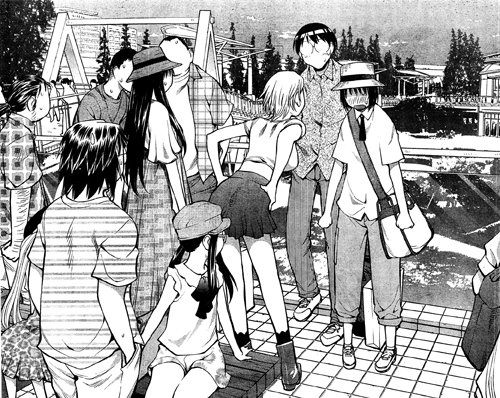
When a couple of guys enter the Genshiken club room in an effort to hit on Hato, and the only senior member available is a spineless coward (Kuchiki), all seems lost until a tall and striking figure appears and shoos them away. The man turns out to be Yoshitake (Rika)’s brother, Rihito, and we learn the following about him: he is one year older than Yoshitake, attends a different university, and is an otaku (also apparently a shotacon). Yajima is completely smitten by this knight in shining armor, which Yoshitake picks up on immediately and uses to tease poor Yajima in subtle ways.

It turns out though that the guy who’d been hitting on Hato (and who had been asking about “the girl with the long brown hair” back in Chapter 60) is a member of the student government named Harima. Harima’s boss, a serious-looking man in glasses named Mikami, is concerned with the fact that this brown-haired girl no one knows has been seen around Genshiken since the start of the semester. There are strict rules against non-students attending, and Hato, though he is of course a student at Shiiou University, is fearful of having his secret revealed. Harima interjects and convinces Mikami to let him handle it.

Harima tries to clear up the misunderstanding about himself with Hato, except that it wasn’t really a misunderstanding and he actually was trying to hit on Hato after all. The awkward situation is only exacerbated when Kuchiki runs in for the “rescue” and is immediately choked out (again) by Hato. Harima is scared off, and Kuchiki falls unconscious with a smile on his face, though in the process inadvertently places his hand on Rihito’s chest. This in turn generates a decidedly feminine response in Rihito, who reflexively recoils away with a yelp, revealing an elaborate charade.

Yoshitake Rihito turns out to be Yoshitake Risa, Yoshitake’s younger sister who attends an all-girls’ high school and is a member of the school’s basketball club (but still actually a shotacon). Risa is a senior and was checking out Shiiou University as a prospective college, when Yoshitake decided to use the fact that Risa is often mistaken for a boy anyway to pull a prank on the others in Genshiken. However, Risa inadvertently reveals that her older sister is older than she seems. Yoshitake, though a freshman in college, is in reality 20 years old due to a combination of having failed the entrance exams the first time around and having an April birthday (the Japanese school year starts in April), and is the reason she was able to buy all of that alcohol back in Chapter 58 without any hiccups (20 is the legal drinking age in Japan). The chapter ends with the first years + Risa drinking over a discussion of the pairing between Mikami and Harima.

With all of the new character introductions and particular displays of characterization contained within Chapter 68, there is a lot to think about, more than even I’m going to talk about, but let’s begin anyway.

As has been pointed out by Japanese blogger Tamagomago, Yoshitake is very socially savvy, and nowhere has it been more obvious than in this chapter. Probably the best example of this is the fact that she is able to immediately pick up on Yajima’s attraction towards “Rihito” because of how Yajima keeps looking away from the older younger Yoshitake sibling. One might say that it’s as classically obvious a signal as possible, but stuff like this can be surprisingly difficult for nerds to pick up on. While Yoshitake isn’t quite on the level of Kasukabe or possibly even Keiko in terms of perceptiveness, she is still far greater than the average otaku. Sasahara may be considered the “normal” otaku to an extent, but I can’t help wondering if Yoshitake deserves that title more, though its meaning changes when applied to her. On the topic of siblings, this is the first familial relationship we’ve seen since Sasahara and Keiko, and in looking at the interaction between Yoshitake and Risa with a bit of hindsight, Yoshitake really does act like the older sister. This is shown in the way she hits Risa, and how Risa appears to be completely used to it.

When I first saw “Rihito” I thought to myself, “So this must be where Yoshitake gets it from.” It seemed that Yoshitake simply had a good role model who made it look perfectly all right to be an otaku and that it didn’t have to affect your attitude or wardrobe. However, the truth turns out to be far more interesting, as the more likely scenario, given what we know now, would have Rika being the model responsible for Risa’s success in balancing a life of exciting high school basketball competition with one of rampant otakudom. Yoshitake makes being otaku look cool and normal, and it has an admirable effect on her younger sister and her generation of fandom.

Speaking of basketball, Risa makes me think of that fateful scene from Volume 5 where Ogiue tries to explain away her attendance at a Scram Dunk BL event by claiming that she has a younger brother who’s into basketball. I wonder how Ogiue would react to seeing “Rihito?” How quickly would her mind race in order to conjure up dangerous situations for Risa? Actually, Ogiue doesn’t even make an appearance this chapter, so I have to wonder if Yoshitake is going to try to pull a fast one on her (and the other absent members) in the near future.

Risa’s character design is quite interesting in that generally when you have a crossdressing female character in anime and manga, they tend to still look very feminine regardless of the clothing (Mayo Chiki), and even someone like Fujioka Haruhi from Ouran High School Host Club, who can pass for a guy fairly well, is still smaller than the men around her. Risa, on the other hand, even when her secret is revealed and she stops acting “manly” (an act which I think was clearly modeled on bishounen characters in the manga she reads) doesn’t just suddenly look like a girl. Her mannerisms do change to an extent (her body language differs and she begins to use her older sister’s signature -ssu in her speech), but she’s still quite different from what you’d typically expect out of a crossdressing female character. Her height helps with this of course, being one of the tallest characters in Genshiken and dwarfing her older sister. The fact that she’s so tall also puts a bit of a spin on the fact that she’s a shotacon, though I’m not exactly sure how.

I’d also like to point out how Risa and Harima in this chapter mirror each other somewhat. Both are assumed to be one way at first (Rihito is a cool dude, Harima is a sleazebag). Then the truth comes out (Rihito is Risa, Harima is a member of the student government), but it turns out that there was a grain of truth in the lie (Risa is into shota after all, Harima was actually trying to get with Hato). One of the trademarks of Kio Shimoku is having his chapter titles (“Your Name is?” being 68’s) mean more than one thing, and this parallel showcases that aspect of his work.

As for Yoshitake’s dark secret (being 20 years old), I think many of her fans are probably breathing a sigh of relief that it didn’t turn out to be anything more serious. As it stands, Yoshitake is not cheerful to compensate for something else, she just is that way. That she was embarrassed of the fact that her behavior isn’t stereotypically befitting of a 20 year old shows that she indeed aware of how things are “supposed to be” but willfully flouts them anyway, and at the same time also shows that she’s not invincible in the way perhaps Kohsaka is. She’s concerned with what others might think about her, but not too much. It adds a nice dimension to her character that we knew was probably there, but weren’t quite sure what form it would take.

The last thing I want to talk about in the chapter is Yajima’s reaction towards “Rihito” because I think it perfectly captures the feeling of the nerd crush, complete with the fact that Yajima clearly felt that he was out of her league. In that respect, it feels different from the other attractions we’ve seen in the manga in that Ogiue’s, Sasahara’s, and Madarame’s had the awkwardness that comes with familiarity, and Kasukabe thought herself on the same level as Kohsaka. Yajima also has to contend with her own personality in that instance, so the embarrassing nature of that moment for her comes not just from body image problems but also that she has set herself up to be kind of a “cool” character. It reminds me of Yajima’s introduction to Genshiken where she tried to pass off her interest in the club as something kind of casual, and the emotional confusion this whole situation has caused for Yajima is surely going to be a fun thing to explore.

So there we have it for Yoshitake’s first-ever chapter with internal monologue. Next chapter continues the drinking party, and I hope we get to learn more about everyone, as much as we’ve learned already. The next chapter quote is taken from Mawaru Penguindrum, which is to say, watch Penguindrum for more sibling hijinks (also penguins).

Show Me the Way to You: Genshiken II, Chapter 67

Chapter 67 of Genshiken II hits short and sweet, but that’s also what makes it fun.

Things are mighty awkward in Genshiken ever since Hato loudly proclaimed his BL fantasies at Comic Festival. Madarame and even Kuchiki are avoiding him. Discussing what to do, Sue points out that the loss of Madarame is the loss of Hato’s only male friend, and that there is only one solution: have Ogiue show Hato (and the other freshmen) her old Sasahara x Madarame doujinshi, so that Hato can know that his opinion, at least in the club itself, is not so unusual.

As the three freshmen are shocked by the combination of outright eroticism in Ogiue’s doujinshi and how she has depicted her own boyfriend manhandling Madarame, Hato takes “acceptance” one step further, now inspired by Ogiue’s drawings to make his own Madarame doujinshi. Just as Hato makes clear his intentions though, Madarame walks into the clubroom.

To break the awkwardness once and for all, Yajima steps up and tells Madarame that every first-year member of Genshiken saw him as an uke from their very first meeting, and that he should just treat it as the unreasonable delusions of a bunch of “rotten-minded” individuals. Kuchiki, always one to restore awkwardness to new heights however, barges in and tries to pull an anime convention move. Trying to force a kiss onto Madarame in order to please Hato, Kuchiki is neutralized by a swift palm strike from Sue and a legitimate sleeper hold from Hato’s judo skills (where according to Wikipedia it’s called a “Naked Strangle”). For the near future, Madarame is not visiting the club.

This chapter of Genshiken II initially feels a little light on content, but the more I think about it, the more I find that there is plenty of “meat” to go around, particularly in the character interactions and the bridging of gaps that occurs within them. Yajima, who has had the hardest time with Hato out of everyone, goes out of her way to make Hato feel more comfortable within the club. Though Yajima still can’t get too close to him because of the fact that Hato is indeed a man, it does feel like they have something you can call a friendship now. Then there’s Ogiue showing her doujinshi to the freshmen, which is not only the first instance of Ogiue willingly displaying it to others since Sasahara (though Sue found it on her own), but something that makes you realize the history gap between the old Genshiken and the new. To Yajima, Yoshitake, and Hato, all of this information is entirely new and exciting, in every sense of the word.

Ogiue displaying her Sasa x Mada work in front of everyone says a lot about how Genshiken, and perhaps anime fan culture has changed, at least in terms of how otaku “should” behave. We’re reminded early in the chapter that Ogiue suffered immensely for being a fujoshi, that her shame and guilt brought her to the point of an attempted suicide which Ogiue herself refers to as a “Perfect Bad End.” Even with Sasahara, she went through a lot to bring herself to show it to him. With the new members though, their reaction is only one of mild surprise, more astounded by the quality of the work itself than the fact that it actually exists. Yoshitake even wonders if Ogiue would be willing to make copies. After all, one of the first things the three first-years did as a group was think up pairings for all of Genshiken guys at a club party. Times have changed, and what was once the ultimate dark secret has become just another “thing.” As if to emphasize this contrast, Ogiue wears a flannel shirt straight out of 1980s otaku subculture during the whole presentation that makes even Yajima look more fashionable.

What’s also similarly interesting is how “Madarame as uke” became the prevailing opinion among everyone. After all, one of the first things Ohno said back when she was introduced to Ogiue’s private doujinshi was that the pairing should probably have Madarame as the aggressor and Sasahara on the receiving end. Given how they presented themselves to the world up to that point–Madarame exuded a forceful persona of “proud otaku” and Sasahara was a quiet guy who went along with the flow–it seemed to be the more “sensible” pairing, but apparently Ogiue was able to see it on a deeper level, though it might just be that Ogiue came in around the time that Madarame and Sasahara began to change, Madarame from unrequited love and Sasahara from growing a spine. Just as Ogiue’s initial impression of everyone in the club was different from that of Sasahara’s, so too have Yajima, Yoshitake, and Hato formed opinions through their own limited experience. Granted, the freshmen are also kind of a different breed of otaku, so there’s no telling what would have happened had they met Madarame a few years ago instead.

Meanwhile through all of this, Yoshitake shows what it’s like to be an anime nerd seemingly free of worry in regards to the opinions of others, all while actually being socially aware, unlike Kuchiki. If ever there was a character to show how the right kind of confidence and passion can counter any inherent awkwardness from a given topic, that would be Ed Chavez, but in his absence Yoshitake Rika is the next best thing. Reading this chapter, I found myself asking, so when does Yoshitake get her time in the spotlight, and as if to answer me directly, the preview blurb mentions that she is getting center stage next chapter.

I’m excited, how about you?

The Fall and Rise of Milton in Peepo Choo

Note: For the purpose of this post, Peepo Choo will refer to the manga by Felipe Smith, while “Peepo Choo” will refer to the in-story manga.

In Felipe Smith’s Peepo Choo, the main character Milton is a Chicago teenager and otaku who finds the opportunity to escape his life by traveling to Japan. Hopelessly dorky and even mistaking the gibberish language of his favorite show “Peepo Choo” for actual Japanese, the series initially feels like it might set him on the course for disaster and despair. Indeed, upon the revelation that “Peepo Choo” was an absolute flop in Japan and even ruined the lives of its creators, Milton is forced to re-evaluate all that he’s lived for up until that point. However, the comic is more than just a sobering wake-up call to nerds to stop living in delusion, instead delivering hope to otaku not just in spite of but because of those cultural misunderstandings.

The main reason that the truth about “Peepo Choo” is such a shock to Milton is that it found success in the United States because it was sold as the anime closest to Japan. The way its distributor “Japa-tastic” marketed it, “Peepo Choo” was proof that everyone in Japan loved anime as much as they did, that people cosplayed to work, that conflicts were a relic of the past, and that they could be understood just by living there. Having the series turn out to be completely unpopular in Japan flies in the face of all of that, but the dismal failure that is “Peepo Choo” actually does more to contribute to Milton’s growth and recovery.

We learn that “Peepo Choo” was the last manga ever made by a beloved children’s author named Ringo Plum. Coming off of the success of his latest title, Ringo Plum decided to create something for adults, pouring all of his talent and efforts into a comic that would be special in a way no other had been before. It was different, but too different, as its theme of universal understanding could not come across to the general Japanese public, who was too put off by the inscrutable visuals of “Peepo Choo.”As one character in the comic puts it, “Peepo Choo” was a little too ahead of is time, and yet Milton is able to fully understand the title and its peaceful message. He was able to do what most of Japan could not. Taking that into consideration, the fact that the series was unpopular in Japan is not an indictment of “Peepo Choo” or its American fans (nor is it an indictment of the Japanese for not “getting it”), but rather a sign that Milton himself is incredibly perceptive even if he is an ardent Japanophile. In other words, while Milton may have been an otaku with a warped image of Japan, his view on “Peepo Choo” is second to none, and it is not just despite but also because of his misconceptions. Even after he learns the truth of “Peepo Choo” and its lack of popularity, his openness and desire to understand others allow him to first, see that manga and anime still have an enormous presence in Japan (just not as omnipresent as he originally thought) and second, win the heart of the character Reiko (who might just be getting her own post dedicated to her).

“Peepo Choo” found success in the United States through deceptive marketing, but that unscrupulous tactic allowed fans in America to give the series a chance when its native readers would not. Whether the ends justify the means in this instance is not a relevant question, and it is simply how things turned out. Even though Milton made a number of mistakes along the way, how and why those mistakes were made are just as important to showing Milton’s true character as they are to darker and more disturbing characters in the story. As Milton is the main character, his particular tale leaves Peepo Choo feeling much more positive than one might expect it to, and that slight disconnect makes the message of understanding in both “Peepo Choo” and Peepo Choo all the more potent.

Ice Ice, Cold Cold: Otakon 2011

Otakon 2011, occurring over a blistering 100-degree weather weekend, was a unique anime convention for me because it was the first US anime convention that I have been able to attend since my departure to the Netherlands. In the context of my vacation back in the US, it was an odd little break within a break that felt all the more special as a result.

There was also just a lot to do at Otakon, even more than previous years.

Premieres

Otakon this year was packed with premieres, anime that had never officially aired outside of Japan. In an age where convention viewing rooms have lost their importance compared to when they were the main reason to go to a convention, the willingness for Japanese companies to debut their works at cons brings back a bit of old school flavor.

I attended the showing of episodes 1 through 3 of Puella Magi Madoka Magica, the dark, subversive magical girl anime which this past year took the Japanese internet by storm. Though normally I would not watch at a con something I’d seen already, especially a series which doesn’t rank among my top favorites, I attended the premiere in order to gauge the audience reaction to the show. Who exactly was attending this premiere? Despite its popularity among fans on the internet, how many people had actually seen Madoka Magica?

Though there were a number of people who had obviously seen the show already, it was clear that for much of the audience, this was all-new. The crowd cheered and clapped not at the moments where you expect someone with full knowledge of the show would, but at points in the episodes where new and exciting things happen, such as when a magical girl transformation happens for the first time. Also, in re-watching these early episodes, I noticed some particular details, such as how Mami’s transformation sequence is different every time. Overall, I think the show made quite a good impression on the viewers, and I expect the series to reach some degree of success.

Another of the big showings was for the film Trigun: Badlands Rumble, a follow-up to the enormously popular Trigun series. Trigun is probably one of the most beloved anime titles among American fans. I’ve known a lot of people both personally and through observation who had been itching for more Trigun anime for years, and Badland Rumbles scratches that itch pretty well. Centering around Vash the Stampede’s confrontation with a robbery-obsessed villain named Gasback, who only ever takes money so he can use it to fund his next heist. The film features all of the main Trigun cast, and acts as a good reunion for fans, though I’m not sure how well it would do for someone who’s never seen any Trigun before. If I had to make a guess, I think it could still do a decent job because of how action-packed and fun it still is.

The last premiere I attended was for Shinkai Makoto’s new film, Hoshi o Ou Kodomo: Children who Chase Lost Voices from Deep Below. Known for deeply introspective works such as 5cm per Second and The Place Promised in Our Early Days, Hoshi o Ou Kodomo is a first for Shinkai, a more mainstream-feeling title that, although possesses a good deal of introspection, has a greater emphasis on adventure and exploration. Focusing on a young girl named Asuna who gets drawn into a mysterious world, the film has a number of flaws, feeling like it tried to introduce too much all at once and so occasionally lost focus. It manages to mostly overcome these problems, though they’re still a sticking point. This may be a sign of Shinkai’s inexperience with this type of film.

Regardless of the film’s strengths and weaknesses however, the showing of Hoshi o Ou Kodomo was made all the more special by the fact that Mr. Shinkai himself was a guest at Otakon 2011, his first ever American anime convention.

Guests, Directors, Producers

We were given a number of opportunities to interact with Shinkai, with a Q&A directly after his film on Saturday, an additional Q&A later in the day, a press conference on Sunday, and then a final Q&A with a bunch of directors and producers. Due to certain conflicts, I was only able to attend the first and last Q&A but both were extremely informative. Shinkai is not just simply polite but actually very humble, giving detailed answers to every question asked. At the first Q&A, Shinkai elaborated on his desire to create a more mainstream film that is visually accessible not only to a Japanese general audience but an international one as well. I was able to ask Shinkai a question myself:

Q: In the film, Agartha is in decline and the people there think it’s best to accept it, but others struggle not just against death itself, but struggle to live their lives. What are your own thoughts on to what extent a person should struggle against that fate or accept it?

To which he responded:

In the film, there are those who have accepted that they are not long for this world. But Shin, a resident of Agartha, hasn’t accepted it. If asked this question 15 years ago, I would have definitely sided with Shin, but now that I’m older I can’t help but say I understand the view of the other people. In this film, I didn’t want to side with either side. I didn’t want to deny either side.

I had originally wanted to ask Shinkai about digital animation, but after seeing the film and the concept of accepting the decline of one’s own civilization, it had me thinking about the way in which all of the various characters struggle in different ways and to varying degrees against their circumstances, and it spurred me to ask this question instead. Fortunately, I would have another opportunity to ask Shinkai about the animation process itself at the Directors Q&A Panel.

The Directors Q&A was nothing short of amazing, as it brought together directors Ishiguro Noboru (Macross, Legend of the Galactic Heroes), Murata Kazuya (To Heart, Full Metal Alchemist: Sacred Star of Milos), and Shinkai, and every answer showcased just how different these three were in terms of age and experience. The best example might be when someone asked what series would be considered the directors’ top must-watch anime. Whereas Murata picked a good, yet fairly expected response in Future Boy Conan, Ishiguro mentioned old Czech puppet shows, Canadian animator Norm McLaren, and a Chinese sumi-e-style animation from decades prior called Muteki and Shinkai actually selected Ishiguro’s own Legend of the Galactic Heroes. This generational difference was also evident in their responses to how the recent earthquake and tsunami might affect the industry and its people, with Ishiguro mentioning that the lack of escalators and power outages were something that he remembers and is familiar with from decades ago, while Shinkai talking about how he thinks that there is definitely potential to use this event to fuel the creative process but doesn’t quite know yet how to do so.

Keeping in mind this living history of directors available, and also remembering a comment from Ishiguro earlier in the panel about how he has had trouble adjusting to digital animation, I crafted my question accordingly: I asked if Shinkai and Murata, who both worked in digital animation, had any advice for Ishiguro in terms of working with digital animators. If you think about it, Ishiguro worked primarily in an age of analog animation, Murata worked in the transitional period between the two, and Shinkai is purely digital, this meant that each of their responses would embody different experiences and values. Knowing that Ishiguro is a living legend and that neither Shinkai nor Murata would want to show any disrespect towards him, I tried to phrase the question to give them as much leeway for politeness as possible, but it was still clear that this was going to be a tricky situation when the translator actually said, “I’m not going to touch this one.” Fortunately, Ishiguro, upon learning what I asked, actually encouraged the younger directors to give answers, sincerely willing to set aside seniority for some help.

Murata spoke of his own initial thoughts towards digital animation. Having worked with cel animation and remembering the hardship of lining up cels and taking photos of the compiled images one by one, Murata saw the move to digital as an opportunity to do more with more freedom. Shinkai, however, actually said that today’s digital animators should be learning from the older cel animators because, at the end of the day, as long as the initial images are still drawn with pencil on paper, those experiences and talents are still very important. Another interesting conversation arose when Shinkai mentioned working with older animators and how they worked in “millimeters” while digital animators think of space in terms of “pixels,” to which Ishiguro responded that he had to deal with the opposite problem, seeing the term “pixels” for the first time and wondering how many millimeters that was supposed to be. My question was the last one and it felt good to end the panel that way.

I was also able to get Evan Minto from Ani-Gamers to ask Shinkai a question at the press conference, about what it’s like to work with computers in animation. Interpreting the question as to mean 3DCG, Shinkai remarked that he actually prefers 2D animation despite his background in games, and would only go back to 3D if 2D faded away. Given the number of great anime creators who only started working in anime because they couldn’t find more “legitimate” work, I have to wonder if this could be another case for allowing 3D anime to fully mature.

There were Q&A sessions with both Ishiguro and Murata, as well as Madhouse founder and perpetual Otakon guest, Maruyama Masao, but unfortunately they conflicted with just about everything else. Notably, Maruyama’s and Ishiguro’s panels ran during the showing of Shinkai’s film. Still, I am glad I got the opportunity to see Ishiguro on the Directors/Producers panel, and I managed to get autographs from both Ishiguro and Maruyama. Speaking of Maruyama, the man has worked on so many things it’s actually kind of hard to be completely unable to find merchandise related to his work. In my case, I had him sign my Cardcaptor Sakura movie DVDs.

Industry Panels

This year’s Otakon included a Sunrise industry panel, which might not seem all that special compared to other companies’ panels until you realize that Sunrise never holds industry panels. Usually, there stuff goes to Bandai Entertainment, but this time it was Studio Sunrise, creators of Gundam, coming straight out of Japan to talk to the fans at Otakon about their shows. The panel began with an introduction from Sunrise producer, Ozaki Masuyuki, and then continued with a video showing called “The World of Gundam,” giving a brief history of the franchise and how it has affected Japanese animation. The video delivered on two points, first of which is that it fulfilled my wish for it to have a hilarious English-language narrator, and second of which is that it managed to result in a few surprises. Ozaki was clearly expecting the cheers for the original Gundam and titles like Gundam W, but when the crowd went into a roar over G Gundam, I could literally see that Ozaki didn’t expect it, with his body actually being taken aback by it.

From there, they showed a recap of the first season of Tiger & Bunny (which contained spoilers!), and it was also evident that the show was extremely popular. I also had a bit of a realization during that section, as Ozaki asked one by one if each hero was the crowd’s favorite character. Naturally, characters like Wild Tiger, Barnaby, and Blue Rose got good reactions, but when he asked about Dragon Kid, I found myself to be the only one clapping and hollering.

(Dragon Kid is the best, forget y’all.)

The panel also had a bunch of new show previews, the most interesting of which is probably (Gundam AGE aside) a series titled Phi Brain Puzzle of God. Apparently, it features a kid who is good at solving puzzles. The title alone makes me want to check it out.

Speaking of Gundam, the Tamashii Nations booth in the Dealer’s Room featured this:

Being that this was the first and possibly only time we’d ever see an official Sunrise panel, a lot of questions were asked about a lot of series. Patz from Insert Disc for example asked about the possibility of streaming older shows, especially the Yuusha robot series, and the answer there was that they were looking into streaming as much as they can but that there were no definite plans. I asked about the possibility of reviving significantly older giant robot franchises such as Zambot 3 and Daitarn 3, to which the response was that Sunrise prefers to create new concepts rather than going back to older ones, unless there is significant fan demand or a director/producer has interest in doing so. Gundam, I assume, falls under both the former and latter. There was also a lot of praise for Tiger & Bunny and hope from the fans that there would be more. Probably the question that sticks out to me most was the lone girl who politely asked them for more My-HiME/My-Otome in a thick southern accent, if only because that franchise didn’t seem to be on anyone’s radar. Interestingly, Ozaki said that the My series is designed to have sequels. These are certainly not concrete answers, but more than I typically expect from a company official.

If you want real answers at an industry panel though, look no further than Vertical Inc., publishers of Twin Spica, Chi’s Sweet Home, and a plethora of classic Tezuka titles. While going through all of their upcoming titles, marketing guy Ed Chavez (who you may remember from the old Vertical Vednesdays) would talk about his own feelings towards them, giving a genuine sense that he had a personal investment in all of their licenses, which include a manga adaptation by Furuya Usamaru of No Longer Human, Princess Knight, and The Drops of God. In answering a question of whether or not the manga would be flipped or unflipped, Ed remarked for instance that The Drops of God would remain unflipped despite its potential for success outside of manga readers because of how the intricate labels on wine bottles would be excessively difficult to correct afterwards.

The Bandai After Dark panel tried to be a somewhat free-flowing, “casual” panel as well but didn’t quite come across that way. That said, there were a number of highlights. The Gosick and Nichijou anime have been licensed for DVD release, as has the Nichijou manga, which according to one person I know is far superior to its adaptation in terms of comedic timing and such. The composer for The Disappearance of Suzumiya Haruhi was also present, and he played a violin solo of that movie’s main theme, Yasashii Boukyaku. I really love that song, and I think that was one of my favorite moments from Otakon.

In terms of industry panels, last but not least must be the Angel ScandyS Q&A, which centered a show that isn’t even actually in production yet. Ishiguro, the aforementioned director of Macross, has thrown his hat into the ring that is the moe idol genre. Planned to be a story about angels, devils, and human idols competing over a young man’s soul (or something), what’s fascinating about this project is that they bothered to show it at Otakon at such an early stage, something I’m certain has never been done before. The voice actors, who were selected first and had characters based on them rather than the other way around, had prepared a skit as well, both in valiant Engrish and in Japanese, to give the audience an idea of what the show might be like. When asked about the music, we were told that Ishiguro himself wrote the lyrics for the music. Ishiguro meanwhile, had been sneaking around the panel itself, preferring to film the panel from an audience perspective. I asked them about the character designs, which seem oddly familiar despite being so generic, but was told that 1) it was done by an unnamed Artland (Ishiguro’s studio) employee and 2) that the character designs aren’t even final. I don’t know, seeing a project so early in its life piques my interest.

Fan Panels

Due to the sheer amount of premieres and unique industry panels this year, on top of the scheduling conflicts that caused similarly themed panels to run at the same time (Gundam Unicorn showing vs. Sunrise panel vs. Gundam panel vs. Underrated Mecha panel), I unfortunately was unable to attend very many fan panels. Still, of what I saw I certainly enjoyed.

The Reverse Thieves ran two panels this year, “The Best Manga You Never Read: Tokyopop Edition” and “Investigating Detective Anime.” The former pointed out titles that the two considered to be underrated titles, many of which did so poorly in the US as to be canceled even prior to Tokyopop’s demise. One good reason to go that panel is actually the Q&A section, not because they give out free stuff, but because they’re actually really good at answering questions and taking suggestions. The Detective Anime panel showed the sheer range of genre fiction available in Japanese animation, and focused less on finding the most obscure titles possible. Again, their Q&A session was excellent.

I also made a quick stop at the “Moe Moe What?” panel, curious about how exactly they were going to approach the subject. Though I cannot say how the panel turned out by the end because I had to leave early, I found the panel to be informative enough, though obviously geared towards fans of moe who are looking for an intelligent way to defend the idea.

I attended both of Daryl Surat of Anime World Order‘s panels, “Remembering Satoshi Kon” and “Anime’s Craziest Deaths.” As someone who knows Kon but doesn’t really know Kon, it was a highly informative panel which showed his influences and his connections to other great names in manga and anime. In particular, Kon began his career as a manga assistant for Otomo Katsuhiro (Akira), and even worked with Oshii Mamoru (Ghost in the Shell) on a number of occasions. As for Anime’s Craziest Deaths, I had talked to Daryl when he was originally planning it a couple (?) of years ago, and even contributed some examples, but was just unable to see the final result for a long time. Now that I’ve experienced it, I can say that it’s really worth its own title, though I realized that my suggestion of Zambot 3  felt a little weak compared to the blood-and-guts violence of the likes of Baoh and Violence Jack. Perhaps something from later on in the series would do it more justice, though I think it more has to do with the fact that the “craziness” of the deaths in Zambot 3 are more contextual than visceral.

The last fan panel I attended was the Otakon Game Show, which had four contestants on-stage showing off their anime trivia skills, one of whom was an aforementioned Reverse Thief. The format of the game had it so that the audience could participate as well, and keen panel attendees might have noticed that I reached second place in Round 1 of the Game Show, just about 30 points shy of the #1 spot.

I realized my own frightening power during that panel. One of the categories in the second round was “Shower Scenes,” and for one question, even before the clip started playing and all the only thing visible was a shower head, I said “Chun-Li” to my friends and was eventually proven to be correct. Sadly, none of the contestants actually got it, though any arguments I make about that shower scene being really distinct and iconic does not help me in any way. Still, for one moment I shined in the most brilliant yet dark way imaginable.

Though that was the last panel I participated in as an audience member, I was also a panelist on “Anime and Manga Studies,” which had us answering questions from both the moderator, Mikhail Koulikov as well as the audience. It was a Sunday 9am panel, which meant that attendance would inevitably be somewhat sparse, but I was still glad to see quite a few people show up. I hope we provided a good panel for you all!

Cosplay

I’ll let this section more or less speak for itself, but I do want to say that the three of the biggest cosplay this year were probably Madoka Magica, Panty & Stocking, and especially Tiger & Bunny. Sadly I did not get any photos of Tiger & Bunny, and the only Dragon Kid cosplayer I managed to find was when I was waiting for the bus on the way home.

Miscellaneous Noteworthy Things

The artist’s alley this year had some really interesting features, an “Art of Akira” exhibit that features the animation cel collection from a diehard Akira fan and did a really good job of showcasing the visual excellence of that film.

A couple of artists also caught my eye, especially one Ashwara, who I commissioned to draw a piece of Ogiue fanart for me. Amidst a number of artists who draw well but pretty much look the same in style, his work really stood out and I was glad to have seen it.

There was also a wall at the Aniplex booth where people could ask Kyubey for a wish. Seeing it, there was one wish I knew I had to make.

Is it a cat?

This year also gave attendees the opportunity to donate to Japan in light of the recent disaster, to which they gave merchandise. I received this Madoka poster for my efforts.

In terms of cheap and simple food, a Jimmy John’s had opened up since the previous year, which had me jumping for joy (you can ask others about it). Back in college, I frequently visited the local Jimmy John’s, and had not been able to partake of it in over five years. Now that I know that there’s one to greet me every Otakon, I know where I’ll be eating at least once. It’s nothing fancy, but it’s really quick and I think it tastes better than Subway.

In terms of more expensive food though, the place to go this year was Abbey Burger Bistro, which features a number of exotic meats in burger form. My burger ended up being a medium-well Kangaroo burger with mushrooms, onion rings, chili mayo, herb yogurt, swiss, and pepper jack. The only thing that made it better was being in the company of good friends, including Daryl and Gerald from Anime World Order, the Reverse Thieves, Patz, the crew over at Ani-Gamers, and many more. Same goes for everyone I met over the weekend. You know who you guys are.

A Special Message

In the sweltering heat of Baltimore in July, when humidity and temperature worked together as an unpleasant duet, only one man was truly able to save us from the sun. He sold cool, freezing temperature water for a mere dollar, and he had a powerful advertising jingle to go with it. Apparently around last year, the addition of the megaphone made his presence fully known. Even for those who did not buy his goods, he was quite possibly the most refreshing part of Otakon 2011, his pitch quickly becoming a popular tune to sing along with for the attendees. I found myself in that group as well.

Ice Cold Water cosplay is inevitable.

Kitchen Sinking: Pretty Cure All Stars DX 3

Pretty Cure All Stars DX 3: To the Future! The Rainbow-Colored Flower that Connects Worlds celebrates the 10th anniversary film of the series, with eight TV series and a whopping 21 Magical Girls featured. Three franchise-wide crossover films. Three instances of combined attacks. Three opportunities to focus on everyone working together, because as the number of Precure shows increases it becomes increasingly difficult  to actually have any breathing room or down time in these things.

The plot is that of every big crossover movie ever, where the girls have to join forces to defeat a powerful opponent. This time it’s Black Hole-sama, an amalgam of all of the evil energy from all of the defeated final bosses so far. Its minions are villains from the various Precure movies. Aware that being a Precure means having strong teamwork, the villains split the Cures up from their respective partners to limit their effectiveness, while pursuing the “Prism Flower” which connects all of their worlds together, like a cosmic treadmill.

These types of movies simply have no time to develop any real plot, so the main appeal is generally to show all of the characters interacting with each other and appealing to fans of the franchise. I found the splitting up of the various Cures to be an interesting mechanic to accomplish this, and though it’s been done to an extent in the previous films, this time around it’s done thematically. The first group is comprised of the leaders, the second group is comprised of the smart and supportive ones, and the third group is best described as a mishmash of the rest. Very quickly, the leader group finds that while everyone is good at taking charge, they don’t exactly understand each others’ dynamics, while the secondary group thinks before they act but realize they’re accustomed to having someone else act first. The third group is the most balanced, and seem to have the least trouble overall.

That said, even within those similar groups, the character’s individual personalities highlight a number of differences among the similarities. Among the leads, Cure Black is the first to try and come up with a plan, while Cure Blossom is a little more thoughtful. Cure Marine is more headstrong than the other “cool blue” characters, which makes her the catalyst to inspire the others in the second group to not give up. Cure Berry is a little more devious than the other cool Cures. In the third group, Cure Lemonade is the most serendipitous, whereas Cure Moonlight is the most mature. It all works pretty well.

Speaking of Heartcatch, I’ve noticed that in these crossover movies, the heavily stylized character designs have to be toned down to fit in more with the rest of the series, which removes some of their charm but is also necessary in a way. The only time you get to see the “proper” style is when they’re fighting a Heartcatch villain.

A crossover also means big fights, and the movie both delivers and doesn’t. One notable scene involves the various teams doing what would normally be stock footage special attacks, but in fact are newly animated. Rather than doing what’s expected for example, Cure Black and Cure White deliver a Marble Screw while running in unison. On the other hand, with the final combined attack, it just uses the familiar poses and footage, and the attack itself just combines into a rainbow-colored beam. It’s a pretty good looking beam, but given the variety of attacks, it feels kind of lacking because it fails to live up to the potential for a truly epic combination attack. Part of the thrill of seeing a Final Dynamic Special is seeing how all of the finishing blows interact with each other.

One problem in the previous crossover film, Precure All Stars DX 2, was that it didn’t give enough respect to the rookies at the time, which was Heartcatch Precure! Blossom and Marine often looked weak and ineffectual, and it diminished their appearance. This time around the newbies are the girls from Suite Precure, and they feel nice and strong, still the most inexperienced by far but also clearly able to hold their own. They might take it too far though, as some of the more emotional scenes seem odd when they’ve only just begun doing this.

This film also has millions of mascot characters, and that can be a difficult thing to watch for people. The audience-interaction magic wands (the kids in the theater are supposed to wave them to power up the girls) are also back.

Since the first crossover, these films have felt like they’ve been phoning it in a good deal, but it’s overall acceptable. Obvious this movie is for existing fans, and is not really recommended for people unfamiliar with Precure, as it again doesn’t really bother to have a cohesive story and is only really decent for fans who understand the existing character dynamics. A fun watch, but try the first crossover first.

Angela Attack: Genshiken II, Chapter 66

I’ve been waiting for a month to use that title.

The final day of Comic Festival is nearing its end, and Madarame is in deep trouble, at least from Hato’s perspective. First, Madarame and Hato encounter Kohsaka, whose picture-perfect crossplay (to promote his company’s new 18+ game) blows away both of them. Hato remarking with amazement that Kohsaka, unlike himself, doesn’t even need makeup to complete the gender illusion, wonders why things aren’t more uncomfortable between Madarame, who likes Saki, and Kohsaka, her boyfriend. Hato comes to the conclusion that Madarame’s just isn’t able to compete for Saki’s affections. Madarame and Hato comfort each other over their respective areas of inferiority relative to Kohsaka, though Hato points out that he’s much better at undergoing the cross-gender transformation by using his feminine voice.

Angela strikes, laying on the flirt as thick as humanly possible, with Madarame naturally not being sure what to do. Hato jumps in for the rescue, pointing out that Angela is flying back the next day, so obviously there’s no way anything could happen between them, but Angela doesn’t quite agree.

Knowing that the actual reason Madarame can’t even begin to think of Angela is because Saki is still in his heart but not wanting Madarame to know that he is aware of Madarame’s unrequited love, Hato changes his thought midstream to try and find a safer reason. In doing so, he blurts out that Madarame is such an uke that there’s no way he should be with a girl, though unbeknownst to Hato, Angela is a big fan of Madarame as “sou-uke,” and instantly bonds with him. Wanting to point out however that real life and fiction are different, physically different, Angela tries to give Madarame his Very First Boob Grab, but is deflected by Sue, who then admonishes Angela’s rash action with a roundhouse kick.

At the end of the day, Angela still has her eyes set out on the 72-year-old Pit Viper, Madarame and Hato grow in their friendship, and Madarame comes to the shocking realization that he is in fact perceived as the catcher in yaoi imaginings.

Angela’s forwardness and acknowledgement of previous experience with one night stands sets her far apart from the nerds of Genshiken and at first it might come across as too far out there from how Genshiken has been in the past, but given what has happened in the manga before, it doesn’t seem so inappropriate. If you think about it, the awkward expression of sexuality has been a big part of Genshiken from day 1, whether it’s Saki having to come to terms with Kohsaka’s 2-D complex, the Sasahara x Madarame doujinshi that underscores Sasahara and Ogiue’s relationship, or even the fact that every ComiFest ever has been about buying comics not to “read” but to “use,” and the understanding that everyone else you know is doing the same. In this regard, the most awkward moment of all might just be seeing Angela’s “sex on the first date is okay” viewpoint collide with Madarame’s otaku chivalry, the same noble attitude that at first kept Madarame from taking a seat on the train in place of Saki back in Chapter 32.

That said, it is still a bit of a shock to just see Angela just blast down that implied wall of silence that surrounds the topic of sex, a wall that normally is talked around  or through tiny holes, but is rarely trampled over so easily. It’s a kind of bluntness similar to Sue, and I have to wonder if this is a shared American trait for the purpose of the story. On the other hand, Angela and Sue’s aggressive attitudes aren’t quite the same, and while we see Sue expressing her fondness for yaoi or making references all the time, I can’t really ever see her coming on to a guy as nonchalantly as Angela does. It makes me want to see their friendship in action outside of the context of a visit to Japan.

While that might be considered an inter-otaku cultural gap between Japan and America (and even only somewhat so), the inter-otaku generation gap is also clearly  present in this chapter with Madarame and Hato. At first when Hato sees Madarame talking to Kohsaka. “Why isn’t Madarame seeing him as a rival?” Hato wonders, but just the fact that Hato is asking that question shows a different mindset from the older members of Genshiken. Going after a girl who’s already in a relationship when, on top of that, you’re friends with the both of them? That stuff is for fiction, man. How differently might this manga have turned out had Madarame gone for it from the start, or if Ogiue and Ohno already had boyfriends prior to meeting Sasahara and Tanaka? Would those two have even bothered? But that’s just not how Genshiken is, because that’s not how the characters are. After all, I’m sure that people besides Tanaka entertained the thought of having a relationship with Ohno after she joined, but once it was established that she had a thing with Tanaka, that ship sailed. It’s not a matter of monogamy or anything like that, but simply that someone like Hato (or Yoshitake) carry an extroverted attitude and awareness of interpersonal relationships romantic, sexual, or otherwise, that only the non-otaku Saki and Keiko could see as clearly.

It’s also nice to see the friendship that has formed between Madarame and Hato. Could it be something more? I doubt it, given that both have said outright that they are not into same-sex relationships, at least outside of the world of BL, but I could see the idea continuing to make things a little awkward for them, especially given the number of (too much) high-power fujoshi populating the club.

There was only one small Ogiue cameo this chapter, so let’s close out with it.

BUDDHA DISLIKES SUFFERING: The Buddha Film

I had the opportunity to see the Buddha animated movie recently, thanks to the New York Asian Film Festival. Based off of a manga by that one-and-only god of comics, Tezuka Osamu, it is meant to be the first part of a trilogy. I have no prior experience with the Buddha manga, so my reflection on it is not influenced by a comparison to the source material.

Following the life of Prince Siddhartha from birth to adulthood, the Buddha movie tells us about the life of Buddha. And by that, I mean it really tells us. Repeatedly, over the head, with a hammer gripped by two ham fists. Scenes which actually start out with some subtlety soon after get bludgeoned by the desire to make every message as clear as possible, whether it’s through excessive narration (literally telling and not showing), dwelling too long on certain details, or having an extremely overwrought musical accompaniment. I found myself at times getting into the movie, feeling for the characters in their lowest hour, and then in comes the music which really, really wants you to know that this is a sad moment. This turned out to be a recurring theme throughout the viewing.

To Buddha‘s credit, this meant that the film was continuously successful in pulling me in, but to its discredit the film would also drag me right back out almost without fail. In a way, the movie is its own worst enemy, and it is very clear that this film is meant to appeal to a wider, more mainstream audience, a summer popcorn flick that can’t seem to get its act together entirely. Siddhartha himself makes for a somewhat lackluster main character, not necessarily because he’s a religious figure and portrayed in the film almost without flaw, but because his “development” just feels like events plucked out of his life, all of which tell the same story. As a young boy, Siddhartha was naturally predisposed to disliking the death and suffering of others. A traumatic event causes him to dislike them even more. As a teenager, Siddhartha still is against death and suffering. Another traumatic event occurs to reinforce those feelings. As an adult, once again, death and suffering bad, here’s another thing to show that Siddhartha continues to be really against those facets of the human condition. His character never really develops, it just becomes much more of the same. This isn’t entirely bad, as I doubt any film like this would show Siddhartha’s “rebellious middle finger to the MAN stage” (and disliking war and violence and the Hindu caste system is technically sticking it to the man in this instance), but if this is just how it happens, then the film could have just been structured around that better.

There are other characters in the film as well, but their strengths and weaknesses are almost the same as Siddhartha’s, except for perhaps one twist in the character of a young peasant named Chapra, who tries to go against the caste system as well, in his own way.

Overall, I think Buddha was just okay, and that’s only because the good narrowly outweighs the bad, of which there is a lot. Again, the film is successful in becoming engrossing, but it continually undermines itself. What would have been much more powerful or poignant are cut off at the knees for the sake of removing ambiguity. Should the next sequel ever get made, I sincerely hope they realize that they have something, albeit mired in so much mud.

Wonderful Dreams of True Friendship: Heartcatch Precure!

There’s something special, really special, about Heartcatch Precure!, so much so that I think the best way to properly convey its brilliance is to take the long, scenic route to introducing it. It’s a show whose strengths can be subtle yet obvious, and I want to really give the show its proper due as a noticeably strong piece of fiction which utilizes nearly all of its elements intelligently and artistically without ever losing its sense of fun.

The premise is simple and familiar. A heroic figure, Cure Moonlight, suffers a traumatic defeat, and in desperation sends two young fairies to Earth to find two individuals capable of taking her place. The first girl is Hanasaki Tsubomi, a young girl and recent junior high transfer student who loves flowers. Tired of her meek personality, Tsubomi sees the move as an opportunity to turn her life around. The second girl is Kurumi Erika, an aspiring fashion designer who immediately sees Tsubomi as a friend, but whose eagerness and hyper disposition exasperate and overwhelm Tsubomi. Together, they become Cure Blossom and Cure Marine, fighting against an evil group whose goal is to transform the Earth into a wasteland by feeding off the fears and doubts of humans.

Pretty typical on its surface, Heartcatch Precure! manages to go above and beyond through not just its technical execution but what I would actually describe as “heart.” One of the most prominent aspects of the show for me is the mature and helpful manner in which it discusses a variety of serious topics that not only kids but even adults can grapple with in their daily lives, and this complexity tempered by graceful simplicity extends to all areas of the anime as well. In terms of visual design, the character designs are less stiff when compared to typical Precure designs (or even anime characters in general) without being overly esoteric, and the pastel colors and free-flowing line work breathe a sense of vibrancy into them. This in turn makes both the show’s action and non-action scenes stand out in a manner reminiscent of Casshern SINS (no surprise given that they share the same character designer), trading the dreary, post-apocalyptic world of that anime for one whose messages of hope and growth are more apparent. The narrative is also bolstered by the visual aesthetics, as they are able to support the strong characterization found in the show through their sheer energy, whether they’re laughing or crying or just walking about.

Right from the first episode, the characters are remarkably complex and their interactions dynamic and fun. Of particular note is Erika (pictured left), who I find to be an amazingly well-rounded character who complements Tsubomi well, and whose traits give her not only a lot of fundamental strength but also room to grow. While the Precure franchise has always been about the contrasting personalities of its main characters, Tsubomi and Erika are not so easily divided into opposing categories like “smart” vs. “athletic,” or “loud” vs. “quiet,” though they exhibit such differences to a certain degree. As the show progresses, rather than trying to make up for each others’ weaknesses, the girls learn from each other and deepen their friendship, and it’s a wonderful thing to see play out.

Going beyond the main two, the character Myoudouin Itsuki provides another interesting example. Itsuki, being the successor to her family’s martial arts dojo, crossdresses in order to represent her status as “next in line.” Unlike many other shows, however, Itsuki’s issue isn’t about whether she feels any bitterness towards having to act as a “man,” but whether or not the amount of responsibility and pressure she’s willingly put on herself is making her disregard her own feelings. This more thorough, yet still relatively simple, psychological exploration contributes to the show’s strong sense of characterization.

Perhaps the greatest strength of Heartcatch Precure! can be found in the way it shows that there is life beyond the immediate. Notable in this regard is the establishment of the character “Dark Precure” (the one who defeats Cure Moonlight at the start) as a powerful antagonist who completely outclasses the heroines and who continues to be a legitimate threat every time she appears. This is a rare feeling in previous Precure series, and part of the show’s draw simply has to do with seeing how the girls can manage to overcome this seemingly insurmountable obstacle, an adversary they are actually unsure of how to defeat.

By far the best representation of this broader perspective, however, comes from the fact that Heartcatch Precure! acknowledges the world past junior high. In every other Precure series, none of the main characters are ever older than 15. Once they hit the end of their third year in junior high(9th grade in the US and other countries), the show ends and nothing more is ever seen of them, and even when they appear in the crossover movies, they are always portrayed as still being in junior high. Heartcatch Precure! bucks that trend. Cure Moonlight is 17 years old. Tsubomi’s grandmother, who is in her late 60s, is actually a former Precure herself. These older figures not only guide the younger Cures through their experience, but also learn from the younger girls’ optimism and zest for life, making it less of a one-way street and more of a mutual growth which spans generations.

My fondness for Heartcatch Precure! is quite obvious at this point, but I do think there are areas where it falls short, and I feel that the best way to sum up my criticism is to compare it to Ojamajo Doremi, a similar magical girl show which actually shares much of the same staff. In that light, I find that the biggest flaw in Heartcatch Precure‘s is how “beating up the enemy” is too often the solution to a character’s problems, even in situations where fighting has little to do with the dilemma at hand. Granted, it’s certainly not the only show in the world to do this, but I know Heartcatch could have done better in this regard, especially given Doremi. In contrast, Doremi‘s most glaring problem, the blatant toy-pushing aspect of the show, is handled far more gracefully in Heartcatch Precure! Owing to the strong visual design of the show mentioned before, the transformation sequences and the special attack animations so typical of the magical girl genre almost never feel tiresome because of how lively they are.

Watch Heartcatch Precure! If you’re not that big a fan of magical girls, if you haven’t enjoyed the Precure franchise in the past, I think this is a really good place to start. It exceeded my expectations in almost every way, and it might do the same for yours. Just keep in mind to not expect too much to quickly and enjoy the show at its own pace.